23. Radio IP
23.1 Introduction
The STM32WB07xC and STM32WB06xC Bluetooth LE controller is a programmable automate, which can act as a master or a slave node compliant up to the Bluetooth® LE standard.
The Bluetooth® LE controller is a coprocessor intended to perform transmission and reception operations without the direct control of the CPU following the instructions included inside some predefined linked lists in RAM. Then, the task of a dedicated link layer firmware is to fill these lists in advance. This allows the controller to start a transaction directly at low power mode exit while the CPU is still booting.
Typically, a processor interrupt service routine runs at the end of every transmitted or received packet in order to prepare/modify the linked lists in RAM or inform the host about changes. When the ISR execution time is a key point, the controller offers the possibility to check if there is enough time to complete the planned transmission/reception and to check the coherency of the RAM lists preventing the reading of not updated data. Furthermore, the controller reads its configuration in three different consecutive phases giving to the CPU the maximum computation time.
The internal sequence of autonomous actions about the transmission or reception is triggered by a timer event that can either wake up the device from deep sleep or not.
A free running counter driven by the internal or external slow clock is always active during sleep mode and provides the absolute time used as reference to schedule the controller activity. It is located in a programmable wakeup block that is also in charge to execute the request from the radio to go into sleep. The CPU is able to program the wakeup block accessing specific registers through the APB interface of the controller.
The Bluetooth® LE controller embeds the following main components:
- • A sequencer, which synchronizes the overall link controller. The sequencer controls all the steps from the beginning (one timer trigger) to the last step (interrupt sent to the CPU).
- • An AHB arbiter block which allows the communication with an SOC.
- • A channel incrementer block which implements in hardware the two-channel incrementing algorithm described in Bluetooth core specification 5.2.
- • An AES hardware engine which is able to manage simultaneously three processes:
- – An “On the fly” data packet payload encryption or decryption.
- – An AES 128-bit manual encryption.
- – An LE privacy resolution engine which complies with Bluetooth core specification 5.2.
- • A transmit block which takes care of the framing of the advertise or data packet. It supports all coded PHY frame format (with S=2 and S=8) and uncoded PHY frame format (1 Mbps and 2 Mbps). It supports data packet length and advertise packet length up to 255 bytes. The transmit block generates ‘on the fly’ the CRC and the data whitening.
- • A receive block which takes care of the data payload de-whitening and the CRC checking for an advertise or data packet. It supports indirectly all coded PHY frame format (with S=2 and S=8) and uncoded PHY frame format (1 Mbps and 2 Mbps). The receive block supports data packet length and advertise packet length up to 255 bytes. It extracts all the header information to ease the sequencer processing.
- • An APB main block that manages all the read/write requests coming from the SOC.
- • An SN/NESN automatic mechanism, which is automatically disabled when a sequence skip is requested or when no receive buffer is available in RAM.
23.2 Functional description
Three possible timers (wakeup timer, timer1 and timer2) trigger the start of the controller internal sequence. Wakeup timer and timer1 are based on the absolute machine time. Timer2 is only relative to the end of the previous transmitted or received packet. The wakeup timer is the only timer that is always on during the sleep mode, so it is the only one able to wake up the system when the digital power supply is switched off.
Each time a trigger event is sent to the Bluetooth LE controller, the sequencer fetches specific tables in RAM to get the required information to know what to configure about the radio and which sequence to start (RX or TX). There are several types of tables:
- • The GlobalStatMach: this table is unique. As the name suggests, it contains valid information for each active link on the device.
- • The StatMach: one table for each active link (up to 128 supported by the hardware), called in this context state machine. It contains information such as: the channel, the transmit power and the link to the current action to be performed by the radio, defined by a TxRxPack.
- • The TxRxPack: one table for a packet in RX or in TX. There is no predefined number of these tables. They are organized in link lists where each packet points to the next one.
- • The DataPack table corresponding to the data buffers pointed by the DataPtr in the TxRxPack. It contains the PDU section of the Bluetooth packet.
After the Bluetooth LE controller is triggered by one of the three timers, the following six actions define the usual sequence related to a radio transaction.
- 1. The Bluetooth LE controller reloads its configuration from retention RAM in order to restore its state (this state might have been modified by the CPU during its interrupt: see action 6 in this list). The link controller reloads its configuration in more separated phases giving more computation time to the CPU.
- 2. The Bluetooth LE controller requests the radio access. This action occurs in parallel when action 1 is running.
- 3. Data transmission or data reception.
- 4. After the end of all previous actions, the Bluetooth LE controller writes back its configuration into several tables in RAM and issues an interrupt to the CPU. Depending on internal interrupt enable configuration, the link controller may increase its interrupt (which is connected to the CPU).
- 5. On interrupt detection, the CPU starts an interrupt service routine (ISR) which checks the controller interrupt status register, reads the configuration saved by the controller in RAM and reads the data received PDU in RAM (in case of valid PDU packet reception). The change from one link state machine to another one is defined by a dedicated function of the ISR, which changes the “CurStMachNum” variable value in the GlobStatMach table.
- 6. After all the previous activities have ended, the CPU may ask the wakeup block to send a sleep request to the power manager block (PM) to go into sleep mode.
23.3 Radio resource manager (RRM)
The radio resource manager (RRM) is the block that manages the requests performed by the Bluetooth LE controller and the CPU to access the radio resources. The requests pass through a semaphore and only one of the two can take control of the radio at a time. The arbitration behaves as follows:
- • check the priority value to choose between the Bluetooth LE controller or the CPU.
- • if the same, then the arbiter eliminates the requester that has been served more recently.
The two controllers can request access to the radio resources through a dedicated port:
- • Port 0 for the Bluetooth LE controller
- • Port 1 for the CPU (it is a virtual port in this case)
By default, neither the Bluetooth LE controller nor the CPU has access to the radio. A contributor (Bluetooth LE or CPU) needs to request a token. The token is requested by software for the CPU. It is done by hardware for the Bluetooth LE controller each time a timer trig event starts a sequence. Nevertheless, the firmware can release the token granted by the Bluetooth LE link layer writing inside the CMDREG APB register. Once the requester has the token, its port is granted and it can access the radio resources.
23.3.1 UDRA
The unified direct register access block allows the software to prepare some commands in a command link list located in the retention RAM. Those commands execute read from and write into the radio registers.
Some interruptions are linked to the UDRA block in the RRM:
- • on a command start event
- • on a command end event.
The main goal of this block is to allow the Bluetooth LE controller to reinitialize the radio registers after a low power mode sequence to start an RF communication while the CPU is still being booted.
23.3.1.1 UDRA RAM command link list
The mapping in RAM for the commands for each port is the following:
- • the RadioConfigPtr field of the GlobalStateMach contains the start address of the command start list
- • the command start list is a 32-bit element table containing the first command addresses of each command number of each port (more command lists are available for each port)
- each command of each port contains some read and/or write actions on radio registers.
The RadioConfigPtr value is loaded by the RRM-UDRA automatically when the radio controller reset is released. If the software did not initialize this RAM address supposed to point on the command_start_list address before this first automatic load, a “reload pointer” command is available by writing 1 in the UDRA_CTRL0[0] APB register (this bit is auto-cleared immediately).
Note: The RadioConfigPtr pointer value loaded and used by the RRM-UDRA block can be read in the UDRA_RADIO_CFG_PTR APB register.
The port mapping has been defined as follows:
- 2 ports (port0=Bluetooth LE, port1= VP_CPU)
- port0 supports 3 command lists
- port1 supports 4 command lists.
This leads to a command start list table as presented below:
Table 75. Command start list details
| Address in RAM | Meaning | Comments |
|---|---|---|
| @RadioConfigPtr(value) + 0x00 | port0->command0 base address | Command executed by the Bluetooth LE controller on wakeup timer trigger event if RadioComListEna bit = 1 in on-going StateMach. |
| @RadioConfigPtr(value) + 0x04 | port0->command1 base address | Command executed by the Bluetooth LE controller on Timer1 trigger event if RadioComListEna bit = 1 in on-going StateMach. |
| @RadioConfigPtr(value) + 0x08 | port0->command2 base address | Command executed by the Bluetooth LE controller on Timer2 trigger event if RadioComListEna bit = 1 in on-going StateMach. |
| @RadioConfigPtr(value) + 0x0C | port1->command0 base address | VP_CPU: if the software needs to use an RRM-UDRA command to access the radio register instead of a direct access through APB. |
| @RadioConfigPtr(value) + 0x10 | port1->command1 base address | VP_CPU: if the software needs to use a second RRM-UDRA command to access the radio register instead of a direct access through APB. |
| @RadioConfigPtr(value) + 0x14 | port1->command2 base address | VP_CPU: if the software needs to use a third RRM-UDRA command to access the radio register instead of a direct access through APB. |
| @RadioConfigPtr(value) + 0x18 | port1->command3 base address | VP_CPU: if the software needs to use a fourth RRM-UDRA command to access the radio register instead of a direct access through APB. |
23.3.1.2 UDRA command format in RAM
The write and read command format are described in the following table. Note that only one radio register address is entered for a write or a read. Then, if the number of data to write/read is more than one, the address is incremented automatically by 1.
Table 76. UDRA command format in RAM
| Byte number | Address in RAM | Byte value | Description |
|---|---|---|---|
| 1 | command_base_addr | 0x-- | bit7: 0=write / 1=read bit[6:0] = number of data to write or to read. n = number of data for the example in this table. |
| 2 | command_base_addr+1 | 8-bit address | Address of a Radio register following the 8-bit address mapping. |
| 3 | command_base_addr+2 | 1st data | If write command: write first 8-bit data to be written. If read command: location where the first 8-bit read data are available. |
| 4 | command_base_addr+3 | 2nd data | Optional (depends on number of data to write/read). If write command: write second 8-bit data to be written. If read command: location where the second 8-bit read data are available. |
| ... |
| Byte number | Address in RAM | Byte value | Description |
|---|---|---|---|
| n+2 | command_base_addr+(n+1) | nth data | Optional (depends on number of data to write/read). If write command: write n
th
8-bit data to be written. If read command: location where the n th 8-bit read data are available. |
| n+3 | command_base_addr+n+2 | 0x-- | Optional: possible to chain other commands. bit7: 0=write / 1=readbit [6:0] = number of data to write or to read. |
| n+4 | command_base_addr+n+3 | 8-bit address | Address of a radio register following the 8-bit address mapping (see Table 160. Radio Controller registers list ) |
| n+5 | command_base_addr+n+4 | 1st data | If write command: write first 8-bit data to be written. If read command: location where the first 8-bit read data are available. |
| ... | |||
| last | command_base_addr+last-1 | 0x00 / 0x80 | MANDATORY. The null command (command with null length) must be added at the end of the command list. This is needed by the state machines of the UDRA to be informed they reached the end of the list. |
Basic examples:
1) Write AAC0_DIG_ENG=0x12 and AAC1_DIG_ENG=0x34 (grouped registers) through port1.command0:
@port1.command0_addr = 0x02; Write 2 data
@port1.command0_addr+1 = 0x AAC0_DIG_ENG_ADDR;
@port1.command0_addr+2 = 0x12; 1st data to write in AAC0_DIG_ENG
@port1.command0_addr+3 = 0x34; 2nd data to write in AAC1_DIG_ENG
@port1.command0_addr+4 = 0x00; null command
At the end of command execution, the 2 radio registers have been modified with new value.
2) Read of the 4 AFCx_DIG_ENG register chained with a write of 0x54 value in RADIO_FSM_USER through port1.command1:
@port1.command1_addr = 0x84; Read 4 data
@port1.command1_addr+1 = 0xAFC0_DIG_ENG_ADDR
@port1.command1_addr+6 = 0x01; Write 1 data
@port1.command1_addr+7 = 0x RADIO_FSM_USER_ADDR;
@port1.command0_addr+8 = 0x54; 1st (and unique) data to write in RADIO_FSM_USER register
@port1.command0_addr+9 = 0x00; null command
Note: @port1.command1_addr+2 to @port1.command1_addr+5 contents are written by the RRM-UDRA block with the result of read.
At the end of the execution:
- • @port1.command1_addr+2 contains the AFC0_DIG_ENG register value
- • @port1.command1_addr+3 contains the AFC1_DIG_ENG register value
- • @port1.command1_addr+4 contains the AFC2_DIG_ENG register value
- • @port1.command1_addr+5 contains the AFC3_DIG_ENG register value
- • RADIO_FSM_USER register has been modified with 0x54
23.3.2 Direct register access
The direct register access block allows the software to access the radio registers directly through an APB access. The radio registers are mainly used to control the analog part of the radio and the radio FSM. The software has to read/write the RF APB registers located inside the RRM APB register list that points directly to the radio registers. The RF APB registers start at RRM address + 0x100. The radio registers are 8-bit only so the APB register bit field [31:8] part is padded with 0. Then, they can be accessed as 32-bit APB registers (address incremented by 4 between each register) through RRM direct access interface. The radio registers can be also accessed exploiting RRM UDRA command list in RAM as 8-bit registers (address incremented by 1 between each register). An internal arbiter manages the case of concurrent accesses on radio registers by both UDRA (executing a command) and direct register access block (on a CPU read/write APB request). The arbitration is based on round-robin priority mechanism. The software must not write any radio registers through direct APB access if they are also modified through commands in RAM (through UDRA block). In this case, there is a risk of multi drivers in parallel and loss of coherency (no way to know which requester wrote the last).
23.3.2.1 CPU access to radio resources
Although the CPU can request the use of radio resources through the RRM, in most cases read and write accesses to the radio registers can be done directly through APB inside the RRM APB registers. In this case, reading is not intrusive, it is faster and there is no risk even if a radio transaction is on-going. Writing to radio registers is not supposed to be done during a radio transfer. Writing through RRM commands can be safer in order to avoid changes while a radio transaction is on-going. Nevertheless, if this is done very close to a trig event, it is not possible to know which command is executed first between radio and CPU so which setting is used for the coming transaction.
23.3.3 RRM registers
Table 77. RRM register list
| Address offset | Name | RW | Reset | Description |
|---|---|---|---|---|
| 0x00 | RRM_ID | R | 0x00000001 | RRM_ID register |
| 0x04 | RRM_CTRL | RW | 0x00000003 | RRM_CTRL register |
| 0x10 | UDRA_CTRL0 | RW | 0x00000000 | UDRA_CTRL0 register |
| 0x14 | UDRA_IRQ_ENABLE | RW | 0x00000000 | UDRA_IRQ_ENABLE register |
| 0x18 | UDRA_IRQ_STATUS | RW | 0x00000000 | UDRA_IRQ_STATUS register |
| 0x1C | UDRA_RADIO_CFG_PTR | R | 0x00000000 | UDRA_RADIO_CFG_PTR register |
| 0x20 | SEMA_IRQ_ENABLE | RW | 0x00000000 | SEMA_IRQ_ENABLE register |
| 0x24 | SEMA_IRQ_STATUS | R | 0x00000000 | SEMA_IRQ_STATUS register |
| 0x28 | BLE_IRQ_ENABLE | RW | 0x00000000 | BLE_IRQ_ENABLE register |
| 0x2C | BLE_IRQ_STATUS | RW | 0x00000000 | BLE_IRQ_STATUS register |
| 0x60 | VP_CPU_CMD_BUS | RW | 0x00000000 | VP_CPU_CMD_BUS register |
| 0x64 | VP_CPU_SEMA_BUS | RW | 0x00000000 | VP_CPU_SEMA_BUS register |
| 0x68 | VP_CPU_IRQ_ENABLE | RW | 0x00000000 | VP_CPU_IRQ_ENABLE register |
| 0x6C | VP_CPU_IRQ_STATUS | RW | 0x00000000 | VP_CPU_IRQ_STATUS register |
| 0x100 | AA0_DIG_USR | RW | 0x000000D6 | AA0_DIG_USR register |
| 0x104 | AA1_DIG_USR | RW | 0x000000BE | AA1_DIG_USR register |
| 0x108 | AA2_DIG_USR | RW | 0x00000089 | AA2_DIG_USR register |
| 0x10C | AA3_DIG_USR | RW | 0x0000008E | AA3_DIG_USR register |
| 0x110 | DEM_MOD_DIG_USR | RW | 0x00000026 | DEM_MOD_DIG_USR register |
| 0x114 | RADIO_FSM_USR | RW | 0x00000004 | RADIO_FSM_USR register |
| 0x118 | PHYCTRL_DIG_USR | RW | 0x00000000 | PHYCTRL_DIG_USR register |
| Address offset | Name | RW | Reset | Description |
|---|---|---|---|---|
| 0x144 | AFC0_DIG_ENG | RW | 0x00000066 | AFC0_DIG_ENG register |
| 0x148 | AFC1_DIG_ENG | RW | 0x00000044 | AFC1_DIG_ENG register |
| 0x14C | AFC2_DIG_ENG | RW | 0x000000FF | AFC2_DIG_ENG register |
| 0x150 | AFC3_DIG_ENG | RW | 0x0000007F | AFC3_DIG_ENG register |
| 0x154 | CR0_DIG_ENG | RW | 0x00000044 | CR0_DIG_ENG register |
| 0x168 | CR0_LR | RW | 0x000000DC | CR0_LR register |
| 0x16C | VIT_CONF_DIG_ENG | RW | 0x00000000 | VIT_CONF_DIG_ENG register |
| 0x184 | LR_PD_THR_DIG_ENG | RW | 0x00000050 | LR_PD_THR_DIG_ENG register |
| 0x188 | LR_RSSI_THR_DIG_ENG | RW | 0x0000001B | LR_RSSI_THR_DIG_ENG register |
| 0x18C | LR_AAC_THR_DIG_ENG | RW | 0x00000038 | LR_AAC_THR_DIG_ENG register |
| 0x1DC | DTB0_DIG_ENG | RW | 0x00000000 | DTB0_DIG_ENG register |
| 0x1F0 | DTB5_DIG_ENG | RW | 0x00000000 | DTB5_DIG_ENG register |
| 0x234 | MOD0_DIG_TST | RW | 0x00000000 | MOD0_DIG_TST register |
| 0x238 | MOD1_DIG_TST | RW | 0x00000000 | MOD1_DIG_TST register |
| 0x23C | MOD2_DIG_TST | RW | 0x00000080 | MOD2_DIG_TST register |
| 0x240 | MOD3_DIG_TST | RW | 0x00000098 | MOD3_DIG_TST register |
| 0x248 | RXADC_ANA_USR | RW | 0x0000001B | RXADC_ANA_USR register |
| 0x254 | LDO_ANA_ENG | RW | 0x00000080 | LDO_ANA_ENG register |
| 0x274 | CBIAS0_ANA_ENG | RW | 0x00000078 | CBIAS0_ANA_ENG register |
| 0x278 | CBIAS1_ANA_ENG | RW | 0x00000007 | CBIAS1_ANA_ENG register |
| 0x27C | CBIAS_ANA_TEST | RW | 0x00000000 | CBIAS_ANA_TEST register |
| 0x280 | SYNTHCAL0_DIG_OUT | R | 0x00000000 | SYNTHCAL0_DIG_OUT register |
| 0x284 | SYNTHCAL1_DIG_OUT | R | 0x00000001 | SYNTHCAL1_DIG_OUT register |
| 0x288 | SYNTHCAL2_DIG_OUT | R | 0x00000040 | SYNTHCAL2_DIG_OUT register |
| 0x28C | SYNTHCAL3_DIG_OUT | R | 0x00000000 | SYNTHCAL3_DIG_OUT register |
| 0x290 | SYNTHCAL4_DIG_OUT | R | 0x00000018 | SYNTHCAL4_DIG_OUT register |
| 0x294 | SYNTHCAL5_DIG_OUT | R | 0x00000007 | SYNTHCAL5_DIG_OUT register |
| 0x298 | FSM_STATUS_DIG_OUT | R | 0x00000000 | FSM_STATUS_DIG_OUT register |
| 0x29C | IRQ_STATUS_DIG_OUT | R | 0x00000000 | IRQ_STATUS_DIG_OUT register |
| 0x2A4 | RSSI0_DIG_OUT | R | 0x00000008 | RSSI0_DIG_OUT register |
| 0x2A8 | RSSI1_DIG_OUT | R | 0x00000008 | RSSI1_DIG_OUT register |
| 0x2AC | AGC_DIG_OUT | R | 0x00000000 | AGC_DIG_OUT register |
| 0x2B0 | DEMOD_DIG_OUT | R | 0x00000000 | DEMOD_DIG_OUT register |
| 0x2B4 | AGC0_ANA_TST | RW | 0x00000000 | AGC0_ANA_TST register |
| 0x2B8 | AGC1_ANA_TST | RW | 0x00000000 | AGC1_ANA_TST register |
| 0x2BC | AGC2_ANA_TST | RW | 0x00000000 | AGC2_ANA_TST register |
| 0x2C0 | AGC0_DIG_ENG | RW | 0x0000004A | AGC0_DIG_ENG register |
| 0x2C4 | AGC1_DIG_ENG | RW | 0x00000084 | AGC1_DIG_ENG register |
| 0x2C8 | AGC2_DIG_ENG | RW | 0x00000006 | AGC2_DIG_ENG register |
| 0x2CC | AGC3_DIG_ENG | RW | 0x0000001A | AGC3_DIG_ENG register |
| Address offset | Name | RW | Reset | Description |
|---|---|---|---|---|
| 0x2D0 | AGC4_DIG_ENG | RW | 0x00000073 | AGC4_DIG_ENG register |
| 0x2D4 | AGC5_DIG_ENG | RW | 0x0000000F | AGC5_DIG_ENG register |
| 0x2D8 | AGC6_DIG_ENG | RW | 0x00000000 | AGC6_DIG_ENG register |
| 0x2DC | AGC7_DIG_ENG | RW | 0x00000000 | AGC7_DIG_ENG register |
| 0x2E0 | AGC8_DIG_ENG | RW | 0x00000000 | AGC8_DIG_ENG register |
| 0x2E4 | AGC9_DIG_ENG | RW | 0x00000090 | AGC9_DIG_ENG register |
| 0x2E8 | AGC10_DIG_ENG | RW | 0x00000000 | AGC10_DIG_ENG register |
| 0x2EC | AGC11_DIG_ENG | RW | 0x00000010 | AGC11_DIG_ENG register |
| 0x2F0 | AGC12_DIG_ENG | RW | 0x00000020 | AGC12_DIG_ENG register |
| 0x2F4 | AGC13_DIG_ENG | RW | 0x00000030 | AGC13_DIG_ENG register |
| 0x2F8 | AGC14_DIG_ENG | RW | 0x00000038 | AGC14_DIG_ENG register |
| 0x2FC | AGC15_DIG_ENG | RW | 0x00000039 | AGC15_DIG_ENG register |
| 0x300 | AGC16_DIG_ENG | RW | 0x0000003A | AGC16_DIG_ENG register |
| 0x304 | AGC17_DIG_ENG | RW | 0x0000003B | AGC17_DIG_ENG register |
| 0x308 | AGC18_DIG_ENG | RW | 0x0000003C | AGC18_DIG_ENG register |
| 0x30C | AGC19_DIG_ENG | RW | 0x0000003D | AGC19_DIG_ENG register |
| 0x310 | AGC20_DIG_ENG | RW | 0x00000080 | AGC20_DIG_ENG register |
| 0x324 | RXADC_HW_TRIM_OUT | R | 0x0000001B | RXADC_HW_TRIM_OUT register |
| 0x328 | CBIAS0_HW_TRIM_OUT | R | 0x00000078 | CBIAS0_HW_TRIM_OUT register |
| 0x32C | CBIAS1_HW_TRIM_OUT | R | 0x00000008 | CBIAS1_HW_TRIM_OUT register |
| 0x330 | AGC_HW_TRIM_OUT | R | 0x00000006 | AGC_HW_TRIM_OUT register |
Table 78. RRM_ID register description
| Bit | Field name | Reset | RW | Description |
|---|---|---|---|---|
| 3:0 | IDENTIFICATION | 0x1 | R | RRM Identification register. |
| 31:4 | RESERVED31_4 | 0x0 | R | Reserved. |
Table 79. RRM_CTRL register description
| Bit | Field name | Reset | RW | Description |
|---|---|---|---|---|
| 1:0 | PRIORITY | 0x3 | RW | Defines the priority between direct register or UDRA for radio register access: - 11: Round-robin. |
| 31:2 | RESERVED31_2 | 0x0 | R | Reserved. |
Table 80. UDRA_CTRL0 register description
| Bit | Field name | Reset | RW | Description |
|---|---|---|---|---|
| 0 | RELOAD_RDCFGPTR | 0x0 | RW | Reload the radio configuration pointer from RAM. This bit is auto-cleared by hardware. |
| 31:1 | RESERVED31_1 | 0x0 | R | Reserved. |
Table 81. UDRA_IRQ_ENABLE register description
| Bit | Field name | Reset | RW | Description |
|---|---|---|---|---|
| 0 | RADIO_CFG_PTR_RELOADED | 0x0 | RW | UDRA interrupt enable (reload radio config pointer). |
| 1 | CMD_START | 0x0 | RW | UDRA interrupt enable (command start). |
| 2 | CMD_END | 0x0 | RW | UDRA interrupt enable (command end). |
| 3 | CMD_NUMBER_ERROR | 0x0 | RW | UDRA interrupt enable (error in the number of command). |
| 31:4 | RESERVED31_4 | 0x0 | R | Reserved. |
Table 82. UDRA_IRQ_STATUS register description
| Bit | Field name | Reset | RW | Description |
|---|---|---|---|---|
| 0 | RADIO_CFG_PTR_RELOADED | 0x0 | RW | UDRA interrupt enable (reload radio config pointer). Write '1' to clear IRQ status bit. |
| 1 | CMD_START | 0x0 | RW | UDRA interrupt enable (command start). Write '1' to clear IRQ status bit. |
| 2 | CMD_END | 0x0 | RW | UDRA interrupt enable (command end). Write '1' to clear IRQ status bit. |
| 3 | CMD_NUMBER_ERROR | 0x0 | RW | UDRA interrupt enable (error in the number of command). Write '1' to clear IRQ status bit. |
| 31:4 | RESERVED31_4 | 0x0 | R | Reserved. |
Table 83. UDRA_RADIO_CFG_PTR register description
| Bit | Field name | Reset | RW | Description |
|---|---|---|---|---|
| 31:0 | RADIO_CONFIG_ADDRESS | 0x0 | R | UDRA radio configuration address. This field contains the value contained by RadioConfigPtr bit field in GlobalStatMach RAM table when the Bluetooth LE controller exits the reset state. This field is updated after a reload configuration pointer command. |
Table 84. SEMA_IRQ_ENABLE register description
| Bit | Field name | Reset | RW | Description |
|---|---|---|---|---|
| 0 | LOCK | 0x0 | RW | Semaphore locked (= one port granted) interrupt enable. |
| 1 | UNLOCK | 0x0 | RW | Semaphore unlocked (= no port selected) interrupt enable. |
| 31:2 | RESERVED31_2 | 0x0 | R | Reserved. |
Table 85. SEMA_IRQ_STATUS register description
| Bit | Field name | Reset | RW | Description |
|---|---|---|---|---|
| 0 | LOCK | 0x0 | R | On read, returns the semaphore locked interrupt status. Write '1' to clear this IRQ status bit. |
| 1 | UNLOCK | 0x0 | R | On read, returns the semaphore unlocked interrupt status. Write '1' to clear this IRQ status bit. |
| 31:2 | RESERVED31_2 | 0x0 | R | Reserved. |
| Bit | Field name | Reset | RW | Description |
|---|---|---|---|---|
| 0 | PORT_GRANT | 0x0 | RW | Bluetooth LE port grant interrupt enable. |
| 1 | PORT_RELEASE | 0x0 | RW | Bluetooth LE port release interrupt enable. |
| 2 | PORT_PREEMPT | 0x0 | RW | Bluetooth LE port preempt interrupt enable. |
| 3 | PORT_CMD_START | 0x0 | RW | Bluetooth LE port command start interrupt enable. |
| 4 | PORT_CMD_END | 0x0 | RW | Bluetooth LE port command end interrupt enable. |
| 31:5 | RESERVED31_5 | 0x0 | R | Reserved |
| Bit | Field name | Reset | RW | Description |
|---|---|---|---|---|
| 0 | PORT_GRANT | 0x0 | RW | Bluetooth LE hardware port granted interrupt status. - 0: the Bluetooth LE port request to semaphore is not granted. - 1: the Bluetooth LE controller request to take the semaphore is granted: the RF registers access and the radio TX and the radio RX data path are selected for that controller. The port stays granted as long as it requests the token and the semaphore is not preempted by another port. Write '1' to clear this IRQ status bit. |
| 1 | PORT_RELEASE | 0x0 | RW | Bluetooth LE hardware port released interrupt status. When read: - 0: the Bluetooth LE controller has not been released. - 1: the Bluetooth LE controller has been released by the semaphore. Write '1' to clear this IRQ status bit. |
| 2 | PORT_PREEMPT | 0x0 | RW | Bluetooth LE hardware port preemption (at semaphore level) interrupt status. When read: - 0: the Bluetooth LE controller has not been preempted by another controller. - 1: the Bluetooth LE controller has been preempted and semaphore token was taken by another port. Write '1' to clear this IRQ status bit. |
| 3 | CMD_START | 0x0 | RW | Bluetooth LE hardware port command start interrupt status. When read: - 0: the Bluetooth LE port command requested by the Bluetooth LE controller is not started. - 1: the Bluetooth LE port command requested by the Bluetooth LE controller is started. Write '1' to clear this IRQ status bit. |
| 4 | CMD_END | 0x0 | RW | Bluetooth LE hardware port command end interrupt status. When read: - 0: the Bluetooth LE port command requested by the Bluetooth LE controller is not completed. - 1: the Bluetooth LE port command requested by the Bluetooth LE controller is completed. Write '1' to clear this IRQ status bit. |
| 31:5 | RESERVED31_5 | 0x0 | R | Reserved |
Note: The Bluetooth LE controller receives the previous information directly by hardware wires and manages the sequence through them. The interrupt mechanism is there in case the CPU needs to monitor the activity between the Bluetooth LE controller and the RRM block.
Table 88. VP_CPU_CMD_BUS register description
| Bit | Field name | Reset | RW | Description |
|---|---|---|---|---|
| 2:0 | COMMAND | 0x0 | RW | Command number. |
| 3 | COMMAND_REQ | 0x0 | RW | CPU Virtual port command request - 0: the RRM command request is released. - 1: request a command to the RRM-UDRA block. This bit is cleared by HW once the command is ended. |
| 31:4 | RESERVED31_4 | 0x0 | R | Reserved. |
Table 89. VP_CPU_SEMA_BUS register description
| Bit | Field name | Reset | RW | Description |
|---|---|---|---|---|
| 2:0 | TAKE_PRIO | 0x0 | RW | Semaphore priority value (between 0 and 7) of the take request. The higher the value, the higher priority is the request. |
| 3 | TAKE_REQ | 0x0 | RW | Semaphore token request - 0: the CPU virtual port releases the semaphore or does not request to take the RRM semaphore. - 1: the CPU virtual port requests to take or to keep the RRM semaphore. |
| 4 | TAKE_PREEMPT | 0x0 | RW | Semaphore token preemption request by the CPU virtual port - 0: Semaphore take request is not applied with pre-emption. This is the usual use case to request the semaphore. - 1: Semaphore take request is applied with preemption. TAKE_PREEMPT=1'b1 should only be used exceptionally when the peripheral cannot wait anymore to get the semaphore due to timing constraint of a radio protocol. |
| 31:5 | RESERVED31_5 | 0x0 | R | Reserved |
Table 90. VP_CPU_IRQ_ENABLE register description
| Bit | Field name | Reset | RW | Description |
|---|---|---|---|---|
| 0 | PORT_GRANT | 0x0 | RW | CPU virtual port grant interrupt enable. |
| 1 | PORT_RELEASE | 0x0 | RW | CPU virtual port release interrupt enable. |
| 2 | PORT_PREEMPT | 0x0 | RW | CPU virtual port preempt interrupt enable. |
| 3 | PORT_CMD_START | 0x0 | RW | CPU virtual port command start interrupt enable. |
| 4 | PORT_CMD_END | 0x0 | RW | CPU virtual port command end interrupt enable. |
Table 91. VP_CPU_IRQ_STATUS register description
| Bit | Field name | Reset | RW | Description |
|---|---|---|---|---|
| 0 | PORT_GRANT | 0x0 | RW | CPU virtual port granted interrupt status. - 0: the CPU virtual port token request is not granted. - 1: the CPU virtual port token request is granted by the semaphore: Write '1' to clear this IRQ status bit. |
| 1 | PORT_RELEASE | 0x0 | RW | CPU virtual port released interrupt status. - 0: the CPU virtual port has not been released (due to TAKE_REQ=1'b1) - 1: the CPU virtual port has been released by the semaphore due to TAKE_REQ=1'b0 (requested by CPU virtual port). Write '1' to clear this IRQ status bit. |
| 2 | PORT_PREEMPT | 0x0 | RW | CPU virtual port preemption (at semaphore level) interrupt status. When read: - 0: the CPU virtual port has not been preempted by another UDRA port. - 1: the CPU virtual port has been preempted by another UDRA port. Write '1' to clear this IRQ status bit. |
| 3 | CMD_START | 0x0 | RW | CPU virtual port command start interrupt status. When read: - 0: the command requested by the CPU virtual port (port1) is not started. - 1: the command requested by the CPU virtual port (port1) is started Write '1' to clear this IRQ status bit. |
| 4 | CMD_END | 0x0 | RW | CPU virtual port command end interrupt status. When read: - 0: the command requested by the CPU virtual port (port1) is not completed. - 1: the command requested by the CPU virtual port (port1) is completed. Write '1' to clear this IRQ status bit. |
23.3.3.1 Radio registers (RRM address + 0x100)
They can be accessed through two different mappings:
- as 32-bit APB register (address incremented by 4 between each register) through RRM direct access interface as 8-bit register (address incremented by 1 between each register) through RRM UDRA command list in RAM.
Table 92. AA0_DIG_USR register description
| Bit | Field name | Reset | RW | Description |
|---|---|---|---|---|
| 7:0 | AA_7_0 | 0xD6 | RW | Least significant byte of the BTLE Access Address code. This register is (over)written by the sequencer during 2 nd INIT step with the StatMach.accaddr[7:0] bit field. |
| 31:8 | RESERVED31_8 | 0x0 | R | Reserved |
| Bit | Field name | Reset | RW | Description |
|---|---|---|---|---|
| 7:0 | AA_15_8 | 0xBE | RW | Next byte of the BTLE access address code. This register is (over)written by the sequencer during 2 nd INIT step with the StatMach.accaddr[15:8] bit field. |
| 31:8 | RESERVED31_8 | 0x0 | R | Reserved |
| Bit | Field name | Reset | RW | Description |
|---|---|---|---|---|
| 7:0 | AA_23_16 | 0x89 | RW | Next byte of the BTLE access address code This register is (over)written by the sequencer during 2 nd INIT step with the StatMach.accaddr[23:16] bit field. |
| 31:8 | RESERVED31_8 | 0x0 | R | Reserved |
| Bit | Field name | Reset | RW | Description |
|---|---|---|---|---|
| 7:0 | AA_31_24 | 0x89 | RW | Next byte of the BTLE access address code. This register is (over)written by the sequencer during 2 nd INIT step with the StatMach.accaddr[31:24] bit field. |
| 31:8 | RESERVED31_8 | 0x0 | R | Reserved |
| Bit | Field name | Reset | RW | Description |
|---|---|---|---|---|
| 0 | SPARE | 0x0 | RW | Spare |
| 7:1 | CHANNEL_NUM | 0x13 | RW | Index for internal lock-up table in which the synthesizer setup is contained. Default value is the Bluetooth LE RF channel 19 -> 2440 MHz. For Bluetooth protocol: this bit field is (over)written by the Bluetooth LE sequencer during the 1 st INIT. The value copied here is the output of the channel Incr and hopping hardware block. Example: value to program to select the channel 19: CHANNEL_NUM = 19 = 0x13. Then, 2402 + (channel number * 2) = 2440 MHz for Bluetooth LE channel 19 Note: This bit field is used by the SYNTH_IF hardware block to generate the physical frequency on the antenna. |
| 31:8 | RESERVED31_8 | 0x0 | R | Reserved |
| Bit | Field name | Reset | RW | Description |
|---|---|---|---|---|
| 0 | TXMODE | 0x0 | RW | Tx mode bit. For Bluetooth protocol, this bit is (over)written by the Bluetooth LE sequencer with the StatMach.TxMode bit during the 1 st INIT step. Note: This bit is not used by the hardware. |
| 1 | EN_CALIB_CBP | 0x0 | RW | CBP calibration enable bit. For Bluetooth protocol, this bit is (over)written by the Bluetooth LE sequencer with the TxRxPack.CalReq bit during the 1 st INIT step. Note: This bit is used by the radio FSM as EN_CALIB_SYNTH information. |
| 2 | EN_CALIB_SYNTH | 0x1 | RW | SYNTH calibration enable bit. For Bluetooth protocol, this bit is (over)written by the Bluetooth LE sequencer with the TxRxPack.CalReq bit during the 1 st INIT step. Note: This bit is used by the Radio FSM as EN_CALIB_SYNTH information. |
| 7:3 | PA_POWER | 0x0 | RW | PA power coefficient. For Bluetooth protocol, this bit is (over)written by the Bluetooth LE sequencer with the StatMach.PAPower bit field during the 1 st INIT step. Note: This bit is used by the PA_RAMP hardware block. |
| 31:8 | RESERVED31_8 | 0x0 | R | Reserved |
| Bit | Field name | Reset | RW | Description |
|---|---|---|---|---|
| 2:0 | RXTXPHY | 0x0 | RW | RXTXPHY selection. For Bluetooth protocol, this bit field is (over)written by the Bluetooth LE sequencer during the 1 st INIT using the StatMach.RxPhy[2:0] or StatMach.TxPhy[2:0], depending if the transfer is a reception or a transmission. - 000: uncoded PHY 1 Mb/s - 001: uncoded PHY 2 Mb/s - 100: coded PHY S=8 1 Mb/s - 110: coded PHY S=2 1 Mb/s Note: This bit field is used by the hardware to inform the digital and analog blocks needing this PHY information. |
| 3:7 | SPARE | 0x0 | RW | Spare. Note: this bit field is overwritten by the Bluetooth LE sequencer during the 1 st INIT step with 0b on each bit. |
| 31:8 | RESERVED31_8 | 0x0 | R | Reserved. |
| Bit | Field name | Reset | RW | Description |
|---|---|---|---|---|
| 3:0 | AFC_GAIN_AFTER | 0x6 | RW | Set the gain of the AFC loop before AA detection to the value \( 2^{-(\text{AFC\_GAIN\_AFTER})} \) . |
| 7:4 | AFC_GAIN_BEFORE | 0x6 | RW | Set the gain of the AFC loop before AA detection to the value \( 2^{-(\text{AFC\_GAIN\_BEFORE})} \) . |
| 31:8 | RESERVED31_8 | 0x0 | R | Reserved. |
| Bit | Field name | Reset | RW | Description |
|---|---|---|---|---|
| 3:0 | AFC_DELAY_AFTER | 0x4 | RW | Set the gain of the AFC loop before AA detection to the value AFC_DELAY_AFTER/256. |
| 7:4 | AFC_DELAY_BEFORE | 0x4 | RW | Set the decay factor of the AFC loop before AA detection to the value AFC_DELAY_BEFORE/256. |
| 31:8 | RESERVED31_8 | 0x0 | R | Reserved. |
| Bit | Field name | Reset | RW | Description |
|---|---|---|---|---|
| 6:0 | AFC_FREQ_LIMIT | 0x7F | RW | Max. (absolute value) of frequency correction. |
| 7 | AFC_ENABLE | 0x1 | RW | Enable/disable the AFC loop - 0: disabled - 1: enabled |
| 31:8 | RESERVED31_8 | 0x0 | R | Reserved. |
| Bit | Field name | Reset | RW | Description |
|---|---|---|---|---|
| 7:0 | AFC_MINMAX_LIMIT | 0x7F | RW | Max. difference allowed on the min./max. peak detectors. Values above this limit are interpreted as noise and the current min./max. trackers are reset. |
| 31:8 | RESERVED31_8 | 0x0 | R | Reserved. |
| Bit | Field name | Reset | RW | Description |
|---|---|---|---|---|
| 3:0 | CR_GAIN_AFTER | 0x4 | RW | Set the gain of the clock recovery loop before AA detection to the value \( 2^{(-CR\_GAIN\_AFTER)} \) . |
| 7:4 | CR_GAIN_BEFORE | 0x4 | RW | Set the gain of the clock recovery loop before AA detection to the value \( 2^{(-CR\_GAIN\_BEFORE)} \) . |
| 31:8 | RESERVED31_8 | 0x0 | R | Reserved. |
| Bit | Field name | Reset | RW | Description |
|---|---|---|---|---|
| 3:0 | CR_LR_GAIN_AFTER | 0x6 | RW | Set the gain of the clock recovery loop before AA detection to the value \( 2^{(-CR\_GAIN\_BEFORE)} \) . |
| 7:4 | CR_LR_GAIN_BEFORE | 0x6 | RW | Set the gain of the clock recovery loop before AA detection to the value \( 2^{(-CR\_GAIN\_BEFORE)} \) . |
| 31:8 | RESERVED31_8 | 0x0 | R | Reserved. |
| Bit | Field name | Reset | RW | Description |
|---|---|---|---|---|
| 7:0 | VIT_CONF | 0x0 | RW | Viterbi control register - VIT_CONF[0] = enable the Viterbi - VIT_CONF[1] = PD_DETECT_MODE: Preamble detection mode selection (0 = Peak repetition, 1 = RSSI) |
| 31:8 | RESERVED31_8 | 0x0 | R | Reserved |
Table 106. LR_PD_THR_DIG_ENG register description
| Bit | Field name | Reset | RW | Description |
|---|---|---|---|---|
| 7:0 | LR_PD_THR | 0x50 | RW | Preamble detect threshold value |
| 31:8 | RESERVED31_8 | 0x0 | R | Reserved. |
Table 107. LR_RSSI_THR_DIG_ENG register description
| Bit | Field name | Reset | RW | Description |
|---|---|---|---|---|
| 7:0 | LR_RSSI_THR | 0x1B | RW | RSSI or peak threshold value. |
| 31:8 | RESERVED31_8 | 0x0 | R | Reserved. |
Table 108. LR_AAC_THR_DIG_ENG register description
| Bit | Field name | Reset | RW | Description |
|---|---|---|---|---|
| 7:0 | LR_RSSI_THR | 0x1B | RW | Address coded correlation threshold. |
| 31:8 | RESERVED31_8 | 0x0 | R | Reserved. |
Table 109. DTB0_DIG_ENG register description
| Bit | Field name | Reset | RW | Description |
|---|---|---|---|---|
| 0 | DTB_EN | 0x0 | RW | Enable DTB. |
| 4:1 | DTB_CFG | 0x0 | RW | DTB configuration. |
| 7:5 | SPARE | 0x0 | RW | Spare. |
| 31:8 | RESERVED31_5 | 0x0 | R | Reserved. |
Table 110. DTB5_DIG_ENG register description
| Bit | Field name | Reset | RW | Description |
|---|---|---|---|---|
| 0 | RXTX_START_SEL | 0x0 | RW | It enables the other bits of the register to control the signal in place of the functional design: 0: the Radio FSM is controlled by the signals generated by the RRM and sequencer 1: the Radio FSM is controlled by the bits of this register. |
| 1 | TX_ACTIVE | 0x0 | RW | Force TX_ACTIVE signal. |
| 2 | RX_ACTIVE | 0x0 | RW | Force RX_ACTIVE signal. |
| 3 | INITIALIZE | 0x0 | RW | Force INITIALIZE signal. |
| 4 | PORT_SELECTED_EN | 0x0 | RW | Enable port selection. |
| 5 | PORT_SELECTED_0 | 0x0 | RW | Force port_selected[0] signal. |
| 7:6 | SPARE | 0x0 | RW | Spare. |
| 31:8 | RESERVED31_8 | 0x0 | R | Reserved. |
Table 111. MOD0_DIG_TST register description
| Bit | Field name | Reset | RW | Description |
|---|---|---|---|---|
| 0 | MOD_DIG_TEST_SEL | 0x0 | RW | Selection - 0: forced by modulator (normal mode) - 1: not forced by modulator but by MODx_TST registers values (test mode) |
| 2:1 | SPARE | 0x0 | RW | Spare |
| 3 | PMU_NO_MODULTATION | 0x0 | RW | Bypass modulation - 0: no bypass - 1: bypass |
| 7:4 | KFORCE_3_0 | 0x0 | RW | Fraction part. |
| 31:8 | RESERVED31_8 | 0x0 | R | Reserved. |
Table 112. MOD1_DIG_TST register description
| Bit | Field name | Reset | RW | Description |
|---|---|---|---|---|
| 7:0 | KFORCE_11_4 | 0x0 | RW | Fraction part. |
| 31:8 | RESERVED31_8 | 0x0 | R | Reserved. |
Table 113. MOD2_DIG_TST register description
| Bit | Field name | Reset | RW | Description |
|---|---|---|---|---|
| 7:0 | KFORCE_19_12 | 0x80 | RW | Fraction part. |
| 31:8 | RESERVED31_8 | 0x0 | R | Reserved. |
Table 114. MOD3_DIG_TST register description
| Bit | Field name | Reset | RW | Description |
|---|---|---|---|---|
| 2:0 | AFORCE | 0x0 | RW | Integer part. |
| 7:3 | MFORCE | 0x13 | RW | Integer part. |
| 31:8 | RESERVED31_8 | 0x0 | R | Reserved. |
Table 115. RXADC_ANA_USR register description
| Bit | Field name | Reset | RW | Description |
|---|---|---|---|---|
| 2:0 | RFD_RXADC_DELAYTRIM_I | 0x3 | RW | ADC loop delay control bits for I channel. |
| 5:3 | RFD_RXADC_DELAYTRIM_Q | 0x3 | RW | ADC loop delay control bits for Q channel. |
| 6 | RXADC_DELAYTRIM_I_TST_SEL | 0x0 | RW | When set, RFD_RXADC_DELAYTRIM_I[2:0] bit field is used instead of the HW trimming. |
| 7 | RXADC_DELAYTRIM_Q_TST_SEL | 0x0 | RW | When set, RFD_RXADC_DELAYTRIM_Q[2:0] bit field is used instead of the HW trimming. |
| 31:8 | RESERVED31_8 | 0x0 | R | Reserved. |
Table 116. LDO_ANA_ENG register description
| Bit | Field name | Reset | RW | Description |
|---|---|---|---|---|
| 0 | SPARE | 0x0 | RW | Spare. |
| 1 | RFD_LDO_TRANSFO_BYPASS | 0x0 | RW | VDD level Bypass mode - 0: Bypass mode disabled - 1: LDO in bypass mode. |
| 2 | RFD_LDO_RXADC_BYPASS | 0x0 | RW | VDD level Bypass mode - 0: Bypass mode disable - 1: LDO in Bypass mode. |
| 3 | RFD_LDO_RX_TX_BYPASS | 0x0 | RW | VDD level Bypass mode - 0: Bypass mode disable - 1: LDO in Bypass mode. |
| 7:4 | SPARE | 0x8 | RW | Spare. |
| 31:8 | RESERVED31_8 | 0x0 | R | Reserved. |
Table 117. CBIAS0_ANA_ENG register description
| Bit | Field name | Reset | RW | Description |
|---|---|---|---|---|
| 3:0 | RFD_CBIAS_IBIAS_TRIM | 0x7 | RW | Ibias current trimming. |
| 7:4 | RFD_CBIAS_IPTAT_TRIM | 0x7 | RW | Ibias current trimming. |
| 31:8 | RESERVED31_8 | 0x0 | R | Reserved. |
Table 118. CBIAS1_ANA_ENG register description
| Bit | Field name | Reset | RW | Description |
|---|---|---|---|---|
| 3:0 | RFD_CBIAS_VBG_TRIM | 0x7 | RW | Software value to overload HW VBG current trimming. |
| 4 | RFD_CBIAS_ENA_ATB_CURR | 0x0 | RW | Enable CB for ATB - 0: disable - 1: enable. |
| 5 | CBIAS_CURR2_PREBOOST | 0x0 | RW | Select the moment to activate the current 2 section: - 0: RFD_CBIAS_SEL_CURR_2 active from ENA_LDO state of the Radio FSM - 1: RFD_CBIAS_SEL_CURR_2 active from VBG_BOOST state of the radio FSM. |
| 6 | CBIAS_VBG_TRIM_TST_SEL | 0x0 | RW | Select the VBG trimming value source: - 0: trimming applied on the analog block are the HW loaded ones - 1: trimming applied on the analog block are provided by the RFD_CBIAS_VBG_TRIM bit fields (SW values). |
| 7 | CBIAS0_TRIM_TST_SEL | 0x0 | RW | Select the CBIAS IPTAT and IBIAS trimming values source: - 0: trimming applied on the analog block are the HW loaded ones - 1: trimming applied on the analog block are provided by the CBIAS0_ANA_ENG bit fields (SW values). |
| 31:8 | RESERVED31_8 | 0x0 | R | Reserved. |
| Bit | Field name | Reset | RW | Description |
|---|---|---|---|---|
| 0 | CBIAS_ANA_TST_SEL | 0x0 | RW | Selection - 0: default value is 0 - 1: forced by this register. |
| 1 | RESERVED | 0x0 | RW | Reserved. |
| 2 | RFD_CBIAS_ENA_CORE | 0x0 | RW | Enable core central bias - 0: disable - 1: enable |
| 3 | RFD_CBIAS_SEL_CURR_1 | 0x0 | RW | Enable the CBIAS CURRENT 1 - 0: disable - 1: enable |
| 4 | RFD_CBIAS_SEL_CURR_2 | 0x0 | RW | Enable the CBIAS CURRENT 2 - 0: disable - 1: enable |
| 5 | RFD_CBIAS_ENA_NF_OFF | 0x0 | RW | Disable the Noise Filter - 0: Noise Filter is ON, - 1: Noise Filter is OFF |
| 6 | RFD_CBIAS_ENA_VBG_BOOST | 0x0 | RW | VBG boost enable - 0: disable - 1: enable |
| 7 | RFD_CBIAS_ENA_VBG | 0x0 | RW | VBG enable - 0: disable - 1: enable |
| 31:8 | RESERVED31_8 | 0x0 | R | Reserved. |
| Bit | Field name | Reset | RW | Description |
|---|---|---|---|---|
| 6:0 | VCO_CALAMP_OUT_6_0 | 0x0 | R | VCO CALAMP value. |
| 7 | RESERVED7 | 0x0 | R | Reserved. |
| 31:8 | RESERVED31_8 | 0x0 | R | Reserved. |
| Bit | Field name | Reset | RW | Description |
|---|---|---|---|---|
| 3:0 | VCO_CALAMP_OUT_10_7 | 0x1 | R | VCO CALAMP value. |
| 7:4 | SPARE | 0x0 | R | Reserved. |
| 31:8 | RESERVED31_8 | 0x0 | R | Reserved. |
| Bit | Field name | Reset | RW | Description |
|---|---|---|---|---|
| 6:0 | VCO_CALFREQ_OUT | 0x40 | R | VCO CALFREQ value. |
| 7 | RESERVED7 | 0x0 | R | Reserved. |
| 31:8 | RESERVED31_8 | 0x0 | R | Reserved. |
Table 123. SYNTHCAL3_DIG_OUT register description
| Bit | Field name | Reset | RW | Description |
|---|---|---|---|---|
| 3:0 | SYNTHCAL_DEBUG_BUS | 0x0 | R | Calibration debug bus. |
| 7:4 | RESERVED7_4 | 0x0 | R | Reserved. |
| 31:8 | RESERVED31_8 | 0x0 | R | Reserved. |
Table 124. SYNTHCAL4_DIG_OUT register description
| Bit | Field name | Reset | RW | Description |
|---|---|---|---|---|
| 5:0 | MOD_REF_DAC_WORD_OUT | 0x18 | R | Calibration word. |
| 7:6 | SPARE | 0x0 | R | Reserved. |
| 31:8 | RESERVED31_8 | 0x0 | R | Reserved. |
Table 125. . SYNTHCAL5_DIG_OUT register description
| Bit | Field name | Reset | RW | Description |
|---|---|---|---|---|
| 3:0 | CBP_CALIB_WORD | 0x7 | R | CBP calibration word. |
| 7:4 | RESERVED7_4 | 0x0 | R | Reserved. |
| 31:8 | RESERVED31_8 | 0x0 | R | Reserved. |
Table 126. FSM_STATUS_DIG_OUT register description
| Bit | Field name | Reset | RW | Description |
|---|---|---|---|---|
| 4:0 | STATUS | 0x0 | R | STATUS: RF FSM state: - 00000: IDLE - 00001: ACTIVE1 - 00010: VBG_BOOST - 00011: ENA_CURR - 00100: ACTIVE2 - 00101 to 01111: Not used - 10000: ENA_LDO - 10001: SYNTH_SETUP - 10010: CALIB10 - 10011: CALIB01 - 10100: CALIB11 - 10101: LOCKRXTX - 10110: Not used - 10111: Not used - 11000: EN_RX - 11001: EN_PA - 11010: RX - 11011: RX_802_RESET - 11100: TX - 11101: Not used - 11110: PA_DWN_ANA - 11111: Not used |
| 6:5 | RESERVED6_5 | 0x0 | R | Reserved. |
| 7 | SYNTH_CAL_ERROR | 0x0 | R | PLL calibration error. |
| 31:8 | RESERVED31_8 | 0x0 | R | Reserved. |
Table 127. IRQ_STATUS_DIG_OUT register description
| Bit | Field name | Reset | RW | Description |
|---|---|---|---|---|
| 7:0 | RESERVED7_0 | 0x0 | R | Reserved. |
| 31:8 | RESERVED31_8 | 0x0 | R | Reserved. |
Table 128. RSSI0_DIG_OUT register description
| Bit | Field name | Reset | RW | Description |
|---|---|---|---|---|
| 7:0 | RSSI_MEAS_OUT_7_0 | 0x8 | R | Measure of the received signal strength. |
| 31:8 | RESERVED31_8 | 0x0 | R | Reserved. |
Table 129. RSSI1_DIG_OUT register description
| Bit | Field name | Reset | RW | Description |
|---|---|---|---|---|
| 7:0 | RSSI_MEAS_OUT_15_8 | 0x8 | R | Measure of the received signal strength. |
| 31:8 | RESERVED31_8 | 0x0 | R | Reserved. |
Table 130. AGC_DIG_OUT register description
| Bit | Field name | Reset | RW | Description |
|---|---|---|---|---|
| 3:0 | AGC_ATT_OUT | 0x0 | R | AGC attenuation value. |
| 7:4 | RESERVED7_4 | 0x0 | R | Reserved. |
| 31:8 | RESERVED31_8 | 0x0 | R | Reserved. |
Table 131. DEMOD_DIG_OUT register description
| Bit | Field name | Reset | RW | Description |
|---|---|---|---|---|
| 1:0 | CI_FIELD | 0x0 | R | CI field |
| 2 | AAC_FOUND | 0x0 | R | aac_found |
| 3 | PD_FOUND | 0x0 | R | pd_found |
| 4 | RX_END | 0x0 | R | rx_end |
| 7:5 | RESERVED7_5 | 0x0 | R | Reserved. |
| 31:8 | RESERVED31_8 | 0x0 | R | Reserved. |
Table 132. AGC0_ANA_TST register
| Bit | Field name | Reset | W | Description |
|---|---|---|---|---|
| 0 | AGC0_ANA_TST_SEL | 0x0 | RW | Selection - 0: default value is 0 (normal mode), - 1: forced by register (test mode). |
| 3:1 | AGC_ANT | 0x0 | RW | AGC on antenna. |
| 4 | AGC_LNA | 0x0 | RW | AGC on LNA. |
| 7:5 | SPARE | 0x0 | RW | Spare. |
| 31:8 | RESERVED31_8 | 0x0 | R | Reserved. |
Table 133. AGC1_ANA_TST register description
| Bit | Field name | Reset | RW | Description |
|---|---|---|---|---|
| 0 | AGC1_ANA_TST_SEL | 0x0 | RW | Selection - 0: default value is 0 (normal mode), - 1: forced by this register (test mode). |
| 5:1 | AGC_IFATT | 0x0 | RW | AGC on IF ATT. |
| 7:6 | SPARE | 0x0 | RW | Spare. |
| 31:8 | RESERVED31_8 | 0x0 | R | Reserved. |
Table 134. AGC2_ANA_TST register description
| Bit | Field name | Reset | RW | Description |
|---|---|---|---|---|
| 0 | AGC2_ANA_TST_SEL | 0x0 | RW | Selection - 0: default value is 0 (normal mode): the AGC antenna trimming value comes from the SoC. - 1: forced by this register (test mode): the AGC antenna trim value comes from the AGC2_ANA_RST[3:1] bit field value. |
| 3:1 | AGC_ANTENNAE_USR_TRIM | 0x0 | RW | AGC trimming. |
| 7:4 | SPARE | 0x0 | RW | Spare. |
| 31:8 | RESERVED31_8 | 0x0 | R | Reserved. |
Table 135. AGC0_DIG_ENG register description
| Bit | Field name | Reset | RW | Description |
|---|---|---|---|---|
| 5:0 | AGC_THR_HIGH | 0x1E | RW | High AGC threshold. |
| 6 | AGC_ENABLE | 0x1 | RW | Enable AGC. |
| 7 | SPARE | 0x0 | RW | Spare. |
| 31:8 | RESERVED31_8 | 0x0 | R | Reserved. |
Table 136. AGC1_DIG_ENG register description
| Bit | Field name | Reset | RW | Description |
|---|---|---|---|---|
| 5:0 | AGC_THR_LOW_6 | 0xD | RW | Low threshold for 6dB steps. |
| 6 | AGC_AUTOLOCK | 0x1 | RW | AGC locks when level is steady between high threshold and lock threshold. |
| 7 | AGC_LOCK_SYNC | 0x1 | RW | AGC locks when AA is detected. |
| 31:8 | RESERVED31_8 | 0x0 | R | Reserved. |
Table 137. AGC2_DIG_ENG register description
| Bit | Field name | Reset | RW | Description |
|---|---|---|---|---|
| 5:0 | AGC_THR_LOW_12 | 0x6 | RW | Low AGC threshold for 12 dB steps. |
| 7:6 | SPARE | 0x0 | RW | Spare. |
| 31:8 | RESERVED31_8 | 0x0 | R | Reserved. |
Table 138. AGC3_DIG_ENG register description
| Bit | Field name | Reset | RW | Description |
|---|---|---|---|---|
| 5:0 | AUTOLOCK_THR | 0x1A | RW | Threshold for autolock. |
| 7:6 | SPARE | 0x0 | RW | Spare. |
| 31:8 | RESERVED31_8 | 0x0 | R | Reserved. |
Table 139. AGC4_DIG_ENG register description
| Bit | Field name | Reset | RW | Description |
|---|---|---|---|---|
| 3:0 | AGC_HOLD_TIME_FAST | 0x3 | RW | AGC hold time for fast transitions. |
| 7:4 | AGC_HOLD_TIME_SLOW | 0x7 | RW | AGC hold time for slow transitions. |
| 31:8 | RESERVED31_8 | 0x0 | R | Reserved. |
| Bit | Field name | Reset | RW | Description |
|---|---|---|---|---|
| 3:0 | T_MEAS | 0xF | RW | Measurement time. |
| 7:4 | T_INT | 0x0 | RW | Duration for AGC initial wait phase. |
| 31:8 | RESERVED31_8 | 0x0 | R | Reserved. |
| Bit | Field name | Reset | RW | Description |
|---|---|---|---|---|
| 6:0 | HOLD_TIME_SEL_10_4 | 0x0 | RW | Hold time selection bit. |
| 7 | SPARE | 0x0 | RW | Spare. |
| 31:8 | RESERVED31_8 | 0x0 | R | Reserved. |
| Bit | Field name | Reset | RW | Description |
|---|---|---|---|---|
| 6:0 | TH_LOW_SEL_10_4 | 0x0 | RW | Low threshold selection bit. |
| 7 | SPARE | 0x0 | RW | Spare. |
| 31:8 | RESERVED31_8 | 0x0 | R | Reserved. |
| Bit | Field name | Reset | RW | Description |
|---|---|---|---|---|
| 3:0 | HOLD_TIME_SEL_3_0 | 0x0 | RW | Hold time selection bit. |
| 7:4 | TH_LOW_SEL_3_0 | 0x0 | RW | Low threshold selection bit. |
| 31:8 | RESERVED31_8 | 0x0 | R | Reserved. |
| Bit | Field name | Reset | RW | Description |
|---|---|---|---|---|
| 3:0 | START_SEQ | 0x0 | RW | Initial AGC value. |
| 7:4 | MAX_SEQ | 0x9 | RW | Maximum value for the AGC value. |
| 31:8 | RESERVED31_8 | 0x0 | R | Reserved. |
| Bit | Field name | Reset | RW | Description |
|---|---|---|---|---|
| 5:0 | ATT_0 | 0x0 | RW | Mapping for AGC step 0. |
| 7:6 | SPARE | 0x0 | RW | Spare. |
| 31:8 | RESERVED31_8 | 0x0 | R | Reserved. |
| Bit | Field name | Reset | RW | Description |
|---|---|---|---|---|
| 5:0 | ATT_1 | 0x0 | RW | Mapping for AGC step 1. |
| 7:6 | SPARE | 0x0 | RW | Spare. |
| 31:8 | RESERVED31_8 | 0x0 | R | Reserved. |
Table 147. AGC12_DIG_ENG register description
| Bit | Field name | Reset | RW | Description |
|---|---|---|---|---|
| 5:0 | ATT_2 | 0x0 | RW | Mapping for AGC step 2. |
| 7:6 | SPARE | 0x0 | RW | Spare. |
| 31:8 | RESERVED31_8 | 0x0 | R | Reserved. |
Table 148. AGC13_DIG_ENG register description
| Bit | Field name | Reset | RW | Description |
|---|---|---|---|---|
| 5:0 | ATT_3 | 0x0 | RW | Mapping for AGC step 3. |
| 7:6 | SPARE | 0x0 | RW | Spare. |
| 31:8 | RESERVED31_8 | 0x0 | R | Reserved. |
Table 149. AGC14_DIG_ENG register description
| Bit | Field name | Reset | RW | Description |
|---|---|---|---|---|
| 5:0 | ATT_4 | 0x0 | RW | Mapping for AGC step 4. |
| 7:6 | SPARE | 0x0 | RW | Spare. |
| 31:8 | RESERVED31_8 | 0x0 | R | Reserved. |
Table 150. AGC15_DIG_ENG register description
| Bit | Field name | Reset | RW | Description |
|---|---|---|---|---|
| 5:0 | ATT_5 | 0x0 | RW | Mapping for AGC step 5. |
| 7:6 | SPARE | 0x0 | RW | Spare. |
| 31:8 | RESERVED31_8 | 0x0 | R | Reserved. |
Table 151. AGC16_DIG_ENG register description
| Bit | Field name | Reset | RW | Description |
|---|---|---|---|---|
| 5:0 | ATT_6 | 0x0 | RW | Mapping for AGC step 6. |
| 7:6 | SPARE | 0x0 | RW | Spare. |
| 31:8 | RESERVED31_8 | 0x0 | R | Reserved. |
Table 152. AGC17_DIG_ENG register description
| Bit | Field name | Reset | RW | Description |
|---|---|---|---|---|
| 5:0 | ATT_7 | 0x0 | RW | Mapping for AGC step 7. |
| 7:6 | SPARE | 0x0 | RW | Spare. |
| 31:8 | RESERVED31_8 | 0x0 | R | Reserved. |
Table 153. AGC18_DIG_ENG register description
| Bit | Field name | Reset | RW | Description |
|---|---|---|---|---|
| 5:0 | ATT_8 | 0x0 | RW | Mapping for AGC step 8. |
| 7:6 | SPARE | 0x0 | RW | Spare. |
| 31:8 | RESERVED31_8 | 0x0 | R | Reserved. |
Table 154. AGC19_DIG_ENG register description
| Bit | Field name | Reset | RW | Description |
|---|---|---|---|---|
| 5:0 | ATT_9 | 0x0 | RW | Mapping for AGC step 9. |
| 7:6 | SPARE | 0x0 | RW | Spare. |
| 31:8 | RESERVED31_8 | 0x0 | R | Reserved. |
Table 155. AGC20_DIG_ENG register description
| Bit | Field name | Reset | RW | Description |
|---|---|---|---|---|
| 7:0 | I_GAIN_COMP | 0x80 | RW | Gain compensation for I branch. |
| 31:8 | RESERVED31_8 | 0x0 | R | Reserved. |
Table 156. RXADC_HW_TRIM_OUT register description
| Bit | Field name | Reset | RW | Description |
|---|---|---|---|---|
| 2:0 | HW_RXADC_DELAYTRIM_I | 0x3 | R | Control bits of the RX ADC loop delay for I channel (provided by the HW trimming, automatically loaded on POR). |
| 5:3 | HW_RXADC_DELAYTRIM_Q | 0x3 | R | Control bits of the RX ADC loop delay for Q channel (provided by the HW trimming, automatically loaded on POR). |
| 7:6 | SPARE | 0x0 | R | Spare. |
| 31:8 | RESERVED31_8 | 0x0 | R | Reserved. |
Table 157. CBIAS0_HW_TRIM_OUT register description
| Bit | Field name | Reset | RW | Description |
|---|---|---|---|---|
| 3:0 | HW_CBIAS_IBIAS_TRIM | 0x8 | R | IBIAS current (provided by the HW trimming, automatically loaded on POR). |
| 7:4 | HW_CBIAS_IPTAT_TRIM | 0xE | R | IPTAT current (provided by the HW trimming, automatically loaded on POR). |
| 31:8 | RESERVED31_8 | 0x0 | R | Reserved. |
Table 158. CBIAS1_HW_TRIM_OUT register description
| Bit | Field name | Reset | RW | Description |
|---|---|---|---|---|
| 3:0 | HW_CBIAS_VBG_TRIM | 0x8 | R | VBG current (provided by the HW trimming, automatically loaded on POR). |
| 31:4 | RESERVED31_8 | 0x0 | R | Reserved. |
Table 159. AGC_HW_TRIM_OUT register description
| Bit | Field name | Reset | RW | Description |
|---|---|---|---|---|
| 0 | RESERVED | 0x0 | R | Reserved. |
| 3:1 | HW_AGC_ANTENNAE_TRIM | 0x6 | R | AGC trim value (provided by the HW trimming, automatically loaded on POR). Note: This value depends on the RF BOM on the board. Value provided by engineering is based on a dedicated BOM and must be overloaded by SW if the user selects/defines another BOM. |
| 31:4 | RESERVED31_4 | 0x0 | R | Reserved. |
23.4 Radio FSM
The radio FSM manages the startup and stop sequences of the analog part of the radio depending on requesting RF transfer.
23.4.1 Radio FSM sequences
This paragraph lists the main steps in radio FSM sequence.
- • The radio FSM stays in IDLE as long as the IP_BLE does not request the RRM token to indicate the radio is about to be used.
- • Once the token is requested, the radio FSM switches to ACTIVE1.
- • When the device switches on the accurate fast clock (external XO) AND if the RRM semaphore granted one port (whatever the port), the radio FSM goes to ACTIVE2 (through a few intermediate steps to start bandgap and central bias current).
- • Once an RX or TX request is received, the radio FSM switches to the RX or TX through intermediate steps to setup properly the analog.
- • The radio FSM goes back to ACTIVE2 as soon as RX or TX request is cleared and back to ACTIVE1 if the accurate clock is replaced by the dirty one or if no more ports request a token to the RRM semaphore.
The current state information is available in the FSM_STATUS_DIG_OUT radio register accessible by direct APB access through RRM register map (see RRM registers list).
23.4.2 Radio FSM interrupts
The Radio FSM provides a dedicated interrupt output signal to the system.
The interrupts can be enabled/disabled individually through the radio controller APB registers:
- • Enable/disable through RADIO_CONTROL_IRQ_ENABLE register
- • Reading the RADIO_CONTROL_IRQ_STATUS register returns the interrupts status
- • Writing a '1' to the RADIO_CONTROL_IRQ_STATUS[x] clears the associated interrupt flag.
See Section 23.5.3: Radio controller registers for more details.
23.5 Radio controller
The radio controller is a small block in charge of two features:
- • Slow clock period measurement
- • Radio FSM interrupt management
23.5.1 Slow clock measurement
The Radio controller contains a block dedicated to the slow clock measurement.
This measurement:
- • is launched automatically by the hardware when the system clock switches on accurate clock (external XO + RC64MPLL mode locked).
- • can be launched by the software when needed (by writing zero in CLK32K_PERIOD register)
The result provided by this block is both a period and a frequency information (in two separate results registers). The software can program the window of measurement (in slow clock cycle number) and period result is provided in 16 MHz half-period unit.
23.5.2 Radio FSM interrupt management
During the sequences, the Radio FSM generates some interruptions to monitor some unexpected behavior at analog level. As the radio FSM block does not have any APB interface, the interrupt control and status flags are managed inside the radio controller block through APB registers:
- • RADIO_CONTROL_IRQ_ENABLE register to enable the wanted interrupt sources.
- • RADIO_CONTROL_IRQ_STATUS register to get the status (on read) and to clear the interrupt (by writing '1' on the associated bit).
23.5.3 Radio controller registers
Table 160. Radio Controller registers list
| Address offset | Name | RW | Reset | Description |
|---|---|---|---|---|
| 0x00 | RADIO_CONTROL_ID | R | 0x00001000 | Radio controller ID register |
| 0x04 | CLK32COUNT_REG | RW | 0x00000017 | Window length register |
| 0x08 | CLK32PERIOD_REG | R | 0x00000000 | Slow clock period register |
| 0x0C | CLK32FREQUENCY_REG | R | 0x00000000 | Slow clock frequency register |
| 0x10 | RADIO_CONTROL_IRQ_STATUS | RW | 0x00000000 | Radio controller interrupt status register |
| 0x14 | RADIO_CONTROL_IRQ_ENABLE | RW | 0x00000000 | Radio controller interrupt control register |
Table 161. RADIO_CONTROL_ID register description
| Bit | Field name | Reset | RW | Description |
|---|---|---|---|---|
| 31:0 | IDENTIFICATION | 0x1000 | R | Radio control Identification register. |
Table 162. CLK32COUNT_REG register description
| Bit | Field name | Reset | RW | Description |
|---|---|---|---|---|
| 8:0 | SLOW_COUNT | 0x17 | RW | Program the window length (in slow clock period) for slow clock measurement. Slow clock is measured in a window of SLOW_COUNT+1 slow clock cycles. Note: - when programming 0xFF, the window is 256 slow clock cycles - to have a good behavior use not less than 0xF |
| 31:9 | RESERVED31_9 | 0x0 | R | Reserved |
Table 163. CLK32PERIOD_REG register description
| Bit | Field name | Reset | RW | Description |
|---|---|---|---|---|
| 18:0 | SLOW_PERIOD | 0x0 | RW | Indicates slow clock period information. The result provided in this field corresponds to the length of SLOW_COUNT periods of the slow clock (32 kHz) measured in 16 MHz half-period unit. Example: if SLOW_COUNT=0x17=23d and SLOW_PERIOD=24000d -> slow clock period = \( \text{SLOW\_PERIOD} / (16e6 \times 2 \times (\text{SLOW\_COUNT}+1)) \) = \( 24000 / (16e6 \times 2 \times 24) = 31.25e-6 \) A new calculation can be launched by writing zero in CLK32PERIOD register. In this case, the time window uses the value programmed in SLOW_COUNT field. |
| 31:19 | RESERVED31_19 | 0x0 | R | Reserved |
Table 164. CLK32FREQUENCY_REG register description
| Bit | Field name | Reset | RW | Description |
|---|---|---|---|---|
| 26:0 | SLOW_FREQUENCY | 0x0 | R | Value equal to
\(
(2^{39} / \text{SLOW\_PERIOD})
\)
. Warning: This register is updated only 28 x 16 MHz cycles = 1.75 µs after the associated IRQ line/status bit are raised. |
| 31:27 | RESERVED31_27 | 0x0 | R | Reserved |
Table 165. RADIO_CONTROL_IRQ_STATUS register description
| Bit | Field name | Reset | RW | Description |
|---|---|---|---|---|
| 0 | SLOW_CLK_IRQ | 0x0 | RW | Slow clock measurement end of calculation interrupt status When read: - 0: no pending interrupt - 1: pending interrupt: slow clock period/frequency values are available. Write '1' to clear the interrupt. |
| 7:1 | RESERVED7_1 | 0x0 | R | Reserved |
| 13:8 | RADIO_FSM_IRQ | 0x0 | RW | Radio FSM interrupt status (aka RfFsm_event_irq). -0: no pending interrupt -1: pending interrupt Write '1' to clear the interrupt. |
| 31:14 | RESERVED31_14 | 0x0 | R | Reserved |
Table 166. RADIO_CONTROL_IRQ_ENABLE register description
| Bit | Field name | Reset | RW | Description |
|---|---|---|---|---|
| 0 | SLOW_CLK_IRQ_MASK | 0x0 | RW | Mask slow clock measurement interrupt 0: IT disabled / 1: IT enabled |
| 7:1 | RESERVED7_1 | 0x0 | R | Reserved |
| 13:8 | RADIO_FSM_IRQ_MASK | 0x0 | RW | Mask for each RfFsm_event (Radio FSM) interrupt. - 0: Interrupt disabled - 1: Interrupt enabled. RfFsm_event [5] = synth_cal_error RfFsm_event [4] = lock_failed RfFsm_event [3] = synth_unlock_detect RfFsm_event [2] = synth_cal_timeout RfFsm_event [1] = cbp_cal_timeout RfFsm_event [0] = lock_timeout |
| 31:14 | RESERVED31_14 | 0x0 | R | Reserved |
23.6 Bluetooth LE controller sequence
The Bluetooth LE controller needs a trigger event to start any action. Then the sequencer manages a transmission or reception (or no) sequence depending on the RAM table content it reads.
23.6.1 Timers
Three different timers can trig the Bluetooth LE controller sequence:
1. Wakeup timer event
- the event comes from the wakeup timer
- this timer is based on absolute time
- If enabled through the StatMach table (RadioComListEna field), the Bluetooth LE controller requests the Command0 to the RRM-UDRA block during the sequence
- This timer is located in the wakeup block and is the only one able to wake up the Bluetooth LE IP (and the SoC) from a low power state.
2. Timer1 timer
- the event comes from the Timer1
- this timer uses the interpolated time provided by the wakeup block
- • If enabled through the StatMach table (RadioComListEna field), the Bluetooth LE controller requests the Command1 to the RRM-UDRA block during the sequence
- • the Timer1 is in fact a comparator between the interpolated time provided by the wakeup block and a match value located in the sequencer of the Bluetooth LE link layer. It cannot be used in low power mode.
3. Timer2 timer
- • the event comes from the Timer2
- • this timer is based on a relative time and starts counting at the end of the previous transmission/reception for the duration programmed in Timer2[19:0] field. In particular, if enabled through the TxRxPack RAM table, then it starts counting at the end of the transfer to trig the next RF transaction or if enabled through the TimeoutDestReg APB register, it really starts counting on the next end of Rx/TX that occurs in the radio.
- • the Timer2 is a counter located inside the sequencer of the Bluetooth LE link layer. It cannot be used in low power mode and is supposed to be used for a short time between two Bluetooth transfers.
Each timer is one-shot. This means once it expires, it stops and the software has to reprogram/re-enable it for a new sequence. The three timers are managed in different ways. Therefore, the software has to ensure it does not start a timer while another one is already on-going for the next sequence.
Here is how the three timers are enabled/disabled:
- • the wakeup timer is programmed through the wakeup BLUE_WAKEUP_TIME APB register and enabled/disabled through BLUE_SLEEP_REQUEST_MODE APB register bit 30 (BLE_WAKEUP_EN). This bit is used to unmask the check BLUE-WAKEUP_TIME[31:4] versus ABSOLUTE_TIME[31:4] to generate a wakeup event when the absolute time counter matches with BLUE_WAKEUP_TIME value. It is cleared by HW when the timeout event triggers or it can be cleared through APB to disable the timer before it expires. It has no interference with the two others.
- • the Timer1:
- – duration is programmed only through the Bluetooth LE controller TimeoutDestReg APB register
- – enable is done only through the Bluetooth LE controller TimeoutDestReg APB register
- – disable can be done through the Bluetooth LE controller TimeoutDestReg APB register.
- • the Timer2:
- – can be programmed either through the Bluetooth LE controller TimeoutDestReg APB register or through the TxRxPack table
- – can be enabled/disabled either through the Bluetooth LE controller TimeoutDestReg APB register or through the TxRxPack table.
Note:
- • Programming respectively Timer1 or Timer2 through the Bluetooth LE controller TimeoutDestReg APB register automatically disables respectively the Timer2 or Timer1.
- • During sequence execution, Timer1 is disabled when the sequencer treats the enable/disable action on Timer2 through the TxRxPack RAM table whatever the Timer2En bit value.
- • If the Bluetooth LE sequence ends on a receive timeout (StatusReg.RcvTimeout = 1), Timer2 is not started even if the TxRxPack.Timer2En associated to this reception was 1.
- • Even if Timer2 can be enabled through the Bluetooth LE controller TimeoutDestReg APB register, it is recommended not to do it in application flow and to use RAM table.
- • TimeoutDestReg[1:0] and TimeoutReg[31:0] need to be programmed at least 15 microseconds before the required start trigger.
23.6.2 Bluetooth LE sequence description
The first RAM access done by the sequencer on any trigger event is to get the GlobalStatMach word 0x01 to check the active bit.
If the active bit is low, then nothing is done except:
- • setting NoActiveLError flag in the StatusReg Bluetooth LE APB register
- • and if IntNoActiveLError is set in the GlobalStatMach, setting the NoActiveLError in Interrupt1Reg Bluetooth LE APB register and generating an associated interrupt.
Otherwise, if active bit is high, the parameters that the controller reads during the first phase are considered as ready and updated. Then, the sequencer block starts a sequence divided in several steps. At the end of these steps, an interrupt (if at least one active source enabled) is generated to the CPU.
23.6.2.1 First initialization step
The 1 st INIT step starts on the trigger event (from the wakeup timer or the Timer1 or the Timer2).
During this initialization step, the sequencer only reads the minimum number of parameters to request the radio initialization for a transmission or a reception.
This first initialization step ends on a timeout defined by a bit field in the GlobalStatMach:
- • WakeupInitDelay (time unit is 16 x slow clock so typically 512 kHz) when trig event source is the wakeup timer
- • Timer12InitDelayCal (time unit is 1 µs) when the trig event is the Timer1 or when the trig event is the Timer2 and CalReq bit in TxRxPack table is set (PLL calibration requested)
- • Timer2InitDelayNoCal (time unit is 1 µs) when the trig event is the Timer2 and CalReq bit in the TxRxPack table is low (no PLL calibration requested).
Note: The Bluetooth LE wakeup event is based on 32 kHz granularity (absolute_time[31:4]). Then Bluetooth LE wakeup event occurs at BLUE_WAKEUP_TIME[31:4], but the controller waits until BLUE_WAKEUP_TIME[31:0] + WakeupInitDelay. It means that in any case the sequencer during 1 st INIT step manages the 512 kHz granularity.
InitDelay is used as a generic name for this duration to simplify the documentation as it can be three different bit fields that define it depending on the configuration.
When the timeout expires, the sequencer checks several conditions to decide if it switches to the second initialization step or exits with error. The checked conditions are:
- • Radio FSM reaches ACTIVE2 state meaning it is ready to receive a TX or RX request (and that system clock is the accurate clock),
- • All RAM accesses and radio register writings to be done by the sequencer during the first initialization step are over
- • No configuration error has occurred.
If all the conditions are true, then the sequencer:
- • sends a TX or RX request to the Radio FSM depending on the transfer direction indicated by TxMode bit in the current StatMach table
- • and switches to the second initialization step.
If at least one of the conditions is false then:
- • the sequence rises the flag(s) associated to the error(s). It can be:
- – StatusReg.ConfigError bit if a configuration error has been detected
- – StatusReg.Active2Error bit if the Radio FSM is not in ACTIVE2 at the end of the InitDelay
- – StatusReg.SemaTimeoutError bit if the semaphore did not grant the Bluetooth LE IP on time
- – DebugStatusReg.SeqError[2] bit if the sequencer did not finish all AHB read/write accesses planned during the first initialization step when timeout occurs.
- • No RAM write back action is done.
- • The error bits set in StatusReg also appear in Interrupt1Reg if their associated interrupt enable bit is set in the GlobalStatMach table.
23.6.2.2 Second Initialization step
The 2 nd INIT step starts when the TX or RX request is sent to the radio FSM and once few delays have been read in the GlobalStatMach by the sequencer. Those delays are needed during the 2 nd INIT and DATA INIT steps.
TxRxPack.AllTableReady is the first flag that the sequencer checks during the second initialization step: if it reads TxRxPack.AllTableReady = 1 then everything is OK and it continues reading the remaining parameters required for the second initialization step. If the sequencer reads TxRxPack.AllTableReady = 0 then this means that the RAM table programming is not coherent and the sequencer stops its sequence by sending an interrupt to the CPU (if enabled) and sets StatusReg.AllTableReadyError = 1.
During the 2 nd INIT step, the sequencer gets all the information from the RAM tables linked to the transfer to proceed (except DatPtr and TxDataReady bit fields).
This means the software must have filled all the RAM tables information (except DatPtr and TxDataReady bit fields) when the InitDelay timeout expires.
This 2 nd INIT step ends on a timeout based on 2-bit fields in the GlobalStatMach:
- init_radio_delay is used as a generic name for this duration to simplify the documentation as it can come from 4 different bit fields depending on the transfer configuration:
- TransmitNoCalDelayChk when the transfer is a TX and no PLL calibration is requested (CalReq bit is low),
- TransmitCalDelayChk when the transfer is a TX and a PLL calibration is requested (CalReq bit is set),
- ReceiveNoCalDelayChk when the transfer is an RX and no PLL calibration is requested (CalReq bit is low),
- ReceiveCalDelayChk when the transfer is an RX and a PLL calibration is requested (CalReq bit is set),
- TxdataReadyCheck
The init_radio_delay duration must not exceed the RF analog set-up time up to power on the antenna for a transmission (or ready to receive on the antenna). This means it must not exceed:
- the duration of the radio FSM to go from ACTIVE2 to TX state for a transmission with few µs of margin
- the duration of the radio FSM to go from ACTIVE2 to RX state for a reception.
Note: For transmission, the init_radio_delay timeout must expire before the radio FSM is in TX mode to avoid missing the start of the preamble sending on the antenna (or else garbage is sent while preamble is supposed to be output). For a reception, the init_radio_delay must expire close to the switch in RX state of the Radio FSM, knowing the RcvTimeout count starts when the init_radio_delay expires.
At very beginning of the 2 nd INIT step:
- the sequencer starts an internal relative timer
- in parallel, the sequencer reads the init_radio_delay, ConfigEndDuration and TxdataReadyCheck information in the GlobalStatMach.
The GlobalStatMach.ConfigEndDuration bit field allows delaying the reading of the transfer information contained in the RAM tables by the sequencer. Indeed, the init_radio_delay (2 nd INIT + DATA INIT steps duration) must fit in the analog radio set-up duration which is supposed to be longer than the RAM tables reading by the sequencer. The 2 nd INIT ends when the relative timer reaches “init_radio_delay – TxdataReadyCheck”.
23.6.2.3 Data initialization step
This Data INIT step starts when the 2 nd INIT step ends.
- During this step, the sequencer only gets 2 values from the table
- TxDataReady bit in the TxRxPack indicating enough bytes are present in the TX payload data buffer (in case of transmission only). The CPU has to set TxRxPack.TxdataReady = 1 when at least four 32-bit words are available in the transmission buffer. TxRxPack.TxdataReady is the last parameter that the sequencer reads before starting to prefetch the data payload: if it reads TxRxPack.TxdataReady = 1 then everything is OK and it continues prefetching the data payload to fill its internal FIFOs. If the sequencer reads TxRxPack.TxdataReady = 0 then this means that the minimum data buffer filling is not enough and the sequencer stops its sequence by sending an interrupt to the CPU (if enabled) and set StatusReg.TxDataReadyError = 1.
- DatPtr bit field in the TxRxPack.
The GlobalStatMach.TxdataReadyCheck is used to delay the start of this DATA INIT step to allow more time to the software to provide the data pointer (and first values to transmit if transfer is a transmission).
The DATA INIT step ends when the relative timer reaches init_radio_delay:
- if all conditions are OK AllTableReady read at 1, TxDataReady read at 1 for a transmission, radio FSM still in a state between ACTIVE2 and RX or TX, a start pulse is sent to the receive/transmit block for a reception/transmission.
- or else no start pulse is sent to the receive/transmit block and status/interrupt flags are updated in the Bluetooth LE APB registers (no RAM write back is done).
The transmit block receives some information from the radio FSM, it is in TX state to synchronize the moment data can start to be sent to the modulator. As the transmit block is supposed to receive the start pulse from the sequencer a bit before the radio FSM reaches the TX state, a wait window needs to be defined to avoid waiting forever: this time window is defined in the GlobalStatMach.TxReadyTimeout bit field.
Caution: It is the responsibility of the software to ensure that the init_radio_delay, the ConfigEndDuration and the TxdataReadyCheck values are coherent to guarantee both data ready on time in the table and start pulse sent on time to the receive/transmit block.
23.6.2.4 Transmission/reception step
The transmission / reception step starts when the start pulse is sent by the sequencer to the transmit or to the receive block.
This step ends when the transmit/receive block indicates the transfer is done:
- • all data transmitted for a transmission (followed by a waiting time defined by GlobalStatMach.TxdelayEnd)
- • a frame has been received or the programmed timeout to wait for a reception expired without any reception.
Important:
- • When a transmission is completed, the timer2, if it is programmed, starts counting only when GlobalStatMach.TxdelayEnd is elapsed
- • When a reception is completed, if the exit reason is a timeout the timer2 does not start.
23.6.2.5 Context saving step
Once the sequence receives the tx_done pulse from the transmit block or the rcv_done pulse from the receive block, it starts the RAM write back operation.
The RAM write back impacts the following RAM table elements:
- • GlobalStatMach Word1 if the GlobalStatMach.ChkFlagAutoClearEna bit is set:
- – clear the Active bit
- – write back the rest of the bit field of this word1 with value previously read by the sequencer in the RAM table.
- • StatMach Word0
- • StatMach Word1: update the TxPoint[31:0] with TxPointNext[31:0] or keep the same.
- • StatMach Word2: update the RcvPoint[31:0] with RcvPointNext[31:0] or keep the same.
- • StatMach Word3: update the TxPointPrev[31:0] with TxPoint[31:0] or keep the same.
- • StatMach Word4: update the RcvPointPrev[31:0] with RcvPoint[31:0] or keep the same.
- • StatMach Word5: update the TxPointNext[31:0] or keep the same.
- • StatMach Word6: update the PCntTx[31:0] or keep the same.
- • StatMach Word7: update the PCntTx[39:32] and PCntRcv[23:16] or keep the same.
- • StatMach Word8:
- – update the PCntRcv[39:24] or keep the same
- – the rest of the Word8 is written back with value previously read by the sequencer in the RAM table.
23.6.3 Bluetooth LE sequence summary
The sequences of operations characterizing a transmission and a reception are summarized in the following timing diagrams.
Figure 185. TX sequence
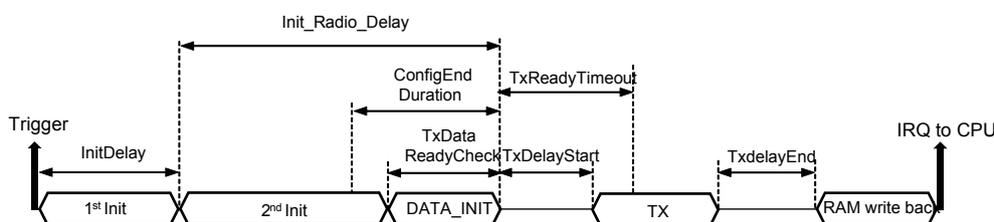
The diagram illustrates the timing sequence for a transmission (TX). It starts with a 'Trigger' signal. The sequence consists of five main stages: '1st Init', '2nd Init', 'DATA_INIT', 'TX', and 'RAM write back'.
Key timing intervals are defined:
• 'Init_Delay': Time from Trigger to the start of '1st Init'.
• 'Init_Radio_Delay': Time from the start of '1st Init' to the start of 'DATA_INIT'.
• 'ConfigEnd_Duration': Time from the end of '2nd Init' to the start of 'TX'.
• 'TxDataReadyCheck': Time within 'DATA_INIT' stage.
• 'TxDelayStart': Time from the end of 'DATA_INIT' to the start of 'TX'.
• 'TxReadyTimeout': Time from the end of 'DATA_INIT' to the end of 'TX'.
• 'TxdelayEnd': Time from the end of 'TX' to the end of 'RAM write back'.
The 'IRQ to CPU' signal is generated at the end of the 'RAM write back' stage.
Figure 186. RX sequence
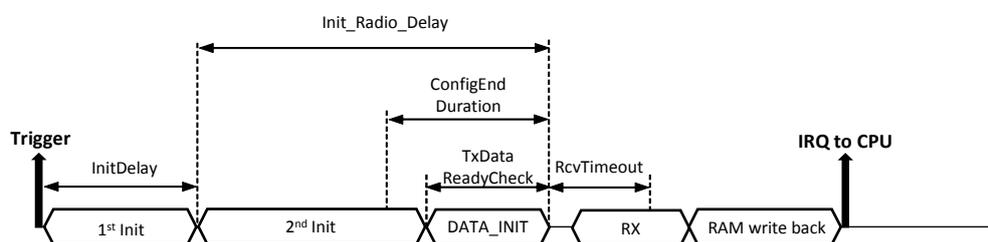
The diagram illustrates the RX sequence timing. It starts with a 'Trigger' signal. The sequence consists of five main stages: '1st Init', '2nd Init', 'DATA_INIT', 'RX', and 'RAM write back'.
- 'InitDelay' is the time between the 'Trigger' and the start of '1st Init'.
- 'Init_Radio_Delay' is the time between the start of '1st Init' and the start of 'DATA_INIT'.
- 'ConfigEnd Duration' is the time between the start of '2nd Init' and the start of 'DATA_INIT'.
- 'TxData ReadyCheck' is the time between the start of 'DATA_INIT' and the start of 'RX'.
- 'RcvTimeout' is the time between the start of 'RX' and the start of 'RAM write back'.
- An 'IRQ to CPU' signal is generated at the end of the 'RAM write back' stage.
23.6.4 TX and RX sequence signals
The controller is able to control an external power amplifier (located on the board to increase the TX power) through a signal provided to the SoC to be connected directly on an external GPIO or to be managed with additional logical mechanism. The external PA can be useful to extend the TX power.
This signal is raised as soon as a transmission is requested (2 nd INIT step starting point) and goes down as soon as the system switches off the internal PA.
On the other hand, the controller provides a signal to monitor a reception request.
See RADIO_TX_SEQUENCE and RADIO_RX_SEQUENCE GPIO alternate functions in Section 7.3.2: I/O pin alternate function multiplexer and mapping to find the pins that support this feature.
23.6.5 Bluetooth LE controller registers
Table 167. Bluetooth LE controller register list
| Address offset | Name | RW | Reset | Description |
|---|---|---|---|---|
| 0x00 | RESERVED | R | 0x00010100 | Reserved. |
| 0x04 | INTERRUPT1REG | RW | 0x00000000 | Interrupt pending and interrupt clear register 1. |
| 0x08 | INTERRUPT2REG | RW | 0x00000000 | Interrupt pending and interrupt clear register 2. |
| 0x0C | TIMEOUTDESTREG | RW | 0x00000000 | Timer1 and Timer2 enable/disable. |
| 0x10 | TIMEOUTREG | RW | 0x00000000 | Timer1 and Timer2 timeout register. |
| 0x14 | TIMERCAPTUREREG | R | 0x00000000 | Timer capture register. |
| 0x18 | CMDREG | RW | 0x00000000 | CmdReg register. |
| 0x1C | STATUSREG | R | 0x00000000 | Status register. |
| 0x20 | INTERRUPT1ENABLEREG | R | 0x00000000 | This read-only register is a copy/summary of all the enable mask bits located in the different RAM tables. When '0', corresponding interrupt was masked during previous sequence. When '1', corresponding interrupt was enabled during the previous sequence. |
| 0x24 | INTERRUPT1LATENCYREG | R | 0x00000000 | Interrupt1 Latency register. |
| 0x28 | MANAESKEY0REG | RW | 0x00000000 | Manual AES Key0 register |
| 0x2C | MANAESKEY1REG | RW | 0x00000000 | Manual AES Key1 register |
| 0x30 | MANAESKEY2REG | RW | 0x00000000 | Manual AES Key2 register |
| 0x34 | MANAESKEY3REG | RW | 0x00000000 | Manual AES Key3 register |
| 0x38 | MANAESCLEARTTEXT0REG | RW | 0x00000000 | Manual AES ClearText0 register |
| 0x3C | MANAESCLEARTTEXT1REG | RW | 0x00000000 | Manual AES ClearText1 register |
| 0x40 | MANAESCLEARTTEXT2REG | RW | 0x00000000 | Manual AES ClearText2 register |
| 0x44 | MANAESCLEARTTEXT3REG | RW | 0x00000000 | Manual AES ClearText3 register |
| 0x48 | MANAESCIPHERTEXT0REG | R | 0x00000000 | Manual AES CipherText0 register |
| 0x4C | MANAESCIPHERTEXT1REG | R | 0x00000000 | Manual AES CipherText1 register |
| 0x50 | MANAESCIPHERTEXT2REG | R | 0x00000000 | Manual AES CipherText2 register |
| 0x54 | MANAESCIPHERTEXT3REG | R | 0x00000000 | Manual AES CipherText3 register |
| 0x58 | MANAESCMDREG | RW | 0x00000000 | Manual AES CmdReg register |
| 0x5C | MANAESSTATREG | R | 0x00000000 | Manual AES Status register |
| 0x60 | AESLEPRIVPOINTERREG | RW | 0x00000000 | AES LE Privacy Pointer register |
| 0x64 | AESLEPRIVHASHREG | RW | 0x00000000 | AES LE Privacy Hash register |
| 0x68 | AESLEPRIVPRANDREG | RW | 0x00000000 | AES LE Privacy Prand register |
| 0x6C | AESLEPRIVCMDREG | RW | 0x00000000 | AES LE Privacy CmdReg register |
| 0x70 | AESLEPRIVSTATREG | R | 0x00000000 | AES LE Privacy Status register |
| 0x74 | DEBUGCMDREG | RW | 0x00000000 | DebugCmdReg register |
| 0x78 | DEBUGSTATUSREG | R | 0x00000000 | DebugStatusReg register |
| Bit | Field name | Reset | RW | Description |
|---|---|---|---|---|
| 3:0 | RESERVED3_0 | 0x0 | R | Reserved |
| 4 | ADDPPOINTERROR | 0x0 | RW | Address Pointer Error. When read, indicates the interrupt status. Write 1'b1 to clear. |
| 5 | RXOVERFLOWERROR | 0x0 | RW | Receive Overflow. When read, indicates the interrupt status. Write 1'b1 to clear. |
| 6 | RESERVED6 | 0x0 | R | Reserved |
| 7 | SEQDONE | 0x0 | RW | Sequencer end of task. When read, indicates the interrupt status. Write 1'b1 to clear. |
| 8 | TXERROR_0 | 0x0 | RW | Transmission error 0 AES did not acknowledge the transmit block request on time. When read, indicates the interrupt status. Write 1'b1 to clear. Note: On this error, the transmit block stops the on-going transmission but the sequencer manages it as a normal end of transmission. |
| 9 | TXERROR_1 | 0x0 | RW | Transmission error 1: a TX skip happened during an on-going transmission. When read, indicates the interrupt status. Write 1'b1 to clear. |
| 10 | TXERROR_2 | 0x0 | RW | Transmission error 2: channel index is greater than 39. When read, indicates the interrupt status. Write 1'b1 to clear. |
| 11 | TXERROR_3 | 0x0 | RW | Transmission error 3: Radio FSM did not provide the tx_ready information on time (timeout defined in GlobalStatMach.TxReadyTimeout[7:0] bit field). When read, indicates the interrupt status. Write 1'b1 to clear. |
| 12 | RESERVED | 0x0 | RW | Reserved. |
| 13 | ENCERROR | 0x0 | RW | Encryption error on receive. When read, indicates the interrupt status. Write 1'b1 to clear. |
| 14 | ALLTABLEREADYERROR | 0x0 | RW | All RAM Table not ready on time. When read, indicates the interrupt status. Write 1'b1 to clear. |
| 15 | TXDATAREADYERROR | 0x0 | RW | Transmit data pack (TxRxDat) not ready when TX on antenna was about to start. When read, indicates the interrupt status. Write 1'b1 to clear. |
| 16 | NOACTIVEERROR | 0x0 | RW | GlobStatMach.active bit error (read as 0 on a triggered sequence). When read, indicates the interrupt status. Write 1'b1 to clear. |
| 17 | RESERVED | 0x0 | RW | Reserved. |
| 18 | RCVLENGTHERROR | 0x0 | RW | Receive length error. When read, indicates the interrupt status. Write 1'b1 to clear. |
| Bit | Field name | Reset | RW | Description |
|---|---|---|---|---|
| 19 | SEMATIMEOUTERROR | 0x0 | RW | Semaphore timeout error. When read, indicates the interrupt. Write 1'b1 to clear. |
| 20 | RESERVED | 0x0 | RW | Reserved. |
| 21 | TXRXSKIP | 0x0 | RW | Transmission/Reception skip. When read, indicates the interrupt status. Write 1'b1 to clear. |
| 22 | ACTIVE2ERROR | 0x0 | RW | Active2 Radio state error. When read, indicates the interrupt status. Write 1'b1 to clear. |
| 23 | CONFIGERROR | 0x0 | RW | Data pointer configuration error. When read, indicates the interrupt status. Write 1'b1 to clear. |
| 24 | TXOK | 0x0 | RW | Previous transmitted packet received OK by the peer device. When read, indicates the interrupt status. Write 1'b1 to clear. |
| 25 | DONE | 0x0 | RW | Receive/Transmit done. When read, indicates the interrupt status. Write 1'b1 to clear. |
| 26 | RCVTIMEOUT | 0x0 | RW | Receive timeout (no preamble found). When read, indicates the interrupt status. Write 1'b1 to clear. |
| 27 | RCVNOMD | 0x0 | RW | Received MD bit embedded in the PDU data packet header was zero. When read, indicates the interrupt status. Write 1'b1 to clear. |
| 28 | RCVCMD | 0x0 | RW | Received command. When read, indicates the interrupt status. Write 1'b1 to clear. |
| 29 | TIMECAPTURETRIG | 0x0 | RW | TimerCaptureReg time capture. When read, indicates the interrupt status. Write 1'b1 to clear. |
| 30 | RCVCRCERR | 0x0 | RW | Receive data fail (CRC error or preamble not found or invalid CI field error). When read, indicates the interrupt status. Write 1'b1 to clear. Note: This error is raised only if at least preamble and access address have been detected. |
| 31 | RCVOK | 0x0 | RW | Receive data OK. When read, indicates the interrupt status. Write 1'b1 to clear. |
| Bit | Field name | Reset | RW | Description |
|---|---|---|---|---|
| 0 | AESMANENCINT | 0x0 | RW | AES manual encryption. When read, indicates the interrupt status. Write 1'b1 to clear. |
| 1 | AESLEPRIVINT | 0x0 | RW | AES LE privacy engine. When read, indicates the interrupt status. Write 1'b1 to clear. |
| 31:2 | RESERVED31_2 | 0x0 | R | Reserved. |
| Bit | Field name | Reset | RW | Description |
|---|---|---|---|---|
| 1:0 | DESTINATION | 0x0 | RW | Timeout timer Destination - 00 or 01: all disabled - 10: Timer1 enable - 11: Timer2 enable (but Timer2 really starts counting at the end of a Rx/Tx sequence) Note: Enabling one of the two timers automatically disables the second one. |
| 31:2 | RESERVED31_2 | 0x0 | R | Reserved |
| Bit | Field name | Reset | RW | Description |
|---|---|---|---|---|
| 31:0 | TIMEOUT | 0x0 | RW | Timer1 or Timer2 Timeout value (depending on destination register). Time units: - in microseconds for Timer2 - in periods of 512 kHz clock for Timer1. |
| Bit | Field name | Reset | RW | Description |
|---|---|---|---|---|
| 31:0 | TIMERCAPTURE | 0x0 | R | Interpolated absolute time capture register (cf. TxRxPack.TrigRcv/TrigDone, GlobStatMach.TimeCapture/TimeCaptureSel for detailed specifications) This register is cleared on the beginning of a new Bluetooth LE sequence. Time unit is in 16 x slow clock so typically 512 kHz period cycle. |
| Bit | Field name | Reset | RW | Description |
|---|---|---|---|---|
| 0 | TXRXSKIP | 0x0 | R | Transmission/Reception skip command. This bit is auto-cleared by the HW. |
| 1:2 | RESERVED | 0x0 | RW | Reserved. |
| 3 | CLEARSEMAREQ | 0x0 | R | Semaphore Clear command. Setting this bit releases the token for the IP_BLE. Software option in parallel with the hardware management by the Bluetooth LE sequencer through TxRxPack.KeepSemaReq bit. This bit is auto-cleared by the HW. |
| 31:4 | RESERVED31_4 | 0x0 | R | Reserved |
| Bit | Field name | Reset | RW | Description |
|---|---|---|---|---|
| 0 | AESONFLYBUSY | 0x0 | R | AES on the fly encryption busy status |
| 1:2 | RESERVED2_1 | 0x0 | R | Reserved |
| 3 | NOT_SUPPORTED_FEATURE | 0x0 | R | It indicates the SW requests an unsupported feature. This event happens if the SW requests a long range transfer (coded PHY) while the feature is disabled by OBL. |
| 4 | ADDPERROR | 0x0 | R | Address Pointer Error status. |
| 5 | RXOVERFLOWERROR | 0x0 | R | AHB arbiter is full and there is no more storage capability available in RX data path |
| 6 | PREVTRANSMIT (*) | 0x0 | R | Previous event was a Transmission (1) or Reception (0) status |
| 7 | SEQDONE | 0x0 | R | Sequencer end of task status. This bit is set each time the sequencer ends the execution of a sequence due to a trigger event whatever the result (OK, with errors, ACTIVE bit not set, etc.). |
| 8 | TXERROR_0 | 0x0 | R | Transmission error 0 status Transmit block missing data error (when the transmit block has to transmit serially a bit and has no more data as the AES block did not provide a new data byte yet). Note: On this error, the transmit block stops the on-going transmission but the sequencer manages it as a normal end of transmission. The flag is the only information available for the user. |
| 9 | TXERROR_1 | 0x0 | R | Transmission error 1 status (when CmdReg.TxRxSkip=1 happens when a transmission is on-going). |
| 10 | TXERROR_2 | 0x0 | R | Transmission error 2 status (if StateMach.Remap_chan >39). |
| 11 | TXERROR_3 | 0x0 | R | Transmission error 3 status (if i_tx_ready=0 after the time value defined by GlobStatMach.TxReadyTimeout.) |
| 12 | TXERROR_4 | 0x0 | R | Transmission error 4 status (the SupplementalTime field is not between 2 and 20 inclusive or in case of coded packet or if Supplemental type is 3) |
| 13 | ENCERROR | 0x0 | R | Encryption error on receive status |
| 14 | ALLTABLEREADYERROR | 0x0 | R | All RAM Table not ready status |
| 15 | TXDATAREADYERROR | 0x0 | R | Transmit data pack (TxRxDat) not ready status |
| 16 | NOACTIVELEERROR | 0x0 | R | GlobStatMach.active bit error (read as 0) status |
| 17 | RESERVED | 0x0 | R | (Was previously INITDELAYERROR but this error can no longer occur with new Time Interpolator implementation) |
| 18 | RCVLENGTHERROR | 0x0 | R | Receive length error status |
| 19 | SEMATIMEOUTERROR | 0x0 | R | Semaphore timeout error status |
| 20 | SEMAWASPREEMPT (*) | 0x0 | R | Bluetooth LE has been preempted. Semaphore status |
| 21 | TXRXSKIP | 0x0 | R | Transmission/Reception skip status |
| 22 | ACTIVE2ERROR | 0x0 | R | Active2 Radio state error status |
| 23 | CONFIGERROR (*) | 0x0 | R | Data pointer configuration error status |
| 24 | TXOK | 0x0 | R | Previous transmitted packet received OK by the peer device status. This bit is updated at the end of a reception. 0: the previous transmitted packet was not received OK by the peer device. 1: the previous transmitted packet was received OK by the peer device. This bit is set only if the following conditions are verified: - this is a data packet, - the SN/NESN mechanism is enabled (TxRxDat.SN_EN = 1), - a preamble and a good access address have been received inside the receive window, - the received NESN is different from the local StatMach.SN bit. |
| 25 | DONE | 0x0 | R | Receive/Transmit done status. |
| Bit | Field name | Reset | RW | Description |
|---|---|---|---|---|
| This flag is set if the sequencer reached the TX/RX phase (start pulse sent to the receive/transmit block which returned a done pulse). | ||||
| 26 | RCVTIMEOUT | 0x0 | R | Receive timeout status (no preamble found). |
| 27 | RCVNOMD | 0x0 | R | Received MD bit embedded in the PDU data packet header was zero status |
| 28 | RCVCMD | 0x0 | R | Received command status This flag is raised when LLID = 2'b11 in the received data packet header. |
| 29 | TIMECAPTURETRIG | 0x0 | R | TimerCaptureReg time capture status |
| 30 | RCVRCERR | 0x0 | R | Receive data fail. (CRC error or preamble not found or invalid CI field) |
| 31 | RCVOK | 0x0 | R | Receive data OK status |
Note:
- • This StatusReg is updated on each Bluetooth LE sequencer end of sequence.
- •
This register is cleared each time the Bluetooth LE sequencer starts a new sequence (timer trig event) except for the bit tagged with (*):
- – CONFIGERROR: updated when the sequencer reads the StatMach
- – PREVTRANSMIT: updated when the sequencer reaches the TX/RX step again
- • After a reception, an SN_NESN error is identified if the StatusReg indicates the RX is done (DONE=1), not OK (RCVOK=0) but no specific error flag is set.
- • When a proper transmission occurred, the DONE flag (in StatusReg and potentially Interrupt1Reg) and the StatusReg.PrevTransmit bit are set.
Table 175. INTERRUPT1ENABLEREG register description
| Bit | Field name | Reset | RW | Description |
|---|---|---|---|---|
| 3:0 | RESERVED3_0 | 0x0 | R | Reserved. |
| 4 | ADDPOINTERROR | 0x0 | R | Address Pointer Error enable interruption (Read Only). |
| 5 | RXOVERFLOWERROR | 0x0 | R | RX Overflow Error enable interruption (Read Only). |
| 6 | RESERVED6 | 0x0 | R | Reserved. |
| 7 | SEQDONE | 0x0 | R | Sequencer end of task enable interruption (Read Only). |
| 8 | TXERROR_0 | 0x0 | R | Transmission error 0 enable interruption (Read Only). |
| 9 | TXERROR_1 | 0x0 | R | Transmission error 1 enable interruption (Read Only). |
| 10 | TXERROR_2 | 0x0 | R | Transmission error 2 enable interruption (Read Only). |
| 11 | TXERROR_3 | 0x0 | R | Transmission error 3 enable interruption (Read Only) |
| 12 | RESERVED | 0x0 | R | Reserved. |
| 13 | ENCERROR | 0x0 | R | Encryption error on receive enable interruption (Read Only). |
| 14 | ALLTABLEREADYERROR | 0x0 | R | All RAM Table not ready enable interruption (Read Only). |
| 15 | TXDATAREADYERROR | 0x0 | R | Transmit data pack (TxRxDat) not ready enable interruption (Read Only). |
| 16 | NOACTIVEERROR | 0x0 | R | GlobStatMach.active bit error (read as 0) enable interruption (Read Only). |
| 17 | RESERVED | 0x0 | R | Reserved. |
| 18 | RCVLENGTHERROR | 0x0 | R | Receive length error enable interruption (Read Only) |
| 19 | SEMATIMEOUTERROR | 0x0 | R | Semaphore timeout error enable interruption (Read Only). |
| 20 | RESERVED | 0x0 | R | Reserved. |
| 21 | TXRXSKIP | 0x0 | R | Transmission/Reception skip enable interruption (Read Only). |
| 22 | ACTIVE2ERROR | 0x0 | R | Active2 Radio state error enable interruption (Read Only). |
| 23 | CONFIGERROR | 0x0 | R | Data pointer configuration error enable interruption (Read Only). |
| 24 | TXOK | 0x0 | R | Previous transmitted packet received OK enable interruption (Read Only). |
| 25 | DONE | 0x0 | R | Receive/Transmit done interruption (Read Only). |
| 26 | RCVTIMEOUT | 0x0 | R | Receive timeout enable interruption (Read Only) (no preamble found). |
| 27 | RCVNOMD | 0x0 | R | Received MD bit embedded in the PDU data packet header was zero enable interruption (Read Only). |
| 28 | RCV CMD | 0x0 | R | Received command enable interruption (Read Only). |
| 29 | TIMECAPTURETRIG | 0x0 | R | TimerCaptureReg time capture enable interruption (Read Only). |
| 30 | RCV CRCERR | 0x0 | R | Receive data fail enable interruption (Read Only). |
| 31 | RCVOK | 0x0 | R | Receive data OK enable interruption. (Read Only). |
Table 176. INTERRUPT1LATENCYREG register description
| Bit | Field name | Reset | RW | Description |
|---|---|---|---|---|
| 7:0 | INTERRUPT1LATENCY | 0x0 | R | Relative time counter after interrupt1. - Time unit: 1us - Clamped at 255. Reset when all interrupt1 sources are cleared or when a new interrupt1 IRQ is raised. |
| 31:8 | RESERVED31_8 | 0x0 | R | Reserved |
| Bit | Field name | Reset | RW | Description |
|---|---|---|---|---|
| 31:0 | MANAESKEY_31_0 | 0x0 | RW | Manual mode AES key |
| Bit | Field name | Reset | RW | Description |
|---|---|---|---|---|
| 31:0 | MANAESKEY_63_32 | 0x0 | RW | Manual mode AES key |
| Bit | Field name | Reset | RW | Description |
|---|---|---|---|---|
| 31:0 | MANAESKEY_95_64 | 0x0 | RW | Manual mode AES key |
| Bit | Field name | Reset | RW | Description |
|---|---|---|---|---|
| 31:0 | MANAESKEY_127_96 | 0x0 | RW | Manual mode AES key |
| Bit | Field name | Reset | RW | Description |
|---|---|---|---|---|
| 31:0 | AES_CLEAR_31_0 | 0x0 | RW | Manual AES Clear Text |
| Bit | Field name | Reset | RW | Description |
|---|---|---|---|---|
| 31:0 | AES_CLEAR_63_32 | 0x0 | RW | Manual AES Clear Text |
| Bit | Field name | Reset | RW | Description |
|---|---|---|---|---|
| 31:0 | AES_CLEAR_95_64 | 0x0 | RW | Manual AES Clear Text |
| Bit | Field name | Reset | RW | Description |
|---|---|---|---|---|
| 31:0 | AES_CLEAR_127_96 | 0x0 | RW | Manual AES Clear Text |
| Bit | Field name | Reset | RW | Description |
|---|---|---|---|---|
| 31:0 | AES_CIPHER_31_0 | 0x0 | R | Manual AES cipher text |
| Bit | Field name | Reset | RW | Description |
|---|---|---|---|---|
| 31:0 | AES_CIPHER_63_32 | 0x0 | R | Manual AES cipher text |
| Bit | Field name | Reset | RW | Description |
|---|---|---|---|---|
| 31:0 | AES_CIPHER_95_64 | 0x0 | R | Manual AES Cipher Text |
| Bit | Field name | Reset | RW | Description |
|---|---|---|---|---|
| 31:0 | AES_CIPHER_127_96 | 0x0 | R | Manual AES cipher Text |
| Bit | Field name | Reset | RW | Description |
|---|---|---|---|---|
| 0 | START | 0x0 | R | AES manual encryption Start command. This bit is auto-cleared by the HW. |
| 1 | INTENA | 0x0 | RW | AES manual encryption interrupt enable on Interrupt2Reg. |
| 31:2 | RESERVED31_2 | 0x0 | R | Reserved. |
| Bit | Field name | Reset | RW | Description |
|---|---|---|---|---|
| 0 | BUSY | 0x0 | R | AES manual encryption busy status |
| 31:1 | RESERVED31_1 | 0x0 | R | Reserved |
| Bit | Field name | Reset | RW | Description |
|---|---|---|---|---|
| 23:0 | POINTER | 0x0 | RW | AES LE privacy pointer |
| 31:24 | RESERVED31_24 | 0x0 | R | Reserved |
| Bit | Field name | Reset | RW | Description |
|---|---|---|---|---|
| 23:0 | HASH | 0x0 | RW | AES LE privacy Reference Hash |
| 31:24 | RESERVED31_24 | 0x0 | R | Reserved |
| Bit | Field name | Reset | RW | Description |
|---|---|---|---|---|
| 0 | START | 0x0 | R | AES LE privacy Start command. This bit is auto-cleared by the HW. |
| 1 | INTENA | 0x0 | RW | AES LE privacy interrupt enable on Interrupt2Reg. |
| 9:2 | NBKEYS | 0x0 | RW | AES LE privacy number of keys pointed by AesLePrivPointerReg (points to the resolution key list). |
| 31:10 | RESERVED31_10 | 0x0 | R | Reserved. |
Table 194. AESLEPRIVSTATREG register description
| Bit | Field name | Reset | RW | Description |
|---|---|---|---|---|
| 0 | BUSY | 0x0 | R | AES LE privacy busy status. |
| 1 | KEYFND | 0x0 | R | AES LE privacy key finding status. |
| 9:2 | KEYFNDINDEX | 0x0 | R | AES LE privacy index of the key found in the resolution key list. |
| 31:10 | RESERVED31_10 | 0x0 | R | Reserved. |
Table 195. DEBUGCMDREG register description
| Bit | Field name | Reset | RW | Description |
|---|---|---|---|---|
| 0 | CLEARDEBUGINT | 0x0 | RW | Debug interrupt. Write '1' to clear. |
| 1 | SEQDEBUGMODE | 0x0 | RW | Enable the debug mode for sequencer. |
| 5:2 | SEQDEBUGBUSSEL[30] | 0x0 | RW | Sequencer debug bus selection for DebugStatusReg[50] meaning. |
| 15:6 | RESERVED15_6 | 0x0 | R | For future use. |
| 19:16 | AESDEBUGMODE | 0x0 | RW | AES debug flags clear. All bits must be written to '1' together to clear the DebugStatusReg[19:16] bits. Caution: this bit field is not cleared by hardware. The software must clear it to be able to get again the AES debug flag information. Note: This clear operation is possible/taken into account only while AES is ON. |
| 31:20 | RESERVED31_20 | 0x0 | R | Reserved. |
Table 196. DEBUGSTATUSREG register description
| Bit | Field name | Reset | RW | Description |
|---|---|---|---|---|
| 6:0 | DEBUGSTATUSREG[6:0] | 0x0 | R | Depending on DebugCmdReg[5:2] bit field value - If DebugCmdReg[5:2] = 0 (default): • SEQERROR_4: detect something was wrong during the sequence and no RAM write back occurred (backdoor for debug). • SEQERROR_3: detect when Rcv/Transmit(No)CalDelayChk duration is elapsed, but all required conditions are not fulfilled • SEQERROR_2: detect when InitDelay duration is elapsed, but all required conditions are not fulfilled • SEQERROR_1: detect when (internal) watchdog timer is elapsed, but the Writeback phase is not finished. • SEQERROR_0: detect when a trig event happened but the sequencer was not in IDLE state (if a sequence was currently running). - If DebugCmdReg[5:2] = 1: • DebugStatusReg[6:5] = 0 • DebugStatusReg[4:0] = MAIN_STATE[4:0] - If DebugCmdReg[5:2] = 2: • DebugStatusReg[6] = 0 • DebugStatusReg[5:0] = SLV_STATE[4:0] - If DebugCmdReg[5:2] = 3: • DebugStatusReg[6] = 0 • DebugStatusReg[5:0] = SLV_STATE_ERROR[4:0] - If DebugCmdReg[5:2] = others: • DebugStatusReg[6:0] = 0 |
| 15:7 | RESERVED15_6 | 0x0 | R | For future use. |
| Bit | Field name | Reset | RW | Description |
|---|---|---|---|---|
| 16 | AESDBG_0 | 0x0 | R | AES RX error flag. RX tries to write a data while the packet key is not available. Cleared by writing 0xF in DebugCmdReg[19:16]. |
| 17 | AESDBG_1 | 0x0 | R | AES TX error flag. TX tries to read a data while the packet key is not available. Cleared by writing 0xF in DebugCmdReg[19:16]. |
| 18 | AESDBG_2 | 0x0 | R | MIC error flag. Cleared by writing 0xF in DebugCmdReg[19:16] |
| 19 | AESDBG_3 | 0x0 | R | For future use |
| 31:20 | RESERVED31_20 | 0x0 | R | For future use |
23.7 Bluetooth LE RAM tables
Each time a trigger event is sent to the Bluetooth LE controller, the sequencer fetches the RAM tables in RAM to get the needed information to know what to configure for the radio and which sequence to start (RX or TX)
There are several types of tables:
- • The GlobalStatMach: this table is unique.
- • The StatMach: one table by active connection (up to 128 supported by the hardware).
- • The TxRxPack: one table packet in RX or in TX. So, there is no predefined number of those tables. They are used as link list from one packet to another during a full connection.
- • The DataPack tables corresponding to the data buffers pointed by the DataPtr in the TxRxPack. It contains the PDU section of the Bluetooth packet.
The following figure gives an overview of RAM tables dependencies.
Figure 187. RAM table tree
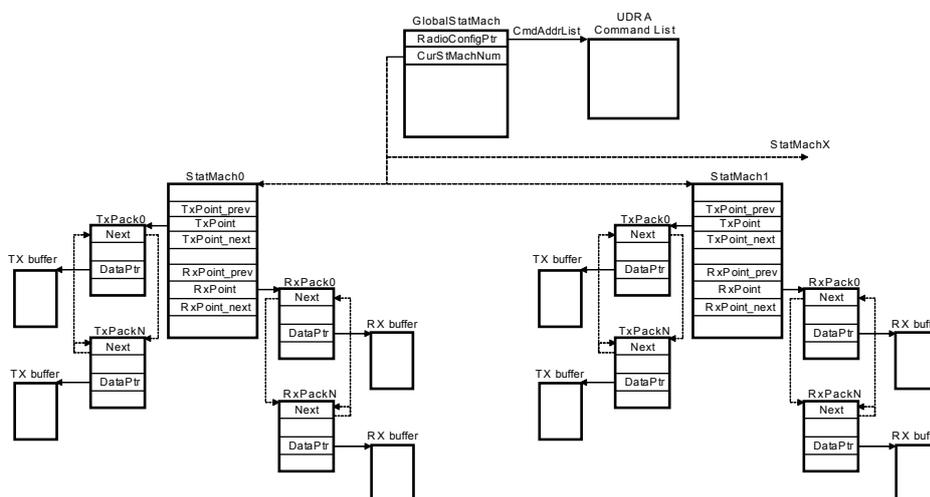
graph TD
    GlobalStatMach[GlobalStatMach
RadioConfigPtr
CurStatMachNum] --> CmdAddrList[CmdAddrList]
    GlobalStatMach --> UDRA[UDRA Command List]
    GlobalStatMach --> StatMach0[StatMach0]
    GlobalStatMach --> StatMach1[StatMach1]

    StatMach0 --> TxPack0_0[TxPack0
Next
DataPtr]
    StatMach0 --> TxPackN_0[TxPackN
Next
DataPtr]
    StatMach0 --> RxPack0_0[RxPack0
Next
DataPtr]
    StatMach0 --> RxPackN_0[RxPackN
Next
DataPtr]

    TxPack0_0 --> TXBuf0_0[TX buffer]
    TxPackN_0 --> TXBufN_0[TX buffer]
    RxPack0_0 --> RXBuf0_0[RX buffer]
    RxPackN_0 --> RXBufN_0[RX buffer]

    StatMach1 --> TxPack0_1[TxPack0
Next
DataPtr]
    StatMach1 --> TxPackN_1[TxPackN
Next
DataPtr]
    StatMach1 --> RxPack0_1[RxPack0
Next
DataPtr]
    StatMach1 --> RxPackN_1[RxPackN
Next
DataPtr]

    TxPack0_1 --> TXBuf0_1[TX buffer]
    TxPackN_1 --> TXBufN_1[TX buffer]
    RxPack0_1 --> RXBuf0_1[RX buffer]
    RxPackN_1 --> RXBufN_1[RX buffer]
23.7.1 GlobalStatMach RAM table
The GlobalStatMach location is frozen by the hardware. This address is 0x200000C0. The GlobalStatMach is unique and mainly contains static information/options.
Table 197. GlobalStatMach
| Address offset | Name | RW | Reset | Description |
|---|---|---|---|---|
| 0x00 | WORD0 | RW | 0x00000000 | Word0 register |
| 0x04 | WORD1 | RW | 0x00000000 | Word1 register |
| 0x08 | WORD2 | RW | 0x00000000 | Word2 register |
| 0x0C | WORD3 | RW | 0x00000000 | Word3 register |
| 0x10 | WORD4 | RW | 0x00000000 | Word4 register |
| 0x14 | WORD5 | RW | 0x00000000 | Word5 register |
| 0x18 | WORD6 | RW | 0x00000000 | Word6 register |
Table 198. GlobalStatMach.WORD0 register description
| Bit | Field name | Reset | RW | Description |
|---|---|---|---|---|
| 31:0 | RADIOCONFIGPTR | 0x00000000 | RW | Radio Configuration address Pointer. Contains the address of the command_start_list used by the RRM block to execute UDRA command. Note: This value is loaded automatically by the RRM when the Bluetooth LE controller exits reset. However, it is also possible to make the RRM reload it through a reload command in UDRA_CTRL register. |
| Bit | Field name | Reset | RW | Description |
|---|---|---|---|---|
| 6:0 | CURSTMACHNUM | 0x0 | RW | Current connection machine number. Defines the state machine number (in the range from 0 to 127) which is running for the current transmission or reception. It is used to calculate the RAM address from which the State machine table ("StateMach") is read. Note: This field is written back with value read at the beginning of the Bluetooth LE sequence only if the ChkFlagAutoClearEna bit = '1'. |
| 7 | ACTIVE | 0x0 | RW | Must be at '1' when the trig event (Wakeup Timer, Timer1 or Timer2) occurs to start a Bluetooth LE controller sequence. Otherwise no RF sequence nor timer management is done by the Bluetooth LE controller. Only SeqDone and NoActiveLError flags are raised in StatusReg and Interrupt1Reg (if associated interrupts are enabled). Note: This field is written back to '0' only if the ChkFlagAutoClearEna bit = '1'. |
| 15:8 | WAKEUPINITDELAY | 0x0 | RW | Delay between wakeup timer trig event on sequencer and RX/TX request sending to the Radio FSM. It corresponds to the sequencer 1 st INIT step duration. Note: This bit field is not used if trig event comes from Timer1 or Timer2. The time unit for this delay/value is a period of slow clock frequency x 16 (if slow clock is 32kHz, this bit field unit is 1 period of 512kHz). Note: This field is written back with value read at the beginning of the Bluetooth LE sequence only if the ChkFlagAutoClearEna bit = '1'. |
| 23:16 | TIMER1INITDELAYCAL | 0x0 | RW | Delay between Timer1 or Timer2 trig event on sequencer and RX/TX request sending to the Radio FSM. It corresponds to the sequencer 1 st INIT step duration. Note: This bit field is used for Timer2 trig event only if CalReq bit is set in current TxRxBank RAM table (PLL Calibration is requested). The time unit for this delay is 1us. Note: This field is written back with value read at the beginning of the Bluetooth LE sequence only if the ChkFlagAutoClearEna bit = '1'. |
| 31:24 | TIMER2INITDELAYNOCAL | 0x0 | RW | Delay between Timer2 trig event on sequencer and RX/TX request sending to the Radio FSM. It corresponds to the sequencer 1 st INIT step duration. This bit field is used for Timer2 trig event only if CalReq bit is low in current TxRxBank RAM table (No PLL Calibration is requested). The time unit for this delay is 1us. Note: This field is written back with value read at the beginning of the Bluetooth LE sequence only if the ChkFlagAutoClearEna bit = '1'. |
| Bit | Field name | Reset | RW | Description |
|---|---|---|---|---|
| 7:0 | TRANSMITCALDELAYCHK | 0x0 | RW | Delay between TX request sent to the Radio FSM and the start pulse sent to the transmit block. It corresponds to the sequencer 2
nd
INIT + DATA INIT steps duration. Note: This bit field is used if TxMode bit is set in the StatMach (transmission) and the CalReq bit is set in current TxRxPack RAM table (PLL Calibration is requested). The time unit for this delay is 1us. |
| 15:8 | TRANSMITNOCALDELAYCHK | 0x0 | RW | Delay between TX request sent to the Radio FSM and the start pulse to the transmit block. It corresponds to the sequencer 2
nd
INIT + DATA INIT steps duration. Note: This bit field is used if TxMode bit is set in the StatMach (transmission) and the CalReq bit is low in current TxRxPack RAM table (no PLL Calibration is requested). The time unit for this delay is 1us. |
| 23:16 | RECEIVECALDELAYCHK | 0x0 | RW | Delay between RX request sent to the Radio FSM and the start pulse sent to the receive block. It corresponds to the sequencer 2
nd
INIT + DATA INIT steps duration. Note: This bit field is used if TxMode bit is low in the StatMach (reception) and the CalReq bit is set in current TxRxPack RAM table (PLL Calibration is requested). The time unit for this delay is 1us. |
| 31:24 | RECEIVENOCALDELAYCHK | 0x0 | RW | Delay between RX request sent to the Radio FSM and the start pulse to the receive block. It corresponds to the sequencer 2
nd
INIT + DATA INIT steps duration. Note: This bit field is used if TxMode bit is low in the StatMach (reception) and the CalReq bit is low in current TxRxPack RAM table (no PLL Calibration is requested). The time unit for this delay is 1us. |
| Bit | Field name | Reset | RW | Description |
|---|---|---|---|---|
| 7:0 | CONFIGENDDURATION | 0x0 | RW | Duration for the Bluetooth LE sequencer to execute the final configuration. The goal of this bit field is to provide more time to the Firmware to prepare the RAM tables. The Bluetooth LE sequencer waits for relative time to be equal to init_radio_delay - ConfigEndDuration before to start the final configuration. The time unit for this delay is 1us. |
| 15:8 | TXDATAREADYCHECK | 0x0 | RW | Duration for the Bluetooth LE sequencer to get the TxDataReady and DatPtr information in TxRxPack table. The goal of this bit field is to provide more time to the Firmware to provide the data pointer address and in case of transmission to provide the data to transmit. The Bluetooth LE sequencer waits for relative time to be equal to init_radio_delay - TxdataReadyCheck before to start the final configuration. The time unit for this delay is 1us. |
| 23:16 | TXDELAYSTART | 0x0 | RW | Delay added between the moment the Radio FSM is in TX mode (PA ramp up done and power present on the antenna) and the first bit transmission to the modulator. The time unit for this delay is 125ns. |
| 29:24 | TXDELAYEND | 0x0 | RW | Delay added between the last bit transmission to the modulator and the "end of transmission" information for the Bluetooth LE sequencer. The time unit for this delay is 125ns. This delay allows giving time to the modulator and analog chain to output on the antenna the last bit. |
| 30 | TIMECAPTURESEL | 0x0 | RW | 0: the captured time (absolute time) corresponds to the end of 1
st
INIT step in the Bluetooth LE sequence (InitDelay timeout event). 1: the captured time (absolute time) corresponds to the end of DATA INIT step in the Bluetooth LE sequence (init_radio_delay timeout event). Note: This bit is for debug purpose. |
| 31 | TIMECAPTURE | 0x0 | RW | 0: no capture is requested to monitor the Bluetooth LE sequence. 1: a time capture is requested to monitor the Bluetooth LE sequence. Captured event is defined by GlobalStatMach.TIMECAPTURESEL bit. Note: If both TIMECAPTURE and TIMECAPTURESEL bits are low, the TimerCaptureReg Bluetooth LE APB register is anyway updated with the InitDelay timeout event (mechanism to bypass the fact those 2 GlobalStatMach bits are checked after 1 st INIT step completion). Note: If TxRxPack.TrigRcv or TxRxPack.TrigDone bit is set, the TimerCaptureReg Bluetooth LE APB register shows this last event trig value at the end. Note: This bit is for debug purpose. |
| Bit | Field name | Reset | RW | Description |
|---|---|---|---|---|
| 7:0 | TXREADYTIMEOUT | 0x0 | RW | Transmission ready timeout. Defines the maximum duration for the transmit block to wait for the Radio FSM to indicate it is in TX state and data can be provided to the modulator. The time unit for this delay is 1us. Note: If this value is set to 0, no timeout is activate to wait the TX ready information. |
| 27:8 | RCVTIMEOUT | 0x0 | RW | Receive window timeout. Define the maximum duration to stay in reception without any preamble + access address detection (rest of the frame can be received even outside this time window). The duration is expressed as \( (4^{RCVTIMEOUT[19:18]} \times RCVTIMEOUT[17:0]) \) The time unit for RCVTIMEOUT[17:0] is 1us. |
| 31:28 | RESERVED31_28 | 0x0 | RW | Ignored on write - read as zero |
| Bit | Field name | Reset | RW | Description |
|---|---|---|---|---|
| 0 | AUTOTXRXSKIPEN | 0x0 | RW | Automatic transfer (TX or RX) skip enable. If set, the Bluetooth LE link layer stops automatically an on-going transfer if PLL lock fail event is detected on PLL start. |
| 1 | RESERVED1 | 0x0 | RW | Ignored on write - read as zero |
| 2 | CHKFLAGAUTOCLEARENA | 0x0 | RW | Active Auto Clear bit Enable. The Active auto clear feature leads the sequencer to clear the GlobalStatMach.Active bit during the RAM write back step at the end of a transfer/sequence. The main goal of this feature is to avoid a new transfer to start on the antenna while the software did not yet prepare the next transfer in RAM tables. 0: the active auto clear bit feature is disabled. 1: The active auto clear bit feature is enabled. |
| 7:3 | RESERVED7_3 | 0x0 | RW | Ignored on write - read as zero |
| 12:8 | INTSEQERROR | 0x0 | RW | Sequencer errors interrupt enable. For each bit of IntSeqError[4:0], the associated SeqError[x] flag (located in DebugStatusReg APB Bluetooth LE register) generates an interrupt on the int3 line (debug interrupt). |
| 19:13 | RESERVED19_13 | 0x0 | RW | Ignored on write - read as zero |
| 20 | INTADDPOINTERROR | 0x0 | RW | Address pointer error interrupt enable. 0: the interrupt associated to Interrupt1Reg.AddPointError is disabled. 1: the interrupt associated to Interrupt1Reg.AddPointError is enabled. |
| 21 | INTALLTABLEREADYERROR | 0x0 | RW | All table ready error interrupt enable. 0: the interrupt associated to Interrupt1Reg.AllTableReadyError is disabled. 1: the interrupt associated to Interrupt1Reg.AllTableReadyError is enabled. |
| 22 | INTTXDATAREADYERROR | 0x0 | RW | Transmission data payload ready error interrupt enable. 0: the interrupt associated to Interrupt1Reg.TxDatReady is disabled. 1: the interrupt associated to Interrupt1Reg.TxDatReady is enabled. |
| 23 | INTNOACTIVELError | 0x0 | RW | Active bit low value reading interrupt enable. 0: the interrupt associated to Interrupt1Reg.NoActiveLError is disabled. 1: the interrupt associated to Interrupt1Reg.NoActiveLError is enabled. |
| 24 | RESERVED | 0x0 | RW | Reserved |
| 25 | INTRCVLENGTHERROR | 0x0 | RW | Too long received payload length interrupt enable. 0: the interrupt associated to Interrupt1Reg.ReceiveLengthError is disabled. 1: the interrupt associated to Interrupt1Reg.ReceiveLengthError is enabled. |
| 26 | INTSEMATIMEOUTERROR | 0x0 | RW | Semaphore timeout error interrupt enable. 0: the interrupt associated to Interrupt1Reg.SemaTimeoutError is disabled. 1: the interrupt associated to Interrupt1Reg.SemaTimeoutError is enabled. |
| 27 | RESERVED | 0x0 | RW | Reserved. |
| 28 | INTSEQDONE | 0x0 | RW | Sequencer end of task interrupt enable. This bit should always be set to ensure an interrupt occurs at the end of sequence whatever the exit reason. 0: the interrupt associated to Interrupt1Reg.SeqDone is disabled. 1: the interrupt associated to Interrupt1Reg.SeqDone is enabled. |
| 29 | INTTXRXSKIP | 0x0 | RW | Transmission or reception skip interrupt enable. 0: the interrupt associated to Interrupt1Reg.intTxRxSkip is disabled. 1: the interrupt associated to Interrupt1Reg.intTxRxSkip is enabled. |
| 30 | INTACTIVE2ERR | 0x0 | RW | no initialization_finished from Radio FSM received on time interrupt enable. 0: the interrupt associated to Interrupt1Reg.Active2Error is disabled. 1: the interrupt associated to Interrupt1Reg.Active2Error is enabled. |
| Bit | Field name | Reset | RW | Description |
|---|---|---|---|---|
| 31 | INTCONFIGERROR | 0x0 | RW | Configuration error interrupt enable. 0: the interrupt associated to Interrupt1Reg.ConfigError is disabled 1: the interrupt associated to Interrupt1Reg. ConfigError is enabled. |
Table 204. GlobalStatMach.WORD6 register description
| Bit | Field name | Reset | RW | Description |
|---|---|---|---|---|
| 31:0 | RESERVED31_0 | 0x0 | RW | Ignored on write - read as zero |
23.7.2 StatMach RAM table
The StatMach table links to an active connection. There are as many StatMach tables as concurrent connections in a limit of 128 (maximum supported by the hardware).
The StatMach RAM table locations are frozen by the hardware as they follow the GlobalStatMach. The formula for a StatMach base address is:
Table 205. StatMach
| Address offset | Name | RW | Reset | Description |
|---|---|---|---|---|
| 0x00 | WORD0 | RW | 0x00000000 | Word0 register |
| 0x04 | WORD1 | RW | 0x00000000 | Word1 register |
| 0x08 | WORD2 | RW | 0x00000000 | Word2 register |
| 0x0C | WORD3 | RW | 0x00000000 | Word3 register |
| 0x10 | WORD4 | RW | 0x00000000 | Word4 register |
| 0x14 | WORD5 | RW | 0x00000000 | Word5 register |
| 0x18 | WORD6 | RW | 0x00000000 | Word6 register |
| 0x1C | WORD7 | RW | 0x00000000 | Word7 register |
| 0x20 | WORD8 | RW | 0x00000000 | Word8 register |
| 0x24 | WORD9 | RW | 0x00000000 | Word9 register |
| 0x28 | WORDA | RW | 0x00000000 | WordA register |
| 0x2C | WORDB | RW | 0x00000000 | WordB register |
| 0x30 | WORDC | RW | 0x00000000 | WordC register |
| 0x34 | WORDD | RW | 0x00000000 | WordD register |
| 0x38 | WORDE | RW | 0x00000000 | WordE register |
| 0x3C | WORDF | RW | 0x00000000 | WordF register |
| 0x40 | WORD10 | RW | 0x00000000 | Word10 register |
| 0x44 | WORD11 | RW | 0x00000000 | Word11 register |
| 0x48 | WORD12 | RW | 0x00000000 | Word12 register |
| Bit | Field name | Reset | RW | Description |
|---|---|---|---|---|
| 5:0 | UCHAN | 0x0 | RW | BTLE unmapped channel index. UChan is used by the channel incrementer and the remapper to generate a new Uchan and RemapChan values through the two algorithms defined by the Bluetooth core 5.0 specification. Note: This field is written back at the end of the transfer by the sequencer: - if TxRxPack.incchan = 0, written back value is the same value, - if TxRxPack.incchan = 1, written back value is the value modified by one of the two algorithms defined by the Bluetooth core 5.0 specification. Note: The standard requests this bit field to be set to 0 for the first connection event. |
| 6 | RESERVED | 0x0 | RW | Reserved. |
| 7 | TXMODE | 0x0 | RW | Transfer type selection of the current sequence. This bit is re-written by the sequencer with StatMach.NextTxMode bit value during each RAM write back phase. 0: requested transfer is a reception. The start address of the TxRxPack packet in which the received data has to be stored is pointed by rcvpoint. 1: requested transfer is a transmission. The start address of the TxRxPack packet to be transmitted is pointed by TxPoint. |
| 13:8 | REMAP_CHAN | 0x0 | RW | BTLE Remapped channel index. This is the remapped channel as described in algorithm1 and algorithm2 in BlueNRG core specification 5.0. This bit field is used by the hardware to generate the physical channel frequency. Note: This field is written back at the end of the transfer by the sequencer: - if TxRxPack.incchan = 0, written back value is the same value, - if TxRxPack.incchan = 1, written back value is the value modified by one of the two algorithms defined by the Bluetooth core 5.0 specification and mapped to the used channels list. Note: The standard requests this bit field to be set to 0 for the first connection event. |
| 14 | SN | 0x0 | RW | BTLE sequence number bit. If TxRxPack.SN_EN = 0 or TxRxPack.Advertise = 1, this bit is kept unchanged at the end of a transfer. If TxRxPack.SN_EN = 1 and TxRxPack.Advertise = 0, this bit is managed automatically by the hardware SN/NESN mechanism (as described in the BlueNRG core specification 5.0). Then, this bit is modified by the hardware only at the end of a reception (not on transmission). Note: In any case, this bit is written back by the sequencer at the end of a transfer (modified or not). |
| 15 | NESN | 0x0 | RW | BTLE next expected sequence number bit. If TxRxPack.SN_EN=0 or TxRxPack.Advertise=1, this bit is kept unchanged at the end of a transfer. If TxRxPack.SN_EN = 1 and TxRxPack.Advertise = 0, this bit is managed automatically by the hardware SN/NESN mechanism (as described in the BlueNRG core specification 5.0). Then, this bit is modified by the hardware only at the end of a reception (not on transmission). Note: In any case, this bit is written back by the sequencer at the end of a transfer (modified or not) |
| 18:16 | RESERVED | 0x0 | RW | Reserved. |
| 19 | RESERVED | 0x0 | RW | Reserved. |
| 20 | BUFFER_FULL | 0x0 | RW | No more receive buffer available. Set this bit to indicate no more buffer is available to receive any packet. In this case: - no data are written back in the RAM at the end of the sequence - the SN/NESN automatic mechanism adapts its behavior by keeping the NESN unchanged and does not increment the encryption receive packet counter. Note: The SN bit management is not impacted to keep the transmission progressing as long as the peer acknowledges the reception of previous transmitted packet. |
| Bit | Field name | Reset | RW | Description |
|---|---|---|---|---|
| 21 | ENCRYPTON | 0x0 | RW | "On the fly" encryption/decryption engine enable. 0: the "On the fly" encryption/decryption engine is disabled. 1: the "On the fly" encryption/decryption engine is enabled. The parameters StateMach.EncryptIV and StateMach.EncryptK are read from RAM during the initialization phase. Note: The "On the fly" encryption/decryption engine does not run for packet with null length. Note: It is mandatory to have TxRxPack.SN_EN = 1 when StateMach.Encryption = 1 as PCntTx is incremented by the SN/NESN automatic management mechanism. |
| 22 | TXENC | 0x0 | RW | Previous transmission packet was encrypted. Note: This bit is fully managed by the hardware. It is set to 1 after the transmission of an encrypted packet (so with length not zero). When TxEnc = 0, PCntTx (transmission packet counter required for the sub-keys calculation) is unchanged. When TxEnc = 1, PCntTx may be incremented depending on the SN/NESN check result. |
| 23 | RCVENC | 0x0 | RW | Last receive packet was encrypted. Note: This bit is fully managed by the hardware. It is set to 1 after the reception of a packet with length not zero (whatever the CRC check result) if StateMach.Encryption = 1. When RcvEnc = 1, the PCntRcv (receive packet counter required for the sub-keys calculation) is incremented depending on the SN/NESN check result. |
| 26:24 | TXPHY | 0x0 | RW | Transmission Phy selection.
|
| 27 | RESERVED27 | 0x0 | RW | Ignored on write -read as zero |
| 30:28 | RXPHY | 0x0 | RW | Reception Phy selection. bit0: bit rate (0=1 Mbps / 1=2 MBps) / bit1: This bit has no effect./ bit2: coded/not coded.
Note: S2/S8 coded choice comes from an auto-detection done by the demodulator. |
| 31 | RESERVED31 | 0x0 | RW | Ignored on write - read as zero |
| Bit | Field name | Reset | RW | Description |
|---|---|---|---|---|
| 31:0 | TXPOINT | 0x0 | RW | Pointer to transmit packet. TxPoint defines the start address of the TxRxPack link list (containing the parameters of the current transmission to be proceeded). This variable needs to be initialized by the firmware with the start address of the first TxRxPack of the transmission linked list each time a StateMach is created in memory (new connection). Then, TxPoint is managed by the hardware, considering the firmware has to guarantee the transmission link list is never empty (or pointing to itself). Note: This pointer address must be 32-bit aligned and is an absolute address (not an offset). |
| Bit | Field name | Reset | RW | Description |
|---|---|---|---|---|
| 31:0 | RCVPOINT | 0x0 | RW | Pointer to receive packet. Rcvpoint defines the start address of the TxRxPack link list (containing the parameters of the current reception to be proceeded) This variable needs to be initialized by the firmware with the start address of the first TxRxPack of the reception linked list each time a StateMach is created in memory (new connection). Then, RcvPoint is managed by the hardware, considering the firmware has to guarantee the reception link list is never empty (or pointing to itself). Note: This pointer address must be 32-bit aligned and is an absolute address (not an offset). |
| Bit | Field name | Reset | RW | Description |
|---|---|---|---|---|
| 31:0 | TXPOINTPREV | 0x0 | RW | Pointer to previous transmit packet. This variable is fully managed by the hardware. It is recommended to initialize to 0 by the firmware when the StateMach is created in memory (new connection). TxPointPrev indicates which buffer can be reallocated (as it is now free). |
| Bit | Field name | Reset | RW | Description |
|---|---|---|---|---|
| 31:0 | RCVPOINTPREV | 0x0 | RW | Pointer to previous receive packet. This variable is fully managed by the hardware. It is recommended to initialize to 0 by the firmware when the StateMach is created in memory (new connection). RcvPointPrev indicates which buffer can be reallocated (as it is now free). |
| Bit | Field name | Reset | RW | Description |
|---|---|---|---|---|
| 31:0 | TXPOINTNEXT | 0x0 | RW | Next transmit pointer. This variable is fully managed by the hardware. It is recommended to initialize to 0 by the firmware when the StateMach is created in memory (new connection). TxPointNext indicates the address of the TxRxPack transmit packet to be used once the transmission managed by the TxPoint is done (TxRxPack.NextPtr[31:0]). The TxPointNext bit field is always updated at the end of a transmission. Note: At the end of a valid reception with TxRxPack.SN_EN = 1 and TxRxPack.Advertise = 0, the StatMach.TxPoint is equal to the StatMach.TxPointNext. |
| Bit | Field name | Reset | RW | Description |
|---|---|---|---|---|
| 31:0 | PCNTTX_31_0 | 0x0 | RW | CCM encryption transmission packet counter [31:0]. PCntTx is used during the on the fly encryption of the transmission data by the AES encryption engine. For each new connection, Bluetooth protocol requires PCntTx to be initialized by the firmware to the value:
Note: It is mandatory to have TxRxPack.SN_EN = 1 when StateMach.Encryption = 1 as PCntTx is incremented by the SN/NESM automatic management mechanism. |
| Bit | Field name | Reset | RW | Description |
|---|---|---|---|---|
| 7:0 | PCNTTX_39_32 | 0x0 | RW | CCM encryption transmission packet counter [39:32]. PCntTx is used during the on the fly encryption of the transmission data by the AES encryption engine. For each new connection, Bluetooth protocol requires PCntTx to be initialized by the firmware to the value: - 40'h80000000000: for Data Channel PDUs sent by the master - 40'h00000000000: for Data Channel PDUs sent by the slave. Note: It is mandatory to have TxRxPack.SN_EN = 1 when StateMach.Encryption = 1 as PCntTx is incremented by the SN/NESM automatic management mechanism. |
| 31:8 | PCNTRCV_23_0 | 0x0 | RW | CCM encryption Receive Packet counter [23:0]. PCntRcv is used during the on the fly encryption of the received data by the AES encryption engine. For each new connection, Bluetooth protocol requires PCntRcv to be initialized by the firmware to the value: - 40'h80000000000: for Data Channel PDUs received by the slave - 40'h00000000000: for Data Channel PDUs received by the master. Note: It is mandatory to have TxRxPack.SN_EN = 1 as PCntRcv is incremented by the SN/NESM automatic management mechanism. |
| Bit | Field name | Reset | RW | Description |
|---|---|---|---|---|
| 15:0 | PCNTRCV_39_24 | 0x0 | RW | CCM encryption Receive Packet counter [39:24]. PCntRcv is used during the on the fly encryption of the received data by the AES encryption engine. For each new connection, Bluetooth protocol requires PCntRcv to be initialized by the firmware to the value: - 40'h80000000000: for Data Channel PDUs received by the slave - 40'h00000000000: for Data Channel PDUs received by the master. Note: It is mandatory to have TxRxPack.SN_EN = 1 as PCntRcv is incremented by the SN/NESM automatic management mechanism. |
| 19:16 | PREAMBLEREP | 0x0 | RW | Transmission Preamble Repetition number. Defines the number of repetition of the transmitted preamble length for coded or uncoded phy. Keep it at 0 to have the Bluetooth® LE standard preamble format (1 byte). Note: If StateMach.EnaPreambleRep = 0, this bit field is not taken into account. This feature is not Bluetooth standard. |
| 20 | ENAPREAMBLEREP | 0x0 | RW | Enable transmission preamble repetition. 0: the preamble feature is disabled and the preamble length is as described in the core specification 5.0. 1: The preamble feature is enabled and the preamble length is defined by StateMach.PreambleRep (for coded and uncoded phy). This feature is not Bluetooth standard. |
| 21 | DISABLECRC | 0x0 | RW | CRC Disable. If set, this bit: - in reception: disable the check of the CRC - in transmission: no CRC field is generated nor inserted in the sent packet. This feature is not Bluetooth standard. |
| 22 | RESERVED | 0x0 | RW | Reserved. |
| Bit | Field name | Reset | RW | Description |
|---|---|---|---|---|
| 23 | RXMICDBG | 0x0 | RW | Receive MIC debug 0: the decrypted MIC (locally computed) is stored in the payload buffer in RAM (at the end of the payload). 1: the received MIC is stored in the payload buffer in RAM (at the end of the payload). When RXMICDBG bit is set, the RCVOK flag is raised at the end of a reception whatever the MIC error status (so even when a MIC error is detected). This feature is for debug. |
| 28:24 | INTTXERROR | 0x0 | RW | Transmission error interrupt enable. If IntTxError[n] = 1: an interrupt is generated and associated flag is set in Interrupt1Reg.TxError[n] if a TxError[n] event occurs during the transmission. If IntTxError[n] = 0: no interrupt nor associated flag in Interrupt1Reg.TxError[n] is available if a TxError[n] event occurs during the transmission. Note: StatusReg.TxError[n] bit is not impacted and always provides the TxError[n] unmasked information. |
| 29 | INTENCERROR | 0x0 | RW | Receive encryption error interrupt enable. 0: the receive encryption error interrupt is disabled. 1: the receive encryption error interrupt is enabled (and associated interrupt flag is visible in Interrupt1Reg.EncError). The interrupt is active if the MIC of the received message does not match the computed one (while the preamble and the access address are received ok, StateMach.Encryption = 1 and the received length is not null). Note: The CRC check result is not taken into account for this interrupt. |
| 30 | INTRXOVERFLOWERROR | 0x0 | RW | Receive data path overflow error interrupt enable 0: the interrupt Interrupt1Reg.IntRxOverflowError is disabled 1: the interrupt Interrupt1Reg.IntRxOverflowError is enabled. |
| 31 | RXDEBUGCRC | 0x0 | RW | Debug mode of the CRC in reception 0: the received CRC is not saved with payload in RAM (this is the normal mode) 1: the received CRC is saved with payload in RAM (this is a debug mode). Warning: the SW has to revert the endianness on the CRC data available in the DataBuffer as the HW stores the value with the same endianness as the PDU. When set:
|
Table 215. StatMach.WORD9 register description
| Bit | Field name | Reset | RW | Description |
|---|---|---|---|---|
| 31:0 | ACCADDR | 0x0 | RW | BlueNRG packet access address. This value is used in transmission and in reception.
Note: The nature of a packet (primary advertising, secondary advertising or data) is only defined by TxRxPack.Advertise so StateMach.Accadr = 0x8E89BED6 does not mean that the packet is an advertising packet. |
| Bit | Field name | Reset | RW | Description |
|---|---|---|---|---|
| 23:0 | CRCINIT | 0x0 | RW | CRC initialization value. This value is used to initialize the CRC for Data packet or for AUX_SYNC_IND PDU and its subordinate set. This field is ignored if TxRxPack.CRCINITSEL = 0. |
| 31:24 | MAXRECEIVEDLENGTH | 0x0 | RW | Maximum receive length. Defines the maximum receive length the Bluetooth LE link controller can accept. If the length of the received packet is greater than this value, the hardware limits the payload RAM write back data to the defined maximum length and stops the reception treatment on this defined maximum length (implying also CRC error, etc.) The ReceiveLengthError event is raised (visible in StatusReg and if associated interrupt is enabled in Interrupt1Reg register). The received packet is processed normally when the received length located in the received packet header is smaller or equal to StateMach.MaxReceivedLength. |
| Bit | Field name | Reset | RW | Description |
|---|---|---|---|---|
| 4:0 | PAPOWER | 0x0 | RW | 32 power levels are available (from 0 to 0x1F). It defines the transmission output power level expressed in dBm as described in Section 23.7.2.1: PaPower bit field description |
| 7:5 | RESERVED7_5 | 0x0 | RW | Ignored on write - read as zero |
| 13:8 | HOPINCR | 0x0 | RW | Hop increment. Defines the hop increment as described in the algorithm 1 of the BlueNRG 5.0 core specification. |
| 15:14 | RESERVED15_14 | 0x0 | RW | Ignored on write - read as zero |
| 31:16 | USEDCHANNELFLAGS_15_0 | 0x0 | RW | Remapping flags[15:0] for all 37 BTLE channels. The remapping flags are used by the Bluetooth smart algorithm 1 and 2. If bit(n) = 1, the channel n may be used for reception or transmission. If bit(n) = 0, the channel n cannot be used for reception or transmission. Note: This parameter is described in channel classification/ channel map in the Bluetooth core specification 5.0. |
| Bit | Field name | Reset | RW | Description |
|---|---|---|---|---|
| 21:0 | USEDCHANNELFLAGS_36_16 | 0x0 | RW | Remapping flags[36:16] for all 37 BTLE channels. The remapping flags are used by the Bluetooth smart algorithm 1 and 2. If bit(n) = 1, the channel n may be used for reception or transmission. If bit(n) = 0, the channel n cannot be used for reception or transmission. Note: This parameter is described in channel classification/ channel map in the Bluetooth core specification 5.0. |
| 31:22 | RESERVED31_22 | 0x0 | RW | Ignored on write - read as zero |
| Bit | Field name | Reset | RW | Description |
|---|---|---|---|---|
| 15:0 | CONNEVENTCOUNTER | 0x0 | RW | Connection event counter value. Contains a copy of the connection event counter value, used by the channel incrementer to compute the algorithm #2. This bit field has to be managed by the SW. |
| 31:16 | PAEVENTCOUNTER | 0x0 | RW | Advertising event counter value. Contains a copy of the Advertising event counter value, used by the channel incrementer to compute the algorithm #2. This bit field has to be managed by the SW. |
| Bit | Field name | Reset | RW | Description |
|---|---|---|---|---|
| 31:0 | ENCRYPTIV_31_0 | 0x0 | RW | Initial vector for encryption [31:0]. This value is used by the AES engine during on the fly AES CCM encryption. See Bluetooth® LE CCM encryption description in BTLE core spec 5.0. |
| Bit | Field name | Reset | RW | Description |
|---|---|---|---|---|
| 31:0 | ENCRYPTIV_63_32 | 0x0 | RW | Initial vector for encryption [63:32]. This value is used by the AES engine during on the fly AES CCM encryption. See Bluetooth® LE CCM encryption description in BTLE core spec 5.0. |
| Bit | Field name | Reset | RW | Description |
|---|---|---|---|---|
| 31:0 | ENCRYPTK_31_0 | 0x0 | RW | Encryption key [31:0]. This value is used by the AES engine during on the fly AES CCM encryption. See Bluetooth® LE CCM encryption description in BTLE core spec 5.0. |
| Bit | Field name | Reset | RW | Description |
|---|---|---|---|---|
| 31:0 | ENCRYPTK_63_32 | 0x0 | RW | Encryption key [63:32]. This value is used by the AES engine during on the fly AES CCM encryption. See Bluetooth® LE CCM encryption description in BTLE core spec 5.0. |
| Bit | Field name | Reset | RW | Description |
|---|---|---|---|---|
| 31:0 | ENCRYPTK_95_64 | 0x0 | RW | Encryption key [95:64]. This value is used by the AES engine during on the fly AES CCM encryption. See Bluetooth® LE CCM encryption description in BTLE core spec 5.0. |
| Bit | Field name | Reset | RW | Description |
|---|---|---|---|---|
| 31:0 | ENCRYPTK_127_96 | 0x0 | RW | Encryption key [127:96]. This value is used by the AES engine during on the fly AES CCM encryption. See Bluetooth® LE CCM encryption description in BTLE core spec 5.0. |
23.7.2.1 PaPower bit field description
The table below provides the PA power correspondence to program the StateMach.PaPower bit field. The SMPS of the SoC must provide a minimum voltage to reach the targeted PaPower:
- • SMPS output level = 1.4 V minimum up to 4 dBm
- • SMPS output level = 1.55 V minimum for 5 dBm
- • SMPS output level = 1.8 V minimum for 6 dBm
For 8 dBm, refer to the note after the table as this PaPower requests a specific configuration.
Table 226. StatMach.PaPower values
| Value (Hexa) | Output power (dBm) | Value (Hexa) | Output power (dBm) | Value (Hexa) | Output power (dBm) | Value (Hexa) | Output power (dBm) |
|---|---|---|---|---|---|---|---|
| 1F | +6/+8 (1) | 17 | -0.5 | F | -5.9 | 7 | -14.1 |
| 1E | +5 | 16 | -0.85 | E | -6.9 | 6 | -15.25 |
| 1D | +4 | 15 | -1.3 | D | -7.8 | 5 | -16.5 |
| 1C | +3 | 14 | -1.8 | C | -8.85 | 4 | -17.6 |
| 1B | +2 | 13 | -2.45 | B | -9.9 | 3 | -18.85 |
| 1A | +1 | 12 | -3.15 | A | -10.9 | 2 | -19.75 |
| 19 | 0 | 11 | -4 | 9 | -12.05 | 1 | -20.85 |
| 18 | -0.15 | 10 | -4.95 | 8 | -13.15 | 0 | -40 |
1. Several settings are needed to reach the +8 dBm in transmission:
- • Program the SMPS located in the SoC to provide 1.85 V
- • Program 0x1F in StatMach.PaPower[4:0] bit field
- • Configure the LDO_TRANSFO in bypass mode by setting radio register LDO_ANA_ENG[1] = RFD_LDO_TRANSFO_BYPASS = 1
Warning: the LDO_ANA_ENG[1] = RFD_LDO_TRANSFO_BYPASS bit must be reset in reception.
23.7.3 TxRxPack RAM table
The firmware has to guarantee that the transmission/reception link list is never empty or at least it must point to itself.
Table 227. TxRxPack
| Address offset | Name | RW | Reset | Description |
|---|---|---|---|---|
| 0x00 | WORD0 | RW | 0x00000000 | Word0 register |
| 0x04 | WORD1 | RW | 0x00000000 | Word1 register |
| 0x08 | WORD2 | RW | 0x00000000 | Word2 register |
| 0x0C | WORD3 | RW | 0x00000000 | Word3 register |
| 0x10 | WORD4 | RW | 0x00000000 | Word4 register |
Table 228. TxRxPack.WORD0 register description
| Bit | Field name | Reset | RW | Description |
|---|---|---|---|---|
| 31:0 | NEXTPTR | 0x0 | RW | Next pointer address entry of the linked list. Points to the next transmit or receive packet. The user must enter the absolute address, not an offset. Caution: This pointer must be 32-bit aligned or else StatusReg.AddPointError is set (and Interrupt1Reg.AddPointError if GlobalStatMach.IntAddPointError = 1). |
| Bit | Field name | Reset | RW | Description |
|---|---|---|---|---|
| 0 | CALREQ | 0x0 | RW | Calibration request. 0: the radio frequency and KVCO2 calibration is disabled. This setting is used when this calibration has already been done and if the radio did not go to low power state. 1: The calibration of the radio frequency, KVCO2, the complex pass band filter and the PLL is enabled. It must be performed at each channel frequency change or after the wakeup. |
| 1 | CHANALGO2SEL | 0x0 | RW | Channel hopping algorithm selection. if TxRxPack.incchan = 0, this bit field has no effect. if TxRxPack.incchan = 1: 0: the algorithm #1 is used for the channel hopping for data channel. For primary advertising, channels are automatically incremented as follows: 37->38->39->37->etc. 1: The algorithm #2 is used for the channel hopping in data connection or for periodic advertising packets. |
| 2 | KEEPSEMAREQ | 0x0 | RW | Request to keep the radio token active at the end of the current transfer.. Caution: This bit MUST be set to fit the IFS = 150 µs constraint. Indeed, when the token is released, the Radio FSM switches back to IDLE mode. The radio FSM needs around 60 µs more (VBG_BOOST and ENA_CUR states) to go back to ACTIVE2 state on next Bluetooth LE trig event. |
| 3 | RESERVED | 0x0 | RW | Reserved. It must be kept at 0. |
| 4 | CRCINITSEL | 0x0 | RW | CRC initialization value selector. 0: the transmit and the receive block initialize their CRC with a constant equal to: 0x5555555 1: the transmit and the receive block initialize their CRC with the value defined by StateMach.CrcInit |
| 5 | ADVERTISE | 0x0 | RW | Advertise packet format 0: the packet format stored in RAM or to be received is a data packet format. 1: The packet format stored in RAM or to be received is an advertise packet format. |
| 6 | SN_EN | 0x0 | RW | Automatic SN, NESN hardware mechanism enable. 0: automatic SN/NESN hardware mechanism is disabled. The receive pointers and transmit pointers are systematically shifted independently of SN, NESN bits and also on a receive timeout sequence. 1: Automatic SN/NESN hardware mechanism is enabled. |
| 7 | INCCHAN | 0x0 | RW | Automatic channel incrementer enable. When enabled, the automatic channel incrementer takes as input StateMach.UChan, TxRxPack.Advertise, TxRxPack.ChanAlgo2Sel, StateMach.Remap_chan, StateMach.hopincr, StateMach.UsedChannelFlags, StateMach.connEventCounter and StateMach.paEventCounter. 0: automatic channel incrementer is disabled 1: automatic channel increment is enabled. |
| 8 | NEXTTXMODE | 0x0 | RW | Flag indicating if next TxRx packet to be handled by the link controller StateMach is a receive packet or a transmit packet. The Bluetooth LE sequencer overloads StateMach.TxMode value with NextTxMode value during each RAM write back phase. 0: next TxRx packet is a receive packet. 1: next TxRx packet is a transmit packet. |
| 9 | ALLTABLEREADY | 0x0 | RW | All table data ready. This bit is checked at the beginning of the 2 nd INIT phase to ensure bit fields related to on-going transfer and about to be read are relevant. 0: the RAM table information related to the on-going transfer are not ready. The transmission is not started by the sequencer. 1: The RAM table information related to the on-going transfer are ready. The transmission is started by the sequencer. Note: The goal of this bit is to allow the software blocking a transfer if RAM table update is not over. |
| Bit | Field name | Reset | RW | Description |
|---|---|---|---|---|
| 10 | TXDATAREADY | 0x0 | RW | Transmission data ready. This bit is checked only if the current transfer is a transmission. The check is done at the beginning of the DATA INIT phase to ensure the at least a few bytes of the transmission payload are already written in the data buffer. This bit allows doing an "On-the-fly" data buffer memcpy while transmission has already started on the antenna. 0: the transmission payload is not ready. The transfer is not started by the sequencer. 1: The transmission payload is ready so the transfer is started by the sequencer. Note: The recommendation for transmission data payload is to set this TxDataReady bit only when at least 16 bytes of data are available in the payload data buffer. |
| 11 | RESERVED | 0x0 | RW | Reserved. It must be kept at 0. |
| 12 | DISABLEWHITENING | 0x0 | RW | Whitening Disable 0: the whitening is enabled in the transmit block and in the receive block. 1: The whitening is disabled in the transmit block and in the receive block. This may be used for debug or during official Bluetooth compliance test. |
| 31:13 | RESERVED31_13 | 0x0 | RW | Reserved. |
| Bit | Field name | Reset | RW | Description |
|---|---|---|---|---|
| 31:0 | DATAPTR | 0x0 | RW | Data pointer address. Points to the data packet linked with TxRxPack (called DataPack in this document). This data packet contains the header and the data, excluding the preamble, the access address and the CRC. The Bluetooth LE link layer writes this packet in RAM in case of reception and reads it from RAM in case of transmission. Note: This pointer has no memory address alignment requirement. However the software must write an absolute address (not an offset). If the 8-bit MSB part of the pointer value is not equal to the RAM 8-bit MAB address, an AddPointError flag is raised. |
| Bit | Field name | Reset | RW | Description |
|---|---|---|---|---|
| 19:0 | TIMER2 | 0x0 | RW | Timer2 triggering value setting. Defines the delay before next Timer2 trigger event if TxRxPack.Timer2En = 1. Time unit is in microseconds. Note: The Timer2 delay starts at the end of the on-going sequence. |
| 20 | TIMER2EN | 0x0 | RW | Timer2 enable (for next timer trig). 0: Timer2 disabled at the end of this current packet. 1: Timer2 is enabled at the end of this current packet. |
| 21 | RESERVED21 | 0x0 | RW | Ignored on write - read as zero |
| 22 | TRIGRCV | 0x0 | RW | Time capture enable on received preamble and access address pattern detection. 0: no time stamping requested on preamble + access address detection. 1: The interpolated absolute time is captured in CurrentTimeReg.TimerCaptureReg when the demodulator detects the preamble + access address in the received bit stream. When this bit is set and if a time capture occurs, the StatusReg.TimeCaptureTrig is set to 1. An interrupt is raised if enabled (associated to Interrupt1Reg. TimeCaptureTrig set to 1). This bit must be set to 0 in transmission TxRxPack table not to disturb other time capture options. Note: If GlobalStatMach.TimeCapture or TxRxPack.TrigDone bit is set, the TimerCaptureReg Bluetooth LE APB register shows this last event trig value at the end. |
| Bit | Field name | Reset | RW | Description |
|---|---|---|---|---|
| 23 | TRIGDONE | 0x0 | RW | Time capture enable on "On air" last transmitted/received bit. 0: no time stamping in CurrentTimeReg.TimerCaptureReg is achieved, no interrupt is generated by TrigDone. 1: The interpolated absolute time is captured in CurrentTimeReg.TimerCaptureReg when the demodulator receives the last bit of the bit stream or when the last transmitted has been shifted out of the transmit block. When this bit is set and if a time capture event occurs, the StatusReg.TrigDone is set to 1. An interrupt is raised if enabled (associated to Interrupt1Reg.TrigDone set to 1). Note: If GlobalStatMach.TimeCapture or TxRxPack.TrigRcv bit is set, the TimerCaptureReg Bluetooth LE APB register shows this last event trig value at the end. |
| 24 | INTTXOK | 0x0 | RW | Interrupt enable of "good reception of transmitted packet is confirmed by the peer device". 0: the interrupt Interrupt1Reg.TxOk is Disabled 1: The interrupt Interrupt1Reg.TxOk is enabled Note: This interrupt has to be enabled in the RxPack table as the feature is active at the end of a reception. |
| 25 | INTDONE | 0x0 | RW | Done interrupt enable 0: the interrupt Interrupt1Reg.Done is Disabled 1: The interrupt Interrupt1Reg.Done is enabled |
| 26 | INTRCVTIMEOUT | 0x0 | RW | Receive timeout interrupt enable 0: the interrupt Interrupt1Reg.RcvTimeout is Disabled 1: The interrupt Interrupt1Reg.RcvTimeout is enabled |
| 27 | INTRCVNOMD | 0x0 | RW | No more Data (end of connection found) interrupt enable 0: the interrupt Interrupt1Reg.RcvNoMd is Disabled 1: The interrupt Interrupt1Reg.RcvNoMd is enabled |
| 28 | INTRCVCMD | 0x0 | RW | "Received packet is a command" interrupt enable 0: the interrupt Interrupt1Reg.RcvCmd is Disabled 1: The interrupt Interrupt1Reg.RcvCmd is enabled |
| 29 | INTTIMECAPTURE | 0x0 | RW | "Time Capture occurred" interrupt enable 0: the interrupt Interrupt1Reg.IntTimeCaptureTrig is Disabled 1: The interrupt Interrupt1Reg.IntTimeCaptureTrig is enabled Note: The event(s) responsible for the interrupt can be the sequencer Time Capture and/or the TrigDone and/or the TrigRcv events. |
| 30 | INTRCVRCERR | 0x0 | RW | Receive CRC error interrupt enable 0: the interrupt Interrupt1Reg.RcvCrcerr is Disabled 1: The interrupt Interrupt1Reg.RcvCrcerr is enabled |
| 31 | INTRCVOK | 0x0 | RW | Receive OK interrupt enable 0: the interrupt Interrupt1Reg.RcvOk is Disabled 1: The interrupt Interrupt1Reg.RcvOk is enabled |
Table 232. TxRxPack.WORD4 register description
| Bit | Field name | Reset | RW | Description |
|---|---|---|---|---|
| 31:0 | RESERVED | 0x0 | RW | Reserved. |
A similar feature allows using the existing slow clock timer to generate a CPU wakeup source. This feature when activated has no impact on the Bluetooth LE transfers (no trigger event generated to the Bluetooth LE sequencer).
In this case, the CPU wakeup process occurs in two steps:
- •
ABSOLUTE_TIME[31:4] = CM0_WAKEUP_TIME [31:4] - Wakeup.WAKEUP_OFFSET[7:0] - • The wakeup block raises a SoC wakeup request towards the Power Controller of the SoC to request voltage/clock restoring
- •
ABSOLUTE_TIME[31:4] = CM0_WAKEUP_TIME [31:4] - • If
WAKEUP_CM0_IRQ_ENABLE.WAKEUP_IT = 1, the wakeup block sends an interrupt towards the CPU (irq_wakeup_cpuline)
23.8 Wakeup block
The wakeup block is partially located in the always-on power domain to stay supplied even in the low power modes of the device. All features not mandatory during low power modes are located in the 1V2 switchable power domain to limit power consumption.
The wakeup block combines in fact two features:
- • wakeup / sleep requests management
- • absolute and interpolated time computation.
The wakeup block computes two kinds of time: the absolute time and the interpolated time.
23.8.1 Absolute time
This timer is located in the always-on power domain and is based on a rollover free running counter. The absolute time is computed by a 28-bit counter clocked on the slow clock (around 32 kHz).
This absolute time:
- • is used by the Bluetooth LE controller and by the CPU to trigger a wakeup. When the current absolute time reaches the wakeup time programmed, then a wakeup signal is generated either for the controller or for the CPU
- • is provided to the time interpolator block to build the 28-bit MSB non-interpolated part of the 32-bit interpolated time.
23.8.2 Interpolated time
The interpolated time is located in the 1.2 V switchable power domain and is clocked at 16 x slow clock frequency (generated from the system clock). This interpolated time is a 32-bit timer built with:
- • 28-bit MSB part corresponding to the non-interpolated time clocked at 32 kHz (absolute time)
- • 4-bit LSB corresponding to the fractional part (interpolation at 512 kHz).
The interpolated time is provided to the Bluetooth LE controller to get current time information and to manage the timer1.
The 512 kHz interpolation part (4-LSB) is generated using both the 32 kHz and the system clock using a 16 MHz base whatever the system clock frequency is.
23.8.3 Sleep request and wakeup management
The wakeup block offers the interface to issue the sleep request to the power controller from Bluetooth LE controller and it raises wakeup requests for the SoC and the Bluetooth LE controller.
The sleep request, coming from Bluetooth LE controller, can be performed through a wakeup block register.
If the wakeup is enabled, two separate IRQs are asserted in order to:
- • indicate to the CPU that the Bluetooth LE controller receives a wakeup request from the wakeup block. The wakeup request source is the wakeup timer.
- • indicate that the CPU wakeup timer reaches the programmed value to trigger an interrupt towards the CPU.
On wakeup, due to a sequencer activity, the wakeup block:
- • manages the SoC wakeup event generation (to restart the power and clock systems)
- • manages the Bluetooth LE wakeup event (supposed to be done once the power and clocks are ready).
In this case, no IRQ is asserted for signaling the SoC wakeup event.
The principle is to wake up the SoC before waking up the Bluetooth LE to allow time to power and clock to settle. This is possible by programming two pieces of information in the wakeup block:
- • Bluetooth LE wakeup event time:
- • Absolute time information to be filled in the
Wakeup.BLUE_WAKEUP_TIME[31:0]APB register.- – This value is in 16 x slow clock periods time units (typically 512 kHz)
- • SoC wakeup event time:
- – A wakeup offset information must be filled in the
Wakeup.WAKEUP_OFFSETregister. - – This value is in slow clock period time units (typically 32 kHz)
- – A wakeup offset information must be filled in the
Both SoC and Bluetooth LE wakeup events generated by the wakeup block are only based on the 32 kHz. Then the wakeup block raises:
- • a wakeup request for the power controller for voltage/clock restoring when the absolute time reaches the programmed values minus the wakeup offset (anticipated wakeup to settle clock and power before Bluetooth LE starts). Then, when
absolute_time[31:4]is equal toWakeup.BLUE_WAKEUP_TIME[31:4]minusWakeup.WAKEUP_OFFSET[7:0] - • a wakeup request for the Bluetooth LE controller when the
absolute_time[31:4]matches the 28 MSB of the programmed value.
![Timing diagram showing wakeup events. A horizontal timeline has two vertical markers. The first marker is labeled 'SoC wakeup event (No IRQ triggered)'. The second marker is labeled 'BLE wakeup event (BLE wakeup IRQ triggered)'. A double-headed arrow between the two markers is labeled 'Wakeup.WAKEUP_OFFSET [7:0]'. Above the second marker, the text 'Wakeup.BLUE_WAKEUP_TIME [31:4]' is shown.](/RM0530-STM32WB07xC-06xC/e56740d6068df2277b64c23d87352e8c_img.jpg)
A similar feature allows using the existing slow clock timer to generate a CPU wakeup source. This feature, when activated, has no impact on the Bluetooth LE transfers (no trigger event generated to the Bluetooth LE sequencer).
In this case, the CPU wakeup process occurs in two steps:
- • At
ABSOLUTE_TIME[31:4] = CM0_WAKEUP_TIME [31:4] - Wakeup.WAKEUP_OFFSET[7:0]
The wakeup block raises an SoC wakeup request towards the Power Controller of the SoC to request voltage/clock restoring. - • At
ABSOLUTE_TIME[31:4] = CM0_WAKEUP_TIME [31:4]
IfWAKEUP_CM0_IRQ_ENABLE.WAKEUP_IT = 1, the wakeup block sends an interrupt towards the CPU (irq_wakeup_cpuline).
23.8.4 Wakeup block registers
Table 233. Wakeup block register list| Address offset | Name | RW | Reset | Description |
|---|---|---|---|---|
| 0x08 | WAKEUP_OFFSET | RW | 0x00000000 | Wakeup offset register |
| 0x10 | ABSOLUTE_TIME | R | 0x00000000 | Absolute time register |
| 0x14 | MINIMUM_PERIOD_LENGTH | R | 0x00000000 | Minimum period length register |
| 0x18 | AVERAGE_PERIOD_LENGTH | R | 0x00000000 | Average period length register |
| 0x1C | MAXIMUM_PERIOD_LENGTH | R | 0x00000000 | Maximum period length register |
| 0x20 | STATISTICS_RESTART | RW | 0x00000000 | Statistics restart register |
| 0x24 | BLUE_WAKEUP_TIME | RW | 0x00000000 | Bluetooth LE wakeup time register |
| 0x28 | BLUE_SLEEP_REQUEST_MODE | RW | 0x00000007 | Bluetooth LE sleep request mode register |
| 0x2C | CM0_WAKEUP_TIME | RW | 0x00000000 | CPU wakeup time register |
| 0x30 | CM0_SLEEP_REQUEST_MODE | RW | 0x80000007 | CPU sleep request mode register |
| 0x40 | WAKEUP_BLE_IRQ_ENABLE | RW | 0x00000000 | Wakeup Bluetooth LE interrupt enable register |
| 0x44 | WAKEUP_BLE_IRQ_STATUS | RW | 0x00000000 | Wakeup Bluetooth LE interrupt status register |
| 0x48 | WAKEUP_CM0_IRQ_ENABLE | RW | 0x00000000 | Wakeup CPU interrupt enable register |
| 0x4C | WAKEUP_CM0_IRQ_STATUS | RW | 0x00000000 | Wakeup CPU interrupt status register |
| Bit | Field name | Reset | RW | Description |
|---|---|---|---|---|
| 7:0 | WAKEUP_OFFSET | 0x0 | RW | Time to let the power and clock to settle up. This value is in slow clock period time units (typically 32 kHz). |
| 31:8 | RESERVED_31_8 | 0x0 | RW | Reserved |
| Bit | Field name | Reset | RW | Description |
|---|---|---|---|---|
| 31:0 | ABSOLUTE_TIME | 0x0 | R | Absolute time Unit of this full bit field is (slow_clock *16) frequency period cycle (typically 512 kHz). Note: ABSOLUTE_TIME[31:4] is clocked on the slow clock (typically 32 kHz), ABSOLUTE_TIME[3:0] is the interpolation at slow clock * 16 frequency (typically 512 kHz). |
| Bit | Field name | Reset | RW | Description |
|---|---|---|---|---|
| 3:0 | RESERVED3_0 | 0x0 | R | Reserved |
| 13:4 | LENGTH | 0x0 | R | Minimum period length computed by time interpolator |
| 31:14 | RESERVED31_14 | 0x0 | R | Reserved |
| Bit | Field name | Reset | RW | Description |
|---|---|---|---|---|
| 3:0 | LENGTH_FRAC | 0x0 | R | Additional information/precision on slow clock frequency. Reading AVERAGE_PERIOD_LENGTH[13:0] indicates the number of 16 MHz clock cycles contained in 16 slow clock periods. This bit field is updated every 16 slow clock periods. |
| 13:4 | LENGTH_INT | 0x0 | R | Average period length computed by Time Interpolator. This value indicates the number of 16 MHz clock cycles contained in 1 slow clock period. This bit field is updated every 16 slow clock periods. |
| 23:14 | RESERVED23_14 | 0x0 | R | Reserved |
| 31:24 | AVERAGE_COUNT | 0x0 | R | Number of slow clock cycles. This value indicates the number of slow clock periods taken into account to calculate the average. This bit field is updated every slow clock period. This bit field is clamped at 0xFF so reading 0xFF means at least 128 slow clock periods are already being used to calculate the average. |
| Bit | Field name | Reset | RW | Description |
|---|---|---|---|---|
| 3:0 | RESERVED3_0 | 0x0 | R | Reserved |
| 13:4 | LENGTH | 0x0 | R | Maximum period length computed by Time Interpolator. |
| 31:14 | RESERVED31_14 | 0x0 | R | Reserved |
| Bit | Field name | Reset | RW | Description |
|---|---|---|---|---|
| 0 | CLR_MIN_MAX | 0x0 | RW | Write '1' to clear the minimum and maximum registers. Note: This bit is auto cleared by the HW. |
| 1 | CLR_AVR | 0x0 | RW | Write '1' to clear the AVERAGE_PERIOD_LENGTH register value. This action clears both the average length value and the average counter. Note: This bit is auto cleared by the HW. |
| 31:2 | RESERVED31_2 | 0x0 | R | Reserved |
| Bit | Field name | Reset | RW | Description |
|---|---|---|---|---|
| 31:0 | WAKEUP_TIME | 0x0 | RW | Programmed wakeup time for the Bluetooth® LE. Unit is in (16 x slow clock) period so typically 512 kHz when slow clock is 32 kHz. |
| Bit | Field name | Reset | RW | Description |
|---|---|---|---|---|
| 2:0 | RESERVED2_0 | 0x7 | RW | Reserved |
| 28:3 | RESERVED28_3 | 0x0 | R | Reserved |
| 29 | SLEEP_EN | 0x0 | RW |
|
| 30 | BLE_WAKEUP_EN | 0x0 | RW |
|
| 31 | FORCE_SLEEPING | 0x0 | RW |
|
| Bit | Field name | Reset | RW | Description |
|---|---|---|---|---|
| 3:0 | RESERVED3_0 | 0x0 | R | Always read as zero as no 512 kHz granularity on this time wakeup. |
| 31:4 | WAKEUP_TIME | 0x0 | RW | Programmed wakeup time for the CPU. Unit is in slow clock period. |
| Bit | Field name | Reset | RW | Description |
|---|---|---|---|---|
| 2:0 | RESERVED2_0 | 0x7 | RW | Reserved |
| 29:3 | RESERVED29_3 | 0x0 | R | Reserved |
| Bit | Field name | Reset | RW | Description |
|---|---|---|---|---|
| 30 | CPU_WAKEUP_EN | 0x0 | RW |
Note: this bit has to be used in combination with the CM0_WAKEUP_TIME register to generate a wakeup request to the SoC when the ABSOLUTE_TIME[31:4] is equal to the value written in CM0_WAKEUP_TIME[31:4].:
|
| 31 | FORCE_SLEEPING | 0x1 | RW |
|
Table 244. WAKEUP_BLE_IRQ_ENABLE register description
| Bit | Field name | Reset | RW | Description |
|---|---|---|---|---|
| 0 | WAKEUP_IT | 0x0 | RW |
|
| 31:1 | RESERVED31_0 | 0x0 | R | Reserved |
Table 245. WAKEUP_BLE_IRQ_STATUS register description
| Bit | Field name | Reset | RW | Description |
|---|---|---|---|---|
| 0 | WAKEUP_IT | 0x0 | RW | Write '1' to clear the interrupt. When read, returns the interrupt status. |
| 31:1 | RESERVED31_0 | 0x0 | R | Reserved |
Table 246. WAKEUP_CM0_IRQ_ENABLE register description
| Bit | Field name | Reset | RW | Description |
|---|---|---|---|---|
| 0 | WAKEUP_IT | 0x0 | RW |
|
| 31:1 | RESERVED31_0 | 0x0 | R | Reserved |
Table 247. WAKEUP_CM0_IRQ_STATUS register description
| Bit | Field name | Reset | RW | Description |
|---|---|---|---|---|
| 0 | WAKEUP_IT | 0x0 | RW | Write '1' to clear the interrupt. When read, returns the interrupt status. |
| 31:1 | RESERVED31_0 | 0x0 | R | Reserved |