4. Radio system
4.1 Introduction
The system is ultra low power compliant with the Bluetooth® core specification BLE5.4 standard.
The radio system consists of a 2.4 GHz RF front end and a Bluetooth® Low Energy (BLE) physical layer controller. The system is controlled from the CPU2 that contains the radio lower protocol software layers. Interface to the application running on the CPU2 is provided via mailbox message system.
4.2 Main features
- • 2.4 GHz RF transceiver supporting:
- – Bluetooth® BLE5.4 (2 Mbps) standard support
- • Programmable output power
- • RSSI
- • Integrated balun
- • Bluetooth® BLE5.4 features:
- – GAP: central, peripheral, observer and broadcaster roles
- – Simultaneous multiple role support
- – Master / slave support
- – ATT / GATT: client and server
4.3 Radio system functional description
4.3.1 General description
The block diagram of the Radio system is shown in Figure 5 .
Figure 5. Radio system block diagram
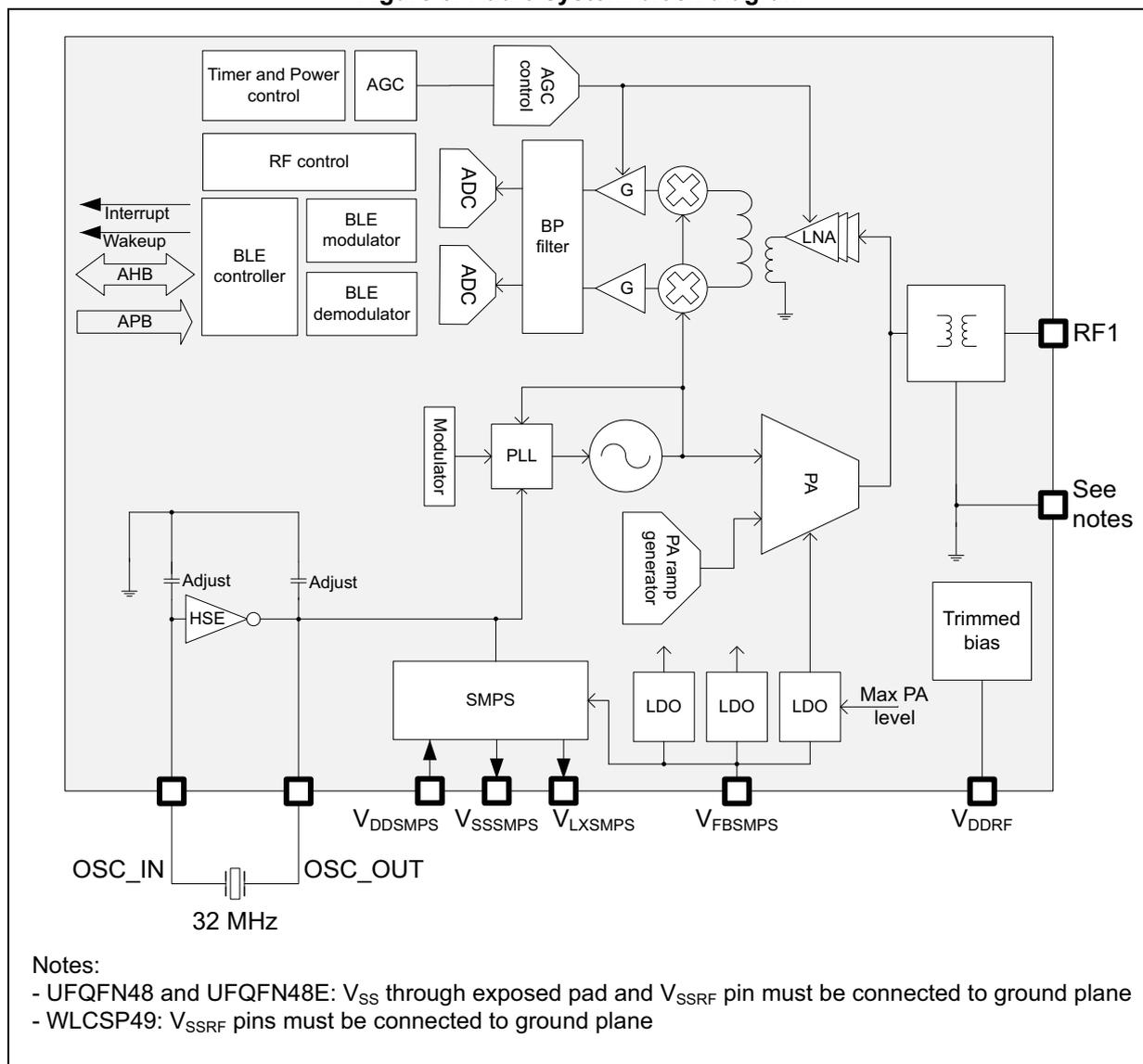
Notes:
- UFQFN48 and UFQFN48E: V
SS
through exposed pad and V
SSRF
pin must be connected to ground plane
- WLCSP49: V
SSRF
pins must be connected to ground plane
The maximum default transmit output power can be supported with a default \( V_{\text{FBSMPS}} \) supply level. For higher output power the \( V_{\text{FBSMPS}} \) supply level must be increased (see the device data sheet for more information).