2. Memory and bus architecture
2.1 System architecture
An AXI bus matrix, two AHB bus matrices and bus bridges allow interconnecting bus masters with bus slaves, as illustrated in Table 2 and Figure 1 .
Table 2. Bus-master-to-bus-slave interconnect
| Bus slave / type (1) | Bus master / type (1) | ||||||||||||||||
|---|---|---|---|---|---|---|---|---|---|---|---|---|---|---|---|---|---|
| Cortex-M7 - AXIM | Cortex-M7 - AHBP | Cortex-M7 - ITCM | Cortex-M7 - DTCM | SDMMC1 | MDMA - AXI | MDMA - AHBS | DMA2D | LTDC | DMA1 - MEM | DMA1 - PERIPH | DMA2 - MEM | DMA2 - PERIPH | Eth. MAC - AHB | SDMMC2 - AHB | USBHS1 - AHB | BDMA - AHB | |
| ITCM | - | - | X | - | - | - | X | - | - | - | - | - | - | - | - | - | - |
| DTCM | - | - | - | X | - | - | X | - | - | - | - | - | - | - | - | - | - |
| AHB3 peripherals | X | - | - | - | - | X | - | - | - | X | X | X | X | X | X | X | - |
| APB3 peripherals | X | - | - | - | - | X | - | - | - | X | X | X | X | X | X | X | - |
| Flash bank 1 | X | - | - | - | X | X | - | X | X | X | X | X | X | X | X | X | - |
| AXI SRAM | X | - | - | - | X | X | - | X | X | X | X | X | X | X | X | X | - |
| RAM shared between ITCM and AXI | X | - | - | - | X | X | - | X | X | X | X | X | X | X | X | X | - |
| OCTOSPI | X | - | - | - | X | X | - | X | X | X | X | X | X | X | X | X | - |
| FMC | X | - | - | - | X | X | - | X | X | X | X | X | X | X | X | X | - |
| SRAM1 | X | - | - | - | - | X | - | X | - | X | X | X | X | X | X | X | - |
| SRAM2 | X | - | - | - | - | X | - | X | - | X | X | X | X | X | X | X | - |
| AHB1 peripherals | - | X | - | - | - | X | - | X | - | X | X | X | X | - | X | - | - |
| APB1 peripherals | - | X | - | - | - | X | - | X | - | X | X | X | X | - | X | - | - |
| AHB2 peripherals | - | X | - | - | - | - | - | - | - | X | X | X | X | - | X | - | - |
| APB2 peripherals | - | X | - | - | - | X | - | X | - | X | X | X | X | - | X | - | - |
| AHB4 peripherals | X | - | - | - | - | X | - | - | - | X | X | X | X | - | X | - | X |
| APB4 peripherals | X | - | - | - | - | X | - | - | - | X | X | X | X | - | X | - | X |
| SRAM4 | X | - | - | - | - | X | - | - | - | X | X | X | X | - | X | - | X |
| Backup RAM | X | - | - | - | - | X | - | - | - | X | X | X | X | - | X | - | X |
1. Bold font type denotes 64-bit bus, plain type denotes 32-bit bus.
2. “X” = access possible, “-” = access not possible, shading = access useful/usable.
Figure 1. System architecture
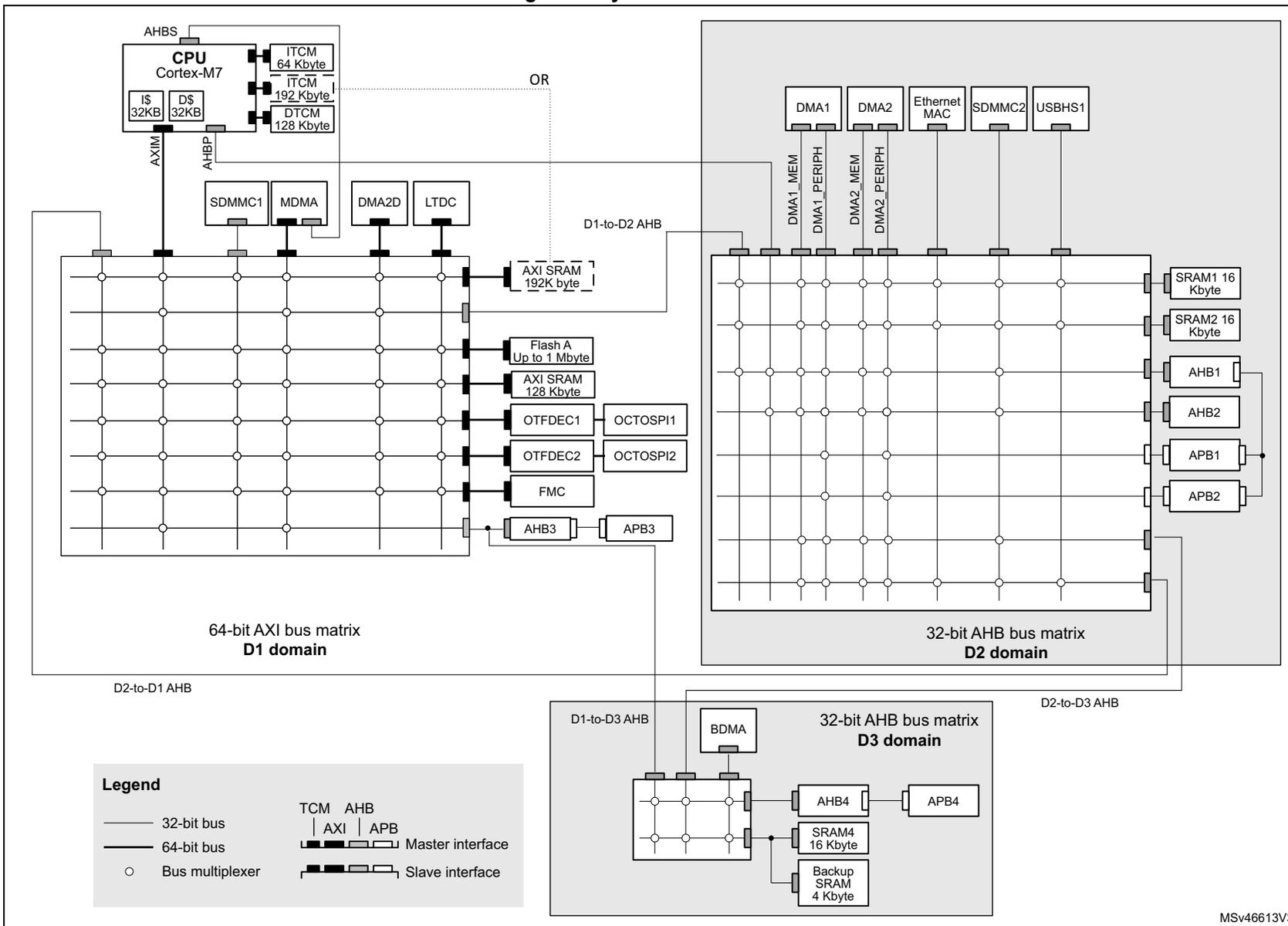
The diagram illustrates the system architecture, organized into three main domains:
- D1 domain: Contains the CPU Cortex-M7 connected to AHBS , AXIM , and AHBP interfaces. It includes ITCM (64 Kbyte, 192 Kbyte) and DTCM (128 Kbyte) memory. The AXIM interface connects to a 64-bit AXI bus matrix . Connected to this matrix are SDMMC1 , MDMA , DMA2D , LTDC , AXI SRAM 192K byte , Flash A Up to 1 Mbyte , AXI SRAM 128 Kbyte , OTFDEC1 (connected to OCTOSPI1 ), OTFDEC2 (connected to OCTOSPI2 ), FMC , and AHB3 (connected to APB3 ). A D2-to-D1 AHB bridge is also present.
- D2 domain: Contains a 32-bit AHB bus matrix connected to DMA1 , DMA2 , Ethernet MAC , SDMMC2 , and USBHS1 . The matrix also connects to SRAM1 16 Kbyte , SRAM2 16 Kbyte , AHB1 , AHB2 , APB1 , and APB2 . A D1-to-D2 AHB bridge connects the D1 and D2 domains.
- D3 domain: Contains a 32-bit AHB bus matrix connected to BDMA , AHB4 (connected to APB4 ), SRAM4 16 Kbyte , and Backup SRAM 4 Kbyte . A D2-to-D3 AHB bridge connects the D2 and D3 domains.
Legend:
- 32-bit bus (thin line)
- 64-bit bus (thick line)
- Bus multiplexer (circle)
- TCM, AXI, AHB, APB interfaces: Master interface (solid black), Slave interface (open rectangle)
MSV46613V3
2.1.1 Bus matrices
AXI bus matrix in D1 domain
The D1 domain multi AXI bus matrix ensures and arbitrates concurrent accesses from multiple masters to multiple slaves. This allows efficient simultaneous operation of high-speed peripherals.
The arbitration uses a round-robin algorithm with QoS capability.
Refer to Section 2.2: AXI interconnect matrix (AXIM) for more information on AXI interconnect.
AHB bus matrices in D2 and D3 domains
The AHB bus matrices in D2 and D3 domains ensure and arbitrate concurrent accesses from multiple masters to multiple slaves. This allows efficient simultaneous operation of high-speed peripherals.
The arbitration uses a round-robin algorithm.
2.1.2 TCM buses
The DTCM and ITCM (data and instruction tightly coupled RAMs) are connected through dedicated TCM buses directly to the Cortex-M7 core. The MDMA controller can access the DTCM and ITCM through AHBS, a specific CPU slave AHB. The DTCM and ITCM are accessed by Cortex-M7 at CPU clock speed, with zero wait states.
2.1.3 Bus-to-bus bridges
To allow peripherals with different types of buses to communicate together, there is a number of bus-to-bus bridges in the system.
The AHB/APB bridges in D1 and D3 domains allow connecting peripherals on APB3 and APB4 to AHB3 and AHB4, respectively. The AHB/APB bridges in D2 domain allow peripherals on APB1 and APB2 to connect to AHB1. These AHB/APB bridges provide full synchronous interfacing, which allows the APB peripherals to operate with clocks independent of AHB that they connect to.
The AHB/APB bridges also allow APB1 and APB2 peripherals to connect to DMA1 and DMA2 peripheral buses, respectively, without transiting through AHB1.
The AHB/APB bridges convert 8-bit / 16-bit APB data to 32-bit AHB data, by replicating it to the three upper bytes / the upper half-word of the 32-bit word.
The AXI bus matrix incorporates AHB/AXI bus bridge functionality on its slave bus interfaces. The AXI/AHB bus bridges on its master interfaces marked as 32-bit in Figure 1 are outside the matrix.
The Cortex-M7 CPU provides AHB/TCM-bus (ITCM and DTCM buses) translation from its AHBS slave AHB, allowing the MDMA controller to access the ITCM and DTCM.
2.1.4 Inter-domain buses
D2-to-D1 AHB
This 32-bit bus connects the D2 domain to the AXI bus matrix in the D1 domain. It allows bus masters in the D2 domain to access resources (bus slaves) in the D1 domain.
D1-to-D2 AHB
This 32-bit bus connects the D1 domain to the D2 domain AHB bus matrix. It allows bus masters in the D1 domain to access resources (bus slaves) in the D2 domain.
D1-to-D3 AHB
This 32-bit bus connects the D1 domain to the D3 domain AHB bus matrix. It allows bus masters in the D1 domain to access resources (bus slaves) in the D3 domain.
D2-to-D3 AHB
This 32-bit bus connects the D2 domain to the D3 domain AHB bus matrix. It allows bus masters in the D2 domain to access resources (bus slaves) in the D3 domain.
2.1.5 CPU buses
Cortex ® -M7 AXIM bus
The Cortex ® -M7 CPU uses the 64-bit AXIM bus to access all memories (excluding ITCM, and DTCM) and AHB3, AHB4, APB3 and APB4 peripherals (excluding AHB1, APB1 and APB2 peripherals).
The AXIM bus connects the CPU to the AXI bus matrix in the D1 domain.
Cortex ® -M7 ITCM bus
The Cortex ® -M7 CPU uses the 64-bit ITCM bus for fetching instructions from and accessing data in the ITCM.
Cortex ® -M7 DTCM bus
The Cortex ® -M7 CPU uses the 2x32-bit DTCM bus for accessing data in the DTCM. The 2x32-bit DTCM bus allows load/load and load/store instruction pairs to be dual-issued on the DTCM memory. It can also fetch instructions.
Cortex ® -M7 AHBS bus
The Cortex ® -M7 CPU uses the 32-bit AHBS slave bus to allow the MDMA controller to access the ITCM and the DTCM.
Cortex ® -M7 AHBP bus
The Cortex ® -M7 CPU uses the 32-bit AHBP bus for accessing AHB1, AHB2, APB1 and APB2 peripherals via the AHB bus matrix in the D2 domain.
2.1.6 Bus master peripherals
SDMMC1
The SDMMC1 uses a 32-bit bus, connected to the AXI bus matrix, through which it can access internal AXI SRAM and Flash memories, and external memories through the Octo-SPI controller and the FMC.
SDMMC2
The SDMMC2 uses a 32-bit bus, connected to the AHB bus matrix in D2 domain. Through the system bus matrices, it can access the internal AXI SRAM, SRAM1, SRAM2, SRAM4, backup RAM, Flash memory, and external memories through the Octo-SPI controller and the FMC.
MDMA controller
The MDMA controller has two bus masters: an AXI 64-bit bus, connected to the AXI bus matrix and an AHB 32-bit bus connected to the Cortex-M7 AHBS slave bus.
The MDMA is optimized for DMA data transfers between memories since it supports linked list transfers that allow performing a chained list of transfers without the need for CPU intervention. Through the system bus matrices and the Cortex-M7 AHBS slave bus, the MDMA can access all internal and external memories through the Octo-SPI controller and the FMC.
DMA1 and DMA2 controllers
The DMA1 and DMA2 controllers have two 32-bit buses - memory bus and peripheral bus, connected to the AHB bus matrix in D2 domain.
The memory bus allows DMA data transfers between memories. Through the system bus matrices, the memory bus can access all internal memories except ITCM and DTCM, and external memories through the Octo-SPI controller and the FMC.
The peripheral bus allows DMA data transfers between two peripherals, between two memories or between a peripheral and a memory. Through the system bus matrices, the peripheral bus can access all internal memories except ITCM and DTCM, external memories through the Octo-SPI controller and the FMC, and all AHB and APB peripherals. A direct access to APB1 and APB2 is available, without passing through AHB1. Direct path to APB1 and APB2 bridges allows reducing the bandwidth usage on AHB1 bus by improving data treatment efficiency for APB and AHB peripherals.
BDMA controller
The BDMA controller uses a 32-bit bus, connected to the AHB bus matrix in D3 domain, for DMA data transfers between two peripherals, between two memories or between a peripheral and a memory. BDMA transfers are limited to the D3 domain resources. It can access the internal SRAM4, backup RAM, and AHB4 and APB4 peripherals through the AHB bus matrix in the D3 domain.
Chrom-Art Accelerator (DMA2D)
The DMA2D graphics accelerator uses a 64-bit bus, connected to the AXI bus matrix. Through the system bus matrices, internal AXI SRAM, SRAM1, SRAM2 and Flash memories, and external memories through the Octo-SPI controller and the FMC.
LCD-TFT controller (LTDC)
The LCD-TFT display controller, LTDC, uses a 64-bit bus, connected to the AXI bus matrix, through which it can access internal AXI SRAM and Flash memories, and external memories through the Octo-SPI controller and the FMC.
Ethernet MAC
The Ethernet MAC uses a 32-bit bus, connected to the AHB bus matrix in the D2 domain. Through the system bus matrices, it can access all internal memories except SRAM4, backup RAM, ITCM, DTCM and external memories, through the Octo-SPI controller and the FMC.
USBHS1 peripheral
The USBHS1 peripheral uses 32-bit buses, connected to the AHB bus matrix in the D2 domain. Through the system bus matrices, it can access all internal memories except SRAM4, backup RAM, ITCM, DTCM and external memories, through the Octo-SPI controller and the FMC.
2.1.7 Clocks to functional blocks
Upon reset, clocks to blocks such as peripherals and some memories are disabled (except for the SRAM, DTCM, ITCM and Flash memory). To operate a block with no clock upon reset, the software must first enable its clock through RCC_AHBxENR or RCC_APBxENR register, respectively.
2.2 AXI interconnect matrix (AXIM)
2.2.1 AXI introduction
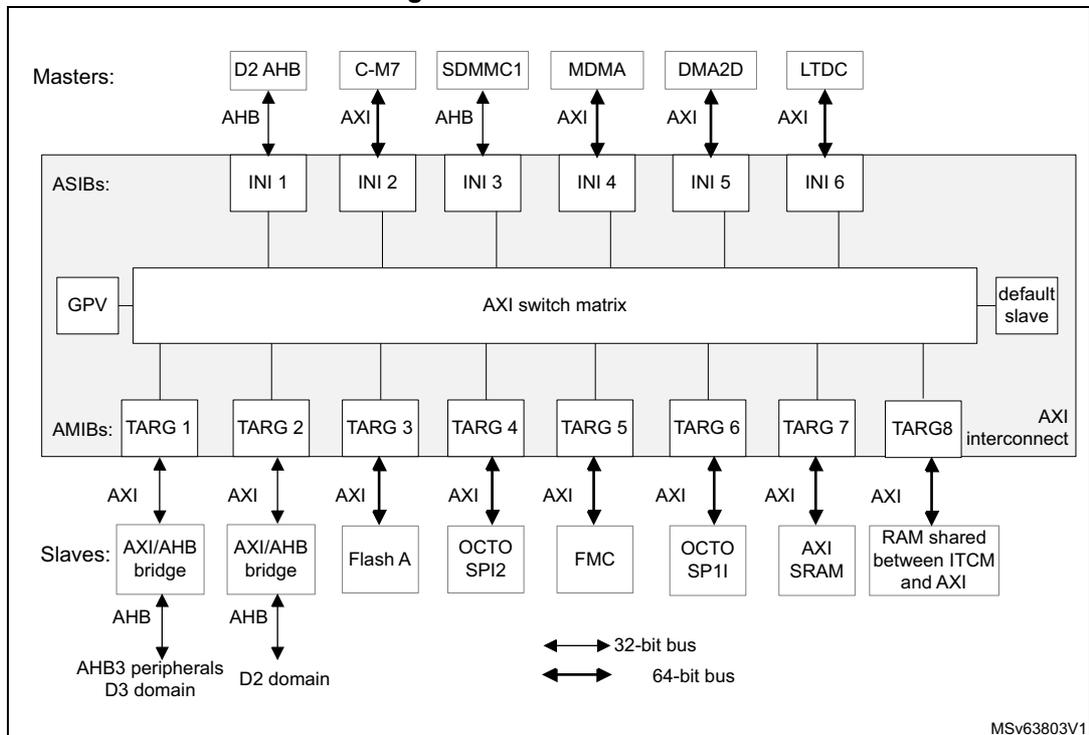
The AXI (advanced extensible interface) interconnect is based on the Arm® CoreLink™ NIC-400 Network Interconnect. The interconnect has six initiator ports, or ASIBs (AMBA slave interface blocks), and eight target ports, or AMIBs (AMBA master interface blocks). The ASIBs are connected to the AMIBs via an AXI switch matrix.
Each ASIB is a slave on an AXI bus or AHB (advanced high-performance bus). Similarly, each AMIB is a master on an AXI or AHB bus. Where an ASIB or AMIB is connected to an AHB, it converts between the AHB and the AXI protocol.
The AXI interconnect includes a GPV (global programmer view) which contains registers for configuring certain parameters, such as the QoS (quality of service) level at each ASIB.
Any accesses to unallocated address space are handled by the default slave, which generates the return signals. This ensures that such transactions complete and do not block the issuing master and ASIB.
2.2.2 AXI interconnect main features
- • 64-bit AXI bus switch matrix with six ASIBs and eight AMIBs, in D1 domain
- • AHB/AXI bridge function built into the ASIBs
- • concurrent connectivity of multiple ASIBs to multiple AMIBs
- • programmable traffic priority management (QoS - quality of service)
- • software-configurable via GPV
2.2.3 AXI interconnect functional description
Block diagram
The AXI interconnect is shown in Figure 2 .
Figure 2. AXI interconnect
ASIB configuration
Table 3 summarizes the characteristics of the ASIBs.
Table 3. ASIB configuration
| ASIB | Connected master | Protocol | Bus width | R/W issuing |
|---|---|---|---|---|
| INI 1 | AHB from D2 domain | AHB-lite | 32 | 1/1 |
| INI 2 | Cortex-M7 | AXI4 | 64 | 7/32 |
| INI 3 | SDMMC1 | AHB-lite | 32 | 1/1 |
| INI 4 | MDMA | AXI4 | 64 | 4/1 |
| ASIB | Connected master | Protocol | Bus width | R/W issuing |
|---|---|---|---|---|
| INI 5 | DMA2D | AXI4 | 64 | 2/1 |
| INI 6 | LTDC | AXI4 | 64 | 1/1 |
AMIB configuration
Table 4 summarizes the characteristics of the AMIBs.
Table 4. AMIB configuration| AMIB | Connected slave | Protocol | Bus width | R/W/Total acceptance |
|---|---|---|---|---|
| TARG 1 | Peripheral 3 and D3 AHB | AXI4 (1) | 32 | 1/1/1 |
| TARG 2 | D2 AHB | AXI4 (1) | 32 | 1/1/1 |
| TARG 3 | Flash A | AXI4 | 64 | 3/2/5 |
| TARG 4 | OCTOSPI2 | AXI4 | 64 | 2/1/3 |
| TARG 5 | FMC | AXI4 | 64 | 3/3/6 |
| TARG 6 | OCTOSPI1 | AXI4 | 64 | 2/1/3 |
| TARG 7 | AXI SRAM | AXI4 | 64 | 2/2/2 |
| TARG 8 | RAM shared between ITCM and AXI | AXI4 | 64 | 2/2/2 |
- 1. Conversion to AHB protocol is done via an AXI/AHB bridge sitting between AXI interconnect and the connected slave.
Quality of service (QoS)
The AXI switch matrix uses a priority-based arbitration when two ASIB simultaneously attempt to access the same AMIB. Each ASIB has programmable read channel and write channel priorities, known as QoS, from 0 to 15, such that the higher the value, the higher the priority. The read channel QoS value is programmed in the AXI interconnect - INI x read QoS register (AXI_INIx_READ_QOS) , and the write channel in the AXI interconnect - INI x write QoS register (AXI_INIx_WRITE_QOS) . The default QoS value for all channels is 0 (lowest priority).
If two coincident transactions arrive at the same AMIB, the higher priority transaction passes before the lower priority. If the two transactions have the same QoS value, then a least-recently-used (LRU) priority scheme is adopted.
The QoS values should be programmed according to the latency requirements for the application. Setting a higher priority for an ASIB ensures a lower latency for transactions initiated by the associated bus master. This can be useful for real-time-constrained tasks, such as graphics processing (LTDC, DMA2D). Assigning a high priority to masters that can make many and frequent accesses to the same slave (such as the Cortex-M7 CPU) can block access to that slave by other lower-priority masters.
Global programmer view (GPV)
The GPV contains configuration registers for the AXI interconnect (see Section 2.2.4 ). These registers are only accessible by the Cortex-M7 CPU.
2.2.4 AXI interconnect registers
AXI interconnect - peripheral ID4 register (AXI_PERIPH_ID_4)
Address offset: 0x1FD0
Reset value: 0x0000 0004
| 31 | 30 | 29 | 28 | 27 | 26 | 25 | 24 | 23 | 22 | 21 | 20 | 19 | 18 | 17 | 16 |
|---|---|---|---|---|---|---|---|---|---|---|---|---|---|---|---|
| Res. | Res. | Res. | Res. | Res. | Res. | Res. | Res. | Res. | Res. | Res. | Res. | Res. | Res. | Res. | Res. |
| 15 | 14 | 13 | 12 | 11 | 10 | 9 | 8 | 7 | 6 | 5 | 4 | 3 | 2 | 1 | 0 |
| Res. | Res. | Res. | Res. | Res. | Res. | Res. | Res. | 4KCOUNT[3:0] | JEP106CON[3:0] | ||||||
| r | r | ||||||||||||||
Bits 31:8 Reserved, must be kept at reset value.
Bits 7:4
4KCOUNT[3:0]
: Register file size
0x0: N/A
Bits 3:0
JEP106CON[3:0]
: JEP106 continuation code
0x4: Arm
®
AXI interconnect - peripheral ID0 register (AXI_PERIPH_ID_0)
Address offset: 0x1FE0
Reset value: 0x0000 0000
| 31 | 30 | 29 | 28 | 27 | 26 | 25 | 24 | 23 | 22 | 21 | 20 | 19 | 18 | 17 | 16 |
|---|---|---|---|---|---|---|---|---|---|---|---|---|---|---|---|
| Res. | Res. | Res. | Res. | Res. | Res. | Res. | Res. | Res. | Res. | Res. | Res. | Res. | Res. | Res. | Res. |
| 15 | 14 | 13 | 12 | 11 | 10 | 9 | 8 | 7 | 6 | 5 | 4 | 3 | 2 | 1 | 0 |
| Res. | Res. | Res. | Res. | Res. | Res. | Res. | Res. | PARTNUM[7:0] | |||||||
| r | |||||||||||||||
Bits 31:8 Reserved, must be kept at reset value.
Bits 7:0
PARTNUM[7:0]
: Peripheral part number bits 0 to 7
0x00: Part number = 0x400
Address offset: 0x1FE4
Reset value: 0x0000 00B4
| 31 | 30 | 29 | 28 | 27 | 26 | 25 | 24 | 23 | 22 | 21 | 20 | 19 | 18 | 17 | 16 |
|---|---|---|---|---|---|---|---|---|---|---|---|---|---|---|---|
| Res. | Res. | Res. | Res. | Res. | Res. | Res. | Res. | Res. | Res. | Res. | Res. | Res. | Res. | Res. | Res. |
| 15 | 14 | 13 | 12 | 11 | 10 | 9 | 8 | 7 | 6 | 5 | 4 | 3 | 2 | 1 | 0 |
| Res. | Res. | Res. | Res. | Res. | Res. | Res. | Res. | JEP106ID[3:0] | PARTNUM[11:8] | ||||||
| r | r | ||||||||||||||
Bits 31:8 Reserved, must be kept at reset value.
Bits 7:4
JEP106ID[3:0]
: JEP106 identity bits 0 to 3
0xB: Arm® JEDEC code
Bits 3:0
PARTNUM[11:8]
: Peripheral part number bits 8 to 11
0x4: Part number = 0x400
Address offset: 0x1FE8
Reset value: 0x0000 002B
| 31 | 30 | 29 | 28 | 27 | 26 | 25 | 24 | 23 | 22 | 21 | 20 | 19 | 18 | 17 | 16 |
|---|---|---|---|---|---|---|---|---|---|---|---|---|---|---|---|
| Res. | Res. | Res. | Res. | Res. | Res. | Res. | Res. | Res. | Res. | Res. | Res. | Res. | Res. | Res. | Res. |
| 15 | 14 | 13 | 12 | 11 | 10 | 9 | 8 | 7 | 6 | 5 | 4 | 3 | 2 | 1 | 0 |
| Res. | Res. | Res. | Res. | Res. | Res. | Res. | Res. | REVISION[3:0] | JEDEC | JEP106ID[6:4] | |||||
| r | r | r | |||||||||||||
Bits 7:4
REVISION[3:0]
: Peripheral revision number
0x2: r0p2
Bit 3
JEDEC
: JEP106 code flag
0x1: JEDEC allocated code
Bits 2:0
JEP106ID[6:4]
: JEP106 Identity bits 4 to 6
0x3: Arm® JEDEC code
Address offset: 0x1FEC
Reset value: 0x0000 0000
| 31 | 30 | 29 | 28 | 27 | 26 | 25 | 24 | 23 | 22 | 21 | 20 | 19 | 18 | 17 | 16 |
|---|---|---|---|---|---|---|---|---|---|---|---|---|---|---|---|
| Res. | Res. | Res. | Res. | Res. | Res. | Res. | Res. | Res. | Res. | Res. | Res. | Res. | Res. | Res. | Res. |
| 15 | 14 | 13 | 12 | 11 | 10 | 9 | 8 | 7 | 6 | 5 | 4 | 3 | 2 | 1 | 0 |
| Res. | Res. | Res. | Res. | Res. | Res. | Res. | Res. | REV_AND[3:0] | CUST_MOD_NUM[3:0] | ||||||
| r | r | ||||||||||||||
Bits 31:8 Reserved, must be kept at reset value.
Bits 7:4 REV_AND[3:0] : Customer version0: None
Bits 3:0 CUST_MOD_NUM[3:0] : Customer modification0: None
AXI interconnect - component ID0 register (AXI_COMP_ID_0)Address offset: 0x1FF0
Reset value: 0x0000 000D
| 31 | 30 | 29 | 28 | 27 | 26 | 25 | 24 | 23 | 22 | 21 | 20 | 19 | 18 | 17 | 16 |
|---|---|---|---|---|---|---|---|---|---|---|---|---|---|---|---|
| Res. | Res. | Res. | Res. | Res. | Res. | Res. | Res. | Res. | Res. | Res. | Res. | Res. | Res. | Res. | Res. |
| 15 | 14 | 13 | 12 | 11 | 10 | 9 | 8 | 7 | 6 | 5 | 4 | 3 | 2 | 1 | 0 |
| Res. | Res. | Res. | Res. | Res. | Res. | Res. | Res. | PREAMBLE[7:0] | |||||||
| r | |||||||||||||||
Bits 31:8 Reserved, must be kept at reset value.
Bits 7:0 PREAMBLE[7:0] : Preamble bits 0 to 70xD: Common ID value
AXI interconnect - component ID1 register (AXI_COMP_ID_1)Address offset: 0x1FF4
Reset value: 0x0000 00F0
| 31 | 30 | 29 | 28 | 27 | 26 | 25 | 24 | 23 | 22 | 21 | 20 | 19 | 18 | 17 | 16 |
|---|---|---|---|---|---|---|---|---|---|---|---|---|---|---|---|
| Res. | Res. | Res. | Res. | Res. | Res. | Res. | Res. | Res. | Res. | Res. | Res. | Res. | Res. | Res. | Res. |
| 15 | 14 | 13 | 12 | 11 | 10 | 9 | 8 | 7 | 6 | 5 | 4 | 3 | 2 | 1 | 0 |
| Res. | Res. | Res. | Res. | Res. | Res. | Res. | Res. | CLASS[3:0] | PREAMBLE[11:8] | ||||||
| r | r | ||||||||||||||
Bits 31:8 Reserved, must be kept at reset value.
Bits 7:4 CLASS[3:0] : Component class0xF: Generic IP component class
Bits 3:0 PREAMBLE[11:8] : Preamble bits 8 to 110x0: Common ID value
AXI interconnect - component ID2 register (AXI_COMP_ID_2)Address offset: 0x1FF8
Reset value: 0x0000 0005
| 31 | 30 | 29 | 28 | 27 | 26 | 25 | 24 | 23 | 22 | 21 | 20 | 19 | 18 | 17 | 16 |
|---|---|---|---|---|---|---|---|---|---|---|---|---|---|---|---|
| Res. | Res. | Res. | Res. | Res. | Res. | Res. | Res. | Res. | Res. | Res. | Res. | Res. | Res. | Res. | Res. |
| 15 | 14 | 13 | 12 | 11 | 10 | 9 | 8 | 7 | 6 | 5 | 4 | 3 | 2 | 1 | 0 |
| Res. | Res. | Res. | Res. | Res. | Res. | Res. | Res. | PREAMBLE[19:12] | |||||||
| r | |||||||||||||||
Bits 31:8 Reserved, must be kept at reset value.
Bits 7:0 PREAMBLE[19:12] : Preamble bits 12 to 190x05: Common ID value
AXI interconnect - component ID3 register (AXI_COMP_ID_3)
Address offset: 0x1FFC
Reset value: 0x0000 00B1
| 31 | 30 | 29 | 28 | 27 | 26 | 25 | 24 | 23 | 22 | 21 | 20 | 19 | 18 | 17 | 16 |
|---|---|---|---|---|---|---|---|---|---|---|---|---|---|---|---|
| Res. | Res. | Res. | Res. | Res. | Res. | Res. | Res. | Res. | Res. | Res. | Res. | Res. | Res. | Res. | Res. |
| 15 | 14 | 13 | 12 | 11 | 10 | 9 | 8 | 7 | 6 | 5 | 4 | 3 | 2 | 1 | 0 |
| Res. | Res. | Res. | Res. | Res. | Res. | Res. | Res. | PREAMBLE[27:20] | |||||||
| r | |||||||||||||||
Bits 31:8 Reserved, must be kept at reset value.
Bits 7:0 PREAMBLE[27:20] : Preamble bits 20 to 27
0xB1: Common ID value
AXI interconnect - TARG x bus matrix issuing functionality register (AXI_TARGx_FN_MOD_ISS_BM)
Address offset: 0x1008 + 0x1000 * x, where x = 1 to 8
Reset value: 0x0000 0000
| 31 | 30 | 29 | 28 | 27 | 26 | 25 | 24 | 23 | 22 | 21 | 20 | 19 | 18 | 17 | 16 |
|---|---|---|---|---|---|---|---|---|---|---|---|---|---|---|---|
| Res. | Res. | Res. | Res. | Res. | Res. | Res. | Res. | Res. | Res. | Res. | Res. | Res. | Res. | Res. | Res. |
| 15 | 14 | 13 | 12 | 11 | 10 | 9 | 8 | 7 | 6 | 5 | 4 | 3 | 2 | 1 | 0 |
| Res. | Res. | Res. | Res. | Res. | Res. | Res. | Res. | Res. | Res. | Res. | Res. | Res. | Res. | WRITE ISS OVERR IDE | READ ISS OVERR IDE |
| rw | rw |
Bits 31:2 Reserved, must be kept at reset value.
Bit 1 WRITE_ISS_OVERRIDE : Switch matrix write issuing override for target
0: Normal issuing capability
1: Set switch matrix write issuing capability to 1
Bit 0 READ_ISS_OVERRIDE : Switch matrix read issuing override for target
0: Normal issuing capability
1: Set switch matrix read issuing capability to 1
AXI interconnect - TARG x bus matrix functionality 2 register
(AXI_TARGx_FN_MOD2)
Address offset: \( 0x1024 + 0x1000 * x \) , where \( x = 1, 2, 7 \) and \( 8 \)
Reset value: 0x0000 0000
| 31 | 30 | 29 | 28 | 27 | 26 | 25 | 24 | 23 | 22 | 21 | 20 | 19 | 18 | 17 | 16 |
|---|---|---|---|---|---|---|---|---|---|---|---|---|---|---|---|
| Res. | Res. | Res. | Res. | Res. | Res. | Res. | Res. | Res. | Res. | Res. | Res. | Res. | Res. | Res. | Res. |
| 15 | 14 | 13 | 12 | 11 | 10 | 9 | 8 | 7 | 6 | 5 | 4 | 3 | 2 | 1 | 0 |
| Res. | Res. | Res. | Res. | Res. | Res. | Res. | Res. | Res. | Res. | Res. | Res. | Res. | Res. | Res. | BYPASS_MERGE |
| rw |
Bits 31:1 Reserved, must be kept at reset value.
Bit 0 BYPASS_MERGE : Disable packing of beats to match the output data width. Unaligned transactions are not realigned to the input data word boundary.
0: Normal operation
1: Disable packing
AXI interconnect - TARG x long burst functionality modification register
(AXI_TARGx_FN_MOD_LB)
Address offset: \( 0x102C + 0x1000 * x \) , where \( x = 1 \) and \( 2 \)
Reset value: 0x0000 0000
| 31 | 30 | 29 | 28 | 27 | 26 | 25 | 24 | 23 | 22 | 21 | 20 | 19 | 18 | 17 | 16 |
|---|---|---|---|---|---|---|---|---|---|---|---|---|---|---|---|
| Res. | Res. | Res. | Res. | Res. | Res. | Res. | Res. | Res. | Res. | Res. | Res. | Res. | Res. | Res. | Res. |
| 15 | 14 | 13 | 12 | 11 | 10 | 9 | 8 | 7 | 6 | 5 | 4 | 3 | 2 | 1 | 0 |
| Res. | Res. | Res. | Res. | Res. | Res. | Res. | Res. | Res. | Res. | Res. | Res. | Res. | Res. | Res. | FN_MOD_LB |
| rw |
Bits 31:1 Reserved, must be kept at reset value.
Bit 0 FN_MOD_LB : Controls burst breaking of long bursts
0: Long bursts can not be generated at the output of the ASIB
1: Long bursts can be generated at the output of the ASIB
AXI interconnect - TARG x issuing functionality modification register (AXI_TARGx_FN_MOD)
Address offset: 0x1108 + 0x1000 * x, where x = 1, 2, 7 and 8
Reset value: 0x0000 0000
| 31 | 30 | 29 | 28 | 27 | 26 | 25 | 24 | 23 | 22 | 21 | 20 | 19 | 18 | 17 | 16 |
|---|---|---|---|---|---|---|---|---|---|---|---|---|---|---|---|
| Res. | Res. | Res. | Res. | Res. | Res. | Res. | Res. | Res. | Res. | Res. | Res. | Res. | Res. | Res. | Res. |
| 15 | 14 | 13 | 12 | 11 | 10 | 9 | 8 | 7 | 6 | 5 | 4 | 3 | 2 | 1 | 0 |
| Res. | Res. | Res. | Res. | Res. | Res. | Res. | Res. | Res. | Res. | Res. | Res. | Res. | Res. | WRITE ISS OVERR IDE | READ ISS OVERR IDE |
| rw | rw |
Bits 31:2 Reserved, must be kept at reset value.
Bit 1 WRITE_ISS_OVERRIDE : Override AMIB write issuing capability
- 0: Normal issuing capability
- 1: Force issuing capability to 1
Bit 0 READ_ISS_OVERRIDE : Override AMIB read issuing capability
- 0: Normal issuing capability
- 1: Force issuing capability to 1
AXI interconnect - INI x functionality modification 2 register (AXI_INIx_FN_MOD2)
Address offset: 0x41024 + 0x1000 * x, where x = 1 and 3
Reset value: 0x0000 0000
| 31 | 30 | 29 | 28 | 27 | 26 | 25 | 24 | 23 | 22 | 21 | 20 | 19 | 18 | 17 | 16 |
|---|---|---|---|---|---|---|---|---|---|---|---|---|---|---|---|
| Res. | Res. | Res. | Res. | Res. | Res. | Res. | Res. | Res. | Res. | Res. | Res. | Res. | Res. | Res. | Res. |
| 15 | 14 | 13 | 12 | 11 | 10 | 9 | 8 | 7 | 6 | 5 | 4 | 3 | 2 | 1 | 0 |
| Res. | Res. | Res. | Res. | Res. | Res. | Res. | Res. | Res. | Res. | Res. | Res. | Res. | Res. | Res. | BYPASS S_MERGE |
| rw |
Bits 31:1 Reserved, must be kept at reset value.
Bit 0 BYPASS_MERGE : Disables alteration of transactions by the up-sizer unless required by the protocol
- 0: Normal operation
- 1: Transactions pass through unaltered where allowed
AXI interconnect - INI x AHB functionality modification register
(AXI_INIx_FN_MOD_AHB)
Address offset: 0x41028 + 0x1000 * x, where x = 1 and 3
Reset value: 0x0000 0000
| 31 | 30 | 29 | 28 | 27 | 26 | 25 | 24 | 23 | 22 | 21 | 20 | 19 | 18 | 17 | 16 |
|---|---|---|---|---|---|---|---|---|---|---|---|---|---|---|---|
| Res. | Res. | Res. | Res. | Res. | Res. | Res. | Res. | Res. | Res. | Res. | Res. | Res. | Res. | Res. | Res. |
| 15 | 14 | 13 | 12 | 11 | 10 | 9 | 8 | 7 | 6 | 5 | 4 | 3 | 2 | 1 | 0 |
| Res. | Res. | Res. | Res. | Res. | Res. | Res. | Res. | Res. | Res. | Res. | Res. | Res. | Res. | WR_IN C_OVE RRIDE | RD_IN C_OVE RRIDE |
| rw | rw |
Bits 31:2 Reserved, must be kept at reset value.
Bit 1 WR_INC_OVERRIDE : Converts all AHB-Lite read transactions to a series of single beat AXI transactions.
0: Override disabled
1: Override enabled
Bit 0 RD_INC_OVERRIDE : Converts all AHB-Lite write transactions to a series of single beat AXI transactions, and each AHB-Lite write beat is acknowledged with the AXI buffered write response.
0: Override disabled
1: Override enabled
AXI interconnect - INI x read QoS register (AXI_INIx_READ_QOS)
Address offset: 0x41100 + 0x1000 * x, where x = 1 to 76
Reset value: 0x0000 0000
| 31 | 30 | 29 | 28 | 27 | 26 | 25 | 24 | 23 | 22 | 21 | 20 | 19 | 18 | 17 | 16 |
|---|---|---|---|---|---|---|---|---|---|---|---|---|---|---|---|
| Res. | Res. | Res. | Res. | Res. | Res. | Res. | Res. | Res. | Res. | Res. | Res. | Res. | Res. | Res. | Res. |
| 15 | 14 | 13 | 12 | 11 | 10 | 9 | 8 | 7 | 6 | 5 | 4 | 3 | 2 | 1 | 0 |
| Res. | Res. | Res. | Res. | Res. | Res. | Res. | Res. | Res. | Res. | Res. | Res. | AR_QOS[3:0] | |||
| rw | |||||||||||||||
Bits 31:4 Reserved, must be kept at reset value.
Bits 3:0 AR_QOS[3:0] : Read channel QoS setting
0x0: Lowest priority
0xF: Highest priority
AXI interconnect - INI x write QoS register (AXI_INIx_WRITE_QOS)Address offset: 0x41104 + 0x1000 * x, where x = 1 to 76
Reset value: 0x0000 0000
| 31 | 30 | 29 | 28 | 27 | 26 | 25 | 24 | 23 | 22 | 21 | 20 | 19 | 18 | 17 | 16 |
|---|---|---|---|---|---|---|---|---|---|---|---|---|---|---|---|
| Res. | Res. | Res. | Res. | Res. | Res. | Res. | Res. | Res. | Res. | Res. | Res. | Res. | Res. | Res. | Res. |
| 15 | 14 | 13 | 12 | 11 | 10 | 9 | 8 | 7 | 6 | 5 | 4 | 3 | 2 | 1 | 0 |
| Res. | Res. | Res. | Res. | Res. | Res. | Res. | Res. | Res. | Res. | Res. | Res. | AW_QOS[3:0] | |||
| rw | |||||||||||||||
Bits 31:4 Reserved, must be kept at reset value.
Bits 3:0 AW_QOS[3:0] : Write channel QoS setting0x0: Lowest priority
0xF: Highest priority
AXI interconnect - INI x issuing functionality modification register (AXI_INIx_FN_MOD)Address offset: 0x41108 + 0x1000 * x, where x = 1 to 76
Reset value: 0x0000 0000
| 31 | 30 | 29 | 28 | 27 | 26 | 25 | 24 | 23 | 22 | 21 | 20 | 19 | 18 | 17 | 16 |
|---|---|---|---|---|---|---|---|---|---|---|---|---|---|---|---|
| Res. | Res. | Res. | Res. | Res. | Res. | Res. | Res. | Res. | Res. | Res. | Res. | Res. | Res. | Res. | Res. |
| 15 | 14 | 13 | 12 | 11 | 10 | 9 | 8 | 7 | 6 | 5 | 4 | 3 | 2 | 1 | 0 |
| Res. | Res. | Res. | Res. | Res. | Res. | Res. | Res. | Res. | Res. | Res. | Res. | Res. | Res. | WRITE ISS OVERR IDE | READ ISS OVERR IDE |
| rw | rw |
Bits 31:2 Reserved, must be kept at reset value.
Bit 1 WRITE_ISS_OVERRIDE : Override ASIB write issuing capability0: Normal issuing capability
1: Force issuing capability to 1
Bit 0 READ_ISS_OVERRIDE : Override ASIB read issuing capability0: Normal issuing capability
1: Force issuing capability to 1
2.2.5 AXI interconnect register map
Table 5. AXI interconnect register map and reset values
| Offset | Register name | 31 | 30 | 29 | 28 | 27 | 26 | 25 | 24 | 23 | 22 | 21 | 20 | 19 | 18 | 17 | 16 | 15 | 14 | 13 | 12 | 11 | 10 | 9 | 8 | 7 | 6 | 5 | 4 | 3 | 2 | 1 | 0 |
|---|---|---|---|---|---|---|---|---|---|---|---|---|---|---|---|---|---|---|---|---|---|---|---|---|---|---|---|---|---|---|---|---|---|
| Res. | Res. | Res. | Res. | Res. | Res. | Res. | Res. | Res. | Res. | Res. | Res. | Res. | Res. | Res. | Res. | Res. | Res. | Res. | Res. | Res. | Res. | Res. | Res. | Res. | Res. | Res. | Res. | Res. | Res. | Res. | Res. | ||
| 0x1FD0 | AXI_PERIPH_ID_4 | 4KCOUNT [3:0] | JEP106CON [3:0] | ||||||||||||||||||||||||||||||
| Reset value | 0 | 0 | 0 | 0 | 0 | 1 | 0 | 0 | |||||||||||||||||||||||||
| 0x1FD4 | AXI_PERIPH_ID_5 | Reserved | |||||||||||||||||||||||||||||||
| Reset value | 0 | 0 | 0 | 0 | 0 | 0 | 0 | 0 | |||||||||||||||||||||||||
| 0x1FD8 | AXI_PERIPH_ID_6 | Reserved | |||||||||||||||||||||||||||||||
| Reset value | 0 | 0 | 0 | 0 | 0 | 0 | 0 | 0 | |||||||||||||||||||||||||
| 0x1FDC | AXI_PERIPH_ID_7 | Reserved | |||||||||||||||||||||||||||||||
| Reset value | 0 | 0 | 0 | 0 | 0 | 0 | 0 | 0 | |||||||||||||||||||||||||
| 0x1FE0 | AXI_PERIPH_ID_0 | PARTNUM[7:0] | |||||||||||||||||||||||||||||||
| Reset value | 0 | 0 | 0 | 0 | 0 | 0 | 0 | 0 | |||||||||||||||||||||||||
| 0x1FE4 | AXI_PERIPH_ID_1 | JEP106ID [3:0] | PARTNUM [11:8] | ||||||||||||||||||||||||||||||
| Reset value | 1 | 0 | 1 | 1 | 0 | 1 | 0 | 0 | |||||||||||||||||||||||||
| 0x1FE8 | AXI_PERIPH_ID_2 | REVISION [3:0] | JEDEC JEP106ID [6:4] | ||||||||||||||||||||||||||||||
| Reset value | 0 | 0 | 1 | 0 | 1 | 0 | 1 | 1 | |||||||||||||||||||||||||
| 0x1FEC | AXI_PERIPH_ID_3 | REV_AND[3:0] CUST_MOD_NUM [3:0] | |||||||||||||||||||||||||||||||
| Reset value | 0 | 0 | 0 | 0 | 0 | 0 | 0 | 0 | |||||||||||||||||||||||||
| 0x1FF0 | AXI_COMP_ID_0 | PREAMBLE[7:0] | |||||||||||||||||||||||||||||||
| Reset value | 0 | 0 | 0 | 0 | 1 | 1 | 0 | 1 | |||||||||||||||||||||||||
| 0x1FF4 | AXI_COMP_ID_1 | CLASS[3:0] PREAMBLE [11:8] | |||||||||||||||||||||||||||||||
| Reset value | 1 | 1 | 1 | 1 | 0 | 0 | 0 | 0 |
Table 5. AXI interconnect register map and reset values (continued)
| Offset | Register name | 31 | 30 | 29 | 28 | 27 | 26 | 25 | 24 | 23 | 22 | 21 | 20 | 19 | 18 | 17 | 16 | 15 | 14 | 13 | 12 | 11 | 10 | 9 | 8 | 7 | 6 | 5 | 4 | 3 | 2 | 1 | 0 |
|---|---|---|---|---|---|---|---|---|---|---|---|---|---|---|---|---|---|---|---|---|---|---|---|---|---|---|---|---|---|---|---|---|---|
| 0x1FF8 | AXI_COMP_ID_2 | Res. | Res. | Res. | Res. | Res. | Res. | Res. | Res. | Res. | Res. | Res. | Res. | Res. | Res. | Res. | Res. | Res. | Res. | Res. | Res. | Res. | Res. | Res. | Res. | PREAMBLE[19:12] | |||||||
| Reset value | 0 | 0 | 0 | 0 | 0 | 1 | 0 | 1 | |||||||||||||||||||||||||
| 0x1FFC | AXI_COMP_ID_3 | Res. | Res. | Res. | Res. | Res. | Res. | Res. | Res. | Res. | Res. | Res. | Res. | Res. | Res. | Res. | Res. | Res. | Res. | Res. | Res. | Res. | Res. | Res. | Res. | PREAMBLE[27:20] | |||||||
| Reset value | 1 | 0 | 1 | 1 | 0 | 0 | 0 | 1 | |||||||||||||||||||||||||
| 0x2000 - 0x2004 | Reserved | Res. | Res. | Res. | Res. | Res. | Res. | Res. | Res. | Res. | Res. | Res. | Res. | Res. | Res. | Res. | Res. | Res. | Res. | Res. | Res. | Res. | Res. | Res. | Res. | Res. | Res. | Res. | Res. | Res. | Res. | Res. | Res. |
| 0x2008 | AXI_TARG1_FN_MOD_ISS_BM | Res. | WRITE_ISS_OVERRIDE | READ_ISS_OVERRIDE | |||||||||||||||||||||||||||||
| Reset value | 0 | 0 | |||||||||||||||||||||||||||||||
| 0x200C - 0x2020 | Reserved | Res. | |||||||||||||||||||||||||||||||
| 0x2024 | AXI_TARG1_FN_MOD2 | Res. | BYPASS_MERGE | ||||||||||||||||||||||||||||||
| Reset value | 0 | ||||||||||||||||||||||||||||||||
| 0x2028 | Reserved | Res. | |||||||||||||||||||||||||||||||
| 0x202C | AXI_TARG1_FN_MOD_LB | Res. | FN_MOD_LB | ||||||||||||||||||||||||||||||
| Reset value | 0 | ||||||||||||||||||||||||||||||||
| 0x2030 - 0x2104 | Reserved | Res. | |||||||||||||||||||||||||||||||
| 0x2108 | AXI_TARG1_FN_MOD | Res. | WRITE_ISS_OVERRIDE | READ_ISS_OVERRIDE | |||||||||||||||||||||||||||||
| Reset value | 0 | 0 | |||||||||||||||||||||||||||||||
| 0x210C - 0x3004 | Reserved | Res. | |||||||||||||||||||||||||||||||
Table 5. AXI interconnect register map and reset values (continued)
| Offset | Register name | 31 | 30 | 29 | 28 | 27 | 26 | 25 | 24 | 23 | 22 | 21 | 20 | 19 | 18 | 17 | 16 | 15 | 14 | 13 | 12 | 11 | 10 | 9 | 8 | 7 | 6 | 5 | 4 | 3 | 2 | 1 | 0 | |
|---|---|---|---|---|---|---|---|---|---|---|---|---|---|---|---|---|---|---|---|---|---|---|---|---|---|---|---|---|---|---|---|---|---|---|
| 0x3008 | AXI_TARG2_ FN_MOD_ ISS_BM | Res. | Res. | Res. | Res. | Res. | Res. | Res. | Res. | Res. | Res. | Res. | Res. | Res. | Res. | Res. | Res. | Res. | Res. | Res. | Res. | Res. | Res. | Res. | Res. | Res. | Res. | Res. | Res. | Res. | Res. | WRITE_ISS_OVERRIDE | READ_ISS_OVERRIDE | |
| Reset value | 0 | 0 | ||||||||||||||||||||||||||||||||
| 0x300C - 0x3020 | Reserved | Res. | Res. | Res. | Res. | Res. | Res. | Res. | Res. | Res. | Res. | Res. | Res. | Res. | Res. | Res. | Res. | Res. | Res. | Res. | Res. | Res. | Res. | Res. | Res. | Res. | Res. | Res. | Res. | Res. | Res. | Res. | Res. | |
| 0x3024 | AXI_TARG2_ FN_MOD2 | Res. | Res. | Res. | Res. | Res. | Res. | Res. | Res. | Res. | Res. | Res. | Res. | Res. | Res. | Res. | Res. | Res. | Res. | Res. | Res. | Res. | Res. | Res. | Res. | Res. | Res. | Res. | Res. | Res. | Res. | Res. | BYPASS_MERGE | |
| Reset value | 0 | |||||||||||||||||||||||||||||||||
| 0x3028 | Reserved | Res. | Res. | Res. | Res. | Res. | Res. | Res. | Res. | Res. | Res. | Res. | Res. | Res. | Res. | Res. | Res. | Res. | Res. | Res. | Res. | Res. | Res. | Res. | Res. | Res. | Res. | Res. | Res. | Res. | Res. | Res. | Res. | |
| 0x302C | AXI_TARG2_ FN_MOD_LB | Res. | Res. | Res. | Res. | Res. | Res. | Res. | Res. | Res. | Res. | Res. | Res. | Res. | Res. | Res. | Res. | Res. | Res. | Res. | Res. | Res. | Res. | Res. | Res. | Res. | Res. | Res. | Res. | Res. | Res. | Res. | FN_MOD_LB | |
| Reset value | 0 | |||||||||||||||||||||||||||||||||
| 0x3030 - 0x3104 | Reserved | Res. | Res. | Res. | Res. | Res. | Res. | Res. | Res. | Res. | Res. | Res. | Res. | Res. | Res. | Res. | Res. | Res. | Res. | Res. | Res. | Res. | Res. | Res. | Res. | Res. | Res. | Res. | Res. | Res. | Res. | Res. | Res. | |
| 0x3108 | AXI_TARG2_ FN_MOD | Res. | Res. | Res. | Res. | Res. | Res. | Res. | Res. | Res. | Res. | Res. | Res. | Res. | Res. | Res. | Res. | Res. | Res. | Res. | Res. | Res. | Res. | Res. | Res. | Res. | Res. | Res. | Res. | Res. | Res. | Res. | WRITE_ISS_OVERRIDE | READ_ISS_OVERRIDE |
| Reset value | 0 | 0 | ||||||||||||||||||||||||||||||||
| 0x310C - 0x4004 | Reserved | Res. | Res. | Res. | Res. | Res. | Res. | Res. | Res. | Res. | Res. | Res. | Res. | Res. | Res. | Res. | Res. | Res. | Res. | Res. | Res. | Res. | Res. | Res. | Res. | Res. | Res. | Res. | Res. | Res. | Res. | Res. | Res. | |
| 0x4008 | AXI_TARG3_ FN_MOD_ ISS_BM | Res. | Res. | Res. | Res. | Res. | Res. | Res. | Res. | Res. | Res. | Res. | Res. | Res. | Res. | Res. | Res. | Res. | Res. | Res. | Res. | Res. | Res. | Res. | Res. | Res. | Res. | Res. | Res. | Res. | Res. | Res. | WRITE_ISS_OVERRIDE | READ_ISS_OVERRIDE |
| Reset value | 0 | 0 | ||||||||||||||||||||||||||||||||
| 0x400C - 0x5004 | Reserved | Res. | Res. | Res. | Res. | Res. | Res. | Res. | Res. | Res. | Res. | Res. | Res. | Res. | Res. | Res. | Res. | Res. | Res. | Res. | Res. | Res. | Res. | Res. | Res. | Res. | Res. | Res. | Res. | Res. | Res. | Res. | Res. |
| Offset | Register name | 31 | 30 | 29 | 28 | 27 | 26 | 25 | 24 | 23 | 22 | 21 | 20 | 19 | 18 | 17 | 16 | 15 | 14 | 13 | 12 | 11 | 10 | 9 | 8 | 7 | 6 | 5 | 4 | 3 | 2 | 1 | 0 | |
|---|---|---|---|---|---|---|---|---|---|---|---|---|---|---|---|---|---|---|---|---|---|---|---|---|---|---|---|---|---|---|---|---|---|---|
| 0x5008 | AXI_TARG4_ FN_MOD_ ISS_BM | Res. | Res. | Res. | Res. | Res. | Res. | Res. | Res. | Res. | Res. | Res. | Res. | Res. | Res. | Res. | Res. | Res. | Res. | Res. | Res. | Res. | Res. | Res. | Res. | Res. | Res. | Res. | Res. | Res. | Res. | WRITE_ISS_OVERRIDE | READ_ISS_OVERRIDE | |
| Reset value | 0 | 0 | ||||||||||||||||||||||||||||||||
| 0x500C - 0x6004 | Reserved | Res. | Res. | Res. | Res. | Res. | Res. | Res. | Res. | Res. | Res. | Res. | Res. | Res. | Res. | Res. | Res. | Res. | Res. | Res. | Res. | Res. | Res. | Res. | Res. | Res. | Res. | Res. | Res. | Res. | Res. | Res. | Res. | |
| 0x6008 | AXI_TARG5_ FN_MOD_ ISS_BM | Res. | Res. | Res. | Res. | Res. | Res. | Res. | Res. | Res. | Res. | Res. | Res. | Res. | Res. | Res. | Res. | Res. | Res. | Res. | Res. | Res. | Res. | Res. | Res. | Res. | Res. | Res. | Res. | Res. | Res. | WRITE_ISS_OVERRIDE | READ_ISS_OVERRIDE | |
| Reset value | 0 | 0 | ||||||||||||||||||||||||||||||||
| 0x600C - 0x7004 | Reserved | Res. | Res. | Res. | Res. | Res. | Res. | Res. | Res. | Res. | Res. | Res. | Res. | Res. | Res. | Res. | Res. | Res. | Res. | Res. | Res. | Res. | Res. | Res. | Res. | Res. | Res. | Res. | Res. | Res. | Res. | Res. | Res. | |
| 0x7008 | AXI_TARG6_ FN_MOD_ ISS_BM | Res. | Res. | Res. | Res. | Res. | Res. | Res. | Res. | Res. | Res. | Res. | Res. | Res. | Res. | Res. | Res. | Res. | Res. | Res. | Res. | Res. | Res. | Res. | Res. | Res. | Res. | Res. | Res. | Res. | Res. | WRITE_ISS_OVERRIDE | READ_ISS_OVERRIDE | |
| Reset value | 0 | 0 | ||||||||||||||||||||||||||||||||
| 0x700C - 0x8004 | Reserved | Res. | Res. | Res. | Res. | Res. | Res. | Res. | Res. | Res. | Res. | Res. | Res. | Res. | Res. | Res. | Res. | Res. | Res. | Res. | Res. | Res. | Res. | Res. | Res. | Res. | Res. | Res. | Res. | Res. | Res. | Res. | Res. | |
| 0x8008 | AXI_TARG7_ FN_MOD_ ISS_BM | Res. | Res. | Res. | Res. | Res. | Res. | Res. | Res. | Res. | Res. | Res. | Res. | Res. | Res. | Res. | Res. | Res. | Res. | Res. | Res. | Res. | Res. | Res. | Res. | Res. | Res. | Res. | Res. | Res. | Res. | WRITE_ISS_OVERRIDE | READ_ISS_OVERRIDE | |
| Reset value | 0 | 0 | ||||||||||||||||||||||||||||||||
| 0x800C - 0x8020 | Reserved | Res. | Res. | Res. | Res. | Res. | Res. | Res. | Res. | Res. | Res. | Res. | Res. | Res. | Res. | Res. | Res. | Res. | Res. | Res. | Res. | Res. | Res. | Res. | Res. | Res. | Res. | Res. | Res. | Res. | Res. | Res. | Res. | |
| 0x8024 | AXI_TARG7_ FN_MOD2 | Res. | Res. | Res. | Res. | Res. | Res. | Res. | Res. | Res. | Res. | Res. | Res. | Res. | Res. | Res. | Res. | Res. | Res. | Res. | Res. | Res. | Res. | Res. | Res. | Res. | Res. | Res. | Res. | Res. | Res. | Res. | BYPASS_MERGE | Res. |
| Reset value | 0 |
Table 5. AXI interconnect register map and reset values (continued)
| Offset | Register name | 31 | 30 | 29 | 28 | 27 | 26 | 25 | 24 | 23 | 22 | 21 | 20 | 19 | 18 | 17 | 16 | 15 | 14 | 13 | 12 | 11 | 10 | 9 | 8 | 7 | 6 | 5 | 4 | 3 | 2 | 1 | 0 |
|---|---|---|---|---|---|---|---|---|---|---|---|---|---|---|---|---|---|---|---|---|---|---|---|---|---|---|---|---|---|---|---|---|---|
| 0x8028 - 0x8104 | Reserved | Res. | Res. | Res. | Res. | Res. | Res. | Res. | Res. | Res. | Res. | Res. | Res. | Res. | Res. | Res. | Res. | Res. | Res. | Res. | Res. | Res. | Res. | Res. | Res. | Res. | Res. | Res. | Res. | Res. | Res. | Res. | Res. |
| 0x8108 | AXI_TARG7_ FN_MOD | Res. | Res. | Res. | Res. | Res. | Res. | Res. | Res. | Res. | Res. | Res. | Res. | Res. | Res. | Res. | Res. | Res. | Res. | Res. | Res. | Res. | Res. | Res. | Res. | Res. | Res. | Res. | Res. | Res. | Res. | WRITE_ISS_OVERRIDE | READ_ISS_OVERRIDE |
| Reset value | 0 | 0 | |||||||||||||||||||||||||||||||
| 0x810C - 0x9004 | Reserved | Res. | Res. | Res. | Res. | Res. | Res. | Res. | Res. | Res. | Res. | Res. | Res. | Res. | Res. | Res. | Res. | Res. | Res. | Res. | Res. | Res. | Res. | Res. | Res. | Res. | Res. | Res. | Res. | Res. | Res. | Res. | Res. |
| 0x9008 | AXI_TARG8_ FN_MOD_ ISS_BM | Res. | Res. | Res. | Res. | Res. | Res. | Res. | Res. | Res. | Res. | Res. | Res. | Res. | Res. | Res. | Res. | Res. | Res. | Res. | Res. | Res. | Res. | Res. | Res. | Res. | Res. | Res. | Res. | Res. | Res. | WRITE_ISS_OVERRIDE | READ_ISS_OVERRIDE |
| Reset value | 0 | 0 | |||||||||||||||||||||||||||||||
| 0x900C - 0x9020 | Reserved | Res. | Res. | Res. | Res. | Res. | Res. | Res. | Res. | Res. | Res. | Res. | Res. | Res. | Res. | Res. | Res. | Res. | Res. | Res. | Res. | Res. | Res. | Res. | Res. | Res. | Res. | Res. | Res. | Res. | Res. | Res. | Res. |
| 0x9024 | AXI_TARG8_ FN_MOD2 | Res. | Res. | Res. | Res. | Res. | Res. | Res. | Res. | Res. | Res. | Res. | Res. | Res. | Res. | Res. | Res. | Res. | Res. | Res. | Res. | Res. | Res. | Res. | Res. | Res. | Res. | Res. | Res. | Res. | Res. | Res. | BYPASS_MERGE |
| Reset value | 0 | ||||||||||||||||||||||||||||||||
| 0x9028 - 0x9104 | Reserved | Res. | Res. | Res. | Res. | Res. | Res. | Res. | Res. | Res. | Res. | Res. | Res. | Res. | Res. | Res. | Res. | Res. | Res. | Res. | Res. | Res. | Res. | Res. | Res. | Res. | Res. | Res. | Res. | Res. | Res. | Res. | Res. |
| 0x9108 | AXI_TARG8_ FN_MOD | Res. | Res. | Res. | Res. | Res. | Res. | Res. | Res. | Res. | Res. | Res. | Res. | Res. | Res. | Res. | Res. | Res. | Res. | Res. | Res. | Res. | Res. | Res. | Res. | Res. | Res. | Res. | Res. | Res. | Res. | WRITE_ISS_OVERRIDE | READ_ISS_OVERRIDE |
| Reset value | 0 | 0 | |||||||||||||||||||||||||||||||
| 0x910C - 0x42020 | Reserved | Res. | Res. | Res. | Res. | Res. | Res. | Res. | Res. | Res. | Res. | Res. | Res. | Res. | Res. | Res. | Res. | Res. | Res. | Res. | Res. | Res. | Res. | Res. | Res. | Res. | Res. | Res. | Res. | Res. | Res. | Res. | Res. |
Table 5. AXI interconnect register map and reset values (continued)
| Offset | Register name | 31 | 30 | 29 | 28 | 27 | 26 | 25 | 24 | 23 | 22 | 21 | 20 | 19 | 18 | 17 | 16 | 15 | 14 | 13 | 12 | 11 | 10 | 9 | 8 | 7 | 6 | 5 | 4 | 3 | 2 | 1 | 0 |
|---|---|---|---|---|---|---|---|---|---|---|---|---|---|---|---|---|---|---|---|---|---|---|---|---|---|---|---|---|---|---|---|---|---|
| 0x42024 | AXI_INI1_FN_MOD2 | Res. | Res. | Res. | Res. | Res. | Res. | Res. | Res. | Res. | Res. | Res. | Res. | Res. | Res. | Res. | Res. | Res. | Res. | Res. | Res. | Res. | Res. | Res. | Res. | Res. | Res. | Res. | Res. | Res. | Res. | Res. | BYPASS_MERGE |
| Reset value | 0 | ||||||||||||||||||||||||||||||||
| 0x42028 | AXI_INI1_FN_MOD_AHB | Res. | Res. | Res. | Res. | Res. | Res. | Res. | Res. | Res. | Res. | Res. | Res. | Res. | Res. | Res. | Res. | Res. | Res. | Res. | Res. | Res. | Res. | Res. | Res. | Res. | Res. | Res. | Res. | Res. | Res. | WR_INC_OVERRIDE | RD_INC_OVERRIDE |
| Reset value | 0 | 0 | |||||||||||||||||||||||||||||||
| 0x4202C-0x420FC | Reserved | Res. | Res. | Res. | Res. | Res. | Res. | Res. | Res. | Res. | Res. | Res. | Res. | Res. | Res. | Res. | Res. | Res. | Res. | Res. | Res. | Res. | Res. | Res. | Res. | Res. | Res. | Res. | Res. | Res. | Res. | Res. | Res. |
| 0x42100 | AXI_INI1_READ_QOS | Res. | AR_QOS [3:0] | ||||||||||||||||||||||||||||||
| Reset value | 0 | 0 | 0 | 0 | |||||||||||||||||||||||||||||
| 0x42104 | AXI_INI1_WRITE_QOS | Res. | AW_QOS [3:0] | ||||||||||||||||||||||||||||||
| Reset value | 0 | 0 | 0 | 0 | |||||||||||||||||||||||||||||
| 0x42108 | AXI_INI1_FN_MOD | Res. | Res. | Res. | Res. | Res. | Res. | Res. | Res. | Res. | Res. | Res. | Res. | Res. | Res. | Res. | Res. | Res. | Res. | Res. | Res. | Res. | Res. | Res. | Res. | Res. | Res. | Res. | Res. | Res. | Res. | WRITE_ISS_OVERRIDE | READ_ISS_OVERRIDE |
| Reset value | 0 | 0 | |||||||||||||||||||||||||||||||
| 0x4210C-0x430FC | Reserved | Res. | |||||||||||||||||||||||||||||||
| 0x43100 | AXI_INI2_READ_QOS | Res. | AR_QOS [3:0] | ||||||||||||||||||||||||||||||
| Reset value | 0 | 0 | 0 | 0 | |||||||||||||||||||||||||||||
| 0x43104 | AXI_INI2_WRITE_QOS | Res. | AW_QOS [3:0] | ||||||||||||||||||||||||||||||
| Reset value | 0 | 0 | 0 | 0 | |||||||||||||||||||||||||||||
Table 5. AXI interconnect register map and reset values (continued)
| Offset | Register name | 31 | 30 | 29 | 28 | 27 | 26 | 25 | 24 | 23 | 22 | 21 | 20 | 19 | 18 | 17 | 16 | 15 | 14 | 13 | 12 | 11 | 10 | 9 | 8 | 7 | 6 | 5 | 4 | 3 | 2 | 1 | 0 |
|---|---|---|---|---|---|---|---|---|---|---|---|---|---|---|---|---|---|---|---|---|---|---|---|---|---|---|---|---|---|---|---|---|---|
| 0x43108 | AXI_INI2_ FN_MOD | Res. | Res. | Res. | Res. | Res. | Res. | Res. | Res. | Res. | Res. | Res. | Res. | Res. | Res. | Res. | Res. | Res. | Res. | Res. | Res. | Res. | Res. | Res. | Res. | Res. | Res. | Res. | Res. | Res. | Res. | WRITE_ISS_OVERRIDE | READ_ISS_OVERRIDE |
| Reset value | 0 | 0 | |||||||||||||||||||||||||||||||
| 0x4310C - 0x44020 | Reserved | Res. | Res. | Res. | Res. | Res. | Res. | Res. | Res. | Res. | Res. | Res. | Res. | Res. | Res. | Res. | Res. | Res. | Res. | Res. | Res. | Res. | Res. | Res. | Res. | Res. | Res. | Res. | Res. | Res. | Res. | Res. | Res. |
| 0x44024 | AXI_INI3_ FN_MOD2 | Res. | Res. | Res. | Res. | Res. | Res. | Res. | Res. | Res. | Res. | Res. | Res. | Res. | Res. | Res. | Res. | Res. | Res. | Res. | Res. | Res. | Res. | Res. | Res. | Res. | Res. | Res. | Res. | Res. | Res. | Res. | BYPASS_MERGE |
| Reset value | 0 | ||||||||||||||||||||||||||||||||
| 0x44028 | AXI_INI3_ FN_MOD_AHB | Res. | Res. | Res. | Res. | Res. | Res. | Res. | Res. | Res. | Res. | Res. | Res. | Res. | Res. | Res. | Res. | Res. | Res. | Res. | Res. | Res. | Res. | Res. | Res. | Res. | Res. | Res. | Res. | Res. | Res. | WR_INC_OVERRIDE | RD_INC_OVERRIDE |
| Reset value | 0 | 0 | |||||||||||||||||||||||||||||||
| 0x4402C- 0x440FC | Reserved | Res. | Res. | Res. | Res. | Res. | Res. | Res. | Res. | Res. | Res. | Res. | Res. | Res. | Res. | Res. | Res. | Res. | Res. | Res. | Res. | Res. | Res. | Res. | Res. | Res. | Res. | Res. | Res. | Res. | Res. | Res. | Res. |
| 0x44100 | AXI_INI3_ READ_QOS | Res. | Res. | Res. | Res. | Res. | Res. | Res. | Res. | Res. | Res. | Res. | Res. | Res. | Res. | Res. | Res. | Res. | Res. | Res. | Res. | Res. | Res. | Res. | Res. | Res. | Res. | Res. | Res. | AR_QOS [3:0] | |||
| Reset value | 0 | 0 | 0 | 0 | |||||||||||||||||||||||||||||
| 0x44104 | AXI_INI3_ WRITE_QOS | Res. | Res. | Res. | Res. | Res. | Res. | Res. | Res. | Res. | Res. | Res. | Res. | Res. | Res. | Res. | Res. | Res. | Res. | Res. | Res. | Res. | Res. | Res. | Res. | Res. | Res. | Res. | Res. | AW_QOS [3:0] | |||
| Reset value | 0 | 0 | 0 | 0 | |||||||||||||||||||||||||||||
| 0x44108 | AXI_INI3_ FN_MOD | Res. | Res. | Res. | Res. | Res. | Res. | Res. | Res. | Res. | Res. | Res. | Res. | Res. | Res. | Res. | Res. | Res. | Res. | Res. | Res. | Res. | Res. | Res. | Res. | Res. | Res. | Res. | Res. | Res. | Res. | WRITE_ISS_OVERRIDE | READ_ISS_OVERRIDE |
| Reset value | 0 | 0 | |||||||||||||||||||||||||||||||
| 0x4410C- 0x450FC | Reserved | Res. | Res. | Res. | Res. | Res. | Res. | Res. | Res. | Res. | Res. | Res. | Res. | Res. | Res. | Res. | Res. | Res. | Res. | Res. | Res. | Res. | Res. | Res. | Res. | Res. | Res. | Res. | Res. | Res. | Res. | Res. | Res. |
| 0x45100 | AXI_INI4_ READ_QOS | Res. | Res. | Res. | Res. | Res. | Res. | Res. | Res. | Res. | Res. | Res. | Res. | Res. | Res. | Res. | Res. | Res. | Res. | Res. | Res. | Res. | Res. | Res. | Res. | Res. | Res. | Res. | Res. | AR_QOS [3:0] | |||
| Reset value | 0 | 0 | 0 | 0 | |||||||||||||||||||||||||||||
Table 5. AXI interconnect register map and reset values (continued)
| Offset | Register name | 31 | 30 | 29 | 28 | 27 | 26 | 25 | 24 | 23 | 22 | 21 | 20 | 19 | 18 | 17 | 16 | 15 | 14 | 13 | 12 | 11 | 10 | 9 | 8 | 7 | 6 | 5 | 4 | 3 | 2 | 1 | 0 |
|---|---|---|---|---|---|---|---|---|---|---|---|---|---|---|---|---|---|---|---|---|---|---|---|---|---|---|---|---|---|---|---|---|---|
| 0x45104 | AXI_INI4_WRITE_QOS | Res. | Res. | Res. | Res. | Res. | Res. | Res. | Res. | Res. | Res. | Res. | Res. | Res. | Res. | Res. | Res. | Res. | Res. | Res. | Res. | Res. | Res. | Res. | Res. | Res. | Res. | Res. | Res. | Res. | Res. | AW_QOS [3:0] | |
| Reset value | 0 | 0 | 0 | 0 | |||||||||||||||||||||||||||||
| 0x45108 | AXI_INI4_FN_MOD | Res. | Res. | Res. | Res. | Res. | Res. | Res. | Res. | Res. | Res. | Res. | Res. | Res. | Res. | Res. | Res. | Res. | Res. | Res. | Res. | Res. | Res. | Res. | Res. | Res. | Res. | Res. | Res. | Res. | Res. | Res. | WRITE ISS OVERRIDE READ ISS OVERRIDE |
| Reset value | 0 | 0 | |||||||||||||||||||||||||||||||
| 0x4510C-0x460FC | Reserved | Res. | Res. | Res. | Res. | Res. | Res. | Res. | Res. | Res. | Res. | Res. | Res. | Res. | Res. | Res. | Res. | Res. | Res. | Res. | Res. | Res. | Res. | Res. | Res. | Res. | Res. | Res. | Res. | Res. | Res. | Res. | Res. |
| 0x46100 | AXI_INI5_READ_QOS | Res. | Res. | Res. | Res. | Res. | Res. | Res. | Res. | Res. | Res. | Res. | Res. | Res. | Res. | Res. | Res. | Res. | Res. | Res. | Res. | Res. | Res. | Res. | Res. | Res. | Res. | Res. | Res. | Res. | Res. | AR_QOS [3:0] | |
| Reset value | 0 | 0 | 0 | 0 | |||||||||||||||||||||||||||||
| 0x46104 | AXI_INI5_WRITE_QOS | Res. | Res. | Res. | Res. | Res. | Res. | Res. | Res. | Res. | Res. | Res. | Res. | Res. | Res. | Res. | Res. | Res. | Res. | Res. | Res. | Res. | Res. | Res. | Res. | Res. | Res. | Res. | Res. | Res. | Res. | AW_QOS [3:0] | |
| Reset value | 0 | 0 | 0 | 0 | |||||||||||||||||||||||||||||
| 0x46108 | AXI_INI5_FN_MOD | Res. | Res. | Res. | Res. | Res. | Res. | Res. | Res. | Res. | Res. | Res. | Res. | Res. | Res. | Res. | Res. | Res. | Res. | Res. | Res. | Res. | Res. | Res. | Res. | Res. | Res. | Res. | Res. | Res. | Res. | Res. | WRITE ISS OVERRIDE READ ISS OVERRIDE |
| Reset value | 0 | 0 | |||||||||||||||||||||||||||||||
| 0x4610C-0x470FC | Reserved | Res. | Res. | Res. | Res. | Res. | Res. | Res. | Res. | Res. | Res. | Res. | Res. | Res. | Res. | Res. | Res. | Res. | Res. | Res. | Res. | Res. | Res. | Res. | Res. | Res. | Res. | Res. | Res. | Res. | Res. | Res. | Res. |
| 0x47100 | AXI_INI6_READ_QOS | Res. | Res. | Res. | Res. | Res. | Res. | Res. | Res. | Res. | Res. | Res. | Res. | Res. | Res. | Res. | Res. | Res. | Res. | Res. | Res. | Res. | Res. | Res. | Res. | Res. | Res. | Res. | Res. | Res. | Res. | AR_QOS [3:0] | |
| Reset value | 0 | 0 | 0 | 0 | |||||||||||||||||||||||||||||
| 0x47104 | AXI_INI6_WRITE_QOS | Res. | Res. | Res. | Res. | Res. | Res. | Res. | Res. | Res. | Res. | Res. | Res. | Res. | Res. | Res. | Res. | Res. | Res. | Res. | Res. | Res. | Res. | Res. | Res. | Res. | Res. | Res. | Res. | Res. | Res. | AW_QOS [3:0] | |
| Reset value | 0 | 0 | 0 | 0 | |||||||||||||||||||||||||||||
| 0x47108 | AXI_INI6_FN_MOD | Res. | Res. | Res. | Res. | Res. | Res. | Res. | Res. | Res. | Res. | Res. | Res. | Res. | Res. | Res. | Res. | Res. | Res. | Res. | Res. | Res. | Res. | Res. | Res. | Res. | Res. | Res. | Res. | Res. | Res. | Res. | WRITE ISS OVERRIDE READ ISS OVERRIDE |
| Reset value | 0 | 0 |
Refer to Section 2.3 on page 131 for the register boundary addresses.
2.3 Memory organization
2.3.1 Introduction
Program memory, data memory, registers and I/O ports are organized within the same linear 4-Gbyte address space.
The bytes are coded in memory in Little Endian format. The lowest numbered byte in a word is considered the word's least significant byte and the highest numbered byte the most significant.
The addressable memory space is divided into eight main blocks, of 512 Mbytes each.
2.3.2 Memory map and register boundary addresses
Table 6. Memory map and default device memory area attributes
| Region | Boundary address | Arm® Cortex®-M7 | Type | Attributes | Execute never |
|---|---|---|---|---|---|
| External Devices | 0xD0000000 - 0xDFFFFFFF | FMC SDRAM Bank2 | Device | - | Yes |
| 0xCC000000 - 0xCFFFFFFF | FMC SDRAM Bank1 (or remap of FMC NOR/PSRAM/SRAM 4 Bank1) | ||||
| 0xC8000000 - 0xCBFFFFFF | FMC SDRAM Bank1 (or remap of FMC NOR/PSRAM/SRAM 3 Bank1) | ||||
| 0xC4000000 - 0xC7FFFFFF | FMC SDRAM Bank1 (or remap of FMC NOR/PSRAM/SRAM 2 Bank1) | ||||
| 0xC0000000 - 0xC3FFFFFF | FMC SDRAM Bank1 (or remap of FMC NOR/PSRAM/SRAM 1 Bank1) | ||||
| 0xA0000000 - 0xBFFFFFFF | Reserved | ||||
| External Memories | 0x90000000 - 0x9FFFFFFF | OCTOSPI1 | Normal | Write-through cache attribute | No |
| 0x80000000 - 0x8FFFFFFF | FMC NAND Flash memory | Write-back, write allocate cache attribute | |||
| 0x70000000 - 0x7FFFFFFF | OCTOSPI2 | ||||
| 0x6C000000 - 0x6FFFFFFF | FMC NOR/PSRAM/SRAM 4 Bank1 (or remap of FMC SDRAM Bank1) | ||||
| 0x68000000 - 0x6BFFFFFF | FMC NOR/PSRAM/SRAM 3 Bank1 (or remap of FMC SDRAM Bank1) | ||||
| 0x64000000 - 0x67FFFFFF | FMC NOR/PSRAM/SRAM 2 Bank1 (or remap of FMC SDRAM Bank1) | ||||
| 0x60000000 - 0x63FFFFFF | FMC NOR/PSRAM/SRAM 1 Bank1 (or remap of FMC SDRAM Bank1) | ||||
| Peripherals | 0x40000000 - 0x5FFFFFFF | Peripherals (refer to Table 7: Register boundary addresses ) | Device | - | Yes |
Table 6. Memory map and default device memory area attributes (continued)
| Region | Boundary address | Arm® Cortex®-M7 | Type | Attributes | Execute never |
|---|---|---|---|---|---|
| RAM | 0x38801000 - 0x3FFFFFF | Reserved | Normal | Write-back, write allocate cache attribute | No |
| 0x38800000 - 0x38800FFF | Backup SRAM | ||||
| 0x38004000 - 0x387FFFFFF | Reserved | ||||
| 0x38000000 - 0x38003FFF | SRAM4 | ||||
| 0x30008000 - 0x37FFFFFF | Reserved | ||||
| 0x30004000 - 0x30007FFF | SRAM2 | ||||
| 0x30000000 - 0x30003FFF | SRAM1 | ||||
| 0x24050000 - 0x2FFFFFF | Reserved | ||||
| 0x24020000 - 0x2404FFF | RAM shared between ITCM and AXI | ||||
| 0x24000000 - 0x2401FFF | AXI SRAM | ||||
| 0x20020000 - 0x23FFFFFF | Reserved | ||||
| 0x20000000 - 0x2001FFF | DTCM | ||||
| Code | 0x1FF20000 - 0x1FFFFFF | Reserved | Normal | Write-through cache attribute | No |
| 0x1FF00000 - 0x1FEFFFF | System Memory | ||||
| 0x08100000 - 0x1FEFFFF | Reserved | ||||
| 0x08000000 - 0x080FFFF | Flash memory bank 1 | ||||
| 0x00040000 - 0x07FFFFFF | Reserved | ||||
| 0x00010000 - 0x0003FFF | RAM shared between ITCM and AXI | ||||
| 0x00000000 - 0x0000FFF | ITCM RAM |
All the memory map areas that are not allocated to on-chip memories and peripherals are considered “Reserved”. For the detailed mapping of available memory and register areas, refer to the following table.
The following table gives the boundary addresses of the peripherals available in the devices.
Table 7. Register boundary addresses (1)
| Boundary address | Peripheral | Bus | Register map |
|---|---|---|---|
| 0x58026400 - 0x580267FF | HSEM | AHB4 (D3) | Section 10.4: HSEM registers |
| 0x58026000 - 0x580263FF | ADC3 | Section 28.7: ADC common registers | |
| 0x58025800 - 0x58025BFF | DMAMUX2 | Section 17.6: DMAMUX registers | |
| 0x58025400 - 0x580257FF | BDMA | Section 16.6: BDMA registers | |
| 0x58024C00 - 0x58024FFF | CRC | Section 21.4: CRC registers | |
| 0x58024800 - 0x58024BFF | PWR | Section 6.8: PWR registers | |
| 0x58024400 - 0x580247FF | RCC | Section 8.7: RCC registers | |
| 0x58022800 - 0x58022BFF | GPIOK | Section 11.4: GPIO registers | |
| 0x58022400 - 0x580227FF | GPIOJ | Section 11.4: GPIO registers | |
| 0x58021C00 - 0x58021FFF | GPIOH | Section 11.4: GPIO registers | |
| 0x58021800 - 0x58021BFF | GPIOG | Section 11.4: GPIO registers | |
| 0x58021400 - 0x580217FF | GPIOF | Section 11.4: GPIO registers | |
| 0x58021000 - 0x580213FF | GPIOE | Section 11.4: GPIO registers | |
| 0x58020C00 - 0x58020FFF | GPIO_D | Section 11.4: GPIO registers | |
| 0x58020800 - 0x58020BFF | GPIOC | Section 11.4: GPIO registers | |
| 0x58020400 - 0x580207FF | GPIOB | Section 11.4: GPIO registers | |
| 0x58020000 - 0x580203FF | GPIOA | Section 11.4: GPIO registers |
| Boundary address | Peripheral | Bus | Register map |
|---|---|---|---|
| 0x58005800 - 0x580067FF | Reserved | APB4 (D3) | Reserved |
| 0x58006800 - 0x58006BFF | DTS | Section 30.6: DTS registers | |
| 0x58005400 - 0x580057FF | SAI4 | Section 56.6: SAI registers | |
| 0x58004C00 - 0x58004FFF | Reserved | Reserved | |
| 0x58004800 - 0x58004BFF | IWDG | Section 50.4: IWDG registers | |
| 0x58004000 - 0x580043FF | RTC & BKP registers | Section 51.7: RTC registers | |
| 0x58003C00 - 0x58003FFF | VREF | Section 32.3: VREFBUF registers | |
| 0x58003800 - 0x58003BFF | COMP1 - COMP2 | Section 33.7: COMP registers | |
| 0x58003000 - 0x580033FF | LPTIM5 | Section 48.7: LPTIM registers | |
| 0x58002C00 - 0x58002FFF | LPTIM4 | Section 48.7: LPTIM registers | |
| 0x58002800 - 0x58002BFF | LPTIM3 | Section 48.7: LPTIM registers | |
| 0x58002400 - 0x580027FF | LPTIM2 | Section 48.7: LPTIM registers | |
| 0x58001C00 - 0x58001FFF | I2C4 | Section 52.7: I2C registers | |
| 0x58001400 - 0x580017FF | SPI/I2S6 | Section 55.11: SPI/I2S registers | |
| 0x58000C00 - 0x58000FFF | LPUART1 | Section 54.7: LPUART registers | |
| 0x58000400 - 0x580007FF | SYSCFG | Section 13.3: SYSCFG registers | |
| 0x58000000 - 0x580003FF | EXTI | Section 20.6: EXTI registers |
| Boundary address | Peripheral | Bus | Register map |
|---|---|---|---|
| 0x5200BC00 - 0x5200BFFF | OTFDEC2 | AHB3 (D1) | Section 42.6: OTFDEC registers |
| 0x5200B800 - 0x5200BFFF | OTFDEC1 | Section 42.6: OTFDEC registers | |
| 0x5200B400 - 0x5200B7FF | OCTOSPI I/O | Section 26.5: OCTOSPIM registers | |
| 0x5200B000 - 0x5200B3FF | Delay Block OCTOSPI2 | Section 27.4: DLYB registers | |
| 0x5200A000 - 0x5200AFFF | OCTOSPI2 | Section 25.7: OCTOSPI registers | |
| 0x52009000 - 0x520093FF | RAMECC D1 domain | Section 3.4: RAMECC registers | |
| 0x52008000 - 0x52008FFF | Delay Block SDMMC1 | Section 27.4: DLYB registers | |
| 0x52007000 - 0x52007FFF | SDMMC1 | Section 60.10: SDMMC registers | |
| 0x52006000 - 0x52006FFF | Delay Block OCTOSPI1 | Section 27.4: DLYB registers | |
| 0x52005000 - 0x52005FFF | OCTOSPI1 control registers | Section 25.7: OCTOSPI registers | |
| 0x52004000 - 0x52004FFF | FMC control registers | Section 24.7.6: NOR/PSRAM controller registers
, Section 24.8.7: NAND Flash controller registers , Section 24.9.5: SDRAM controller registers | |
| 0x52002000 - 0x52002FFF | Flash interface registers | Section 4.9: FLASH registers | |
| 0x52001000 - 0x52001FFF | Chrom-Art (DMA2D) | Section 18.5: DMA2D registers | |
| 0x52000000 - 0x52000FFF | MDMA | Section 14.5: MDMA registers | |
| 0x51000000 - 0x510FFFFF | GPV | Section 2.2: AXI interconnect matrix (AXIM) | |
| 0x50003000 - 0x50003FFF | WWDG | APB3 (D1) | Section 49.5: WWDG interrupts |
| 0x50001000 - 0x50001FFF | LTDC | Section 38.7: LTDC registers | |
| 0x50000000 - 0x50000FFF | Reserved | - | |
| 0x48024400 - 0x480247FF | CORDIC | AHB2 (D2) | Section 22.4: CORDIC registers |
| 0x48024000 - 0x480243FF | FMAC | Section 23.4: FMAC registers | |
| 0x48023000 - 0x48023FFF | RAMECC D2 domain | Section 3.4: RAMECC registers | |
| 0x48022800 - 0x48022BFF | Delay Block SDMMC2 | Section 27.4: DLYB registers | |
| 0x48022400 - 0x480227FF | SDMMC2 | Section 60.10: SDMMC registers | |
| 0x48021800 - 0x48021BFF | RNG | Section 39.7: RNG registers | |
| 0x48021400 - 0x480217FF | HASH | Section 41.7: HASH registers | |
| 0x48021000 - 0x480213FF | CRYPTO | Section 40.7: CRYP registers | |
| 0x48020400 - 0x480207FF | PSSI | Section 37.5: PSSI registers | |
| 0x48020000 - 0x480203FF | DCMI | Section 36.5: DCMI registers |
| Boundary address | Peripheral | Bus | Register map |
|---|---|---|---|
| 0x40001400 - 0x400017FF | TIM7 | APB1 (D2) | Section 47.4: TIM6/TIM7 registers |
| 0x40001000 - 0x400013FF | TIM6 | Section 47.4: TIM6/TIM7 registers | |
| 0x40000C00 - 0x40000FFF | TIM5 | Section 44.4: TIM2/TIM3/TIM4/TIM5/TIM23/TIM24 registers | |
| 0x40000800 - 0x40000BFF | TIM4 | Section 44.4: TIM2/TIM3/TIM4/TIM5/TIM23/TIM24 registers | |
| 0x40000400 - 0x400007FF | TIM3 | Section 44.4: TIM2/TIM3/TIM4/TIM5/TIM23/TIM24 registers | |
| 0x40000000 - 0x400003FF | TIM2 | Section 44.4: TIM2/TIM3/TIM4/TIM5/TIM23/TIM24 registers |
1. Accessing a reserved area results in a bus error. Accessing undefined memory space in a peripheral returns zeros.
2.4 Embedded SRAM
The STM32H72x and STM32H73x devices include:
- • 128 Kbytes of AXI-SRAM mapped onto the AXI bus on D1 domain
- • 64 Kbytes of instruction TCM RAM
- • 128 Kbytes of data TCM RAM
- • 192 Kbyte SRAM on D1 domain that can be shared between to Instruction TCM or AXI-SRAM with 64 Kbyte granularity (see Section : RAM shared between ITCM and AXI RAM )
- • 16 Kbyte SRAM1 mapped on D2 domain
- • 16 Kbyte SRAM2 mapped on D2 domain
- • 16 Kbyte SRAM4 mapped on D3 domain
The embedded system SRAM is divided into up to five blocks over the three power domains:
- • D1 domain, AXI SRAM:
- – AXI SRAM is mapped at address 0x2400 0000 and accessible by all system masters except BDMA through D1 domain AXI bus matrix. AXI SRAM can be used for application data which are not allocated in DTCM RAM or reserved for graphic objects (such as frame buffers)
- • D2 domain, AHB SRAM:
- – AHB SRAM1 is mapped at address 0x3000 0000 and accessible by all system masters except BDMA, SDMMC1 and LTDC, through D2 domain AHB matrix. AHB SRAM1 can be used as DMA buffers to store peripheral input/output data in D2 domain.
- – AHB SRAM2 is mapped at address 0x3000 4000 and accessible by all system masters except BDMA, SDMMC1 and LTDC, through D2 domain AHB matrix.
AHB SRAM2 can be used as DMA buffers to store peripheral input/output data in D2 domain.
- • D3 domain, AHB SRAM:
- – AHB SRAM4 is mapped at address 0x3800 0000 and accessible by most of system masters through D3 domain AHB matrix. AHB SRAM4 can be used as BDMA buffers to store peripheral input/output data in D3 domain. It can also be used to retain some application code/data when D1 and D2 domain enter DStandby mode.
The system AHB SRAM can be accessed as bytes, half-words (16-bit units) or words (32-bit units), while the system AXI SRAM can be accessed as bytes, half-words, words or double-words (64-bit units). These memories can be addressed at maximum system clock frequency without wait state.
The AHB masters can read/write-access an SRAM section concurrently with the Ethernet MAC or the USB OTG HS peripheral accessing another SRAM section. For example, the Ethernet MAC accesses the SRAM2 while the CPU accesses the SRAM1, concurrently.
The TCM SRAMs are dedicated to the Cortex ® -M7:
- • DTCM-RAM on TCM interface is mapped at the address 0x2000 0000 and accessible by Cortex ® -M7, and by MDMA through AHBS slave bus of the Cortex ® -M7 CPU. The DTCM-RAM can be used as read-write segment to host critical real-time data (such as stack and heap) for application running on Cortex ® -M7 CPU.
- • ITCM-RAM on TCM interface mapped at the address 0x0000 0000 and accessible by Cortex ® -M7 and by MDMA through AHBS slave bus of the Cortex ® -M7 CPU. The ITCM-RAM can be used to host code for time-critical routines (such as interrupt handlers) that requires deterministic execution.
The backup RAM is mapped at the address 0x3880 0000 and is accessible by most of the system masters through D3 domain's AHB matrix. With a battery connected to the V BAT pin, the backup SRAM can be used to retain data during low-power mode (Standby and V BAT mode).
Error code correction (ECC)
SRAM data are protected by ECC:
- • 7 ECC bits are added per 32-bit word.
- • 8 ECC bits are added per 64-bit word for AXI-SRAM and ITCM-RAM.
The ECC mechanism is based on the SECDED algorithm. It supports single-error correction and double-error detection.
When a half word is written to an internal SRAM (except DTCM and ITCM) and a reset occurs, this half word is not really written to the SRAM after reset. This due to the ECC behavior.
To ensures the data are effectively written to DTCM and ITCM internal memories, read back the programmed data.
The ECC is always active except when the CPU frequency boost feature is used. In that case the ECC is no more active on TCM RAMs. The CPU frequency boost can be enabled through the CPUFREQ_BOOST option byte in FLASH_OPTSR2_PRG register.
Refer to Section 4: Embedded Flash memory (FLASH) for a description of the CPUFREQ_BOOST option byte and to Section 3: RAM ECC monitoring (RAMECC) for details on RAM ECC monitoring.
RAM shared between ITCM and AXI RAM
192 Kbyte of RAM can be used either as ITCM or as AXI SRAM. This feature can be configured through the TCM_AXI_SHARED[1:0] option byte in FLASH_OPTSR2_PRG register as described in Table 8 .
Table 8. ITCM/DTCM/AXI configuration
| TCM_AXI_SHARED[1,0] | ITCM size (Kbyte) | ITCM memory mapping | AXI size (Kbyte) | AXI memory mapping |
|---|---|---|---|---|
| 00 | 64 | 0x00000 0000 - 0x0000 FFFF | 320 | 0x2400 0000 - 0x2404 FFFF |
| 01 | 128 | 0x0000 0000 - 0x0001 FFFF | 256 | 0x2400 0000 - 0x2403 FFFF |
| 10 | 192 | 0x0000 0000 - 0x0002 FFFF | 192 | 0x2400 0000 - 0x2402 FFFF |
| 11 | 256 | 0x0000 0000 - 0x0003 FFFF | 128 | 0x2400 0000 - 0x2401 FFFF |
Refer to Section 4: Embedded Flash memory (FLASH) for a description of the TCM_AXI_SHARED option byte.
2.5 Flash memory overview
The Flash memory interface manages accesses to the Flash memory. It implements the erase and program Flash memory operations and the read and write protection mechanisms.
The Flash memory is organized as follows:
- • A main memory block divided into sectors.
- • An information block:
- – System memory from which the device boots in System memory boot mode
- – Option bytes to configure read and write protection, BOR level, watchdog software/hardware and reset when the device is in Standby or Stop mode.
Refer to Section 4: Embedded Flash memory (FLASH) for more details.
2.6 Boot configuration
In the STM32H72x and STM32H73x, two different boot areas can be selected through the BOOT pin and the boot base address programmed in the BOOT_ADD0 and BOOT_ADD1 option bytes as shown in the Table 9 .
Table 9. Boot modes
| Boot mode selection | Boot area | |
|---|---|---|
| BOOT | Boot address option bytes | |
| 0 | BOOT_ADD0[15:0] | Boot address defined by user option byte BOOT_ADD0[15:0] ST programmed value: Flash memory at 0x0800 0000 |
| 1 | BOOT_ADD1[15:0] | Boot address defined by user option byte BOOT_ADD1[15:0] ST programmed value: System bootloader at 0x1FF0 0000 |
The values on the BOOT pin are latched on the 4th rising edge of SYSCLK after reset release. It is up to the user to set the BOOT pin after reset.
The BOOT pin is also re-sampled when the device exits the Standby mode. Consequently, they must be kept in the required Boot mode configuration when the device is in the Standby mode.
After startup delay, the selection of the boot area is done before releasing the processor reset.
The BOOT_ADD0 and BOOT_ADD1 address option bytes allows to program any boot memory address from 0x0000 0000 to 0x3FFF 0000 which includes:
- • All Flash address space
- • All RAM address space: ITCM, DTCM RAMs and SRAMs
- • The TCM-RAM
The BOOT_ADD0 / BOOT_ADD1 option bytes can be modified after reset in order to boot from any other boot address after next reset.
If the programmed boot memory address is out of the memory mapped area or a reserved area, the default boot fetch address is programmed as follows:
- • Boot address 0: FLASH at 0x0800 0000
- • Boot address 1: ITCM-RAM at 0x0000 0000
When the Flash level 2 protection is enabled, only boot from Flash memory is available. If the boot address already programmed in the BOOT_ADD0 / BOOT_ADD1 option bytes is out of the memory range or belongs to the RAM address range, the default fetch will be forced from Flash memory at address 0x0800 0000.
Embedded bootloader
The embedded bootloader code is located in system memory. It is programmed by ST during production. It is used to reprogram the Flash memory using one of the following serial interfaces:
- • USART1 on PA9/PA10 pins, USART2 on PA3/2 pins, and USART3 on PB10/PB11 or PD8/PD9 pins.
- • I2C1 on PB6/9 pins, I2C2 on PF0/PF1 pins, and I2C3 on PA8/PC9 pins.
- • USB OTG FS in Device mode (DFU) on PA11/PA12 pins
- • SPI1 on PA7/6/5/4 pins, SPI3 on PC12/11/10/PA15 pins, and SPI4 on PE14/13/12/11 pins.
- • FDCAN1 on PH13/PH14 and PD1/PD0 pins.
For additional information, refer to the application note AN2606.