73. USB on-the-go high-speed (OTG_HS)
This section applies to STM32U59x/5Ax/5Fx/5Gx devices only.
73.1 OTG_HS introduction
Portions Copyright (c) Synopsys, Inc. All rights reserved. Used with permission.
This section presents the architecture and the programming model of the OTG_HS controller.
The following acronyms are used throughout the section:
| FS | Full-speed |
| LS | Low-speed |
| HS | High-speed |
| MAC | Media access controller |
| OTG | On-the-go |
| PFC | Packet FIFO controller |
| PHY | Physical layer |
| USB | Universal serial bus |
| UTMI | USB 2.0 Transceiver Macrocell interface (UTMI) |
| LPM | Link power management |
| BCD | Battery charging detector |
| HNP | Host negotiation protocol |
| SRP | Session request protocol |
References are made to the following documents:
- • USB On-The-Go Supplement, Revision 2.0
- • Universal Serial Bus Revision 2.0 Specification
- • USB 2.0 Link Power Management Addendum Engineering Change Notice to the USB 2.0 specification, July 16, 2007
- • Errata for USB 2.0 ECN: Link Power Management (LPM) - 7/2007
- • Battery Charging Specification, Revision 1.2
The USB OTG is a dual-role device (DRD) controller that supports both device and host functions and is fully compliant with the On-The-Go Supplement to the USB 2.0 Specification . It can also be configured as a host-only or device-only controller, fully compliant with the USB 2.0 Specification . OTG_HS supports the speeds defined in the Table 761: OTG_HS speeds supported below. The only external device required is a charge pump for V BUS in OTG mode.
Table 761. OTG_HS speeds supported
| - | HS (480 Mbit/s) | FS (12 Mbit/s) | LS (1.5 Mbit/s) |
|---|---|---|---|
| Host mode | X | X | X |
| Device mode | X | X | - |
73.2 OTG_HS main features
The main features can be divided into three categories: general, host-mode, and device-mode features.
73.2.1 General features
The OTG_HS interface general features are the following:
- • It is USB-IF certified to the Universal Serial Bus Specification Rev 2.0.
- • OTG_HS supports the following PHY interfaces:
- – A UTMI interface for internal HS PHY
- • It includes support (PHY) for the optional On-The-Go (OTG) protocol detailed in the On-The-Go Supplement Rev 2.0 specification
- – Integrated support for A-B device identification (ID line)
- – It allows host to turn \( V_{BUS} \) off to conserve battery power in OTG applications.
- – It supports OTG monitoring of \( V_{BUS} \) levels with internal comparators.
- • It is software-configurable to operate as:
- – USB On-The-Go Full-Speed Dual Role device
- • It supports HS SOF and LS Keep-alives with
- – SOF pulse PAD connectivity
- – SOF pulse internal connection to timer (TIMx)
- – Configurable framing period
- – Configurable end of frame interrupt
- • OTG_HS embeds an internal DMA with thresholding support and software selectable AHB burst type in DMA mode.
- • It includes power saving features such as system stop during USB suspend, switch-off of clock domains internal to the digital core, PHY and DFIFO power management.
- • It features a dedicated RAM of 4 Kbytes with advanced FIFO control:
- – Configurable partitioning of RAM space into different FIFOs for flexible and efficient use of RAM
- – Each FIFO can hold multiple packets.
- – Dynamic memory allocation
- – Configurable FIFO sizes that are not powers of 2 to allow the use of contiguous memory locations
- • It guarantees max USB bandwidth for up to one frame (1 ms) without system intervention.
- • It supports charging port detection as described in Battery Charging Specification Revision 1.2.
73.2.2 Host-mode features
The OTG_HS interface main features and requirements in host-mode are the following:
- • External charge pump for V BUS voltage generation
- • Up to 16 host channels (pipes): each channel is dynamically reconfigurable to allocate any type of USB transfer.
- • Built-in hardware scheduler holding:
- – Up to 16 interrupt plus isochronous transfer requests in the periodic hardware queue
- – Up to 16 control plus bulk transfer requests in the non-periodic hardware queue
- • Management of a shared Rx FIFO, a periodic Tx FIFO and a nonperiodic Tx FIFO for efficient usage of the USB data RAM.
73.2.3 Peripheral-mode features
The OTG_HS interface main features in peripheral-mode are the following:
- • 1 bidirectional control endpoint0
- • 8 IN endpoints (EPs) configurable to support bulk, interrupt or isochronous transfers
- • 8 OUT endpoints configurable to support bulk, interrupt or isochronous transfers
- • Management of a shared Rx FIFO and a Tx-OUT FIFO for efficient usage of the USB data RAM
- • Management of up to 9 dedicated Tx-IN FIFOs (one for each active IN EP) to put less load on the application
- • Support for the soft disconnect feature.
73.3 OTG_HS implementation
Table 762. OTG_HS implementation (1)
| USB features | OTG_HS for STM32U59x/5Ax/5Fx/5Gx |
|---|---|
| Device bidirectional endpoints (including EP0) | 9 |
| Host mode channels | 16 |
| Size of dedicated SRAM | 4 Kbytes |
| USB 2.0 link power management (LPM) support | X |
| OTG revision supported | 2.0 |
| Battery charging detection (BCD) support | X |
| Integrated PHY | HS |
| HNP and SRP support | - |
| SRP: OTG_DVBUSDIS register | - |
| SRP: OTG_DVBUSPULSE register | - |
| HNP: OTG_GOTGCTL bits 11:8 | - |
| SRP: OTG_GOTGCTL bits 1:0 | - |
| HNP/SRP: OTG_GOTGINT bits 19; 17; 9:8 | - |
| USB features | OTG_HS for STM32U59x/5Ax/5Fx/5Gx |
|---|---|
| HNP: OTG_GUSBCFG bit 9 | - |
| SRP: OTG_GUSBCFG bit 8 | - |
| OTG_PCGCTL1 register | X |
1. "X" = supported, "-" = not supported, "FS" = supported in FS mode, "HS" = supported in HS mode.
73.4 OTG_HS functional description
73.4.1 OTG_HS block diagram
Figure 918. OTG_HS high-speed block diagram
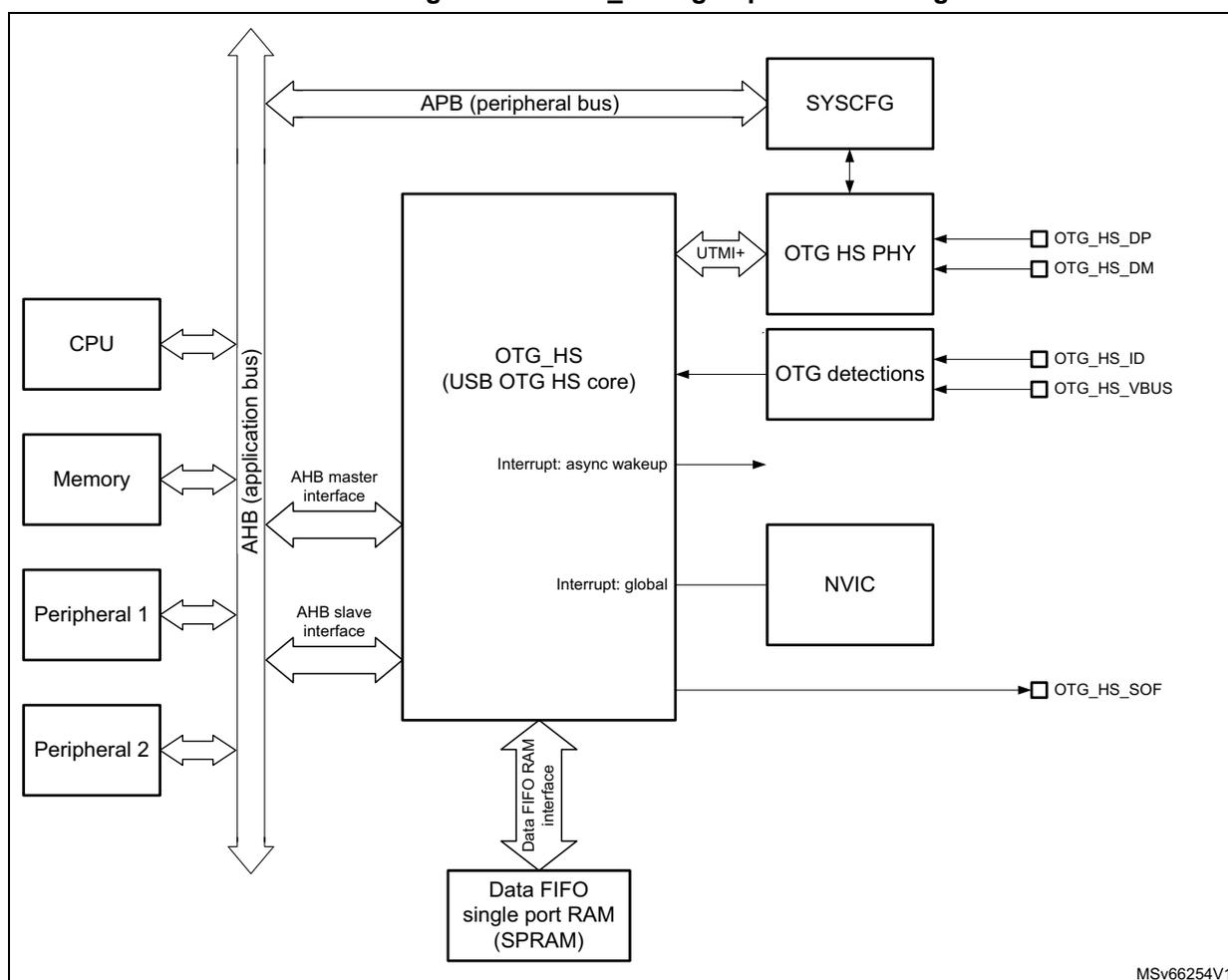
The block diagram illustrates the internal architecture of the OTG_HS (USB OTG HS core) and its connections to various system components:
- CPU, Memory, Peripheral 1, and Peripheral 2 are connected to the AHB (application bus) .
- The AHB (application bus) is connected to the OTG_HS (USB OTG HS core) via an AHB master interface and an AHB slave interface .
- The OTG_HS (USB OTG HS core) is connected to the SYSCFG block via the APB (peripheral bus) .
- The OTG_HS (USB OTG HS core) is connected to the OTG HS PHY block via the UTMI+ interface.
- The OTG HS PHY block is connected to the external pins OTG_HS_DP and OTG_HS_DM .
- The OTG_HS (USB OTG HS core) is connected to the OTG detections block, which is connected to the external pins OTG_HS_ID and OTG_HS_VBUS .
- The OTG_HS (USB OTG HS core) is connected to the NVIC block via Interrupt: async wakeup and Interrupt: global lines.
- The OTG_HS (USB OTG HS core) is connected to the Data FIFO single port RAM (SPRAM) block via the Data FIFO RAM interface .
- An external pin OTG_HS_SOF is connected to the OTG_HS (USB OTG HS core) .
MSV66254V1
73.4.2 OTG_HS pin and internal signals
Table 763. OTG_HS input/output pins
| Signal name | Signal type | Description |
|---|---|---|
| OTG_HS_DP | Digital input/output | USB OTG D+ line |
| OTG_HS_DM | Digital input/output | USB OTG D- line |
| OTG_HS_ID | Digital input | USB OTG ID |
| OTG_HS_VBUS | Analog input | USB OTG VBUS |
| OTG_HS_SOF | Digital output | USB OTG Start Of Frame (visibility) |
Table 764. OTG_HS input/output signals
| Signal name | Signal type | Description |
|---|---|---|
| usb_sof | Digital output | USB OTG start-of-frame event for on chip peripherals |
| usb_wkup | Digital output | USB OTG wake-up event output |
| usb_gbl_it | Digital output | USB OTG global interrupt |
73.4.3 OTG_HS core
The OTG_HS receives the 60 MHz clock from the reset and clock controller (RCC). This is typically generated in the PLL associated with the HS PHY and enabled in the RCC. This clock is used for driving the 60 MHz domain at high-speed (480 Mbit/s) and must be enabled prior to configuring the OTG core.
The CPU reads and writes from/to the OTG core registers through the AHB peripheral bus. It is informed of USB events through the single USB OTG interrupt line described in Section 73.12: OTG_HS interrupts .
The CPU submits data over the USB by writing 32-bit words to dedicated OTG locations (push registers). The data are then automatically stored into Tx-data FIFOs configured within the USB data RAM. There is one Tx FIFO push register for each in-endpoint (peripheral mode) or out-channel (host mode).
The CPU receives the data from the USB by reading 32-bit words from dedicated OTG addresses (pop registers). The data are then automatically retrieved from a shared Rx FIFO configured within the 4-Kbyte USB data RAM. There is one Rx FIFO pop register for each out-endpoint or in-channel.
The USB protocol layer is driven by the serial interface engine (SIE) and serialized over the USB by the transceiver module within the on-chip physical layer (PHY).
Caution: To guarantee a correct operation for the USB OTG_HS peripheral, the AHB frequency must be higher than 30 MHz.
73.4.4 OTG detections
Additionally the OTG_HS uses the following functions:
- • Integrated ID pull-up resistor used to sample the ID line for A/B device identification.
- • \( V_{BUS} \) sensing comparators with hysteresis used to detect \( V_{BUS} \) valid, A-B session valid and session-end voltage thresholds. They are used to detect valid startup and end-of-session conditions, and constantly monitor the \( V_{BUS} \) supply during USB operations.
73.4.5 High-speed OTG PHY connected to OTG_HS
Note: Refer to implementation table to determine if an HS PHY is embedded.
The USB OTG core includes an internal UTMI interface which is connected to the embedded HS PHY (see Section 73.4.1: OTG_HS block diagram ).
73.4.6 Battery charging detection
Support is available for the USB battery charging specification (v1.2).
The OTG_HS includes the necessary circuits to enable battery charging detection (portable device).
There is also a possibility to behave as a charging data port (the port advertises 1.5 A available on its VBUS pin).
Various fields control this functions and are implemented in register OTG_GCCFG.
73.5 OTG_HS dual role device (DRD)
Figure 919. OTG_HS A-B device connection
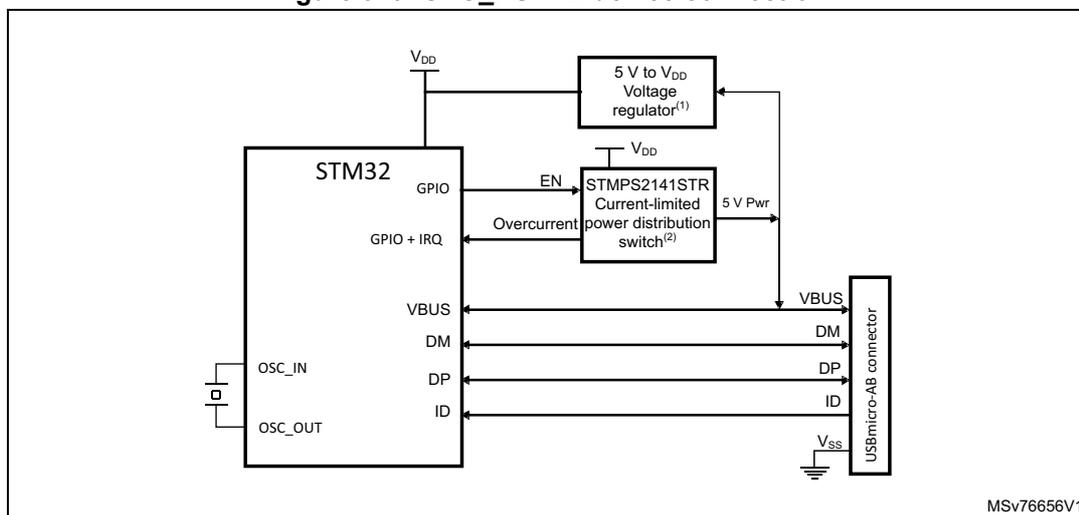
1. External voltage regulator only needed when building a VBUS powered device.
2. STMP2141STR needed only if the application has to support a VBUS powered device. A basic power switch can be used if 5 V are available on the application board.
73.5.1 ID line detection
The host or peripheral (the default) role is assumed depending on the ID input pin. The ID line status is determined on plugging in the USB cable, depending on whether a MicroA or MicroB plug is connected to the micro-AB receptacle.
- • If the B-side of the USB cable is connected with a floating ID wire, the integrated pull-up resistor detects a high ID level and the default peripheral role is confirmed. In this configuration the OTG_HS complies with the standard FSM described in section 4.2.4: ID pin of the On-the-Go specification Rev2.0, supplement to the USB2.0.
- • If the A-side of the USB cable is connected with a grounded ID, the OTG_HS issues an ID line status change interrupt (CIDSCHG bit in OTG_GINTSTS) for host software initialization, and automatically switches to the host role. In this configuration the OTG_HS complies with the standard FSM described by section 4.2.4: ID pin of the On-the-Go specification Rev2.0, supplement to the USB2.0.
73.6 OTG_HS as a USB peripheral
This section gives the functional description of the OTG_HS in the USB peripheral mode. The OTG_HS works as an USB peripheral in the following circumstances:
- • OTG B-Peripheral
- – OTG B-device default state if B-side of USB cable is plugged in
- • B-device
- – If the ID line is present, functional and connected to the B-side of the USB cable.
- • Peripheral only
- – The force device mode bit (FDMOD) in the Section 73.14.4: OTG USB configuration register (OTG_GUSBFCFG) is set to 1, forcing the OTG_HS core to work as an USB peripheral-only. In this case, the ID line is ignored even if it is present on the USB connector.
Note: To build a bus-powered device implementation in case of the B-device or peripheral-only configuration, an external regulator has to be added, that generates the necessary power-supply from \( V_{BUS} \) .
Figure 920. OTG_HS peripheral-only connection
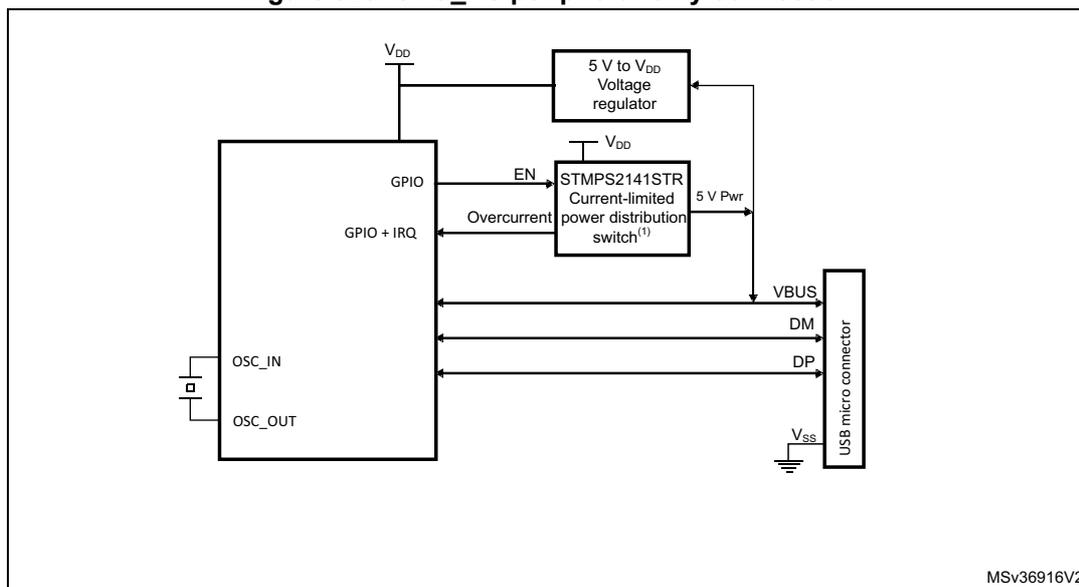
- 1. Use a regulator to build a bus-powered device.
73.6.1 Peripheral states
Powered state
The \( V_{BUS} \) input detects the B-session valid voltage by which the USB peripheral is allowed to enter the powered state (see USB2.0 section 9.1). The OTG_HS then automatically connects the DP pull-up resistor to signal full-speed device connection to the host and generates the session request interrupt (SRQINT bit in OTG_GINTSTS) to notify the powered state.
The \( V_{BUS} \) input also ensures that valid \( V_{BUS} \) levels are supplied by the host during USB operations. If a drop in \( V_{BUS} \) below B-session valid happens to be detected (for instance because of a power disturbance or if the host port has been switched off), the OTG_HS automatically disconnects and the session end detected (SEDET bit in OTG_GOTGINT) interrupt is generated to notify that the OTG_HS has exited the powered state.
In the powered state, the OTG_HS expects to receive some reset signaling from the host. No other USB operation is possible. When a reset signaling is received the reset detected interrupt (USBRST in OTG_GINTSTS) is generated. When the reset signaling is complete, the enumeration done interrupt (ENUMDNE bit in OTG_GINTSTS) is generated and the OTG_HS enters the Default state.
Soft disconnect
The powered state can be exited by software with the soft disconnect feature. The DP pull-up resistor is removed by setting the soft disconnect bit in the device control register (SDIS bit in OTG_DCTL), causing a device disconnect detection interrupt on the host side even though the USB cable was not really removed from the host port.
Default state
In the Default state the OTG_HS expects to receive a SET_ADDRESS command from the host. No other USB operation is possible. When a valid SET_ADDRESS command is
decoded on the USB, the application writes the corresponding number into the device address field in the device configuration register (DAD bit in OTG_DCFG). The OTG_HS then enters the address state and is ready to answer host transactions at the configured USB address.
Suspended state
The OTG_HS peripheral constantly monitors the USB activity. After counting 3 ms of USB idleness, the early suspend interrupt (ESUSP bit in OTG_GINTSTS) is issued, and confirmed 3 ms later, if appropriate, by the suspend interrupt (USBSUSP bit in OTG_GINTSTS). The device suspend bit is then automatically set in the device status register (SUSPSTS bit in OTG_DSTS) and the OTG_HS enters the suspended state.
The suspended state may optionally be exited by the device itself. In this case the application sets the remote wake-up signaling bit in the device control register (RWUSIG bit in OTG_DCTL) and clears it after 1 to 15 ms.
When a resume signaling is detected from the host, the resume interrupt (WKUPINT bit in OTG_GINTSTS) is generated and the device suspend bit is automatically cleared.
73.6.2 Peripheral endpoints
The OTG_HS core instantiates the following USB endpoints:
- • Control endpoint 0:
- – Bidirectional and handles control messages only
- – Separate set of registers to handle in and out transactions
- – Dedicated control (OTG_DIEPCTL0/OTG_DOEPCTL0), transfer configuration (OTG_DIEPTSIZ0/OTG_DOEPTSIZ0), and status-interrupt (OTG_DIEPINT0/OTG_DOEPINT0) registers. The available set of bits inside the control and transfer size registers slightly differs from that of other endpoints
- • eight IN endpoints
- – Each of them can be configured to support the isochronous, bulk or interrupt transfer type
- – Each of them has dedicated control (OTG_DIEPCTLx), transfer configuration (OTG_DIEPTSIZx), and status-interrupt (OTG_DIEPINTx) registers
- – The device IN endpoints common interrupt mask register (OTG_DIEPMSK) is available to enable/disable a single kind of endpoint interrupt source on all of the IN endpoints (EP0 included)
- – Support for incomplete isochronous IN transfer interrupt (IISOIXFR bit in OTG_GINTSTS), asserted when there is at least one isochronous IN endpoint on
which the transfer is not completed in the current frame. This interrupt is asserted along with the end of periodic frame interrupt (OTG_GINTSTS/EOPF).
- • eight OUT endpoints
- – Each of them can be configured to support the isochronous, bulk or interrupt transfer type
- – Each of them has a dedicated control (OTG_DOEPCTLx), transfer configuration (OTG_DOEPTSIZx) and status-interrupt (OTG_DOEPINTx) register
- – Device OUT endpoints common interrupt mask register (OTG_DOEPMSK) is available to enable/disable a single kind of endpoint interrupt source on all of the OUT endpoints (EP0 included)
- – Support for incomplete isochronous OUT transfer interrupt (INCOMPISOOUT bit in OTG_GINTSTS), asserted when there is at least one isochronous OUT endpoint on which the transfer is not completed in the current frame. This interrupt is asserted along with the end of periodic frame interrupt (OTG_GINTSTS/EOPF).
Endpoint control
- • The following endpoint controls are available to the application through the device endpoint-x IN/OUT control register (OTG_DIEPCTLx/OTG_DOEPCTLx):
- – endpoint enable/disable
- – endpoint activate in current configuration
- – program USB transfer type (isochronous, bulk, interrupt)
- – program supported packet size
- – program Tx FIFO number associated with the IN endpoint
- – program the expected or transmitted data0/data1 PID (bulk/interrupt only)
- – program the even/odd frame during which the transaction is received or transmitted (isochronous only)
- – optionally program the NAK bit to always negative-acknowledge the host regardless of the FIFO status
- – optionally program the STALL bit to always stall host tokens to that endpoint
- – optionally program the SNOOP mode for OUT endpoint not to check the CRC field of received data
Endpoint transfer
The device endpoint-x transfer size registers (OTG_DIEPTSIZx/OTG_DOEPTSIZx) allow the application to program the transfer size parameters and read the transfer status. Programming must be done before setting the endpoint enable bit in the endpoint control register. Once the endpoint is enabled, these fields are read-only as the OTG_HS core updates them with the current transfer status.
The following transfer parameters can be programmed:
- • transfer size in bytes
- • number of packets that constitute the overall transfer size
Endpoint status/interrupt
The device endpoint-x interrupt registers (OTG_DIEPINTx/OTG_DOEPINTx) indicate the status of an endpoint with respect to USB- and AHB-related events. The application must read these registers when the OUT endpoint interrupt bit or the IN endpoint interrupt bit in
the core interrupt register (OEPINT bit in OTG_GINTSTS or IEPINT bit in OTG_GINTSTS, respectively) is set. Before the application can read these registers, it must first read the device all endpoints interrupt (OTG_DAINT) register to get the exact endpoint number for the device endpoint-x interrupt register. The application must clear the appropriate bit in this register to clear the corresponding bits in the OTG_DAINT and OTG_GINTSTS registers
The peripheral core provides the following status checks and interrupt generation:
- • transfer completed interrupt, indicating that data transfer was completed on both the application (AHB) and USB sides
- • setup stage has been done (control-out only)
- • associated transmit FIFO is half or completely empty (in endpoints)
- • NAK acknowledge has been transmitted to the host (isochronous-in only)
- • IN token received when Tx FIFO was empty (bulk-in/interrupt-in only)
- • Out token received when endpoint was not yet enabled
- • babble error condition has been detected
- • endpoint disable by application is effective
- • endpoint NAK by application is effective (isochronous-in only)
- • more than 3 back-to-back setup packets were received (control-out only)
- • timeout condition detected (control-in only)
- • isochronous out packet has been dropped, without generating an interrupt
73.7 OTG_HS as a USB host
This section gives the functional description of the OTG_HS in the USB host mode. The OTG_HS works as a USB host in the following circumstances:
Automatic host mode direct from ID pin:
The ID pin is not always available, refer to product datasheet for available pins.
- • Use cases:
- – Micro connector: A-Device with a Micro-A plug inserted, and connector ID pin connected to the STM32 ID pin which is then detected in a low state.
- • Note that the integrated pull-down resistors are automatically set on the DP/DM lines.
Manual forcing of host mode when not possible via ID pin:
The force host mode bit (FHMOD) in the OTG USB configuration register (OTG_GUSBCFG) forces the OTG_HS core to work as a USB host-only when required.
- • Use cases:
- – Standard-A connector which always implies Host mode.
- – Micro connector, so ID present on connector, but ID pin not available in pinout, at A-plug insertion (detected by another means, for example: GPIO).
- – A Type-C connector, when host functionality is determined at cable attachment or via power delivery messages.
- • Note that the integrated pull-down resistors are set on the DP/DM lines by setting bit FORCEHOSTPD.
Note: On-chip 5 V \( V_{BUS} \) generation is not supported. For this reason, a charge pump or, if 5 V are available on the application board, a basic power switch must be added externally to drive
the 5 V \( V_{BUS} \) line. The external charge pump can be driven by any GPIO output. This is required for the OTG A-host, A-device and host-only configurations.
Figure 921. OTG_HS host-only connection
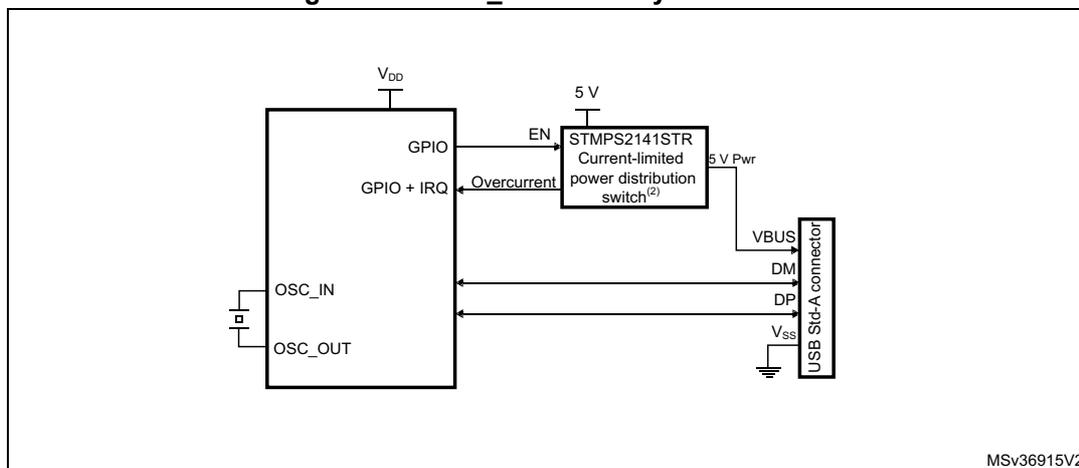
- 1. \( V_{DD} \) range is between 2 V and 3.6 V.
73.7.1 USB host states
Host port power
On-chip 5 V \( V_{BUS} \) generation is not supported. For this reason, a charge pump or, if 5 V are available on the application board, a basic power switch, must be added externally to drive the 5 V \( V_{BUS} \) line. The external charge pump can be driven by any GPIO output or via an I 2 C interface connected to an external PMIC (power management IC). When the application decides to power on \( V_{BUS} \) , it must also set the port power bit in the host port control and status register (PPWR bit in OTG_HPRT).
\( V_{BUS} \) valid
In Host mode, the VBUS sensing pin does not need to be connected to \( V_{BUS} \) .
The charge pump overcurrent flag can also be used to prevent electrical damage. Connect the overcurrent flag output from the charge pump to any GPIO input and configure it to generate a port interrupt on the active level. The overcurrent ISR must promptly disable the \( V_{BUS} \) generation and clear the port power bit.
Host detection of a peripheral connection
USB peripherals or B-device are detected as soon as they are connected. The OTG_HS core issues a host port interrupt triggered by the device connected bit in the host port control and status (PCDET bit in OTG_HPRT).
Host detection of peripheral a disconnection
The peripheral disconnection event triggers the disconnect detected interrupt (DISCINT bit in OTG_GINTSTS).
Host enumeration
After detecting a peripheral connection the host must start the enumeration process by sending USB reset and configuration commands to the new peripheral.
The application drives a USB reset signaling (single-ended zero) over the USB by keeping the port reset bit set in the host port control and status register (PRST bit in OTG_HPRT) for a minimum of 10 ms and a maximum of 20 ms. The application takes care of the timing count and then of clearing the port reset bit.
Once the USB reset sequence has completed, the host port interrupt is triggered by the port enable/disable change bit (PENCHNG bit in OTG_HPRT). This informs the application that the speed of the enumerated peripheral can be read from the port speed field in the host port control and status register (PSPD bit in OTG_HPRT) and that the host is starting to drive SOFs (FS) or Keep alives (LS). The host is now ready to complete the peripheral enumeration by sending peripheral configuration commands.
Host suspend
The application decides to suspend the USB activity by setting the port suspend bit in the host port control and status register (PSUSP bit in OTG_HPRT). The OTG_HS core stops sending SOFs and enters the suspended state.
The suspended state can be optionally exited on the remote device's initiative (remote wake-up). In this case the remote wake-up interrupt (WKUPINT bit in OTG_GINTSTS) is generated upon detection of a remote wake-up signaling, the port resume bit in the host port control and status register (PRES bit in OTG_HPRT) self-sets, and resume signaling is automatically driven over the USB. The application must time the resume window and then clear the port resume bit to exit the suspended state and restart the SOF.
If the suspended state is exited on the host initiative, the application must set the port resume bit to start resume signaling on the host port, time the resume window and finally clear the port resume bit.
73.7.2 Host channels
The OTG_HS core instantiates 16 host channels. Each host channel supports an USB host transfer (USB pipe). The host is not able to support more than 16 transfer requests at the same time. If more than 16 transfer requests are pending from the application, the host controller driver (HCD) must re-allocate channels when they become available from previous duty, that is, after receiving the transfer completed and channel halted interrupts.
Each host channel can be configured to support in/out and any type of periodic/nonperiodic transaction. Each host channel makes use of dedicated control (OTG_HCCHARx), transfer configuration (OTG_HCTSIZx) and status/interrupt (OTG_HCINTx) registers with associated mask (OTG_HCINTMSKx) registers.
Host channel control
- • The following host channel controls are available to the application through the host channel-x characteristics register (OTG_HCCHARx):
- – Channel enable/disable
- – Program the HS/FS/LS speed of target USB peripheral
- – Program the address of target USB peripheral
- – Program the endpoint number of target USB peripheral
- – Program the transfer IN/OUT direction
- – Program the USB transfer type (control, bulk, interrupt, isochronous)
- – Program the maximum packet size (MPS)
- – Program the periodic transfer to be executed during odd/even frames
Host channel transfer
The host channel transfer size registers (OTG_HCTSIZx) allow the application to program the transfer size parameters, and read the transfer status. Programming must be done before setting the channel enable bit in the host channel characteristics register. Once the endpoint is enabled the packet count field is read-only as the OTG_HS core updates it according to the current transfer status.
- • The following transfer parameters can be programmed:
- – transfer size in bytes
- – number of packets making up the overall transfer size
- – initial data PID
Host channel status/interrupt
The host channel-x interrupt register (OTG_HCINTx) indicates the status of an endpoint with respect to USB- and AHB-related events. The application must read these registers when the host channels interrupt bit in the core interrupt register (HCINT bit in OTG_GINTSTS) is set. Before the application can read these registers, it must first read the host all channels interrupt (OTG_HAINT) register to get the exact channel number for the host channel-x interrupt register. The application must clear the appropriate bit in this register to clear the corresponding bits in the OTG_HAINT and OTG_GINTSTS registers.
The mask bits for each interrupt source of each channel are also available in the OTG_HCINTMSKx register.
- • The host core provides the following status checks and interrupt generation:
- – Transfer completed interrupt, indicating that the data transfer is complete on both the application (AHB) and USB sides
- – Channel has stopped due to transfer completed, USB transaction error or disable command from the application
- – Associated transmit FIFO is half or completely empty (IN endpoints)
- – ACK response received
- – NAK response received
- – STALL response received
- – USB transaction error due to CRC failure, timeout, bit stuff error, false EOP
- – Babble error
- – frame overrun
- – data toggle error
73.7.3 Host scheduler
The host core features a built-in hardware scheduler which is able to autonomously re-order and manage the USB transaction requests posted by the application. At the beginning of each frame the host executes the periodic (isochronous and interrupt) transactions first, followed by the nonperiodic (control and bulk) transactions to achieve the higher level of priority granted to the isochronous and interrupt transfer types by the USB specification.
The host processes the USB transactions through request queues (one for periodic and one for nonperiodic). Each request queue can hold up to 8 entries. Each entry represents a pending transaction request from the application, and holds the IN or OUT channel number along with other information to perform a transaction on the USB. The order in which the requests are written to the queue determines the sequence of the transactions on the USB interface.
At the beginning of each frame, the host processes the periodic request queue first, followed by the nonperiodic request queue. The host issues an incomplete periodic transfer interrupt (IPXFR bit in OTG_GINTSTS) if an isochronous or interrupt transaction scheduled for the current frame is still pending at the end of the current frame. The OTG_HS core is fully responsible for the management of the periodic and nonperiodic request queues. The periodic transmit FIFO and queue status register (OTG_HPTXSTS) and nonperiodic transmit FIFO and queue status register (OTG_HNPTXSTS) are read-only registers which can be used by the application to read the status of each request queue. They contain:
- • The number of free entries currently available in the periodic (nonperiodic) request queue (8 max)
- • Free space currently available in the periodic (nonperiodic) Tx FIFO (out-transactions)
- • IN/OUT token, host channel number and other status information.
As request queues can hold a maximum of eight entries each, the application can push to schedule host transactions in advance with respect to the moment they physically reach the SB for a maximum of eight pending periodic transactions plus 8 pending non-periodic transactions.
To post a transaction request to the host scheduler (queue) the application must check that there is at least 1 entry available in the periodic (nonperiodic) request queue by reading the
PTXQSAV bits in the OTG_HNPTXSTS register or NPTQXSAV bits in the OTG_HNPTXSTS register.
73.8 OTG_HS SOF trigger
Figure 922. SOF connectivity (SOF trigger output to TIM and ITR1 connection)
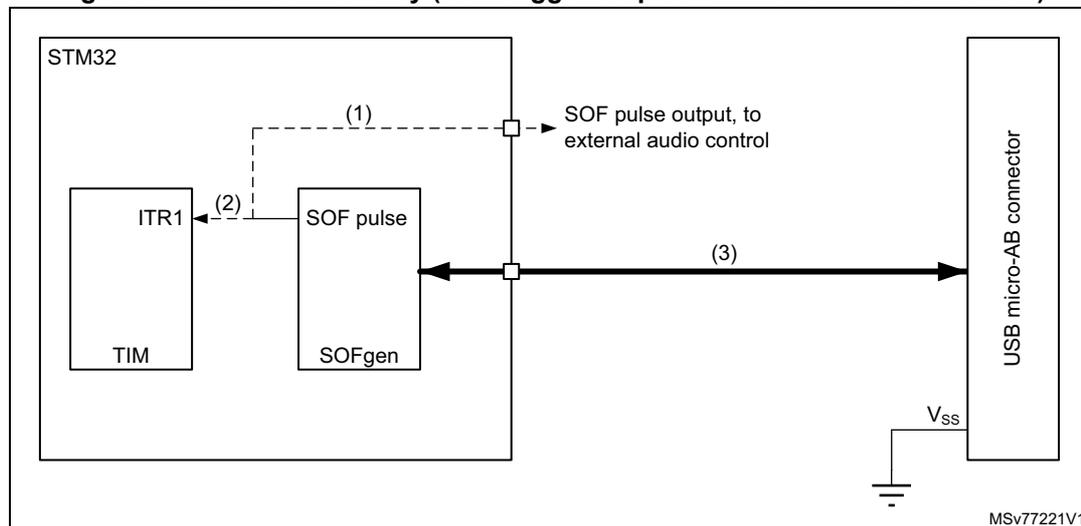
The diagram illustrates the internal architecture of the STM32 microcontroller for SOF connectivity. It shows three main components: the STM32 core, the TIM (Timer) block, and the SOFgen (SOF generator) block. The connections are as follows:
- (1) A dashed line representing the SOF pulse output from the STM32 core to an external audio control.
- (2) A solid line representing the SOF pulse output from the SOFgen block to the ITR1 (Input Trigger) of the TIM block.
- (3) A solid line representing the SOF pulse input from the USB micro-AB connector to the SOFgen block.
The USB micro-AB connector is shown with a V SS pin connected to ground.
- 1. SOF pulse output is available on this product.
- 2. SOF timer connection is available on this product.
- 3. See Table 763: OTG_HS input/output pins for full pin list.
The OTG_HS core provides means to monitor, track and configure SOF framing in the host and peripheral, as well as an SOF pulse output connectivity feature.
Such utilities are especially useful for adaptive audio clock generation techniques, where the audio peripheral needs to synchronize to the isochronous stream provided by the PC, or the host needs to trim its framing rate according to the requirements of the audio peripheral.
73.8.1 Host SOFs
In host mode the number of PHY clocks occurring between the generation of two consecutive SOF (HS/FS) or Keep-alive (LS) tokens is programmable in the host frame interval register (HFIR), thus providing application control over the SOF framing period. An interrupt is generated at any start of frame (SOF bit in OTG_GINTSTS). The current frame number and the time remaining until the next SOF are tracked in the host frame number register (HFNUM).
A SOF pulse signal, is generated at any SOF starting token and with a width of 20 HCLK cycles. The SOF pulse is also internally connected to the input trigger of the timer, so that the input capture feature, the output compare feature and the timer can be triggered by the SOF pulse.
73.8.2 Peripheral SOFs
In device mode, the start of frame interrupt is generated each time an SOF token is received on the USB (SOF bit in OTG_GINTSTS). The corresponding frame number can be read from the device status register (FNSOF bit in OTG_DSTS). A SOF pulse signal with a width
of 20 HCLK cycles is also generated. The SOF pulse signal is also internally connected to the TIM input trigger, so that the input capture feature, the output compare feature and the timer can be triggered by the SOF pulse.
The end of periodic frame interrupt (OTG_GINTSTS/EOPF) is used to notify the application when 80%, 85%, 90% or 95% of the time frame interval elapsed depending on the periodic frame interval field in the device configuration register (PFIVL bit in OTG_DCFG). This feature can be used to determine if all of the isochronous traffic for that frame is complete.
73.9 OTG_HS low-power modes
Table 765 below defines the STM32 low power modes and their compatibility with the OTG.
Table 765. Compatibility of STM32 low power modes with the OTG
| Mode | Description | USB compatibility |
|---|---|---|
| Run | MCU fully active | Required when USB not in suspend state. |
| Sleep | USB suspend exit causes the device to exit Sleep mode. Peripheral registers content is kept. | Available while USB is in suspend state. |
| Stop | USB suspend exit causes the device to exit Stop mode. Peripheral registers content is kept (1) . | Available while USB is in suspend state. |
| Standby | Powered-down. The peripheral must be reinitialized after exiting Standby mode. | Not compatible with USB applications. |
- 1. Within Stop mode there are different possible settings. Some restrictions may also exist, refer to Section 10: Power control (PWR) to understand which (if any) restrictions apply when using OTG.
The following bits and procedures reduce power consumption.
The power consumption of the OTG PHY is controlled by the following bit in the general core configuration register:
- •
\(
V_{BUS}
\)
detection enable (OTG_GCCFG/VBDEN)
It switches on/off the \( V_{BUS} \) sensing comparators associated with OTG operations
Power reduction techniques are available while in the USB suspended state, when the USB session is not yet valid or the device is disconnected.
- • Stop PHY clock (STPPCLK bit in OTG_PCGCTL)
When setting the stop PHY clock bit in the clock gating control register, most of the transceiver is disabled, and only the part in charge of detecting the asynchronous resume or remote wake-up event is kept alive. - • Gate HCLK (GATEHCLK bit in OTG_PCGCTL)
When setting the Gate HCLK bit in the clock gating control register, most of the system clock domain internal to the OTG_HS core is switched off by clock gating. Only the register read and write interface is kept alive. The dynamic power consumption due to the USB clock switching activity is cut even if the system clock is kept running by the application for other purposes. - • USB system stop
When the OTG_HS is in the USB suspended state, the application may decide to drastically reduce the overall power consumption by a complete shut down of all the
clock sources in the system. USB System Stop is activated by first setting the Stop PHY clock bit and then configuring the system deep sleep mode in the power control system module (PWR).
The OTG_HS core automatically reactivates both system and USB clocks by asynchronous detection of remote wake-up (as an host) or resume (as a device) signaling on the USB.
To save dynamic power, the USB data FIFO is clocked only when accessed by the OTG_HS core.
73.10 OTG_HS Dynamic update of the OTG_HFIR register
The USB core embeds a dynamic trimming capability of micro-SOF framing period in host mode allowing to synchronize an external device with the micro-SOF frames.
When the OTG_HFIR register is changed within a current micro-SOF frame, the SOF period correction is applied in the next frame as described in Figure 923 .
For a dynamic update, it is required to set RLDCTRL=1.
Figure 923. Updating OTG_HFIR dynamically (RLDCTRL = 1)
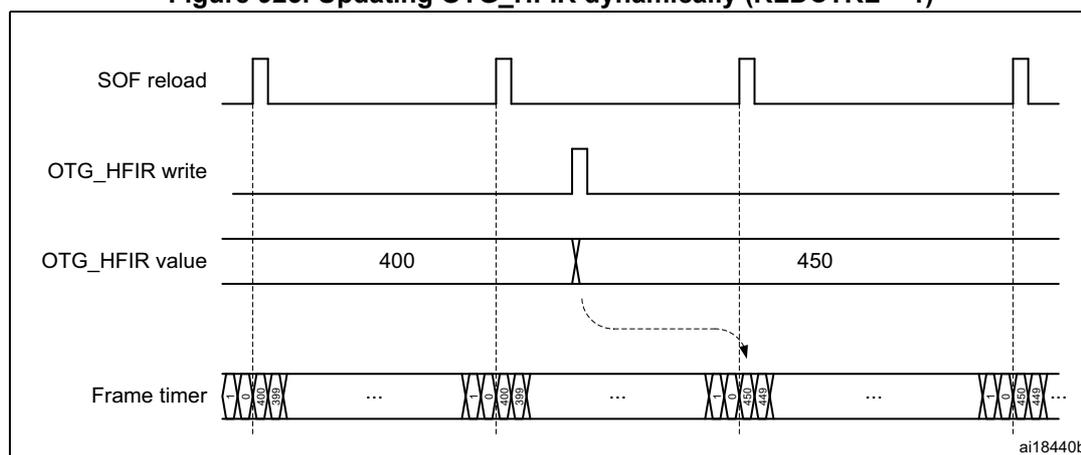
The figure is a timing diagram illustrating the dynamic update of the OTG_HFIR register. It consists of four horizontal signal lines. The top line, 'SOF reload', shows periodic pulses. The second line, 'OTG_HFIR write', shows a pulse that occurs during a SOF reload. The third line, 'OTG_HFIR value', shows a change from 400 to 450. The bottom line, 'Frame timer', shows a series of pulses, with the period between pulses decreasing after the OTG_HFIR value change. A dashed arrow indicates the transition from the old value (400) to the new value (450) in the OTG_HFIR register. The diagram is labeled ai18440b.
73.11 OTG_HS data FIFOs
The USB system features 4 Kbytes of dedicated RAM with a sophisticated FIFO control mechanism. The packet FIFO controller module in the OTG_HS core organizes RAM space into Tx FIFOs into which the application pushes the data to be temporarily stored before the USB transmission, and into a single Rx FIFO where the data received from the USB are temporarily stored before retrieval (popped) by the application. The number of instructed FIFOs and how these are organized inside the RAM depends on the device's role. In peripheral mode an additional Tx FIFO is instructed for each active IN endpoint. Any FIFO size is software configured to better meet the application requirements.
73.11.1 Peripheral FIFO architecture
Figure 924. Device-mode FIFO address mapping and AHB FIFO access mapping
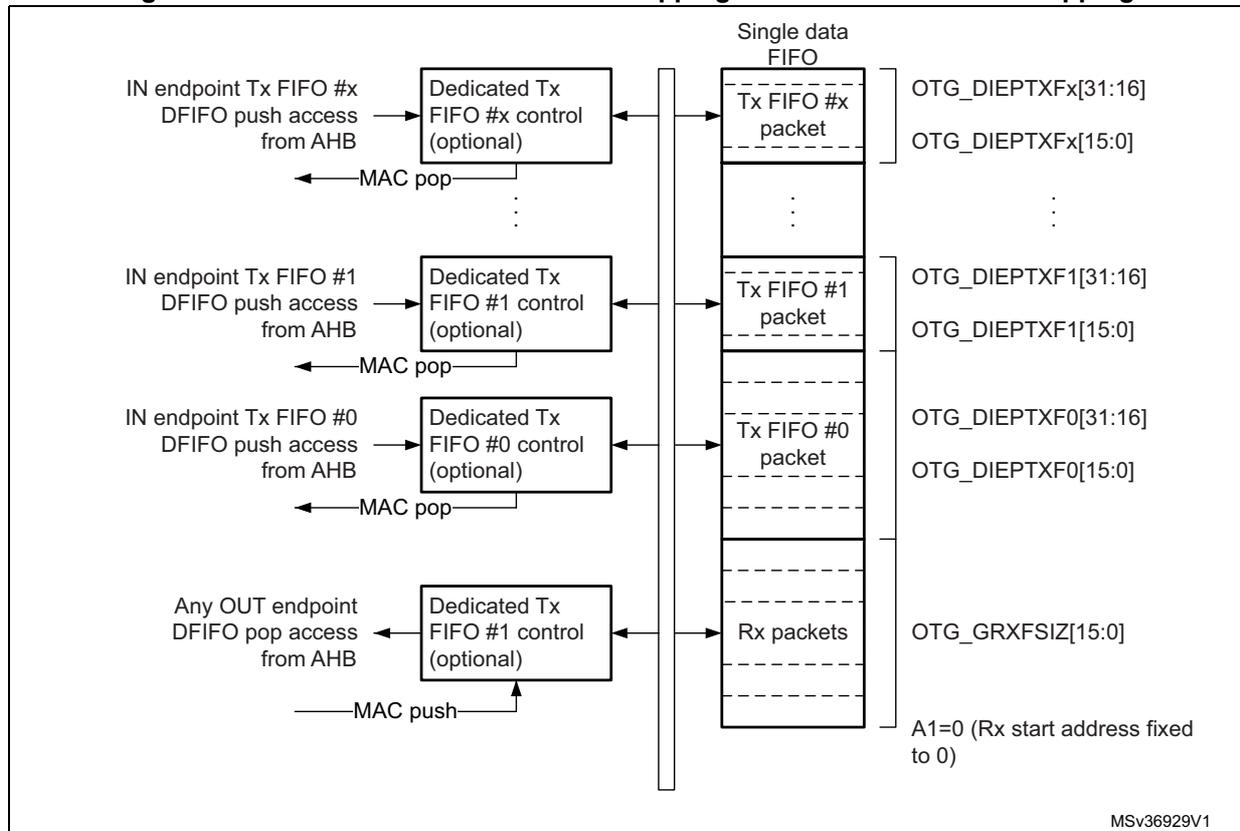
The diagram illustrates the FIFO architecture for device mode. On the left, IN endpoint Tx FIFOs are shown. IN endpoint Tx FIFO #x, IN endpoint Tx FIFO #1, and IN endpoint Tx FIFO #0 each have a 'Dedicated Tx FIFO #x control (optional)' block. These are accessed via 'DFIFO push access from AHB' and 'MAC pop'. On the right, a 'Single data FIFO' contains 'Tx FIFO #x packet', 'Tx FIFO #1 packet', and 'Tx FIFO #0 packet'. These map to OTG registers: OTG_DIEPTXFx[31:16], OTG_DIEPTXFx[15:0], OTG_DIEPTXF1[31:16], OTG_DIEPTXF1[15:0], OTG_DIEPTXF0[31:16], and OTG_DIEPTXF0[15:0]. Below the Tx FIFOs is a section for 'Rx packets' which maps to OTG_GRXFSIZ[15:0]. This section is accessed via 'Dedicated Tx FIFO #1 control (optional)' with 'DFIFO pop access from AHB' and 'MAC push'. A note indicates 'A1=0 (Rx start address fixed to 0)'. The diagram is labeled MSv36929V1.
Peripheral Rx FIFO
The OTG peripheral uses a single receive FIFO that receives the data directed to all OUT endpoints. Received packets are stacked back-to-back until free space is available in the Rx FIFO. The status of the received packet (which contains the OUT endpoint destination number, the byte count, the data PID and the validity of the received data) is also stored by the core on top of the data payload. When no more space is available, host transactions are NACKed and an interrupt is received on the addressed endpoint. The size of the receive FIFO is configured in the receive FIFO size register (OTG_GRXFSIZ).
The single receive FIFO architecture makes it more efficient for the USB peripheral to fill in the receive RAM buffer:
- • All OUT endpoints share the same RAM buffer (shared FIFO)
- • The OTG_HS core can fill in the receive FIFO up to the limit for any host sequence of OUT tokens
The application keeps receiving the Rx FIFO non-empty interrupt (RXFLVL bit in OTG_GINTSTS) as long as there is at least one packet available for download. It reads the packet information from the receive status read and pop register (OTG_GRXSTSP) and finally pops data off the receive FIFO by reading from the endpoint-related pop address.
Peripheral Tx FIFOs
The core has a dedicated FIFO for each IN endpoint. The application configures FIFO sizes by writing the endpoint 0 transmit FIFO size register (OTG_DIEPTXF0) for IN endpoint0 and the device IN endpoint transmit FIFOx registers (OTG_DIEPTXFx) for IN endpoint-x.
73.11.2 Host FIFO architecture
Figure 925. Host-mode FIFO address mapping and AHB FIFO access mapping
![Diagram of Host-mode FIFO address mapping and AHB FIFO access mapping. It shows a 'Single data FIFO' divided into three sections: 'Periodic Tx packets', 'Non-periodic Tx packets', and 'Rx packets'. On the left, 'Any periodic channel DFIFO push access from AHB' connects to 'Periodic Tx FIFO control (optional)', which connects to the 'Periodic Tx packets' section. 'Any non-periodic channel DFIFO push access from AHB' connects to 'Non-periodic Tx FIFO control', which connects to the 'Non-periodic Tx packets' section. 'Any channel DFIFO pop access from AHB' connects to 'Rx FIFO control', which connects to the 'Rx packets' section. 'MAC pop' arrows point from the control blocks to the AHB access. 'MAC push' arrows point from the AHB access to the control blocks. On the right, size registers are listed: OTG_HPTXFSIZ[31:16] and OTG_HPTXFSIZ[15:0] for periodic tx, OTG_HNPTXFSIZ[31:16] and OTG_HNPTXFSIZ[15:0] for non-periodic tx, and OTG_GRXFSIZ[15:0] for rx. A note indicates 'Rx start address fixed to 0 A1=0'. The diagram is labeled MSv36930V1.](/RM0456-STM32U5/8b22adac436d3af06de9d2700b3e40bd_img.jpg)
Host Rx FIFO
The host uses one receiver FIFO for all periodic and nonperiodic transactions. The FIFO is used as a receive buffer to hold the received data (payload of the received packet) from the USB until it is transferred to the system memory. Packets received from any remote IN endpoint are stacked back-to-back until free space is available. The status of each received packet with the host channel destination, byte count, data PID and validity of the received data are also stored into the FIFO. The size of the receive FIFO is configured in the receive FIFO size register (OTG_GRXFSIZ).
The single receive FIFO architecture makes it highly efficient for the USB host to fill in the receive data buffer:
- • All IN configured host channels share the same RAM buffer (shared FIFO)
- • The OTG_HS core can fill in the receive FIFO up to the limit for any sequence of IN tokens driven by the host software
The application receives the Rx FIFO not-empty interrupt as long as there is at least one packet available for download. It reads the packet information from the receive status read and pop register and finally pops the data off the receive FIFO.
Host Tx FIFOs
The host uses one transmit FIFO for all non-periodic (control and bulk) OUT transactions and one transmit FIFO for all periodic (isochronous and interrupt) OUT transactions. FIFOs are used as transmit buffers to hold the data (payload of the transmit packet) to be transmitted over the USB. The size of the periodic (nonperiodic) Tx FIFO is configured in the host periodic (nonperiodic) transmit FIFO size OTG_HPTXFSIZ / OTG_HNPTXFSIZ register.
The two Tx FIFO implementation derives from the higher priority granted to the periodic type of traffic over the USB frame. At the beginning of each frame, the built-in host scheduler processes the periodic request queue first, followed by the nonperiodic request queue.
The two transmit FIFO architecture provides the USB host with separate optimization for periodic and nonperiodic transmit data buffer management:
- • All host channels configured to support periodic (nonperiodic) transactions in the OUT direction share the same RAM buffer (shared FIFOs)
- • The OTG_HS core can fill in the periodic (nonperiodic) transmit FIFO up to the limit for any sequence of OUT tokens driven by the host software
The OTG_HS core issues the periodic Tx FIFO empty interrupt (PTXFE bit in OTG_GINTSTS) as long as the periodic Tx FIFO is half or completely empty, depending on the value of the periodic Tx FIFO empty level bit in the AHB configuration register (PTXFELVL bit in OTG_GAHBCFG). The application can push the transmission data in advance as long as free space is available in both the periodic Tx FIFO and the periodic request queue. The host periodic transmit FIFO and queue status register (OTG_HPTXSTS) can be read to know how much space is available in both.
OTG_HS core issues the non periodic Tx FIFO empty interrupt (NPTXFE bit in OTG_GINTSTS) as long as the nonperiodic Tx FIFO is half or completely empty depending on the non periodic Tx FIFO empty level bit in the AHB configuration register (TXFELVL bit in OTG_GAHBCFG). The application can push the transmission data as long as free space is available in both the nonperiodic Tx FIFO and nonperiodic request queue. The host nonperiodic transmit FIFO and queue status register (OTG_HNPTXSTS) can be read to know how much space is available in both.
73.11.3 FIFO RAM allocation
Device mode
Receive FIFO RAM allocation: the application must allocate RAM for SETUP packets:
- • 10 locations must be reserved in the receive FIFO to receive SETUP packets on control endpoint. The core does not use these locations, which are reserved for SETUP packets, to write any other data.
- • One location is to be allocated for Global OUT NAK.
- • Status information is written to the FIFO along with each received packet. Therefore, a minimum space of \( (\text{largest packet size} / 4) + 1 \) must be allocated to receive packets. If multiple isochronous endpoints are enabled, then at least two \( (\text{largest packet size} / 4) + 1 \) spaces must be allocated to receive back-to-back packets. Typically, two \( (\text{largest packet size} / 4) + 1 \) spaces are recommended so that when the previous packet is being transferred to the CPU, the USB can receive the subsequent packet.
- • Along with the last packet for each endpoint, transfer complete status information is also pushed to the FIFO. One location for each OUT endpoint is recommended.
Device RxFIFO =
\( (5 * \text{number of control endpoints} + 8) + ((\text{largest USB packet used} / 4) + 1 \text{ for status information}) + (2 * \text{number of OUT endpoints}) + 1 \text{ for Global NAK} \)
Example: The MPS is 1,024 bytes for a periodic USB packet and 512 bytes for a non-periodic USB packet. There are three OUT endpoints, three IN endpoints, one control endpoint, and three host channels.
Device RxFIFO = \( (5 * 1 + 8) + ((1,024 / 4) + 1) + (2 * 4) + 1 = 279 \)
Transmit FIFO RAM allocation:
the minimum RAM space required for each IN endpoint
Transmit FIFO is the maximum packet size for that particular IN endpoint.
Note: More space allocated in the transmit IN endpoint FIFO results in better performance on the USB.
Host mode
Receive FIFO RAM allocation:
Status information is written to the FIFO along with each received packet. Therefore, a minimum space of \( (\text{largest packet size} / 4) + 1 \) must be allocated to receive packets. If multiple isochronous channels are enabled, then at least two \( (\text{largest packet size} / 4) + 1 \) spaces must be allocated to receive back-to-back packets. Typically, two \( (\text{largest packet size} / 4) + 1 \) spaces are recommended so that when the previous packet is being transferred to the CPU, the USB can receive the subsequent packet.
Along with the last packet in the host channel, transfer complete status information is also pushed to the FIFO. So one location must be allocated for this.
Host RxFIFO = \( (\text{largest USB packet used} / 4) + 1 \text{ for status information} + 1 \text{ transfer complete} \)
Example: Host RxFIFO = \( ((1,024 / 4) + 1) + 1 = 258 \)
Transmit FIFO RAM allocation:
The minimum amount of RAM required for the host Non-periodic Transmit FIFO is the largest maximum packet size among all supported non-periodic OUT channels.
Typically, two largest packet sizes worth of space is recommended, so that when the current packet is under transfer to the USB, the CPU can get the next packet.
Non-Periodic TxFIFO = largest non-periodic USB packet used / 4
Example: Non-Periodic TxFIFO = \( (512 / 4) = 128 \)
The minimum amount of RAM required for host periodic Transmit FIFO is the largest maximum packet size out of all the supported periodic OUT channels. If there is at least one isochronous OUT endpoint, then the space must be at least two times the maximum packet size of that channel.
Host Periodic TxFIFO = largest periodic USB packet used / 4
Example: Host Periodic TxFIFO = \( (1,024 / 4) = 256 \)
Note: More space allocated in the Transmit Non-periodic FIFO results in better performance on the USB.
73.12 OTG_HS interrupts
When the OTG_HS controller is operating in one mode, either device or host, the application must not access registers from the other mode. If an illegal access occurs, a mode mismatch interrupt is generated and reflected in the core interrupt register (MMIS bit in the OTG_GINTSTS register). When the core switches from one mode to the other, the registers in the new mode of operation must be reprogrammed as they would be after a power-on reset.
Figure 926 shows the interrupt hierarchy.
Figure 926. Interrupt hierarchy
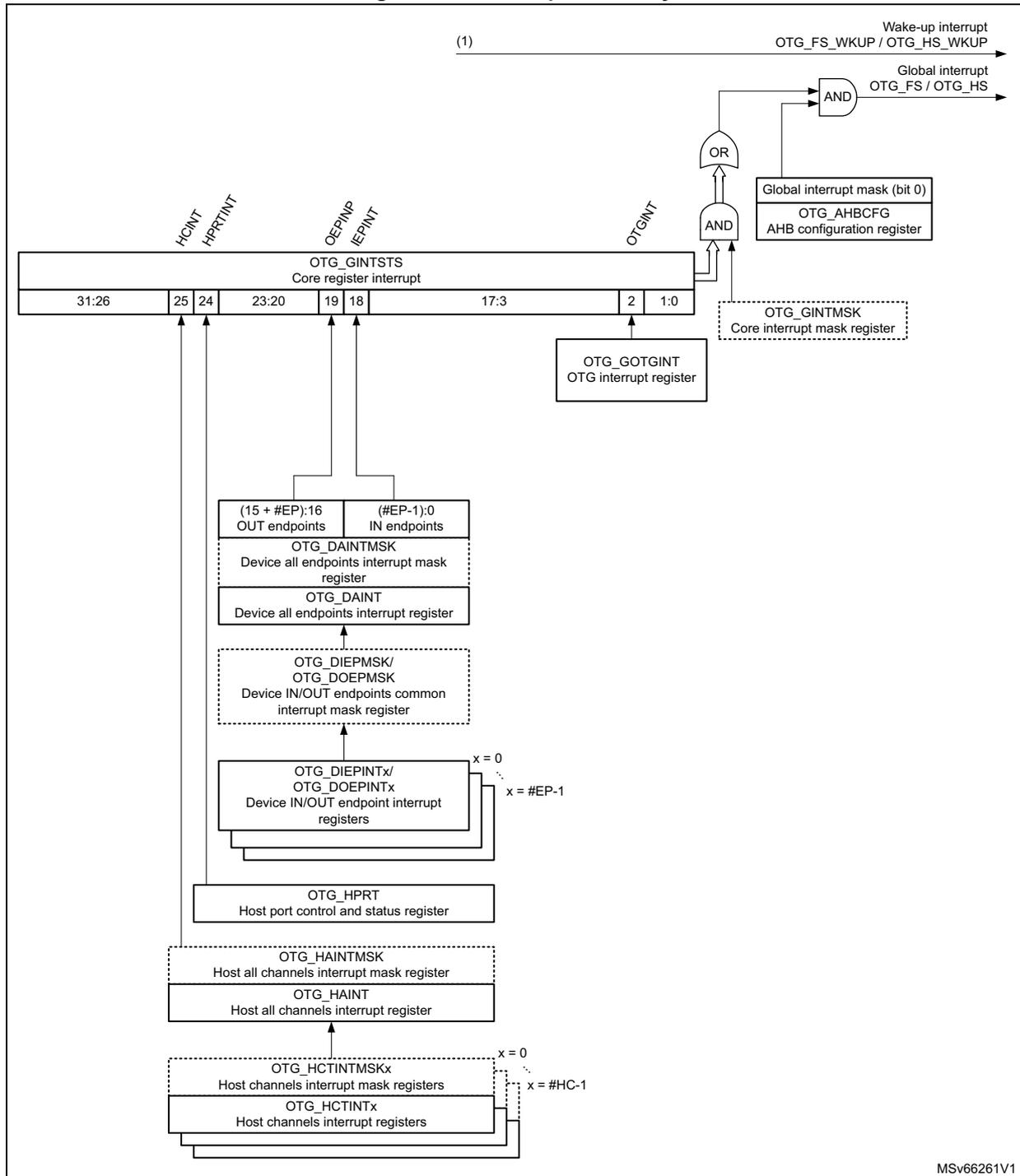
The diagram illustrates the interrupt hierarchy for the OTG_HS USB controller. At the top, the OTG_GINTSTS (Core register interrupt) is shown with its bit fields: 31:26, 25 (HCINT), 24 (HPRTINT), 23:20, 19 (OEPINT), 18 (IEPINT), 17:3, 2 (OTGINT), and 1:0. Below this, the hierarchy branches into Host and Device interrupt paths.
Host Path: The HCINT (bit 25) is generated from the OTG_HAINT (Host all channels interrupt register). The OTG_HAINT is derived from a stack of OTG_HCTINTx (Host channels interrupt registers) for \( x = 0 \) to \( x = \#HC-1 \) , which are masked by OTG_HCTINTMSKx (Host channels interrupt mask registers). These are further masked by the OTG_HAINTMSK (Host all channels interrupt mask register). The HPRTINT (bit 24) is generated from the OTG_HPRT (Host port control and status register).
Device Path: The OEPINT (bit 19) and IEPINT (bit 18) are generated from the OTG_DAINT (Device all endpoints interrupt register). The OTG_DAINT is derived from a stack of OTG_DIEPINTx/OTG_DOEPINTx (Device IN/OUT endpoint interrupt registers) for \( x = 0 \) to \( x = \#EP-1 \) , which are masked by OTG_DIEPMSK/OTG_DOEPMSK (Device IN/OUT endpoints common interrupt mask register). These are further masked by the OTG_DAINTMSK (Device all endpoints interrupt mask register).
OTG Path: The OTGINT (bit 2) is generated from the OTG_GOTINT (OTG interrupt register).
The signals from OTG_GINTSTS are ANDed with the OTG_GINTMSK (Core interrupt mask register) and then combined via an OR gate. This result is ANDed with the Global interrupt mask (bit 0) from the OTG_AHBCFG (AHB configuration register). The final output is the Global interrupt OTG_FS / OTG_HS . A separate Wake-up interrupt OTG_FS_WKUP / OTG_HS_WKUP is also shown.
1. OTG_HS_WKUP becomes active (high state) when resume condition occurs during L1 SLEEP or L2 SUSPEND states.
73.13 OTG_HS control and status registers
By reading from and writing to the control and status registers (CSRs) through the AHB slave interface, the application controls the OTG_HS controller. These registers are 32 bits wide, and the addresses are 32-bit block aligned. The OTG_HS registers must be accessed by words (32 bits).
CSRs are classified as follows:
- • Core global registers
- • Host-mode registers
- • Host global registers
- • Host port CSRs
- • Host channel-specific registers
- • Device-mode registers
- • Device global registers
- • Device endpoint-specific registers
- • Power and clock-gating registers
- • Data FIFO (DFIFO) access registers
Only the core global, power and clock-gating, data FIFO access, and host port control and status registers can be accessed in both host and device modes. When the OTG_HS controller is operating in one mode, either device or host, the application must not access registers from the other mode. If an illegal access occurs, a mode mismatch interrupt is generated and reflected in the core interrupt register (MMIS bit in the OTG_GINTSTS register). When the core switches from one mode to the other, the registers in the new mode of operation must be reprogrammed as they would be after a power-on reset.
73.13.1 CSR memory map
The host and device mode registers occupy different addresses. All registers are implemented in the AHB clock domain.
Global CSR map
These registers are available in both host and device modes.
Table 766. Core global control and status registers (CSRs)
| Acronym | Address offset | Register name |
|---|---|---|
| OTG_GOTGCTL | 0x000 | Section 73.14.1: OTG control and status register (OTG_GOTGCTL) |
| OTG_GOTGINT | 0x004 | Section 73.14.2: OTG interrupt register (OTG_GOTGINT) |
| OTG_GAHBCFG | 0x008 | Section 73.14.3: OTG AHB configuration register (OTG_GAHBCFG) |
| OTG_GUSBCFG | 0x00C | Section 73.14.4: OTG USB configuration register (OTG_GUSBCFG) |
| OTG_GRSTCTL | 0x010 | Section 73.14.5: OTG reset register (OTG_GRSTCTL) |
| OTG_GINTSTS | 0x014 | Section 73.14.6: OTG core interrupt register [alternate] (OTG_GINTSTS) Section 73.14.7: OTG core interrupt register [alternate] (OTG_GINTSTS) |
Table 766. Core global control and status registers (CSRs) (continued)
1. The general rule is to use OTG_HNPTXFSIZ for host mode and OTG_DIEPTXF0 for device mode.
Host-mode CSR map
These registers must be programmed every time the core changes to host mode.
Table 767. Host-mode control and status registers (CSRs)
| Acronym | Offset address | Register name |
|---|---|---|
| OTG_HCFG | 0x400 | Section 73.14.24: OTG host configuration register (OTG_HCFG) |
| OTG_HFIR | 0x404 | Section 73.14.25: OTG host frame interval register (OTG_HFIR) |
| OTG_HFNUM | 0x408 | Section 73.14.26: OTG host frame number/frame time remaining register (OTG_HFNUM) |
| OTG_HPTXSTS | 0x410 | Section 73.14.27: OTG Host periodic transmit FIFO/queue status register (OTG_HPTXSTS) |
Table 767. Host-mode control and status registers (CSRs) (continued)
| Acronym | Offset address | Register name |
|---|---|---|
| OTG_HAINT | 0x414 | Section 73.14.28: OTG host all channels interrupt register (OTG_HAINT) |
| OTG_HAINTMSK | 0x418 | Section 73.14.29: OTG host all channels interrupt mask register (OTG_HAINTMSK) |
| OTG_HPRT | 0x440 | Section 73.14.30: OTG host port control and status register (OTG_HPRT) |
| OTG_HCCHARx | 0x500 0x520 .... 0x6E0 | Section 73.14.31: OTG host channel x characteristics register (OTG_HCCHARx) |
| OTG_HCSPLTx | 0x504 0x524 .... 0x6E4 | Section 73.14.32: OTG host channel x split control register (OTG_HCSPLTx) |
| OTG_HCINTx | 0x508 0x528 .... 0x6E8 | Section 73.14.33: OTG host channel x interrupt register (OTG_HCINTx) |
| OTG_HCINTMSKx | 0x50C 0x52C .... 0x6EC | Section 73.14.34: OTG host channel x interrupt mask register (OTG_HCINTMSKx) |
| OTG_HCTSIZx | 0x510 0x530 .... 0x6F0 | Section 73.14.35: OTG host channel x transfer size register (OTG_HCTSIZx) |
| OTG_HCDMAx | 0x514 0x534 .... 0x6F4 | Section 73.14.36: OTG host channel x DMA address register(OTG_HCDMAx) |
Device-mode CSR map
These registers must be programmed every time the core changes to device mode.
Table 768. Device-mode control and status registers
| Acronym | Offset address | Register name |
|---|---|---|
| OTG_DCFG | 0x800 | Section 73.14.38: OTG device configuration register (OTG_DCFG) |
| OTG_DCTL | 0x804 | Section 73.14.39: OTG device control register (OTG_DCTL) |
| OTG_DSTS | 0x808 | Section 73.14.40: OTG device status register (OTG_DSTS) |
Table 768. Device-mode control and status registers (continued)
Table 768. Device-mode control and status registers (continued)
| Acronym | Offset address | Register name |
|---|---|---|
| OTG_DOEPTSIZ0 | 0xB10 | Section 73.14.56: OTG device OUT endpoint 0 transfer size register (OTG_DOEPTSIZ0) |
| OTG_DOEPDMAx | 0xB14 0xB34 ... 0xC14 | Section 73.14.57: OTG device OUT endpoint x DMA address register (OTG_DOEPDMAx) |
| OTG_DOEPCTLx | 0xB20 0xB40 ... 0xC00 | Section 73.14.58: OTG device OUT endpoint x control register [alternate] (OTG_DOEPCTLx) Section 73.14.59: OTG device OUT endpoint x control register [alternate] (OTG_DOEPCTLx) |
| OTG_DOEPTSIZx | 0xB30 0xB50 .. 0xBF0 | Section 73.14.60: OTG device OUT endpoint x transfer size register (OTG_DOEPTSIZx) |
Data FIFO (DFIFO) access register map
These registers, available in both host and device modes, are used to read or write the FIFO space for a specific endpoint or a channel, in a given direction. If a host channel is of type IN, the FIFO can only be read on the channel. Similarly, if a host channel is of type OUT, the FIFO can only be written on the channel.
Table 769. Data FIFO (DFIFO) access register map
| FIFO access register section | Offset address | Access |
|---|---|---|
| Device IN endpoint 0/Host OUT Channel 0: DFIFO write access Device OUT endpoint 0/Host IN Channel 0: DFIFO read access | 0x1000–0x1FFC | w r |
| Device IN endpoint 1/Host OUT Channel 1: DFIFO write access Device OUT endpoint 1/Host IN Channel 1: DFIFO read access | 0x2000–0x2FFC | w r |
| ... | ... | ... |
| Device IN endpoint x
(1)
/Host OUT Channel x
(1)
: DFIFO write access Device OUT endpoint x (1) /Host IN Channel x (1) : DFIFO read access | 0xX000–0xXFFC | w r |
1. Where x is 8 in device mode and 15 in host mode.
Power and clock gating CSR map
There is a single register for power and clock gating. It is available in both host and device modes.
Table 770. Power and clock gating control and status registers
| Acronym | Offset address | Register name |
|---|---|---|
| OTG_PCGCTL | 0xE00–0xE04 | Section 73.14.61: OTG power and clock gating control register (OTG_PCGCTL) |
73.14 OTG_HS registers
These registers are available in both host and device modes, and do not need to be reprogrammed when switching between these modes.
Bit values in the register descriptions are expressed in binary unless otherwise specified.
73.14.1 OTG control and status register (OTG_GOTGCTL)
The OTG_GOTGCTL register controls the behavior and reflects the status of the OTG function of the core.
Address offset: 0x000
Reset value: 0x0001 0000
| 31 | 30 | 29 | 28 | 27 | 26 | 25 | 24 | 23 | 22 | 21 | 20 | 19 | 18 | 17 | 16 |
|---|---|---|---|---|---|---|---|---|---|---|---|---|---|---|---|
| Res. | Res. | Res. | Res. | Res. | Res. | Res. | Res. | Res. | Res. | CUR MOD | OTG VER | BSVLD | ASVLD | DBCT | CID STS |
| r | rw | r | r | r | r | ||||||||||
| 15 | 14 | 13 | 12 | 11 | 10 | 9 | 8 | 7 | 6 | 5 | 4 | 3 | 2 | 1 | 0 |
| Res. | Res. | Res. | EHEN | Res. | Res. | Res. | Res. | BVALO VAL | BVALO EN | AVALO VAL | AVALO EN | VBVAL OVAL | VBVAL OEN | Res. | Res. |
| rw | rw | rw | rw | rw | rw | rw |
Bits 31:22 Reserved, must be kept at reset value.
Bit 21 CURMOD : Current mode of operation
Indicates the current mode (host or device).
0: Device mode
1: Host mode
Bit 20 OTGVER : OTG version
Selects the OTG revision.
0:OTG Version 1.3. OTG1.3 is obsolete for new product development.
1:OTG Version 2.0. In this version the core supports only data line pulsing for SRP.
Bit 19 BSVLD : B-session valid
Indicates the device mode transceiver status.
0: B-session is not valid.
1: B-session is valid.
In OTG mode, the user can use this bit to determine if the device is connected or disconnected.
Note: Only accessible in device mode.
Bit 18 ASVLD : A-session validIndicates the host mode transceiver status.
0: A-session is not valid
1: A-session is valid
Note: Only accessible in host mode.
Bit 17 DBCT : Long/short debounce timeIndicates the debounce time of a detected connection.
0: Long debounce time, used for physical connections (100 ms + 2.5 µs)
1: Short debounce time, used for soft connections (2.5 µs)
Note: Only accessible in host mode.
Bit 16 CIDSTS : Connector ID statusIndicates the connector ID status on a connect event.
0: The OTG_HS controller is in A-device mode
1: The OTG_HS controller is in B-device mode
Note: Accessible in both device and host modes.
Bits 15:13 Reserved, must be kept at reset value.
Bit 12 EHEN : Embedded host enableIt is used to select between OTG A device state machine and embedded host state machine.
0: OTG A device state machine is selected
1: Embedded host state machine is selected
Bits 11:8 Reserved, must be kept at reset value.
Bit 7 BVALOVAL : B-peripheral session valid override valueThis bit is used to set override value for Bvalid signal when BVALOEN bit is set.
0: Bvalid value is '0' when BVALOEN = 1
1: Bvalid value is '1' when BVALOEN = 1
Note: Only accessible in device mode.
Bit 6 BVALOEN : B-peripheral session valid override enableThis bit is used to enable/disable the software to override the Bvalid signal using the BVALOVAL bit.
0: Override is disabled and Bvalid signal from the respective PHY selected is used internally by the core
1: Internally Bvalid received from the PHY is overridden with BVALOVAL bit value
Note: Only accessible in device mode.
Bit 5 AVALOVAL : A-peripheral session valid override valueThis bit is used to set override value for Avalid signal when AVALOEN bit is set.
0: Avalid value is '0' when AVALOEN = 1
1: Avalid value is '1' when AVALOEN = 1
Note: Only accessible in host mode.
Bit 4 AVALOEN : A-peripheral session valid override enableThis bit is used to enable/disable the software to override the Avalid signal using the AVALOVAL bit.
0: Override is disabled and Avalid signal from the respective PHY selected is used internally by the core
1: Internally Avalid received from the PHY is overridden with AVALOVAL bit value
Note: Only accessible in host mode.
Bit 3 VBVALOVAL : V BUS valid override value
This bit is used to set override value for vbusvalid signal when VBVALOEN bit is set.
0: vbusvalid value is '0' when VBVALOEN = 1
1: vbusvalid value is '1' when VBVALOEN = 1
Note: Only accessible in host mode.
Bit 2 VBVALOEN : V BUS valid override enable
This bit is used to enable/disable the software to override the vbusvalid signal using the VBVALOVAL bit.
0: Override is disabled and vbusvalid signal from the respective PHY selected is used internally by the core
1: Internally vbusvalid received from the PHY is overridden with VBVALOVAL bit value
Note: Only accessible in host mode.
Bits 1:0 Reserved, must be kept at reset value.
73.14.2 OTG interrupt register (OTG_GOTGINT)
The application reads this register whenever there is an OTG interrupt and clears the bits in this register to clear the OTG interrupt.
Address offset: 0x004
Reset value: 0x0000 0000
| 31 | 30 | 29 | 28 | 27 | 26 | 25 | 24 | 23 | 22 | 21 | 20 | 19 | 18 | 17 | 16 |
|---|---|---|---|---|---|---|---|---|---|---|---|---|---|---|---|
| Res. | Res. | Res. | Res. | Res. | Res. | Res. | Res. | Res. | Res. | Res. | Res. | Res. | ADTO CHG | Res. | Res. |
| rc_w1 | |||||||||||||||
| 15 | 14 | 13 | 12 | 11 | 10 | 9 | 8 | 7 | 6 | 5 | 4 | 3 | 2 | 1 | 0 |
| Res. | Res. | Res. | Res. | Res. | Res. | Res. | Res. | Res. | Res. | Res. | Res. | Res. | SEDET | Res. | Res. |
| rc_w1 |
Bits 31:19 Reserved, must be kept at reset value.
Bit 18 ADTOCHG : A-device timeout change
The core sets this bit to indicate that the A-device has timed out while waiting for the B-device to connect.
Note: Accessible in both device and host modes.
Bits 17:3 Reserved, must be kept at reset value.
Bit 2 SEDET : Session end detected
The core sets this bit to indicate that the level of the voltage on V BUS is no longer valid for a B-Peripheral session when V BUS < 0.8 V.
Note: Accessible in both device and host modes.
Bits 1:0 Reserved, must be kept at reset value.
73.14.3 OTG AHB configuration register (OTG_GAHBCFG)
This register can be used to configure the core after power-on or a change in mode. This register mainly contains AHB system-related configuration parameters. Do not change this register after the initial programming. The application must program this register before starting any transactions on either the AHB or the USB.
Address offset: 0x008
Reset value: 0x0000 0000
| 31 | 30 | 29 | 28 | 27 | 26 | 25 | 24 | 23 | 22 | 21 | 20 | 19 | 18 | 17 | 16 |
|---|---|---|---|---|---|---|---|---|---|---|---|---|---|---|---|
| Res. | Res. | Res. | Res. | Res. | Res. | Res. | Res. | Res. | Res. | Res. | Res. | Res. | Res. | Res. | Res. |
| 15 | 14 | 13 | 12 | 11 | 10 | 9 | 8 | 7 | 6 | 5 | 4 | 3 | 2 | 1 | 0 |
| Res. | Res. | Res. | Res. | Res. | Res. | Res. | PTXFE LVL | TXFE LVL | Res. | DMAEN | HBSTLEN[3:0] | GINT MSK | |||
| rw | rw | rw | rw | rw | rw | rw | rw | ||||||||
Bits 31:9 Reserved, must be kept at reset value.
Bit 8 PTXFELVL : Periodic Tx FIFO empty level
Indicates when the periodic Tx FIFO empty interrupt bit in the OTG_GINTSTS register (PTXFE bit in OTG_GINTSTS) is triggered.
0: PTXFE (in OTG_GINTSTS) interrupt indicates that the Periodic Tx FIFO is half empty
1: PTXFE (in OTG_GINTSTS) interrupt indicates that the Periodic Tx FIFO is completely empty
Note: Only accessible in host mode.
Bit 7 TXFELVL : Tx FIFO empty level
Condition: device mode
This bit indicates when IN endpoint Transmit FIFO empty interrupt (TXFE in OTG_DIEPINTx) is triggered:
0: The TXFE (in OTG_DIEPINTx) interrupt indicates that the IN endpoint Tx FIFO is half empty
1: The TXFE (in OTG_DIEPINTx) interrupt indicates that the IN endpoint Tx FIFO is completely empty
Condition: host mode
This bit indicates when the nonperiodic Tx FIFO empty interrupt (NPTXFE bit in OTG_GINTSTS) is triggered:
0: The NPTXFE (in OTG_GINTSTS) interrupt indicates that the nonperiodic Tx FIFO is half empty
1: The NPTXFE (in OTG_GINTSTS) interrupt indicates that the nonperiodic Tx FIFO is completely empty
Bit 6 Reserved, must be kept at reset value.
Bit 5 DMAEN : DMA enabled
0: The core operates in slave mode
1: The core operates in DMA mode
Bits 4:1 HBSTLEN[3:0] : Burst length/type
0000 Single: Bus transactions use single 32 bit accesses (not recommended)
0001 INCR: Bus transactions use unspecified length accesses (not recommended, uses the INCR AHB bus command)
0011 INCR4: Bus transactions target 4x 32 bit accesses
0101 INCR8: Bus transactions target 8x 32 bit accesses
0111 INCR16: Bus transactions based on 16x 32 bit accesses
Others: Reserved
Bit 0 GINTMSK : Global interrupt mask
The application uses this bit to mask or unmask the interrupt line assertion to itself.
Irrespective of this bit setting, the interrupt status registers are updated by the core.
0: Mask the interrupt assertion to the application.
1: Unmask the interrupt assertion to the application.
Note: Accessible in both device and host modes.
73.14.4 OTG USB configuration register (OTG_GUSBCFG)
This register can be used to configure the core after power-on or a changing to host mode or device mode. It contains USB and USB-PHY related configuration parameters. The application must program this register before starting any transactions on either the AHB or the USB. Do not make changes to this register after the initial programming.
Address offset: 0x00C
Reset value: 0x0000 1400
| 31 | 30 | 29 | 28 | 27 | 26 | 25 | 24 | 23 | 22 | 21 | 20 | 19 | 18 | 17 | 16 |
|---|---|---|---|---|---|---|---|---|---|---|---|---|---|---|---|
| Res. | FD MOD | FH MOD | Res. | Res. | Res. | Res. | Res. | Res. | TSDPS | Res. | Res. | Res. | Res. | Res. | Res. |
| rw | rw | rw |
| 15 | 14 | 13 | 12 | 11 | 10 | 9 | 8 | 7 | 6 | 5 | 4 | 3 | 2 | 1 | 0 |
|---|---|---|---|---|---|---|---|---|---|---|---|---|---|---|---|
| PHYL PC | Res. | TRDT[3:0] | Res. | Res. | Res. | Res. | Res. | Res. | Res. | TOCAL[2:0] | |||||
| rw | rw | rw | rw | rw | rw | rw | rw | ||||||||
Bit 31 Reserved, must be kept at reset value.
Bit 30 FDMOD : Force device mode
Writing a 1 to this bit, forces the core to device mode irrespective of the OTG_ID input pin.
0: Normal mode
1: Force device mode
After setting the force bit, the application must wait at least 25 ms before the change takes effect.
Note: Accessible in both device and host modes.
Bit 29 FHMOD : Force host mode
Writing a 1 to this bit, forces the core to host mode irrespective of the OTG_ID input pin.
0: Normal mode
1: Force host mode
After setting the force bit, the application must wait at least 25 ms before the change takes effect.
Note: Accessible in both device and host modes.
Bits 28:26 Reserved, must be kept at reset value.
Bits 25:23 Reserved, must be kept at reset value.
Bit 22 TSDPS : TermSel DLine pulsing selection
This bit selects utmi_termselect to drive the data line pulse during SRP (session request protocol).
0: Data line pulsing using utmi_txvalid (default)
1: Data line pulsing using utmi_termsel
Bits 21:16 Reserved, must be kept at reset value.
Bit 15 PHYLPC : PHY Low-power clock select
This bit selects either 480 MHz or 48 MHz (low-power) PHY mode. In FS and LS modes, the PHY can usually operate on a 48 MHz clock to save power.
0: 480 MHz internal PLL clock
1: 48 MHz external clock
In 480 MHz mode, the UTMI interface operates at either 60 or 30 MHz, depending on whether the 8- or 16-bit data width is selected. In 48 MHz mode, the UTMI interface operates at 48 MHz in FS and LS modes.
Bit 14 Reserved, must be kept at reset value.
Bits 13:10 TRDT[3:0] : USB turnaround time
These bits allows to set the turnaround time in PHY clocks. They must be configured according to Table 771: TRDT values , depending on the application AHB frequency. Higher TRDT values allow stretching the USB response time to IN tokens in order to compensate for longer AHB read access latency to the data FIFO.
Note: Only accessible in device mode.
Bits 9:8 Reserved, must be kept at reset value.
Bit 7 Reserved, must be kept at reset value.
Bit 6 Reserved, must be kept at reset value.
Bit 5 Reserved, must be kept at reset value.
Bit 4 Reserved, must be kept at reset value.
Bit 3 Reserved, must be kept at reset value.
Bits 2:0 TOCAL[2:0] : FS timeout calibration
The number of PHY clocks that the application programs in this field is added to the full-speed interpacket timeout duration in the core to account for any additional delays introduced by the PHY. This can be required, because the delay introduced by the PHY in generating the line state condition can vary from one PHY to another.
The USB standard timeout value for full-speed operation is 16 to 18 (inclusive) bit times. The application must program this field based on the speed of enumeration. The number of bit times added per PHY clock is 0.25 bit times.
Table 771. TRDT values
| AHB frequency range (MHz) | TRDT minimum value | |
|---|---|---|
| Min | Max | |
| 30 | - | 0x9 |
73.14.5 OTG reset register (OTG_GRSTCTL)
The application uses this register to reset various hardware features inside the core.
Address offset: 0x010
Reset value: 0x8000 0000
| 31 | 30 | 29 | 28 | 27 | 26 | 25 | 24 | 23 | 22 | 21 | 20 | 19 | 18 | 17 | 16 |
|---|---|---|---|---|---|---|---|---|---|---|---|---|---|---|---|
| AHB IDL | DMAR EQ | Res. | Res. | Res. | Res. | Res. | Res. | Res. | Res. | Res. | Res. | Res. | Res. | Res. | Res. |
| r | r | ||||||||||||||
| 15 | 14 | 13 | 12 | 11 | 10 | 9 | 8 | 7 | 6 | 5 | 4 | 3 | 2 | 1 | 0 |
| Res. | Res. | Res. | Res. | Res. | TXFNUM[4:0] | TXF FLSH | RXF FLSH | Res. | FCRST | PSRST | CSRST | ||||
| rw | rw | rw | rw | rw | rs | rs | rs | rs | rs | ||||||
Bit 31 AHBIDL : AHB master idle
Indicates that the AHB master state machine is in the Idle condition.
Note: Accessible in both device and host modes.
Bit 30 DMAREQ : DMA request signal enabled
This bit indicates that the DMA request is in progress. Used for debug.
Bits 29:11 Reserved, must be kept at reset value.
Bits 10:6 TXFNUM[4:0] : Tx FIFO numberThis is the FIFO number that must be flushed using the Tx FIFO Flush bit. This field must not be changed until the core clears the Tx FIFO Flush bit.
Condition: host mode
00000: Non-periodic Tx FIFO flush
00001: Periodic Tx FIFO flush
10000: Flush all the transmit FIFOs
Condition: device mode
00000: Tx FIFO 0 flush
00001: Tx FIFO 1 flush
00010: Tx FIFO 2 flush
...
01111: Tx FIFO 15 flush
10000: Flush all the transmit FIFOs
Note: Accessible in both device and host modes.
Bit 5 TXFFLSH : Tx FIFO flushThis bit selectively flushes a single or all transmit FIFOs, but cannot do so if the core is in the midst of a transaction.
The application must write this bit only after checking that the core is neither writing to the Tx FIFO nor reading from the Tx FIFO. Verify using these registers:
Read—NAK Effective interrupt ensures the core is not reading from the FIFO
Write—AHBIDL bit in OTG_GRSTCTL ensures the core is not writing anything to the FIFO.
Flushing is normally recommended when FIFOs are reconfigured. FIFO flushing is also recommended during device endpoint disable. The application must wait until the core clears this bit before performing any operations. This bit takes eight clocks to clear, using the slower clock of phy_clk or hclk.
Note: Accessible in both device and host modes.
Bit 4 RXFFLSH : Rx FIFO flushThe application can flush the entire Rx FIFO using this bit, but must first ensure that the core is not in the middle of a transaction.
The application must only write to this bit after checking that the core is neither reading from the Rx FIFO nor writing to the Rx FIFO.
The application must wait until the bit is cleared before performing any other operations. This bit requires 8 clocks (slowest of PHY or AHB clock) to clear.
Note: Accessible in both device and host modes.
Bit 3 Reserved, must be kept at reset value.
Bit 2 FCRST: Host frame counter resetThe application writes this bit to reset the (micro-)frame number counter inside the core.
When the (micro-)frame counter is reset, the subsequent SOF sent out by the core has a frame number of 0.
When application writes '1' to the bit, it might not be able to read back the value as it gets cleared by the core in a few clock cycles.
Note: Only accessible in host mode.
Bit 1 PSRST: Partial soft resetResets the internal state machines but keeps the enumeration info. Can be used to recover some specific PHY errors.
Note: Accessible in both device and host modes.
Bit 0 CSRST: Core soft resetResets the HCLK and PHY clock domains as follows:
Clears the interrupts and all the CSR register bits except for the following bits:
- – GATEHCLK bit in OTG_PCGCCTL
- – STPPCLK bit in OTG_PCGCCTL
- – FSLSPCS bits in OTG_HCFG
- – DSPD bit in OTG_DCFG
- – SDIS bit in OTG_DCTL
- – OTG_GCCFG register
- – FDMOD bit in OTG_GUSBFG
- – FHMOD bit in OTG_GUSBFG
- – PHYLPC bit in OTG_GUSBFG
- – TSDPS bit in OTG_GUSBFG
All module state machines (except for the AHB slave unit) are reset to the Idle state, and all the transmit FIFOs and the receive FIFO are flushed.
Any transactions on the AHB Master are terminated as soon as possible, after completing the last data phase of an AHB transfer. Any transactions on the USB are terminated immediately.
The application can write to this bit any time it wants to reset the core. This is a self-clearing bit and the core clears this bit after all the necessary logic is reset in the core, which can take several clocks, depending on the current state of the core. Once this bit has been cleared, the software must wait at least 3 PHY clocks before accessing the PHY domain (synchronization delay). The software must also check that bit 31 in this register is set to 1 (AHB Master is Idle) before starting any operation.
Typically, the software reset is used during software development and also when the user dynamically changes the PHY selection bits in the above listed USB configuration registers. When the user changes the PHY, the corresponding clock for the PHY is selected and used in the PHY domain. Once a new clock is selected, the PHY domain has to be reset for proper operation.
Note: Accessible in both device and host modes.
73.14.6 OTG core interrupt register [alternate] (OTG_GINTSTS)
Valid for Host mode, see next section for Device mode.
This register also indicates the current mode. To clear the interrupt status bits of the rc_w1 type, the application must write 1 into the bit.
This register interrupts the application for system-level events in the current mode (device mode or host mode).
The FIFO status interrupts are read-only; once software reads from or writes to the FIFO while servicing these interrupts, FIFO interrupt conditions are cleared automatically.
The application must clear the OTG_GINTSTS register at initialization before unmasking the interrupt bit to avoid any interrupts generated prior to initialization.
Address offset: 0x014
Reset value: 0x0400 0020
| 31 | 30 | 29 | 28 | 27 | 26 | 25 | 24 | 23 | 22 | 21 | 20 | 19 | 18 | 17 | 16 |
|---|---|---|---|---|---|---|---|---|---|---|---|---|---|---|---|
| WKUP INT | SRQ INT | DISC INT | CIDS CHG | LPM INT | PTXFE | HCINT | HPRT INT | RST DET | DATAF SUSP | IPXFR | IISOI XFR | OEP INT | IEPINT | Res. | Res. |
| rc_w1 | rc_w1 | rc_w1 | rc_w1 | rc_w1 | r | r | r | rc_w1 | rc_w1 | rc_w1 | rc_w1 | r | r | ||
| 15 | 14 | 13 | 12 | 11 | 10 | 9 | 8 | 7 | 6 | 5 | 4 | 3 | 2 | 1 | 0 |
| EOPF | ISOO DRP | ENUM DNE | USB RST | USB SUSP | ESUSP | Res. | Res. | GO NAK EFF | GI NAK EFF | NPTXF E | RXF LVL | SOF | OTG INT | MMIS | CMOD |
| rc_w1 | rc_w1 | rc_w1 | rc_w1 | rc_w1 | rc_w1 | r | r | r | r | rc_w1 | r | rc_w1 | r |
Bit 31 WKUPINT : Resume/remote wake-up detected interrupt
Wake-up interrupt during suspend(L2) or LPM(L1) state.
- – During suspend(L2):
In device mode, this interrupt is asserted when a resume is detected on the USB. In host mode, this interrupt is asserted when a remote wake-up is detected on the USB.
- – During LPM(L1):
This interrupt is asserted for either host initiated resume or device initiated remote wake-up on USB.
Note: Accessible in both device and host modes.
Bit 30 SRQINT : Session request/new session detected interrupt
In host mode, this interrupt is asserted when a session request is detected from the device.
In device mode, this interrupt is asserted when V
BUS
is in the valid range for a B-peripheral device. Accessible in both device and host modes.
Bit 29 DISCINT : Disconnect detected interrupt
Asserted when a device disconnect is detected.
Note: Only accessible in host mode.
Bit 28 CIDSCHG : Connector ID status change
The core sets this bit when there is a change in connector ID status.
Note: Accessible in both device and host modes.
Bit 27 LPMINT: LPM interruptIn device mode, this interrupt is asserted when the device receives an LPM transaction and responds with a non-ERRORed response.
In host mode, this interrupt is asserted when the device responds to an LPM transaction with a non-ERRORed response or when the host core has completed LPM transactions for the programmed number of times (RETRYCNT bit in OTG_GLPMCFG).
This field is valid only if the LPMEN bit in OTG_GLPMCFG is set to 1.
Bit 26 PTXFE: Periodic Tx FIFO emptyAsserted when the periodic transmit FIFO is either half or completely empty and there is space for at least one entry to be written in the periodic request queue. The half or completely empty status is determined by the periodic Tx FIFO empty level bit in the OTG_GAHBCFG register (PTXFELVL bit in OTG_GAHBCFG).
Note: Only accessible in host mode.
Bit 25 HCINT: Host channels interruptThe core sets this bit to indicate that an interrupt is pending on one of the channels of the core (in host mode). The application must read the OTG_HAINT register to determine the exact number of the channel on which the interrupt occurred, and then read the corresponding OTG_HCINTx register to determine the exact cause of the interrupt. The application must clear the appropriate status bit in the OTG_HCINTx register to clear this bit.
Note: Only accessible in host mode.
Bit 24 HPRTINT: Host port interruptThe core sets this bit to indicate a change in port status of one of the OTG_HS controller ports in host mode. The application must read the OTG_HPRT register to determine the exact event that caused this interrupt. The application must clear the appropriate status bit in the OTG_HPRT register to clear this bit.
Note: Only accessible in host mode.
Bit 23 RSTDET: Reset detected interruptIn device mode, this interrupt is asserted when a reset is detected on the USB in partial power-down mode when the device is in suspend.
Note: Only accessible in device mode.
Bit 22 DATAFSUSP: Data fetch suspendedThis interrupt is valid only in DMA mode. This interrupt indicates that the core has stopped fetching data for IN endpoints due to the unavailability of TxFIFO space or request queue space. This interrupt is used by the application for an endpoint mismatch algorithm. For example, after detecting an endpoint mismatch, the application:
- – Sets a global nonperiodic IN NAK handshake
- – Disables IN endpoints
- – Flushes the FIFO
- – Determines the token sequence from the IN token sequence learning queue
- – Re-enables the endpoints
Clears the global nonperiodic IN NAK handshake If the global nonperiodic IN NAK is cleared, the core has not yet fetched data for the IN endpoint, and the IN token is received: the core generates an “IN token received when FIFO empty” interrupt. The OTG then sends a NAK response to the host. To avoid this scenario, the application can check the FetSusp interrupt in OTG_GINTSTS, which ensures that the FIFO is full before clearing a global NAK handshake. Alternatively, the application can mask the “IN token received when FIFO empty” interrupt when clearing a global IN NAK handshake.
Bit 21 IPXFR: Incomplete periodic transferIn host mode, the core sets this interrupt bit when there are incomplete periodic transactions still pending, which are scheduled for the current frame.
Bit 20 IISOIXFR: Incomplete isochronous IN transferThe core sets this interrupt to indicate that there is at least one isochronous IN endpoint on which the transfer is not completed in the current frame. This interrupt is asserted along with the End of periodic frame interrupt (EOPF) bit in this register.
Note: Only accessible in device mode.
Bit 19 OEPINT: OUT endpoint interruptThe core sets this bit to indicate that an interrupt is pending on one of the OUT endpoints of the core (in device mode). The application must read the OTG_DAINT register to determine the exact number of the OUT endpoint on which the interrupt occurred, and then read the corresponding OTG_DOEPINTx register to determine the exact cause of the interrupt. The application must clear the appropriate status bit in the corresponding OTG_DOEPINTx register to clear this bit.
Note: Only accessible in device mode.
Bit 18 IEPINT: IN endpoint interruptThe core sets this bit to indicate that an interrupt is pending on one of the IN endpoints of the core (in device mode). The application must read the OTG_DAINT register to determine the exact number of the IN endpoint on which the interrupt occurred, and then read the corresponding OTG_DIEPINTx register to determine the exact cause of the interrupt. The application must clear the appropriate status bit in the corresponding OTG_DIEPINTx register to clear this bit.
Note: Only accessible in device mode.
Bits 17:16 Reserved, must be kept at reset value.
Bit 15 EOPF: End of periodic frame interruptIndicates that the period specified in the periodic frame interval field of the OTG_DCFG register (PFIVL bit in OTG_DCFG) has been reached in the current frame.
Note: Only accessible in device mode.
Bit 14 ISOODRP: Isochronous OUT packet dropped interruptThe core sets this bit when it fails to write an isochronous OUT packet into the Rx FIFO because the Rx FIFO does not have enough space to accommodate a maximum size packet for the isochronous OUT endpoint.
Note: Only accessible in device mode.
Bit 13 ENUMDNE: Enumeration doneThe core sets this bit to indicate that speed enumeration is complete. The application must read the OTG_DSTS register to obtain the enumerated speed.
Note: Only accessible in device mode.
Bit 12 USBRST: USB resetThe core sets this bit to indicate that a reset is detected on the USB.
Note: Only accessible in device mode.
Bit 11 USBSUSP: USB suspendThe core sets this bit to indicate that a suspend was detected on the USB. The core enters the suspended state when there is no activity on the data lines for an extended period of time.
Note: Only accessible in device mode.
Bit 10 ESUSP: Early suspendThe core sets this bit to indicate that an Idle state has been detected on the USB for 3 ms.
Note: Only accessible in device mode.
Bits 9:8 Reserved, must be kept at reset value.
Bit 7 GONAKEFF: Global OUT NAK effectiveIndicates that the Set global OUT NAK bit in the OTG_DCTL register (SGONAK bit in OTG_DCTL), set by the application, has taken effect in the core. This bit can be cleared by writing the Clear global OUT NAK bit in the OTG_DCTL register (CGONAK bit in OTG_DCTL).
Note: Only accessible in device mode.
Bit 6 GINAKEFF: Global IN non-periodic NAK effectiveIndicates that the Set global non-periodic IN NAK bit in the OTG_DCTL register (SGINAK bit in OTG_DCTL), set by the application, has taken effect in the core. That is, the core has sampled the Global IN NAK bit set by the application. This bit can be cleared by clearing the Clear global non-periodic IN NAK bit in the OTG_DCTL register (CGINAK bit in OTG_DCTL). This interrupt does not necessarily mean that a NAK handshake is sent out on the USB. The STALL bit takes precedence over the NAK bit.
Note: Only accessible in device mode.
Bit 5 NPTXFE: Non-periodic Tx FIFO emptyThis interrupt is asserted when the non-periodic Tx FIFO is either half or completely empty, and there is space for at least one entry to be written to the non-periodic transmit request queue. The half or completely empty status is determined by the non-periodic Tx FIFO empty level bit in the OTG_GAHBCFG register (TXFELVL bit in OTG_GAHBCFG).
Note: Accessible in host mode only.
Bit 4 RXFLVL: Rx FIFO non-emptyIndicates that there is at least one packet pending to be read from the Rx FIFO.
Note: Accessible in both host and device modes.
Bit 3 SOF: Start of frameIn host mode, the core sets this bit to indicate that an SOF (FS), or Keep-Alive (LS) is transmitted on the USB. The application must write a 1 to this bit to clear the interrupt.
In device mode, in the core sets this bit to indicate that an SOF token has been received on the USB. The application can read the OTG_DSTS register to get the current frame number. This interrupt is seen only when the core is operating in FS.
Note: This register may return '1' if read immediately after power on reset. If the register bit reads '1' immediately after power on reset it does not indicate that an SOF has been sent (in case of host mode) or SOF has been received (in case of device mode). The read value of this interrupt is valid only after a valid connection between host and device is established. If the bit is set after power on reset the application can clear the bit.
Note: Accessible in both host and device modes.
Bit 2 OTGINT : OTG interrupt
The core sets this bit to indicate an OTG protocol event. The application must read the OTG interrupt status (OTG_GOTGINT) register to determine the exact event that caused this interrupt. The application must clear the appropriate status bit in the OTG_GOTGINT register to clear this bit.
Note: Accessible in both host and device modes.
Bit 1 MMIS : Mode mismatch interrupt
The core sets this bit when the application is trying to access:
- – A host mode register, when the core is operating in device mode
- – A device mode register, when the core is operating in host mode
The register access is completed on the AHB with an OKAY response, but is ignored by the core internally and does not affect the operation of the core.
Note: Accessible in both host and device modes.
Bit 0 CMOD : Current mode of operation
Indicates the current mode.
0: Device mode
1: Host mode
Note: Accessible in both host and device modes.
73.14.7 OTG core interrupt register [alternate] (OTG_GINTSTS)
Valid for Device mode, see previous section for Host mode.
This register also indicates the current mode. To clear the interrupt status bits of the rc_w1 type, the application must write 1 into the bit.
This register interrupts the application for system-level events in the current mode (device mode or host mode).
The FIFO status interrupts are read-only; once software reads from or writes to the FIFO while servicing these interrupts, FIFO interrupt conditions are cleared automatically.
The application must clear the OTG_GINTSTS register at initialization before unmasking the interrupt bit to avoid any interrupts generated prior to initialization.
Address offset: 0x014
Reset value: 0x0400 0020
| 31 | 30 | 29 | 28 | 27 | 26 | 25 | 24 | 23 | 22 | 21 | 20 | 19 | 18 | 17 | 16 |
|---|---|---|---|---|---|---|---|---|---|---|---|---|---|---|---|
| WKUP INT | SRQ INT | DISC INT | CIDS CHG | LPM INT | PTXFE | HCINT | HPRT INT | RST DET | DATAF SUSP | IN COMP ISO OUT | IISOI XFR | OEP INT | IEPINT | Res. | Res. |
| rc_w1 | rc_w1 | rc_w1 | rc_w1 | rc_w1 | r | r | r | rc_w1 | rc_w1 | rc_w1 | rc_w1 | r | r | ||
| 15 | 14 | 13 | 12 | 11 | 10 | 9 | 8 | 7 | 6 | 5 | 4 | 3 | 2 | 1 | 0 |
| EOPE | ISOO DRP | ENUM DNE | USB RST | USB SUSP | ESUSP | Res. | Res. | GO NAK EFF | GI NAK EFF | NPTXF E | RXF LVL | SOF | OTG INT | MMIS | CMOD |
| rc_w1 | rc_w1 | rc_w1 | rc_w1 | rc_w1 | rc_w1 | r | r | r | r | rc_w1 | r | rc_w1 | r |
Bit 31 WKUPINT : Resume/remote wake-up detected interrupt
Wake-up interrupt during suspend(L2) or LPM(L1) state.
– During suspend(L2):
In device mode, this interrupt is asserted when a resume is detected on the USB. In host mode, this interrupt is asserted when a remote wake-up is detected on the USB.
– During LPM(L1):
This interrupt is asserted for either host initiated resume or device initiated remote wake-up on USB.
Note: Accessible in both device and host modes.
Bit 30 SRQINT : Session request/new session detected interrupt
In host mode, this interrupt is asserted when a session request is detected from the device.
In device mode, this interrupt is asserted when \( V_{BUS} \) is in the valid range for a B-peripheral device. Accessible in both device and host modes.
Bit 29 DISCINT : Disconnect detected interrupt
Asserted when a device disconnect is detected.
Note: Only accessible in host mode.
Bit 28 CIDSCHG : Connector ID status change
The core sets this bit when there is a change in connector ID status.
Note: Accessible in both device and host modes.
Bit 27 LPMINT : LPM interrupt
In device mode, this interrupt is asserted when the device receives an LPM transaction and responds with a non-ERRORed response.
In host mode, this interrupt is asserted when the device responds to an LPM transaction with a non-ERRORed response or when the host core has completed LPM transactions for the programmed number of times (RETRYCNT bit in OTG_GLPMCFG).
This field is valid only if the LPMMEN bit in OTG_GLPMCFG is set to 1.
Bit 26 PTXFE : Periodic Tx FIFO empty
Asserted when the periodic transmit FIFO is either half or completely empty and there is space for at least one entry to be written in the periodic request queue. The half or completely empty status is determined by the periodic Tx FIFO empty level bit in the OTG_GAHBCFG register (PTXFELVL bit in OTG_GAHBCFG).
Note: Only accessible in host mode.
Bit 25 HCINT : Host channels interrupt
The core sets this bit to indicate that an interrupt is pending on one of the channels of the core (in host mode). The application must read the OTG_HAINT register to determine the exact number of the channel on which the interrupt occurred, and then read the corresponding OTG_HCINTx register to determine the exact cause of the interrupt. The application must clear the appropriate status bit in the OTG_HCINTx register to clear this bit.
Note: Only accessible in host mode.
Bit 24 HPRTINT : Host port interrupt
The core sets this bit to indicate a change in port status of one of the OTG_HS controller ports in host mode. The application must read the OTG_HPRT register to determine the exact event that caused this interrupt. The application must clear the appropriate status bit in the OTG_HPRT register to clear this bit.
Note: Only accessible in host mode.
Bit 23 RSTDET: Reset detected interruptIn device mode, this interrupt is asserted when a reset is detected on the USB in partial power-down mode when the device is in suspend.
Note: Only accessible in device mode.
Bit 22 DATAFSUSP: Data fetch suspendedThis interrupt is valid only in DMA mode. This interrupt indicates that the core has stopped fetching data for IN endpoints due to the unavailability of TxFIFO space or request queue space. This interrupt is used by the application for an endpoint mismatch algorithm. For example, after detecting an endpoint mismatch, the application:
- – Sets a global nonperiodic IN NAK handshake
- – Disables IN endpoints
- – Flushes the FIFO
- – Determines the token sequence from the IN token sequence learning queue
- – Re-enables the endpoints
Clears the global nonperiodic IN NAK handshake If the global nonperiodic IN NAK is cleared, the core has not yet fetched data for the IN endpoint, and the IN token is received: the core generates an “IN token received when FIFO empty” interrupt. The OTG then sends a NAK response to the host. To avoid this scenario, the application can check the FetSusp interrupt in OTG_GINTSTS, which ensures that the FIFO is full before clearing a global NAK handshake. Alternatively, the application can mask the “IN token received when FIFO empty” interrupt when clearing a global IN NAK handshake.
Bit 21 INCOMPISOOUT: Incomplete isochronous OUT transferIn device mode, the core sets this interrupt to indicate that there is at least one isochronous OUT endpoint on which the transfer is not completed in the current frame. This interrupt is asserted along with the End of periodic frame interrupt (EOPF) bit in this register.
Bit 20 IISOIXFR: Incomplete isochronous IN transferThe core sets this interrupt to indicate that there is at least one isochronous IN endpoint on which the transfer is not completed in the current frame. This interrupt is asserted along with the End of periodic frame interrupt (EOPF) bit in this register.
Note: Only accessible in device mode.
Bit 19 OEPINT: OUT endpoint interruptThe core sets this bit to indicate that an interrupt is pending on one of the OUT endpoints of the core (in device mode). The application must read the OTG_DAINT register to determine the exact number of the OUT endpoint on which the interrupt occurred, and then read the corresponding OTG_DOEPINTx register to determine the exact cause of the interrupt. The application must clear the appropriate status bit in the corresponding OTG_DOEPINTx register to clear this bit.
Note: Only accessible in device mode.
Bit 18 IEPINT: IN endpoint interruptThe core sets this bit to indicate that an interrupt is pending on one of the IN endpoints of the core (in device mode). The application must read the OTG_DAINT register to determine the exact number of the IN endpoint on which the interrupt occurred, and then read the corresponding OTG_DIEPINTx register to determine the exact cause of the interrupt. The application must clear the appropriate status bit in the corresponding OTG_DIEPINTx register to clear this bit.
Note: Only accessible in device mode.
Bits 17:16 Reserved, must be kept at reset value.
Bit 15 EOPF: End of periodic frame interruptIndicates that the period specified in the periodic frame interval field of the OTG_DCFG register (PFIVL bit in OTG_DCFG) has been reached in the current frame.
Note: Only accessible in device mode.
Bit 14 ISOODRP: Isochronous OUT packet dropped interruptThe core sets this bit when it fails to write an isochronous OUT packet into the Rx FIFO because the Rx FIFO does not have enough space to accommodate a maximum size packet for the isochronous OUT endpoint.
Note: Only accessible in device mode.
Bit 13 ENUMDNE: Enumeration doneThe core sets this bit to indicate that speed enumeration is complete. The application must read the OTG_DSTS register to obtain the enumerated speed.
Note: Only accessible in device mode.
Bit 12 USBRST: USB resetThe core sets this bit to indicate that a reset is detected on the USB.
Note: Only accessible in device mode.
Bit 11 USBSUSP: USB suspendThe core sets this bit to indicate that a suspend was detected on the USB. The core enters the suspended state when there is no activity on the data lines for an extended period of time.
Note: Only accessible in device mode.
Bit 10 ESUSP: Early suspendThe core sets this bit to indicate that an Idle state has been detected on the USB for 3 ms.
Note: Only accessible in device mode.
Bits 9:8 Reserved, must be kept at reset value. Bit 7 GONAKEFF: Global OUT NAK effectiveIndicates that the Set global OUT NAK bit in the OTG_DCTL register (SGONAK bit in OTG_DCTL), set by the application, has taken effect in the core. This bit can be cleared by writing the Clear global OUT NAK bit in the OTG_DCTL register (CGONAK bit in OTG_DCTL).
Note: Only accessible in device mode.
Bit 6 GINAKEFF: Global IN non-periodic NAK effectiveIndicates that the Set global non-periodic IN NAK bit in the OTG_DCTL register (SGINAK bit in OTG_DCTL), set by the application, has taken effect in the core. That is, the core has sampled the Global IN NAK bit set by the application. This bit can be cleared by clearing the Clear global non-periodic IN NAK bit in the OTG_DCTL register (CGINAK bit in OTG_DCTL). This interrupt does not necessarily mean that a NAK handshake is sent out on the USB. The STALL bit takes precedence over the NAK bit.
Note: Only accessible in device mode.
Bit 5 NPTXFE: Non-periodic Tx FIFO emptyThis interrupt is asserted when the non-periodic Tx FIFO is either half or completely empty, and there is space for at least one entry to be written to the non-periodic transmit request queue. The half or completely empty status is determined by the non-periodic Tx FIFO empty level bit in the OTG_GAHBCFG register (TXFELVL bit in OTG_GAHBCFG).
Note: Accessible in host mode only.
Bit 4 RXFLVL: Rx FIFO non-emptyIndicates that there is at least one packet pending to be read from the Rx FIFO.
Note: Accessible in both host and device modes.
Bit 3 SOF: Start of frameIn host mode, the core sets this bit to indicate that an SOF (FS), or Keep-Alive (LS) is transmitted on the USB. The application must write a 1 to this bit to clear the interrupt.
In device mode, in the core sets this bit to indicate that an SOF token has been received on the USB. The application can read the OTG_DSTS register to get the current frame number. This interrupt is seen only when the core is operating in FS.
Note: This register may return '1' if read immediately after power on reset. If the register bit reads '1' immediately after power on reset it does not indicate that an SOF has been sent (in case of host mode) or SOF has been received (in case of device mode). The read value of this interrupt is valid only after a valid connection between host and device is established. If the bit is set after power on reset the application can clear the bit.
Note: Accessible in both host and device modes.
Bit 2 OTGINT: OTG interruptThe core sets this bit to indicate an OTG protocol event. The application must read the OTG interrupt status (OTG_GOTGINT) register to determine the exact event that caused this interrupt. The application must clear the appropriate status bit in the OTG_GOTGINT register to clear this bit.
Note: Accessible in both host and device modes.
Bit 1 MMIS: Mode mismatch interruptThe core sets this bit when the application is trying to access:
- – A host mode register, when the core is operating in device mode
- – A device mode register, when the core is operating in host mode
The register access is completed on the AHB with an OKAY response, but is ignored by the core internally and does not affect the operation of the core.
Note: Accessible in both host and device modes.
Bit 0 CMOD: Current mode of operationIndicates the current mode.
0: Device mode
1: Host mode
Note: Accessible in both host and device modes.
73.14.8 OTG interrupt mask register [alternate] (OTG_GINTMSK)
Valid for Host mode, see next section for Device mode.
This register works with the core interrupt register to interrupt the application. When an interrupt bit is masked, the interrupt associated with that bit is not generated. However, the core interrupt (OTG_GINTSTS) register bit corresponding to that interrupt is still set.
Address offset: 0x018
Reset value: 0x0000 0000
| 31 | 30 | 29 | 28 | 27 | 26 | 25 | 24 | 23 | 22 | 21 | 20 | 19 | 18 | 17 | 16 |
|---|---|---|---|---|---|---|---|---|---|---|---|---|---|---|---|
| WUIM | SRQIM | DISCINT | CIDSC HGM | LPMINTM | PTXFEM | HCIM | PRTIM | Res. | Res. | IPXFEM | Res. | Res. | Res. | Res. | Res. |
| rw | rw | rw | rw | rw | rw | rw | r | rw | |||||||
| 15 | 14 | 13 | 12 | 11 | 10 | 9 | 8 | 7 | 6 | 5 | 4 | 3 | 2 | 1 | 0 |
| Res. | Res. | Res. | Res. | Res. | Res. | Res. | Res. | Res. | Res. | NPTXFEM | RXFLVLM | SOFM | OTGINT | MMISM | Res. |
| rw | rw | rw | rw | rw |
Bit 31 WUIM : Resume/remote wake-up detected interrupt mask
0: Masked interrupt
1: Unmasked interrupt
Bit 30 SRQIM : Session request/new session detected interrupt mask
0: Masked interrupt
1: Unmasked interrupt
Bit 29 DISCINT : Disconnect detected interrupt mask
0: Masked interrupt
1: Unmasked interrupt
Bit 28 CIDSCHGM : Connector ID status change mask
0: Masked interrupt
1: Unmasked interrupt
Bit 27 LPMINTM : LPM interrupt mask
0: Masked interrupt
1: Unmasked interrupt
Bit 26 PTXFEM : Periodic Tx FIFO empty mask
0: Masked interrupt
1: Unmasked interrupt
Bit 25 HCIM : Host channels interrupt mask
0: Masked interrupt
1: Unmasked interrupt
Bit 24 PRTIM : Host port interrupt mask
0: Masked interrupt
1: Unmasked interrupt
Bits 23:22 Reserved, must be kept at reset value.
Bit 21 IPXFEM : Incomplete periodic transfer mask
0: Masked interrupt
1: Unmasked interrupt
- Bits 20:6 Reserved, must be kept at reset value.
- Bit 5
NPTXFEM
: Non-periodic Tx FIFO empty mask
- 0: Masked interrupt
- 1: Unmasked interrupt
- Bit 4
RXFLVLM
: Receive FIFO non-empty mask
- 0: Masked interrupt
- 1: Unmasked interrupt
- Bit 3
SOFM
: Start of frame mask
- 0: Masked interrupt
- 1: Unmasked interrupt
- Bit 2
OTGINT
: OTG interrupt mask
- 0: Masked interrupt
- 1: Unmasked interrupt
- Bit 1
MMISM
: Mode mismatch interrupt mask
- 0: Masked interrupt
- 1: Unmasked interrupt
- Bit 0 Reserved, must be kept at reset value.
73.14.9 OTG interrupt mask register [alternate] (OTG_GINTMSK)
Valid for Device mode, see previous section for Host mode.
This register works with the core interrupt register to interrupt the application. When an interrupt bit is masked, the interrupt associated with that bit is not generated. However, the core interrupt (OTG_GINTSTS) register bit corresponding to that interrupt is still set.
Address offset: 0x018
Reset value: 0x0000 0000
| 31 | 30 | 29 | 28 | 27 | 26 | 25 | 24 | 23 | 22 | 21 | 20 | 19 | 18 | 17 | 16 |
|---|---|---|---|---|---|---|---|---|---|---|---|---|---|---|---|
| WUIM | SRQIM | Res. | CIDSC HGM | LPMIN TM | Res. | Res. | Res. | RSTDE TM | FSUS PM | IISOX FRM | IISOX FRM | OEPIN T | IEPINT | Res. | Res. |
| rw | rw | rw | rw | rw | rw | rw | rw | rw | rw | ||||||
| 15 | 14 | 13 | 12 | 11 | 10 | 9 | 8 | 7 | 6 | 5 | 4 | 3 | 2 | 1 | 0 |
| EOPF M | ISOOD RPM | ENUM DNEM | USBRST | USBSPM | ESUSP M | Res. | Res. | GONA KEFFM | GINAK EFFM | Res. | RXFLV LM | SOFM | OTGIN T | MMISM | Res. |
| rw | rw | rw | rw | rw | rw | rw | rw | rw | rw | rw | rw |
- Bit 31
WUIM
: Resume/remote wake-up detected interrupt mask
- 0: Masked interrupt
- 1: Unmasked interrupt
- Bit 30
SRQIM
: Session request/new session detected interrupt mask
- 0: Masked interrupt
- 1: Unmasked interrupt
- Bit 29 Reserved, must be kept at reset value.
- Bit 28
CIDSCHGM
: Connector ID status change mask
- 0: Masked interrupt
- 1: Unmasked interrupt
- Bit 27
LPMINTM
: LPM interrupt mask
0: Masked interrupt
1: Unmasked interrupt - Bits 26:24 Reserved, must be kept at reset value.
- Bit 23
RSTDETM
: Reset detected interrupt mask
0: Masked interrupt
1: Unmasked interrupt - Bit 22
FSUSPM
: Data fetch suspended mask
0: Masked interrupt
1: Unmasked interrupt - Bit 21
IISOOXFRM
: Incomplete isochronous OUT transfer mask
0: Masked interrupt
1: Unmasked interrupt - Bit 20
IISOIXFRM
: Incomplete isochronous IN transfer mask
0: Masked interrupt
1: Unmasked interrupt - Bit 19
OEPINT
: OUT endpoints interrupt mask
0: Masked interrupt
1: Unmasked interrupt - Bit 18
IEPINT
: IN endpoints interrupt mask
0: Masked interrupt
1: Unmasked interrupt - Bits 17:16 Reserved, must be kept at reset value.
- Bit 15
EOPFM
: End of periodic frame interrupt mask
0: Masked interrupt
1: Unmasked interrupt - Bit 14
ISOODRPM
: Isochronous OUT packet dropped interrupt mask
0: Masked interrupt
1: Unmasked interrupt - Bit 13
ENUMDNEM
: Enumeration done mask
0: Masked interrupt
1: Unmasked interrupt - Bit 12
USBRST
: USB reset mask
0: Masked interrupt
1: Unmasked interrupt - Bit 11
USBSUSPM
: USB suspend mask
0: Masked interrupt
1: Unmasked interrupt - Bit 10
ESUSPM
: Early suspend mask
0: Masked interrupt
1: Unmasked interrupt - Bits 9:8 Reserved, must be kept at reset value.
- Bit 7
GONAKEFFM
: Global OUT NAK effective mask
- 0: Masked interrupt
- 1: Unmasked interrupt
- Bit 6
GINAKEFFM
: Global non-periodic IN NAK effective mask
- 0: Masked interrupt
- 1: Unmasked interrupt
- Bit 5 Reserved, must be kept at reset value.
- Bit 4
RXFLVLM
: Receive FIFO non-empty mask
- 0: Masked interrupt
- 1: Unmasked interrupt
- Bit 3
SOFM
: Start of frame mask
- 0: Masked interrupt
- 1: Unmasked interrupt
- Bit 2
OTGINT
: OTG interrupt mask
- 0: Masked interrupt
- 1: Unmasked interrupt
- Bit 1
MMISM
: Mode mismatch interrupt mask
- 0: Masked interrupt
- 1: Unmasked interrupt
- Bit 0 Reserved, must be kept at reset value.
73.14.10 OTG receive status debug read register [alternate] (OTG_GRXSTSR)
This description is for register OTG_GRXSTSR in Device mode.
A read to the receive status debug read register returns the contents of the top of the receive FIFO.
The core ignores the receive status read when the receive FIFO is empty and returns a value of 0x0000 0000.
Address offset: 0x01C
Reset value: 0x0000 0000
| 31 | 30 | 29 | 28 | 27 | 26 | 25 | 24 | 23 | 22 | 21 | 20 | 19 | 18 | 17 | 16 |
|---|---|---|---|---|---|---|---|---|---|---|---|---|---|---|---|
| Res. | Res. | Res. | Res. | STSPH ST | Res. | Res. | FRMNUM[3:0] | PKTSTS[3:0] | DPID[1] | ||||||
| r | r | r | r | r | r | r | r | r | r | ||||||
| 15 | 14 | 13 | 12 | 11 | 10 | 9 | 8 | 7 | 6 | 5 | 4 | 3 | 2 | 1 | 0 |
|---|---|---|---|---|---|---|---|---|---|---|---|---|---|---|---|
| DPID[0] | BCNT[10:0] | EPNUM[3:0] | |||||||||||||
| r | r | r | r | r | r | r | r | r | r | r | r | r | r | r | r |
Bits 31:28 Reserved, must be kept at reset value.
Bit 27 STSPHST : Status phase start
Indicates the start of the status phase for a control write transfer. This bit is set along with the OUT transfer completed PKTSTS pattern.
Bits 26:25 Reserved, must be kept at reset value.
Bits 24:21
FRMNUM[3:0]
: Frame number
This is the least significant 4 bits of the frame number in which the packet is received on the USB. This field is supported only when isochronous OUT endpoints are supported.
Bits 20:17
PKTSTS[3:0]
: Packet status
Indicates the status of the received packet
0001: Global OUT NAK (triggers an interrupt)
0010: OUT data packet received
0011: OUT transfer completed (triggers an interrupt)
0100: SETUP transaction completed (triggers an interrupt)
0110: SETUP data packet received
Others: Reserved
Bits 16:15
DPID[1:0]
: Data PID
Indicates the data PID of the received OUT data packet
00: DATA0
10: DATA1
01: DATA2
11: MDATA
Bits 14:4
BCNT[10:0]
: Byte count
Indicates the byte count of the received data packet.
Bits 3:0
EPNUM[3:0]
: Endpoint number
Indicates the endpoint number to which the current received packet belongs.
73.14.11 OTG receive status debug read register [alternate] (OTG_GRXSTSR)
This description is for register OTG_GRXSTSR in Host mode.
A read to the receive status debug read register returns the contents of the top of the receive FIFO.
The core ignores the receive status read when the receive FIFO is empty and returns a value of 0x0000 0000.
Address offset: 0x01C
Reset value: 0x0000 0000
| 31 | 30 | 29 | 28 | 27 | 26 | 25 | 24 | 23 | 22 | 21 | 20 | 19 | 18 | 17 | 16 |
|---|---|---|---|---|---|---|---|---|---|---|---|---|---|---|---|
| Res. | Res. | Res. | Res. | Res. | Res. | Res. | Res. | Res. | Res. | Res. | PKTSTS[3:0] | DPID | |||
| r | r | r | r | r | |||||||||||
| 15 | 14 | 13 | 12 | 11 | 10 | 9 | 8 | 7 | 6 | 5 | 4 | 3 | 2 | 1 | 0 |
| DPID | BCNT[10:0] | CHNUM[3:0] | |||||||||||||
| r | r | r | r | r | r | r | r | r | r | r | r | r | r | r | r |
Bits 31:21 Reserved, must be kept at reset value.
Bits 20:17 PKTSTS[3:0] : Packet status
Indicates the status of the received packet
0010: IN data packet received
0011: IN transfer completed (triggers an interrupt)
0101: Data toggle error (triggers an interrupt)
0111: Channel halted (triggers an interrupt)
Others: Reserved
Bits 16:15 DPID[1:0] : Data PID
Indicates the data PID of the received packet
00: DATA0
10: DATA1
01: DATA2
11: MDATA
Bits 14:4 BCNT[10:0] : Byte count
Indicates the byte count of the received IN data packet.
Bits 3:0 CHNUM[3:0] : Channel number
Indicates the channel number to which the current received packet belongs.
73.14.12 OTG status read and pop registers (OTG_GRXSTSP)
This description is for register OTG_GRXSTSP in Device mode.
Similarly to OTG_GRXSTSR (receive status debug read register) where a read returns the contents of the top of the receive FIFO, a read to OTG_GRXSTSP (receive status read and pop register) additionally pops the top data entry out of the Rx FIFO.
The core ignores the receive status pop/read when the receive FIFO is empty and returns a value of 0x0000 0000. The application must only pop the receive status FIFO when the receive FIFO non-empty bit of the core interrupt register (RXFLVL bit in OTG_GINTSTS) is asserted.
Address offset: 0x020
Reset value: 0x0000 0000
| 31 | 30 | 29 | 28 | 27 | 26 | 25 | 24 | 23 | 22 | 21 | 20 | 19 | 18 | 17 | 16 |
|---|---|---|---|---|---|---|---|---|---|---|---|---|---|---|---|
| Res. | Res. | Res. | Res. | STSPH ST | Res. | Res. | FRMNUM[3:0] | PKTSTS[3:0] | DPID[1] | ||||||
| r | r | r | r | r | r | r | r | r | r | ||||||
| 15 | 14 | 13 | 12 | 11 | 10 | 9 | 8 | 7 | 6 | 5 | 4 | 3 | 2 | 1 | 0 |
| DPID[0] | BCNT[10:0] | EPNUM[3:0] | |||||||||||||
| r | r | r | r | r | r | r | r | r | r | r | r | r | r | r | r |
Bits 31:28 Reserved, must be kept at reset value.
Bit 27 STSPHST : Status phase start
Indicates the start of the status phase for a control write transfer. This bit is set along with the OUT transfer completed PKTSTS pattern.
Bits 26:25 Reserved, must be kept at reset value.
Bits 24:21 FRMNUM[3:0] : Frame number
This is the least significant 4 bits of the frame number in which the packet is received on the USB. This field is supported only when isochronous OUT endpoints are supported.
Bits 20:17 PKTSTS[3:0] : Packet status
Indicates the status of the received packet
0001: Global OUT NAK (triggers an interrupt)
0010: OUT data packet received
0011: OUT transfer completed (triggers an interrupt)
0100: SETUP transaction completed (triggers an interrupt)
0110: SETUP data packet received
Others: Reserved
Bits 16:15 DPID[1:0] : Data PID
Indicates the data PID of the received OUT data packet
00: DATA0
10: DATA1
01: DATA2
11: MDATA
Bits 14:4 BCNT[10:0] : Byte count
Indicates the byte count of the received data packet.
Bits 3:0 EPNUM[3:0] : Endpoint number
Indicates the endpoint number to which the current received packet belongs.
73.14.13 OTG status read and pop registers [alternate] (OTG_GRXSTSP)
This description is for register OTG_GRXSTSP in Host mode.
Similarly to OTG_GRXSTSR (receive status debug read register) where a read returns the contents of the top of the receive FIFO, a read to OTG_GRXSTSP (receive status read and pop register) additionally pops the top data entry out of the Rx FIFO.
The core ignores the receive status pop/read when the receive FIFO is empty and returns a value of 0x0000 0000. The application must only pop the receive status FIFO when the receive FIFO non-empty bit of the core interrupt register (RXFLVL bit in OTG_GINTSTS) is asserted.
Address offset: 0x020
Reset value: 0x0000 0000
| 31 | 30 | 29 | 28 | 27 | 26 | 25 | 24 | 23 | 22 | 21 | 20 | 19 | 18 | 17 | 16 |
|---|---|---|---|---|---|---|---|---|---|---|---|---|---|---|---|
| Res. | Res. | Res. | Res. | Res. | Res. | Res. | Res. | Res. | Res. | Res. | PKTSTS[3:0] | DPID | |||
| r | r | r | r | r | |||||||||||
| 15 | 14 | 13 | 12 | 11 | 10 | 9 | 8 | 7 | 6 | 5 | 4 | 3 | 2 | 1 | 0 |
| DPID | BCNT[10:0] | CHNUM[3:0] | |||||||||||||
| r | r | r | r | r | r | r | r | r | r | r | r | r | r | r | r |
Bits 31:21 Reserved, must be kept at reset value.
Bits 20:17 PKTSTS[3:0] : Packet status
- Indicates the status of the received packet
- 0010: IN data packet received
- 0011: IN transfer completed (triggers an interrupt)
- 0101: Data toggle error (triggers an interrupt)
- 0111: Channel halted (triggers an interrupt)
- Others: Reserved
Bits 16:15 DPID[1:0] : Data PID
- Indicates the data PID of the received packet
- 00: DATA0
- 10: DATA1
- 01: DATA2
- 11: MDATA
Bits 14:4 BCNT[10:0] : Byte count
Indicates the byte count of the received IN data packet.
Bits 3:0 CHNUM[3:0] : Channel number
Indicates the channel number to which the current received packet belongs.
73.14.14 OTG receive FIFO size register (OTG_GRXFSIZ)
The application can program the RAM size that must be allocated to the Rx FIFO.
Address offset: 0x024
Reset value: 0x0000 0400
| 31 | 30 | 29 | 28 | 27 | 26 | 25 | 24 | 23 | 22 | 21 | 20 | 19 | 18 | 17 | 16 |
|---|---|---|---|---|---|---|---|---|---|---|---|---|---|---|---|
| Res. | Res. | Res. | Res. | Res. | Res. | Res. | Res. | Res. | Res. | Res. | Res. | Res. | Res. | Res. | Res. |
| 15 | 14 | 13 | 12 | 11 | 10 | 9 | 8 | 7 | 6 | 5 | 4 | 3 | 2 | 1 | 0 |
| RXFD[15:0] | |||||||||||||||
| rw | rw | rw | rw | rw | rw | rw | rw | rw | rw | rw | rw | rw | rw | rw | rw |
Bits 31:16 Reserved, must be kept at reset value.
Bits 15:0 RXFD[15:0] : Rx FIFO depth
This value is in terms of 32-bit words.
Maximum value is 1024
Programmed values must respect the available FIFO memory allocation and must not exceed the power-on value.
73.14.15 OTG host non-periodic transmit FIFO size register [alternate] (OTG_HNPTXFSIZ)
Valid for Host mode, see next section for Device mode.
Address offset: 0x028
Reset value: 0x0200 0200
| 31 | 30 | 29 | 28 | 27 | 26 | 25 | 24 | 23 | 22 | 21 | 20 | 19 | 18 | 17 | 16 |
|---|---|---|---|---|---|---|---|---|---|---|---|---|---|---|---|
| NPTXFD[15:0] | |||||||||||||||
| rw | rw | rw | rw | rw | rw | rw | rw | rw | rw | rw | rw | rw | rw | rw | rw |
| 15 | 14 | 13 | 12 | 11 | 10 | 9 | 8 | 7 | 6 | 5 | 4 | 3 | 2 | 1 | 0 |
| NPTXFSA[15:0] | |||||||||||||||
| rw | rw | rw | rw | rw | rw | rw | rw | rw | rw | rw | rw | rw | rw | rw | rw |
Bits 31:16 NPTXFD[15:0] : Non-periodic Tx FIFO depth
This value is in terms of 32-bit words.
Minimum value is 16
Programmed values must respect the available FIFO memory allocation and must not exceed the power-on value.
Bits 15:0 NPTXFSA[15:0] : Non-periodic transmit RAM start address
This field configures the memory start address for non-periodic transmit FIFO RAM.
73.14.16 Endpoint 0 transmit FIFO size [alternate] (OTG_DIEPTXF0)
Valid for Device mode, see previous section for Host mode.
Address offset: 0x028
Reset value: 0x0200 0200
| 31 | 30 | 29 | 28 | 27 | 26 | 25 | 24 | 23 | 22 | 21 | 20 | 19 | 18 | 17 | 16 |
|---|---|---|---|---|---|---|---|---|---|---|---|---|---|---|---|
| TX0FD[15:0] | |||||||||||||||
| rw | rw | rw | rw | rw | rw | rw | rw | rw | rw | rw | rw | rw | rw | rw | rw |
| 15 | 14 | 13 | 12 | 11 | 10 | 9 | 8 | 7 | 6 | 5 | 4 | 3 | 2 | 1 | 0 |
| TX0FSA[15:0] | |||||||||||||||
| rw | rw | rw | rw | rw | rw | rw | rw | rw | rw | rw | rw | rw | rw | rw | rw |
Bits 31:16 TX0FD[15:0] : Endpoint 0 Tx FIFO depth
This value is in terms of 32-bit words.
Minimum value is 16
Programmed values must respect the available FIFO memory allocation and must not exceed the power-on value.
Bits 15:0 TX0FSA[15:0] : Endpoint 0 transmit RAM start address
This field configures the memory start address for the endpoint 0 transmit FIFO RAM.
73.14.17 OTG non-periodic transmit FIFO/queue status register (OTG_HNPTXSTS)
Note: In device mode, this register is not valid.
This read-only register contains the free space information for the non-periodic Tx FIFO and the non-periodic transmit request queue.
Address offset: 0x02C
Reset value: 0x0008 0400
| 31 | 30 | 29 | 28 | 27 | 26 | 25 | 24 | 23 | 22 | 21 | 20 | 19 | 18 | 17 | 16 |
|---|---|---|---|---|---|---|---|---|---|---|---|---|---|---|---|
| Res. | NPTXQTOP[6:0] | NPTQXSAV[7:0] | |||||||||||||
| r | r | r | r | r | r | r | r | r | r | r | r | r | r | r | |
| 15 | 14 | 13 | 12 | 11 | 10 | 9 | 8 | 7 | 6 | 5 | 4 | 3 | 2 | 1 | 0 |
| NPTXFSAV[15:0] | |||||||||||||||
| r | r | r | r | r | r | r | r | r | r | r | r | r | r | r | r |
Bit 31 Reserved, must be kept at reset value.
Bits 30:24 NPTXQTOP[6:0] : Top of the non-periodic transmit request queue
- Entry in the non-periodic Tx request queue that is currently being processed by the MAC.
- Bits 30:27: Channel/endpoint number
- Bits 26:25:
- XXXX00X: IN/OUT token
- XXXX01X: Zero-length transmit packet (device IN/host OUT)
- XXXX11X: Channel halt command
- Bit 24: Terminate (last entry for selected channel/endpoint)
Bits 23:16 NPTQXSAV[7:0] : Non-periodic transmit request queue space available
- Indicates the amount of free space available in the non-periodic transmit request queue. This queue holds both IN and OUT requests.
- 0: Non-periodic transmit request queue is full
- 1: 1 location available
- 2: 2 locations available
- n: n locations available ( \( 0 \leq n \leq 8 \) )
- Others: Reserved
Bits 15:0 NPTXFSAV[15:0] : Non-periodic Tx FIFO space available
- Indicates the amount of free space available in the non-periodic Tx FIFO. Values are in terms of 32-bit words.
- 0: Non-periodic Tx FIFO is full
- 1: 1 word available
- 2: 2 words available
- n: n words available (where \( 0 \leq n \leq 512 \) )
- Others: Reserved
73.14.18 OTG general core configuration register (OTG_GCCFG)
This register is available in host and device modes.
Address offset: 0x038
Reset value: 0x0000 XXXX
| 31 | 30 | 29 | 28 | 27 | 26 | 25 | 24 | 23 | 22 | 21 | 20 | 19 | 18 | 17 | 16 |
|---|---|---|---|---|---|---|---|---|---|---|---|---|---|---|---|
| Res. | Res. | Res. | Res. | Res. | Res. | FORCE HOSTP D | VBVAL OVEN | VBVAL OVAL | SDEN | VBDEN | PDEN | DCDE N | HVDM SRCEN | HCDP DETEN | HCDPE N |
| rw | rw | rw | rw | rw | rw | rw | rw | rw | rw |
| 15 | 14 | 13 | 12 | 11 | 10 | 9 | 8 | 7 | 6 | 5 | 4 | 3 | 2 | 1 | 0 |
|---|---|---|---|---|---|---|---|---|---|---|---|---|---|---|---|
| Res. | Res. | Res. | Res. | Res. | Res. | Res. | Res. | Res. | Res. | Res. | Res. | SESS VLD | FSVMI NUS | FSVPL US | CHGD ET |
| r | r | r | r |
Bits 31:29 Reserved, must be kept at reset value.
Bit 28 Reserved, must be kept at reset value.
Bit 27 Reserved, must be kept at reset value.
Bit 26 Reserved, must be kept at reset value.
Bit 25 FORCEHOSTPD : Force host mode pull-downs
If the ID pin functions are enabled, the host mode pull-downs on DP and DM activate automatically. However, whenever that is not the case, yet host mode is required, this bit must be used to force the pull-downs active.
0: Do not force host mode pull-downs
1: Force host mode pull-downs
Bit 24 VBVALOVEN : Enables a software override of the VBUS B-session detection
0: Use hardware
1: Use VBVALOVAL to indicate B-session active
Bit 23 VBVALOVAL : Software override value of the VBUS B-session detection
0: B-session inactive
1: B-session active
Bit 22 SDEN : Battery charging specification – secondary detection enable
0: Secondary detection disabled
1: Secondary detection enabled
Bit 21 VBDEN : VBUS detection enable
Enables VBUS sensing comparators in order to detect VBUS presence and/or perform OTG operation.
0: VBUS detection disabled
1: VBUS detection enabled
Bit 20 PDEN : Battery charging specification – primary detection enable
0: Primary detection disabled
1: Primary detection enabled
Bit 19 DCDEN : Battery charging specification – data contact detection enable
0: Data Contact Detection disabled
1: Data Contact Detection enabled
- Bit 18
HVDMSRCEN
: Battery charging specification – host CDP port voltage source enable on DM
0: DM voltage source disabled
1: DM Voltage source enabled - Bit 17
HCDPDETEN
: Battery charging specification – host CDP port voltage detector enable on DP
0: DP voltage detection disabled
1: DP voltage detection enabled - Bit 16
HCDPEN
: Battery charging specification – host CDP behavior enable
0: Disable CDP behavior
1: Enable CDP behavior - Bits 15:5 Reserved, must be kept at reset value.
- Bit 4 Reserved, must be kept at reset value.
- Bit 3
SESSVLD
: VBUS session indicator
Indicates if VBUS is above VBUS session threshold.
0: VBUS is below VBUS session threshold
1: VBUS is above VBUS session threshold - Bit 2
FSVMINUS
: Battery charging specification – single-ended DM indicator
This bit gives the voltage level on DM (also result of the comparison with \( V_{LGC} \) threshold as defined in BC v1.2 standard).
0: DM voltage at low level
1: DM voltage at high level - Bit 1
FSVPLUS
: Battery charging specification – single-ended DP indicator
This bit gives the voltage level on DP (also result of the comparison with \( V_{LGC} \) threshold as defined in BC v1.2 standard).
0: DM voltage at low level
1: DM voltage at high level - Bit 0
CHGDET
: Battery charging specification – charger detection, result of the current mode (primary or secondary).
0: Low value on pin
1: High value on pin
73.14.19 OTG core ID register (OTG_CID)
This is a register containing the Product ID as reset value.
Address offset: 0x03C
Reset value: 0x0000 5000
| 31 | 30 | 29 | 28 | 27 | 26 | 25 | 24 | 23 | 22 | 21 | 20 | 19 | 18 | 17 | 16 |
|---|---|---|---|---|---|---|---|---|---|---|---|---|---|---|---|
| PRODUCT_ID[31:16] | |||||||||||||||
| rw | rw | rw | rw | rw | rw | rw | rw | rw | rw | rw | rw | rw | rw | rw | rw |
| 15 | 14 | 13 | 12 | 11 | 10 | 9 | 8 | 7 | 6 | 5 | 4 | 3 | 2 | 1 | 0 |
| PRODUCT_ID[15:0] | |||||||||||||||
| rw | rw | rw | rw | rw | rw | rw | rw | rw | rw | rw | rw | rw | rw | rw | rw |
- Bits 31:0
PRODUCT_ID[31:0]
: Product ID field
Application-programmable ID field.
73.14.20 OTG core LPM configuration register (OTG_GLPMCFG)
Address offset: 0x054
Reset value: 0x0000 0000
| 31 | 30 | 29 | 28 | 27 | 26 | 25 | 24 | 23 | 22 | 21 | 20 | 19 | 18 | 17 | 16 |
|---|---|---|---|---|---|---|---|---|---|---|---|---|---|---|---|
| Res. | Res. | Res. | EN BESL | LPMRCNTSTS[2:0] | SND LPM | LPMRCNT[2:0] | LPMCHIDX[3:0] | L1RSM OK | |||||||
| rw | r | r | r | rs | rw | rw | rw | rw | rw | rw | rw | r | |||
| 15 | 14 | 13 | 12 | 11 | 10 | 9 | 8 | 7 | 6 | 5 | 4 | 3 | 2 | 1 | 0 |
|---|---|---|---|---|---|---|---|---|---|---|---|---|---|---|---|
| SLP STS | LPMRSP[1:0] | L1DS EN | BESLTHRS[3:0] | L1SS EN | REM WAKE | BESL[3:0] | LPM ACK | LPM EN | |||||||
| r | r | r | rw | rw | rw | rw | rw | rw | rw | rw | rw | rw | rw | rw | rw |
Bits 31:29 Reserved, must be kept at reset value.
Bit 28 ENBESL : Enable best effort service latency
This bit enables the BESL feature as defined in the LPM errata:
0: The core works as described in the following document:
USB 2.0 Link Power Management Addendum Engineering Change Notice to the USB 2.0 specification, July 16, 2007
1: The core works as described in the LPM Errata:
Errata for USB 2.0 ECN: Link Power Management (LPM) - 7/2007
Note: Only the updated behavior (described in LPM Errata) is considered in this document and so the ENBESL bit must be set to '1' by application SW.
Bits 27:25 LPMRCNTSTS[2:0] : LPM retry count status
Number of LPM host retries still remaining to be transmitted for the current LPM sequence.
Note: Accessible only in host mode.
Bit 24 SNDLPM : Send LPM transaction
When the application software sets this bit, an LPM transaction containing two tokens, EXT and LPM is sent. The hardware clears this bit once a valid response (STALL, NYET, or ACK) is received from the device or the core has finished transmitting the programmed number of LPM retries.
Note: This bit must be set only when the host is connected to a local port.
Note: Accessible only in host mode.
Bits 23:21 LPMRCNT[2:0] : LPM retry count
When the device gives an ERROR response, this is the number of additional LPM retries that the host performs until a valid device response (STALL, NYET, or ACK) is received.
Note: Accessible only in host mode.
Bits 20:17 LPMCHIDX[3:0] : LPM Channel Index
The channel number on which the LPM transaction has to be applied while sending an LPM transaction to the local device. Based on the LPM channel index, the core automatically inserts the device address and endpoint number programmed in the corresponding channel into the LPM transaction.
Note: Accessible only in host mode.
Bit 16 L1RSMOK: Sleep state resume OKIndicates that the device or host can start resume from Sleep state. This bit is valid in LPM sleep (L1) state. It is set in sleep mode after a delay of 50 µs ( \( T_{L1Residency} \) ).
This bit is reset when SLPSTS is 0.
1: The application or host can start resume from Sleep state
0: The application or host cannot start resume from Sleep state
Bit 15 SLPSTS: Port sleep status Device mode:This bit is set as long as a Sleep condition is present on the USB bus. The core enters the Sleep state when an ACK response is sent to an LPM transaction and the \( T_{L1TokenRetry} \) timer has expired. To stop the PHY clock, the application must set the STPPCLK bit in OTG_PCGCCTL, which asserts the PHY suspend input signal.
The application must rely on SLPSTS and not ACK in LPMRSP to confirm transition into sleep.
The core comes out of sleep:
- – When there is any activity on the USB linestate
- – When the application writes to the RWUSIG bit in OTG_DCTL or when the application resets or soft-disconnects the device.
The host transitions to Sleep (L1) state as a side-effect of a successful LPM transaction by the core to the local port with ACK response from the device. The read value of this bit reflects the current Sleep status of the port.
The core clears this bit after:
- – The core detects a remote L1 wake-up signal,
- – The application sets the PRST bit or the PRES bit in the OTG_HPRT register, or
- – The application sets the L1Resume/ remote wake-up detected interrupt bit or disconnect detected interrupt bit in the core interrupt register (WKUPINT or DISCINT bit in OTG_GINTSTS, respectively).
0: Core not in L1
1: Core in L1
Bits 14:13 LPMRSP[1:0]: LPM response Device mode:The response of the core to LPM transaction received is reflected in these two bits.
Host mode:Handshake response received from local device for LPM transaction
11: ACK
10: NYET
01: STALL
00: ERROR (No handshake response)
Bit 12 L1DSEN: L1 deep sleep enableEnables suspending the PHY in L1 Sleep mode. For maximum power saving during L1 Sleep mode, this bit must be set to '1' by application SW in all the cases.
Bits 11:8 BESLTHRS[3:0] : BESL threshold
Device mode:
The core puts the PHY into deep low power mode in L1 when BESL value is greater than or equal to the value defined in this field BESL_Thres[3:0].
Host mode:
The core puts the PHY into deep low power mode in L1. BESLTHRS[3:0] specifies the time for which resume signaling is to be reflected by host ( \( T_{L1HubDrvResume2} \) ) on the USB bus when it detects device initiated resume.
BESLTHRS must not be programmed with a value greater than 1100b in host mode, because this exceeds maximum \( T_{L1HubDrvResume2} \) .
Thres[3:0] host mode resume signaling time ( \( \mu\text{s} \) ):
0000: 75
0001: 100
0010: 150
0011: 250
0100: 350
0101: 450
0110: 950
All other values: reserved
Bit 7 L1SSEN : L1 Shallow Sleep enable
Enables suspending the PHY in L1 Sleep mode. For maximum power saving during L1 Sleep mode, this bit must be set to '1' by application SW in all the cases.
Bit 6 REMWAKE : bRemoteWake value
Host mode:
The value of remote wake up to be sent in the wIndex field of LPM transaction.
Device mode (read-only):
This field is updated with the received LPM token bRemoteWake bmAttribute when an ACK, NYET, or STALL response is sent to an LPM transaction.
Bits 5:2 BESL[3:0] : Best effort service latency
Host mode:
The value of BESL to be sent in an LPM transaction. This value is also used to initiate resume for a duration \( T_{L1HubDrvResume1} \) for host initiated resume.
Device mode (read-only):
This field is updated with the received LPM token BESL bmAttribute when an ACK, NYET, or STALL response is sent to an LPM transaction.
BESL[3:0] \( T_{BESL} \) ( \( \mu \) s)
0000: 125
0001: 150
0010: 200
0011: 300
0100: 400
0101: 500
0110: 1000
0111: 2000
1000: 3000
1001: 4000
1010: 5000
1011: 6000
1100: 7000
1101: 8000
1110: 9000
1111: 10000
Bit 1 LPMACK : LPM token acknowledge enable
Handshake response to LPM token preprogrammed by device application software.
1: ACK
Even though ACK is preprogrammed, the core device responds with ACK only on successful LPM transaction. The LPM transaction is successful if:
- – No PID/CRC5 errors in either EXT token or LPM token (else ERROR)
- – Valid bLinkState = 0001B (L1) received in LPM transaction (else STALL)
- – No data pending in transmit queue (else NYET).
0: NYET
The preprogrammed software bit is over-ridden for response to LPM token when:
- – The received bLinkState is not L1 (STALL response), or
- – An error is detected in either of the LPM token packets because of corruption (ERROR response).
Note: Accessible only in device mode.
Bit 0 LPMEN : LPM support enable
The application uses this bit to control the OTG_HS core LPM capabilities.
If the core operates as a non-LPM-capable host, it cannot request the connected device or hub to activate LPM mode.
If the core operates as a non-LPM-capable device, it cannot respond to any LPM transactions.
0: LPM capability is not enabled
1: LPM capability is enabled
73.14.21 OTG host periodic transmit FIFO size register (OTG_HPTXFSIZ)
Address offset: 0x100
Reset value: 0x0400 0800
| 31 | 30 | 29 | 28 | 27 | 26 | 25 | 24 | 23 | 22 | 21 | 20 | 19 | 18 | 17 | 16 |
|---|---|---|---|---|---|---|---|---|---|---|---|---|---|---|---|
| PTXFSIZ[15:0] | |||||||||||||||
| rw | rw | rw | rw | rw | rw | rw | rw | rw | rw | rw | rw | rw | rw | rw | rw |
| 15 | 14 | 13 | 12 | 11 | 10 | 9 | 8 | 7 | 6 | 5 | 4 | 3 | 2 | 1 | 0 |
| PTXSA[15:0] | |||||||||||||||
| rw | rw | rw | rw | rw | rw | rw | rw | rw | rw | rw | rw | rw | rw | rw | rw |
Bits 31:16 PTXFSIZ[15:0] : Host periodic Tx FIFO depth
This value is in terms of 32-bit words.
Minimum value is 16
Bits 15:0 PTXSA[15:0] : Host periodic Tx FIFO start address
This field configures the memory start address for periodic transmit FIFO RAM.
73.14.22 OTG device IN endpoint transmit FIFO x size register (OTG_DIEPTXFx)
Address offset: 0x104 + 0x04 * (x - 1), (x = 1 to 8)
Reset value: 0x0200 0400, 0x0200 0600, 0x0200 0800, 0x0200 0A00, 0x0200 0C00, 0x0200 0E00, 0x0200 1000, 0x0200 1200
| 31 | 30 | 29 | 28 | 27 | 26 | 25 | 24 | 23 | 22 | 21 | 20 | 19 | 18 | 17 | 16 |
|---|---|---|---|---|---|---|---|---|---|---|---|---|---|---|---|
| INEPTXFD[15:0] | |||||||||||||||
| rw | rw | rw | rw | rw | rw | rw | rw | rw | rw | rw | rw | rw | rw | rw | rw |
| 15 | 14 | 13 | 12 | 11 | 10 | 9 | 8 | 7 | 6 | 5 | 4 | 3 | 2 | 1 | 0 |
| INEPTXSA[15:0] | |||||||||||||||
| rw | rw | rw | rw | rw | rw | rw | rw | rw | rw | rw | rw | rw | rw | rw | rw |
Bits 31:16 INEPTXFD[15:0] : IN endpoint Tx FIFO depth
This value is in terms of 32-bit words.
Minimum value is 16
Bits 15:0 INEPTXSA[15:0] : IN endpoint FIFOx transmit RAM start address
This field contains the memory start address for IN endpoint transmit FIFOx. The address must be aligned with a 32-bit memory location.
73.14.23 Host-mode registers
Bit values in the register descriptions are expressed in binary unless otherwise specified.
Host-mode registers affect the operation of the core in the host mode. Host mode registers must not be accessed in device mode, as the results are undefined. Host mode registers can be categorized as follows:
73.14.24 OTG host configuration register (OTG_HCFG)
This register configures the core after power-on. Do not make changes to this register after initializing the host.
Address offset: 0x400
Reset value: 0x0000 0000
| 31 | 30 | 29 | 28 | 27 | 26 | 25 | 24 | 23 | 22 | 21 | 20 | 19 | 18 | 17 | 16 |
|---|---|---|---|---|---|---|---|---|---|---|---|---|---|---|---|
| Res. | Res. | Res. | Res. | Res. | Res. | Res. | Res. | Res. | Res. | Res. | Res. | Res. | Res. | Res. | Res. |
| 15 | 14 | 13 | 12 | 11 | 10 | 9 | 8 | 7 | 6 | 5 | 4 | 3 | 2 | 1 | 0 |
| Res. | Res. | Res. | Res. | Res. | Res. | Res. | Res. | Res. | Res. | Res. | Res. | Res. | FSLSS | FSLSPCS[1:0] | |
| r | rw | rw | |||||||||||||
Bits 31:3 Reserved, must be kept at reset value.
Bit 2 FSLSS : FS- and LS-only support
The application uses this bit to control the core enumeration speed. Using this bit, the application can make the core enumerate as an FS host, even if the connected device supports HS traffic. Do not make changes to this field after initial programming.
Bits 1:0 FSLSPCS[1:0] : FS/LS PHY clock select
Condition : FS host mode
01: PHY clock is running at 48 MHz
Others: Reserved
Condition : LS host mode
00: Reserved
01: Select 48 MHz PHY clock frequency
10: Select 6 MHz PHY clock frequency
11: Reserved
Note: The FSLSPCS must be set on a connection event according to the speed of the connected device (after changing this bit, a software reset must be performed).
73.14.25 OTG host frame interval register (OTG_HFIR)
This register stores the frame interval information for the current speed to which the OTG_HS controller has enumerated.
Address offset: 0x404
Reset value: 0x0000 EA60
| 31 | 30 | 29 | 28 | 27 | 26 | 25 | 24 | 23 | 22 | 21 | 20 | 19 | 18 | 17 | 16 |
|---|---|---|---|---|---|---|---|---|---|---|---|---|---|---|---|
| Res. | Res. | Res. | Res. | Res. | Res. | Res. | Res. | Res. | Res. | Res. | Res. | Res. | Res. | Res. | RLD CTRL |
| rw | |||||||||||||||
| 15 | 14 | 13 | 12 | 11 | 10 | 9 | 8 | 7 | 6 | 5 | 4 | 3 | 2 | 1 | 0 |
| FRIVL[15:0] | |||||||||||||||
| rw | rw | rw | rw | rw | rw | rw | rw | rw | rw | rw | rw | rw | rw | rw | rw |
Bits 31:17 Reserved, must be kept at reset value.
Bit 16 RLDCTRL : Reload control
This bit allows dynamic reloading of the HFIR register during run time.
0: The HFIR cannot be reloaded dynamically
1: The HFIR can be dynamically reloaded during run time.
This bit needs to be programmed during initial configuration and its value must not be changed during run time.
Caution: RLDCTRL = 0 is not recommended.
Bits 15:0 FRIVL[15:0] : Frame interval
The value that the application programs to this field, specifies the interval between two consecutive micro-SOFs (HS) or Keep-Alive tokens (LS). This field contains the number of PHY clocks that constitute the required frame interval. The application can write a value to this register only after the port enable bit of the host port control and status register (PENA bit in OTG_HPRT) has been set. If no value is programmed, the core calculates the value based on the PHY clock specified in the FS/LS PHY clock select field of the host configuration register (FSLSPCS in OTG_HCFG). Do not change the value of this field after the initial configuration, unless the RLDCTRL bit is set. In such case, the FRIVL is reloaded with each SOF event.
– Frame interval = 125 µs × (FRIVL - 1) in high speed operation
– Frame interval = 1 ms × (FRIVL - 1) in low/full speed operation
73.14.26 OTG host frame number/frame time remaining register (OTG_HFNUM)
This register indicates the current frame number. It also indicates the time remaining (in terms of the number of PHY clocks) in the current frame.
Address offset: 0x408
Reset value: 0x0000 3FFF
| 31 | 30 | 29 | 28 | 27 | 26 | 25 | 24 | 23 | 22 | 21 | 20 | 19 | 18 | 17 | 16 |
|---|---|---|---|---|---|---|---|---|---|---|---|---|---|---|---|
| FTREM[15:0] | |||||||||||||||
| r | r | r | r | r | r | r | r | r | r | r | r | r | r | r | r |
| 15 | 14 | 13 | 12 | 11 | 10 | 9 | 8 | 7 | 6 | 5 | 4 | 3 | 2 | 1 | 0 |
| FRNUM[15:0] | |||||||||||||||
| r | r | r | r | r | r | r | r | r | r | r | r | r | r | r | r |
Bits 31:16 FTREM[15:0] : Frame time remaining
Indicates the amount of time remaining in the current frame, in terms of PHY clocks. This field decrements on each PHY clock. When it reaches zero, this field is reloaded with the value in the Frame interval register and a new SOF is transmitted on the USB.
Bits 15:0 FRNUM[15:0] : Frame number
This field increments when a new SOF is transmitted on the USB, and is cleared to 0 when it reaches 0x3FFF.
73.14.27 OTG_Host periodic transmit FIFO/queue status register (OTG_HPTXSTS)
This read-only register contains the free space information for the periodic Tx FIFO and the periodic transmit request queue.
Address offset: 0x410
Reset value: 0x0008 0100
| 31 | 30 | 29 | 28 | 27 | 26 | 25 | 24 | 23 | 22 | 21 | 20 | 19 | 18 | 17 | 16 |
|---|---|---|---|---|---|---|---|---|---|---|---|---|---|---|---|
| PTXQTOP[7:0] | PTXQSAV[7:0] | ||||||||||||||
| r | r | r | r | r | r | r | r | r | r | r | r | r | r | r | r |
| 15 | 14 | 13 | 12 | 11 | 10 | 9 | 8 | 7 | 6 | 5 | 4 | 3 | 2 | 1 | 0 |
| PTXFSAVL[15:0] | |||||||||||||||
| r | r | r | r | r | r | r | r | r | r | r | r | r | r | r | r |
Bits 31:24 PTXQTOP[7:0]: Top of the periodic transmit request queue
This indicates the entry in the periodic Tx request queue that is currently being processed by the MAC.
This register is used for debugging.
Bit 31: Odd/Even frame
0XXXXXXX: send in even frame
1XXXXXXX: send in odd frame
Bits 30:27: Channel/endpoint number
Bits 26:25: Type
XXXXX00X: IN/OUT
XXXXX01X: Zero-length packet
XXXXX11X: Disable channel command
Bit 24: Terminate (last entry for the selected channel/endpoint)
Bits 23:16 PTXQSAV[7:0]: Periodic transmit request queue space available
Indicates the number of free locations available to be written in the periodic transmit request queue. This queue holds both IN and OUT requests.
- 0: Periodic transmit request queue is full
- 1: 1 location available
- 2: 2 locations available
- n: n locations available ( \( 0 \le n \le 8 \) )
- Others: Reserved
Bits 15:0 PTXFSAVL[15:0]: Periodic transmit data FIFO space available
Indicates the number of free locations available to be written to in the periodic Tx FIFO.
Values are in terms of 32-bit words
- 0: Periodic Tx FIFO is full
- 1: 1 word available
- 2: 2 words available
- n: n words available (where \( 0 \le n \le PTXFD \) )
- Others: Reserved
73.14.28 OTG host all channels interrupt register (OTG_HAINT)
When a significant event occurs on a channel, the host all channels interrupt register interrupts the application using the host channels interrupt bit of the core interrupt register (HCINT bit in OTG_GINTSTS). This is shown in Figure 926 . There is one interrupt bit per channel, up to a maximum of 16 bits. Bits in this register are set and cleared when the application sets and clears bits in the corresponding host channel-x interrupt register.
Address offset: 0x414
Reset value: 0x0000 0000
| 31 | 30 | 29 | 28 | 27 | 26 | 25 | 24 | 23 | 22 | 21 | 20 | 19 | 18 | 17 | 16 |
|---|---|---|---|---|---|---|---|---|---|---|---|---|---|---|---|
| Res. | Res. | Res. | Res. | Res. | Res. | Res. | Res. | Res. | Res. | Res. | Res. | Res. | Res. | Res. | Res. |
| 15 | 14 | 13 | 12 | 11 | 10 | 9 | 8 | 7 | 6 | 5 | 4 | 3 | 2 | 1 | 0 |
| HAINT[15:0] | |||||||||||||||
| r | r | r | r | r | r | r | r | r | r | r | r | r | r | r | r |
Bits 31:16 Reserved, must be kept at reset value.
Bits 15:0 HAINT[15:0] : Channel interrupts
One bit per channel: Bit 0 for Channel 0, bit 15 for Channel 15
73.14.29 OTG host all channels interrupt mask register (OTG_HAINTMSK)
The host all channel interrupt mask register works with the host all channel interrupt register to interrupt the application when an event occurs on a channel. There is one interrupt mask bit per channel, up to a maximum of 16 bits.
Address offset: 0x418
Reset value: 0x0000 0000
| 31 | 30 | 29 | 28 | 27 | 26 | 25 | 24 | 23 | 22 | 21 | 20 | 19 | 18 | 17 | 16 |
|---|---|---|---|---|---|---|---|---|---|---|---|---|---|---|---|
| Res. | Res. | Res. | Res. | Res. | Res. | Res. | Res. | Res. | Res. | Res. | Res. | Res. | Res. | Res. | Res. |
| 15 | 14 | 13 | 12 | 11 | 10 | 9 | 8 | 7 | 6 | 5 | 4 | 3 | 2 | 1 | 0 |
| HAINTM[15:0] | |||||||||||||||
| rw | rw | rw | rw | rw | rw | rw | rw | rw | rw | rw | rw | rw | rw | rw | rw |
Bits 31:16 Reserved, must be kept at reset value.
Bits 15:0 HAINTM[15:0] : Channel interrupt mask
0: Masked interrupt
1: Unmasked interrupt
One bit per channel: Bit 0 for channel 0, bit 15 for channel 15
73.14.30 OTG host port control and status register (OTG_HPRT)
This register is available only in host mode. Currently, the OTG host supports only one port.
A single register holds USB port-related information such as USB reset, enable, suspend, resume, connect status, and test mode for each port. It is shown in Figure 926. The
rc_w1
bits in this register can trigger an interrupt to the application through the host port interrupt bit of the core interrupt register (
HPRTINT
bit in
OTG_GINTSTS
). On a port interrupt, the application must read this register and clear the bit that caused the interrupt. For the
rc_w1
bits, the application must write a 1 to the bit to clear the interrupt.
Address offset: 0x440
Reset value: 0x0000 0000
| 31 | 30 | 29 | 28 | 27 | 26 | 25 | 24 | 23 | 22 | 21 | 20 | 19 | 18 | 17 | 16 |
|---|---|---|---|---|---|---|---|---|---|---|---|---|---|---|---|
| Res. | Res. | Res. | Res. | Res. | Res. | Res. | Res. | Res. | Res. | Res. | Res. | Res. | PSPD[1:0] | PTCTL [3] | |
| r | r | rw | |||||||||||||
| 15 | 14 | 13 | 12 | 11 | 10 | 9 | 8 | 7 | 6 | 5 | 4 | 3 | 2 | 1 | 0 |
|---|---|---|---|---|---|---|---|---|---|---|---|---|---|---|---|
| PTCTL[2:0] | PPWR | PLSTS[1:0] | Res. | PRST | PSUSP | PRES | POC CHNG | POCA | PEN CHNG | PENA | PCDET | PCSTS | |||
| rw | rw | rw | rw | r | r | rw | rs | rw | rc_w1 | r | rc_w1 | rc_w1 | rc_w1 | r | |
Bits 31:19 Reserved, must be kept at reset value.
Bits 18:17 PSPD[1:0] : Port speed
Indicates the speed of the device attached to this port.
01: Full speed
10: Low speed
11: Reserved
00: High speed
Bits 16:13 PTCTL[3:0] : Port test control
The application writes a nonzero value to this field to put the port into a Test mode, and the corresponding pattern is signaled on the port.
0000: Test mode disabled
0001: Test_J mode
0010: Test_K mode
0011: Test_SE0_NAK mode
0100: Test_Packet mode
0101: Test_Force_Enable
Others: Reserved
Bit 12 PPWR : Port power
The application uses this field to control power to this port, and the core clears this bit on an overcurrent condition. Note that this bit does not directly activate the voltage on the connector VBUS.
0: Power off
1: Power on
Bits 11:10 PLSTS[1:0] : Port line status
Indicates the current logic level USB data lines
Bit 10: Logic level of OTG_HS_DP
Bit 11: Logic level of OTG_HS_DM
Bit 9 Reserved, must be kept at reset value.
Bit 8 PRST : Port reset
When the application sets this bit, a reset sequence is started on this port. The application must time the reset period and clear this bit after the reset sequence is complete.
0: Port not in reset
1: Port in reset
The application must leave this bit set for a minimum duration of at least 10 ms to start a reset on the port. The application can leave it set for another 10 ms in addition to the required minimum duration, before clearing the bit, even though there is no maximum limit set by the USB standard.
High speed: 50 ms
Full speed/Low speed: 10 ms
Bit 7 PSUSP : Port suspend
The application sets this bit to put this port in suspend mode. The core only stops sending SOFs when this is set. To stop the PHY clock, the application must set the port clock stop bit, which asserts the suspend input pin of the PHY.
The read value of this bit reflects the current suspend status of the port. This bit is cleared by the core after a remote wake-up signal is detected or the application sets the port reset bit or port resume bit in this register or the resume/remote wake-up detected interrupt bit or disconnect detected interrupt bit in the core interrupt register (WKUPINT or DISCINT in OTG_GINTSTS, respectively).
0: Port not in suspend mode
1: Port in suspend mode
Bit 6 PRES : Port resume
The application sets this bit to drive resume signaling on the port. The core continues to drive the resume signal until the application clears this bit.
If the core detects a USB remote wake-up sequence, as indicated by the port resume/remote wake-up detected interrupt bit of the core interrupt register (WKUPINT bit in OTG_GINTSTS), the core starts driving resume signaling without application intervention and clears this bit when it detects a disconnect condition. The read value of this bit indicates whether the core is currently driving resume signaling.
0: No resume driven
1: Resume driven
When LPM is enabled and the core is in L1 state, the behavior of this bit is as follow:
1. The application sets this bit to drive resume signaling on the port.
2. The core continues to drive the resume signal until a predetermined time specified in BESLTHRS[3:0] field of OTG_GLPMCFG register.
3. If the core detects a USB remote wake-up sequence, as indicated by the port L1Resume/Remote L1wake-up detected interrupt bit of the core interrupt register (WKUPINT in OTG_GINTSTS), the core starts driving resume signaling without application intervention and clears this bit at the end of resume. This bit can be set or cleared by both the core and the application. This bit is cleared by the core even if there is no device connected to the host.
Bit 5 POCCHNG : Port overcurrent change
The core sets this bit when the status of the port overcurrent active bit (bit 4) in this register changes.
Bit 4 POCA : Port overcurrent active
Indicates the overcurrent condition of the port.
0: No overcurrent condition
1: Overcurrent condition
Bit 3 PENCHNG : Port enable/disable change
The core sets this bit when the status of the port enable bit 2 in this register changes.
Bit 2 PENA : Port enable
A port is enabled only by the core after a reset sequence, and is disabled by an overcurrent condition, a disconnect condition, or by the application clearing this bit. The application cannot set this bit by a register write. It can only clear it to disable the port. This bit does not trigger any interrupt to the application.
0: Port disabled
1: Port enabled
Bit 1 PCDET : Port connect detected
The core sets this bit when a device connection is detected to trigger an interrupt to the application using the host port interrupt bit in the core interrupt register (HPRTINT bit in OTG_GINTSTS). The application must write a 1 to this bit to clear the interrupt.
Bit 0 PCSTS : Port connect status
0: No device is attached to the port
1: A device is attached to the port
73.14.31 OTG host channel x characteristics register (OTG_HCCHARx)
Address offset: 0x500 + 0x20 * x, (x = 0 to 15)
Reset value: 0x0000 0000
| 31 | 30 | 29 | 28 | 27 | 26 | 25 | 24 | 23 | 22 | 21 | 20 | 19 | 18 | 17 | 16 |
|---|---|---|---|---|---|---|---|---|---|---|---|---|---|---|---|
| CHENA | CHDIS | ODD FRM | DAD[6:0] | MCNT[1:0] | EPTYP[1:0] | LSDEV | Res. | ||||||||
| rs | rs | rw | rw | rw | rw | rw | rw | rw | rw | rw | rw | rw | rw | rw | |
| 15 | 14 | 13 | 12 | 11 | 10 | 9 | 8 | 7 | 6 | 5 | 4 | 3 | 2 | 1 | 0 |
| EPDIR | EPNUM[3:0] | MPSIZ[10:0] | |||||||||||||
| rw | rw | rw | rw | rw | rw | rw | rw | rw | rw | rw | rw | rw | rw | rw | rw |
Bit 31 CHENA : Channel enable
This field is set by the application and cleared by the OTG host.
0: Channel disabled
1: Channel enabled
Bit 30 CHDIS : Channel disable
The application sets this bit to stop transmitting/receiving data on a channel, even before the transfer for that channel is complete. The application must wait for the Channel disabled interrupt before treating the channel as disabled.
Bit 29 ODDFRM : Odd frame
This field is set (reset) by the application to indicate that the OTG host must perform a transfer in an odd frame. This field is applicable for only periodic (isochronous and interrupt) transactions.
0: Even frame
1: Odd frame
Bits 28:22 DAD[6:0] : Device address
This field selects the specific device serving as the data source or sink.
Bits 21:20 MCNT[1:0] : MulticountThis field indicates to the host the number of transactions that must be executed per frame for this periodic endpoint. For non-periodic transfers, this field is not used
00: Reserved. This field yields undefined results
01: 1 transaction
10: 2 transactions per frame to be issued for this endpoint
11: 3 transactions per frame to be issued for this endpoint
Note: This field must be set to at least 01.
Bits 19:18 EPTYP[1:0] : Endpoint typeIndicates the transfer type selected.
00: Control
01: Isochronous
10: Bulk
11: Interrupt
Bit 17 LSDEV : Low-speed deviceThis field is set by the application to indicate that this channel is communicating to a low-speed device.
Bit 16 Reserved, must be kept at reset value.
Bit 15 EPDIR : Endpoint directionIndicates whether the transaction is IN or OUT.
0: OUT
1: IN
Bits 14:11 EPNUM[3:0] : Endpoint numberIndicates the endpoint number on the device serving as the data source or sink.
Bits 10:0 MPSIZ[10:0] : Maximum packet sizeIndicates the maximum packet size of the associated endpoint.
73.14.32 OTG host channel x split control register (OTG_HCSPLTx)
Address offset: 0x504 + 0x20 * x, (x = 0 to 15)
Reset value: 0x0000 0000
| 31 | 30 | 29 | 28 | 27 | 26 | 25 | 24 | 23 | 22 | 21 | 20 | 19 | 18 | 17 | 16 |
|---|---|---|---|---|---|---|---|---|---|---|---|---|---|---|---|
| SPLIT EN | Res. | Res. | Res. | Res. | Res. | Res. | Res. | Res. | Res. | Res. | Res. | Res. | Res. | Res. | COMP LSPLIT |
| rw | rw | ||||||||||||||
| 15 | 14 | 13 | 12 | 11 | 10 | 9 | 8 | 7 | 6 | 5 | 4 | 3 | 2 | 1 | 0 |
| XACTPOS[1:0] | HUBADDR[6:0] | PRTADDR[6:0] | |||||||||||||
| rw | rw | rw | rw | rw | rw | rw | rw | rw | rw | rw | rw | rw | rw | rw | rw |
The application sets this bit to indicate that this channel is enabled to perform split transactions.
Bits 30:17 Reserved, must be kept at reset value.
Bit 16 COMPLSPLIT : Do complete splitThe application sets this bit to request the OTG host to perform a complete split transaction.
Bits 15:14 XACTPOS[1:0] : Transaction position
This field is used to determine whether to send all, first, middle, or last payloads with each OUT transaction.
11: All. This is the entire data payload of this transaction (which is less than or equal to 188 bytes)
10: Begin. This is the first data payload of this transaction (which is larger than 188 bytes)
00: Mid. This is the middle payload of this transaction (which is larger than 188 bytes)
01: End. This is the last payload of this transaction (which is larger than 188 bytes)
Bits 13:7 HUBADDR[6:0] : Hub address
This field holds the device address of the transaction translator hub.
Bits 6:0 PRTADDR[6:0] : Port address
This field is the port number of the recipient transaction translator.
73.14.33 OTG host channel x interrupt register (OTG_HCINTx)
This register indicates the status of a channel with respect to USB- and AHB-related events. It is shown in Figure 926 . The application must read this register when the host channels interrupt bit in the core interrupt register (HCINT bit in OTG_GINTSTS) is set. Before the application can read this register, it must first read the host all channels interrupt (OTG_HAINT) register to get the exact channel number for the host channel-x interrupt register. The application must clear the appropriate bit in this register to clear the corresponding bits in the OTG_HAINT and OTG_GINTSTS registers.
Address offset: 0x508 + 0x20 * x, (x = 0 to 15)
Reset value: 0x0000 0000
| 31 | 30 | 29 | 28 | 27 | 26 | 25 | 24 | 23 | 22 | 21 | 20 | 19 | 18 | 17 | 16 |
|---|---|---|---|---|---|---|---|---|---|---|---|---|---|---|---|
| Res. | Res. | Res. | Res. | Res. | Res. | Res. | Res. | Res. | Res. | Res. | Res. | Res. | Res. | Res. | Res. |
| 15 | 14 | 13 | 12 | 11 | 10 | 9 | 8 | 7 | 6 | 5 | 4 | 3 | 2 | 1 | 0 |
| Res. | Res. | Res. | Res. | Res. | DTERR | FRM OR | BBERR | TXERR | NYET | ACK | NAK | STALL | AHB ERR | CHH | XFRC |
| rc_w1 | rc_w1 | rc_w1 | rc_w1 | rc_w1 | rc_w1 | rc_w1 | rc_w1 | rc_w1 | rc_w1 | rc_w1 |
Bits 31:11 Reserved, must be kept at reset value.
Bit 10 DTERR : Data toggle error.
Bit 9 FRMOR : Frame overrun.
Bit 8 BBERR : Babble error.
Bit 7 TXERR : Transaction error.
Indicates one of the following errors occurred on the USB.
CRC check failure
Timeout
Bit stuff error
False EOP
Bit 6 NYET : Not yet ready response received interrupt.
Bit 5 ACK : ACK response received/transmitted interrupt.
Bit 4 NAK : NAK response received interrupt.
Bit 3 STALL : STALL response received interrupt.
Bit 2 AHBERR : AHB error
This error is generated only in Internal DMA mode when an AHB error occurs during an AHB read/write operation. The application can read the corresponding DMA channel address register to get the error address.
Bit 1 CHH : Channel halted
This indicates that the transfer completed:
- – because of any USB transaction error
- – in response to disable request by the application
- – normally
Bit 0 XFR : Transfer completed.
Transfer completed normally without any errors.
73.14.34 OTG host channel x interrupt mask register (OTG_HCINTMSKx)
This register reflects the mask for each channel status described in the previous section.
Address offset: 0x50C + 0x20 * x, (x = 0 to 15)
Reset value: 0x0000 0000
| 31 | 30 | 29 | 28 | 27 | 26 | 25 | 24 | 23 | 22 | 21 | 20 | 19 | 18 | 17 | 16 |
|---|---|---|---|---|---|---|---|---|---|---|---|---|---|---|---|
| Res. | Res. | Res. | Res. | Res. | Res. | Res. | Res. | Res. | Res. | Res. | Res. | Res. | Res. | Res. | Res. |
| 15 | 14 | 13 | 12 | 11 | 10 | 9 | 8 | 7 | 6 | 5 | 4 | 3 | 2 | 1 | 0 |
| Res. | Res. | Res. | Res. | Res. | DTERR M | FRM ORM | BBERR M | TXERR M | NYET | ACKM | NAKM | STALL M | AHB ERRM | CHHM | XFR M |
| rw | rw | rw | rw | rw | rw | rw | rw | rw | rw | rw |
Bits 31:11 Reserved, must be kept at reset value.
Bit 10 DTERRM : Data toggle error mask.
- 0: Masked interrupt
- 1: Unmasked interrupt
Bit 9 FRMORM : Frame overrun mask.
- 0: Masked interrupt
- 1: Unmasked interrupt
Bit 8 BBERRM : Babble error mask.
- 0: Masked interrupt
- 1: Unmasked interrupt
Bit 7 TXERRM : Transaction error mask.
- 0: Masked interrupt
- 1: Unmasked interrupt
Bit 6 NYET : response received interrupt mask.
- 0: Masked interrupt
- 1: Unmasked interrupt
Bit 5 ACKM : ACK response received/transmitted interrupt mask.
0: Masked interrupt
1: Unmasked interrupt
Bit 4 NAKM : NAK response received interrupt mask.
0: Masked interrupt
1: Unmasked interrupt
Bit 3 STALLM : STALL response received interrupt mask.
0: Masked interrupt
1: Unmasked interrupt
Bit 2 AHBERM : AHB error.
0: Masked interrupt
1: Unmasked interrupt
Bit 1 CHHM : Channel halted mask
0: Masked interrupt
1: Unmasked interrupt
Bit 0 XFRCM : Transfer completed mask
0: Masked interrupt
1: Unmasked interrupt
73.14.35 OTG host channel x transfer size register (OTG_HCTSIZx)
Address offset: 0x510 + 0x20 * x, (x = 0 to 15)
Reset value: 0x0000 0000
| 31 | 30 | 29 | 28 | 27 | 26 | 25 | 24 | 23 | 22 | 21 | 20 | 19 | 18 | 17 | 16 |
|---|---|---|---|---|---|---|---|---|---|---|---|---|---|---|---|
| DO PNG | DPID[1:0] | PKTCNT[9:0] | XFRSIZ[18:16] | ||||||||||||
| rw | rw | rw | rw | rw | rw | rw | rw | rw | rw | rw | rw | rw | rw | rw | rw |
| 15 | 14 | 13 | 12 | 11 | 10 | 9 | 8 | 7 | 6 | 5 | 4 | 3 | 2 | 1 | 0 |
| XFRSIZ[15:0] | |||||||||||||||
| rw | rw | rw | rw | rw | rw | rw | rw | rw | rw | rw | rw | rw | rw | rw | rw |
Bit 31 DOPNG : Do Ping
This bit is used only for OUT transfers. Setting this field to 1 directs the host to do PING protocol.
Note: Do not set this bit for IN transfers. If this bit is set for IN transfers, it disables the channel.
Bits 30:29 DPID[1:0] : Data PID
The application programs this field with the type of PID to use for the initial transaction. The host maintains this field for the rest of the transfer.
00: DATA0
01: DATA2
10: DATA1
11: SETUP (control) / MDATA (non-control)
Bits 28:19 PKTCNT[9:0] : Packet count
This field is programmed by the application with the expected number of packets to be transmitted (OUT) or received (IN).
The host decrements this count on every successful transmission or reception of an OUT/IN packet. Once this count reaches zero, the application is interrupted to indicate normal completion.
Bits 18:0 XFRSIZ[18:0] : Transfer size
For an OUT, this field is the number of data bytes the host sends during the transfer.
For an IN, this field is the buffer size that the application has reserved for the transfer. The application is expected to program this field as an integer multiple of the maximum packet size for IN transactions (periodic and non-periodic).
73.14.36 OTG host channel x DMA address register(OTG_HCDMAx)
Address offset: 0x514 + 0x20 * x, (x = 0 to 15)
Reset value: 0x0000 0000
| 31 | 30 | 29 | 28 | 27 | 26 | 25 | 24 | 23 | 22 | 21 | 20 | 19 | 18 | 17 | 16 |
|---|---|---|---|---|---|---|---|---|---|---|---|---|---|---|---|
| DMAADDR[31:16] | |||||||||||||||
| rw | rw | rw | rw | rw | rw | rw | rw | rw | rw | rw | rw | rw | rw | rw | rw |
| 15 | 14 | 13 | 12 | 11 | 10 | 9 | 8 | 7 | 6 | 5 | 4 | 3 | 2 | 1 | 0 |
| DMAADDR[15:0] | |||||||||||||||
| rw | rw | rw | rw | rw | rw | rw | rw | rw | rw | rw | rw | rw | rw | rw | rw |
Bits 31:0 DMAADDR[31:0] : DMA address
This field holds the start address in the external memory from which the data for the endpoint must be fetched or to which it must be stored. This register is incremented on every AHB transaction.
73.14.37 Device-mode registers
These registers must be programmed every time the core changes to device mode
73.14.38 OTG device configuration register (OTG_DCFG)
This register configures the core in device mode after power-on or after certain control commands or enumeration. Do not make changes to this register after initial programming.
Address offset: 0x800
Reset value: 0x0220 0000
| 31 | 30 | 29 | 28 | 27 | 26 | 25 | 24 | 23 | 22 | 21 | 20 | 19 | 18 | 17 | 16 |
|---|---|---|---|---|---|---|---|---|---|---|---|---|---|---|---|
| Res. | Res. | Res. | Res. | Res. | Res. | PERSCHIVL[1:0] | Res. | Res. | Res. | Res. | Res. | Res. | Res. | Res. | Res. |
| rw | rw | ||||||||||||||
| 15 | 14 | 13 | 12 | 11 | 10 | 9 | 8 | 7 | 6 | 5 | 4 | 3 | 2 | 1 | 0 |
| ERRATIM | Res. | Res. | PFIVL[1:0] | DAD[6:0] | Res. | NZLSOHSK | DSPD[1:0] | ||||||||
| rw | rw | rw | rw | rw | rw | rw | rw | rw | rw | rw | rw | rw | |||
Bits 31:26 Reserved, must be kept at reset value.
Bits 25:24 PERSCHIVL[1:0] : Periodic schedule intervalThis field specifies the amount of time the Internal DMA engine must allocate for fetching periodic IN endpoint data. Based on the number of periodic endpoints, this value must be specified as 25, 50 or 75% of the (micro) frame.
- – When any periodic endpoints are active, the internal DMA engine allocates the specified amount of time in fetching periodic IN endpoint data
- – When no periodic endpoint is active, then the internal DMA engine services nonperiodic endpoints, ignoring this field
- – After the specified time within a (micro) frame, the DMA switches to fetching nonperiodic endpoints
00: 25% of (micro)frame
01: 50% of (micro)frame
10: 75% of (micro)frame
11: Reserved
Bits 23:16 Reserved, must be kept at reset value.
Bit 15 ERRATIM : Erratic error interrupt mask1: Mask early suspend interrupt on erratic error
0: Early suspend interrupt is generated on erratic error
Bit 14 Reserved, must be kept at reset value.
Bit 13 Reserved, must be kept at reset value.
Bits 12:11 PFIVL[1:0] : Periodic frame intervalIndicates the time within a frame at which the application must be notified using the end of periodic frame interrupt. This can be used to determine if all the isochronous traffic for that frame is complete.
00: 80% of the frame interval
01: 85% of the frame interval
10: 90% of the frame interval
11: 95% of the frame interval
Bits 10:4 DAD[6:0] : Device addressThe application must program this field after every SetAddress control command.
Bit 3 Reserved, must be kept at reset value.
Bit 2 NZLSOHSK : Non-zero-length status OUT handshakeThe application can use this field to select the handshake the core sends on receiving a nonzero-length data packet during the OUT transaction of a control transfer's status stage.
1: Send a STALL handshake on a nonzero-length status OUT transaction and do not send the received OUT packet to the application.
0: Send the received OUT packet to the application (zero-length or nonzero-length) and send a handshake based on the NAK and STALL bits for the endpoint in the device endpoint control register.
Bits 1:0 DSPD[1:0] : Device speed
Indicates the speed at which the application requires the core to enumerate, or the maximum speed the application can support. However, the actual bus speed is determined only after the chirp sequence is completed, and is based on the speed of the USB host to which the core is connected.
00: High speed
01: Full speed
10: Reserved
11: Reserved
73.14.39 OTG device control register (OTG_DCTL)
Address offset: 0x804
Reset value: 0x0000 0002
| 31 | 30 | 29 | 28 | 27 | 26 | 25 | 24 | 23 | 22 | 21 | 20 | 19 | 18 | 17 | 16 |
|---|---|---|---|---|---|---|---|---|---|---|---|---|---|---|---|
| Res. | Res. | Res. | Res. | Res. | Res. | Res. | Res. | Res. | Res. | Res. | Res. | Res. | DS BESL RJCT | Res. | Res. |
| rw | |||||||||||||||
| 15 | 14 | 13 | 12 | 11 | 10 | 9 | 8 | 7 | 6 | 5 | 4 | 3 | 2 | 1 | 0 |
| Res. | Res. | Res. | Res. | PO PRG DNE | CGO NAK | SGO NAK | CGI NAK | SGI NAK | TCTL[2:0] | GON STS | GIN STS | SDIS | RWU SIG | ||
| rw | w | w | w | w | rw | rw | rw | r | r | rw | rw | ||||
Bits 31:19 Reserved, must be kept at reset value.
Bit 18 DSBESLRJCT : Deep sleep BESL reject
Core rejects LPM request with BESL value greater than BESL threshold programmed. NYET response is sent for LPM tokens with BESL value greater than BESL threshold. By default, the deep sleep BESL reject feature is disabled.
Bits 17:12 Reserved, must be kept at reset value.
Bit 11 POPRGDNE : Power-on programming done
The application uses this bit to indicate that register programming is completed after a wake-up from power down mode.
Bit 10 CGONAK : Clear global OUT NAK
Writing 1 to this field clears the Global OUT NAK.
Bit 9 SGONAK : Set global OUT NAK
Writing 1 to this field sets the Global OUT NAK.
The application uses this bit to send a NAK handshake on all OUT endpoints.
The application must set this bit only after making sure that the Global OUT NAK effective bit in the core interrupt register (GONAKEFF bit in OTG_GINTSTS) is cleared.
Bit 8 CGINAK : Clear global IN NAK
Writing 1 to this field clears the Global IN NAK.
Bit 7 SGINAK : Set global IN NAK
Writing 1 to this field sets the Global non-periodic IN NAK. The application uses this bit to send a NAK handshake on all non-periodic IN endpoints.
The application must set this bit only after making sure that the Global IN NAK effective bit in the core interrupt register (GINAKEFF bit in OTG_GINTSTS) is cleared.
Bits 6:4 TCTL[2:0] : Test control
000: Test mode disabled
001: Test_J mode
010: Test_K mode
011: Test_SE0_NAK mode
100: Test_Packet mode
101: Test_Force_Enable
Others: Reserved
Bit 3 GONSTS : Global OUT NAK status
0: A handshake is sent based on the FIFO status and the NAK and STALL bit settings.
1: No data is written to the Rx FIFO, irrespective of space availability. Sends a NAK handshake on all packets, except on SETUP transactions. All isochronous OUT packets are dropped.
Bit 2 GINSTS : Global IN NAK status
0: A handshake is sent out based on the data availability in the transmit FIFO.
1: A NAK handshake is sent out on all non-periodic IN endpoints, irrespective of the data availability in the transmit FIFO.
Bit 1 SDIS : Soft disconnect
The application uses this bit to signal the USB OTG core to perform a soft disconnect. As long as this bit is set, the host does not see that the device is connected, and the device does not receive signals on the USB. The core stays in the disconnected state until the application clears this bit.
0: Normal operation. When this bit is cleared after a soft disconnect, the core generates a device connect event to the USB host. When the device is reconnected, the USB host restarts device enumeration.
1: The core generates a device disconnect event to the USB host.
Bit 0 RWUSIG : Remote wake-up signaling
When the application sets this bit, the core initiates remote signaling to wake up the USB host. The application must set this bit to instruct the core to exit the suspend state. As specified in the USB 2.0 specification, the application must clear this bit 1 ms to 15 ms after setting it.
If LPM is enabled and the core is in the L1 (sleep) state, when the application sets this bit, the core initiates L1 remote signaling to wake up the USB host. The application must set this bit to instruct the core to exit the sleep state. As specified in the LPM specification, the hardware automatically clears this bit 50 µs ( \( T_{L1DevDrvResume} \) ) after being set by the application. The application must not set this bit when bRemoteWake from the previous LPM transaction is zero (refer to REMWAKE bit in GLPMCFG register).
Table 772 contains the minimum duration (according to device state) for which the Soft disconnect (SDIS) bit must be set for the USB host to detect a device disconnect. To accommodate clock jitter, it is recommended that the application add some extra delay to the specified minimum duration.
Table 772. Minimum duration for soft disconnect
| Operating speed | Device state | Minimum duration |
|---|---|---|
| Full speed | Suspended | 1 ms + 2.5 µs |
| Full speed | Idle | 2.5 µs |
| Full speed | Not Idle or suspended (Performing transactions) | 2.5 µs |
| High speed | Not Idle or suspended (Performing transactions) | 125 µs |
73.14.40 OTG device status register (OTG_DSTS)
This register indicates the status of the core with respect to USB-related events. It must be read on interrupts from the device all interrupts (OTG_DAINNT) register.
Address offset: 0x808
Reset value: 0x0000 0010
| 31 | 30 | 29 | 28 | 27 | 26 | 25 | 24 | 23 | 22 | 21 | 20 | 19 | 18 | 17 | 16 |
|---|---|---|---|---|---|---|---|---|---|---|---|---|---|---|---|
| Res. | Res. | Res. | Res. | Res. | Res. | Res. | Res. | DEVLNSTS[1:0] | FNSOF[13:8] | ||||||
| r | r | r | r | r | r | r | r | r | r | r | r | r | r | r | r |
| 15 | 14 | 13 | 12 | 11 | 10 | 9 | 8 | 7 | 6 | 5 | 4 | 3 | 2 | 1 | 0 |
| FNSOF[7:0] | Res. | Res. | Res. | Res. | EERR | ENUMSPD[1:0] | SUSP STS | ||||||||
| r | r | r | r | r | r | r | r | r | r | r | r | ||||
Bits 31:24 Reserved, must be kept at reset value.
Bits 23:22 DEVLNSTS[1:0] : Device line status
Indicates the current logic level USB data lines.
Bit [23]: Logic level of D+
Bit [22]: Logic level of D-
Bits 21:8 FNSOF[13:0] : Frame number of the received SOF
Bits 7:4 Reserved, must be kept at reset value.
Bit 3 EERR : Erratic error
The core sets this bit to report any erratic errors.
Due to erratic errors, the OTG_HS controller goes into suspended state and an interrupt is generated to the application with Early suspend bit of the OTG_GINTSTS register (ESUSP bit in OTG_GINTSTS). If the early suspend is asserted due to an erratic error, the application can only perform a soft disconnect/recover.
Bits 2:1 ENUMSPD[1:0] : Enumerated speed
Indicates the speed at which the OTG_HS controller has come up after speed detection through a chirp sequence.
00: High Speed
01: Full Speed
11: Reserved
Others: reserved
Bit 0 SUSPSTS : Suspend status
In device mode, this bit is set as long as a suspend condition is detected on the USB. The core enters the suspended state when there is no activity on the USB data lines for a period of 3 ms. The core comes out of the suspend:
- – When there is an activity on the USB data lines
- – When the application writes to the remote wake-up signaling bit in the OTG_DCTL register (RWUSIG bit in OTG_DCTL).
73.14.41 OTG device IN endpoint common interrupt mask register (OTG_DIEPMSK)
This register works with each of the OTG_DIEPINTx registers for all endpoints to generate an interrupt per IN endpoint. The IN endpoint interrupt for a specific status in the OTG_DIEPINTx register can be masked by writing to the corresponding bit in this register. Status bits are masked by default.
Address offset: 0x810
Reset value: 0x0000 0000
| 31 | 30 | 29 | 28 | 27 | 26 | 25 | 24 | 23 | 22 | 21 | 20 | 19 | 18 | 17 | 16 |
|---|---|---|---|---|---|---|---|---|---|---|---|---|---|---|---|
| Res. | Res. | Res. | Res. | Res. | Res. | Res. | Res. | Res. | Res. | Res. | Res. | Res. | Res. | Res. | Res. |
| 15 | 14 | 13 | 12 | 11 | 10 | 9 | 8 | 7 | 6 | 5 | 4 | 3 | 2 | 1 | 0 |
| Res. | Res. | NAKM | Res. | Res. | Res. | Res. | TXFURM | Res. | INEPNEM | INEPNMM | ITTXFEMSK | TOM | AHBERRM | EPDM | XFRM |
| rw | rw | rw | rw | rw | rw | rw | rw | rw |
Bits 31:14 Reserved, must be kept at reset value.
Bit 13 NAKM : NAK interrupt mask
0: Masked interrupt
1: Unmasked interrupt
Bits 12:10 Reserved, must be kept at reset value.
Bit 9 Reserved, must be kept at reset value.
Bit 8 TXFURM : FIFO underrun mask
0: Masked interrupt
1: Unmasked interrupt
Bit 7 Reserved, must be kept at reset value.
Bit 6 INEPNEM : IN endpoint NAK effective mask
0: Masked interrupt
1: Unmasked interrupt
Bit 5 INEPNMM : IN token received with EP mismatch mask
0: Masked interrupt
1: Unmasked interrupt
Bit 4 ITTXFEMSK : IN token received when Tx FIFO empty mask
0: Masked interrupt
1: Unmasked interrupt
Bit 3 TOM : Timeout condition mask (Non-isochronous endpoints)
0: Masked interrupt
1: Unmasked interrupt
Bit 2 AHBERRM : AHB error mask
0: Masked interrupt
1: Unmasked interrupt
Bit 1 EPDM : Endpoint disabled interrupt mask
0: Masked interrupt
1: Unmasked interrupt
Bit 0 XFRCM : Transfer completed interrupt mask
0: Masked interrupt
1: Unmasked interrupt
73.14.42 OTG device OUT endpoint common interrupt mask register (OTG_DOEPMSK)
This register works with each of the OTG_DOEPINTx registers for all endpoints to generate an interrupt per OUT endpoint. The OUT endpoint interrupt for a specific status in the OTG_DOEPINTx register can be masked by writing into the corresponding bit in this register. Status bits are masked by default.
Address offset: 0x814
Reset value: 0x0000 0000
| 31 | 30 | 29 | 28 | 27 | 26 | 25 | 24 | 23 | 22 | 21 | 20 | 19 | 18 | 17 | 16 |
|---|---|---|---|---|---|---|---|---|---|---|---|---|---|---|---|
| Res. | Res. | Res. | Res. | Res. | Res. | Res. | Res. | Res. | Res. | Res. | Res. | Res. | Res. | Res. | Res. |
| 15 | 14 | 13 | 12 | 11 | 10 | 9 | 8 | 7 | 6 | 5 | 4 | 3 | 2 | 1 | 0 |
| Res. | NYET MSK | NAK MSK | BERR M | Res. | Res. | Res. | OUT PKT ERRM | Res. | B2B STUPM | STS PHSR XM | OTEPD M | STUPM | AHB ERRM | EPDM | XFRM |
| rw | rw | rw | rw | rw | rw | rw | rw | rw | rw | rw |
Bits 31:15 Reserved, must be kept at reset value.
Bit 14 NYETMSK : NYET interrupt mask
0: Masked interrupt
1: Unmasked interrupt
Bit 13 NAKMSK : NAK interrupt mask
0: Masked interrupt
1: Unmasked interrupt
Bit 12 BERRM : Babble error interrupt mask
0: Masked interrupt
1: Unmasked interrupt
Bits 11:10 Reserved, must be kept at reset value.
Bit 9 Reserved, must be kept at reset value.
Bit 8 OUTPKTERRM : Out packet error mask
0: Masked interrupt
1: Unmasked interrupt
Bit 7 Reserved, must be kept at reset value.
Bit 6 B2BSTUPM : Back-to-back SETUP packets received mask
Applies to control OUT endpoints only.
0: Masked interrupt
1: Unmasked interrupt
- Bit 5
STSPHSRXM
: Status phase received for control write mask
- 0: Masked interrupt
- 1: Unmasked interrupt
- Bit 4
OTEPDM
: OUT token received when endpoint disabled mask. Applies to control OUT endpoints only.
- 0: Masked interrupt
- 1: Unmasked interrupt
- Bit 3
STUPM
: SETUP phase done mask. Applies to control endpoints only.
- 0: Masked interrupt
- 1: Unmasked interrupt
- Bit 2
AHBERM
: AHB error mask
- 0: Masked interrupt
- 1: Unmasked interrupt
- Bit 1
EPDM
: Endpoint disabled interrupt mask
- 0: Masked interrupt
- 1: Unmasked interrupt
- Bit 0
XFRM
: Transfer completed interrupt mask
- 0: Masked interrupt
- 1: Unmasked interrupt
73.14.43 OTG device all endpoints interrupt register (OTG_DAINT)
When a significant event occurs on an endpoint, a OTG_DAINT register interrupts the application using the device OUT endpoints interrupt bit or device IN endpoints interrupt bit of the OTG_GINTSTS register (OEPINT or IEPINT in OTG_GINTSTS, respectively). There is one interrupt bit per endpoint, up to a maximum of 16 bits for OUT endpoints and 16 bits for IN endpoints. For a bidirectional endpoint, the corresponding IN and OUT interrupt bits are used. Bits in this register are set and cleared when the application sets and clears bits in the corresponding device endpoint-x interrupt register (OTG_DIEPINTx/OTG_DOEPINTx).
Address offset: 0x818
Reset value: 0x0000 0000
| 31 | 30 | 29 | 28 | 27 | 26 | 25 | 24 | 23 | 22 | 21 | 20 | 19 | 18 | 17 | 16 |
|---|---|---|---|---|---|---|---|---|---|---|---|---|---|---|---|
| OEPINT[15:0] | |||||||||||||||
| r | r | r | r | r | r | r | r | r | r | r | r | r | r | r | r |
| 15 | 14 | 13 | 12 | 11 | 10 | 9 | 8 | 7 | 6 | 5 | 4 | 3 | 2 | 1 | 0 |
| IEPINT[15:0] | |||||||||||||||
| r | r | r | r | r | r | r | r | r | r | r | r | r | r | r | r |
Bits 31:16 OEPINT[15:0] : OUT endpoint interrupt bits
One bit per OUT endpoint:
Bit 16 for OUT endpoint 0, bit 19 for OUT endpoint 3.
Bits 15:0 IEPINT[15:0] : IN endpoint interrupt bits
One bit per IN endpoint:
Bit 0 for IN endpoint 0, bit 3 for endpoint 3.
73.14.44 OTG all endpoints interrupt mask register (OTG_DAININTMSK)
The OTG_DAININTMSK register works with the device endpoint interrupt register to interrupt the application when an event occurs on a device endpoint. However, the OTG_DAININT register bit corresponding to that interrupt is still set.
Address offset: 0x81C
Reset value: 0x0000 0000
| 31 | 30 | 29 | 28 | 27 | 26 | 25 | 24 | 23 | 22 | 21 | 20 | 19 | 18 | 17 | 16 |
|---|---|---|---|---|---|---|---|---|---|---|---|---|---|---|---|
| OEP[15:0] | |||||||||||||||
| rw | rw | rw | rw | rw | rw | rw | rw | rw | rw | rw | rw | rw | rw | rw | rw |
| 15 | 14 | 13 | 12 | 11 | 10 | 9 | 8 | 7 | 6 | 5 | 4 | 3 | 2 | 1 | 0 |
| IEP[15:0] | |||||||||||||||
| rw | rw | rw | rw | rw | rw | rw | rw | rw | rw | rw | rw | rw | rw | rw | rw |
Bits 31:16 OEP[15:0] : OUT EP interrupt mask bits
One per OUT endpoint:
Bit 16 for OUT EP 0, bit 19 for OUT EP 3
0: Masked interrupt
1: Unmasked interrupt
Bits 15:0 IEP[15:0] : IN EP interrupt mask bits
One bit per IN endpoint:
Bit 0 for IN EP 0, bit 3 for IN EP 3
0: Masked interrupt
1: Unmasked interrupt
73.14.45 OTG device threshold control register (OTG_DTHRCTL)
Address offset: 0x0830
Reset value: 0x0000 0000
| 31 | 30 | 29 | 28 | 27 | 26 | 25 | 24 | 23 | 22 | 21 | 20 | 19 | 18 | 17 | 16 |
|---|---|---|---|---|---|---|---|---|---|---|---|---|---|---|---|
| Res. | Res. | Res. | Res. | ARPEN | Res. | RXTHRELEN[8:0] | RXTHREN | ||||||||
| rw | rw | rw | rw | rw | rw | rw | rw | rw | rw | rw | |||||
| 15 | 14 | 13 | 12 | 11 | 10 | 9 | 8 | 7 | 6 | 5 | 4 | 3 | 2 | 1 | 0 |
| Res. | Res. | Res. | Res. | Res. | TXTHRELEN[8:0] | ISOTHREN | NONISOTHREN | ||||||||
| rw | rw | rw | rw | rw | rw | rw | rw | rw | rw | rw | |||||
Bits 31:28 Reserved, must be kept at reset value.
Bit 27 ARPEN : Arbiter parking enable
This bit controls internal DMA arbiter parking for IN endpoints. When thresholding is enabled and this bit is set to one, then the arbiter parks on the IN endpoint for which there is a token received on the USB. This is done to avoid getting into underrun conditions. By default parking is enabled.
Bit 26 Reserved, must be kept at reset value.
Bits 25:17 RXTHRCFG[8:0] : Receive threshold length
This field specifies the receive thresholding size in 32-bit words. This field also specifies the amount of data received on the USB before the core can start transmitting on the AHB. The threshold length has to be at least eight 32-bit words. The recommended value for RXTHRCFG is to be the same as the programmed AHB burst length (HBSTLEN bit in OTG_GAHBCFG).
Bit 16 RXTHREN : Receive threshold enable
When this bit is set, the core enables thresholding in the receive direction.
Bits 15:11 Reserved, must be kept at reset value.
Bits 10:2 TXTHRCFG[8:0] : Transmit threshold length
This field specifies the transmit thresholding size in 32-bit words. This field specifies the amount of data in bytes to be in the corresponding endpoint transmit FIFO, before the core can start transmitting on the USB. The threshold length has to be at least eight 32-bit words. This field controls both isochronous and nonisochronous IN endpoint thresholds. The recommended value for TXTHRCFG is to be the same as the programmed AHB burst length (HBSTLEN bit in OTG_GAHBCFG).
Bit 1 ISOTHREN : ISO IN endpoint threshold enable
When this bit is set, the core enables thresholding for isochronous IN endpoints.
Bit 0 NONISOTHREN : Nonisochronous IN endpoints threshold enable
When this bit is set, the core enables thresholding for nonisochronous IN endpoints.
73.14.46 OTG device IN endpoint FIFO empty interrupt mask register (OTG_DIEPMSK)
This register is used to control the IN endpoint FIFO empty interrupt generation (TXFE_OTG_DIEPINTx).
Address offset: 0x834
Reset value: 0x0000 0000
| 31 | 30 | 29 | 28 | 27 | 26 | 25 | 24 | 23 | 22 | 21 | 20 | 19 | 18 | 17 | 16 |
|---|---|---|---|---|---|---|---|---|---|---|---|---|---|---|---|
| Res | Res | Res | Res | Res | Res | Res | Res | Res | Res | Res | Res | Res | Res | Res | Res |
| 15 | 14 | 13 | 12 | 11 | 10 | 9 | 8 | 7 | 6 | 5 | 4 | 3 | 2 | 1 | 0 |
| INEPTXFEM[15:0] | |||||||||||||||
| rw | rw | rw | rw | rw | rw | rw | rw | rw | rw | rw | rw | rw | rw | rw | rw |
Bits 31:16 Reserved, must be kept at reset value.
Bits 15:0 INEPTXFEM[15:0] : IN EP Tx FIFO empty interrupt mask bits
These bits act as mask bits for OTG_DIEPINTx.
TXFE interrupt one bit per IN endpoint:
Bit 0 for IN endpoint 0, bit 3 for IN endpoint 3
0: Masked interrupt
1: Unmasked interrupt
73.14.47 OTG device IN endpoint x control register [alternate] (OTG_DIEPCTLx)
Valid for INT/BULK endpoints, see next section for ISO endpoints.
The application uses this register to control the behavior of each logical endpoint other than endpoint 0.
Address offset: 0x900 + 0x20 * x, (x = 0 to 8)
Reset value: 0x0000 0000
| 31 | 30 | 29 | 28 | 27 | 26 | 25 | 24 | 23 | 22 | 21 | 20 | 19 | 18 | 17 | 16 |
|---|---|---|---|---|---|---|---|---|---|---|---|---|---|---|---|
| EPENA | EPDIS | SD1 PID | SD0 PID | SNAK | CNAK | TXFNUM[3:0] | STALL | Res. | EPTYP[1:0] | NAK STS | DPID | ||||
| rs | rs | w | w | w | w | rw | rw | rw | rw | rw | rw | rw | r | r | |
| 15 | 14 | 13 | 12 | 11 | 10 | 9 | 8 | 7 | 6 | 5 | 4 | 3 | 2 | 1 | 0 |
| USBA EP | Res. | Res. | Res. | Res. | MPSIZ[10:0] | ||||||||||
| rw | rw | rw | rw | rw | rw | rw | rw | rw | rw | rw | rw | ||||
Bit 31 EPENA : Endpoint enable
The application sets this bit to start transmitting data on an endpoint.
The core clears this bit before setting any of the following interrupts on this endpoint:
- – SETUP phase done
- – Endpoint disabled
- – Transfer completed
Bit 30 EPDIS : Endpoint disable
The application sets this bit to stop transmitting/receiving data on an endpoint, even before the transfer for that endpoint is complete. The application must wait for the endpoint disabled interrupt before treating the endpoint as disabled. The core clears this bit before setting the endpoint disabled interrupt. The application must set this bit only if endpoint enable is already set for this endpoint.
Bit 29 SD1PID : Set DATA1 PID
Writing to this field sets the endpoint data PID (DPID) field in this register to DATA1.
Bit 28 SD0PID : Set DATA0 PID
Applies to interrupt/bulk IN endpoints only.
Writing to this field sets the endpoint data PID (DPID) field in this register to DATA0.
Bit 27 SNAK : Set NAK
A write to this bit sets the NAK bit for the endpoint.
Using this bit, the application can control the transmission of NAK handshakes on an endpoint. The core can also set this bit for OUT endpoints on a transfer completed interrupt, or after a SETUP is received on the endpoint.
Bit 26 CNAK : Clear NAK
A write to this bit clears the NAK bit for the endpoint.
Bits 25:22 TXFNUM[3:0] : Tx FIFO number
These bits specify the FIFO number associated with this endpoint. Each active IN endpoint must be programmed to a separate FIFO number.
This field is valid only for IN endpoints.
Bit 21 STALL : STALL handshakeApplies to non-control, non-isochronous IN endpoints only (access type is rw).
The application sets this bit to stall all tokens from the USB host to this endpoint. If a NAK bit, Global IN NAK, or Global OUT NAK is set along with this bit, the STALL bit takes priority. Only the application can clear this bit, never the core.
Bit 20 Reserved, must be kept at reset value.
Bits 19:18 EPTYP[1:0] : Endpoint typeThis is the transfer type supported by this logical endpoint.
00: Control
01: Isochronous
10: Bulk
11: Interrupt
Bit 17 NAKSTS : NAK statusIt indicates the following:
0: The core is transmitting non-NAK handshakes based on the FIFO status.
1: The core is transmitting NAK handshakes on this endpoint.
When either the application or the core sets this bit:
For non-isochronous IN endpoints: The core stops transmitting any data on an IN endpoint, even if there are data available in the Tx FIFO.
For isochronous IN endpoints: The core sends out a zero-length data packet, even if there are data available in the Tx FIFO.
Irrespective of this bit's setting, the core always responds to SETUP data packets with an ACK handshake.
Bit 16 DPID : Endpoint data PIDApplies to interrupt/bulk IN endpoints only.
Contains the PID of the packet to be received or transmitted on this endpoint. The application must program the PID of the first packet to be received or transmitted on this endpoint, after the endpoint is activated. The application uses the SD0PID and SD1PID register fields to program either DATA0 or DATA1 PID.
0: DATA0
1: DATA1
Bit 15 USBAEP : USB active endpointIndicates whether this endpoint is active in the current configuration and interface. The core clears this bit for all endpoints (other than EP 0) after detecting a USB reset. After receiving the SetConfiguration and SetInterface commands, the application must program endpoint registers accordingly and set this bit.
Bits 14:11 Reserved, must be kept at reset value.
Bits 10:0 MPSIZ[10:0] : Maximum packet sizeThe application must program this field with the maximum packet size for the current logical endpoint. This value is in bytes.
73.14.48 OTG device IN endpoint x control register [alternate] (OTG_DIEPCTLx)
Valid for ISO endpoints, see previous section for INT/BULK endpoints.
The application uses this register to control the behavior of each logical endpoint other than endpoint 0.
Address offset: 0x900 + 0x20 * x, (x = 0 to 8)
Reset value: 0x0000 0000
| 31 | 30 | 29 | 28 | 27 | 26 | 25 | 24 | 23 | 22 | 21 | 20 | 19 | 18 | 17 | 16 |
|---|---|---|---|---|---|---|---|---|---|---|---|---|---|---|---|
| EPENA | EPDIS | SODD FRM | SEVN FRM | SNAK | CNAK | TXFNUM[3:0] | STALL | Res. | EPTYP[1:0] | NAK STS | EO NUM | ||||
| rs | rs | w | w | w | w | rw | rw | rw | rw | rw | rw | rw | r | r | |
| 15 | 14 | 13 | 12 | 11 | 10 | 9 | 8 | 7 | 6 | 5 | 4 | 3 | 2 | 1 | 0 |
| USBA EP | Res. | Res. | Res. | Res. | MPSIZ[10:0] | ||||||||||
| rw | rw | rw | rw | rw | rw | rw | rw | rw | rw | rw | rw | ||||
Bit 31 EPENA: Endpoint enable
The application sets this bit to start transmitting data on an endpoint.
The core clears this bit before setting any of the following interrupts on this endpoint:
- – SETUP phase done
- – Endpoint disabled
- – Transfer completed
Bit 30 EPDIS: Endpoint disable
The application sets this bit to stop transmitting/receiving data on an endpoint, even before the transfer for that endpoint is complete. The application must wait for the endpoint disabled interrupt before treating the endpoint as disabled. The core clears this bit before setting the endpoint disabled interrupt. The application must set this bit only if endpoint enable is already set for this endpoint.
Bit 29 SODDFRM: Set odd frame
Applies to isochronous IN and OUT endpoints only.
Writing to this field sets the Even/Odd frame (EONUM) field to odd frame.
Bit 28 SEVNFRM: Set even frame
Applies to isochronous IN endpoints only.
Writing to this field sets the Even/Odd frame (EONUM) field to even frame.
Bit 27 SNAK: Set NAK
A write to this bit sets the NAK bit for the endpoint.
Using this bit, the application can control the transmission of NAK handshakes on an endpoint. The core can also set this bit for OUT endpoints on a transfer completed interrupt, or after a SETUP is received on the endpoint.
Bit 26 CNAK: Clear NAK
A write to this bit clears the NAK bit for the endpoint.
Bits 25:22 TXFNUM[3:0]: Tx FIFO number
These bits specify the FIFO number associated with this endpoint. Each active IN endpoint must be programmed to a separate FIFO number.
This field is valid only for IN endpoints.
Bit 21 STALL : STALL handshakeApplies to non-control, non-isochronous IN endpoints only (access type is rw).
The application sets this bit to stall all tokens from the USB host to this endpoint. If a NAK bit, Global IN NAK, or Global OUT NAK is set along with this bit, the STALL bit takes priority.
Only the application can clear this bit, never the core.
Bit 20 Reserved, must be kept at reset value.
Bits 19:18 EPTYP[1:0] : Endpoint typeThis is the transfer type supported by this logical endpoint.
00: Control
01: Isochronous
10: Bulk
11: Interrupt
Bit 17 NAKSTS : NAK statusIt indicates the following:
0: The core is transmitting non-NAK handshakes based on the FIFO status.
1: The core is transmitting NAK handshakes on this endpoint.
When either the application or the core sets this bit:
For non-isochronous IN endpoints: The core stops transmitting any data on an IN endpoint, even if there are data available in the Tx FIFO.
For isochronous IN endpoints: The core sends out a zero-length data packet, even if there are data available in the Tx FIFO.
Irrespective of this bit's setting, the core always responds to SETUP data packets with an ACK handshake.
Bit 16 EONUM : Even/odd frameApplies to isochronous IN endpoints only.
Indicates the frame number in which the core transmits/receives isochronous data for this endpoint. The application must program the even/odd frame number in which it intends to transmit/receive isochronous data for this endpoint using the SEVNFRM and SODDFRM fields in this register.
0: Even frame
1: Odd frame
Bit 15 USBAEP : USB active endpointIndicates whether this endpoint is active in the current configuration and interface. The core clears this bit for all endpoints (other than EP 0) after detecting a USB reset. After receiving the SetConfiguration and SetInterface commands, the application must program endpoint registers accordingly and set this bit.
Bits 14:11 Reserved, must be kept at reset value.
Bits 10:0 MPSIZ[10:0] : Maximum packet sizeThe application must program this field with the maximum packet size for the current logical endpoint. This value is in bytes.
73.14.49 OTG device IN endpoint x interrupt register (OTG_DIEPINTx)
This register indicates the status of an endpoint with respect to USB- and AHB-related events. It is shown in Figure 926 . The application must read this register when the IN endpoints interrupt bit of the core interrupt register (IEPINT in OTG_GINTSTS) is set. Before the application can read this register, it must first read the device all endpoints interrupt (OTG_DAINT) register to get the exact endpoint number for the device endpoint-x interrupt register. The application must clear the appropriate bit in this register to clear the corresponding bits in the OTG_DAINT and OTG_GINTSTS registers.
Address offset: 0x908 + 0x20 * x, (x = 0 to 8)
Reset value: 0x0000 0080
| 31 | 30 | 29 | 28 | 27 | 26 | 25 | 24 | 23 | 22 | 21 | 20 | 19 | 18 | 17 | 16 |
|---|---|---|---|---|---|---|---|---|---|---|---|---|---|---|---|
| Res. | Res. | Res. | Res. | Res. | Res. | Res. | Res. | Res. | Res. | Res. | Res. | Res. | Res. | Res. | Res. |
| 15 | 14 | 13 | 12 | 11 | 10 | 9 | 8 | 7 | 6 | 5 | 4 | 3 | 2 | 1 | 0 |
| Res. | Res. | NAK | Res. | PKTD RPSTS | Res. | Res. | TXFIF OUD RN | TXFE | IN EPNE | IN EPNM | ITTXFE | TOC | AHB ERR | EP DISD | XFRC |
| rc_w1 | rc_w1 | rc_w1 | r | rc_w1 | rc_w1 | rc_w1 | rc_w1 | rc_w1 | rc_w1 | rc_w1 |
Bits 31:14 Reserved, must be kept at reset value.
Bit 13 NAK : NAK input
The core generates this interrupt when a NAK is transmitted or received by the device. In case of isochronous IN endpoints the interrupt gets generated when a zero length packet is transmitted due to unavailability of data in the Tx FIFO.
Bit 12 Reserved, must be kept at reset value.
Bit 11 PKTDRPSTS : Packet dropped status
This bit indicates to the application that an ISOC OUT packet has been dropped. This bit does not have an associated mask bit and does not generate an interrupt.
Bit 10 Reserved, must be kept at reset value.
Bit 9 Reserved, must be kept at reset value.
Bit 8 TXFIFOUDRN : Transmit FIFO Underrun (TxfifoUndrn)
The core generates this interrupt when it detects a transmit FIFO underrun condition for this endpoint. Dependency: This interrupt is valid only when Thresholding is enabled
Bit 7 TXFE : Transmit FIFO empty
This interrupt is asserted when the Tx FIFO for this endpoint is either half or completely empty. The half or completely empty status is determined by the Tx FIFO Empty Level bit in the OTG_GAHBCFG register (TXFELVL bit in OTG_GAHBCFG).
Bit 6 INEPNE : IN endpoint NAK effective
This bit can be cleared when the application clears the IN endpoint NAK by writing to the CNAK bit in OTG_DIEPCTLx.
This interrupt indicates that the core has sampled the NAK bit set (either by the application or by the core). The interrupt indicates that the IN endpoint NAK bit set by the application has taken effect in the core.
This interrupt does not guarantee that a NAK handshake is sent on the USB. A STALL bit takes priority over a NAK bit.
Bit 5 INEPNM : IN token received with EP mismatch
Indicates that the data in the top of the non-periodic TxFIFO belongs to an endpoint other than the one for which the IN token was received. This interrupt is asserted on the endpoint for which the IN token was received.
Bit 4 ITTXFE : IN token received when Tx FIFO is empty
Indicates that an IN token was received when the associated Tx FIFO (periodic/non-periodic) was empty. This interrupt is asserted on the endpoint for which the IN token was received.
Bit 3 TOC : Timeout condition
Indicates that the core has detected a timeout condition on the USB for the last IN token on this endpoint.
Bit 2 AHBERR : AHB error
This is generated only in internal DMA mode when there is an AHB error during an AHB read/write. The application can read the corresponding endpoint DMA address register to get the error address.
Bit 1 EPDISD : Endpoint disabled interrupt
This bit indicates that the endpoint is disabled per the application's request.
Bit 0 XFRC : Transfer completed interrupt
This field indicates that the programmed transfer is complete on the AHB as well as on the USB, for this endpoint.
73.14.50 OTG device IN endpoint 0 transfer size register (OTG_DIEPTSIZ0)
The application must modify this register before enabling endpoint 0. Once endpoint 0 is enabled using the endpoint enable bit in the device control endpoint 0 control registers (EPENA in OTG_DIEPCTL0), the core modifies this register. The application can only read this register once the core has cleared the endpoint enable bit.
Nonzero endpoints use the registers for endpoints 1–3.
Address offset: 0x910
Reset value: 0x0000 0000
| 31 | 30 | 29 | 28 | 27 | 26 | 25 | 24 | 23 | 22 | 21 | 20 | 19 | 18 | 17 | 16 |
|---|---|---|---|---|---|---|---|---|---|---|---|---|---|---|---|
| Res. | Res. | Res. | Res. | Res. | Res. | Res. | Res. | Res. | Res. | Res. | PKTCNT[1:0] | Res. | Res. | Res. | |
| rw | rw | ||||||||||||||
| 15 | 14 | 13 | 12 | 11 | 10 | 9 | 8 | 7 | 6 | 5 | 4 | 3 | 2 | 1 | 0 |
| Res. | Res. | Res. | Res. | Res. | Res. | Res. | Res. | Res. | XFRSIZ[6:0] | ||||||
| rw | rw | rw | rw | rw | rw | rw | |||||||||
Bits 31:21 Reserved, must be kept at reset value.
Bits 20:19 PKTCNT[1:0] : Packet count
Indicates the total number of USB packets that constitute the transfer size amount of data for endpoint 0.
This field is decremented every time a packet (maximum size or short packet) is read from the Tx FIFO.
Bits 18:7 Reserved, must be kept at reset value.
Bits 6:0 XFRSIZ[6:0] : Transfer size
Indicates the transfer size in bytes for endpoint 0. The core interrupts the application only after it has exhausted the transfer size amount of data. The transfer size can be set to the maximum packet size of the endpoint, to be interrupted at the end of each packet.
The core decrements this field every time a packet from the external memory is written to the Tx FIFO.
73.14.51 OTG device IN endpoint x DMA address register (OTG_DIEPDMAX)
Address offset: 0x914 + 0x20 * x, (x = 0 to 8)
Reset value: 0x0000 0000
| 31 | 30 | 29 | 28 | 27 | 26 | 25 | 24 | 23 | 22 | 21 | 20 | 19 | 18 | 17 | 16 |
|---|---|---|---|---|---|---|---|---|---|---|---|---|---|---|---|
| DMAADDR[31:16] | |||||||||||||||
| rw | rw | rw | rw | rw | rw | rw | rw | rw | rw | rw | rw | rw | rw | rw | rw |
| 15 | 14 | 13 | 12 | 11 | 10 | 9 | 8 | 7 | 6 | 5 | 4 | 3 | 2 | 1 | 0 |
| DMAADDR[15:0] | |||||||||||||||
| rw | rw | rw | rw | rw | rw | rw | rw | rw | rw | rw | rw | rw | rw | rw | rw |
Bits 31:0 DMAADDR[31:0] : DMA Address
This field holds the start address in the external memory from which the data for the endpoint must be fetched. This register is incremented on every AHB transaction.
73.14.52 OTG device IN endpoint transmit FIFO status register (OTG_DTXFSTSx)
This read-only register contains the free space information for the device IN endpoint Tx FIFO.
Address offset: 0x918 + 0x20 * x, (x = 0 to 8)
Reset value: 0x0000 0200
| 31 | 30 | 29 | 28 | 27 | 26 | 25 | 24 | 23 | 22 | 21 | 20 | 19 | 18 | 17 | 16 |
|---|---|---|---|---|---|---|---|---|---|---|---|---|---|---|---|
| Res. | Res. | Res. | Res. | Res. | Res. | Res. | Res. | Res. | Res. | Res. | Res. | Res. | Res. | Res. | Res. |
| 15 | 14 | 13 | 12 | 11 | 10 | 9 | 8 | 7 | 6 | 5 | 4 | 3 | 2 | 1 | 0 |
| INEPTFSAV[15:0] | |||||||||||||||
| r | r | r | r | r | r | r | r | r | r | r | r | r | r | r | r |
Bits 31:16 Reserved, must be kept at reset value.
Bits 15:0 INEPTFSAV[15:0] : IN endpoint Tx FIFO space available
Indicates the amount of free space available in the endpoint Tx FIFO.
Values are in terms of 32-bit words:
0x0: Endpoint Tx FIFO is full
0x1: 1 word available
0x2: 2 words available
0xn: n words available
Others: Reserved
73.14.53 OTG device IN endpoint x transfer size register (OTG_DIEPTSIZx)
The application must modify this register before enabling the endpoint. Once the endpoint is enabled using the endpoint enable bit in the OTG_DIEPCTLx registers (EPENA bit in OTG_DIEPCTLx), the core modifies this register. The application can only read this register once the core has cleared the endpoint enable bit.
Address offset: 0x910 + 0x20 * x, (x = 1 to 8)
Reset value: 0x0000 0000
| 31 | 30 | 29 | 28 | 27 | 26 | 25 | 24 | 23 | 22 | 21 | 20 | 19 | 18 | 17 | 16 |
|---|---|---|---|---|---|---|---|---|---|---|---|---|---|---|---|
| Res. | MCNT[1:0] | PKTCNT[9:0] | XFRSIZ[18:16] | ||||||||||||
| rw | rw | rw | rw | rw | rw | rw | rw | rw | rw | rw | rw | rw | rw | rw | |
| 15 | 14 | 13 | 12 | 11 | 10 | 9 | 8 | 7 | 6 | 5 | 4 | 3 | 2 | 1 | 0 |
| XFRSIZ[15:0] | |||||||||||||||
| rw | rw | rw | rw | rw | rw | rw | rw | rw | rw | rw | rw | rw | rw | rw | rw |
Bit 31 Reserved, must be kept at reset value.
Bits 30:29 MCNT[1:0] : Multi count
For periodic IN endpoints, this field indicates the number of packets that must be transmitted per frame on the USB. The core uses this field to calculate the data PID for isochronous IN endpoints.
01: 1 packet
10: 2 packets
11: 3 packets
Bits 28:19 PKTCNT[9:0] : Packet count
Indicates the total number of USB packets that constitute the transfer size amount of data for this endpoint.
This field is decremented every time a packet (maximum size or short packet) is read from the Tx FIFO.
Bits 18:0 XFRSIZ[18:0] : Transfer size
This field contains the transfer size in bytes for the current endpoint. The core only interrupts the application after it has exhausted the transfer size amount of data. The transfer size can be set to the maximum packet size of the endpoint, to be interrupted at the end of each packet.
The core decrements this field every time a packet from the external memory is written to the Tx FIFO.
73.14.54 OTG device control OUT endpoint 0 control register (OTG_DOEPCTL0)
This section describes the OTG_DOEPCTL0 register. Nonzero control endpoints use registers for endpoints 1–8.
Address offset: 0xB00
Reset value: 0x0000 8000
| 31 | 30 | 29 | 28 | 27 | 26 | 25 | 24 | 23 | 22 | 21 | 20 | 19 | 18 | 17 | 16 |
|---|---|---|---|---|---|---|---|---|---|---|---|---|---|---|---|
| EPENA | EPDIS | Res. | Res. | SNAK | CNAK | Res. | Res. | Res. | Res. | STALL | SNPM | EPTYP[1:0] | NAK STS | Res. | |
| w | r | w | w | rs | rw | r | r | r | |||||||
| 15 | 14 | 13 | 12 | 11 | 10 | 9 | 8 | 7 | 6 | 5 | 4 | 3 | 2 | 1 | 0 |
|---|---|---|---|---|---|---|---|---|---|---|---|---|---|---|---|
| USBA EP | Res. | Res. | Res. | Res. | Res. | Res. | Res. | Res. | Res. | Res. | Res. | Res. | Res. | MPSIZ[1:0] | |
| r | r | r | |||||||||||||
Bit 31 EPENA : Endpoint enable
The application sets this bit to start transmitting data on endpoint 0.
The core clears this bit before setting any of the following interrupts on this endpoint:
- – SETUP phase done
- – Endpoint disabled
- – Transfer completed
Bit 30 EPDIS : Endpoint disable
The application cannot disable control OUT endpoint 0.
Bits 29:28 Reserved, must be kept at reset value.
Bit 27 SNAK : Set NAK
A write to this bit sets the NAK bit for the endpoint.
Using this bit, the application can control the transmission of NAK handshakes on an endpoint. The core can also set this bit on a transfer completed interrupt, or after a SETUP is received on the endpoint.
Bit 26 CNAK : Clear NAK
A write to this bit clears the NAK bit for the endpoint.
Bits 25:22 Reserved, must be kept at reset value.
Bit 21 STALL : STALL handshake
The application can only set this bit, and the core clears it, when a SETUP token is received for this endpoint. If a NAK bit or Global OUT NAK is set along with this bit, the STALL bit takes priority. Irrespective of this bit's setting, the core always responds to SETUP data packets with an ACK handshake.
Bit 20 SNPM : Snoop mode
This bit configures the endpoint to Snoop mode. In Snoop mode, the core does not check the correctness of OUT packets before transferring them to application memory.
Bits 19:18 EPTYP[1:0] : Endpoint type
Hardcoded to 00 for control.
Bit 17 NAKSTS : NAK status
Indicates the following:
0: The core is transmitting non-NAK handshakes based on the FIFO status.
1: The core is transmitting NAK handshakes on this endpoint.
When either the application or the core sets this bit, the core stops receiving data, even if there is space in the Rx FIFO to accommodate the incoming packet. Irrespective of this bit's setting, the core always responds to SETUP data packets with an ACK handshake.
Bit 16 Reserved, must be kept at reset value.
Bit 15 USBAEP : USB active endpoint
This bit is always set to 1, indicating that a control endpoint 0 is always active in all configurations and interfaces.
Bits 14:2 Reserved, must be kept at reset value.
Bits 1:0 MPSIZ[1:0] : Maximum packet size
The maximum packet size for control OUT endpoint 0 is the same as what is programmed in control IN endpoint 0.
00: 64 bytes
01: 32 bytes
10: 16 bytes
11: 8 bytes
73.14.55 OTG device OUT endpoint x interrupt register (OTG_DOEPINTx)
This register indicates the status of an endpoint with respect to USB- and AHB-related events. It is shown in Figure 926 . The application must read this register when the OUT endpoints interrupt bit of the OTG_GINTSTS register (OEPINT bit in OTG_GINTSTS) is set. Before the application can read this register, it must first read the OTG_DAINT register to get the exact endpoint number for the OTG_DOEPINTx register. The application must clear the appropriate bit in this register to clear the corresponding bits in the OTG_DAINT and OTG_GINTSTS registers.
Address offset: 0xB08 + 0x20 * x, (x = 0 to 8)
Reset value: 0x0000 0080
| 31 | 30 | 29 | 28 | 27 | 26 | 25 | 24 | 23 | 22 | 21 | 20 | 19 | 18 | 17 | 16 |
|---|---|---|---|---|---|---|---|---|---|---|---|---|---|---|---|
| Res. | Res. | Res. | Res. | Res. | Res. | Res. | Res. | Res. | Res. | Res. | Res. | Res. | Res. | Res. | Res. |
| 15 | 14 | 13 | 12 | 11 | 10 | 9 | 8 | 7 | 6 | 5 | 4 | 3 | 2 | 1 | 0 |
| STPK TRX | NYET | NAK | BERR | Res. | Res. | Res. | OUT PKT ERR | Res. | B2B STUP | STSPH SRX | OTEP DIS | STUP | AHB ERR | EP DISD | XFRC |
| rc_w1 | rc_w1 | rc_w1 | rc_w1 | rc_w1 | rc_w1 | rc_w1 | rc_w1 | rc_w1 | rc_w1 | rc_w1 | rc_w1 |
Bits 31:16 Reserved, must be kept at reset value.
Bit 15 STPKTRX : Setup packet received
Applicable for control OUT endpoints in only in the Buffer DMA Mode. Set by the OTG_HS, this bit indicates that this buffer holds 8 bytes of setup data. There is only one setup packet per buffer. On receiving a setup packet, the OTG_HS closes the buffer and disables the corresponding endpoint after SETUP_COMPLETE status is seen in the Rx FIFO. OTG_HS puts a SETUP_COMPLETE status into the Rx FIFO when it sees the first IN or OUT token after the SETUP packet for that particular endpoint. The application must then re-enable the endpoint to receive any OUT data for the control transfer and reprogram the buffer start address. Because of the above behavior, OTG_HS can receive any number of back to back setup packets and one buffer for every setup packet is used.
Bit 14 NYET : NYET interrupt
This interrupt is generated when a NYET response is transmitted for a non isochronous OUT endpoint.
Bit 13 NAK : NAK input
The core generates this interrupt when a NAK is transmitted or received by the device. In case of isochronous IN endpoints the interrupt gets generated when a zero length packet is transmitted due to unavailability of data in the Tx FIFO.
Bit 12 BERR : Babble error interrupt
The core generates this interrupt when babble is received for the endpoint.
Bits 11:10 Reserved, must be kept at reset value.
Bit 9 Reserved, must be kept at reset value.
Bit 8 OUTPKTERR : OUT packet error
This interrupt is asserted when the core detects an overflow or a CRC error for an OUT packet. This interrupt is valid only when thresholding is enabled.
Bit 7 Reserved, must be kept at reset value.
Bit 6 B2BSTUP : Back-to-back SETUP packets received
Applies to control OUT endpoint only.
This bit indicates that the core has received more than three back-to-back SETUP packets for this particular endpoint.
Bit 5 STSPHSRX : Status phase received for control write
This interrupt is valid only for control OUT endpoints. This interrupt is generated only after OTG_HS has transferred all the data that the host has sent during the data phase of a control write transfer, to the system memory buffer. The interrupt indicates to the application that the host has switched from data phase to the status phase of a control write transfer. The application can use this interrupt to ACK or STALL the status phase, after it has decoded the data phase.
Bit 4 OTEPDIS : OUT token received when endpoint disabled
Applies only to control OUT endpoints.
Indicates that an OUT token was received when the endpoint was not yet enabled. This interrupt is asserted on the endpoint for which the OUT token was received.
Bit 3 STUP : SETUP phase done
Applies to control OUT endpoint only. Indicates that the SETUP phase for the control endpoint is complete and no more back-to-back SETUP packets were received for the current control transfer. On this interrupt, the application can decode the received SETUP data packet.
Bit 2 AHBERR : AHB error
This is generated only in internal DMA mode when there is an AHB error during an AHB read/write. The application can read the corresponding endpoint DMA address register to get the error address.
Bit 1 EPDISD : Endpoint disabled interrupt
This bit indicates that the endpoint is disabled per the application's request.
Bit 0 XFRC : Transfer completed interrupt
This field indicates that the programmed transfer is complete on the AHB as well as on the USB, for this endpoint.
73.14.56 OTG device OUT endpoint 0 transfer size register (OTG_DOEPTSIZ0)
The application must modify this register before enabling endpoint 0. Once endpoint 0 is enabled using the endpoint enable bit in the OTG_DOEPCTL0 registers (EPENA bit in OTG_DOEPCTL0), the core modifies this register. The application can only read this register once the core has cleared the endpoint enable bit.
Nonzero endpoints use the registers for endpoints 1–8.
Address offset: 0xB10
Reset value: 0x0000 0000
| 31 | 30 | 29 | 28 | 27 | 26 | 25 | 24 | 23 | 22 | 21 | 20 | 19 | 18 | 17 | 16 |
|---|---|---|---|---|---|---|---|---|---|---|---|---|---|---|---|
| Res. | STUPCNT[1:0] | Res. | Res. | Res. | Res. | Res. | Res. | Res. | Res. | Res. | Res. | PKTCNT | Res. | Res. | Res. |
| rw | rw | rw | |||||||||||||
| 15 | 14 | 13 | 12 | 11 | 10 | 9 | 8 | 7 | 6 | 5 | 4 | 3 | 2 | 1 | 0 |
| Res. | Res. | Res. | Res. | Res. | Res. | Res. | Res. | Res. | XFRSIZ[6:0] | ||||||
| rw | rw | rw | rw | rw | rw | rw | |||||||||
Bit 31 Reserved, must be kept at reset value.
Bits 30:29 STUPCNT[1:0] : SETUP packet count
This field specifies the number of back-to-back SETUP data packets the endpoint can receive.
01: 1 packet
10: 2 packets
11: 3 packets
Bits 28:20 Reserved, must be kept at reset value.
Bit 19 PKTCNT : Packet count
This field is decremented to zero after a packet is written into the Rx FIFO.
Bits 18:7 Reserved, must be kept at reset value.
Bits 6:0 XFRSIZ[6:0] : Transfer size
Indicates the transfer size in bytes for endpoint 0. The core interrupts the application only after it has exhausted the transfer size amount of data. The transfer size can be set to the maximum packet size of the endpoint, to be interrupted at the end of each packet.
The core decrements this field every time a packet is read from the Rx FIFO and written to the external memory.
73.14.57 OTG device OUT endpoint x DMA address register (OTG_DOEPDMAx)
Address offset: 0xB14 + 0x20 * x, (x = 0 to 8)
Reset value: 0x0000 0000
| 31 | 30 | 29 | 28 | 27 | 26 | 25 | 24 | 23 | 22 | 21 | 20 | 19 | 18 | 17 | 16 |
|---|---|---|---|---|---|---|---|---|---|---|---|---|---|---|---|
| DMAADDR[31:16] | |||||||||||||||
| rw | rw | rw | rw | rw | rw | rw | rw | rw | rw | rw | rw | rw | rw | rw | rw |
| 15 | 14 | 13 | 12 | 11 | 10 | 9 | 8 | 7 | 6 | 5 | 4 | 3 | 2 | 1 | 0 |
| DMAADDR[15:0] | |||||||||||||||
| rw | rw | rw | rw | rw | rw | rw | rw | rw | rw | rw | rw | rw | rw | rw | rw |
Bits 31:0 DMAADDR[31:0] : DMA Address
This field holds the start address in the external memory from which the data for the endpoint must be fetched. This register is incremented on every AHB transaction.
73.14.58 OTG device OUT endpoint x control register [alternate] (OTG_DOEPCTLx)
Valid for INT/BULK endpoints, see next section for ISO endpoints.
The application uses this register to control the behavior of each logical endpoint other than endpoint 0.
Address offset: 0xB00 + 0x20 * x, (x = 1 to 8)
Reset value: 0x0000 0000
| 31 | 30 | 29 | 28 | 27 | 26 | 25 | 24 | 23 | 22 | 21 | 20 | 19 | 18 | 17 | 16 |
|---|---|---|---|---|---|---|---|---|---|---|---|---|---|---|---|
| EPENA | EPDIS | SD1 PID | SD0 PID | SNAK | CNAK | Res. | Res. | Res. | Res. | STALL | SNPM | EPTYP[1:0] | NAK STS | DPID | |
| rs | rs | w | w | w | w | rw | rw | rw | rw | r | r | ||||
| 15 | 14 | 13 | 12 | 11 | 10 | 9 | 8 | 7 | 6 | 5 | 4 | 3 | 2 | 1 | 0 |
| MPSIZ[10:0] | |||||||||||||||
| rw | Res. | Res. | Res. | Res. | rw | rw | rw | rw | rw | rw | rw | rw | rw | rw | rw |
Bit 31 EPENA : Endpoint enable
Applies to IN and OUT endpoints.
The application sets this bit to start transmitting data on an endpoint.
The core clears this bit before setting any of the following interrupts on this endpoint:
- – SETUP phase done
- – Endpoint disabled
- – Transfer completed
Bit 30 EPDIS : Endpoint disable
The application sets this bit to stop transmitting/receiving data on an endpoint, even before the transfer for that endpoint is complete. The application must wait for the endpoint disabled interrupt before treating the endpoint as disabled. The core clears this bit before setting the endpoint disabled interrupt. The application must set this bit only if endpoint enable is already set for this endpoint.
Bit 29 SD1PID : Set DATA1 PIDWriting to this field sets the endpoint data PID (DPID) field in this register to DATA1.
Bit 28 SD0PID : Set DATA0 PIDApplies to interrupt/bulk OUT endpoints only.
Writing to this field sets the endpoint data PID (DPID) field in this register to DATA0.
Bit 27 SNAK : Set NAKA write to this bit sets the NAK bit for the endpoint.
Using this bit, the application can control the transmission of NAK handshakes on an endpoint. The core can also set this bit for OUT endpoints on a transfer completed interrupt, or after a SETUP is received on the endpoint.
Bit 26 CNAK : Clear NAKA write to this bit clears the NAK bit for the endpoint.
Bits 25:22 Reserved, must be kept at reset value.
Bit 21 STALL : STALL handshakeApplies to non-control, non-isochronous OUT endpoints only (access type is rw).
The application sets this bit to stall all tokens from the USB host to this endpoint. If a NAK bit, Global IN NAK, or Global OUT NAK is set along with this bit, the STALL bit takes priority. Only the application can clear this bit, never the core.
Applies to control endpoints only (access type is rs).
The application can only set this bit, and the core clears it, when a SETUP token is received for this endpoint. If a NAK bit, Global IN NAK, or Global OUT NAK is set along with this bit, the STALL bit takes priority. Irrespective of this bit's setting, the core always responds to SETUP data packets with an ACK handshake.
Bit 20 SNPM : Snoop modeThis bit configures the endpoint to Snoop mode. In Snoop mode, the core does not check the correctness of OUT packets before transferring them to application memory.
Bits 19:18 EPTYP[1:0] : Endpoint typeThis is the transfer type supported by this logical endpoint.
00: Control
01: Isochronous
10: Bulk
11: Interrupt
Bit 17 NAKSTS : NAK statusIndicates the following:
0: The core is transmitting non-NAK handshakes based on the FIFO status.
1: The core is transmitting NAK handshakes on this endpoint.
When either the application or the core sets this bit:
The core stops receiving any data on an OUT endpoint, even if there is space in the Rx FIFO to accommodate the incoming packet.
Irrespective of this bit's setting, the core always responds to SETUP data packets with an ACK handshake.
Bit 16 DPID : Endpoint data PID
Applies to interrupt/bulk OUT endpoints only.
Contains the PID of the packet to be received or transmitted on this endpoint. The application must program the PID of the first packet to be received or transmitted on this endpoint, after the endpoint is activated. The application uses the SD0PID and SD1PID register fields to program either DATA0 or DATA1 PID.
0: DATA0
1: DATA1
Bit 15 USBAEP : USB active endpoint
Indicates whether this endpoint is active in the current configuration and interface. The core clears this bit for all endpoints (other than EP 0) after detecting a USB reset. After receiving the SetConfiguration and SetInterface commands, the application must program endpoint registers accordingly and set this bit.
Bits 14:11 Reserved, must be kept at reset value.
Bits 10:0 MPSIZ[10:0] : Maximum packet size
The application must program this field with the maximum packet size for the current logical endpoint. This value is in bytes.
73.14.59 OTG device OUT endpoint x control register [alternate] (OTG_DOEPCTLx)
Valid for ISO endpoints, see previous section for INT/BULK endpoints.
The application uses this register to control the behavior of each logical endpoint other than endpoint 0.
Address offset: 0xB00 + 0x20 * x, (x = 1 to 8)
Reset value: 0x0000 0000
| 31 | 30 | 29 | 28 | 27 | 26 | 25 | 24 | 23 | 22 | 21 | 20 | 19 | 18 | 17 | 16 |
|---|---|---|---|---|---|---|---|---|---|---|---|---|---|---|---|
| EPENA | EPDIS | SODD FRM | SEVN FRM | SNAK | CNAK | Res. | Res. | Res. | Res. | STALL | SNPM | EPTYP[1:0] | NAK STS | EO NUM | |
| rs | rs | w | w | w | w | rw | rw | rw | r | r | |||||
| 15 | 14 | 13 | 12 | 11 | 10 | 9 | 8 | 7 | 6 | 5 | 4 | 3 | 2 | 1 | 0 |
| USBA EP | Res. | Res. | Res. | Res. | MPSIZ[10:0] | ||||||||||
| rw | rw | rw | rw | rw | rw | rw | rw | rw | rw | rw | rw | ||||
Bit 31 EPENA : Endpoint enable
Applies to IN and OUT endpoints.
The application sets this bit to start transmitting data on an endpoint.
The core clears this bit before setting any of the following interrupts on this endpoint:
- – SETUP phase done
- – Endpoint disabled
- – Transfer completed
The application sets this bit to stop transmitting/receiving data on an endpoint, even before the transfer for that endpoint is complete. The application must wait for the endpoint disabled interrupt before treating the endpoint as disabled. The core clears this bit before setting the endpoint disabled interrupt. The application must set this bit only if endpoint enable is already set for this endpoint.
Bit 29 SODDFRM: Set odd frameApplies to isochronous IN and OUT endpoints only.
Writing to this field sets the Even/Odd frame (EONUM) field to odd frame.
Bit 28 SEVNFRM: Set even frameApplies to isochronous OUT endpoints only.
Writing to this field sets the Even/Odd frame (EONUM) field to even frame.
Bit 27 SNAK: Set NAKA write to this bit sets the NAK bit for the endpoint.
Using this bit, the application can control the transmission of NAK handshakes on an endpoint. The core can also set this bit for OUT endpoints on a transfer completed interrupt, or after a SETUP is received on the endpoint.
Bit 26 CNAK: Clear NAKA write to this bit clears the NAK bit for the endpoint.
Bits 25:22 Reserved, must be kept at reset value.
Bit 21 STALL: STALL handshakeApplies to non-control, non-isochronous OUT endpoints only (access type is rw).
The application sets this bit to stall all tokens from the USB host to this endpoint. If a NAK bit, Global IN NAK, or Global OUT NAK is set along with this bit, the STALL bit takes priority. Only the application can clear this bit, never the core.
Applies to control endpoints only (access type is rs).
The application can only set this bit, and the core clears it, when a SETUP token is received for this endpoint. If a NAK bit, Global IN NAK, or Global OUT NAK is set along with this bit, the STALL bit takes priority. Irrespective of this bit's setting, the core always responds to SETUP data packets with an ACK handshake.
Bit 20 SNPM: Snoop modeThis bit configures the endpoint to Snoop mode. In Snoop mode, the core does not check the correctness of OUT packets before transferring them to application memory.
Bits 19:18 EPTYP[1:0]: Endpoint typeThis is the transfer type supported by this logical endpoint.
00: Control
01: Isochronous
10: Bulk
11: Interrupt
Bit 17 NAKSTS: NAK statusIndicates the following:
0: The core is transmitting non-NAK handshakes based on the FIFO status.
1: The core is transmitting NAK handshakes on this endpoint.
When either the application or the core sets this bit:
The core stops receiving any data on an OUT endpoint, even if there is space in the Rx FIFO to accommodate the incoming packet.
Irrespective of this bit's setting, the core always responds to SETUP data packets with an ACK handshake.
Bit 16 EONUM : Even/odd frame
Applies to isochronous OUT endpoints only.
Indicates the frame number in which the core transmits/receives isochronous data for this endpoint. The application must program the even/odd frame number in which it intends to transmit/receive isochronous data for this endpoint using the SEVNFRM and SODDFRM fields in this register.
0: Even frame
1: Odd frame
Bit 15 USBAEP : USB active endpoint
Indicates whether this endpoint is active in the current configuration and interface. The core clears this bit for all endpoints (other than EP 0) after detecting a USB reset. After receiving the SetConfiguration and SetInterface commands, the application must program endpoint registers accordingly and set this bit.
Bits 14:11 Reserved, must be kept at reset value.
Bits 10:0 MPSIZ[10:0] : Maximum packet size
The application must program this field with the maximum packet size for the current logical endpoint. This value is in bytes.
73.14.60 OTG device OUT endpoint x transfer size register (OTG_DOEPTSIZx)
The application must modify this register before enabling the endpoint. Once the endpoint is enabled using endpoint enable bit of the OTG_DOEPCTLx registers (EPENA bit in OTG_DOEPCTLx), the core modifies this register. The application can only read this register once the core has cleared the endpoint enable bit.
Address offset: 0xB10 + 0x20 * x, (x = 1 to 8)
Reset value: 0x0000 0000
| 31 | 30 | 29 | 28 | 27 | 26 | 25 | 24 | 23 | 22 | 21 | 20 | 19 | 18 | 17 | 16 |
|---|---|---|---|---|---|---|---|---|---|---|---|---|---|---|---|
| Res. | RXDPID[1:0] | PKTCNT[9:0] | XFRSIZ[18:16] | ||||||||||||
| rw | rw | rw | rw | rw | rw | rw | rw | rw | rw | rw | rw | rw | rw | rw | |
| 15 | 14 | 13 | 12 | 11 | 10 | 9 | 8 | 7 | 6 | 5 | 4 | 3 | 2 | 1 | 0 |
| XFRSIZ[15:0] | |||||||||||||||
| rw | rw | rw | rw | rw | rw | rw | rw | rw | rw | rw | rw | rw | rw | rw | rw |
Bit 31 Reserved, must be kept at reset value.
Bits 30:29 RXDPID[1:0] :
Condition : isochronous OUT endpoints
Received data PID
This is the data PID received in the last packet for this endpoint.
00: DATA0
01: DATA2
10: DATA1
11: MDATA
Condition : control OUT endpoints
STUPCNT[1:0]: SETUP packet count
This field specifies the number of back-to-back SETUP data packets the endpoint can receive.
01: 1 packet
10: 2 packets
11: 3 packets
Bits 28:19 PKTCNT[9:0] : Packet count
Indicates the total number of USB packets that constitute the transfer size amount of data for this endpoint.
This field is decremented every time a packet (maximum size or short packet) is written to the Rx FIFO.
Bits 18:0 XFRSIZ[18:0] : Transfer size
This field contains the transfer size in bytes for the current endpoint. The core only interrupts the application after it has exhausted the transfer size amount of data. The transfer size can be set to the maximum packet size of the endpoint, to be interrupted at the end of each packet.
The core decrements this field every time a packet is read from the Rx FIFO and written to the external memory.
73.14.61 OTG power and clock gating control register (OTG_PCGCTL)
This register is available in host and device modes.
Address offset: 0xE00
Reset value: 0x200B 8000
| 31 | 30 | 29 | 28 | 27 | 26 | 25 | 24 | 23 | 22 | 21 | 20 | 19 | 18 | 17 | 16 |
|---|---|---|---|---|---|---|---|---|---|---|---|---|---|---|---|
| Res. | Res. | Res. | Res. | Res. | Res. | Res. | Res. | Res. | Res. | Res. | Res. | Res. | Res. | Res. | Res. |
| 15 | 14 | 13 | 12 | 11 | 10 | 9 | 8 | 7 | 6 | 5 | 4 | 3 | 2 | 1 | 0 |
| Res. | Res. | Res. | Res. | Res. | Res. | Res. | Res. | SUSP | PHY SLEEP | ENL1 GTG | PHY SUSP | Res. | Res. | GATE HCLK | STPP CLK |
| r | r | rw | r | rw | rw |
Bits 31:8 Reserved, must be kept at reset value.
Bit 7 SUSP : Deep Sleep
This bit indicates that the PHY is in Deep Sleep when in L1 state.
Bit 6 PHYSLEEP : PHY in Sleep
This bit indicates that the PHY is in the Sleep state.
Bit 5 ENL1GTG : Enable sleep clock gating
When this bit is set, core internal clock gating is enabled in Sleep state if the core cannot assert utmi_l1_suspend_n. When this bit is not set, the PHY clock is not gated in Sleep state.
Bit 4 PHYSUSP : PHY suspended
Indicates that the PHY has been suspended. This bit is updated once the PHY is suspended after the application has set the STPPCLK bit.
Bits 3:2 Reserved, must be kept at reset value.
Bit 1 GATEHCLK : Gate HCLK
The application sets this bit to gate HCLK to modules other than the AHB Slave and Master and wake-up logic when the USB is suspended or the session is not valid. The application clears this bit when the USB is resumed or a new session starts.
Bit 0 STPPCLK : Stop PHY clock
The application sets this bit to stop the PHY clock when the USB is suspended, the session is not valid, or the device is disconnected. The application clears this bit when the USB is resumed or a new session starts.
73.14.62 OTG power and clock gating control register 1 (OTG_PCGCTL1)
This register is available in host and device modes.
Address offset: 0xE04
Reset value: 0x0000 0000
| 31 | 30 | 29 | 28 | 27 | 26 | 25 | 24 | 23 | 22 | 21 | 20 | 19 | 18 | 17 | 16 |
|---|---|---|---|---|---|---|---|---|---|---|---|---|---|---|---|
| Res. | Res. | Res. | Res. | Res. | Res. | Res. | Res. | Res. | Res. | Res. | Res. | Res. | Res. | Res. | Res. |
| 15 | 14 | 13 | 12 | 11 | 10 | 9 | 8 | 7 | 6 | 5 | 4 | 3 | 2 | 1 | 0 |
| Res. | Res. | Res. | Res. | Res. | Res. | Res. | Res. | Res. | Res. | Res. | Res. | RAM GATE EN | CNTGATECLK [1:0] | GATE EN | |
| rw | rw | rw | rw |
Bits 31:4 Reserved, must be kept at reset value.
Bit 3 RAMGATEEN : Enable RAM clock gating
Enable gating of the FIFO RAM.
Bits 2:1 CNTGATECLK[1:0] : Counter for clock gating
Indicates to the controller how many PHY Clock cycles and AHB Clock cycles of 'IDLE' (no activity) the controller waits for before Gating the respective PHY and AHB clocks internal to the controller.
00: 64 clocks
01: 128 clocks
10: Reserved
11: Reserved
Bit 0 GATEEN : Enable active clock gating
The application programs GATEEN to enable Active Clock Gating feature for the PHY and AHB clocks.
73.14.63 OTG_HS register map
The table below gives the USB OTG register map and reset values.
Table 773. OTG_HS register map and reset values
| Offset | Register name | 31 | 30 | 29 | 28 | 27 | 26 | 25 | 24 | 23 | 22 | 21 | 20 | 19 | 18 | 17 | 16 | 15 | 14 | 13 | 12 | 11 | 10 | 9 | 8 | 7 | 6 | 5 | 4 | 3 | 2 | 1 | 0 | |
|---|---|---|---|---|---|---|---|---|---|---|---|---|---|---|---|---|---|---|---|---|---|---|---|---|---|---|---|---|---|---|---|---|---|---|
| Res. | Res. | Res. | Res. | Res. | Res. | Res. | Res. | Res. | Res. | CURMOD | OTGVER | BSVLD | ASVLD | DBCT | CIDSTS | Res. | Res. | Res. | EHEN | Res. | Res. | Res. | Res. | Res. | BVALOVAL | BVALOEN | AVALOVAL | AVALOEN | VBVALOVA | VBVALOEN | Res. | Res. | ||
| 0x000 | OTG_GOTGCTL | |||||||||||||||||||||||||||||||||
| Reset value | 0 | 0 | 0 | 0 | 0 | 1 | 0 | 0 | 0 | 0 | 0 | 0 | 0 | |||||||||||||||||||||
| 0x004 | OTG_GOTGINT | Res. | Res. | Res. | Res. | Res. | Res. | Res. | Res. | Res. | Res. | Res. | Res. | Res. | ADTOCHG | Res. | Res. | Res. | Res. | Res. | Res. | Res. | Res. | Res. | Res. | Res. | Res. | Res. | Res. | Res. | Res. | SEDET | Res. | Res. |
| Reset value | 0 | 0 | ||||||||||||||||||||||||||||||||
| 0x008 | OTG_GAHBCFG | Res. | Res. | Res. | Res. | Res. | Res. | Res. | Res. | Res. | Res. | Res. | Res. | Res. | Res. | Res. | Res. | Res. | Res. | Res. | Res. | Res. | Res. | Res. | PTXFELVL | TXFELVL | Res. | DMAEN | HBSTLEN | GINTMSK | ||||
| Reset value | 0 | 0 | 0 | 0 | 0 | 0 | 0 | 0 | ||||||||||||||||||||||||||
| 0x00C | OTG_GUSBCFG | Res. | FMOD | FHMOD | Res. | Res. | Res. | Res. | Res. | Res. | TSDPS | Res. | Res. | Res. | Res. | Res. | PHYLP | Res. | TRDT | Res. | Res. | Res. | Res. | Res. | Res. | Res. | Res. | Res. | Res. | TOTAL | ||||
| Reset value | 0 | 0 | 0 | 0 | 0 | 1 | 0 | 1 | 0 | 0 | 0 | |||||||||||||||||||||||
| 0x010 | OTG_GRSTCTL | AHBIDL | DMAREQ | Res. | Res. | Res. | Res. | Res. | Res. | Res. | Res. | Res. | Res. | Res. | Res. | Res. | Res. | Res. | Res. | Res. | Res. | TXFNUM | TXFFLSH | RXFFLSH | Res. | FCRST | PSRST | CSRST | ||||||
| Reset value | 1 | 0 | 0 | 0 | 0 | 0 | 0 | 0 | 0 | 0 | 0 | 0 | 0 | |||||||||||||||||||||
| 0x014 | OTG_GINTSTS (Device mode) | WKUPINT | SRQINT | DISINT | CIDSCHG | LPMINT | PTXFE | HCINT | HPRTINT | RSTDET | DATAFSUSP | IPXFR | ISOIXFR | OEPINT | IEPINT | Res. | Res. | EOPF | ISOODRP | ENUMDNE | USBRS | USBSUSP | ESUSP | Res. | Res. | GONAKEFF | GINAKEFF | NPTXFE | RXFLVL | SOF | OTGINT | MMIS | CMOD | |
| Reset value | 0 | 0 | 0 | 0 | 0 | 1 | 0 | 0 | 0 | 0 | 0 | 0 | 0 | 0 | 0 | 0 | 0 | 0 | 0 | 0 | 0 | 0 | 1 | 0 | 0 | 0 | 0 | 0 | ||||||
| OTG_GINTSTS (Host mode) | WKUPINT | SRQINT | DISINT | CIDSCHG | LPMINT | PTXFE | HCINT | HPRTINT | RSTDET | DATAFSUSP | INCOMPISOOUT | ISOIXFR | OEPINT | IEPINT | Res. | Res. | EOPF | ISOODRP | ENUMDNE | USBRS | USBSUSP | ESUSP | Res. | Res. | GONAKEFF | GINAKEFF | NPTXFE | RXFLVL | SOF | OTGINT | MMIS | CMOD | ||
| Reset value | 0 | 0 | 0 | 0 | 0 | 1 | 0 | 0 | 0 | 0 | 0 | 0 | 0 | 0 | 0 | 0 | 0 | 0 | 0 | 0 | 0 | 0 | 1 | 0 | 0 | 0 | 0 | 0 | ||||||
Table 773. OTG_HS register map and reset values (continued)
| Offset | Register name | 31 | 30 | 29 | 28 | 27 | 26 | 25 | 24 | 23 | 22 | 21 | 20 | 19 | 18 | 17 | 16 | 15 | 14 | 13 | 12 | 11 | 10 | 9 | 8 | 7 | 6 | 5 | 4 | 3 | 2 | 1 | 0 | |
|---|---|---|---|---|---|---|---|---|---|---|---|---|---|---|---|---|---|---|---|---|---|---|---|---|---|---|---|---|---|---|---|---|---|---|
| 0x018 | OTG_GINTMSK (Device mode) | WUIM | SRQIM | DISCINT | CIDSCHGM | LPMINTM | PTXFEM | HCIM | PRTIM | RSTDETM | FSUSPM | IPXFRM | IISOIXFRM | OEPINT | IEPINT | Res. | Res. | EOPFM | ISOODRPM | ENUMDNEM | USBRST | USBSUSPM | ESUSPM | Res. | Res. | GONAKEFFM | GINAKEFFM | NPTXFEM | RXFLVLM | SOFM | OTGINT | MMISM | Res. | |
| Reset value | 0 | 0 | 0 | 0 | 0 | 0 | 0 | 0 | 0 | 0 | 0 | 0 | 0 | 0 | 0 | 0 | 0 | 0 | 0 | 0 | 0 | 0 | 0 | 0 | 0 | 0 | 0 | |||||||
| OTG_GINTMSK (Host mode) | WUIM | SRQIM | DISCINT | CIDSCHGM | LPMINTM | PTXFEM | HCIM | PRTIM | RSTDETM | FSUSPM | IISOOXFRM | IISOIXFRM | OEPINT | IEPINT | Res. | Res. | EOPFM | ISOODRPM | ENUMDNEM | USBRST | USBSUSPM | ESUSPM | Res. | Res. | GONAKEFFM | GINAKEFFM | NPTXFEM | RXFLVLM | SOFM | OTGINT | MMISM | Res. | ||
| Reset value | 0 | 0 | 0 | 0 | 0 | 0 | 0 | 0 | 0 | 0 | 0 | 0 | 0 | 0 | 0 | 0 | 0 | 0 | 0 | 0 | 0 | 0 | 0 | 0 | 0 | 0 | 0 | |||||||
| 0x01C | OTG_GRXSTSR (Device mode) | Res. | Res. | Res. | Res. | STSPHST | Res. | Res. | Res. | FRMNUM | PKTSTS | DPID | BCNT | EPNUM | ||||||||||||||||||||
| Reset value | 0 | 0 | 0 | 0 | 0 | 0 | 0 | 0 | 0 | 0 | 0 | 0 | 0 | 0 | 0 | 0 | 0 | 0 | 0 | 0 | 0 | 0 | 0 | 0 | ||||||||||
| OTG_GRXSTSR (Host mode) | Res. | Res. | Res. | Res. | Res. | Res. | Res. | Res. | Res. | Res. | Res. | PKTSTS | DPID | BCNT | CHNUM | |||||||||||||||||||
| Reset value | 0 | 0 | 0 | 0 | 0 | 0 | 0 | 0 | 0 | 0 | 0 | 0 | 0 | 0 | 0 | 0 | 0 | 0 | 0 | 0 | ||||||||||||||
| 0x020 | OTG_GRXSTSP (Device mode) | Res. | Res. | Res. | Res. | STSPHST | Res. | Res. | Res. | FRMNUM | PKTSTS | DPID | BCNT | EPNUM | ||||||||||||||||||||
| Reset value | 0 | 0 | 0 | 0 | 0 | 0 | 0 | 0 | 0 | 0 | 0 | 0 | 0 | 0 | 0 | 0 | 0 | 0 | 0 | 0 | 0 | 0 | 0 | 0 | ||||||||||
| OTG_GRXSTSP (Host mode) | Res. | Res. | Res. | Res. | Res. | Res. | Res. | Res. | Res. | Res. | Res. | PKTSTS | DPID | BCNT | CHNUM | |||||||||||||||||||
| Reset value | 0 | 0 | 0 | 0 | 0 | 0 | 0 | 0 | 0 | 0 | 0 | 0 | 0 | 0 | 0 | 0 | 0 | 0 | 0 | 0 | ||||||||||||||
| 0x024 | OTG_GRXFSIZ | Res. | Res. | Res. | Res. | Res. | Res. | Res. | Res. | Res. | Res. | Res. | Res. | Res. | Res. | Res. | Res. | RXFD | ||||||||||||||||
| Reset value | 0 | 0 | 0 | 0 | 0 | 0 | 1 | 0 | 0 | 0 | 0 | 0 | 0 | 0 | 0 | 0 | ||||||||||||||||||
| 0x028 | OTG_HNPTXFSIZ (Device mode) | NPTXFD | NPTXFSA | |||||||||||||||||||||||||||||||
| Reset value | 0 | 0 | 0 | 0 | 0 | 0 | 1 | 0 | 0 | 0 | 0 | 0 | 0 | 0 | 0 | 0 | 0 | 0 | 0 | 0 | 0 | 0 | 1 | 0 | 0 | 0 | 0 | 0 | 0 | 0 | 0 | 0 | ||
| OTG_DIEPTXF0 (Host mode) | TX0FD | TX0FSA | ||||||||||||||||||||||||||||||||
| Reset value | 0 | 0 | 0 | 0 | 0 | 0 | 1 | 0 | 0 | 0 | 0 | 0 | 0 | 0 | 0 | 0 | 0 | 0 | 0 | 0 | 0 | 0 | 1 | 0 | 0 | 0 | 0 | 0 | 0 | 0 | 0 | 0 | ||
| 0x02C | OTG_HNPTXSTS | Res. | NPTXQTOP | NPTQXSAV | NPTXFSAV | |||||||||||||||||||||||||||||
| Reset value | 0 | 0 | 0 | 0 | 0 | 0 | 0 | 0 | 0 | 0 | 0 | 0 | 0 | 1 | 0 | 0 | 0 | 0 | 0 | 0 | 0 | 0 | 1 | 0 | 0 | 0 | 0 | 0 | 0 | 0 | 0 | |||
| 0x038 | OTG_GCCFG | Res. | Res. | Res. | Res. | Res. | BCDEN | FORCEHOSTPD | VBVALOVEN | FORCEHOSTPD | SDEN | VBDEN | PDEN | DCDEN | HVDMSCRCEN | HCDPDETEN | HCDPEN | Res. | Res. | Res. | Res. | Res. | Res. | Res. | Res. | Res. | Res. | Res. | Res. | Res. | SESSVLD | FSVMINUS | FSVPLUS | CHGDET |
| Reset value | 0 | 0 | 0 | 0 | 0 | 0 | 0 | 0 | 0 | 0 | 0 | X | X | X | X | |||||||||||||||||||
Table 773. OTG_HS register map and reset values (continued)
| Offset | Register name | 31 | 30 | 29 | 28 | 27 | 26 | 25 | 24 | 23 | 22 | 21 | 20 | 19 | 18 | 17 | 16 | 15 | 14 | 13 | 12 | 11 | 10 | 9 | 8 | 7 | 6 | 5 | 4 | 3 | 2 | 1 | 0 |
|---|---|---|---|---|---|---|---|---|---|---|---|---|---|---|---|---|---|---|---|---|---|---|---|---|---|---|---|---|---|---|---|---|---|
| 0x03C | OTG_CID | PRODUCT_ID | |||||||||||||||||||||||||||||||
| Reset value | 0 | 0 | 0 | 0 | 0 | 0 | 0 | 0 | 0 | 0 | 0 | 0 | 0 | 0 | 0 | 0 | 0 | 0 | 0 | 1 | 0 | 1 | 0 | 0 | 0 | 0 | 0 | 0 | 0 | 0 | 0 | 0 | |
| 0x054 | OTG_GLPMCFG | Res. | Res. | Res. | ENBESL | LPMR CNTSTS | SNDLPM | LPM RCNT | LPMCHIDX | L1RSMOK | SLPSTS | LPM RSP | L1DSEN | BESLTHRS | L1SSEN | REMWAKE | BESL | LPMACK | LPMEN | ||||||||||||||
| Reset value | 0 | 0 | 0 | 0 | 0 | 0 | 0 | 0 | 0 | 0 | 0 | 0 | 0 | 0 | 0 | 0 | 0 | 0 | 0 | 0 | 0 | 0 | 0 | 0 | 0 | 0 | 0 | 0 | 0 | ||||
| 0x100 | OTG_HPTXFSIZ | PTXFSIZ | PTXSA | ||||||||||||||||||||||||||||||
| Reset value | 0 | 0 | 0 | 0 | 0 | 0 | 1 | 0 | 0 | 0 | 0 | 0 | 0 | 0 | 0 | 0 | 0 | 0 | 0 | 0 | 0 | 1 | 0 | 0 | 0 | 0 | 0 | 0 | 0 | 0 | 0 | 0 | |
| 0x104 | OTG_ DIEPTXF1 | INEPTXFD | INEPTXSA | ||||||||||||||||||||||||||||||
| Reset value | 0 | 0 | 0 | 0 | 0 | 0 | 1 | 0 | 0 | 0 | 0 | 0 | 0 | 0 | 0 | 0 | 0 | 0 | 0 | 0 | 0 | 1 | 0 | 0 | 0 | 0 | 0 | 0 | 0 | 0 | 0 | 0 | |
| . | . | . | . | ||||||||||||||||||||||||||||||
| . | . | . | . | ||||||||||||||||||||||||||||||
| 0x120 | OTG_DIEPTXF8 | INEPTXFD | INEPTXSA | ||||||||||||||||||||||||||||||
| Reset value | 0 | 0 | 0 | 0 | 0 | 0 | 1 | 0 | 0 | 0 | 0 | 0 | 0 | 0 | 0 | 0 | 0 | 0 | 0 | 0 | 1 | 1 | 0 | 0 | 0 | 0 | 0 | 0 | 0 | 0 | 0 | 0 | |
| 0x400 | OTG_HCFG | Res. | Res. | Res. | Res. | Res. | Res. | Res. | Res. | Res. | Res. | Res. | Res. | Res. | Res. | Res. | Res. | Res. | Res. | Res. | Res. | Res. | Res. | Res. | Res. | Res. | Res. | Res. | Res. | Res. | FSLSS | FSLS PCS | |
| Reset value | 0 | 0 | 0 | ||||||||||||||||||||||||||||||
| 0x404 | OTG_HFIR | Res. | Res. | Res. | Res. | Res. | Res. | Res. | Res. | Res. | Res. | Res. | Res. | Res. | Res. | Res. | RLDCTRL | FRIVL | |||||||||||||||
| Reset value | 0 | 1 | 1 | 1 | 0 | 1 | 0 | 1 | 0 | 0 | 1 | 1 | 0 | 0 | 0 | 0 | 0 | ||||||||||||||||
| 0x408 | OTG_HFNUM | FTREM | FRNUM | ||||||||||||||||||||||||||||||
| Reset value | 0 | 0 | 0 | 0 | 0 | 0 | 0 | 0 | 0 | 0 | 0 | 0 | 0 | 0 | 0 | 0 | 0 | 0 | 1 | 1 | 1 | 1 | 1 | 1 | 1 | 1 | 1 | 1 | 1 | 1 | 1 | 1 | |
| 0x410 | OTG_HPTXSTS | PTXQTOP | PTXQSAV | PTXFSAVL | |||||||||||||||||||||||||||||
| Reset value | 0 | 0 | 0 | 0 | 0 | 0 | 0 | 0 | 0 | 0 | 0 | 0 | 1 | 0 | 0 | 0 | 0 | 0 | 0 | 0 | 0 | 1 | 0 | 0 | 0 | 0 | 0 | 0 | 0 | 0 | 0 | 0 | |
| 0x414 | OTG_HAINT | Res. | Res. | Res. | Res. | Res. | Res. | Res. | Res. | Res. | Res. | Res. | Res. | Res. | Res. | Res. | Res. | HAINT | |||||||||||||||
| Reset value | 0 | 0 | 0 | 0 | 0 | 0 | 0 | 0 | 0 | 0 | 0 | 0 | 0 | 0 | 0 | 0 | |||||||||||||||||
| 0x418 | OTG_ HAINTMSK | Res. | Res. | Res. | Res. | Res. | Res. | Res. | Res. | Res. | Res. | Res. | Res. | Res. | Res. | Res. | Res. | HAINTM | |||||||||||||||
| Reset value | 0 | 0 | 0 | 0 | 0 | 0 | 0 | 0 | 0 | 0 | 0 | 0 | 0 | 0 | 0 | 0 | |||||||||||||||||
| 0x440 | OTG_HPRT | Res. | Res. | Res. | Res. | Res. | Res. | Res. | Res. | Res. | Res. | Res. | Res. | Res. | PSPD | PTCTL | PPWR | PLSTS | Res. | PRST | PSUSP | PRES | POCCHNG | POCA | PENCHNG | PENA | PCDET | PCSTS | |||||
| Reset value | 0 | 0 | 0 | 0 | 0 | 0 | 0 | 0 | 0 | 0 | 0 | 0 | 0 | 0 | 0 | 0 | 0 | 0 | |||||||||||||||
| 0x500 | OTG_ HCCHAR0 | CHENA | CHDIS | ODDFRM | DAD | MCNT | EPTYP | LSDEV | Res. | EPDIR | EPNUM | MPSIZ | |||||||||||||||||||||
| Reset value | 0 | 0 | 0 | 0 | 0 | 0 | 0 | 0 | 0 | 0 | 0 | 0 | 0 | 0 | 0 | 0 | 0 | 0 | 0 | 0 | 0 | 0 | 0 | 0 | 0 | 0 | 0 | 0 | 0 | 0 | 0 | 0 | |
Table 773. OTG_HS register map and reset values (continued)
| Offset | Register name | 31 | 30 | 29 | 28 | 27 | 26 | 25 | 24 | 23 | 22 | 21 | 20 | 19 | 18 | 17 | 16 | 15 | 14 | 13 | 12 | 11 | 10 | 9 | 8 | 7 | 6 | 5 | 4 | 3 | 2 | 1 | 0 | ||
|---|---|---|---|---|---|---|---|---|---|---|---|---|---|---|---|---|---|---|---|---|---|---|---|---|---|---|---|---|---|---|---|---|---|---|---|
| 0x504 | OTG_HCSPLT0 | SPLITEN | Res. | COMPLSPLIT | XAC TPO S | HUBADDR | PRTADDR | ||||||||||||||||||||||||||||
| Reset value | 0 | 0 | 0 | 0 | 0 | 0 | 0 | 0 | 0 | 0 | 0 | 0 | 0 | 0 | 0 | 0 | 0 | 0 | |||||||||||||||||
| 0x508 | OTG_HCINT0 | Res. | Res. | DTERR | FRMOR | BBERR | TXERR | Res. | CHH | XFRC | |||||||||||||||||||||||||
| Reset value | 0 | 0 | 0 | 0 | 0 | 0 | |||||||||||||||||||||||||||||
| 0x508 | OTG_HCINT0 | Res. | Res. | DTERR | FRMOR | BBERR | TXERR | NYET | ACK | NAK | STALL | Res. | CHH | XFRC | |||||||||||||||||||||
| Reset value | 0 | 0 | 0 | 0 | 0 | 0 | 0 | 0 | 0 | 0 | |||||||||||||||||||||||||
| 0x50C | OTG_HCINTMSK0 | Res. | Res. | DTERRM | FRMORM | BBERRM | TXERRM | NYET | ACKM | NAKM | STALLM | Res. | CHHM | XFRCM | |||||||||||||||||||||
| Reset value | 0 | 0 | 0 | 0 | 0 | 0 | 0 | 0 | 0 | 0 | |||||||||||||||||||||||||
| 0x510 | OTG_HCTSIZ0 | DOPNG | DPID | PKTCNT | XFRSIZ | ||||||||||||||||||||||||||||||
| Reset value | 0 | 0 | 0 | 0 | 0 | 0 | 0 | 0 | 0 | 0 | 0 | 0 | 0 | 0 | 0 | 0 | 0 | 0 | 0 | 0 | 0 | 0 | 0 | 0 | 0 | 0 | 0 | 0 | 0 | 0 | 0 | 0 | |||
| 0x514 | OTG_HCDMA0 | DMAADDR | |||||||||||||||||||||||||||||||||
| Reset value | 0 0 0 0 0 0 0 0 0 0 0 0 0 0 0 0 0 0 0 0 0 0 0 0 0 0 0 0 0 0 0 0 | ||||||||||||||||||||||||||||||||||
| . | . | .Iterating preceding block of registers starting at offset 0x500.. | |||||||||||||||||||||||||||||||||
| . | . | ||||||||||||||||||||||||||||||||||
| . | . | ||||||||||||||||||||||||||||||||||
| 0x6E0 | OTG_HCCHAR15 | CHENA | CHDIS | ODDFRM | DAD | MCNT | EPTYP | LSDEV | Res. | EPDIR | EPNUM | MPSIZ | |||||||||||||||||||||||
| Reset value | 0 | 0 | 0 | 0 | 0 | 0 | 0 | 0 | 0 | 0 | 0 | 0 | 0 | 0 | 0 | 0 | 0 | - | 0 | 0 | 0 | 0 | 0 | 0 | 0 | 0 | 0 | 0 | 0 | 0 | 0 | 0 | |||
| 0x6E4 | OTG_HCSPLT15 | SPLITEN | Res. | COMPLSPLIT | XAC TPO S | HUBADDR | PRTADDR | ||||||||||||||||||||||||||||
| Reset value | 0 | 0 | 0 | 0 | 0 | 0 | 0 | 0 | 0 | 0 | 0 | 0 | 0 | 0 | 0 | 0 | 0 | 0 | |||||||||||||||||
| 0x6E8 | OTG_HCINT15 | Res. | Res. | DTERR | FRMOR | BBERR | TXERR | Res. | CHH | XFRC | |||||||||||||||||||||||||
| Reset value | 0 | 0 | 0 | 0 | 0 | 0 | |||||||||||||||||||||||||||||
| 0x6EC | OTG_HCINTMSK15 | Res. | Res. | DTERRM | FRMORM | BBERRM | TXERRM | NYET | ACKM | NAKM | STALLM | Res. | CHHM | XFRCM | |||||||||||||||||||||
| Reset value | 0 | 0 | 0 | 0 | 0 | 0 | 0 | 0 | 0 | 0 | |||||||||||||||||||||||||
Table 773. OTG_HS register map and reset values (continued)
| Offset | Register name | 31 | 30 | 29 | 28 | 27 | 26 | 25 | 24 | 23 | 22 | 21 | 20 | 19 | 18 | 17 | 16 | 15 | 14 | 13 | 12 | 11 | 10 | 9 | 8 | 7 | 6 | 5 | 4 | 3 | 2 | 1 | 0 | ||||
|---|---|---|---|---|---|---|---|---|---|---|---|---|---|---|---|---|---|---|---|---|---|---|---|---|---|---|---|---|---|---|---|---|---|---|---|---|---|
| 0x6F0 | OTG_HCTSIZ15 | DOPNG | DPID | PKTCNT | XFRSIZ | ||||||||||||||||||||||||||||||||
| Reset value | 0 | 0 | 0 | 0 | 0 | 0 | 0 | 0 | 0 | 0 | 0 | 0 | 0 | 0 | 0 | 0 | 0 | 0 | 0 | 0 | 0 | 0 | 0 | 0 | 0 | 0 | 0 | 0 | 0 | 0 | 0 | 0 | |||||
| 0x6F4 | OTG_HCDMA15 | DMAADDR | |||||||||||||||||||||||||||||||||||
| Reset value | 0 | 0 | 0 | 0 | 0 | 0 | 0 | 0 | 0 | 0 | 0 | 0 | 0 | 0 | 0 | 0 | 0 | 0 | 0 | 0 | 0 | 0 | 0 | 0 | 0 | 0 | 0 | 0 | 0 | 0 | 0 | 0 | |||||
| 0x800 | OTG_DCFG | Res. | Res. | Res. | Res. | Res. | Res. | PERSCHIVL | Res. | Res. | Res. | Res. | Res. | Res. | ERRATIM | XCVRDLY | Res. | PFIVL | Res. | Res. | Res. | DAD | Res. | NZLSOHSK | Res. | DSPD | |||||||||||
| Reset value | 0 | 0 | 0 | 0 | 0 | 0 | 0 | 0 | 0 | 0 | 0 | 0 | 0 | 0 | 0 | 0 | 0 | ||||||||||||||||||||
| 0x804 | OTG_DCTL | Res. | Res. | Res. | Res. | Res. | Res. | Res. | Res. | Res. | Res. | Res. | Res. | Res. | DSBESLRJCT | Res. | Res. | Res. | Res. | Res. | Res. | POPRGDNE | CGONAK | SGONAK | CGINAK | SGINAK | TCTL | GONSTS | GINSTS | SDIS | RWUSIG | ||||||
| Reset value | 0 | 0 | 0 | 0 | 0 | 0 | 0 | 0 | 0 | 0 | 0 | 1 | 0 | ||||||||||||||||||||||||
| 0x808 | OTG_DSTS | Res. | Res. | Res. | Res. | Res. | Res. | Res. | Res. | Res. | Res. | DEVLNSTS | FNSOF | Res. | Res. | Res. | Res. | EERR | ENUMSPD | SUSPSTS | |||||||||||||||||
| Reset value | 0 | 0 | 0 | 0 | 0 | 0 | 0 | 0 | 0 | 0 | 0 | 0 | 0 | 0 | 0 | 0 | 0 | ||||||||||||||||||||
| 0x810 | OTG_DIEPMSK | Res. | Res. | Res. | Res. | Res. | Res. | Res. | Res. | Res. | Res. | Res. | Res. | Res. | Res. | Res. | Res. | Res. | Res. | NAKM | Res. | Res. | Res. | Res. | Res. | TXFURM | Res. | INEPNEM | INEPNMM | ITTXFEMSK | TOM | AHBERRM | EPDM | XFRCM | |||
| Reset value | 0 | 0 | 0 | 0 | 0 | 0 | 0 | 0 | 0 | ||||||||||||||||||||||||||||
| 0x814 | OTG_DOEPMSK | Res. | Res. | Res. | Res. | Res. | Res. | Res. | Res. | Res. | Res. | Res. | Res. | Res. | Res. | Res. | Res. | NYETMSK | NAKMSK | BERRM | Res. | Res. | Res. | Res. | OUTPKTERRM | Res. | B2BSTUPM | Res. | OTEPDM | STUPM | AHBERRM | EPDM | XFRCM | ||||
| Reset value | 0 | 0 | 0 | 0 | 0 | 0 | 0 | 0 | 0 | 0 | |||||||||||||||||||||||||||
| 0x818 | OTG_DAINT | OEPINT | IEPINT | ||||||||||||||||||||||||||||||||||
| Reset value | 0 | 0 | 0 | 0 | 0 | 0 | 0 | 0 | 0 | 0 | 0 | 0 | 0 | 0 | 0 | 0 | 0 | 0 | 0 | 0 | 0 | 0 | 0 | 0 | 0 | 0 | 0 | 0 | 0 | 0 | 0 | 0 | |||||
| 0x81C | OTG_DAINTMSK | OEPM | IEPM | ||||||||||||||||||||||||||||||||||
| Reset value | 0 | 0 | 0 | 0 | 0 | 0 | 0 | 0 | 0 | 0 | 0 | 0 | 0 | 0 | 0 | 0 | 0 | 0 | 0 | 0 | 0 | 0 | 0 | 0 | 0 | 0 | 0 | 0 | 0 | 0 | 0 | 0 | |||||
| 0x830 | OTG_DTHRCTL | Res. | Res. | Res. | Res. | ARPEN | RXTHRLEN | RXTHREN | Res. | Res. | Res. | Res. | TXTXHRLEN | ISOTHREN | NONISOTHREN | ||||||||||||||||||||||
| Reset value | 0 | 0 | 0 | 0 | 0 | 0 | 0 | 0 | 0 | 0 | 0 | 0 | 0 | 0 | |||||||||||||||||||||||
| 0x834 | OTG_DIEPEMPMSK | Res. | Res. | Res. | Res. | Res. | Res. | Res. | Res. | Res. | Res. | Res. | Res. | Res. | Res. | Res. | Res. | INEPTXFEM | |||||||||||||||||||
| Reset value | 0 | 0 | 0 | 0 | 0 | 0 | 0 | 0 | 0 | 0 | 0 | 0 | 0 | 0 | 0 | 0 | |||||||||||||||||||||
Table 773. OTG_HS register map and reset values (continued)
| Offset | Register name | 31 | 30 | 29 | 28 | 27 | 26 | 25 | 24 | 23 | 22 | 21 | 20 | 19 | 18 | 17 | 16 | 15 | 14 | 13 | 12 | 11 | 10 | 9 | 8 | 7 | 6 | 5 | 4 | 3 | 2 | 1 | 0 |
|---|---|---|---|---|---|---|---|---|---|---|---|---|---|---|---|---|---|---|---|---|---|---|---|---|---|---|---|---|---|---|---|---|---|
| 0x900 | OTG_DIEPCTL0 (INT/BULK) | EPENA | EPDIS | SD1PID | SD1POD | SNAK | CNAK | TXFNUM | STALL | Res. | EPTYP | NAKSTS | DPID | USBAEP | Res. | Res. | Res. | Res. | Res. | MPSIZ | |||||||||||||
| Reset value | 0 | 0 | 0 | 0 | 0 | 0 | 0 | 0 | 0 | 0 | 0 | 0 | 0 | 0 | 0 | 0 | 0 | 0 | 0 | 0 | 0 | 0 | 0 | 0 | 0 | 0 | 0 | ||||||
| OTG_DIEPCTL0 (ISO) | EPENA | EPDIS | SODDFRM | SEVNFRM | SNAK | CNAK | TXFNUM | STALL | Res. | EPTYP | NAKSTS | EONUM | USBAEP | Res. | Res. | Res. | Res. | Res. | MPSIZ | ||||||||||||||
| Reset value | 0 | 0 | 0 | 0 | 0 | 0 | 0 | 0 | 0 | 0 | 0 | 0 | 0 | 0 | 0 | 0 | 0 | 0 | 0 | 0 | 0 | 0 | 0 | 0 | 0 | 0 | |||||||
| 0x908 | OTG_DIEPINT0 | Res. | Res. | Res. | Res. | Res. | Res. | Res. | Res. | Res. | Res. | Res. | Res. | Res. | Res. | Res. | Res. | Res. | Res. | NAK | PKTDRPSTS | Res. | Res. | Res. | TXFIFOUDRN | TXFE | INEPNE | INEPNM | ITTIFE | TOC | AHBERR | EPDISD | XFRC |
| Reset value | 0 | 0 | 0 | 1 | 0 | 0 | 0 | 0 | 0 | 0 | 0 | ||||||||||||||||||||||
| 0x910 | OTG_DIEPTSIZ0 | Res. | Res. | Res. | Res. | Res. | Res. | Res. | Res. | Res. | Res. | Res. | PKT CNT | Res. | Res. | Res. | Res. | Res. | Res. | Res. | Res. | Res. | Res. | Res. | Res. | Res. | XFRSIZ | ||||||
| Reset value | 0 | 0 | 0 | 0 | 0 | 0 | 0 | 0 | |||||||||||||||||||||||||
| 0x914 | OTG_DIEPDMA0 | DMAADDR | |||||||||||||||||||||||||||||||
| Reset value | 0 | 0 | 0 | 0 | 0 | 0 | 0 | 0 | 0 | 0 | 0 | 0 | 0 | 0 | 0 | 0 | 0 | 0 | 0 | 0 | 0 | 0 | 0 | 0 | 0 | 0 | 0 | 0 | 0 | 0 | 0 | ||
| 0x918 | OTG_DTXFSTS0 | Res. | Res. | Res. | Res. | Res. | Res. | Res. | Res. | Res. | Res. | Res. | Res. | Res. | Res. | Res. | Res. | INEPTFSAV | |||||||||||||||
| Reset value | 0 | 0 | 0 | 0 | 0 | 0 | 1 | 0 | 0 | 0 | 0 | 0 | 0 | 0 | 0 | ||||||||||||||||||
| 0x920 | . | Iterating preceding block of registers starting at offset 0x900. | |||||||||||||||||||||||||||||||
| . | |||||||||||||||||||||||||||||||||
| . | |||||||||||||||||||||||||||||||||
| . | |||||||||||||||||||||||||||||||||
| 0x9E0 | OTG_DIEPCTL7 (INT/BULK) | EPENA | EPDIS | SD1PID | SD1POD | SNAK | CNAK | TXFNUM | STALL | Res. | EPTYP | NAKSTS | DPID | USBAEP | Res. | Res. | Res. | Res. | Res. | MPSIZ | |||||||||||||
| Reset value | 0 | 0 | 0 | 0 | 0 | 0 | 0 | 0 | 0 | 0 | 0 | 0 | 0 | 0 | 0 | 0 | 0 | 0 | 0 | 0 | 0 | 0 | 0 | 0 | 0 | 0 | |||||||
| OTG_DIEPCTL7 (ISO) | EPENA | EPDIS | SODDFRM | SEVNFRM | SNAK | CNAK | TXFNUM | STALL | Res. | EPTYP | NAKSTS | EONUM | USBAEP | Res. | Res. | Res. | Res. | Res. | MPSIZ | ||||||||||||||
| Reset value | 0 | 0 | 0 | 0 | 0 | 0 | 0 | 0 | 0 | 0 | 0 | 0 | 0 | 0 | 0 | 0 | 0 | 0 | 0 | 0 | 0 | 0 | 0 | 0 | 0 | ||||||||
| 0x9E8 | OTG_DIEPINT7 | Res. | Res. | Res. | Res. | Res. | Res. | Res. | Res. | Res. | Res. | Res. | Res. | Res. | Res. | Res. | Res. | Res. | Res. | NAK | PKTDRPSTS | Res. | Res. | Res. | TXFIFOUDRN | TXFE | INEPNE | INEPNM | ITTIFE | TOC | AHBERR | EPDISD | XFRC |
| Reset value | 0 | 0 | 0 | 1 | 0 | 0 | 0 | 0 | 0 | 0 | |||||||||||||||||||||||
| 0x9F0 | OTG_DIEPTSIZ7 | Res. | MCNT | PKTCNT | |||||||||||||||||||||||||||||
| Reset value | 0 | 0 | 0 | 0 | 0 | 0 | 0 | 0 | 0 | 0 | 0 | 0 | 0 | 0 | 0 | 0 | 0 | 0 | 0 | 0 | 0 | 0 | 0 | 0 | 0 | 0 | 0 | 0 | 0 | 0 | |||
| 0x9F8 | OTG_DTXFSTS7 | Res. | Res. | Res. | Res. | Res. | Res. | Res. | Res. | Res. | Res. | Res. | Res. | Res. | Res. | Res. | Res. | INEPTFSAV | |||||||||||||||
| Reset value | 0 | 0 | 0 | 0 | 0 | 0 | 1 | 0 | 0 | 0 | 0 | 0 | 0 | 0 | 0 | ||||||||||||||||||
Table 773. OTG_HS register map and reset values (continued)
| Offset | Register name | 31 | 30 | 29 | 28 | 27 | 26 | 25 | 24 | 23 | 22 | 21 | 20 | 19 | 18 | 17 | 16 | 15 | 14 | 13 | 12 | 11 | 10 | 9 | 8 | 7 | 6 | 5 | 4 | 3 | 2 | 1 | 0 | ||
|---|---|---|---|---|---|---|---|---|---|---|---|---|---|---|---|---|---|---|---|---|---|---|---|---|---|---|---|---|---|---|---|---|---|---|---|
| 0xB00 | OTG_DOEPCTL0 | EPENA | EPDIS | Res. | Res. | SNAK | CNAK | Res. | Res. | Res. | Res. | STALL | SNPM | EPTYP | NAKSTS | Res. | USBAEP | Res. | Res. | Res. | Res. | Res. | Res. | Res. | Res. | Res. | Res. | Res. | Res. | Res. | Res. | Res. | MPSIZ | ||
| Reset value | 0 | 0 | 0 | 0 | 0 | 0 | 0 | 0 | 0 | 1 | 0 | ||||||||||||||||||||||||
| 0xB08 | OTG_DOEPINT0 | Res. | Res. | Res. | Res. | Res. | Res. | Res. | Res. | Res. | Res. | Res. | Res. | Res. | Res. | Res. | STPKTRX | NYET | NAK | BERR | Res. | Res. | Res. | Res. | OUTPKTERR | Res. | B2BSTUP | STSPHSRX | OTEPDIS | STUP | AHBERR | EPDISD | XFRC | ||
| Reset value | 0 | 0 | 0 | 0 | 0 | 0 | 0 | 0 | 0 | 0 | 0 | ||||||||||||||||||||||||
| 0xB10 | OTG_DOEPTSIZ0 | Res. | STUP | CNT | Res. | Res. | Res. | Res. | Res. | Res. | Res. | Res. | Res. | PKTCNT | Res. | Res. | Res. | Res. | Res. | Res. | Res. | Res. | Res. | Res. | Res. | Res. | Res. | XFRSIZ | |||||||
| Reset value | 0 | 0 | 0 | 0 | 0 | 0 | 0 | 0 | 0 | 0 | |||||||||||||||||||||||||
| 0xB14 | OTG_DOEPDMA0 | DMAADDR | |||||||||||||||||||||||||||||||||
| Reset value | 0 | 0 | 0 | 0 | 0 | 0 | 0 | 0 | 0 | 0 | 0 | 0 | 0 | 0 | 0 | 0 | 0 | 0 | 0 | 0 | 0 | 0 | 0 | 0 | 0 | 0 | 0 | 0 | 0 | 0 | 0 | 0 | |||
| 0xB20 | OTG_DOEPCTL1 (INT/BULK) | EPENA | EPDIS | SD1PID | SD0PID | SNAK | CNAK | Res. | Res. | Res. | Res. | STALL | SNPM | TYP | NAKSTS | DPID | USBAEP | Res. | Res. | Res. | Res. | Res. | MPSIZ | ||||||||||||
| Reset value | 0 | 0 | 0 | 0 | 0 | 0 | 0 | 0 | 0 | 0 | 0 | 0 | 0 | 0 | 0 | 0 | 0 | 0 | 0 | 0 | 0 | 0 | |||||||||||||
| OTG_DOEPCTL1 (ISO) | EPENA | EPDIS | SODDFRM | SEVNFRM | SNAK | CNAK | Res. | Res. | Res. | Res. | STALL | SNPM | TYP | NAKSTS | EONUM | USBAEP | Res. | Res. | Res. | Res. | Res. | MPSIZ | |||||||||||||
| Reset value | 0 | 0 | 0 | 0 | 0 | 0 | 0 | 0 | 0 | 0 | 0 | 0 | 0 | 0 | 0 | 0 | 0 | 0 | 0 | 0 | 0 | 0 | |||||||||||||
| 0xB28 | OTG_DOEPINT1 | Res. | Res. | Res. | Res. | Res. | Res. | Res. | Res. | Res. | Res. | Res. | Res. | Res. | Res. | Res. | STPKTRX | NYET | NAK | BERR | Res. | Res. | Res. | OUTPKTERR | Res. | B2BSTUP | STSPHSRX | OTEPDIS | STUP | AHBERR | EPDISD | XFRC | |||
| Reset value | 0 | 0 | 0 | 0 | 0 | 0 | 0 | 0 | 0 | 0 | 0 | 0 | |||||||||||||||||||||||
| 0xB30 | OTG_DOEPTSIZ1 | Res. | RXDPID/STUPCNT | PKTCNT | XFRSIZ | ||||||||||||||||||||||||||||||
| Reset value | 0 | 0 | 0 | 0 | 0 | 0 | 0 | 0 | 0 | 0 | 0 | 0 | 0 | 0 | 0 | 0 | 0 | 0 | 0 | 0 | 0 | 0 | 0 | 0 | 0 | 0 | 0 | 0 | 0 | 0 | |||||
| 0xB34 | OTG_DOEPDMA1 | DMAADDR | |||||||||||||||||||||||||||||||||
| Reset value | 0 | 0 | 0 | 0 | 0 | 0 | 0 | 0 | 0 | 0 | 0 | 0 | 0 | 0 | 0 | 0 | 0 | 0 | 0 | 0 | 0 | 0 | 0 | 0 | 0 | 0 | 0 | 0 | 0 | 0 | 0 | ||||
| . | . | Iterating preceding block of registers starting at offset 0xB20. | |||||||||||||||||||||||||||||||||
| . | . | ||||||||||||||||||||||||||||||||||
| . | . | ||||||||||||||||||||||||||||||||||
| . | . | ||||||||||||||||||||||||||||||||||
Table 773. OTG_HS register map and reset values (continued)
| Offset | Register name | 31 | 30 | 29 | 28 | 27 | 26 | 25 | 24 | 23 | 22 | 21 | 20 | 19 | 18 | 17 | 16 | 15 | 14 | 13 | 12 | 11 | 10 | 9 | 8 | 7 | 6 | 5 | 4 | 3 | 2 | 1 | 0 |
|---|---|---|---|---|---|---|---|---|---|---|---|---|---|---|---|---|---|---|---|---|---|---|---|---|---|---|---|---|---|---|---|---|---|
| 0xC00 | OTG_DOEPCTL8 (INT/BULK) | EPENA | EPDIS | SD1PID | SD0PID | SNAK | CNAK | Res. | Res. | Res. | Res. | STALL | SNPM | T YP | NAKSTS | DPID | USBAEP | Res. | Res. | Res. | Res. | Res. | MPSIZ | ||||||||||
| Reset value | 0 | 0 | 0 | 0 | 0 | 0 | 0 | 0 | 0 | 0 | 0 | 0 | 0 | 0 | 0 | 0 | 0 | 0 | 0 | 0 | 0 | 0 | 0 | 0 | |||||||||
| OTG_DOEPCTL8 (ISO) | EPENA | EPDIS | SODDFRM | SEVNFRM | SNAK | CNAK | Res. | Res. | Res. | Res. | STALL | SNPM | T YP | NAKSTS | EONUM | USBAEP | Res. | Res. | Res. | Res. | Res. | MPSIZ | |||||||||||
| Reset value | 0 | 0 | 0 | 0 | 0 | 0 | 0 | 0 | 0 | 0 | 0 | 0 | 0 | 0 | 0 | 0 | 0 | 0 | 0 | 0 | 0 | 0 | 0 | ||||||||||
| 0xC08 | OTG_DOEPINT8 | Res. | Res. | Res. | Res. | Res. | Res. | Res. | Res. | Res. | Res. | Res. | Res. | Res. | Res. | Res. | STPKTRX | NYET | NAK | BERR | Res. | Res. | Res. | Res. | OUTPKTERR | Res. | B2BSTUP | STSPHSRX | OTEPDIS | STUP | AHBERR | EPDISD | XFRC |
| Reset value | 0 | 0 | 0 | 0 | 0 | 0 | 0 | 0 | 0 | 0 | 0 | 0 | |||||||||||||||||||||
| 0xC10 | OTG_DOEPTSZ8 | Res. | RXDPID/ RXDPID/ | STUPCNT | PKTCNT | XFRSIZ | |||||||||||||||||||||||||||
| Reset value | 0 | 0 | 0 | 0 | 0 | 0 | 0 | 0 | 0 | 0 | 0 | 0 | 0 | 0 | 0 | 0 | 0 | 0 | 0 | 0 | 0 | 0 | 0 | 0 | 0 | 0 | 0 | 0 | 0 | 0 | |||
| 0xC14 | OTG_DOEPDMA8 | DMAADDR | |||||||||||||||||||||||||||||||
| Reset value | 0 | 0 | 0 | 0 | 0 | 0 | 0 | 0 | 0 | 0 | 0 | 0 | 0 | 0 | 0 | 0 | 0 | 0 | 0 | 0 | 0 | 0 | 0 | 0 | 0 | 0 | 0 | 0 | 0 | 0 | 0 | ||
| 0xE00 | OTG_PCGCTL | Res. | Res. | Res. | Res. | Res. | Res. | Res. | Res. | Res. | Res. | Res. | Res. | Res. | Res. | Res. | Res. | Res. | Res. | Res. | Res. | Res. | Res. | Res. | SUSP | PHYSLEEP | ENL1GTG | PHYSUSP | Res. | Res. | GATEHCLK | STPCLK | |
| Reset value | 0 | 0 | 0 | 0 | 0 | 0 | |||||||||||||||||||||||||||
| 0xE04 | OTG_PCGCTL1 | Res. | Res. | Res. | Res. | Res. | Res. | Res. | Res. | Res. | Res. | Res. | Res. | Res. | Res. | Res. | Res. | Res. | Res. | Res. | Res. | Res. | Res. | Res. | Res. | Res. | Res. | Res. | RAMGATEEN | CNTGATECLK | GATEEN | ||
| Reset value | 0 | 0 | 0 | 0 | |||||||||||||||||||||||||||||
Refer to Section 2.3: Memory organization for the register boundary addresses.
73.15 OTG_HS programming model
73.15.1 Core initialization
The application must perform the core initialization sequence. If the cable is connected during power-up, the current mode of operation bit in the OTG_GINTSTS (CMOD bit in OTG_GINTSTS) reflects the mode. The OTG_HS controller enters host mode when an “A” plug is connected or device mode when a “B” plug is connected.
This section explains the initialization of the OTG_HS controller after power-on. The application must follow the initialization sequence irrespective of host or device mode operation. All core global registers are initialized according to the core's configuration:
- 1. Program the following fields in the OTG_GAHBCFG register:
- – Global interrupt mask bit GINTMSK = 1
- – Rx FIFO non-empty (RXFLVL bit in OTG_GINTSTS)
- – Periodic Tx FIFO empty level
- 2. Program the following fields in the OTG_GUSBCFG register:
- – OTG_HS timeout calibration field
- – USB turnaround time field
- 3. The software must unmask the following bits in the OTG_GINTMSK register:
- OTG interrupt mask
- Mode mismatch interrupt mask
- 4. The software can read the CMOD bit in OTG_GINTSTS to determine whether the OTG_HS controller is operating in host or device mode.
73.15.2 Host initialization
To initialize the core as host, the application must perform the following steps:
- 1. Program the HPRTINT in the OTG_GINTMSK register to unmask
- 2. Program the OTG_HCFG register to select full-speed host
- 3. Program the PPWR bit in OTG_HPRT to 1. The port is now considered powered however this does not actually drive V BUS on the USB, so a further action must be taken to control the external circuitry in the system so as to enable V BUS generation.
- 4. Wait for the PCDET interrupt in OTG_HPRT0. This indicates that a device is connecting to the port.
- 5. Program the PRST bit in OTG_HPRT to 1. This starts the reset process.
- 6. Wait at least 10 ms for the reset process to complete.
- 7. Program the PRST bit in OTG_HPRT to 0.
- 8. Wait for the PENCHNG interrupt in OTG_HPRT.
- 9. Read the PSPD bit in OTG_HPRT to get the enumerated speed.
- 10. Program the HFIR register with a value corresponding to the selected PHY clock 1
- 11. Program the FSLSPCS field in the OTG_HCFG register following the speed of the device detected in step 9. If FSLSPCS has been changed a port reset must be performed.
- 12. Program the OTG_GRXFSIZ register to select the size of the receive FIFO.
- 13. Program the OTG_HNPTXFSIZ register to select the size and the start address of the Non-periodic transmit FIFO for non-periodic transactions.
- 14. Program the OTG_HPTXFSIZ register to select the size and start address of the periodic transmit FIFO for periodic transactions.
To communicate with devices, the system software must initialize and enable at least one channel.
73.15.3 Device initialization
The application must perform the following steps to initialize the core as a device on power-up or after a mode change from host to device.
- 1. Program the following fields in the OTG_DCFG register:
- – Device speed
- – Non-zero-length status OUT handshake
- – Periodic Frame Interval
- 2. Program the Device threshold control register. This is required only if you are using DMA mode and you are planning to enable thresholding.
- 3. Clear the DCTL.SDIS bit. The core issues a connect after this bit is cleared.
- 4. Program the OTG_GINTMSK register to unmask the following interrupts:
- – USB reset
- – Enumeration done
- – Early suspend
- – USB suspend
- – SOF
- 5. Wait for the USBRST interrupt in OTG_GINTSTS. It indicates that a reset has been detected on the USB that lasts for about 10 ms on receiving this interrupt.
- 6. Wait for the ENUMDNE interrupt in OTG_GINTSTS. This interrupt indicates the end of reset on the USB. On receiving this interrupt, the application must read the OTG_DSTS register to determine the enumeration speed and perform the steps listed in Endpoint initialization on enumeration completion .
At this point, the device is ready to accept SOF packets and perform control transfers on control endpoint 0.
73.15.4 DMA mode
The OTG host uses the AHB master interface to fetch the transmit packet data (AHB to USB) and receive the data update (USB to AHB). The AHB master uses the programmed DMA address (OTG_HCDMAx register in host mode and OTG_DIEPDMAX/OTG_DOEPDMAX register in peripheral mode) to access the data buffers.
73.15.5 Host programming model
Channel initialization
The application must initialize one or more channels before it can communicate with connected devices. To initialize and enable a channel, the application must perform the following steps:
- 1. Program the OTG_GINTMSK register to unmask the following:
- 2. Channel interrupt
- – Non-periodic transmit FIFO empty for OUT transactions (applicable when operating in pipelined transaction-level with the packet count field programmed with more than one).
- – Non-periodic transmit FIFO half-empty for OUT transactions (applicable when operating in pipelined transaction-level with the packet count field programmed with more than one).
- 3. Program the OTG_HAINTMSK register to unmask the selected channels' interrupts.
- 4. Program the OTG_HCINTMSK register to unmask the transaction-related interrupts of interest given in the host channel interrupt register.
- 5. Program the selected channel's OTG_HCTSIZx register with the total transfer size, in bytes, and the expected number of packets, including short packets. The application must program the PID field with the initial data PID (to be used on the first OUT transaction or to be expected from the first IN transaction).
- 6. Program the OTG_HCCHARx register of the selected channel with the device's endpoint characteristics, such as type, speed, direction, and so forth. (The channel can be enabled by setting the channel enable bit to 1 only when the application is ready to transmit or receive any packet).
- 7. Program the selected channels in the OTG_HCSPLTx register(s) with the hub and port addresses (split transactions only).
- 8. Program the selected channels in the OTG_HCDMAx register(s) with the buffer start address (DMA transactions only).
Halting a channel
The application can disable any channel by programming the OTG_HCCHARx register with the CHDIS and CHENA bits set to 1. This enables the OTG_HS host to flush the posted requests (if any) and generates a channel halted interrupt. The application must wait for the CHH interrupt in OTG_HCINTx before reallocating the channel for other transactions. The OTG_HS host does not interrupt the transaction that has already been started on the USB.
To disable a channel in DMA mode operation, the application does not need to check for space in the request queue. The OTG_HS host checks for space to write the disable request on the disabled channel's turn during arbitration. Meanwhile, all posted requests are dropped from the request queue when the CHDIS bit in OTG_HCCHARx is set to 1.
Before disabling a channel, the application must ensure that there is at least one free space available in the non-periodic request queue (when disabling a non-periodic channel) or the periodic request queue (when disabling a periodic channel). The application can simply flush the posted requests when the request queue is full (before disabling the channel), by programming the OTG_HCCHARx register with the CHDIS bit set to 1 which automatically clears the CHENA bit to 0.
The application is expected to disable a channel on any of the following conditions:
- 1. When an STALL, TXERR, BBERR or DTERR interrupt in OTG_HCINTx is received for an IN or OUT channel. The application must be able to receive other interrupts (DTERR, Nak, data, TXERR) for the same channel before receiving the halt.
- 2. When an XFRC interrupt in OTG_HCINTx is received during a non periodic IN transfer or high-bandwidth interrupt IN transfer
- 3. When a DISCINT (disconnect device) interrupt in OTG_GINTSTS is received. (The application is expected to disable all enabled channels).
- 4. When the application aborts a transfer before normal completion.
Ping protocol
When the OTG_HS host operates in high speed, the application must initiate the ping protocol when communicating with high-speed bulk or control (data and status stage) OUT endpoints. The application must initiate the ping protocol when it receives a NAK/NYET/TXERR interrupt. When the OTG_HS host receives one of the above responses, it does not continue any transaction for a specific endpoint, drops all posted or fetched OUT requests (from the request queue), and flushes the corresponding data (from the transmit FIFO). This is valid in slave mode only. In Slave mode, the application can send a ping token either by setting the DOPING bit in OTG_HCTSIZx before enabling the channel or by just writing the OTG_HCTSIZx register with the DOPING bit set when the channel is already enabled. This enables the OTG_HS host to write a ping request entry to the request queue. The application must wait for the response to the ping token (a NAK, ACK, or TXERR interrupt) before continuing the transaction or sending another ping token. The application can continue the data transaction only after receiving an ACK from the OUT endpoint for the requested ping. In DMA mode operation, the application does not need to set the DOPING bit in OTG_HCTSIZx for a NAK/NYET response in case of bulk/control OUT. The OTG_HS host automatically sets the DOPING bit in OTG_HCTSIZx, and issues the ping tokens for bulk/control OUT. The OTG_HS host continues sending ping tokens until it receives an ACK, and then switches automatically to the data transaction.
Operational model
The application must initialize a channel before communicating to the connected device. This section explains the sequence of operation to be performed for different types of USB transactions.
- • Writing the transmit FIFO
The OTG_HS host automatically writes an entry (OUT request) to the periodic/non-periodic request queue, along with the last 32-bit word write of a packet. The application must ensure that at least one free space is available in the periodic/non-periodic request queue before starting to write to the transmit FIFO. The application must always write to the transmit FIFO in 32-bit words. If the packet size is non-32-bit word aligned, the application must use padding. The OTG_HS host determines the actual packet size based on the programmed maximum packet size and transfer size.
Figure 927. Transmit FIFO write task
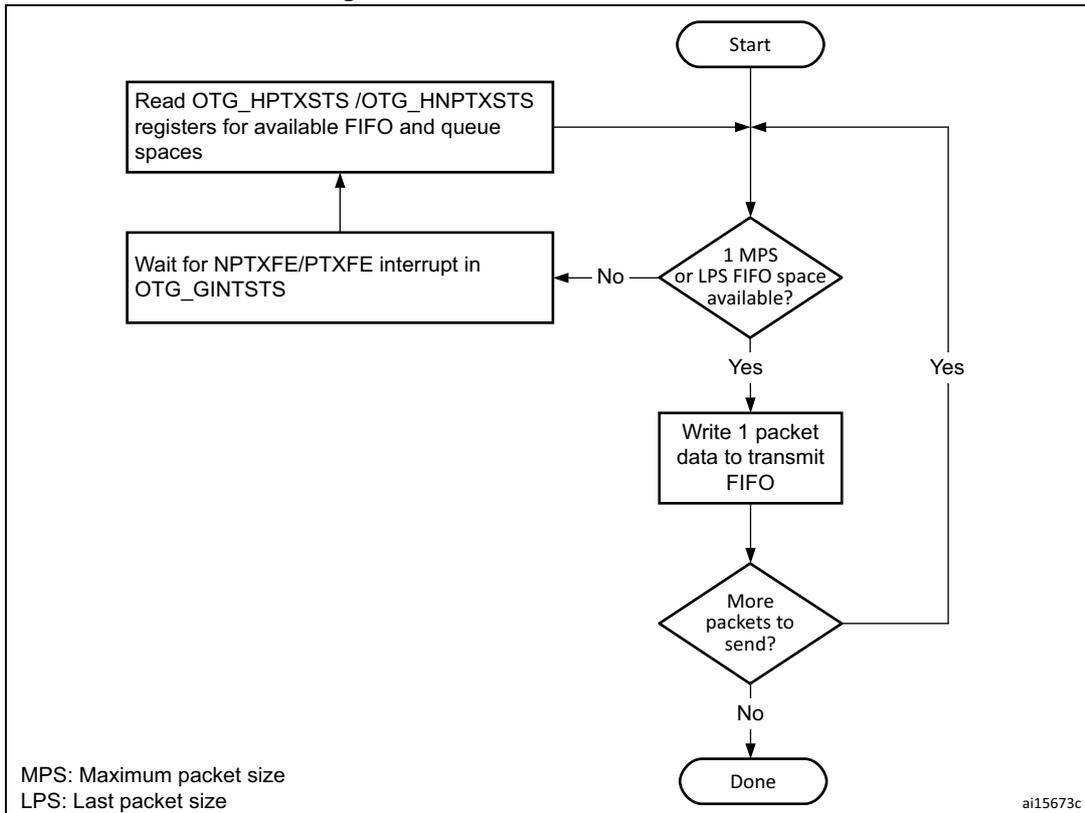
graph TD; Start([Start]) --> Decision1{1 MPS or LPS FIFO space available?}; Decision1 -- No --> Wait[Wait for NPTXFE/PTXFE interrupt in OTG_GINTSTS]; Wait --> Read[Read OTG_HPTXSTS /OTG_HNPTXSTS registers for available FIFO and queue spaces]; Read --> Decision1; Decision1 -- Yes --> Write[Write 1 packet data to transmit FIFO]; Write --> Decision2{More packets to send?}; Decision2 -- No --> Done([Done]); Decision2 -- Yes --> Decision1;MPS: Maximum packet size
LPS: Last packet size
ai15673c
- • Reading the receive FIFO
The application must ignore all packet statuses other than IN data packet (bx0010).
Figure 928. Receive FIFO read task
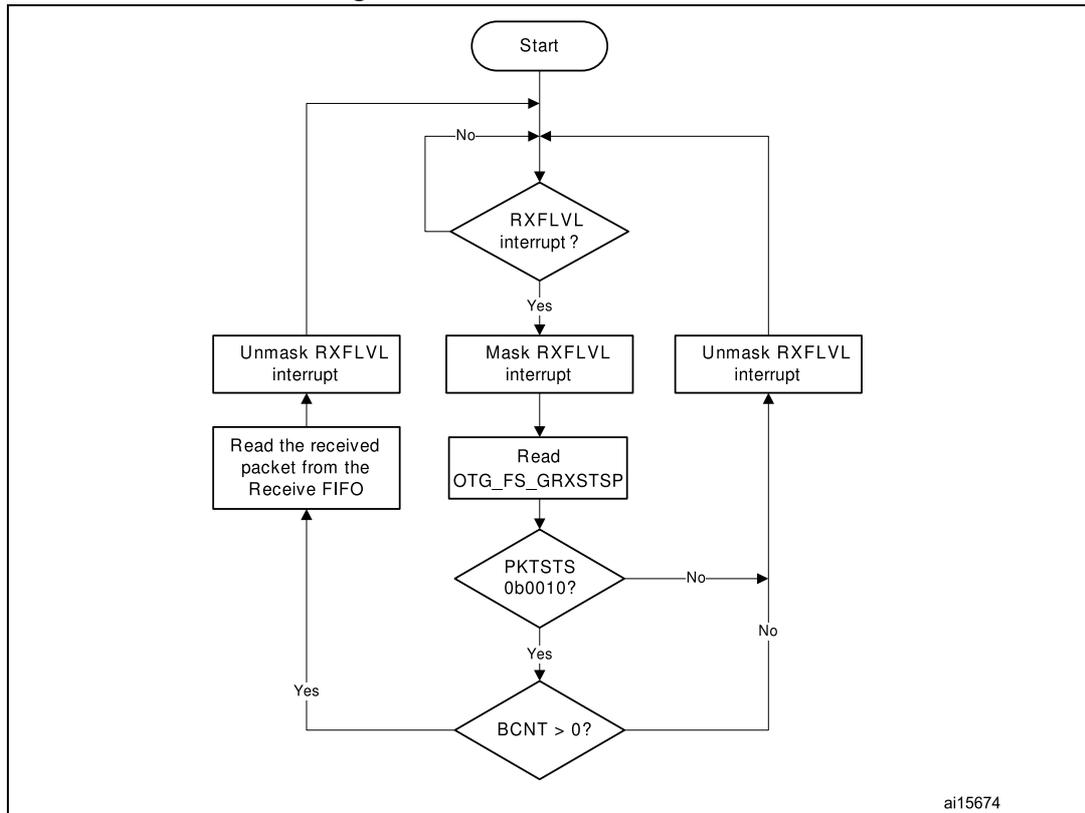
graph TD
    Start([Start]) --> RXFLVL{RXFLVL interrupt?}
    RXFLVL -- No --> RXFLVL
    RXFLVL -- Yes --> Mask[Mask RXFLVL interrupt]
    Mask --> ReadOTG[Read OTG_FS_GRXSTSP]
    ReadOTG --> PKTSTS{PKTSTS 0b0010?}
    PKTSTS -- No --> Unmask1[Unmask RXFLVL interrupt]
    PKTSTS -- Yes --> BCNT{BCNT > 0?}
    BCNT -- No --> Unmask2[Unmask RXFLVL interrupt]
    BCNT -- Yes --> ReadFIFO[Read the received packet from the Receive FIFO]
    ReadFIFO --> Unmask3[Unmask RXFLVL interrupt]
    Unmask1 --> RXFLVL
    Unmask2 --> RXFLVL
    Unmask3 --> RXFLVL
ai15674
- • Bulk and control OUT/SETUP transactions
A typical bulk or control OUT/SETUP pipelined transaction-level operation is shown in Figure 929. See channel 1 (ch_1). Two bulk OUT packets are transmitted. A control SETUP transaction operates in the same way but has only one packet. The assumptions are:
- – The application is attempting to send two maximum-packet-size packets (transfer size = 1, 024 bytes).
- – The non-periodic transmit FIFO can hold two packets (1 Kbyte for HS).
- – The non-periodic request queue depth = 4.
- • Normal bulk and control OUT/SETUP operations
The sequence of operations in (channel 1) is as follows:
- 1. Initialize channel 1
- 2. Write the first packet for channel 1
- 3. Along with the last word write, the core writes an entry to the non-periodic request queue
- 4. As soon as the non-periodic queue becomes non-empty, the core attempts to send an OUT token in the current frame
- 5. Write the second (last) packet for channel 1
- 6. The core generates the XFRC interrupt as soon as the last transaction is completed successfully
- 7. In response to the XFRC interrupt, de-allocate the channel for other transfers
- 8. Handling non-ACK responses
Figure 929. Normal bulk/control OUT/SETUP
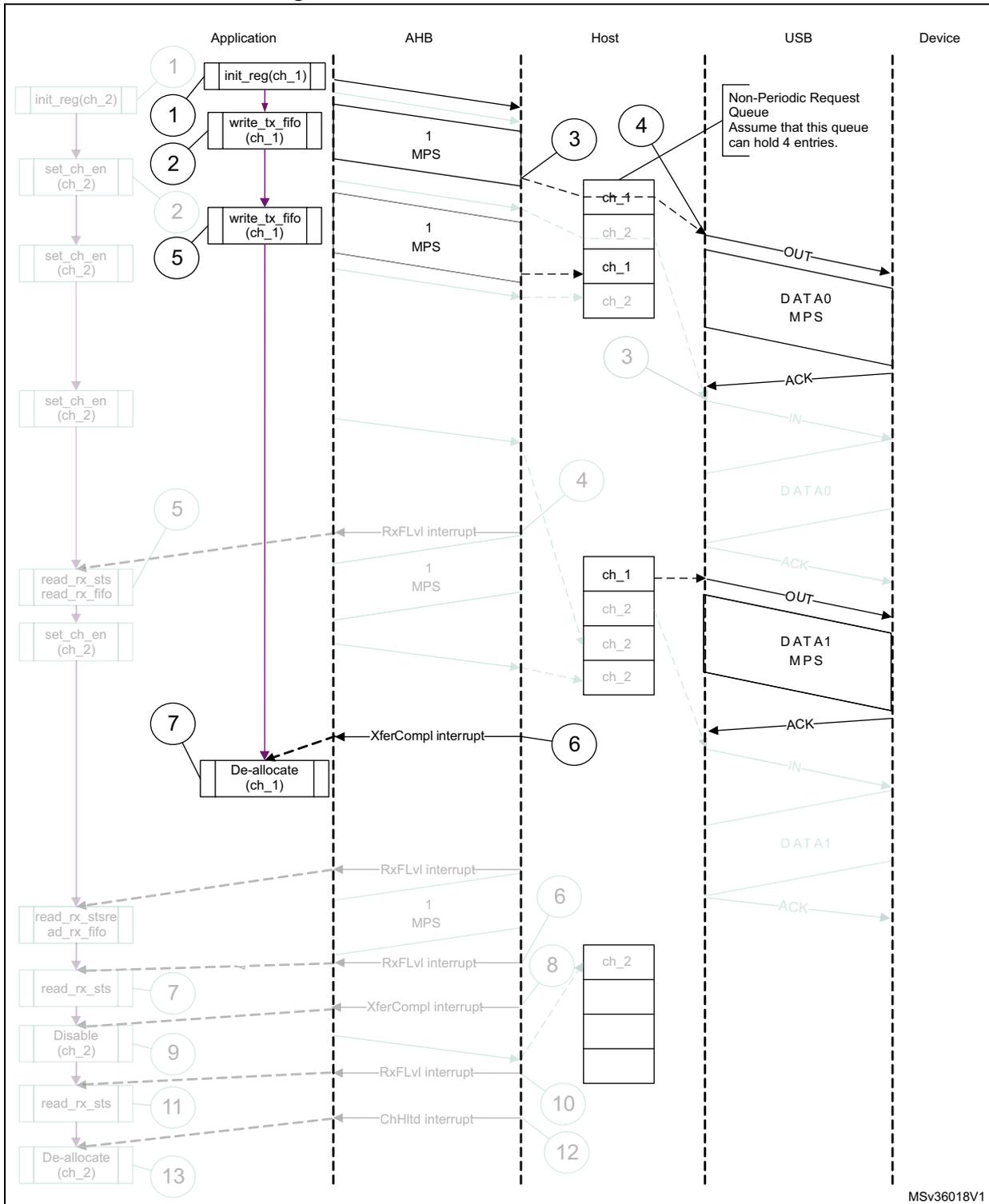
The diagram illustrates the sequence of events for a normal bulk/control OUT/SETUP transaction across five lifelines: Application, AHB, Host, USB, and Device.
- Application:
- 1.
init_reg(ch_1)(relevant) andinit_reg(ch_2)(grayed out). - 2.
write_tx_fifo(ch_1)(relevant) andset_ch_en(ch_2)(grayed out). - 5.
set_ch_en(ch_2)(grayed out). - 5.
read_rx_sts(grayed out). - 7.
De-allocate(ch_1)(relevant). - 7.
read_rx_sts(grayed out). - 9.
Disable(ch_2)(grayed out). - 11.
read_rx_sts(grayed out). - 13.
De-allocate(ch_2)(grayed out).
- 1.
- Host:
- 3. Receives data from AHB and stores it in the Non-Periodic Request Queue (Assume that this queue can hold 4 entries).
- 4. Initiates the OUT transaction on the USB.
- 3. Receives ACK from Device.
- 4. Initiates the next OUT transaction.
- 3. Receives ACK from Device.
- 6. Receives XferCompl interrupt from USB.
- 6. Sends RxFLvl interrupt to AHB.
- 8. Receives RxFLvl interrupt from USB.
- 10. Receives ChHltd interrupt from USB.
- 12. Sends RxFLvl interrupt to AHB.
- USB:
- DATA0 MPS (OUT transaction 1).
- ACK (response to OUT 1).
- DATA0 (OUT transaction 2).
- ACK (response to OUT 2).
- DATA1 MPS (OUT transaction 3).
- ACK (response to OUT 3).
- DATA1 (OUT transaction 4).
- ACK (response to OUT 4).
- Device:
- Receives OUT and DATA packets from USB.
- Sends ACK responses to USB.
Grayed elements (init_reg(ch_2), set_ch_en(ch_2), read_rx_sts, De-allocate(ch_2)) are not relevant in this context.
MSV36018V1
1. The grayed elements are not relevant in the context of this figure.
The channel-specific interrupt service routine for bulk and control OUT/SETUP transactions is shown in the following code samples.
- • Interrupt service routine for bulk/control OUT/SETUP and bulk/control IN transactions
- a) Bulk/control OUT/SETUP
Unmask (NAK/TXERR/STALL/XFRC)
if (XFRC)
{Reset Error Count
Mask ACK
De-allocate Channel
}
else if (STALL)
{Transfer Done = 1
Unmask CHH
Disable Channel
}
else if (NAK or TXERR )
{Rewind Buffer Pointers
Unmask CHH
Disable Channel
if (TXERR)
{Increment Error Count
Unmask ACK
}
else
{Reset Error Count
}
}
else if (CHH)
{Mask CHH
if (Transfer Done or (Error_count == 3))
{De-allocate Channel
}
else
{Re-initialize Channel
}
}
    else if (ACK)
    {
        Reset Error Count
        Mask ACK
    }

    The application is expected to write the data packets into the transmit FIFO when the
    space is available in the transmit FIFO and the request queue. The application can
    make use of the NPTXFE interrupt in OTG_GINTSTS to find the transmit FIFO space.

    b) Bulk/control IN

Unmask (TXERR/XFRC/BBERR/STALL/DTERR)
if (XFRC)
{
    Reset Error Count
    Unmask CHH
    Disable Channel
    Reset Error Count
    Mask ACK
}

else if (TXERR or BBERR or STALL)
{
    Unmask CHH
    Disable Channel
    if (TXERR)
    {
        Increment Error Count
        Unmask ACK
    }
}

else if (CHH)
{
    Mask CHH
    if (Transfer Done or (Error_count == 3))
    {
        De-allocate Channel
    }
    else
    {
        Re-initialize Channel
    }
}

else if (ACK)
{
    Reset Error Count
    Mask ACK
}
else if (DTERR)
{
Reset Error Count
}The application is expected to write the requests as and when the request queue space is available and until the XFRG interrupt is received.
- • Bulk and control IN transactions
A typical bulk or control IN pipelined transaction-level operation is shown in Figure 930 . See channel 2 (ch_2). The assumptions are:
- – The application is attempting to receive two maximum-packet-size packets (transfer size = 1 024 bytes).
- – The receive FIFO can contain at least one maximum-packet-size packet and two status words per packet (520 bytes for HS).
- – The non-periodic request queue depth = 4.
Figure 930. Bulk/control IN transactions
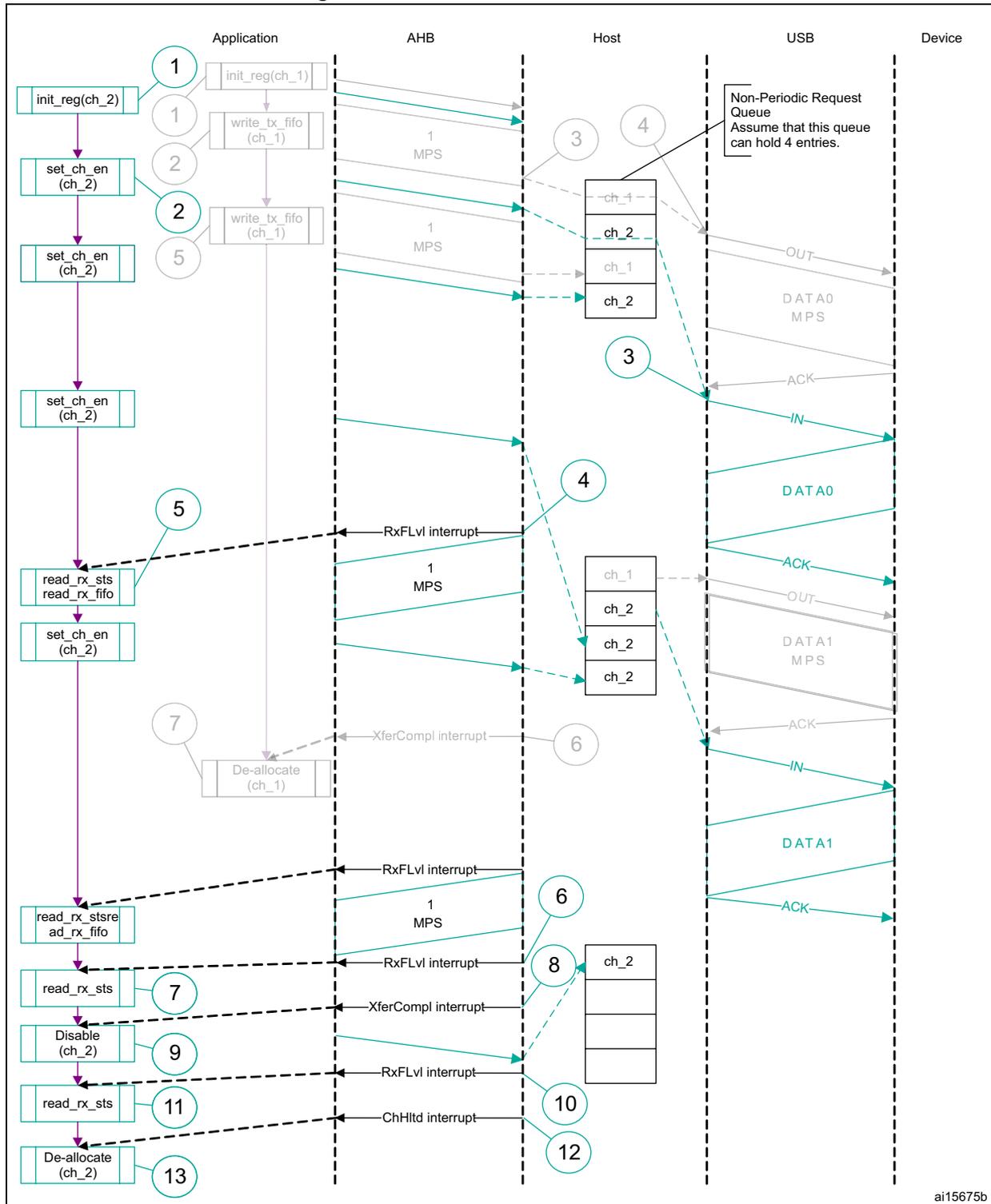
The diagram illustrates the interaction between an Application, AHB, Host, USB, and Device for bulk/control IN transactions. The sequence is as follows:
- Application
calls
init_reg(ch_1)(1) to initialize channel 1. - Application
calls
write_tx_fifo(ch_1)(2) to write data to the transmit FIFO. - Host (3) initiates a transfer request via AHB (1 MPS).
- Host (4) adds the request to the Non-Periodic Request Queue (Assume that this queue can hold 4 entries).
- USB
(OUT) sends
DATA0(MPS) to the Device . - Device (ACK) responds with an ACK signal.
- Host (3) receives an RxFLvl interrupt from the USB .
- Application
(5) calls
read_rx_fifoto read the received data. - Application
calls
set_ch_en(ch_2)(2) to initialize channel 2. - Application
calls
write_tx_fifo(ch_1)(5) to write data to the transmit FIFO for channel 1. - Host (4) initiates another transfer request via AHB (1 MPS).
- Host (6) adds the request to the Non-Periodic Request Queue .
- USB
(OUT) sends
DATA1(MPS) to the Device . - Device (ACK) responds with an ACK signal.
- Host (4) receives an XferCompl interrupt from the USB .
- Application
(7) calls
De-allocate(ch_1)to deallocate channel 1. - Host (6) initiates a transfer request via AHB (1 MPS).
- Host (8) adds the request to the Non-Periodic Request Queue .
- USB
(OUT) sends
DATA0(MPS) to the Device . - Device (ACK) responds with an ACK signal.
- Host (6) receives an RxFLvl interrupt from the USB .
- Application
(7) calls
read_rx_fifoto read the received data. - Host (8) receives an XferCompl interrupt from the USB .
- Application
(9) calls
Disable(ch_2)to disable channel 2. - Host (10) receives an RxFLvl interrupt from the USB .
- Application
(11) calls
read_rx_fifoto read the received data. - Host (12) receives a ChHltd interrupt from the USB .
- Application
(13) calls
De-allocate(ch_2)to deallocate channel 2.
Grayed-out elements (init_reg(ch_2), set_ch_en(ch_2), read_rx_sts, read_rx_sts, Disable(ch_2), read_rx_sts, De-allocate(ch_2)) are not relevant in the context of this figure.
ai15675b
1. The grayed elements are not relevant in the context of this figure.
The sequence of operations is as follows:
- 1. Initialize channel 2.
- 2. Set the CHENA bit in OTG_HCCHAR2 to write an IN request to the non-periodic request queue.
- 3. The core attempts to send an IN token after completing the current OUT transaction.
- 4. The core generates an RXFLVL interrupt as soon as the received packet is written to the receive FIFO.
- 5. In response to the RXFLVL interrupt, mask the RXFLVL interrupt and read the received packet status to determine the number of bytes received, then read the receive FIFO accordingly. Following this, unmask the RXFLVL interrupt.
- 6. The core generates the RXFLVL interrupt for the transfer completion status entry in the receive FIFO.
- 7. The application must read and ignore the receive packet status when the receive packet status is not an IN data packet (PKTSTS in OTG_GRXSTSR \( \neq \) 0b0010).
- 8. The core generates the XFRC interrupt as soon as the receive packet status is read.
- 9. In response to the XFRC interrupt, disable the channel and stop writing the OTG_HCCHAR2 register for further requests. The core writes a channel disable request to the non-periodic request queue as soon as the OTG_HCCHAR2 register is written.
- 10. The core generates the RXFLVL interrupt as soon as the halt status is written to the receive FIFO.
- 11. Read and ignore the receive packet status.
- 12. The core generates a CHH interrupt as soon as the halt status is popped from the receive FIFO.
- 13. In response to the CHH interrupt, de-allocate the channel for other transfers.
- 14. Handling non-ACK responses
- • Control transactions
Setup, data, and status stages of a control transfer must be performed as three separate transfers. setup-, data- or status-stage OUT transactions are performed similarly to the bulk OUT transactions explained previously. Data- or status-stage IN transactions are performed similarly to the bulk IN transactions explained previously. For all three stages, the application is expected to set the EPTYP field in
OTG_HCCHAR1 to control. During the setup stage, the application is expected to set the PID field in OTG_HCTSIZ1 to SETUP.
- • Interrupt OUT transactions
A typical interrupt OUT operation is shown in Figure 931 . The assumptions are:
- – The application is attempting to send one packet in every frame (up to 1 maximum packet size), starting with the odd frame (transfer size = 1 024 bytes)
- – The periodic transmit FIFO can hold one packet (1 Kbyte)
- – Periodic request queue depth = 4
The sequence of operations is as follows:
- 1. Initialize and enable channel 1. The application must set the ODDFRM bit in OTG_HCCHAR1.
- 2. Write the first packet for channel 1.
- 3. Along with the last word write of each packet, the OTG_HS host writes an entry to the periodic request queue.
- 4. The OTG_HS host attempts to send an OUT token in the next (odd) frame.
- 5. The OTG_HS host generates an XFRC interrupt as soon as the last packet is transmitted successfully.
- 6. In response to the XFRC interrupt, reinitialize the channel for the next transfer.
Figure 931. Normal interrupt OUT
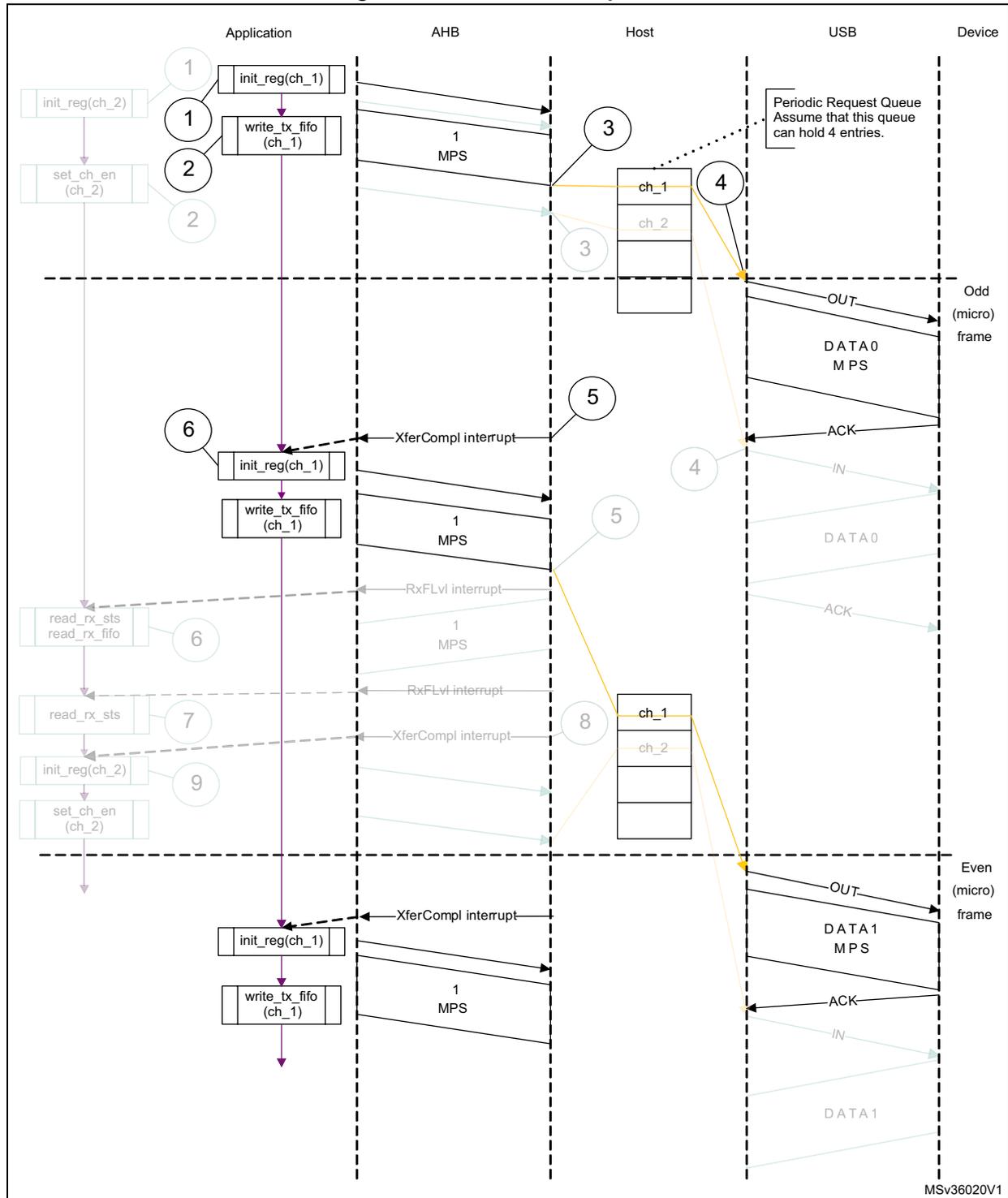
The diagram illustrates the sequence of events for a normal interrupt OUT transaction. The interaction is between the Application, AHB, Host, USB, and Device.
- Application:
- 1:
init_reg(ch_1)(relevant) - 2:
write_tx_fifo(ch_1)(relevant) - 6:
init_reg(ch_1)(relevant) - 7:
write_tx_fifo(ch_1)(relevant) - 9:
init_reg(ch_1)(relevant) - 10:
write_tx_fifo(ch_1)(relevant) - Grayed-out elements:
init_reg(ch_2),set_ch_en(ch_2),read_rx_sts,read_rx_fifo(not relevant)
- 1:
- Host:
- 3: Receives
1 MPSfrom AHB and stores it in the Periodic Request Queue (ch_1). - 4: Retrieves ch_1 from the queue and initiates an OUT transaction in the Odd (micro) frame.
- 5: Receives
DATA 0(1 MPS) from Device and ACK. - 6: Receives
XferCompl interruptfrom AHB. - 7: Retrieves ch_1 from the queue and initiates an OUT transaction in the Even (micro) frame.
- 8: Receives
DATA 1(1 MPS) from Device and ACK. - 9: Receives
XferCompl interruptfrom AHB.
- 3: Receives
- USB:
- Odd (micro) frame: OUT,
DATA 0(1 MPS), ACK. - Even (micro) frame: OUT,
DATA 1(1 MPS), ACK.
- Odd (micro) frame: OUT,
- Device:
- Receives OUT, sends
DATA 0(1 MPS) and ACK in the Odd frame. - Receives OUT, sends
DATA 1(1 MPS) and ACK in the Even frame.
- Receives OUT, sends
- Interrupts:
XferCompl interruptfrom AHB to Host (steps 6 and 9).RxFLvl interruptfrom Host to AHB (steps 6 and 7, grayed-out).
MSV36020V1
1. The grayed elements are not relevant in the context of this figure.
- • Interrupt service routine for interrupt OUT/IN transactions
- a) Interrupt OUT
Unmask (NAK/TXERR/STALL/XFRC/FRMOR)
if (XFRC)
{
    Reset Error Count
    Mask ACK
    De-allocate Channel
}
else
    if (STALL or FRMOR)
    {
        Mask ACK
        Unmask CHH
        Disable Channel
        if (STALL)
        {
            Transfer Done = 1
        }
    }
    else
        if (NAK or TXERR)
        {
            Rewind Buffer Pointers
            Reset Error Count
            Mask ACK
            Unmask CHH
            Disable Channel
        }
        else
            if (CHH)
            {
                Mask CHH
                if (Transfer Done or (Error_count == 3))
                {
                    De-allocate Channel
                }
                else
                {
                    Re-initialize Channel (in next b_interval - 1 Frame)
                }
            }
            else
                if (ACK)
                {
                    Reset Error Count
                    Mask ACK
                }
The application uses the NPTXFE interrupt in OTG_GINTSTS to find the transmit FIFO space.
Interrupt IN
Unmask (NAK/TXERR/XFRC/BBERR/STALL/FRMOR/DTERR)
if (XFRC)
{
    Reset Error Count
    Mask ACK
    if (OTG_HCTSIZx.PKTCNT == 0)
    {
        De-allocate Channel
    }
    else
    {
        Transfer Done = 1
        Unmask CHH
        Disable Channel
    }
}
else
    if (STALL or FRMOR or NAK or DTERR or BBERR)
    {
        Mask ACK
        Unmask CHH
        Disable Channel
        if (STALL or BBERR)
        {
            Reset Error Count
            Transfer Done = 1
        }
        else
            if (!FRMOR)
            {
                Reset Error Count
            }
    }
    else
        if (TXERR)
        {
            Increment Error Count
            Unmask ACK
            Unmask CHH
            Disable Channel
        }
    else
if (CHH)
{
Mask CHH
if (Transfer Done or (Error_count == 3))
{
De-allocate Channel
}
else
Re-initialize Channel (in next b_interval - 1 /Frame)
}
}
else
if (ACK)
{
Reset Error Count
Mask ACK
}- • Interrupt IN transactions
The assumptions are:
- – The application is attempting to receive one packet (up to 1 maximum packet size) in every frame, starting with odd (transfer size = 1 024 bytes).
- – The receive FIFO can hold at least one maximum-packet-size packet and two status words per packet (1 031 bytes).
- – Periodic request queue depth = 4.
- • Normal interrupt IN operation
The sequence of operations is as follows:
- 1. Initialize channel 2. The application must set the ODDFRM bit in OTG_HCCHAR2.
- 2. Set the CHENA bit in OTG_HCCHAR2 to write an IN request to the periodic request queue.
- 3. The OTG_HS host writes an IN request to the periodic request queue for each OTG_HCCHAR2 register write with the CHENA bit set.
- 4. The OTG_HS host attempts to send an IN token in the next (odd) frame.
- 5. As soon as the IN packet is received and written to the receive FIFO, the OTG_HS host generates an RXFLVL interrupt.
- 6. In response to the RXFLVL interrupt, read the received packet status to determine the number of bytes received, then read the receive FIFO accordingly. The application must mask the RXFLVL interrupt before reading the receive FIFO, and unmask after reading the entire packet.
- 7. The core generates the RXFLVL interrupt for the transfer completion status entry in the receive FIFO. The application must read and ignore the receive packet status when the receive packet status is not an IN data packet (PKTSTS in GRXSTS ≠ 0b0010).
- 8. The core generates an XFRC interrupt as soon as the receive packet status is read.
- 9. In response to the XFRC interrupt, read the PKTCNT field in OTG_HCTSIZ2. If the PKTCNT bit in OTG_HCTSIZ2 is not equal to 0, disable the channel before re-
initializing the channel for the next transfer, if any). If PKTCNT bit in OTG_HCTSIZ2 = 0, reinitialize the channel for the next transfer. This time, the application must reset the ODDFRM bit in OTG_HCCHAR2.
Figure 932. Normal interrupt IN
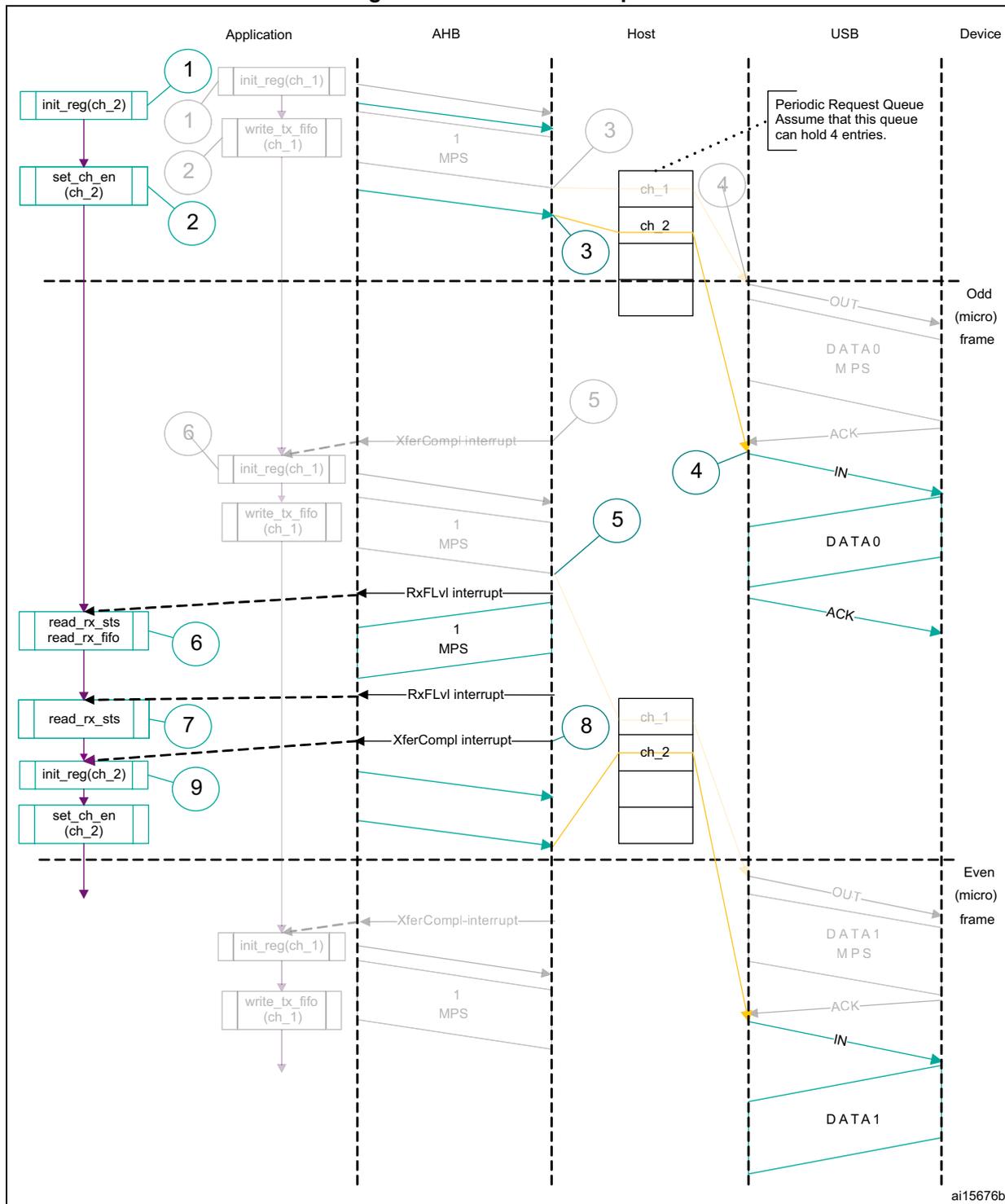
The diagram illustrates the interaction for a 'Normal interrupt IN' transaction. It is divided into five vertical columns: Application, AHB, Host, USB, and Device. The timeline is split into 'Odd (micro) frame' and 'Even (micro) frame' by horizontal dashed lines.
- Application:
- Step 1:
init_reg(ch_1)(grayed out) - Step 2:
set_ch_en(ch_2)(grayed out) - Step 3:
write_tx_fifo(ch_1)(grayed out) - Step 4:
init_reg(ch_1)(grayed out) - Step 5:
write_tx_fifo(ch_1)(grayed out) - Step 6:
read_rx_stsandread_rx_fifo(grayed out) - Step 7:
read_rx_sts(grayed out) - Step 8:
init_reg(ch_2)(grayed out) - Step 9:
set_ch_en(ch_2)(grayed out)
- Step 1:
- Host:
- Contains a 'Periodic Request Queue' with entries for
ch_1andch_2. A note states: 'Assume that this queue can hold 4 entries.' - Step 3: Interrupts are generated for
ch_1andch_2. - Step 4: Interrupts are generated for
ch_1andch_2. - Step 5: Interrupts are generated for
ch_1andch_2. - Step 6: Interrupts are generated for
ch_1andch_2. - Step 7: Interrupts are generated for
ch_1andch_2. - Step 8: Interrupts are generated for
ch_1andch_2. - Step 9: Interrupts are generated for
ch_1andch_2.
- Contains a 'Periodic Request Queue' with entries for
- USB:
- Odd (micro) frame: OUT packet (DATA 0, MPS) is sent to the Device. ACK is received from the Device. IN packet (DATA 0) is received from the Device. ACK is sent to the Device.
- Even (micro) frame: OUT packet (DATA 1, MPS) is sent to the Device. ACK is received from the Device. IN packet (DATA 1) is received from the Device. ACK is sent to the Device.
- Device:
- Receives OUT packets (DATA 0 and DATA 1) and sends ACKs.
- Sends IN packets (DATA 0 and DATA 1) and receives ACKs.
- Interrupts:
XferComplinterrupt: Generated when a transfer is complete (e.g., after receiving an ACK for an OUT packet).RxFLvlinterrupt: Generated when data is received in the receive FIFO (e.g., after receiving an IN packet).
Grayed elements are not relevant in the context of this figure.
1. The grayed elements are not relevant in the context of this figure.
- • Isochronous OUT transactions
A typical isochronous OUT operation is shown in Figure 933 . The assumptions are:
- – The application is attempting to send one packet every frame (up to 1 maximum)
packet size), starting with an odd frame. (transfer size = 1 024 bytes).
- – The periodic transmit FIFO can hold one packet (1 Kbyte).
- – Periodic request queue depth = 4.
The sequence of operations is as follows:
- 1. Initialize and enable channel 1. The application must set the ODDFRM bit in OTG_HCCHAR1.
- 2. Write the first packet for channel 1.
- 3. Along with the last word write of each packet, the OTG_HS host writes an entry to the periodic request queue.
- 4. The OTG_HS host attempts to send the OUT token in the next frame (odd).
- 5. The OTG_HS host generates the XFRC interrupt as soon as the last packet is transmitted successfully.
- 6. In response to the XFRC interrupt, reinitialize the channel for the next transfer.
- 7. Handling non-ACK responses
Figure 933. Isochronous OUT transactions
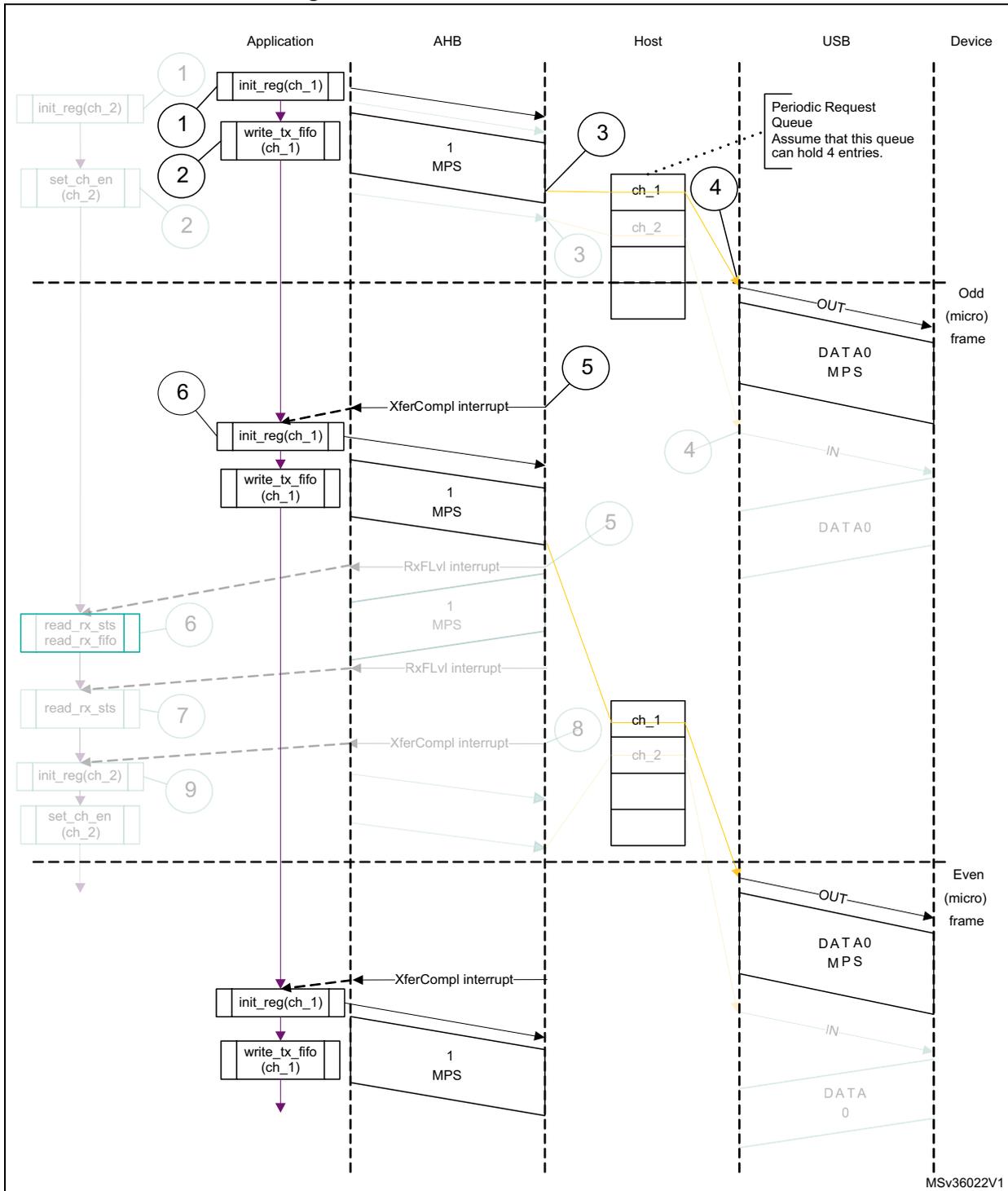
The diagram illustrates the sequence of events for isochronous OUT transactions across five lifelines: Application, AHB, Host, USB, and Device. The timeline is split into Odd (micro) frame and Even (micro) frame sections by horizontal dashed lines.
- Odd (micro) frame:
- Application: Initiates channel 1 (init_reg(ch_1)) and writes data (write_tx_fifo(ch_1)). Channel 2 is also initialized (init_reg(ch_2), set_ch_en(ch_2)) but is grayed out.
- Host: Receives the request and adds it to the Periodic Request Queue (containing ch_1, ch_2). It then sends an OUT transaction to the Device.
- Device: Receives the OUT transaction and DATA 0.
- USB: Facilitates the transaction.
- Interrupts: XferCompl interrupt is generated when the transfer is complete. RxFLvl interrupt is generated when data is received in the FIFO.
- Even (micro) frame:
- Application: Receives the XferCompl interrupt for channel 1, re-initializes it (init_reg(ch_1)), and writes more data (write_tx_fifo(ch_1)).
- Host: Processes the next request from the queue and sends another OUT transaction to the Device.
- Device: Receives the OUT transaction and DATA 0.
- Interrupts: Another XferCompl interrupt is generated.
Grayed elements (init_reg(ch_2), set_ch_en(ch_2), read_rx_sts, read_rx_fifo) are not relevant in this context.
1. The grayed elements are not relevant in the context of this figure.
- • Interrupt service routine for isochronous OUT/IN transactions
Code sample: isochronous OUT
Unmask (FRMOR/XFRC)
if (XFRC)
{
    De-allocate Channel
}
else
    if (FRMOR)
    {
        Unmask CHH
        Disable Channel
    }
    else
        if (CHH)
        {
            Mask CHH
            De-allocate Channel
        }
Code sample: Isochronous IN
Unmask (TXERR/XFRC/FRMOR/BBERR)
if (XFRC or FRMOR)
{
    if (XFRC and (OTG_HCTSIZx.PKTCNT == 0))
    {
        Reset Error Count
        De-allocate Channel
    }
    else
    {
        Unmask CHH
        Disable Channel
    }
}
else
    if (TXERR or BBERR)
    {
        Increment Error Count
        Unmask CHH
        Disable Channel
    }
    else
        if (CHH)
        {
            Mask CHH
            if (Transfer Done or (Error_count == 3))
            {
                De-allocate Channel
            }
        }
}
else
{
Re-initialize Channel
}
}- • Isochronous IN transactions
The assumptions are:
- – The application is attempting to receive one packet (up to 1 maximum packet size) in every frame starting with the next odd frame (transfer size = 1 024 bytes).
- – The receive FIFO can hold at least one maximum-packet-size packet and two status word per packet (1 031 bytes).
- – Periodic request queue depth = 4.
The sequence of operations is as follows:
- 1. Initialize channel 2. The application must set the ODDFRM bit in OTG_HCCHAR2.
- 2. Set the CHENA bit in OTG_HCCHAR2 to write an IN request to the periodic request queue.
- 3. The OTG_HS host writes an IN request to the periodic request queue for each OTG_HCCHAR2 register write with the CHENA bit set.
- 4. The OTG_HS host attempts to send an IN token in the next odd frame.
- 5. As soon as the IN packet is received and written to the receive FIFO, the OTG_HS host generates an RXFLVL interrupt.
- 6. In response to the RXFLVL interrupt, read the received packet status to determine the number of bytes received, then read the receive FIFO accordingly. The application must mask the RXFLVL interrupt before reading the receive FIFO, and unmask it after reading the entire packet.
- 7. The core generates an RXFLVL interrupt for the transfer completion status entry in the receive FIFO. This time, the application must read and ignore the receive packet status when the receive packet status is not an IN data packet (PKTSTS bit in OTG_GRXSTSR ≠ 0b0010).
- 8. The core generates an XFRC interrupt as soon as the receive packet status is read.
- 9. In response to the XFRC interrupt, read the PKTCNT field in OTG_HCTSIZ2. If PKTCNT ≠ 0 in OTG_HCTSIZ2, disable the channel before re-initializing the channel for the next transfer, if any. If PKTCNT = 0 in OTG_HCTSIZ2, reinitialize the channel for the next transfer. This time, the application must reset the ODDFRM bit in OTG_HCCHAR2.
Figure 934. Isochronous IN transactions
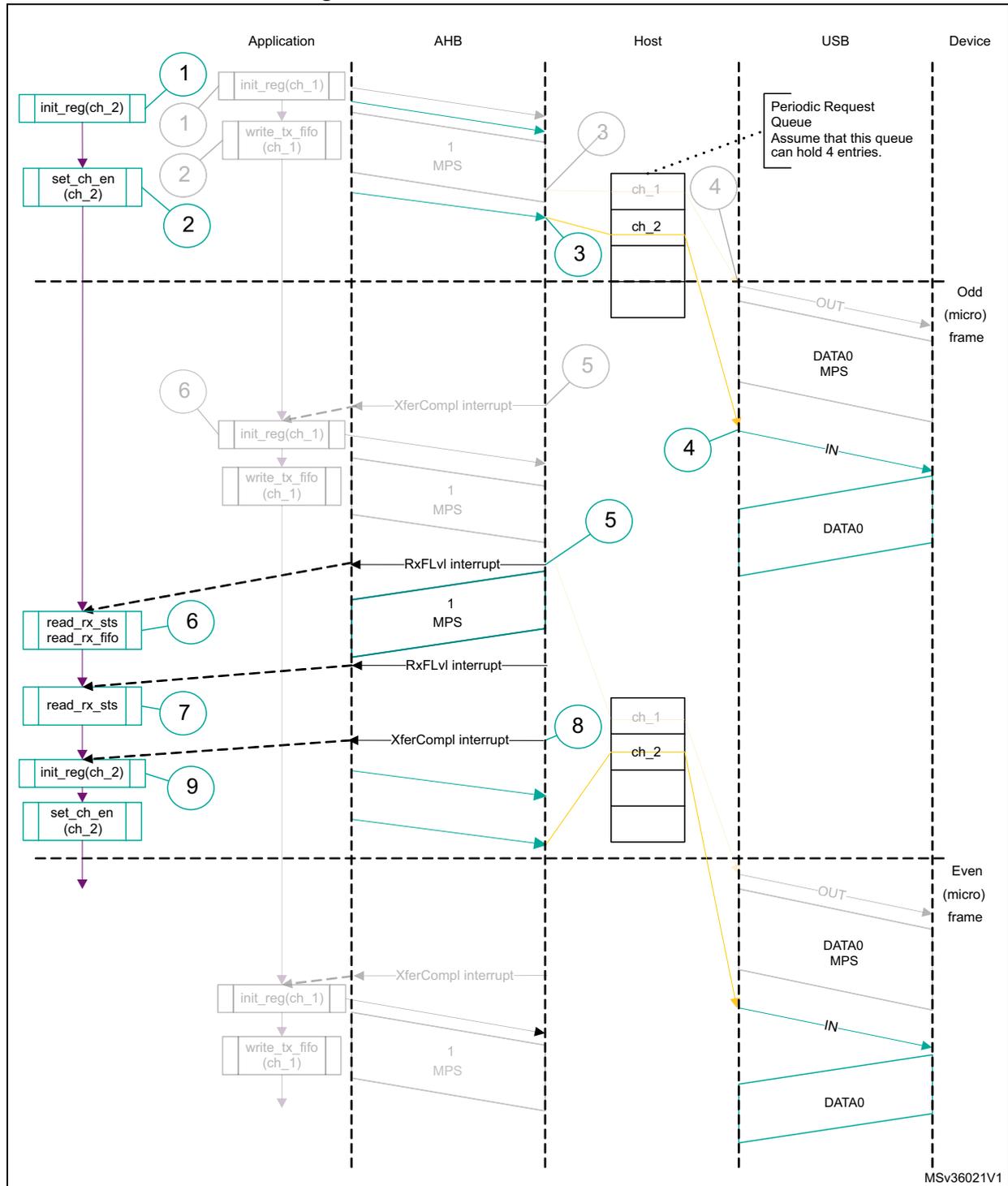
The diagram illustrates the sequence of operations for isochronous IN transactions across five lifelines: Application, AHB, Host, USB, and Device. The timeline is split into Odd (micro) frame and Even (micro) frame sections by horizontal dashed lines.
- Odd (micro) frame:
- Application:
Steps 1 and 2 involve initializing registers (
init_reg(ch_1),init_reg(ch_2)) and enabling channel 2 (set_ch_en(ch_2)). Step 6 shows reading RX FIFO status and data (read_rx_sts,read_rx_fifo). Step 7 shows reading RX FIFO status (read_rx_sts). Step 9 shows re-initializing registers (init_reg(ch_2)) and enabling channel 2 (set_ch_en(ch_2)). - Host:
Step 3 shows the Host sending a Periodic Request Queue entry for channel 1. Step 4 shows the Host sending an OUT transaction to the Device. Step 5 shows the Host receiving an interrupt (
XferCompl). - USB: The USB layer sends an OUT transaction to the Device, followed by DATA0 MPS and DATA0 packets.
- Device: The Device receives the OUT transaction and DATA packets.
- Interrupts:
The AHB receives
RxFLvlinterrupts from the Host at steps 6 and 7, and anXferComplinterrupt at step 8.
- Application:
Steps 1 and 2 involve initializing registers (
- Even (micro) frame:
- Application:
The Application initializes channel 1 (
init_reg(ch_1)) and writes data to the TX FIFO (write_tx_fifo(ch_1)). - Host:
The Host receives an
XferComplinterrupt from the AHB at step 5. - USB: The USB layer sends an OUT transaction to the Device, followed by DATA0 MPS and DATA0 packets.
- Device: The Device receives the OUT transaction and DATA packets.
- Application:
The Application initializes channel 1 (
A callout box indicates: "Periodic Request Queue Assume that this queue can hold 4 entries." The diagram is labeled MSV36021V1 at the bottom right.
1. The grayed elements are not relevant in the context of this figure.
- • Selecting the queue depth
Choose the periodic and non-periodic request queue depths carefully to match the number of periodic/non-periodic endpoints accessed.
The non-periodic request queue depth affects the performance of non-periodic
transfers. The deeper the queue (along with sufficient FIFO size), the more often the core is able to pipeline non-periodic transfers. If the queue size is small, the core is able to put in new requests only when the queue space is freed up.
The core's periodic request queue depth is critical to perform periodic transfers as scheduled. Select the periodic queue depth, based on the number of periodic transfers scheduled in a microframe. If the periodic request queue depth is smaller than the periodic transfers scheduled in a microframe, a frame overrun condition occurs.
- • Handling babble conditions
OTG_HS controller handles two cases of babble: packet babble and port babble. Packet babble occurs if the device sends more data than the maximum packet size for the channel. Port babble occurs if the core continues to receive data from the device at EOF2 (the end of frame 2, which is very close to SOF).
When OTG_HS controller detects a packet babble, it stops writing data into the Rx buffer and waits for the end of packet (EOP). When it detects an EOP, it flushes already written data in the Rx buffer and generates a Babble interrupt to the application.
When OTG_HS controller detects a port babble, it flushes the Rx FIFO and disables the port. The core then generates a port disabled interrupt (HPRTINT in OTG_GINTSTS, PENCHNG in OTG_HPRT). On receiving this interrupt, the application must determine that this is not due to an overcurrent condition (another cause of the port disabled interrupt) by checking POCA in OTG_HPRT, then perform a soft reset. The core does not send any more tokens after it has detected a port babble condition.
- • Bulk and control OUT/SETUP transactions in DMA mode
The sequence of operations is as follows:
- 1. Initialize and enable channel 1 as explained in Section : Channel initialization .
- 2. The OTG_HS host starts fetching the first packet as soon as the channel is enabled. For internal DMA mode, the OTG_HS host uses the programmed DMA address to fetch the packet.
- 3. After fetching the last 32-bit word of the second (last) packet, the OTG_HS host masks channel 1 internally for further arbitration.
- 4. The OTG_HS host generates a CHH interrupt as soon as the last packet is sent.
- 5. In response to the CHH interrupt, de-allocate the channel for other transfers.
Figure 935. Normal bulk/control OUT/SETUP transactions - DMA
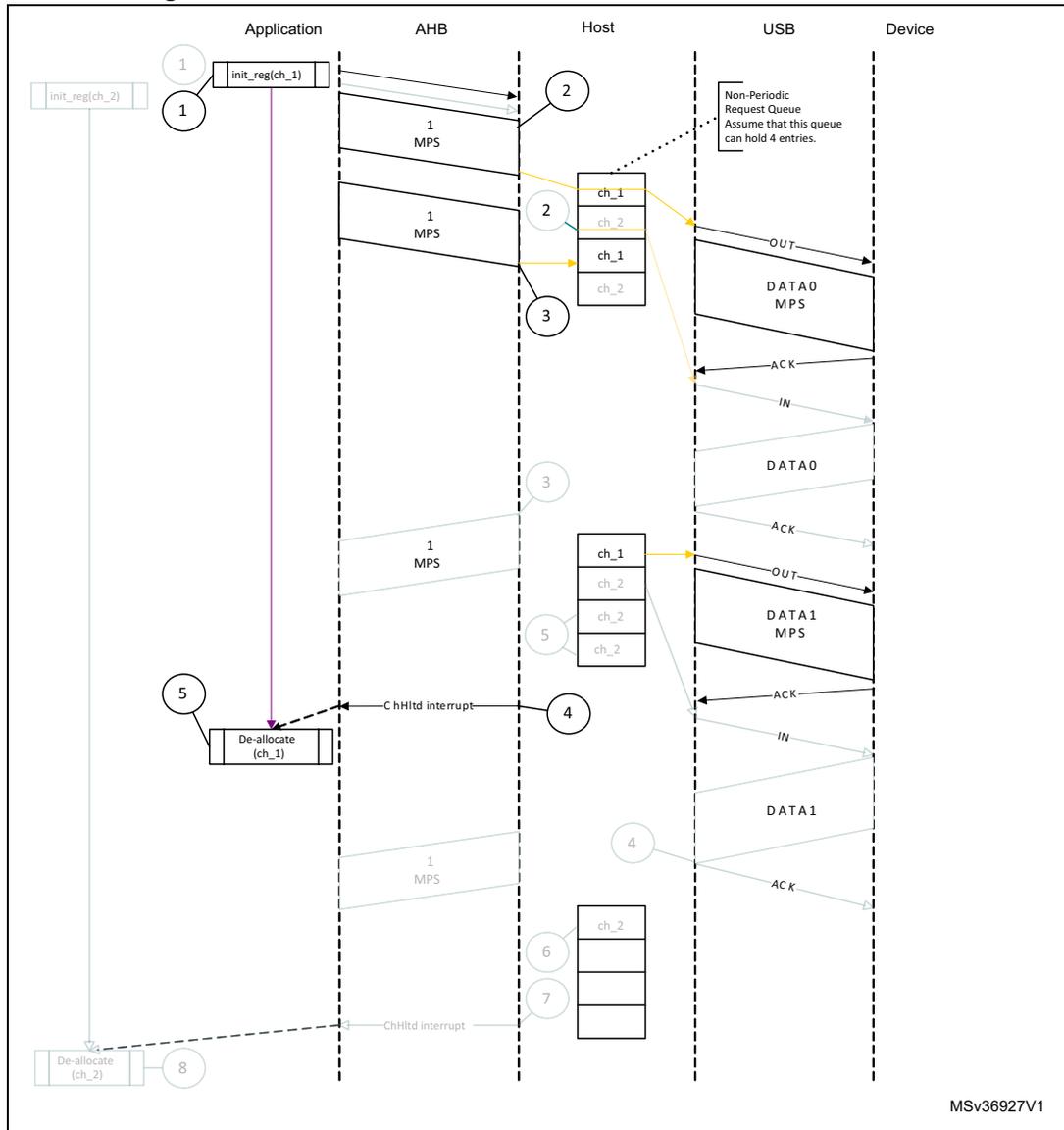
The diagram illustrates the sequence of events for normal bulk/control OUT/SETUP transactions using DMA. The participants are Application, AHB, Host, USB, and Device. The sequence is as follows:
- The Application initializes the channels by writing to
init_reg(ch_1)andinit_reg(ch_2). - The Host sends a bulk OUT transaction (1 MPS) to the Device via the USB.
- The Device responds with DATA0 (1 MPS) and ACK.
- The Host receives the ACK and generates a ChHltd interrupt to the Application.
- The Application calls
De-allocate (ch_1). - The Host sends another bulk OUT transaction (1 MPS) to the Device via the USB.
- The Device responds with DATA1 (1 MPS) and ACK.
- The Host receives the ACK and generates another ChHltd interrupt to the Application.
- The Application calls
De-allocate (ch_2).
A note in the diagram states: "Non-Periodic Request Queue Assume that this queue can hold 4 entries."
MSv36927V1
- • NAK and NYET handling with internal DMA:
- 1. The OTG_HS host sends a bulk OUT transaction.
- 2. The device responds with NAK or NYET.
- 3. If the application has unmasked NAK or NYET, the core generates the corresponding interrupt(s) to the application. The application is not required to service these interrupts, since the core takes care of rewinding the buffer pointers and re-initializing the Channel without application intervention.
- 4. The core automatically issues a ping token.
- 5. When the device returns an ACK, the core continues with the transfer. Optionally, the application can utilize these interrupts, in which case the NAK or NYET interrupt is masked by the application.
The core does not generate a separate interrupt when NAK or NYET is received by the host functionality.
- • Bulk and control IN transactions in DMA mode
The sequence of operations is as follows:
- 1. Initialize and enable the used channel (channel x) as explained in Section : Channel initialization .
- 2. The OTG_HS host writes an IN request to the request queue as soon as the channel receives the grant from the arbiter (arbitration is performed in a round-robin fashion).
- 3. The OTG_HS host starts writing the received data to the system memory as soon as the last byte is received with no errors.
- 4. When the last packet is received, the OTG_HS host sets an internal flag to remove any extra IN requests from the request queue.
- 5. The OTG_HS host flushes the extra requests.
- 6. The final request to disable channel x is written to the request queue. At this point, channel 2 is internally masked for further arbitration.
- 7. The OTG_HS host generates the CHH interrupt as soon as the disable request comes to the top of the queue.
- 8. In response to the CHH interrupt, de-allocate the channel for other transfers.
Figure 936. Normal bulk/control IN transaction - DMA
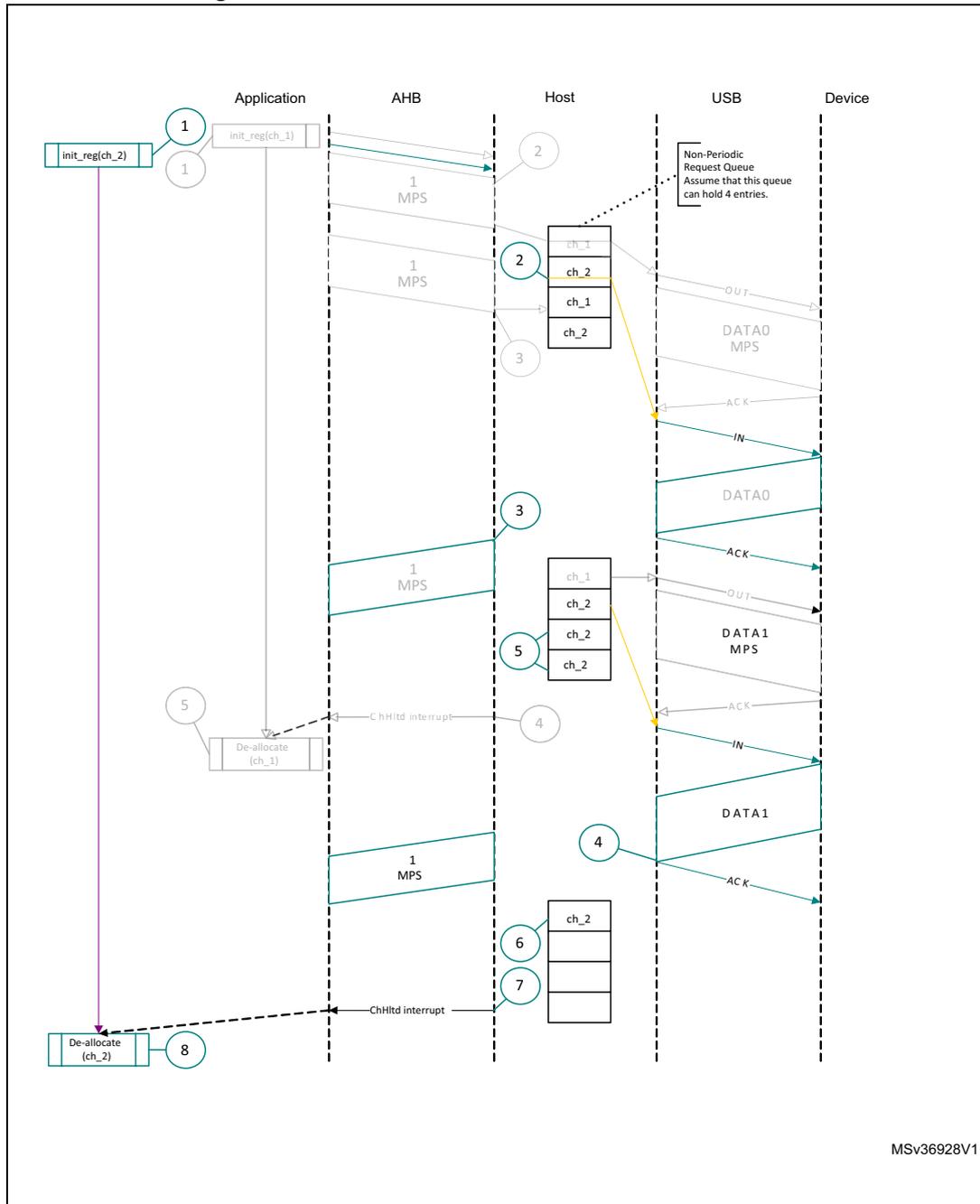
The diagram illustrates the sequence of events for a normal bulk/control IN transaction in DMA mode. It is divided into five vertical lifelines: Application, AHB, Host, USB, and Device.
- 1
: Application initializes
init_reg(ch_1)andinit_reg(ch_2). - 2
: Host fetches the first packet from
init_reg(ch_1)via AHB (1 MPS). - 3
: Host fetches subsequent packets from
init_reg(ch_1)via AHB (1 MPS). - 4 : Host sends an OUT token and DATA0 packet to the Device via USB.
- 5
: Device responds with an ACK. Host receives a
CHHltd interruptfrom AHB. - 6
: Host fetches the next packet from
init_reg(ch_1)via AHB (1 MPS). - 7 : Host sends DATA1 packet to the Device via USB.
- 8
: Device responds with an ACK. Host receives another
CHHltd interruptfrom AHB, which triggers the Application toDe-allocate (ch_2).
A note in the USB lifeline states: "Non-Periodic Request Queue Assume that this queue can hold 4 entries."
MSV36928V1
- • Interrupt OUT transactions in DMA mode
- 1. Initialize and enable channel x as explained in Section : Channel initialization .
- 2. The OTG_HS host starts fetching the first packet as soon the channel is enabled and writes the OUT request along with the last 32-bit word fetch. In high-bandwidth transfers, the OTG_HS host continues fetching the next packet (up to the value specified in the MC field) before switching to the next channel.
- 3. The OTG_HS host attempts to send the OUT token at the beginning of the next odd frame/micro-frame.
- 4. After successfully transmitting the packet, the OTG_HS host generates a CHH interrupt.
- 5. In response to the CHH interrupt, reinitialize the channel for the next transfer.
Figure 937. Normal interrupt OUT transactions - DMA mode
![Sequence diagram of normal interrupt OUT transactions in DMA mode. The diagram shows the interaction between an Application, AHB, Host, USB, and Device. The sequence starts with the Application initializing channel 1 (init_reg[ch_1]) and channel 2 (init_reg[ch_2]). The Host then writes 1 MPS to the USB. The USB sends an OUT (micro) frame to the Device, which responds with DATA0 and ACK. The Host then generates a CHH interrupt, and the Application reinitializes channel 1. This process repeats for channel 2 and then for channel 1 again. A note indicates that the Periodic Request Queue is assumed to hold 4 entries.](/RM0456-STM32U5/17c5b15af8dbc5bc12321ee6eff86146_img.jpg)
The diagram illustrates the sequence of operations for normal interrupt OUT transactions in DMA mode. It is divided into five vertical lifelines: Application, AHB, Host, USB, and Device. The sequence is as follows:
- 1. The Application initializes channel 1 (init_reg[ch_1]) and channel 2 (init_reg[ch_2]).
- 2. The Host writes 1 MPS to the USB.
- 3. The USB sends an OUT (micro) frame to the Device. The Device responds with DATA0 and ACK. The Host then generates a CHH interrupt.
- 4. The Application reinitializes channel 1 (init_reg[ch_1]) in response to the CHH interrupt.
- 5. The Host writes 1 MPS to the USB again.
- 6. The USB sends an OUT (micro) frame to the Device. The Device responds with DATA1 and ACK. The Host then generates a CHH interrupt.
- 7. The Application reinitializes channel 1 (init_reg[ch_1]) in response to the CHH interrupt.
- 8. The Host writes 1 MPS to the USB again.
A note in the diagram indicates: "Periodic Request Queue Assume that this queue can hold 4 entries."
- • Interrupt IN transactions in DMA mode
The sequence of operations (channelx) is as follows:
- 1. Initialize and enable channel x as explained in Section : Channel initialization .
- 2. The OTG_HS host writes an IN request to the request queue as soon as the channel x gets the grant from the arbiter (round-robin with fairness). In high-bandwidth transfers, the OTG_HS host writes consecutive writes up to MC times.
- 3. The OTG_HS host attempts to send an IN token at the beginning of the next (odd) frame/micro-frame.
- 4. As soon the packet is received and written to the receive FIFO, the OTG_HS host generates a CHH interrupt.
- 5. In response to the CHH interrupt, reinitialize the channel for the next transfer.
Figure 938. Normal interrupt IN transactions - DMA mode
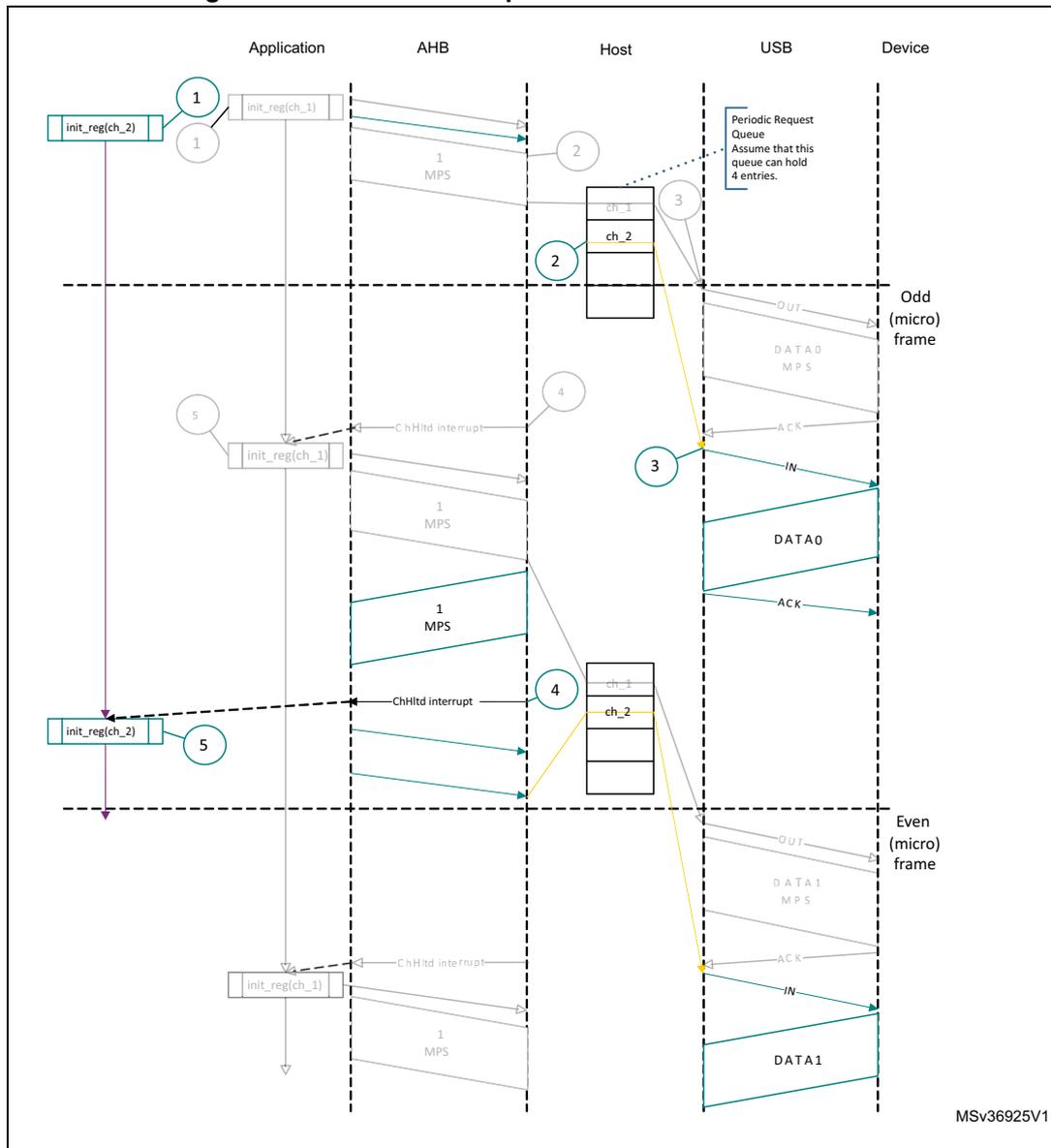
The diagram illustrates the sequence of events for normal interrupt IN transactions in DMA mode. It is divided into two main sections: Odd (micro) frame and Even (micro) frame, separated by a horizontal dashed line. The vertical axis represents time, and the horizontal axis represents the entities involved: Application, AHB, Host, USB, and Device.
- Application:
Initiates channel initialization by writing to
init_reg(ch_1)orinit_reg(ch_2). It also handles CHH interrupts by reinitializing the channel. - Host:
Contains a
Periodic Request Queue
(assume 4 entries) with slots for
ch_1,ch_2,ch_3, andch_4. It generates CHH interrupts when data is received. - USB: Handles the actual USB transactions, including OUT requests, IN tokens, and DATA packets (DATA0, DATA1).
- Device: The external USB device that receives OUT requests and responds with IN tokens and DATA packets.
Sequence of Events:
- Initialization:
The Application writes to
init_reg(ch_1)(1) to initialize and enable the channel. The Host fetches the configuration (1 MPS) (2). - Odd (micro) frame:
- The USB sends an OUT request to the Device.
- The Device responds with DATA0 (MPS).
- The USB receives an ACK from the Device.
- Simultaneously, the USB sends an IN token to the Device.
- The Device responds with DATA0 (MPS).
- The USB receives an ACK from the Device.
- The Host generates a CHHld interrupt (4) to the Application.
- The Application reinitializes the channel with
init_reg(ch_1)(5).
- Even (micro) frame:
- The USB sends an OUT request to the Device.
- The Device responds with DATA1 (MPS).
- The USB receives an ACK from the Device.
- Simultaneously, the USB sends an IN token to the Device.
- The Device responds with DATA1 (MPS).
- The USB receives an ACK from the Device.
- The Host generates a CHHld interrupt (4) to the Application.
- The Application reinitializes the channel with
init_reg(ch_1)(5).
MSV36925V1
• Isochronous OUT transactions in DMA mode
- 1. Initialize and enable channel x as explained in Section : Channel initialization .
- 2. The OTG_HS host starts fetching the first packet as soon as the channel is enabled, and writes the OUT request along with the last 32-bit word fetch. In high-bandwidth
transfers, the OTG_HS host continues fetching the next packet (up to the value specified in the MC field) before switching to the next channel.
- 3. The OTG_HS host attempts to send an OUT token at the beginning of the next (odd) frame/micro-frame.
- 4. After successfully transmitting the packet, the OTG_HS host generates a CHH interrupt.
- 5. In response to the CHH interrupt, reinitialize the channel for the next transfer.
Figure 939. Normal isochronous OUT transaction - DMA mode
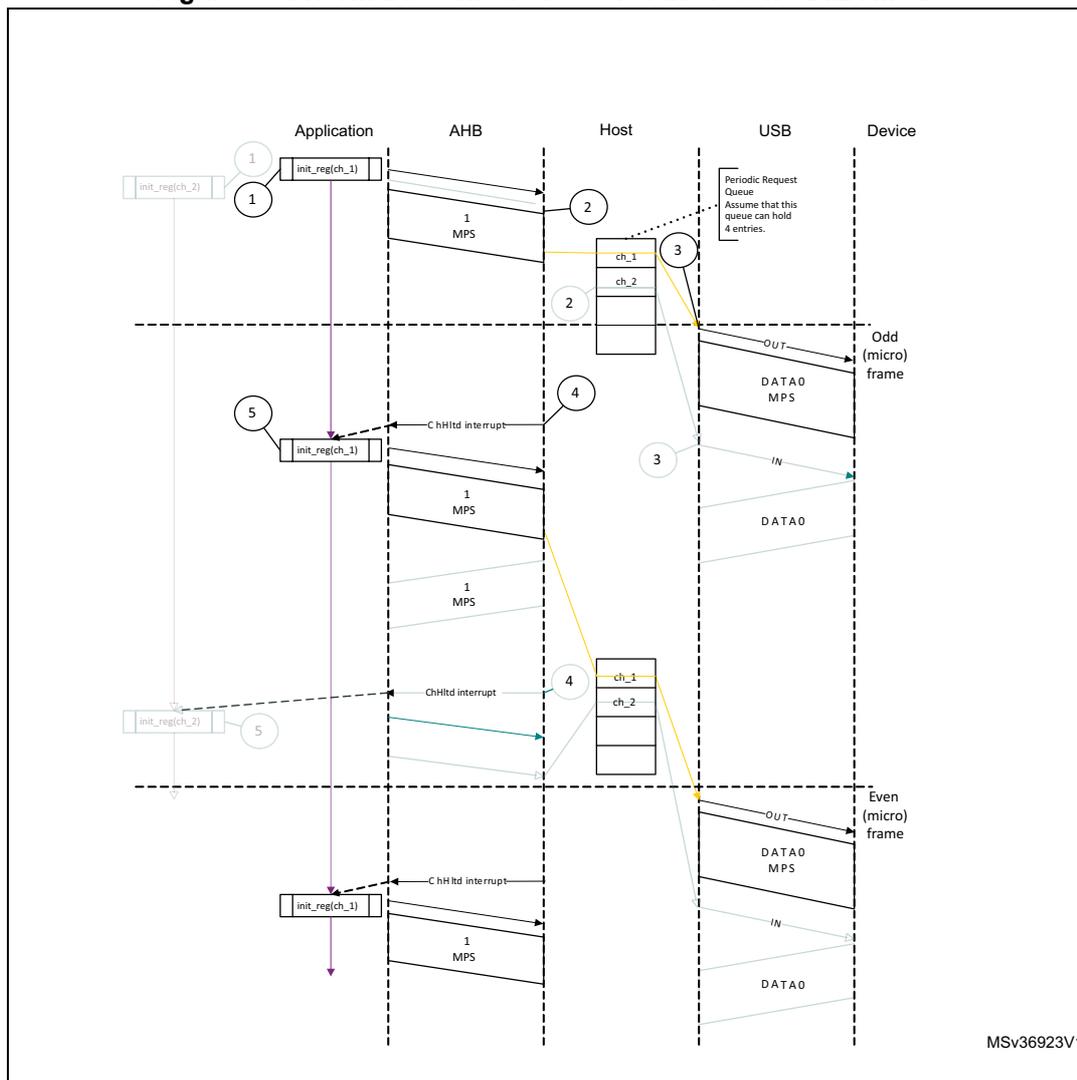
The diagram illustrates the sequence of operations for a normal isochronous OUT transaction in DMA mode. It features five vertical lifelines: Application, AHB, Host, USB, and Device. 1. The Application sends initialization commands (init_reg_ch_1, init_reg_ch_2) to the Host via the AHB. 2. The Host uses the AHB to transfer data (1 MPS) to the USB. 3. The USB has a 'Periodic Request Queue' (assume 4 entries). The Host adds entries for channels ch_1 and ch_2. 4. The USB transmits an OUT token and DATA0 packet to the Device in an 'Odd (micro) frame'. 5. The Host generates a 'CHHtd interrupt' when the channel is halted. 6. The USB transmits an OUT token and DATA0 packet to the Device in an 'Even (micro) frame'. 7. The Host generates another 'CHHtd interrupt'. The diagram is labeled MSV36923V1.
- • Isochronous IN transactions in DMA mode
The sequence of operations ((channel x) is as follows:
- 1. Initialize and enable channel x as explained in Section : Channel initialization .
- 2. The OTG_HS host writes an IN request to the request queue as soon as the channel x gets the grant from the arbiter (round-robin with fairness). In high-bandwidth transfers, the OTG_HS host performs consecutive write operations up to MC times.
- 3. The OTG_HS host attempts to send an IN token at the beginning of the next (odd) frame/micro-frame.
- 4. As soon the packet is received and written to the receive FIFO, the OTG_HS host generates a CHH interrupt.
- 5. In response to the CHH interrupt, reinitialize the channel for the next transfer.
Figure 940. Normal isochronous IN transactions - DMA mode
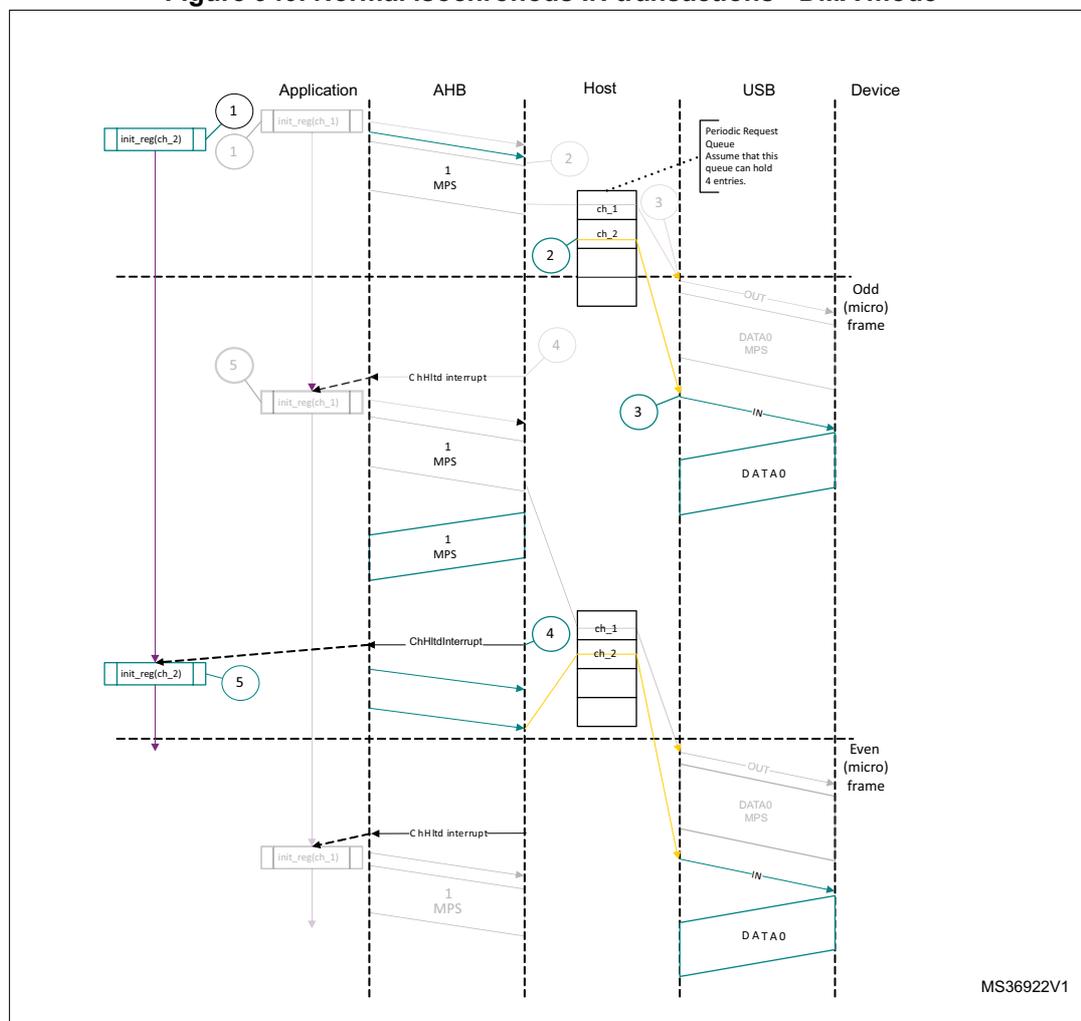
- • Bulk and control OUT/SETUP split transactions in DMA mode
The sequence of operations in (channel x) is as follows:
- 1. Initialize and enable channel x for start split as explained in Section : Channel initialization .
- 2. The OTG_HS host starts fetching the first packet as soon the channel is enabled and writes the OUT request along with the last 32-bit word fetch.
- 3. After successfully transmitting start split, the OTG_HS host generates the CHH interrupt.
- 4. In response to the CHH interrupt, set the COMPLSPLT bit in OTG_HCSPLT1 to send the complete split.
5. After successfully transmitting complete split, the OTG_HS host generates the CHH interrupt.
6. In response to the CHH interrupt, de-allocate the channel.
- • Bulk/control IN split transactions in DMA mode
The sequence of operations (channel x) is as follows:
- 1. Initialize and enable channel x as explained in Section : Channel initialization .
- 2. The OTG_HS host writes the start split request to the nonperiodic request after getting the grant from the arbiter. The OTG_HS host masks the channel x internally for the arbitration after writing the request.
- 3. As soon as the IN token is transmitted, the OTG_HS host generates the CHH interrupt.
- 4. In response to the CHH interrupt, set the COMPLSPLT bit in OTG_HCSPLT2 and re-enable the channel to send the complete split token. This unmaskes channel x for arbitration.
- 5. The OTG_HS host writes the complete split request to the nonperiodic request after receiving the grant from the arbiter.
- 6. The OTG_HS host starts writing the packet to the system memory after receiving the packet successfully.
- 7. As soon as the received packet is written to the system memory, the OTG_HS host generates a CHH interrupt.
- 8. In response to the CHH interrupt, de-allocate the channel.
- • Interrupt OUT split transactions in DMA mode
The sequence of operations in (channel x) is as follows:
- 1. Initialize and enable channel 1 for start split as explained in Section : Channel initialization . The application must set the ODDFRM bit in OTG_HCCHAR1.
- 2. The OTG_HS host starts reading the packet.
- 3. The OTG_HS host attempts to send the start split transaction.
- 4. After successfully transmitting the start split, the OTG_HS host generates the CHH interrupt.
- 5. In response to the CHH interrupt, set the COMPLSPLT bit in OTG_HCSPLT1 to send the complete split.
- 6. After successfully completing the complete split transaction, the OTG_HS host generates the CHH interrupt.
- 7. In response to CHH interrupt, de-allocate the channel.
- • Interrupt IN split transactions in DMA mode
The sequence of operations in (channel x) is as follows:
- 1. Initialize and enable channel x for start split as explained in Section : Channel initialization .
- 2. The OTG_HS host writes an IN request to the request queue as soon as channel x receives the grant from the arbiter.
- 3. The OTG_HS host attempts to send the start split IN token at the beginning of the next odd micro-frame.
- 4. The OTG_HS host generates the CHH interrupt after successfully transmitting the start split IN token.
- 5. In response to the CHH interrupt, set the COMPLSPLT bit in OTG_HCSPLT2 to send the complete split.
- 6. As soon as the packet is received successfully, the OTG_HS host starts writing the data to the system memory.
- 7. The OTG_HS host generates the CHH interrupt after transferring the received data to the system memory.
- 8. In response to the CHH interrupt, de-allocate or reinitialize the channel for the next start split.
- • Isochronous OUT split transactions in DMA mode
The sequence of operations (channel x) is as follows:
- 1. Initialize and enable channel x for start split (begin) as explained in Section : Channel initialization . The application must set the ODDFRM bit in OTG_HCCHAR1. Program the MPS field.
- 2. The OTG_HS host starts reading the packet.
- 3. After successfully transmitting the start split (begin), the OTG_HS host generates the CHH interrupt.
- 4. In response to the CHH interrupt, reinitialize the registers to send the start split (end).
- 5. After successfully transmitting the start split (end), the OTG_HS host generates a CHH interrupt.
- 6. In response to the CHH interrupt, de-allocate the channel.
- • Isochronous IN split transactions in DMA mode
The sequence of operations (channel x) is as follows:
- 1. Initialize and enable channel x for start split as explained in Section : Channel initialization .
- 2. The OTG_HS host writes an IN request to the request queue as soon as channel x receives the grant from the arbiter.
- 3. The OTG_HS host attempts to send the start split IN token at the beginning of the next odd micro-frame.
- 4. The OTG_HS host generates the CHH interrupt after successfully transmitting the start split IN token.
- 5. In response to the CHH interrupt, set the COMPLSPLIT bit in OTG_HCSPLIT2 to send the complete split.
- 6. As soon as the packet is received successfully, the OTG_HS host starts writing the data to the system memory.
The OTG_HS host generates the CHH interrupt after transferring the received data to the system memory. In response to the CHH interrupt, de-allocate the channel or reinitialize the channel for the next start split.
73.15.6 Device programming model
Endpoint initialization on USB reset
- 1. Set the NAK bit for all OUT endpoints
- – SNAK = 1 in OTG_DOEPCTLx (for all OUT endpoints)
- 2. Unmask the following interrupt bits
- – INEP0 = 1 in OTG_DAINTEMSK (control 0 IN endpoint)
- – OUTEP0 = 1 in OTG_DAINTEMSK (control 0 OUT endpoint)
- – STUPM = 1 in OTG_DOEPMASK
- – XFRCM = 1 in OTG_DOEPMASK
- – XFRCM = 1 in OTG_DIEPMASK
- – TOM = 1 in OTG_DIEPMASK
- 3. Set up the data FIFO RAM for each of the FIFOs
- – Program the OTG_GRXFSIZ register, to be able to receive control OUT data and setup data. If thresholding is not enabled, at a minimum, this must be equal to 1 max packet size of control endpoint 0 + 2 words (for the status of the control OUT data packet) + 10 words (for setup packets).
- – Program the OTG_DIEPTXF0 register (depending on the FIFO number chosen) to be able to transmit control IN data. At a minimum, this must be equal to 1 max packet size of control endpoint 0.
- 4. Program the following fields in the endpoint-specific registers for control OUT endpoint 0 to receive a SETUP packet
- – STUPCNT = 3 in OTG_DOEPTSIZ0 (to receive up to 3 back-to-back SETUP packets)
- 5. For USB OTG_HS in DMA mode, the OTG_DOEPDMA0 register must have a valid memory address to store any SETUP packets received.
At this point, all initialization required to receive SETUP packets is done.
Endpoint initialization on enumeration completion
- 1. On the Enumeration Done interrupt (ENUMDNE in OTG_GINTSTS), read the OTG_DSTS register to determine the enumeration speed.
- 2. Program the MPSIZ field in OTG_DIEPCTL0 to set the maximum packet size. This step configures control endpoint 0. The maximum packet size for a control endpoint depends on the enumeration speed.
- 3. For USB OTG_HS in DMA mode, program the OTG_DOEPCTL0 register to enable control OUT endpoint 0, to receive a SETUP packet.
At this point, the device is ready to receive SOF packets and is configured to perform control transfers on control endpoint 0.
Endpoint initialization on SetAddress command
This section describes what the application must do when it receives a SetAddress command in a SETUP packet.
- 1. Program the OTG_DCFG register with the device address received in the SetAddress command
- 2. Program the core to send out a status IN packet
Endpoint initialization on SetConfiguration/SetInterface command
This section describes what the application must do when it receives a SetConfiguration or SetInterface command in a SETUP packet.
- 1. When a SetConfiguration command is received, the application must program the endpoint registers to configure them with the characteristics of the valid endpoints in the new configuration.
- 2. When a SetInterface command is received, the application must program the endpoint registers of the endpoints affected by this command.
- 3. Some endpoints that were active in the prior configuration or alternate setting are not valid in the new configuration or alternate setting. These invalid endpoints must be deactivated.
- 4. Unmask the interrupt for each active endpoint and mask the interrupts for all inactive endpoints in the OTG_DAINTRMSK register.
- 5. Set up the data FIFO RAM for each FIFO.
- 6. After all required endpoints are configured; the application must program the core to send a status IN packet.
At this point, the device core is configured to receive and transmit any type of data packet.
Endpoint activation
This section describes the steps required to activate a device endpoint or to configure an existing device endpoint to a new type.
- 1. Program the characteristics of the required endpoint into the following fields of the OTG_DIEPCTLx register (for IN or bidirectional endpoints) or the OTG_DOEPCTLx register (for OUT or bidirectional endpoints).
- – Maximum packet size
- – USB active endpoint = 1
- – Endpoint start data toggle (for interrupt and bulk endpoints)
- – Endpoint type
- – Tx FIFO number
- 2. Once the endpoint is activated, the core starts decoding the tokens addressed to that endpoint and sends out a valid handshake for each valid token received for the endpoint.
Endpoint deactivation
This section describes the steps required to deactivate an existing endpoint.
- 1. In the endpoint to be deactivated, clear the USB active endpoint bit in the OTG_DIEPCTLx register (for IN or bidirectional endpoints) or the OTG_DOEPCTLx register (for OUT or bidirectional endpoints).
- 2. Once the endpoint is deactivated, the core ignores tokens addressed to that endpoint, which results in a timeout on the USB.
Note: The application must meet the following conditions to set up the device core to handle traffic:
NPTXFEM and RXFLVLM in the OTG_GINTMSK register must be cleared.
Operational model
SETUP and OUT data transfers:
This section describes the internal data flow and application-level operations during data OUT transfers and SETUP transactions.
- • Packet read
This section describes how to read packets (OUT data and SETUP packets) from the receive FIFO.
- 1. On catching an RXFLVL interrupt (OTG_GINTSTS register), the application must read the receive status pop register (OTG_GRXSTSP).
- 2. The application can mask the RXFLVL interrupt (in OTG_GINTSTS) by writing to RXFLVLM = 0 (in OTG_GINTMSK), until it has read the packet from the receive FIFO.
- 3. If the received packet's byte count is not 0, the byte count amount of data is popped from the receive data FIFO and stored in memory. If the received packet byte count is 0, no data is popped from the receive data FIFO.
- 4. The receive status readout of the packet of FIFO indicates one of the following:
- a) Global OUT NAK pattern:
PKTSTS = Global OUT NAK, BCNT = 0x000, EPNUM = (0x0),
DPID = (0b00).
These data indicate that the global OUT NAK bit has taken effect. - b) SETUP packet pattern:
PKTSTS = SETUP, BCNT = 0x008, EPNUM = Control EP Num,
DPID = DATA0. These data indicate that a SETUP packet for the specified endpoint is now available for reading from the receive FIFO. - c) Setup stage done pattern:
PKTSTS = Setup Stage Done, BCNT = 0x0, EPNUM = Control EP Num,
DPID = (0b00).
These data indicate that the setup stage for the specified endpoint has completed and the data stage has started. After this entry is popped from the receive FIFO, the core asserts a setup interrupt on the specified control OUT endpoint. - d) Data OUT packet pattern:
PKTSTS = DataOUT, BCNT = size of the received data OUT packet ( \( 0 \leq BCNT \leq 1024 \) ), EPNUM = EPNUM on which the packet was received, DPID = Actual Data PID. - e) Data transfer completed pattern:
PKTSTS = Data OUT transfer done, BCNT = 0x0, EPNUM = OUT EP Num on which the data transfer is complete, DPID = (0b00).
These data indicate that an OUT data transfer for the specified OUT endpoint has completed. After this entry is popped from the receive FIFO, the core asserts a transfer completed interrupt on the specified OUT endpoint.
- a) Global OUT NAK pattern:
- 5. After the data payload is popped from the receive FIFO, the RXFLVL interrupt (OTG_GINTSTS) must be unmasked.
- 6. Steps 1–5 are repeated every time the application detects assertion of the interrupt line due to RXFLVL in OTG_GINTSTS. Reading an empty receive FIFO can result in undefined core behavior.
Figure 941 provides a flowchart of the above procedure.
Figure 941. Receive FIFO packet read
![Flowchart for receiving a FIFO packet. The process starts with 'wait until RXFLVL in OTG_FS_GINTSTSG', followed by 'rd_data = rd_reg(OTG_FS_GRXSTSP)'. A decision diamond 'rd_data.BCNT = 0' follows. If 'Y' (Yes), the process ends. If 'N' (No), it enters a loop: 'mem[0: word_cnt - 1] = rd_rxfifo(rd_data.EPNUM, word_cnt)'. A bracket on the left labels this as 'packet store in memory'. A bracket on the right labels the loop as 'rcv_out_pkt()'. A box on the right shows the calculation: 'word_cnt = BCNT[11:2] + (BCNT[1] BCNT[1])'. The flowchart ends with 'ai15677b'.](/RM0456-STM32U5/c2c53743877429b6f23bbdada02c2317_img.jpg)
graph TD
    Start(( )) --> Wait[wait until RXFLVL in OTG_FS_GINTSTSG]
    Wait --> RdData[rd_data = rd_reg(OTG_FS_GRXSTSP)]
    RdData --> Decision{rd_data.BCNT = 0}
    Decision -- Y --> End(( ))
    Decision -- N --> MemStore[mem[0: word_cnt - 1] = rd_rxfifo(rd_data.EPNUM, word_cnt)]
    MemStore --> WordCntCalc[word_cnt = BCNT[11:2] + (BCNT[1] BCNT[1])]
    WordCntCalc --> MemStore
    MemStore -.-> PacketStore[packet store in memory]
    MemStore -.-> RcvoOutPkt[rcv_out_pkt()]
    WordCntCalc -.-> RcvoOutPkt
    WordCntCalc -.-> Ai15677b[ai15677b]
SETUP transactions
This section describes how the core handles SETUP packets and the application's sequence for handling SETUP transactions.
- • Application requirements
- 1. To receive a SETUP packet, the STUPCNT field (OTG_DOEPTSIZx) in a control OUT endpoint must be programmed to a non-zero value. When the application programs the STUPCNT field to a non-zero value, the core receives SETUP packets and writes them to the receive FIFO, irrespective of the NAK status and EPENA bit setting in OTG_DOEPCTLx. The STUPCNT field is decremented every time the control endpoint receives a SETUP packet. If the STUPCNT field is not programmed to a proper value before receiving a SETUP packet, the core still receives the SETUP packet and decrements the STUPCNT field, but the application may not be able to determine the correct number of SETUP packets received in the setup stage of a control transfer.
- – STUPCNT = 3 in OTG_DOEPTSIZx
- 2. The application must always allocate some extra space in the receive data FIFO, to be able to receive up to three SETUP packets on a control endpoint.
- – The space to be reserved is 10 words. Three words are required for the first SETUP packet, 1 word is required for the setup stage done word and 6 words are required to store two extra SETUP packets among all control endpoints.
- – 3 words per SETUP packet are required to store 8 bytes of SETUP data and 4 bytes of SETUP status (setup packet pattern). The core reserves this space in the
receive data FIFO to write SETUP data only, and never uses this space for data packets.
- 3. The application must read the 2 words of the SETUP packet from the receive FIFO.
- 4. The application must read and discard the setup stage done word from the receive FIFO.
- • Internal data flow
- 1. When a SETUP packet is received, the core writes the received data to the receive FIFO, without checking for available space in the receive FIFO and irrespective of the endpoint's NAK and STALL bit settings.
- – The core internally sets the IN NAK and OUT NAK bits for the control IN/OUT endpoints on which the SETUP packet was received.
- 2. For every SETUP packet received on the USB, 3 words of data are written to the receive FIFO, and the STUPCNT field is decremented by 1.
- – The first word contains control information used internally by the core
- – The second word contains the first 4 bytes of the SETUP command
- – The third word contains the last 4 bytes of the SETUP command
- 3. When the setup stage changes to a data IN/OUT stage, the core writes an entry (setup stage done word) to the receive FIFO, indicating the completion of the setup stage.
- 4. On the AHB side, SETUP packets are emptied by the application.
- 5. When the application pops the setup stage done word from the receive FIFO, the core interrupts the application with an STUP interrupt (OTG_DOEPINTx), indicating it can process the received SETUP packet.
- 6. The core clears the endpoint enable bit for control OUT endpoints.
- • Application programming sequence
- 1. Program the OTG_DOEPTSIZx register.
- – STUPCNT = 3
- 2. Wait for the RXFLVL interrupt (OTG_GINTSTS) and empty the data packets from the receive FIFO.
- 3. Assertion of the STUP interrupt (OTG_DOEPINTx) marks a successful completion of the SETUP data transfer.
- – On this interrupt, the application must read the OTG_DOEPTSIZx register to determine the number of SETUP packets received and process the last received SETUP packet.
Figure 942. Processing a SETUP packet
![Flowchart illustrating the processing of a SETUP packet. The steps are: Wait for STP in OTG_DOEPINTx, rem_supcnt = rd_reg(OTG_DOEPTSIZx), setup_cmd[31:0] = mem[4 - 2 * rem_supcnt], setup_cmd[63:32] = mem[5 - 2 * rem_supcnt], Find setup cmd type, and a decision diamond for ctrl_rd/wr/2 stage. The decision leads to Read (setup_np_in_pkt Data IN phase), 2-stage (setup_np_in_pkt Status IN phase), or Write (rcv_out_pkt Data OUT phase).](/RM0456-STM32U5/fa64ab72f0f4d1608728c44cbae28ba8_img.jpg)
graph TD
    A[Wait for STP in OTG_DOEPINTx] --> B["rem_supcnt=
rd_reg(OTG_DOEPTSIZx)"]
    B --> C["setup_cmd[31:0] = mem[4 - 2 * rem_supcnt]
setup_cmd[63:32] = mem[5 - 2 * rem_supcnt]"]
    C --> D[Find setup cmd type]
    D --> E{ctrl_rd/wr/2 stage}
    E -- Read --> F["setup_np_in_pkt
Data IN phase"]
    E -- 2-stage --> G["setup_np_in_pkt
Status IN phase"]
    E -- Write --> H["rcv_out_pkt
Data OUT phase"]
MSv37035V1
- • Handling more than three back-to-back SETUP packets
Per the USB 2.0 specification, normally, during a SETUP packet error, a host does not send more than three back-to-back SETUP packets to the same endpoint. However, the USB 2.0 specification does not limit the number of back-to-back SETUP packets a host can send to the same endpoint. When this condition occurs, the OTG_HS controller generates an interrupt (B2BSTUP in OTG_DOEPINTx).
- • Setting the global OUT NAK
Internal data flow:
- 1. When the application sets the Global OUT NAK (SGONAK bit in OTG_DCTL), the core stops writing data, except SETUP packets, to the receive FIFO. Irrespective of the space availability in the receive FIFO, non-isochronous OUT tokens receive a NAK handshake response, and the core ignores isochronous OUT data packets
- 2. The core writes the Global OUT NAK pattern to the receive FIFO. The application must reserve enough receive FIFO space to write this data pattern.
- 3. When the application pops the Global OUT NAK pattern word from the receive FIFO, the core sets the GONAKEFF interrupt (OTG_GINTSTS).
- 4. Once the application detects this interrupt, it can assume that the core is in Global OUT NAK mode. The application can clear this interrupt by clearing the SGONAK bit in OTG_DCTL.
Application programming sequence:
- 1. To stop receiving any kind of data in the receive FIFO, the application must set the Global OUT NAK bit by programming the following field:
- – SGONAK = 1 in OTG_DCTL
- 2. Wait for the assertion of the GONAKEFF interrupt in OTG_GINTSTS. When asserted, this interrupt indicates that the core has stopped receiving any type of data except SETUP packets.
- 3. The application can receive valid OUT packets after it has set SGONAK in OTG_DCTL and before the core asserts the GONAKEFF interrupt (OTG_GINTSTS).
- 4. The application can temporarily mask this interrupt by writing to the GONAKEFFM bit in the OTG_GINTMSK register.
- – GONAKEFFM = 0 in the OTG_GINTMSK register
- 5. Whenever the application is ready to exit the Global OUT NAK mode, it must clear the SGONAK bit in OTG_DCTL. This also clears the GONAKEFF interrupt (OTG_GINTSTS).
- – CGONAK = 1 in OTG_DCTL
- 6. If the application has masked this interrupt earlier, it must be unmasked as follows:
- – GONAKEFFM = 1 in OTG_GINTMSK
- • Disabling an OUT endpoint
The application must use this sequence to disable an OUT endpoint that it has enabled.
Application programming sequence:
- 1. Before disabling any OUT endpoint, the application must enable Global OUT NAK mode in the core.
- – SGONAK = 1 in OTG_DCTL
- 2. Wait for the GONAKEFF interrupt (OTG_GINTSTS)
- 3. Disable the required OUT endpoint by programming the following fields:
- – EPDIS = 1 in OTG_DOEPCTLx
- – SNAK = 1 in OTG_DOEPCTLx
- 4. Wait for the EPDISD interrupt (OTG_DOEPINTx), which indicates that the OUT endpoint is completely disabled. When the EPDISD interrupt is asserted, the core also clears the following bits:
- – EPDIS = 0 in OTG_DOEPCTLx
- – EPENA = 0 in OTG_DOEPCTLx
- 5. The application must clear the Global OUT NAK bit to start receiving data from other non-disabled OUT endpoints.
- – SGONAK = 0 in OTG_DCTL
- • Transfer Stop Programming for OUT endpoints
The application must use the following programming sequence to stop any transfers (because of an interrupt from the host, typically a reset).
Sequence of operations:
- 1. Enable all OUT endpoints by setting
- – EPENA = 1 in all OTG_DOEPCTLx registers.
- 2. Flush the RxFIFO as follows
- – Poll OTG_GRSTCTL.AHBIDL until it is 1. This indicates that AHB master is idle.
- – Perform read modify write operation on OTG_GRSTCTL.RXFFLSH = 1
- – Poll OTG_GRSTCTL.RXFFLSH until it is 0, but also using a timeout of less than 10 milli-seconds (corresponds to minimum reset signaling duration). If 0 is seen before the timeout, then the RxFIFO flush is successful. If at the moment the timeout occurs, there is still a 1, (this may be due to a packet on EP0 coming from the host) then go back (once only) to the previous step (“Perform read modify write operation”).
- 3. Before disabling any OUT endpoint, the application must enable Global OUT NAK mode in the core, according to the instructions in “Setting the global OUT NAK” . This ensures that data in the RxFIFO is sent to the application successfully. Set SGONAK = 1 in OTG_DCTL
- 4. Wait for the GONAKEFF interrupt (OTG_GINTSTS)
- 5. Disable all active OUT endpoints by programming the following register bits:
- – EPDIS = 1 in registers OTG_DOEPCTLx
- – SNAK = 1 in registers OTG_DOEPCTLx
- 6. Wait for the EPDIS interrupt in OTG_DOEPINTx for each OUT endpoint programmed in the previous step. The EPDIS interrupt in OTG_DOEPINTx indicates that the corresponding OUT endpoint is completely disabled. When the EPDIS interrupt is asserted, the following bits are cleared:
- – EPENA = 0 in registers OTG_DOEPCTLx
- – EPDIS = 0 in registers OTG_DOEPCTLx
- – SNAK = 0 in registers OTG_DOEPCTLx
- • Generic non-isochronous OUT data transfers
This section describes a regular non-isochronous OUT data transfer (control, bulk, or interrupt).
Application requirements:
- 1. Before setting up an OUT transfer, the application must allocate a buffer in the memory to accommodate all data to be received as part of the OUT transfer.
- 2. For OUT transfers, the transfer size field in the endpoint’s transfer size register must be a multiple of the maximum packet size of the endpoint, adjusted to the word boundary.
- – transfer size[EPNUM] = \( n \times (\text{MPSIZ[EPNUM]} + 4 - (\text{MPSIZ[EPNUM]} \bmod 4)) \)
- – packet count[EPNUM] = \( n \)
- – \( n > 0 \)
- 3. On any OUT endpoint interrupt, the application must read the endpoint’s transfer size register to calculate the size of the payload in the memory. The received payload size can be less than the programmed transfer size.
- – Payload size in memory = application programmed initial transfer size – core updated final transfer size
- – Number of USB packets in which this payload was received = application programmed initial packet count – core updated final packet count
Internal data flow:
- 1. The application must set the transfer size and packet count fields in the endpoint-specific registers, clear the NAK bit, and enable the endpoint to receive the data.
- 2. Once the NAK bit is cleared, the core starts receiving data and writes it to the receive FIFO, as long as there is space in the receive FIFO. For every data packet received on the USB, the data packet and its status are written to the receive FIFO. Every packet (maximum packet size or short packet) written to the receive FIFO decrements the packet count field for that endpoint by 1.
- – OUT data packets received with bad data CRC are flushed from the receive FIFO automatically.
- – After sending an ACK for the packet on the USB, the core discards non-isochronous OUT data packets that the host, which cannot detect the ACK, re-sends. The application does not detect multiple back-to-back data OUT packets on the same endpoint with the same data PID. In this case the packet count is not decremented.
- – If there is no space in the receive FIFO, isochronous or non-isochronous data packets are ignored and not written to the receive FIFO. Additionally, non-isochronous OUT tokens receive a NAK handshake reply.
- – In all the above three cases, the packet count is not decremented because no data are written to the receive FIFO.
- 3. When the packet count becomes 0 or when a short packet is received on the endpoint, the NAK bit for that endpoint is set. Once the NAK bit is set, the isochronous or non-isochronous data packets are ignored and not written to the receive FIFO, and non-isochronous OUT tokens receive a NAK handshake reply.
- 4. After the data are written to the receive FIFO, the application reads the data from the receive FIFO and writes it to external memory, one packet at a time per endpoint.
- 5. At the end of every packet write on the AHB to external memory, the transfer size for the endpoint is decremented by the size of the written packet.
- 6. The OUT data transfer completed pattern for an OUT endpoint is written to the receive FIFO on one of the following conditions:
- – The transfer size is 0 and the packet count is 0
- – The last OUT data packet written to the receive FIFO is a short packet ( \( 0 \leq \text{packet size} < \text{maximum packet size} \) )
- 7. When either the application pops this entry (OUT data transfer completed), a transfer completed interrupt is generated for the endpoint and the endpoint enable is cleared.
Application programming sequence:
- 1. Program the OTG_DOEPTSIZx register for the transfer size and the corresponding packet count.
- 2. Program the OTG_DOEPCTLx register with the endpoint characteristics, and set the EPENA and CNAK bits.
- – EPENA = 1 in OTG_DOEPCTLx
- – CNAK = 1 in OTG_DOEPCTLx
- 3. Wait for the RXFLVL interrupt (in OTG_GINTSTS) and empty the data packets from the receive FIFO.
- – This step can be repeated many times, depending on the transfer size.
- 4. Asserting the XFRC interrupt (OTG_DOEPINTx) marks a successful completion of the non-isochronous OUT data transfer.
- 5. Read the OTG_DOEPTSIZx register to determine the size of the received data payload.
- • Generic isochronous OUT data transfer
This section describes a regular isochronous OUT data transfer.
Application requirements:
- 1. All the application requirements for non-isochronous OUT data transfers also apply to isochronous OUT data transfers.
- 2. For isochronous OUT data transfers, the transfer size and packet count fields must always be set to the number of maximum-packet-size packets that can be received in a single frame and no more. Isochronous OUT data transfers cannot span more than 1 frame.
- 3. The application must read all isochronous OUT data packets from the receive FIFO (data and status) before the end of the periodic frame (EOPF interrupt in OTG_GINTSTS).
- 4. To receive data in the following frame, an isochronous OUT endpoint must be enabled after the EOPF (OTG_GINTSTS) and before the SOF (OTG_GINTSTS).
Internal data flow:
- 1. The internal data flow for isochronous OUT endpoints is the same as that for non-isochronous OUT endpoints, but for a few differences.
- 2. When an isochronous OUT endpoint is enabled by setting the endpoint enable and clearing the NAK bits, the Even/Odd frame bit must also be set appropriately. The core receives data on an isochronous OUT endpoint in a particular frame only if the following condition is met:
- – EONUM (in OTG_DOEPCTLx) = FNSOF[0] (in OTG_DSTS)
- 3. When the application completely reads an isochronous OUT data packet (data and status) from the receive FIFO, the core updates the RXDPID field in OTG_DOEPTSIZx with the data PID of the last isochronous OUT data packet read from the receive FIFO.
Application programming sequence:
- 1. Program the OTG_DOEPTSIZx register for the transfer size and the corresponding packet count
- 2. Program the OTG_DOEPCTLx register with the endpoint characteristics and set the endpoint enable, ClearNAK, and Even/Odd frame bits.
- – EPENA = 1
- – CNAK = 1
- – EONUM = (0: Even/1: Odd)
- 3. Wait for the RXFLVL interrupt (in OTG_GINTSTS) and empty the data packets from the receive FIFO
- – This step can be repeated many times, depending on the transfer size.
- 4. The assertion of the XFRC interrupt (in OTG_DOEPINTx) marks the completion of the isochronous OUT data transfer. This interrupt does not necessarily mean that the data in memory are good.
- 5. This interrupt cannot always be detected for isochronous OUT transfers. Instead, the application can detect the INCOMPISOOUT interrupt in OTG_GINTSTS.
- 6. Read the OTG_DOEPTSIZx register to determine the size of the received transfer and to determine the validity of the data received in the frame. The application must treat the data received in memory as valid only if one of the following conditions is met:
- – RXDPID = DATA0 (in OTG_DOEPTSIZx) and the number of USB packets in which this payload was received = 1
- – RXDPID = DATA1 (in OTG_DOEPTSIZx) and the number of USB packets in which this payload was received = 2
- – RXDPID = D2 (in OTG_DOEPTSIZx) and the number of USB packets in which this payload was received = 3
Application programmed initial packet count – core updated final packet count
The application can discard invalid data packets.
- • Incomplete isochronous OUT data transfers
This section describes the application programming sequence when isochronous OUT data packets are dropped inside the core.
Internal data flow:
- 1. For isochronous OUT endpoints, the XFRC interrupt (in OTG_DOEPINTx) may not always be asserted. If the core drops isochronous OUT data packets, the application may fail to detect the XFRC interrupt (OTG_DOEPINTx) under the following circumstances:
- – When the receive FIFO cannot accommodate the complete ISO OUT data packet, the core drops the received ISO OUT data
- – When the isochronous OUT data packet is received with CRC errors
- – When the isochronous OUT token received by the core is corrupted
- – When the application is very slow in reading the data from the receive FIFO
- 2. When the core detects an end of periodic frame before transfer completion to all isochronous OUT endpoints, it asserts the incomplete isochronous OUT data interrupt (INCOMPISOOUT in OTG_GINTSTS), indicating that an XFRC interrupt (in OTG_DOEPINTx) is not asserted on at least one of the isochronous OUT endpoints. At
this point, the endpoint with the incomplete transfer remains enabled, but no active transfers remain in progress on this endpoint on the USB.
Application programming sequence:
- 1. Asserting the INCOMPISOOUT interrupt (OTG_GINTSTS) indicates that in the current frame, at least one isochronous OUT endpoint has an incomplete transfer.
- 2. If this occurs because isochronous OUT data is not completely emptied from the endpoint, the application must ensure that the application empties all isochronous OUT data (data and status) from the receive FIFO before proceeding.
- – When all data are emptied from the receive FIFO, the application can detect the XFRC interrupt (OTG_DOEPINTx). In this case, the application must re-enable the endpoint to receive isochronous OUT data in the next frame.
- 3. When it receives an INCOMPISOOUT interrupt (in OTG_GINTSTS), the application must read the control registers of all isochronous OUT endpoints (OTG_DOEPCTLx) to determine which endpoints had an incomplete transfer in the current microframe. An endpoint transfer is incomplete if both the following conditions are met:
- – EONUM bit (in OTG_DOEPCTLx) = FNSOF[0] (in OTG_DSTS)
- – EPENA = 1 (in OTG_DOEPCTLx)
- 4. The previous step must be performed before the SOF interrupt (in OTG_GINTSTS) is detected, to ensure that the current frame number is not changed.
- 5. For isochronous OUT endpoints with incomplete transfers, the application must discard the data in the memory and disable the endpoint by setting the EPDIS bit in OTG_DOEPCTLx.
- 6. Wait for the EPDISD interrupt (in OTG_DOEPINTx) and enable the endpoint to receive new data in the next frame.
- – Because the core can take some time to disable the endpoint, the application may not be able to receive the data in the next frame after receiving bad isochronous data.
• Stalling a non-isochronous OUT endpoint
This section describes how the application can stall a non-isochronous endpoint.
- 1. Put the core in the Global OUT NAK mode.
- 2. Disable the required endpoint
- – When disabling the endpoint, instead of setting the SNAK bit in OTG_DOEPCTL, set STALL = 1 (in OTG_DOEPCTL).
The STALL bit always takes precedence over the NAK bit.
- 3. When the application is ready to end the STALL handshake for the endpoint, the STALL bit (in OTG_DOEPCTLx) must be cleared.
- 4. If the application is setting or clearing a STALL for an endpoint due to a SetFeature.Endpoint Halt or ClearFeature.Endpoint Halt command, the STALL bit must be set or cleared before the application sets up the status stage transfer on the control endpoint.
Examples
This section describes and depicts some fundamental transfer types and scenarios.
- • Bulk OUT transaction
Figure 943 depicts the reception of a single Bulk OUT data packet from the USB to the AHB and describes the events involved in the process.
Figure 943. Bulk OUT transaction
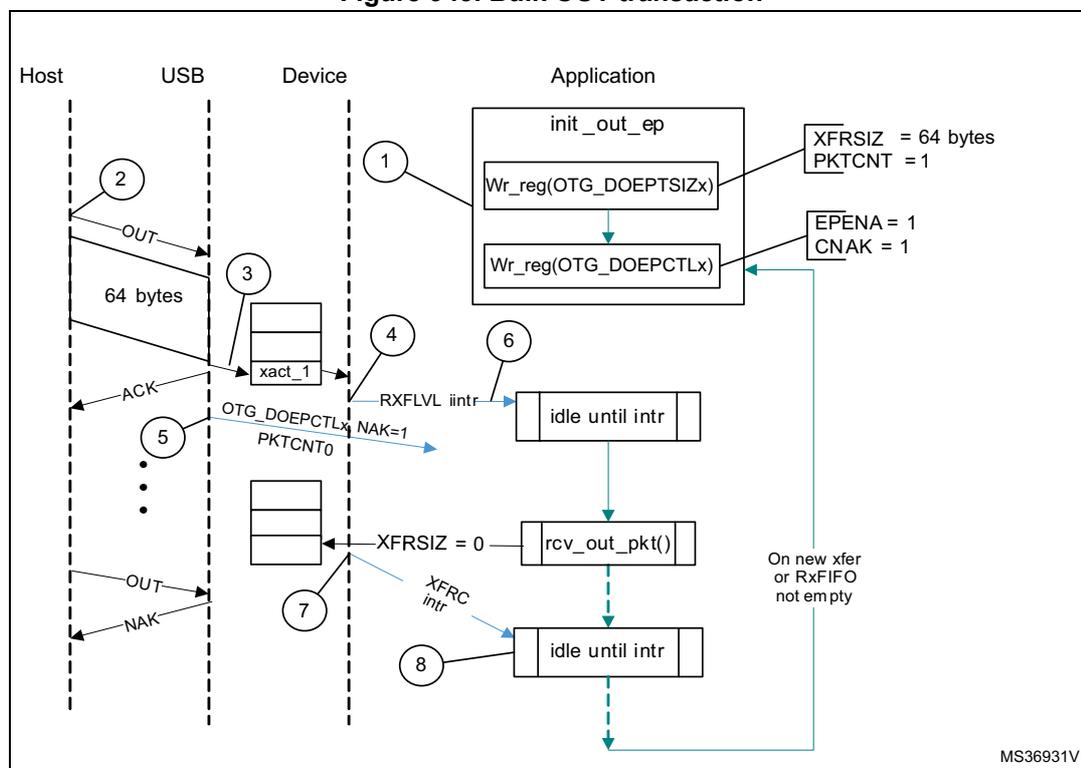
The diagram illustrates the sequence of events for a Bulk OUT transaction. It is divided into four vertical lanes: Host, USB, Device, and Application.
1. The Application initializes the endpoint using
init_out_ep
, writing to
OTG_DOEPTSIZx
(setting
XFRSIZ = 64
bytes and
PKTCNT = 1
) and
OTG_DOEPCTLx
(setting
EPENA = 1
and
CNAK = 1
).
2. The Host sends an OUT token (step 2) to the USB.
3. The USB transfers 64 bytes of data (step 3) to the Device's Rx FIFO.
4. The Device asserts the
RXFLVL
interrupt (step 4) when the FIFO is non-empty.
5. The Application responds with
NAK=1
and
PKTCNT0
(step 5) via
OTG_DOEPCTLx
.
6. The Application enters an
idle until intr
state (step 6).
7. After reading the data, the Device sets
XFRSIZ = 0
(step 7).
8. The Device generates an
XFRC
interrupt (step 8) when the transfer is complete.
9. The Application processes the
XFRC
interrupt and returns to an
idle until intr
state.
A feedback loop indicates that on a new transfer or if the Rx FIFO is not empty, the application will again write to
OTG_DOEPCTLx
.
After a SetConfiguration/SetInterface command, the application initializes all OUT endpoints by setting
CNAK = 1
and
EPENA = 1
(in
OTG_DOEPCTLx
), and setting a suitable
XFRSIZ
and
PKTCNT
in the
OTG_DOEPTSIZx
register.
- 1. host attempts to send data (OUT token) to an endpoint.
- 2. When the core receives the OUT token on the USB, it stores the packet in the Rx FIFO because space is available there.
- 3. After writing the complete packet in the Rx FIFO, the core then asserts the RXFLVL interrupt (in
OTG_GINTSTS). - 4. On receiving the
PKTCNTnumber of USB packets, the core internally sets the NAK bit for this endpoint to prevent it from receiving any more packets. - 5. The application processes the interrupt and reads the data from the Rx FIFO.
- 6. When the application has read all the data (equivalent to
XFRSIZ), the core generates an XFRC interrupt (inOTG_DOEPINTx). - 7. The application processes the interrupt and uses the setting of the XFRC interrupt bit (in
OTG_DOEPINTx) to determine that the intended transfer is complete.
IN data transfers
- • Packet write
This section describes how the application writes data packets to the endpoint FIFO when dedicated transmit FIFOs are enabled.
- 1. The application can either choose the polling or the interrupt mode.
- – In polling mode, the application monitors the status of the endpoint transmit data FIFO by reading the OTG_DTXFSTSx register, to determine if there is enough space in the data FIFO.
- – In interrupt mode, the application waits for the TXFE interrupt (in OTG_DIEPINTx) and then reads the OTG_DTXFSTSx register, to determine if there is enough space in the data FIFO.
- – To write a single non-zero length data packet, there must be space to write the entire packet in the data FIFO.
- – To write zero length packet, the application must not look at the FIFO space.
- 2. Using one of the above mentioned methods, when the application determines that there is enough space to write a transmit packet, the application must first write into the endpoint control register, before writing the data into the data FIFO. Typically, the application, must do a read modify write on the OTG_DIEPCTLx register to avoid modifying the contents of the register, except for setting the endpoint enable bit.
The application can write multiple packets for the same endpoint into the transmit FIFO, if space is available. For periodic IN endpoints, the application must write packets only for one microframe. It can write packets for the next periodic transaction only after getting transfer complete for the previous transaction.
- • Setting IN endpoint NAK
Internal data flow:
- 1. When the application sets the IN NAK for a particular endpoint, the core stops transmitting data on the endpoint, irrespective of data availability in the endpoint's transmit FIFO.
- 2. Non-isochronous IN tokens receive a NAK handshake reply
- – Isochronous IN tokens receive a zero-data-length packet reply
- 3. The core asserts the INEPNE (IN endpoint NAK effective) interrupt in OTG_DIEPINTx in response to the SNAK bit in OTG_DIEPCTLx.
- 4. Once this interrupt is seen by the application, the application can assume that the endpoint is in IN NAK mode. This interrupt can be cleared by the application by setting the CNAK bit in OTG_DIEPCTLx.
Application programming sequence:
- 1. To stop transmitting any data on a particular IN endpoint, the application must set the IN NAK bit. To set this bit, the following field must be programmed.
- – SNAK = 1 in OTG_DIEPCTLx
- 2. Wait for assertion of the INEPNE interrupt in OTG_DIEPINTx. This interrupt indicates that the core has stopped transmitting data on the endpoint.
- 3. The core can transmit valid IN data on the endpoint after the application has set the NAK bit, but before the assertion of the NAK Effective interrupt.
- 4. The application can mask this interrupt temporarily by writing to the INEPNEM bit in OTG_DIEPMSK.
- – INEPNEM = 0 in OTG_DIEPMSK
- 5. To exit endpoint NAK mode, the application must clear the NAK status bit (NAKSTS) in OTG_DIEPCTLx. This also clears the INEPNE interrupt (in OTG_DIEPINTx).
- – CNAK = 1 in OTG_DIEPCTLx
- 6. If the application masked this interrupt earlier, it must be unmasked as follows:
- – INEPNEM = 1 in OTG_DIEPMSK
- • IN endpoint disable
Use the following sequence to disable a specific IN endpoint that has been previously enabled.
Application programming sequence:
- 1. The application must stop writing data on the AHB for the IN endpoint to be disabled.
- 2. The application must set the endpoint in NAK mode.
- – SNAK = 1 in OTG_DIEPCTLx
- 3. Wait for the INEPNE interrupt in OTG_DIEPINTx.
- 4. Set the following bits in the OTG_DIEPCTLx register for the endpoint that must be disabled.
- – EPDIS = 1 in OTG_DIEPCTLx
- – SNAK = 1 in OTG_DIEPCTLx
- 5. Assertion of the EPDISD interrupt in OTG_DIEPINTx indicates that the core has completely disabled the specified endpoint. Along with the assertion of the interrupt, the core also clears the following bits:
- – EPENA = 0 in OTG_DIEPCTLx
- – EPDIS = 0 in OTG_DIEPCTLx
- 6. The application must read the OTG_DIEPTSIz register for the periodic IN EP, to calculate how much data on the endpoint were transmitted on the USB.
- 7. The application must flush the data in the endpoint transmit FIFO, by setting the following fields in the OTG_GRSTCTL register:
- – TXFNUM (in OTG_GRSTCTL) = Endpoint transmit FIFO number
- – TXFFLSH in (OTG_GRSTCTL) = 1
The application must poll the OTG_GRSTCTL register, until the TXFFLSH bit is cleared by the core, which indicates the end of flush operation. To transmit new data on this endpoint, the application can re-enable the endpoint at a later point.
- • Transfer Stop Programming for IN endpoints
The application must use the following programming sequence to stop any transfers (because of an interrupt from the host, typically a reset).
Sequence of operations:
- 1. Disable the IN endpoint by setting:
- – EPDIS = 1 in all OTG_DIEPCTLx registers
- 2. Wait for the EPDIS interrupt in OTG_DIEPINTx, which indicates that the IN endpoint is completely disabled. When the EPDIS interrupt is asserted the following bits are cleared:
- – EPDIS = 0 in OTG_DIEPCTLx
- – EPENA = 0 in OTG_DIEPCTLx
- 3. Flush the TxFIFO by programming the following bits:
- – TXFFLSH = 1 in OTG_GRSTCTL
- – TXFNUM = “FIFO number specific to endpoint” in OTG_GRSTCTL
- 4. The application can start polling till TXFFLSH in OTG_GRSTCTL is cleared. When this bit is cleared, it ensures that there is no data left in the Tx FIFO.
• Generic non-periodic IN data transfers
Application requirements:
- 1. Before setting up an IN transfer, the application must ensure that all data to be transmitted as part of the IN transfer are part of a single buffer.
- 2. For IN transfers, the transfer size field in the endpoint transfer size register denotes a payload that constitutes multiple maximum-packet-size packets and a single short packet. This short packet is transmitted at the end of the transfer.
- – To transmit a few maximum-packet-size packets and a short packet at the end of the transfer:
Transfer size[EPNUM] = \( x \times \text{MPSIZ[EPNUM]} + \text{sp} \)
If ( \( \text{sp} > 0 \) ), then packet count[EPNUM] = \( x + 1 \) .
Otherwise, packet count[EPNUM] = \( x \)
- – To transmit a single zero-length data packet:
Transfer size[EPNUM] = 0
Packet count[EPNUM] = 1
- – To transmit a few maximum-packet-size packets and a zero-length data packet at the end of the transfer, the application must split the transfer into two parts. The first sends maximum-packet-size data packets and the second sends the zero-length data packet alone.
First transfer: transfer size[EPNUM] = \( x \times \text{MPSIZ[epnum]} \) ; packet count = \( n \) ;
Second transfer: transfer size[EPNUM] = 0; packet count = 1;
- 3. Once an endpoint is enabled for data transfers, the core updates the transfer size register. At the end of the IN transfer, the application must read the transfer size register to determine how much data posted in the transmit FIFO have already been sent on the USB.
- 4. Data fetched into transmit FIFO = Application-programmed initial transfer size – core-updated final transfer size
- – Data transmitted on USB = (application-programmed initial packet count – core updated final packet count) \( \times \text{MPSIZ[EPNUM]} \)
- – Data yet to be transmitted on USB = (Application-programmed initial transfer size – data transmitted on USB)
Internal data flow:
- 1. The application must set the transfer size and packet count fields in the endpoint-specific registers and enable the endpoint to transmit the data.
- 2. The application must also write the required data to the transmit FIFO for the endpoint.
- 3. Every time a packet is written into the transmit FIFO by the application, the transfer size for that endpoint is decremented by the packet size. The data is fetched from the memory by the application, until the transfer size for the endpoint becomes 0. After writing the data into the FIFO, the “number of packets in FIFO” count is incremented (this is a 3-bit count, internally maintained by the core for each IN endpoint transmit FIFO. The maximum number of packets maintained by the core at any time in an IN endpoint FIFO is eight). For zero-length packets, a separate flag is set for each FIFO, without any data in the FIFO.
- 4. Once the data are written to the transmit FIFO, the core reads them out upon receiving an IN token. For every non-isochronous IN data packet transmitted with an ACK handshake, the packet count for the endpoint is decremented by one, until the packet count is zero. The packet count is not decremented on a timeout.
- 5. For zero length packets (indicated by an internal zero length flag), the core sends out a zero-length packet for the IN token and decrements the packet count field.
- 6. If there are no data in the FIFO for a received IN token and the packet count field for that endpoint is zero, the core generates an “IN token received when Tx FIFO is empty” (ITTxfe) interrupt for the endpoint, provided that the endpoint NAK bit is not set. The core responds with a NAK handshake for non-isochronous endpoints on the USB.
- 7. The core internally rewinds the FIFO pointers and no timeout interrupt is generated.
- 8. When the transfer size is 0 and the packet count is 0, the transfer complete (XFRC) interrupt for the endpoint is generated and the endpoint enable is cleared.
Application programming sequence:
- 1. Program the OTG_DIEPTSIZx register with the transfer size and corresponding packet count.
- 2. Program the OTG_DIEPCTLx register with the endpoint characteristics and set the CNAK and EPENA (endpoint enable) bits.
- 3. When transmitting non-zero length data packet, the application must poll the OTG_DTXFSTSx register (where x is the FIFO number associated with that endpoint) to determine whether there is enough space in the data FIFO. The application can optionally use TXFE (in OTG_DIEPINTx) before writing the data.
• Generic periodic IN data transfers
This section describes a typical periodic IN data transfer.
Application requirements:
- 1. Application requirements 1, 2, 3, and 4 of
Generic non-periodic IN data transfers
also apply to periodic IN data transfers, except for a slight modification of requirement 2.
- – The application can only transmit multiples of maximum-packet-size data packets or multiples of maximum-packet-size packets, plus a short packet at the end. To
transmit a few maximum-packet-size packets and a short packet at the end of the transfer, the following conditions must be met:
transfer size[EPNUM] = \( x \times \text{MPSIZ}[\text{EPNUM}] + \text{sp} \)
(where \( x \) is an integer \( \geq 0 \) , and \( 0 \leq \text{sp} < \text{MPSIZ}[\text{EPNUM}] \) )
If ( \( \text{sp} > 0 \) ), packet count[EPNUM] = \( x + 1 \)
Otherwise, packet count[EPNUM] = \( x \) ;
MCNT[EPNUM] = packet count[EPNUM]
- – The application cannot transmit a zero-length data packet at the end of a transfer. It can transmit a single zero-length data packet by itself. To transmit a single zero-length data packet:
- – transfer size[EPNUM] = 0
- – packet count[EPNUM] = 1
- – MCNT[EPNUM] = packet count[EPNUM]
- 2. The application can only schedule data transfers one frame at a time.
- – \( (\text{MCNT} - 1) \times \text{MPSIZ} \leq \text{XFERSIZ} \leq \text{MCNT} \times \text{MPSIZ} \)
- – PKTCNT = MCNT (in OTG_DIEPTSIZx)
- – If \( \text{XFERSIZ} < \text{MCNT} \times \text{MPSIZ} \) , the last data packet of the transfer is a short packet.
- – Note that: MCNT is in OTG_DIEPTSIZx, MPSIZ is in OTG_DIEPCTLx, PKTCNT is in OTG_DIEPTSIZx and XFERSIZ is in OTG_DIEPTSIZx
- 3. The complete data to be transmitted in the frame must be written into the transmit FIFO by the application, before the IN token is received. Even when 1 word of the data to be transmitted per frame is missing in the transmit FIFO when the IN token is received, the core behaves as when the FIFO is empty. When the transmit FIFO is empty:
- – A zero data length packet would be transmitted on the USB for isochronous IN endpoints
- – A NAK handshake would be transmitted on the USB for interrupt IN endpoints
- 2. The application can only schedule data transfers one frame at a time.
Internal data flow:
- 1. The application must set the transfer size and packet count fields in the endpoint-specific registers and enable the endpoint to transmit the data.
- 2. The application must also write the required data to the associated transmit FIFO for the endpoint.
- 3. Every time the application writes a packet to the transmit FIFO, the transfer size for that endpoint is decremented by the packet size. The data are fetched from application memory until the transfer size for the endpoint becomes 0.
- 4. When an IN token is received for a periodic endpoint, the core transmits the data in the FIFO, if available. If the complete data payload (complete packet, in dedicated FIFO
- mode) for the frame is not present in the FIFO, then the core generates an IN token received when Tx FIFO empty interrupt for the endpoint.
- – A zero-length data packet is transmitted on the USB for isochronous IN endpoints
- – A NAK handshake is transmitted on the USB for interrupt IN endpoints
- 5. The packet count for the endpoint is decremented by 1 under the following conditions:
- – For isochronous endpoints, when a zero- or non-zero-length data packet is transmitted
- – For interrupt endpoints, when an ACK handshake is transmitted
- – When the transfer size and packet count are both 0, the transfer completed interrupt for the endpoint is generated and the endpoint enable is cleared.
- 6. At the “Periodic frame Interval” (controlled by PFIVL in OTG_DCFG), when the core finds non-empty any of the isochronous IN endpoint FIFOs scheduled for the current frame non-empty, the core generates an IISOIXFR interrupt in OTG_GINTSTS.
- 5. The packet count for the endpoint is decremented by 1 under the following conditions:
Application programming sequence:
- 1. Program the OTG_DIEPCTLx register with the endpoint characteristics and set the CNAK and EPENA bits.
- 2. Write the data to be transmitted in the next frame to the transmit FIFO.
- 3. Asserting the ITTXFE interrupt (in OTG_DIEPINTx) indicates that the application has not yet written all data to be transmitted to the transmit FIFO.
- 4. If the interrupt endpoint is already enabled when this interrupt is detected, ignore the interrupt. If it is not enabled, enable the endpoint so that the data can be transmitted on the next IN token attempt.
- 5. Asserting the XFRC interrupt (in OTG_DIEPINTx) with no ITTXFE interrupt in OTG_DIEPINTx indicates the successful completion of an isochronous IN transfer. A read to the OTG_DIEPTSIZx register must give transfer size = 0 and packet count = 0, indicating all data were transmitted on the USB.
- 6. Asserting the XFRC interrupt (in OTG_DIEPINTx), with or without the ITTXFE interrupt (in OTG_DIEPINTx), indicates the successful completion of an interrupt IN transfer. A read to the OTG_DIEPTSIZx register must give transfer size = 0 and packet count = 0, indicating all data were transmitted on the USB.
- 7. Asserting the incomplete isochronous IN transfer (IISOIXFR) interrupt in OTG_GINTSTS with none of the aforementioned interrupts indicates the core did not receive at least 1 periodic IN token in the current frame.
• Incomplete isochronous IN data transfers
This section describes what the application must do on an incomplete isochronous IN data transfer.
Internal data flow:
- 1. An isochronous IN transfer is treated as incomplete in one of the following conditions:
- a) The core receives a corrupted isochronous IN token on at least one isochronous IN endpoint. In this case, the application detects an incomplete isochronous IN transfer interrupt (IISOIXFR in OTG_GINTSTS).
- b) The application is slow to write the complete data payload to the transmit FIFO and an IN token is received before the complete data payload is written to the FIFO. In this case, the application detects an IN token received when Tx FIFO empty interrupt in OTG_DIEPINTx. The application can ignore this interrupt, as it
eventually results in an incomplete isochronous IN transfer interrupt (IISOIXFR in OTG_GINTSTS) at the end of periodic frame.
The core transmits a zero-length data packet on the USB in response to the received IN token.
- 2. The application must stop writing the data payload to the transmit FIFO as soon as possible.
- 3. The application must set the NAK bit and the disable bit for the endpoint.
- 4. The core disables the endpoint, clears the disable bit, and asserts the endpoint disable interrupt for the endpoint.
Application programming sequence:
- 1. The application can ignore the IN token received when Tx FIFO empty interrupt in OTG_DIEPINTx on any isochronous IN endpoint, as it eventually results in an incomplete isochronous IN transfer interrupt (in OTG_GINTSTS).
- 2. Assertion of the incomplete isochronous IN transfer interrupt (in OTG_GINTSTS) indicates an incomplete isochronous IN transfer on at least one of the isochronous IN endpoints.
- 3. The application must read the endpoint control register for all isochronous IN endpoints to detect endpoints with incomplete IN data transfers.
- 4. The application must stop writing data to the Periodic Transmit FIFOs associated with these endpoints on the AHB.
- 5. Program the following fields in the OTG_DIEPCTLx register to disable the endpoint:
- – SNAK = 1 in OTG_DIEPCTLx
- – EPDIS = 1 in OTG_DIEPCTLx
- 6. The assertion of the endpoint disabled interrupt in OTG_DIEPINTx indicates that the core has disabled the endpoint.
- – At this point, the application must flush the data in the associated transmit FIFO or overwrite the existing data in the FIFO by enabling the endpoint for a new transfer in the next microframe. To flush the data, the application must use the OTG_GRSTCTL register.
- • Stalling non-isochronous IN endpoints
This section describes how the application can stall a non-isochronous endpoint.
Application programming sequence:
- 1. Disable the IN endpoint to be stalled. Set the STALL bit as well.
- 2. EPDIS = 1 in OTG_DIEPCTLx, when the endpoint is already enabled
- – STALL = 1 in OTG_DIEPCTLx
- – The STALL bit always takes precedence over the NAK bit
- 3. Assertion of the endpoint disabled interrupt (in OTG_DIEPINTx) indicates to the application that the core has disabled the specified endpoint.
- 4. The application must flush the non-periodic or periodic transmit FIFO, depending on the endpoint type. In case of a non-periodic endpoint, the application must re-enable the other non-periodic endpoints that do not need to be stalled, to transmit data.
- 5. Whenever the application is ready to end the STALL handshake for the endpoint, the STALL bit must be cleared in OTG_DIEPCTLx.
- 6. If the application sets or clears a STALL bit for an endpoint due to a SetFeature.Endpoint Halt command or ClearFeature.Endpoint Halt command, the STALL bit must be set or cleared before the application sets up the status stage transfer on the control endpoint.
Special case: stalling the control OUT endpoint
The core must stall IN/OUT tokens if, during the data stage of a control transfer, the host sends more IN/OUT tokens than are specified in the SETUP packet. In this case, the application must enable the ITTXFE interrupt in OTG_DIEPINTx and the OTEPDIS interrupt in OTG_DOEPINTx during the data stage of the control transfer, after the core has transferred the amount of data specified in the SETUP packet. Then, when the application receives this interrupt, it must set the STALL bit in the corresponding endpoint control register, and clear this interrupt.
73.15.7 Worst case response time
When the OTG_HS controller acts as a device, there is a worst case response time for any tokens that follow an isochronous OUT. This worst case response time depends on the AHB clock frequency.
The core registers are in the AHB domain, and the core does not accept another token before updating these register values. The worst case is for any token following an isochronous OUT, because for an isochronous transaction, there is no handshake and the next token may come sooner. This worst case value is 7 PHY clocks when the AHB clock is the same as the PHY clock. When the AHB clock is faster, this value is smaller.
If this worst case condition occurs, the core responds to bulk/interrupt tokens with a NAK and drops isochronous and SETUP tokens. The host interprets this as a timeout condition for SETUP and retries the SETUP packet. For isochronous transfers, the Incomplete isochronous IN transfer interrupt (IISOIXFR) and Incomplete isochronous OUT transfer interrupt (IISOOXFR) inform the application that isochronous IN/OUT packets were dropped.
Choosing the value of TRDT in OTG_GUSBCFG
The value in TRDT (OTG_GUSBCFG) is the time it takes for the MAC, in terms of PHY clocks after it has received an IN token, to get the FIFO status, and thus the first data from the PFC block. This time involves the synchronization delay between the PHY and AHB clocks. The worst case delay for this is when the AHB clock is the same as the PHY clock. In this case, the delay is 5 clocks.
Once the MAC receives an IN token, this information (token received) is synchronized to the AHB clock by the PFC (the PFC runs on the AHB clock). The PFC then reads the data from the SPRAM and writes them into the dual clock source buffer. The MAC then reads the data out of the source buffer (4 deep).
If the AHB is running at a higher frequency than the PHY, the application can use a smaller value for TRDT (in OTG_GUSBCFG).
Figure 944 has the following signals:
- • tkn_rcvd: Token received information from MAC to PFC
- • dynced_tkn_rcvd: Doubled sync tkn_rcvd, from PCLK to HCLK domain
- • spr_read: Read to SPRAM
- • spr_addr: Address to SPRAM
- • spr_rdata: Read data from SPRAM
- • srcbuf_push: Push to the source buffer
- • srcbuf_rdata: Read data from the source buffer. Data seen by MAC
To calculate the value of TRDT, refer to Table 771: TRDT values .
Figure 944. TRDT max timing case
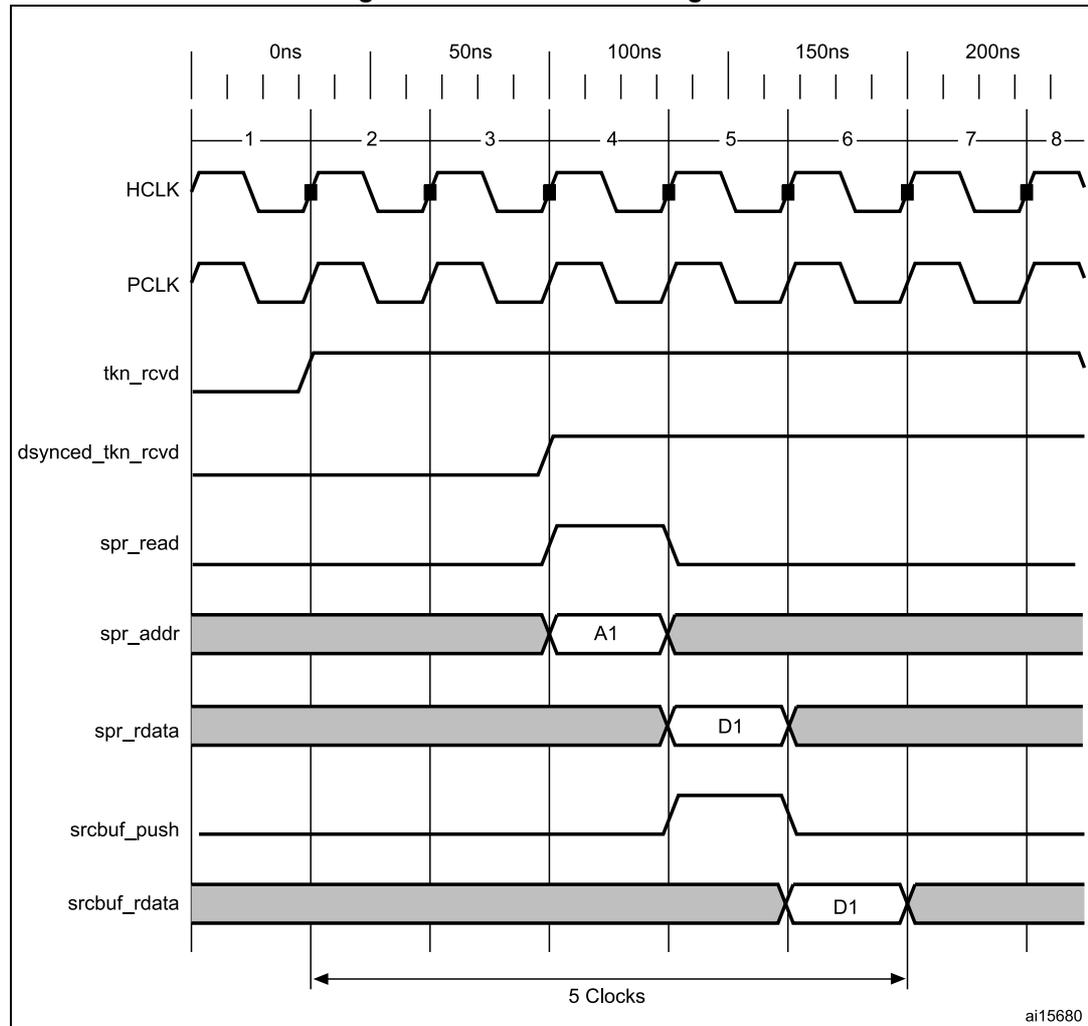
The timing diagram shows the following signals and events:
- HCLK : High-speed AHB clock, shown as a periodic square wave.
- PCLK : Peripheral clock, shown as a periodic square wave with a lower frequency than HCLK.
- tkn_rcvd : Token received signal, which goes high at the first rising edge of HCLK (0ns).
- dsynced_tkn_rcvd : Doubled sync tkn_rcvd signal, which goes high at the third rising edge of HCLK (50ns).
- spr_read : Read to SPRAM signal, which goes high at the third rising edge of HCLK (50ns) and returns low at the fourth rising edge (100ns).
- spr_addr : Address to SPRAM, which is valid (A1) between the third and fourth rising edges of HCLK.
- spr_rdata : Read data from SPRAM, which is valid (D1) between the fourth and fifth rising edges of HCLK.
- srcbuf_push : Push to the source buffer signal, which goes high at the fourth rising edge of HCLK (100ns) and returns low at the fifth rising edge (150ns).
- srcbuf_rdata : Read data from the source buffer, which is valid (D1) between the fifth and sixth rising edges of HCLK.
A horizontal double-headed arrow at the bottom indicates a duration of 5 HCLK clocks between the rising edge of tkn_rcvd and the rising edge of srcbuf_rdata.
73.15.8 OTG programming model
The OTG_HS controller is an OTG device. When the core is connected to an “A” plug, it is referred to as an A-device. When the core is connected to a “B” plug it is referred to as a B-device.