52. SPDIF receiver interface (SPDIFRX)
52.1 SPDIFRX interface introduction
The SPDIFRX interface handles S/PDIF audio protocol.
52.2 SPDIFRX main features
- • Up to 4 inputs available
- • Automatic symbol rate detection
- • Maximum symbol rate: 12.288 MHz
- • Stereo stream from 8 to 192 kHz (a) supported
- • Supports audio IEC-60958 and IEC-61937, consumer applications
- • Parity bit management
- • Communication using DMA for audio samples
- • Communication using DMA for control and user channel information
- • Interrupt capabilities
52.3 SPDIFRX functional description
The SPDIFRX peripheral, is designed to receive an S/PDIF flow compliant with IEC-60958 and IEC-61937. These standards support simple stereo streams up to high sample rate, and compressed multi-channel surround sound, such as those defined by Dolby or DTS.
The receiver provides all the necessary features to detect the symbol rate, and decode the incoming data. It is possible to use a dedicated path for the user and channel information in order to ease the interface handling. Figure 668 shows a simplified block diagram.
The SPDIFRX_DC block is responsible of the decoding of the S/PDIF stream received from SPDIFRX_IN[4:1] inputs. This block re-sample the incoming signal, decode the manchester stream, recognize frames, sub-frames and blocks elements. It delivers to the REG_IF part, decoded data, and associated status flags.
This peripheral can be fully controlled via the APB bus, and can handle two DMA channels:
- • A DMA channel dedicated to the transfer of audio samples
- • A DMA channel dedicated to the transfer of IEC60958 channel status and user information
Interrupt services are also available either as an alternative function to the DMA, or for signaling error or key status of the peripheral.
The SPDIFRX also offers a signal named spdifrx_frame_sync, which toggles every time that a sub-frame's preamble is detected. So the duty cycle is 50%, and the frequency equal to the frame rate.
This signal can be connected to timer events, in order to compute frequency drift.
a. Check the RCC capabilities in order to verify which sampling rates can be supported.
Figure 668. SPDIFRX block diagram
![Figure 668. SPDIFRX block diagram. The diagram shows the internal architecture of the SPDIFRX block. On the left, external signals include spdifrx_ker_ck (kernel clock), spdifrx_pclk (register interface clock), a 32-bit APB bus, spdifrx_it (interrupt), spdifrx_dat_dma (data DMA), and spdifrx_ctrl_dma (control DMA). The SPDIFRX block contains a Register interface with registers: SPDIFRX_FMTx_DR, SPDIFRX_CR, SPDIFRX_IMR, SPDIFRX_CSR, SPDIFRX_SR, SPDIFRX_IFCR, and SPDIFRX_DIR. These are connected to a 32-bit APB bus and a SYNC block. Below the registers are an IRQ interface and a DMA interface, which are also connected to the APB bus and the SYNC block. The SPDIFRX_DC (Data Channel) block contains RX_BUF 32 bits, SPDIFRX_SEQ (SPDIF data packing and sequencer), SPDIFRX_DEC (Biphase and transition decoder), and SPDIFRX_FE (Re-sync & Edge detection). The RX_BUF is connected to the SPDIFRX_FMTx_DR register. The SPDIFRX_SEQ is connected to the RX_BUF and the SPDIFRX_DEC. The SPDIFRX_DEC is connected to the SPDIFRX_FE. The SPDIFRX_FE is connected to the SPDIFRX_IN[x], SPDIFRX_IN[x+1], ..., SPDIFRX_IN[x+n] inputs and the spdifrx_frame_sync output. The SPDIFRX_DC block is in the spdif_ker_ck clock domain, while the rest of the SPDIFRX block is in the spdifrx_pclk clock domain.](/RM0433-STM32H742-743-753-750/897bf6adccc8fa4a3a1b20ea7af22b95_img.jpg)
1. 'n' is fixed to 4, and 'x' is set to 1.
52.3.1 SPDIFRX pins and internal signals
Table 435 lists the SPDIFRX internal input/output signals, Table 436 the SPDIFRX pins (alternate functions).
Table 435. SPDIFRX internal input/output signals
| Signal name | Signal type | Description |
|---|---|---|
| spdifrx_ker_ck | Digital input | SPDIFRX kernel clock |
| spdifrx_pclk | Digital input | SPDIFRX register interface clock |
| spdifrx_it | Digital output | SPDIFRX global interrupt |
| spdifrx_dat_dma | Digital input/output | SPDIFRX DMA request (and acknowledge) for data transfer |
| spdifrx_ctrl_dma | Digital input/output | SPDIFRX DMA request (and acknowledge) for channel status and user information transfer |
| spdifrx_frame_sync | Digital output | SPDIFRX frame rate synchronization signal |
Table 436. SPDIFRX pins
| Signal name | Signal type | Description |
|---|---|---|
| SPDIFRX_IN1 | Digital input | Input 1 for S/PDIF signal |
| SPDIFRX_IN2 | Digital input | Input 2 for S/PDIF signal |
| SPDIFRX_IN3 | Digital input | Input 3 for S/PDIF signal |
| SPDIFRX_IN4 | Digital input | Input 4 for S/PDIF signal |
52.3.2 S/PDIF protocol (IEC-60958)
S/PDIF block
A S/PDIF frame is composed of two sub-frames (see Figure 669 ). Each sub-frame contains 32 bits (or time slots):
- • Bits 0 to 3 carry one of the synchronization preambles
- • Bits 4 to 27 carry the audio sample word in linear 2's complement representation. The most significant bit (MSB) is carried by bit 27. When a 20-bit coding range is used, bits 8 to 27 carry the audio sample word with the LSB in bit 8.
- • Bit 28 (validity bit "V") indicates if the data is valid (for converting it to analog for example)
- • Bit 29 (user data bit "U") carries the user data information like the number of tracks of a Compact Disk.
- • Bit 30 (channel status bit "C") carries the channel status information like sample rate and protection against copy.
- • Bit 31 (parity bit "P") carries a parity bit such that bits 4 to 31 inclusive carry an even number of ones and an even number of zeroes (even parity).
Figure 669. S/PDIF sub-frame format
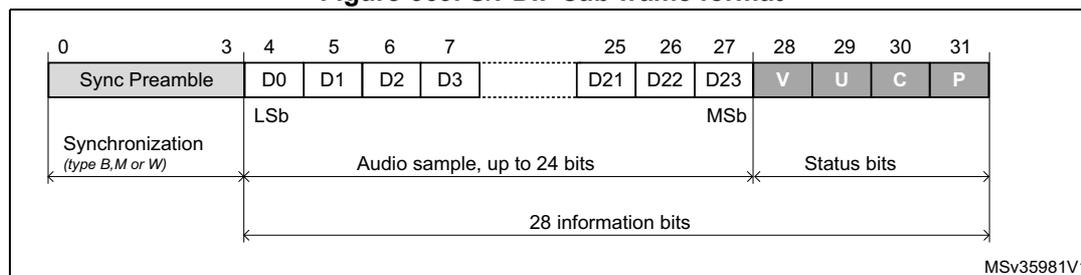
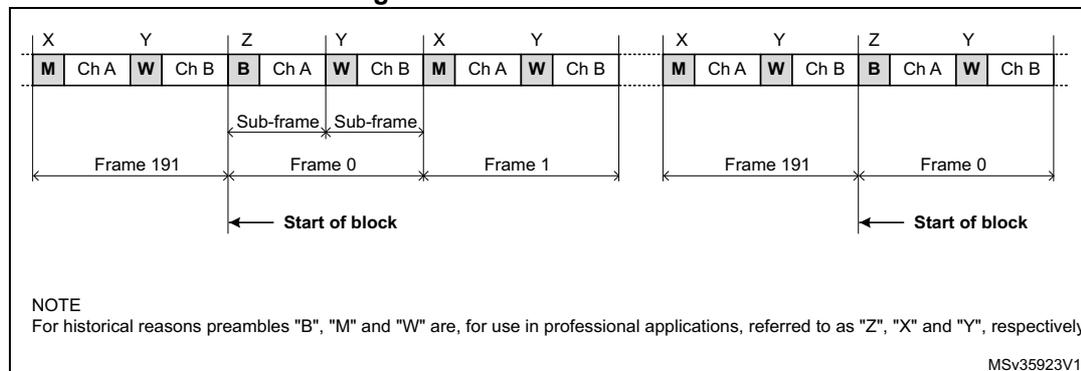
For linear coded audio applications, the first sub-frame (left or "A" channel in stereophonic operation and primary channel in monophonic operation) normally starts with preamble "M". However, the preamble changes to preamble "B" once every 192 frames to identify the start of the block structure used to organize the channel status and user information. The second sub-frame (right or "B" channel in stereophonic operation and secondary channel in monophonic operation) always starts with preamble "W".
A S/PDIF block contains 192 pairs of sub-frames of 32 bits.
Figure 670. S/PDIF block format
Synchronization preambles
The preambles patterns are inverted or not according to the previous half-bit value. This previous half-bit value is the level of the line before enabling a transfer for the first “B” preamble of the first frame. For the others preambles, this previous half-bit value is the second half-bit of the parity bit of the previous sub-frame. The preambles patterns B, M and W are described in the Figure 671 .
Figure 671. S/PDIF Preambles
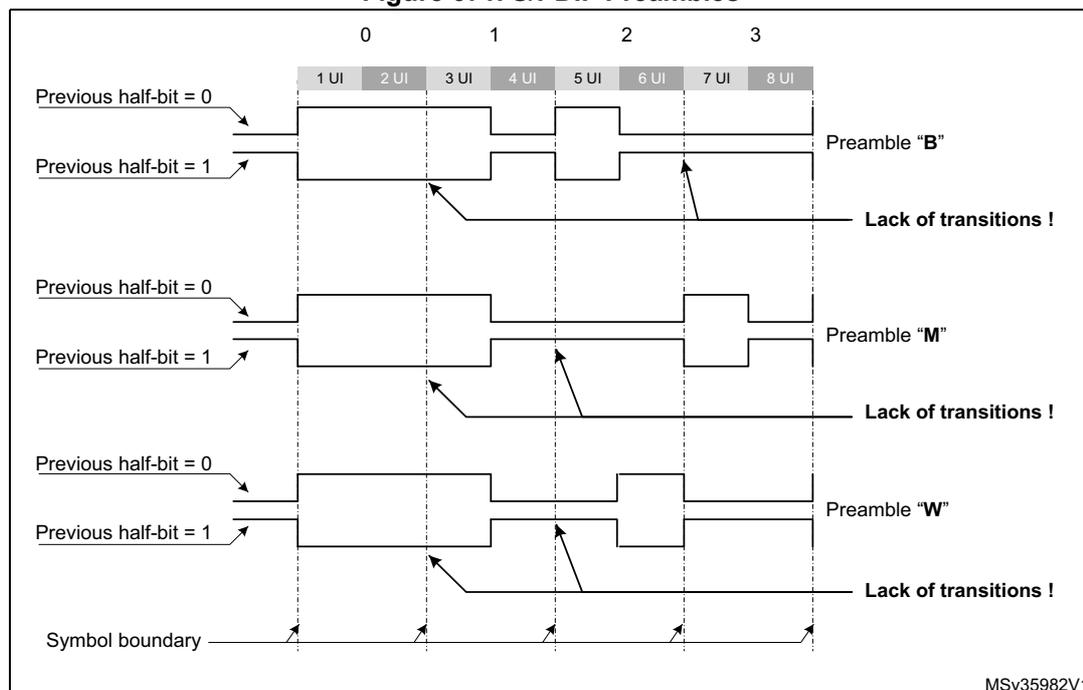
The diagram shows the signal levels for three types of preambles (B, M, and W) over 8 unit intervals (UI). The x-axis is labeled 0, 1, 2, 3, and the y-axis shows signal levels. The top row shows Preamble "B" with two cases: "Previous half-bit = 0" and "Previous half-bit = 1". The bottom row shows Preamble "W" with two cases: "Previous half-bit = 0" and "Previous half-bit = 1". The middle row shows Preamble "M" with two cases: "Previous half-bit = 0" and "Previous half-bit = 1". The diagram also indicates "Lack of transitions !" for some cases. The bottom row shows "Symbol boundary" markers.
Coding of information bits
In order to minimize the DC component value on the transmission line, and to facilitate clock recovery from the data stream, bits 4 to 31 are encoded in biphase-mark.
Each bit to be transmitted is represented by a symbol comprising two consecutive binary states. The first state of a symbol is always different from the second state of the previous symbol. The second state of the symbol is identical to the first if the bit to be transmitted is logical 0. However, it is different if the bit is logical 1. These states are named “UI” (unit interval) in the IEC-60958 specification.
The 24 data bits are transferred LSB first.
Figure 672. Channel coding example
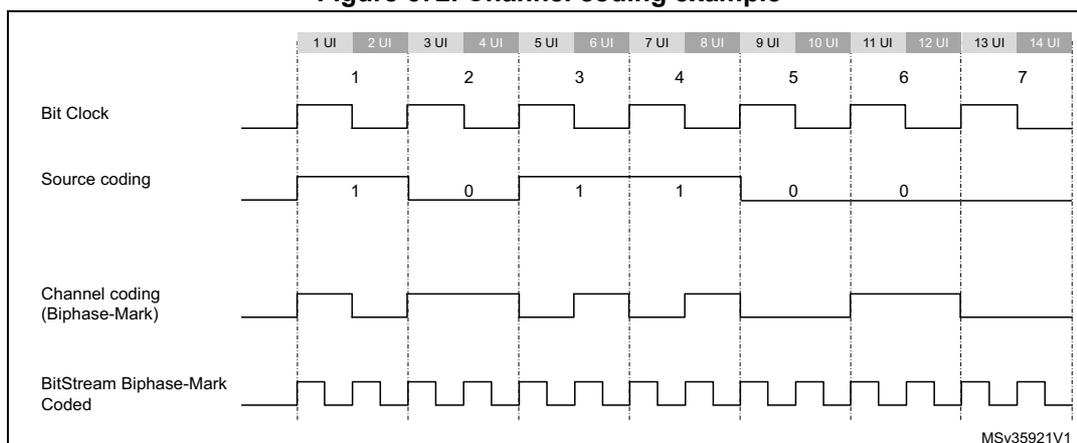
The figure is a timing diagram illustrating the channel coding process for SPDIF. It consists of four horizontal signal traces over a 14 Unit Interval (UI) period, divided into seven 2 UI segments labeled 1 through 7.
- Bit Clock: A periodic square wave with a period of 1 UI.
- Source coding: Shows the input bits: 1, 0, 1, 1, 0, 0, 1. Each bit is represented by a level that changes at the start of its 2 UI duration.
- Channel coding (Biphase-Mark):
Shows the encoded signal. For each bit:
- A '1' is represented by a high-to-low transition at the start of the 2 UI interval.
- A '0' is represented by a low-to-high transition at the start of the 2 UI interval.
- BitStream Biphase-Mark Coded: Shows the final encoded signal, which is a biphase-mark signal where each bit is represented by two UIs. The signal transitions at the start of each 2 UI interval according to the bit value.
52.3.3 SPDIFRX decoder (SPDIFRX_DC)
Main principle
The technique used by the SPDIFRX in order to decode the S/PDIF stream is based on the measurement of the time interval between two consecutive edges. Three kinds of time intervals may be found into an S/PDIF stream:
- • The long time interval, having a duration of 3 x UI, noted TL. It appears only during preambles.
- • The medium time interval, having a duration of 2 x UI, noted TM. It appears both in some preambles or into the information field.
- • The short time interval, having a duration of 1 x UI, noted TS. It appears both in some preambles or into the information field.
The SPDIFRX_DC block is responsible of the decoding of the received S/PDIF stream. It takes care of the following functions:
- • Resampling and filtering of the incoming signal
- • Estimation of the time-intervals
- • Estimation of the symbol rate and synchronization
- • Decoding of the serial data, and check of integrity
- • Detection of the block, and sub-frame preambles
- • Continuous tracking of the symbol rate
Figure 673 gives a detailed view of the SPDIFRX decoder.
Figure 673. SPDIFRX decoder
![Figure 673. SPDIFRX decoder block diagram. The diagram shows the internal architecture of the SPDIFRX decoder. It starts with SPDIFRX_IN[x] and SPDIFRX_IN[x+n] inputs entering the SPDIFRX_FE (Noise filtering & Edge detection) block. The output of SPDIFRX_FE goes to the SPDIFRX_DEC block. Inside SPDIFRX_DEC, there is a 'Longest & shortest transition detector' which outputs MAX_CNT and MIN_CNT. These are followed by a 'Transition coder & Preamble detector' which outputs preamble_info and trans_info. These signals go to a 'Biphase decoder' which outputs data. The data is then processed by 'Data Packing' and 'RX_BUF' to produce the final data and ctrl_ch. The SPDIFRX_SEQ block contains a TRCNT (13 bits) counter, which is clocked by spdifrx_ker_ck. The counter is reset by transition_pulse and its value is stored in transition_width_count. The transition_width_count is used by the 'Longest & shortest transition detector'.](/RM0433-STM32H742-743-753-750/4e6dd8760374aea1dd58c2d92e702b46_img.jpg)
1. 'n' is fixed to 4, and 'x' is set to 1.
Noise filtering and rising/falling edge detection
The S/PDIF signal received on the selected SPDIFRX_IN is re-sampled using the spdifrx_ker_ck clock (acquisition clock). A simple filtering is applied in order to cancel spurs. This is performed by the stage detecting the edge transitions. The edge transitions are detected as follows:
- • A rising edge is detected when the sequence 0 followed by two 1 is sampled.
- • A falling edge is detected when the sequence 1 followed by two 0 is sampled.
- • After a rising edge, a falling edge sequence is expected.
- • After a falling edge, a rising edge sequence is expected.
Figure 674. Noise filtering and edge detection
![Figure 674. Noise filtering and edge detection timing diagram. The diagram shows the timing of the SPDIFRX_IN[x] signal, the spdifrx_ker_ck clock, the resampled input, the filtered input, and the transition_pulse. The SPDIFRX_IN[x] signal shows transitions labeled S1, S2, S3, and S4, with a 'Glitch !!' indicated in S2. The spdifrx_ker_ck is a high-frequency clock. The resampled input shows bit sequences like '0 1 1', '1 1 1', '0 0 0', etc. The filtered input shows a cleaned version of the signal, and transition_pulse shows pulses at each detected edge transition.](/RM0433-STM32H742-743-753-750/80b893107c9cdf83c5cf3d8d2343c3fa_img.jpg)
Longest and shortest transition detector
The longest and shortest transition detector block detects the maximum (MAX_CNT) and minimum (MIN_CNT) duration between two transitions. The TRCNT counter is used to measure the time interval duration. It is clocked by the spdifrx_ker_ck signal. On every transition pulse, the counter value is stored and the counter is reset to start counting again.
The maximum duration is normally found during the preamble period. This maximum duration is sent out as MAX_CNT. The minimum duration is sent out as MIN_CNT.
The search of the longest and shortest transition is stopped when the transition timer expires. The transition timer is like a watchdog timer that generates a trigger after 70 transitions of the incoming signal. Note that counting 70 transitions insures a delay a bit longer than a sub-frame.
Note that when the TRCNT overflows due to a too long time interval between two pulses, the SPDIFRX is stopped and the flag TERR of SPDIFRX_SR register is set to 1.
Transition coder and preamble detector
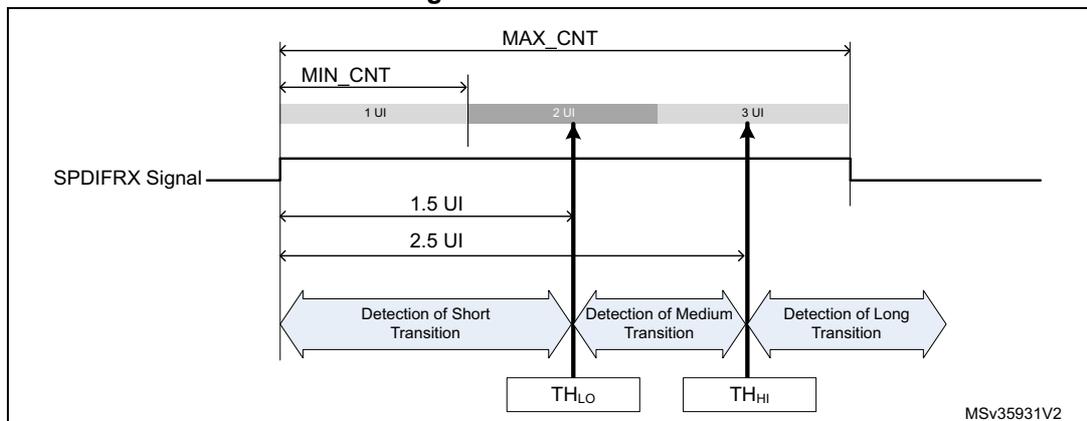
The transition coder and preamble detector block receives the MAX_CNT and MIN_CNT. It also receives the current transition width from the TRCNT counter (see Figure 673 ). This block encodes the current transition width by comparing the current transition width with two different thresholds, names TH HI and TH LO .
- • If the current transition width is less than (TH LO - 1), then the data received is half part of data bit '1', and is coded as TS.
- • If the current transition width is greater than (TH LO - 1), and less than TH HI , then the data received is data bit '0', and is coded as TM.
- • If the current transition width is greater than TH HI , then the data received is the long pulse of preambles, and is coded as TL.
- • Else an error code is generated (FERR flag is set).
The thresholds TH HI and TH LO are elaborated using two different methods.
If the peripheral is doing its initial synchronization ('coarse synchronization'), then the thresholds are computed as follow:
- • \( TH_{LO} = MAX\_CNT / 2 \) .
- • \( TH_{HI} = MIN\_CNT + MAX\_CNT / 2 \) .
Once the 'coarse synchronization' is completed, then the SPDIFRX uses a more accurate reference in order to elaborate the thresholds. The SPDIFRX measures the length of 24 symbols (WIDTH24) for defining TH LO and the length of 40 symbols (WIDTH40) for TH HI . TH HI and TH LO are computed as follow:
- • \( TH_{LO} = (WIDTH24) / 32 \)
- • \( TH_{HI} = (WIDTH40) / 32 \)
This second synchronization phase is called the 'fine synchronization'. Refer to Figure 677 for additional information.
As shown in the figure hereafter, \( TH_{LO} \) is ideally equal to 1.5 UI, and to \( TH_{HI} \) 2.5 UI.
Figure 675. Thresholds
The preamble detector checks four consecutive transitions of a specific sequence to determine if they form the part of preamble. Let us say TRANS0, TRANS1, TRANS2 and TRANS3 represent four consecutive transitions encoded as mentioned above. Table 437 shows the values of these four transitions to form a preamble. Absence of this pattern indicates that these transitions form part of the data in the sub frame and bi-phase decoder decode them.
Table 437. Transition sequence for preamble
| Preamble type | Biphase data pattern | TRANS3 | TRANS2 | TRANS1 | TRANS0 |
|---|---|---|---|---|---|
| Preamble B | 11101000 | TL | TS | TS | TL |
| Preamble M | 11100010 | TL | TL | TS | TS |
| Preamble W | 11100100 | TL | TM | TS | TM |
Bi-phase decoder
The Bi-phase decoder decodes the input bi-phase marked data stream using the transition information provided by the transition coder and preamble detector block. It first waits for the preamble detection information. After the preamble detection, it decodes the following transition information:
- • If the incoming transition information is TM then it is decoded as a '0'.
- • Two consecutive TS are decoded as a '1'.
- • Any other transition sequence generates an error signal (FERR set to 1).
After decoding 28 data bits this way, this module looks for the following preamble data. If the new preamble is not what is expected, then this block generates an error signal (FERR set to 1). Refer to Section 52.3.9: Reception errors , for additional information on error flags.
Data packing
This block is responsible of the decoding of the IEC-60958 frames and blocks. It also handles the writing into the RX_BUF or into SPDIFRX_CSR register.
52.3.4 SPDIFRX tolerance to clock deviation
The SPDIFRX tolerance to clock deviation depends on the number of sample clock cycles in one bit slot. The fastest spdifrx_ker_ck is, the more robust the reception is. The ratio between spdifrx_ker_ck frequency and the symbol rate must be at least 11.
Two kinds of phenomenon (at least) can degrade the reception quality:
- • The cycle-to-cycle jitter which reflects the difference of transition length between two consecutive transitions.
- • The long term jitter which reflects a cumulative effect of the cycle-to-cycle jitter. It can be seen as a low-frequency symbol modulation.
52.3.5 SPDIFRX synchronization
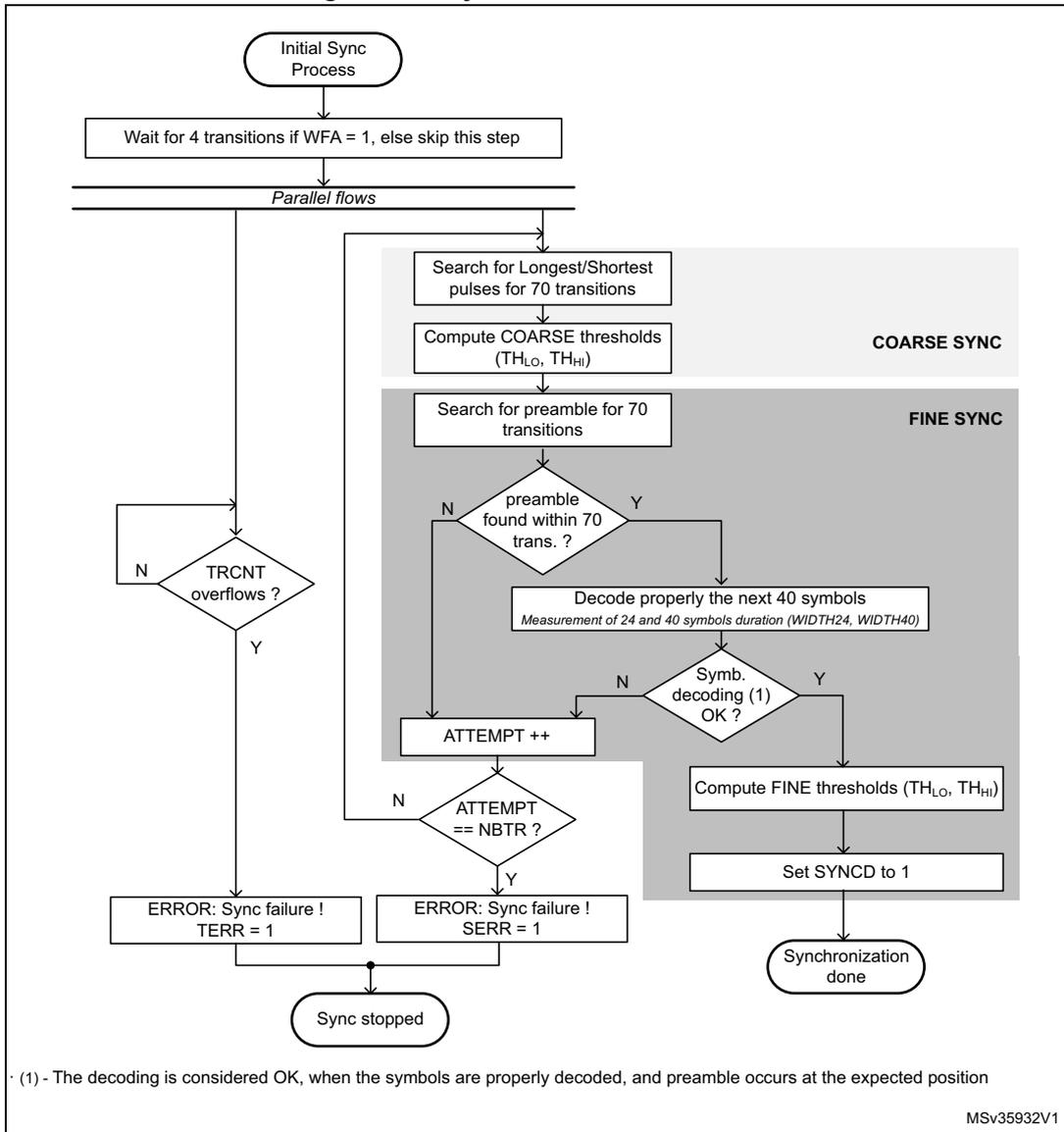
The synchronization phase starts when setting SPDIFRXEN to 01 or 11. Figure 676 shows the synchronization process.
If the bit WFA of SPDIFRX_CR register is set to 1, then the peripheral must first detect activity on the selected SPDIFRX_IN line before starting the synchronization process. The activity detection is performed by detecting four transitions on the selected SPDIFRX_IN. The peripheral remains in this state until transitions are not detected. This function can be particularly helpful because the SPDIFRX switches in COARSE SYNC mode only if activity is present on the selected SPDIFRX_IN input, avoiding synchronization errors. See Section 52.4: Programming procedures for additional information.
The user can still set the SPDIFRX into STATE_IDLE by setting SPDIFRXEN to 0. If the WFA is set to 0, the peripheral starts the coarse synchronization without checking activity.
The next step consists on doing a first estimate of the thresholds (COARSE SYNC), in order to perform the fine synchronization (FINE SYNC). Due to disturbances of the SPDIFRX line, it can happen that the process is not executed first time right. For this purpose, the user can program the number of allowed re-tries (NBTR) before setting SERR error flag.
When the SPDIFRX is able to measure properly the duration of 24 and 40 consecutive symbols then the FINE SYNC is completed, the threshold values are updated, and the flag SYNCD is set to 1. Refer to Section : Transition coder and preamble detector for additional information.
Two kinds of errors are detected:
- • An overflow of the TRCNT, which generally means that there is no valid S/PDIF stream in the input line. This overflow is indicated by TERR flag.
- • The number of retries reached the programmed value. This means that strong jitter is present on the S/PDIF signal. This error is indicated by SERR flag.
When the first FINE SYNC is completed, the reception of channel status (C) and user data (U) starts when the next “B” preamble is detected (see Figure 680 ). Then the user can read IEC-60958 C and U bits through SPDIFRX_CSR register. According to this information the user can then select the proper settings for DRFMT and RXSTEO. For example if the user detects that the current audio stream transports encoded data, then he can put RXSTEO to 0, and DRFMT to 10 prior to start data reception. Note that DRFMT and RXSTEO cannot be modified when SPDIFRXEN = 11. Writes to these fields are ignored if SPDIFRXEN is already 11, though these field can be changed with the same write instruction that causes SPDIFRXEN to become 11.
Then the SPDIFRX waits for SPDIFRXEN = 11 and the “B” preamble before starting saving audio samples.
Figure 676. Synchronization flowchart
graph TD
    Start([Initial Sync Process]) --> Wait[Wait for 4 transitions if WFA = 1, else skip this step]
    Wait --> Parallel[Parallel flows]
    Parallel --> TRCNT{TRCNT overflows ?}
    TRCNT -- N --> Parallel
    TRCNT -- Y --> ERROR_TERR[ERROR: Sync failure ! TERR = 1]
    Parallel --> Coarse[Search for Longest/Shortest pulses for 70 transitions]
    Coarse --> CoarseTh[Compute COARSE thresholds (THLo, THHi)]
    CoarseTh --> FineSearch[Search for preamble for 70 transitions]
    FineSearch --> PreambleFound{preamble found within 70 trans. ?}
    PreambleFound -- N --> AttemptInc[ATTEMPT ++]
    PreambleFound -- Y --> Decode[Decode properly the next 40 symbols
Measurement of 24 and 40 symbols duration (WIDTH24, WIDTH40)]
    Decode --> SymbOK{Symb. decoding (1) OK ?}
    SymbOK -- N --> AttemptInc
    SymbOK -- Y --> FineTh[Compute FINE thresholds (THLo, THHi)]
    FineTh --> SetSYNCD[Set SYNCD to 1]
    SetSYNCD --> Done([Synchronization done])
    AttemptInc --> AttemptEq{ATTEMPT == NBTR ?}
    AttemptEq -- N --> Parallel
    AttemptEq -- Y --> ERROR_SERR[ERROR: Sync failure ! SERR = 1]
    ERROR_TERR --> Stopped([Sync stopped])
    ERROR_SERR --> Stopped
(1) - The decoding is considered OK, when the symbols are properly decoded, and preamble occurs at the expected position
MSV35932V1
Refer to Frame structure and synchronization error for additional information concerning TRCNT overflow.
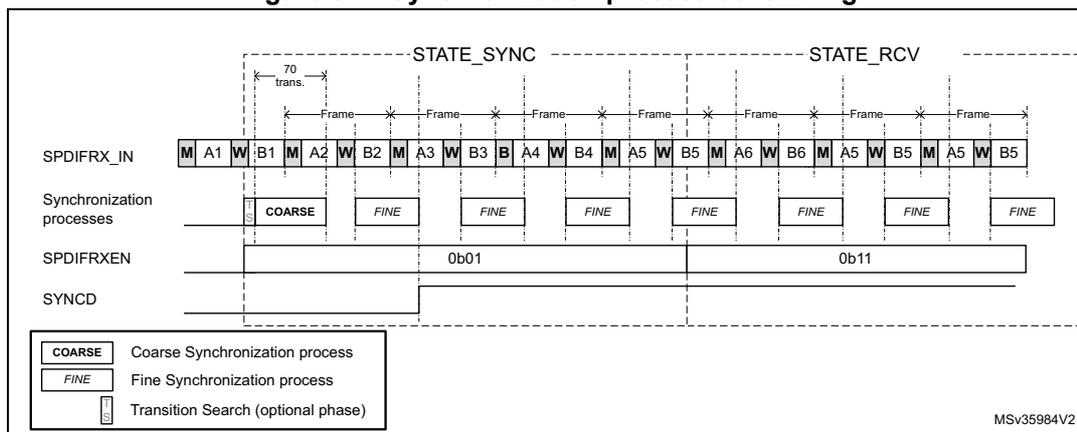
The FINE SYNC process is re-triggered every frame in order to update thresholds as shown in Figure 677 in order to continuously track S/PDIF synchronization.
Figure 677. Synchronization process scheduling
The diagram illustrates the synchronization process scheduling for the SPDIFRX interface. It shows the timing of the SPDIFRX_IN signal, which consists of a sequence of frames. Each frame contains a preamble (M, A, W) followed by a data block (B1, B2, B3, B4, B5, B6). The synchronization processes are divided into COARSE and FINE phases. The SPDIFRXEN signal is shown in two states: 0b01 during the STATE_SYNC phase and 0b11 during the STATE_RCV phase. The SYNCD signal is active during the STATE_SYNC phase. A legend indicates that COARSE represents the Coarse Synchronization process, FINE represents the Fine Synchronization process, and a small box represents the Transition Search (optional phase). The diagram is labeled MSV35984V2.
52.3.6 SPDIFRX handling
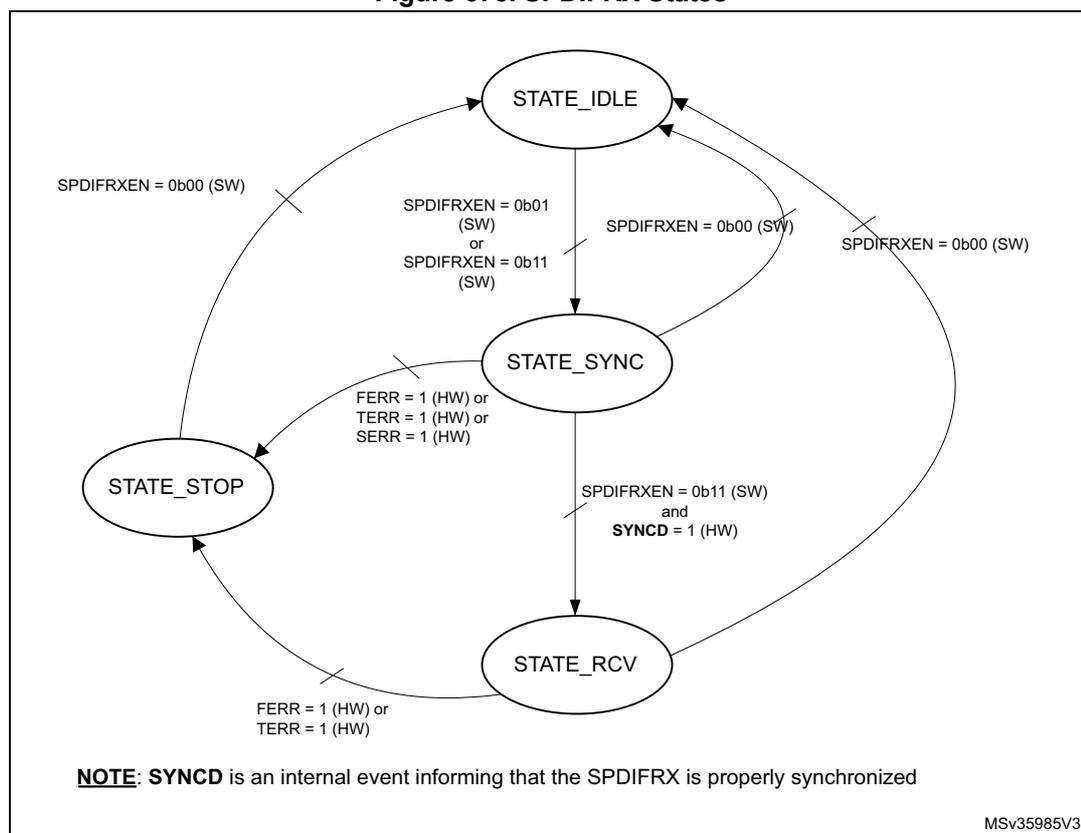
The software can control the state of the SPDIFRX through SPDIFRXEN field. The SPDIFRX can be into one of the following states:
- •
STATE_IDLE:
The peripheral is disabled, the spdifrx_ker_ck domain is reset. The spdifrx_pclk domain is functional. - •
STATE_SYNC:
The peripheral is synchronized to the stream, thresholds are updated regularly, user and channel status can be read via interrupt or DMA. The audio samples are not provided to receive buffer. - •
STATE_RCV:
The peripheral is synchronized to the stream, thresholds are updated regularly, user, channel status and audio samples can be read via interrupt or DMA channels. When SPDIFRXEN goes to 11, the SPDIFRX waits for “B” preamble before starting saving audio samples. - •
STOP_STATE:
The peripheral is no longer synchronized, the reception of the user, channel status and audio samples are stopped. It is expected that the software re-starts the SPDIFRX.
Figure 678 shows the possible states of the SPDIFRX, and how to transition from one state to the other. The bits under software control are followed by the mention “(SW)”, the bits under SPDIFRX control are followed by the mention “(HW)”.
Figure 678. SPDIFRX States
stateDiagram-v2
    [*] --> STATE_IDLE
    STATE_IDLE --> STATE_SYNC : SPDIFRXEN = 0b01 (SW) or SPDIFRXEN = 0b11 (SW)
    STATE_SYNC --> STATE_IDLE : SPDIFRXEN = 0b00 (SW)
    STATE_SYNC --> STATE_RCV : SPDIFRXEN = 0b11 (SW) and SYNCN = 1 (HW)
    STATE_SYNC --> STATE_STOP : FERR = 1 (HW) or TERR = 1 (HW) or SERR = 1 (HW)
    STATE_RCV --> STATE_IDLE : SPDIFRXEN = 0b00 (SW)
    STATE_RCV --> STATE_STOP : FERR = 1 (HW) or TERR = 1 (HW)
    STATE_STOP --> STATE_IDLE : SPDIFRXEN = 0b00 (SW)
NOTE: SYNCN is an internal event informing that the SPDIFRX is properly synchronized
MSv35985V3.
When SPDIFRX is in STATE_IDLE:
- • The software can transition to STATE_SYNC by setting SPDIFRXEN to 01 or 11
When SPDIFRX is in STATE_SYNC:
- • If the synchronization fails or if the received data are not properly decoded with no chance of recovery without a re-synchronization (FERR or SERR or TERR = 1), the SPDIFRX goes to STATE_STOP, and waits for software acknowledge.
- • When the synchronization phase is completed, if SPDIFRXEN = 01 the peripheral remains in this state.
- • At any time the software can set SPDIFRXEN to 0, then SPDIFRX returns immediately to STATE_IDLE. If a DMA transfer is on-going, it is properly completed.
- • The SPDIFRX goes to STATE_RCV if SPDIFRXEN = 11 and if the SYNCN = 1
When SPDIFRX is in STATE_RCV:
- • If the received data are not properly decoded with no chance of recovery without a re-synchronization (FERR or SERR or TERR = 1), the SPDIFRX goes to STATE_STOP, and waits for software acknowledge.
- • At any time the software can set SPDIFRXEN to 0, then SPDIFRX returns immediately to STATE_IDLE. If a DMA transfer is on-going, it is properly completed.
When SPDIFRX is in STATE_STOP:
- • The SPDIFRX stops reception and synchronization, and waits for the software to set the bit SPDIFRXEN to 0, in order to clear the error flags.
When SPDIFRXEN is set to 0, the SPDIFRX is disabled, meaning that all the state machines are reset, and RX_BUF is flushed. Note as well that flags FERR, SERR and TERR are reset.
52.3.7 Data reception management
The SPDIFRX offers a double buffer for the audio sample reception. A 32-bit buffer located into the spdifrx_ker_ck clock domain (RX_BUF), and the SPDIFRX_FMTx_DR register. The valid data contained into the RX_BUF are immediately transferred into SPDIFRX_FMTx_DR if SPDIFRX_FMTx_DR is empty.
The valid data contained into the RX_BUF are transferred into SPDIFRX_FMTx_DR when the two following conditions are reached:
- • The transition between the parity bit (P) and the next preamble is detected (this indicated that the word is completely received).
- • The SPDIFRX_FMTx_DR is empty.
Having a 2-word buffer gives more flexibility for the latency constraint.
The maximum latency allowed is \( T_{\text{SAMPLE}} - 2T_{\text{PCLK}} - 2T_{\text{spdifrx\_ker\_ck}} \)
Where \( T_{\text{SAMPLE}} \) is the audio sampling rate of the received stereo audio samples, \( T_{\text{PCLK}} \) is the period of spdifrx_pclk clock, and \( T_{\text{spdifrx\_ker\_ck}} \) is the period of spdifrx_ker_ck clock.
The SPDIFRX offers the possibility to use either DMA (spdifrx_dat_dma and spdifrx_ctrl_dma) or interrupts for transferring the audio samples into the memory. The recommended option is DMA, refer to Section 52.3.11: DMA interface for additional information.
The SPDIFRX offers several way on handling the received data. The user can either have a separate flow for control information and audio samples, or get them all together.
For each sub-frame, the data reception register SPDIFRX_FMTx_DR contains the 24 data bits, and optionally the V, U, C, PE status bits, and the PT (see Mixing data and control flow ).
Note that PE bit stands for parity error bit, and is set to 1 when a parity error is detected in the decoded sub-frame.
The PT field carries the preamble type (B, M or W).
V, U and C are a direct copy of the value received from the S/PDIF interface.
The bit DRFMT allows the selection between 3 audio formats as shown in Figure 679 .
This document describes 3 data registers: SPDIFRX_FMTx[2:0] (x = 2 to 0), but in reality there is only one physical data register, having 3 possible formats:
- • When DRFMT = 0, the format of the data register is the one described by SPDIFRX_FMT0_DR
- • When DRFMT = 1, the format of the data register is the one described by SPDIFRX_FMT1_DR
- • When DRFMT = 2, the format of the data register is the one described by SPDIFRX_FMT2_DR"
Figure 679. SPDIFRX_FMTx_DR register format
![Figure 679. SPDIFRX_FMTx_DR register format. The diagram shows the mapping of IEC60958 sub-frames to the SPDIFRX_FMTx_DR register for three different formats: FMT0_DR, FMT1_DR, and FMT2_DR. It includes bit positions (0-31), field names (Sync Preamble, S0-S3, S8, S21-S23, V, U, C, P, DR[23:0], DRNL2[15:0], DRNL1[15:0]), and alignment markers (LSb, MSb).](/RM0433-STM32H742-743-753-750/fab41cda519ef82a9e79350935f42f53_img.jpg)
The diagram illustrates the mapping of IEC60958 sub-frames to the SPDIFRX_FMTx_DR register for three different formats:
- SPDIFRX_FMT0_DR (i.e. DRFMT = 0b00) : This format shows a 32-bit register. Bit 31 is S23 (MSb), bits 23-0 are DR[23:0], and bit 0 is S0 (LSb). Bits 29-24 are PT[1:0] or 0, C or 0, U or 0, V or 0, PE or 0. Bit 23 is S23 (MSb).
- SPDIFRX_FMT1_DR (i.e. DRFMT = 0b01) : This format shows a 32-bit register. Bit 31 is S23 (MSb), bits 8-0 are S0, 0, 0, PT[1:0] or 0, C or 0, U or 0, V or 0, PE or 0, and bits 23-9 are DR[23:0]. Bit 8 is S8 (LSb).
- SPDIFRX_FMT2_DR (i.e. DRFMT = 0b10) : This format shows a 32-bit register. Bit 31 is S23 (MSb), bits 16-9 are DRNL2[15:0], bit 8 is S8 (LSb), bit 7 is S23 (MSb), bits 15-0 are DRNL1[15:0], and bit 0 is S8 (LSb). The register is divided into two 16-bit channels, Ch A and Ch B.
MSV35925V4
Setting DRFMT to 00 or 01, offers the possibility to have the data either right or left aligned into the SPDIFRX_FMTx_DR register. The status information can be enabled or forced to zero according to the way the software wants to handle them.
The format given by DRFMT= 10 is interesting in non-linear mode, as only 16 bits per sub-frame are used. By using this format, the data of two consecutive sub-frames are stored into SPDIFRX_FMTx_DR, dividing by two the amount of memory footprint. Note that when RXSTEO = 1, there is no misalignment risks (i.e. data from ChA are always stored into SPDIFRX_FMTx_DR[31:16]). If RXSTEO = 0, then there is a misalignment risk is case of overrun situation. In that case SPDIFRX_FMTx_DR[31:16] always contain the oldest value and SPDIFRX_FMTx_DR[15:0] the more recent value (see Figure 681).
In this format the status information cannot be mixed with data, but the user can still get them through SPDIFRX_CSR register, and use a dedicated DMA channel or interrupt to transfer them to memory (see Section 52.3.8: Dedicated control flow )
Mixing data and control flow
The user can choose to use this mode in order to get the full flexibility of the handling of the control flow. The user can select which field must be kept into the data register (SPDIFRX_FMTx_DR).
- • When bit PMSK = 1, the parity error information is masked (set to 0), otherwise it is copied into SPDIFRX_FMTx_DR.
- • When bit VMSK = 1, the validity information is masked (set to 0), otherwise it is copied into SPDIFRX_FMTx_DR.
- • When bit CUMSK = 1, the channel status, and used data information are masked (set to 0), otherwise they are copied into SPDIFRX_FMTx_DR.
- • When bit PTMSK = 1, the preamble type is masked (set to 0), otherwise it is copied into SPDIFRX_FMTx_DR.
52.3.8 Dedicated control flow
The SPDIFRX offers the possibility to catch both user data and channel status information via a dedicated DMA channel. This feature allows the SPDIFRX to acquire continuously the channel status and user information. The acquisition starts at the beginning of a IEC 60958 block. Two fields are available to control this path: CBDMAEN and SPDIFRXEN. When SPDIFRXEN is set to 01 or 0x11, the acquisition is started, after completion of the synchronization phase. When 8 channel status and 16 user data bits are received, they are packed and stored into SPDIFRX_CSR register. A DMA request is triggered if the bit CBDMAEN is set to 1 (see Figure 680).
If CS[0] corresponds to the first bit of a new block, the bit SOB is set to 1. Refer to Section 52.5.8: SPDIFRX channel status register (SPDIFRX_CSR) . A bit is available (CHSEL) in order to select if the user wants to select channel status information (C) from the channel A or B.
Figure 680. Channel/user data format
![Figure 680. Channel/user data format. This diagram illustrates the timing and data flow for the SPDIFRX interface. The top section shows the SPDIFRX_IN signal as a sequence of frames (Frame 191, Frame 0, Frame 7, Frame 8, Frame 15, Frame 16). Each frame consists of a preamble (M, A, W, B) followed by 32 bits of data (A1, B1, B2, A2, W2, B3, B4, A3, W3, B5, B6, A4, W4, B7, B8). The SPDIFRXEN signal is shown as a horizontal line with a value of 0b01 or 0b11. The SYNCD signal is a pulse that goes high when the first start of block (B preamble) is detected. The spdifrx_dat_dma and spdifrx_ctrl_dma signals are shown as pulses that go high when the first and second SPDIFRX_CB words are transferred. The bottom section shows the SPDIFRX_CSR format, which is a 32-bit register with the following fields: reserved (bits 31-25), SOB (bit 24), CS[7:0] (bits 23-16), and USR[15:0] (bits 15-0).](/RM0433-STM32H742-743-753-750/87ecd1df4c9560ec11c2ad0164c14e9c_img.jpg)
SPDIFRX_IN: [M A1 W B1] [B A2 W B2] [M A3 W B3] [B A4 W B4] [M A5 W B5] [M A6 W B6] [M A5 W B5] [M A5 W B5]
SPDIFRXEN: 0b01 or 0b11
SYNCD: Start of a new block
spdifrx_dat_dma
spdifrx_ctrl_dma
SPDIFRX_CSR format
| 31 | 25 | 24 | 23 | 16 | 15 | 0 |
| reserved | SOB | CS[7:0] | USR[15:0] | |||
MSv35924V3
Note: Once the first start of block is detected (B preamble), the SPDIFRX is checking the preamble type every 8 frames.
Note: Overrun error on SPDIFRX_FMTx_DR register does not affect this path.
52.3.9 Reception errors
Frame structure and synchronization error
The SPDIFRX, detects errors, when one of the following condition occurs:
- • The FERR bit is set to 1 on the following conditions:
- – For each of the 28 information bits, if one symbol transition sequence is not correct: for example if short pulses are not grouped by pairs.
- – If preambles occur to an unexpected place, or an expected preamble is not received.
- • The SERR bit is set when the synchronization fails, because the number of re-tries exceeded the programmed value.
- • The TERR bit is set when the counter used to estimate the width between two transitions overflows (TRCNT).
The overflow occurs when no transition is detected during 8192 periods of spdifrx_ker_ck clock. It represents at most a time interval of 11.6 frames.
When one of those flags goes to 1, the traffic on selected SPDIFRX_IN is then ignored, an interrupt is generated if the IFEIE bit of the SPDIFRX_CR register is set.
The normal procedure when one of those errors occur is:
- • Set SPDIFRXEN to 0 in order to clear the error flags
- • Set SPDIFRXEN to 01 or 11 in order to restart the SPDIFRX
Refer to Figure 678 for additional information.
Parity error
For each sub-frame, an even number of zeros and ones is expected inside the 28 information bits. If not, the parity error bit PERR is set in the SPDIFRX_SR register and an interrupt is generated if the parity interrupt enable PERRIE bit is set in the SPDIFRX_CR register. The reception of the incoming data is not paused, and the SPDIFRX continue to deliver data to SPDIFRX_FMTx_DR even if the interrupt is still pending.
The interrupt is acknowledged by clearing the PERR flag through PERRCF bit.
If the software wants to guarantee the coherency between the data read in the SPDIFRX_FMTx_DR register and the value of the bit PERR, the bit PMSK must be set to 0.
Overrun error
If both SPDIFRX_FMTx_DR and RX_BUF are full, while the SPDIFRX_DC needs to write a new sample in RX_BUF, this new sample is dropped, and an overrun condition is triggered. The overrun error flag OVR is set in the SPDIFRX_SR register and an interrupt is generated if the OVRIE bit of the SPDIFRX_CR register is set.
If the RXSTEO bit is set to 0, then as soon as the RX_BUF is empty, the SPDIFRX stores the next incoming data, even if the OVR flag is still pending. The main purpose is to reduce as much as possible the amount of lost samples. Note that the behavior is similar independently of DRFMT value. See Figure 681 .
Figure 681. S/PDIF overrun error when RXSTEO = 0
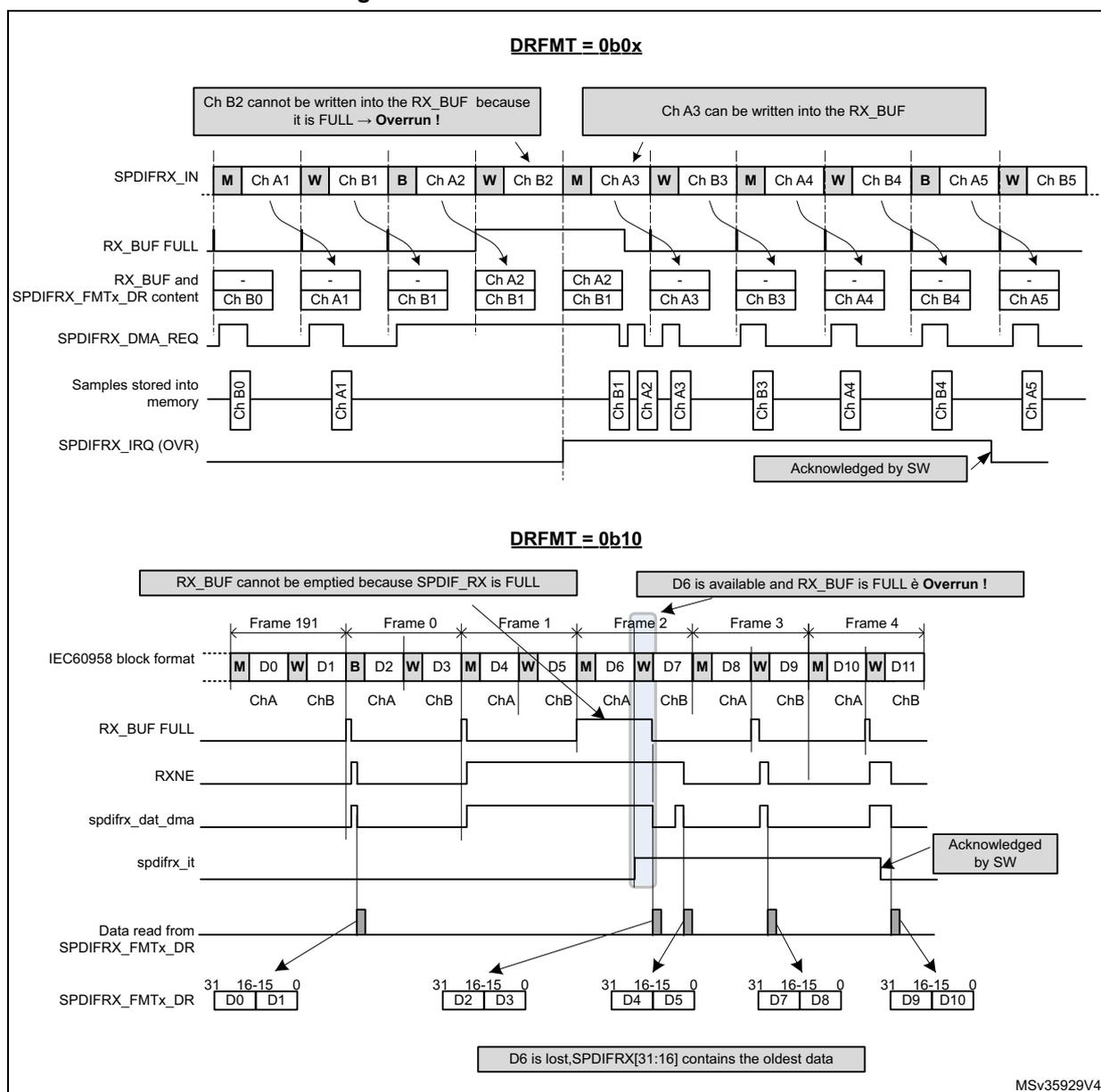
DRFMT = 0b0x
Ch B2 cannot be written into the RX_BUF because it is FULL → Overrun !
Ch A3 can be written into the RX_BUF
SPDIFRX_IN: M Ch A1 W Ch B1 B Ch A2 W Ch B2 M Ch A3 W Ch B3 M Ch A4 W Ch B4 B Ch A5 W Ch B5
RX_BUF FULL
RX_BUF and SPDIFRX_FMTx_DR content: Ch B0, Ch A1, Ch B1, Ch A2, Ch B1, Ch A3, Ch B3, Ch A4, Ch B4, Ch A5
SPDIFRX_DMA_REQ
Samples stored into memory: Ch B0, Ch A1, Ch B1, Ch A2, Ch B1, Ch A3, Ch B3, Ch A4, Ch B4, Ch A5
SPDIFRX_IRQ (OVR)
Acknowledged by SW
DRFMT = 0b10
RX_BUF cannot be emptied because SPDIF_RX is FULL
D6 is available and RX_BUF is FULL → Overrun !
IEC60958 block format: Frame 191, Frame 0, Frame 1, Frame 2, Frame 3, Frame 4
M D0 W D1 B D2 W D3 M D4 W D5 M D6 W D7 M D8 W D9 M D10 W D11
ChA ChB ChA ChB ChA ChB ChA ChB ChA ChB ChA ChB
RX_BUF FULL
RXNE
spdifrx_dat_dma
spdifrx_it
Acknowledged by SW
Data read from SPDIFRX_FMTx_DR
SPDIFRX_FMTx_DR: 31 16-15 0 (D0, D1), 31 16-15 0 (D2, D3), 31 16-15 0 (D4, D5), 31 16-15 0 (D7, D8), 31 16-15 0 (D9, D10)
D6 is lost, SPDIFRX[31:16] contains the oldest data
MSV35929V4
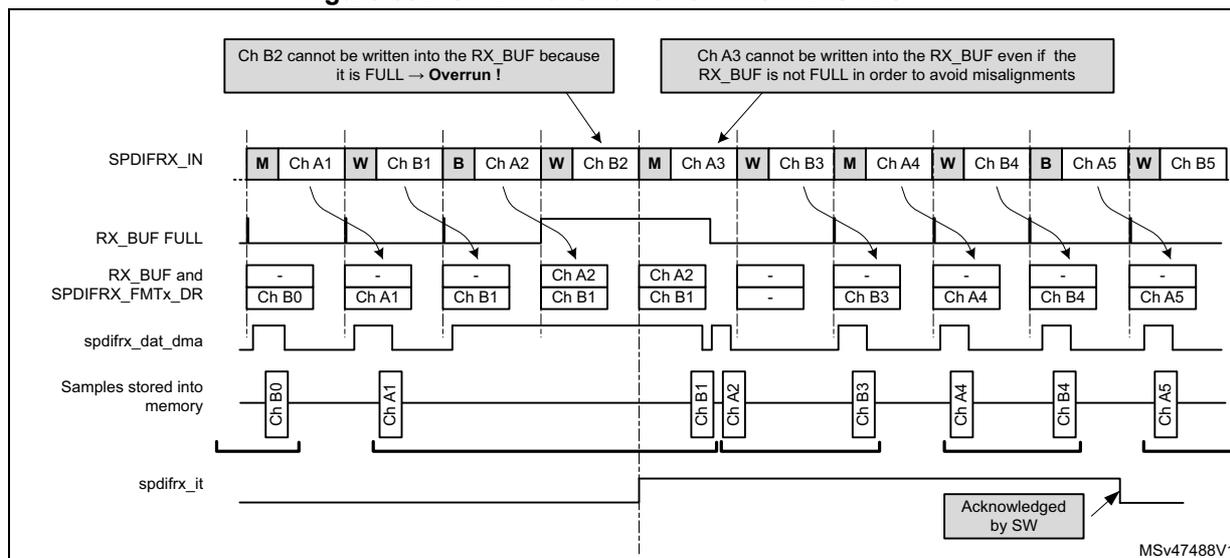
If the RXSTEO bit is set to 1, it means that stereo data are transported, then the SPDIFRX has to avoid misalignment between left and right channels. So the peripheral has to drop a second sample even if there is room inside the RX_BUF in order to avoid misalignment. Then the incoming samples can be written normally into the RX_BUF even if the OVR flag is still pending. Refer to Figure 682 .
The OVR flag is cleared by software, by setting the OVRCF bit to 1.
Figure 682. S/PDIF overrun error when RXSTEO = 1
52.3.10 Clocking strategy
The SPDIFRX block needs two different clocks:
- • The APB clock (spdifrx_pclk), which is used for the register interface,
- • The spdifrx_ker_ck which is mainly used by the SPDIFRX_DC part. Those clocks are not supposed to be phase locked, so all signals crossing those clock domains are re-synchronized (SYNC block on Figure 668).
In order to decode properly the incoming S/PDIF stream the SPDIFRX_DC must re-sample the received data with a clock at least 11 times higher than the maximum symbol rate, or 704 times higher than the audio sample rate. For example if the user expects to receive a symbol rate to up to 12.288 MHz, the sample rate must be at least 135.2 MHz. The clock used by the SPDIFRX_DC is the spdifrx_ker_ck.
The frequency of the spdifrx_pclk must be at least equal to the symbol rate.
Table 438. Minimum spdifrx_ker_ck frequency versus audio sampling rate (1)| Symbol rate | Minimum spdifrx_ker_ck frequency | Comments |
|---|---|---|
| 3.072 MHz | 33.8 MHz | For 48 kHz stream |
| 6.144 MHz | 67.6 MHz | For 96 kHz stream |
| 12.288 MHz | 135.2 MHz | For 192 kHz stream |
- 1. Check the RCC capabilities in order to verify which sampling rates can be supported.
52.3.11 DMA interface
The SPDIFRX interface is able to perform communication using the DMA.
Note: The user must refer to product specifications for availability of the DMA controller.
The SPDIFRX offers two independent DMA channels:
- • A DMA channel dedicated to the data transfer
- • A DMA channel dedicated to the channel status and user data transfer
The DMA mode for the data can be enabled for reception by setting the RXDMAEN bit in the SPDIFRX_CR register. In this case, as soon as the SPDIFRX_FMTx_DR is not empty, the SPDIFRX interface sends a transfer request to the DMA. The DMA reads the data received through the SPDIFRX_FMTx_DR register without CPU intervention.
For the use of DMA for the control data refer to Section 52.3.8: Dedicated control flow .
52.3.12 Interrupt generation
An interrupt line is shared between:
- • Reception events for data flow (RXNE)
- • Reception event for control flow (CSRNE)
- • Data corruption detection (PERR)
- • Transfer flow interruption (OVR)
- • Frame structure and synchronization errors (SERR, TERR and FERR)
- • Start of new block interrupt (SBD)
- • Synchronization done (SYNCN)
Figure 683. SPDIFRX interface interrupt mapping diagram
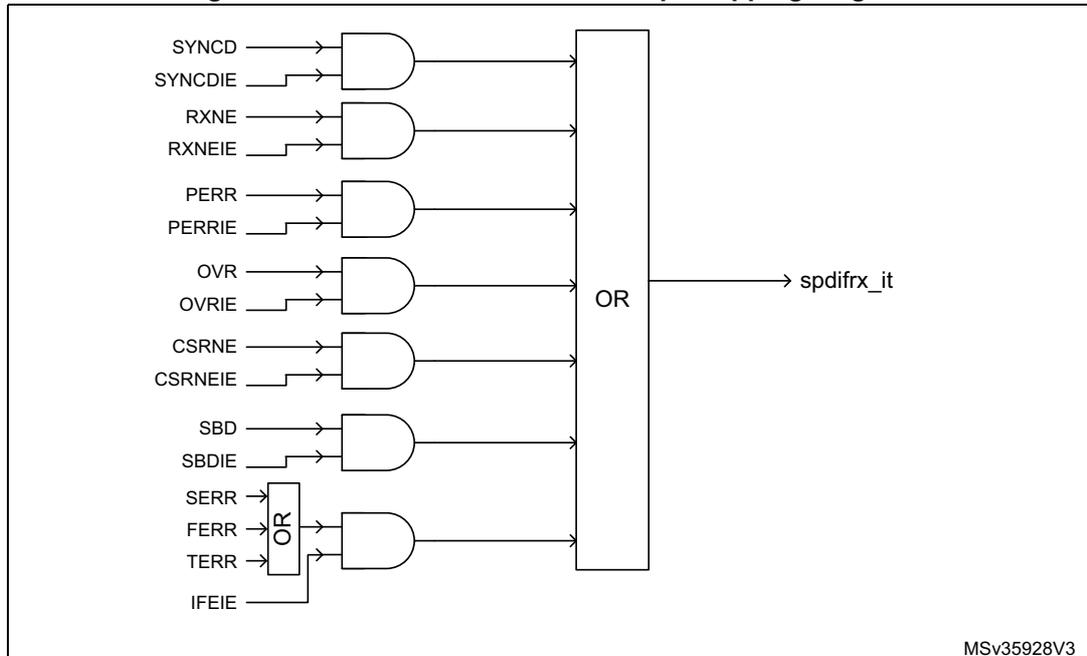
The diagram illustrates the interrupt mapping for the SPDIFRX interface. It features a series of AND gates and an OR gate. The inputs are as follows:
- SYNCN and SYNCNIE are inputs to the first AND gate.
- RXNE and RXNEIE are inputs to the second AND gate.
- PERR and PERRIE are inputs to the third AND gate.
- OVR and OVRIE are inputs to the fourth AND gate.
- CSRNE and CSRNEIE are inputs to the fifth AND gate.
- SBD and SBDIE are inputs to the sixth AND gate.
- SERR, FERR, and TERR are inputs to an OR gate, which is also labeled 'OR'. The output of this OR gate is then connected to the seventh AND gate along with IFEIE.
The outputs of all seven AND gates are connected to a large vertical OR gate. The output of this large OR gate is labeled
spdifrx_it
.
MSv35928V3
Clearing interrupt source
- • RXNE is cleared when SPDIFRX_FMTx_DR register is read
- • CSRNE is cleared when SPDIFRX_CSR register is read
- • FERR is cleared when SPDIFRXEN is set to 0
- • SERR is cleared when SPDIFRXEN is set to 0
- • TERR is cleared when SPDIFRXEN is set to 0
- • Others are cleared through SPDIFRX_IFCR register
Note: The SBD event can only occur when the SPDIFRX is synchronized to the input stream (SYNCD = 1).
The SBD flag behavior is not guaranteed when the sub-frame which contains the B preamble is lost due to an overrun.
52.3.13 Register protection
The SPDIFRX block embeds some hardware protection avoid erroneous use of control registers. The table hereafter shows the bit field properties according to the SPDIFRX state.
Table 439. Bit field property versus SPDIFRX state
| Registers | Field | SPDIFRXEN | ||
|---|---|---|---|---|
| 00 (STATE_IDLE) | 01 (STATE_SYNC) | 11 (STATE_RCV) | ||
| SPDIFRX_CR | INSEL | rw | r | r |
| WFA | rw | r | r | |
| NBTR | rw | r | r | |
| CHSEL | rw | r | r | |
| CBDMAEN | rw | rw | rw | |
| PTMSK | rw | rw | rw | |
| CUMSK | rw | rw | rw | |
| VMSK | rw | rw | rw | |
| PMSK | rw | rw | rw | |
| DRFMT | rw | rw | r | |
| RXSTEO | rw | rw | r | |
| RXDMAEN | rw | rw | rw | |
| SPDIFRX_IMR | All fields | rw | rw | rw |
The table clearly shows that fields such as INSEL must be programmed when the SPDIFRX is in STATE_IDLE. In the others SPDIFRX states, the hardware prevents writing to this field.
Note: Even if the hardware allows the writing of CBDMAEN and RXDMAEN “on-the-fly”, it is not recommended to enable the DMA when the SPDIFRX already receives data.
Each of the mask bits (such as PMSK, VMSK) can be changed “on-the-fly” at any SPDIFRX state, but any change does not affect data which are already hold in SPDIFRX_FMTx_DR.
52.4 Programming procedures
The following example illustrates a complete activation sequence of the SPDIFRX block. The data path and channel status and user information both use a dedicated DMA channel. The activation sequence is then split into the following steps:
- • Wait for valid data on the selected SPDIFRX_IN input
- • Synchronize to the S/PDIF stream
- • Read the channel status and user information in order to setup the complete audio path
- • Start data acquisition
A simple way to check if valid data are available into the SPDIFRX_IN line is to switch the SPDIFRX into the STATE_SYNC, with bit WFA set to 1. The description hereafter focuses on detection. It is also possible to implement this function as follows:
- • The software has to check from time to time (i.e. every 100 ms for example) if the SPDIFRX can find synchronization. This can be done by checking if the bit TERR is set. When it is set it indicates that no activity has been found.
- • Connect the SPDIFRX_IN input to an external interrupt event block in order to detect transitions of SPDIFRX_IN line. When activity is detected, then SPDIFRXEN can be set to 01 or 11.
For those two implementations, the bit WFA is set to 0.
52.4.1 Initialization phase
- • The initialization function looks like this:
- • Configure the DMA transfer for both audio samples and IEC60958 channel status and user information (DMA channel selection and activation, priority, number of data to transfer, circular/no circular mode, DMA interrupts)
- • Configure the destination address:
- – Configure the address of the SPDIFRX_CSR register as source address for IEC60958 channel status and user information
- – Configure the address of the SPDIFRX_FMTx_DR register as source address for audio samples
- – Enable the generation of the spdifrx_ker_ck. Refer to Table 438 in order to define the minimum clock frequency versus supported audio sampling rate. Note that the audio sampling rate of the received stream is not known in advance. This means that the user has to select a spdifrx_ker_ck frequency at least 704 times higher than the maximum audio sampling rate the application is supposed to handle: for example if the application is able to handle streams up to 96 kHz, then \( F_{\text{spdifrx\_ker\_ck}} \) must be at least \( 704 \times 96 \text{ kHz} = 67.6 \text{ MHz} \)
- • Enable interrupt for errors and event signaling (IFEIE = SYNCIE = OVRIE, PERRIE = 1, others set to 0). Note that SYNCIE can be set to 0.
- • Configure the SPDIFRX_CR register:
- – INSEL must select the wanted input
- – NBTR = 2, WFA = 1 (16 re-tries allowed, wait for activity before going to synchronization phase),
- – PTMSK = CUMSK = 1 (Preamble, C and U bits are not mixed with data)
- – VMSK = PMSK = 0 (Parity error and validity bit mixed with data)
- – CHSEL = 0 (channels status are read from sub-frame A)
- – DRFMT = 01 (data aligned to the left)
- – RXSTEO = 1 (expected stereo mode linear)
- – CBDMAEN = RXDMAEN = 1 (enable DMA channels)
- – SPDIFRXEN = 01 (switch SPDIFRX to STATE_SYNC)
- • The CPU can enter in WFI mode
Then the CPU receives interrupts coming either from DMA or SPDIFRX.
52.4.2 Handling of interrupts coming from SPDIFRX
When an interrupt from the SPDIFRX is received, then the software has to check what is the source of the interrupt by reading the SPDIFRX_SR register.
- • If SYNCD is set to 1, then it means that the synchronization is properly completed. No action has to be performed in our case as the DMA is already programmed. The software just needs to wait for DMA interrupt in order to read channel status information.
The SYNCD flag must be cleared by setting SYNCDCF bit of SPDIFRX_IFCR register to 1.
- • If TERR or SERR or FERR are set to 1, the software has to set SPDIFRXEN to 0, and re-start from the initialization phase.
- – TERR indicates that a time-out occurs either during synchronization phase or after.
- – SERR indicates that the synchronization fails because the maximum allowed re-tries are reached.
- – FERR indicates that the reading of information after synchronization fails (such as unexpected preamble, bad data decoding).
- • If PERR is set to 1, it means that a parity error is detected, so one of the received audio sample or the channel status or user data bits are corrupted. The action taken here depends on the application: one action can be to drop the current channel status block as it is not reliable. There is no need to re-start from the initialization phase, as the synchronization is not lost.
The PERR flag must be cleared by setting PERRCF bit of SPDIFRX_IFCR register to 1.
52.4.3 Handling of interrupts coming from DMA
If an interrupt comes from the DMA channel used of the channel status (SPDIFRX_CSR):
If no error occurred (that is PERR), the CPU can start the decoding of channel information. For example bit 1 of the channel status informs the user if the current stream is linear or not. This information is very important in order to set-up the proper
processing chain. In the same way, bits 24 to 27 of the channel status give the sampling frequency of the stream incoming stream.
Thanks to that information, the user can then configure the RXSTEO bit and DRFMT field prior to start the data reception. For example if the current stream is non linear PCM then RXSTEO is set to 0, and DRFMT is set to 10. Then the user can enable the data reception by setting SPDIFRXEN to 11.
The SOB bit, when set to 1 indicates the start of a new block. This information helps the software to identify the bit 0 of the channel status. Note that if the DMA generates an interrupt every time 24 values are transferred into the memory, then the first word always corresponds to the start of a new block.
If an interrupt comes from the DMA channel used of the audio samples (SPDIFRX_FMTx_DR):
The process performed here depends of the data type (linear or non-linear), and on the data format selected.
For example in linear mode, if PE or V bit is set a special processing can be performed locally in order to avoid spurs on output. In non-linear mode those bits are not important as data frame have their own checksum.
52.5 SPDIFRX interface registers
52.5.1 SPDIFRX control register (SPDIFRX_CR)
Only 32-bit accesses are allowed in this register.
Address offset: 0x00
Reset value: 0x0000 0000
| 31 | 30 | 29 | 28 | 27 | 26 | 25 | 24 | 23 | 22 | 21 | 20 | 19 | 18 | 17 | 16 |
|---|---|---|---|---|---|---|---|---|---|---|---|---|---|---|---|
| Res. | Res. | Res. | Res. | Res. | Res. | Res. | Res. | Res. | Res. | Res. | Res. | Res. | INSEL[2:0] | ||
| rw | rw | rw | |||||||||||||
| 15 | 14 | 13 | 12 | 11 | 10 | 9 | 8 | 7 | 6 | 5 | 4 | 3 | 2 | 1 | 0 |
|---|---|---|---|---|---|---|---|---|---|---|---|---|---|---|---|
| Res. | WFA | NBTR[1:0] | CHSEL | CBDMAEN | PTMSK | CUMSK | VMSK | PMSK | DRFMT[1:0] | RXSTEO | RXDMAEN | SPDIFRXEN[1:0] | |||
| rw | rw | rw | rw | rw | rw | rw | rw | rw | rw | rw | rw | rw | rw | rw | |
Bits 31:19 Reserved, must be kept at reset value.
Bits 18:16 INSEL[2:0] : SPDIFRX input selection (1)
000: SPDIFRX_IN1 selected
001: SPDIFRX_IN2 selected
010: SPDIFRX_IN3 selected
011: SPDIFRX_IN4 selected
other: reserved
Bit 15 Reserved, must be kept at reset value.
Bit 14 WFA : Wait for activity (1)This bit is set/reset by software.
1: The SPDIFRX waits for activity on SPDIFRX_IN line (4 transitions) before performing the synchronization.
0: The SPDIFRX does not wait for activity on SPDIFRX_IN line before performing the synchronization.
Bits 13:12 NBTR[1:0] : Maximum allowed re-tries during synchronization phase (1)00: No re-try is allowed (only one attempt)
01: 3 re-tries allowed
10: 15 re-tries allowed
11: 63 re-tries allowed
Bit 11 CHSEL : Channel selection (1)This bit is set/reset by software.
1: The control flow takes the channel status from channel B.
0: The control flow takes the channel status from channel A.
Bit 10 CBDMAEN : Control buffer DMA enable for control flow (1)This bit is set/reset by software.
1: DMA mode is enabled for reception of channel status and used data information.
0: DMA mode is disabled for reception of channel status and used data information.
Note: When this bit is set, the DMA request is made whenever the CSRNE flag is set.
Bit 9 PTMSK : Mask of preamble type bits (1)This bit is set/reset by software.
1: The preamble type bits are not copied into the SPDIFRX_FMTx_DR, zeros are written instead.
0: The preamble type bits are copied into the SPDIFRX_FMTx_DR.
Bit 8 CUMSK : Mask of channel status and user bits (1)This bit is set/reset by software.
1: The channel status and user bits are not copied into the SPDIFRX_FMTx_DR, zeros are written instead.
0: The channel status and user bits are copied into the SPDIFRX_FMTx_DR.
Bit 7 VMSK : Mask of validity bit (1)This bit is set/reset by software.
1: The validity bit is not copied into the SPDIFRX_FMTx_DR, a zero is written instead.
0: The validity bit is copied into the SPDIFRX_FMTx_DR.
Bit 6 PMSK : Mask parity error bit (1)This bit is set/reset by software.
1: The parity error bit is not copied into the SPDIFRX_FMTx_DR, a zero is written instead.
0: The parity error bit is copied into the SPDIFRX_FMTx_DR.
Bits 5:4 DRFMT[1:0] : RX data format (1)This bit is set/reset by software.
11: reserved
10: Data sample are packed by setting two 16-bit sample into a 32-bit word.
01: Data samples are aligned in the left (MSB)
00: Data samples are aligned in the right (LSB).
Bit 3 RXSTEO : Stereo mode (1)
This bit is set/reset by software.
1: The peripheral is in stereo mode.
0: The peripheral is in mono mode.
Note: This bit is used in case of overrun situation in order to handle misalignment.
Bit 2 RXDMAEN : Receiver DMA enable for data flow (1)
This bit is set/reset by software.
1: DMA mode is enabled for reception.
0: DMA mode is disabled for reception.
Note: When this bit is set, the DMA request is made whenever the RXNE flag is set.
Bits 1:0 SPDIFRXEN[1:0] : Peripheral block enable (1)
This field is modified by software.
It must be used to change the peripheral phase among the three possible states: STATE_IDLE, STATE_SYNC and STATE_RCV.
00: Disable SPDIFRX (STATE_IDLE).
01: Enable SPDIFRX synchronization only.
10: Reserved
11: Enable SPDIF receiver.
Note: It is not possible to transition from STATE_RCV to STATE_SYNC, the user must first go the STATE_IDLE.
it is possible to transition from STATE_IDLE to STATE_RCV: in that case the peripheral transitions from STATE_IDLE to STATE_SYNC and as soon as the synchronization is performed goes to STATE_RCV.
1. Refer to Section 52.3.13: Register protection for additional information on fields properties.
52.5.2 SPDIFRX interrupt mask register (SPDIFRX_IMR)
Address offset: 0x04
Reset value: 0x0000 0000
| 31 | 30 | 29 | 28 | 27 | 26 | 25 | 24 | 23 | 22 | 21 | 20 | 19 | 18 | 17 | 16 |
|---|---|---|---|---|---|---|---|---|---|---|---|---|---|---|---|
| Res. | Res. | Res. | Res. | Res. | Res. | Res. | Res. | Res. | Res. | Res. | Res. | Res. | Res. | Res. | Res. |
| 15 | 14 | 13 | 12 | 11 | 10 | 9 | 8 | 7 | 6 | 5 | 4 | 3 | 2 | 1 | 0 |
| Res. | Res. | Res. | Res. | Res. | Res. | Res. | Res. | Res. | IFE IE | SYNCD IE | SBLK IE | OVR IE | PERR IE | CSRNE IE | RXNE IE |
| rw | rw | rw | rw | rw | rw | rw |
Bits 31:7 Reserved, must be kept at reset value.
Bit 6 IFEIE : Serial interface error interrupt enable
This bit is set and cleared by software.
0: Interrupt is inhibited.
1: A SPDIFRX interface interrupt is generated whenever SERR = 1, TERR = 1, or FERR = 1 in the SPDIFRX_SR register.
Bit 5 SYNCDIE : Synchronization done
This bit is set and cleared by software.
0: Interrupt is inhibited.
1: A SPDIFRX interface interrupt is generated whenever SYNCD = 1 in the SPDIFRX_SR register.
- Bit 4
SBLKIE
: Synchronization block detected interrupt enable
This bit is set and cleared by software.
0: Interrupt is inhibited.
1: A SPDIFRX interface interrupt is generated whenever SBD = 1 in the SPDIFRX_SR register. - Bit 3
OVRIE
: Overrun error interrupt enable
This bit is set and cleared by software.
0: Interrupt is inhibited.
1: A SPDIFRX interface interrupt is generated whenever OVR=1 in the SPDIFRX_SR register. - Bit 2
PERRIE
: Parity error interrupt enable
This bit is set and cleared by software.
0: Interrupt is inhibited.
1: A SPDIFRX interface interrupt is generated whenever PERR=1 in the SPDIFRX_SR register. - Bit 1
CSRNEIE
: Control buffer ready interrupt enable
This bit is set and cleared by software.
0: Interrupt is inhibited.
1: A SPDIFRX interface interrupt is generated whenever CSRNE = 1 in the SPDIFRX_SR register. - Bit 0
RXNEIE
: RXNE interrupt enable
This bit is set and cleared by software.
0: Interrupt is inhibited.
1: A SPDIFRX interface interrupt is generated whenever RXNE=1 in the SPDIFRX_SR register.
52.5.3 SPDIFRX status register (SPDIFRX_SR)
Address offset: 0x08
Reset value: 0x0000 0000
| 31 | 30 | 29 | 28 | 27 | 26 | 25 | 24 | 23 | 22 | 21 | 20 | 19 | 18 | 17 | 16 |
|---|---|---|---|---|---|---|---|---|---|---|---|---|---|---|---|
| Res. | WIDTH5[14:0] | ||||||||||||||
| r | r | r | r | r | r | r | r | r | r | r | r | r | r | r | |
| 15 | 14 | 13 | 12 | 11 | 10 | 9 | 8 | 7 | 6 | 5 | 4 | 3 | 2 | 1 | 0 |
| Res. | Res. | Res. | Res. | Res. | Res. | Res. | TERR | SERR | FERR | SYNCD | SBD | OVR | PERR | CSRNE | RXNE |
| r | r | r | r | r | r | r | r | r | |||||||
Bit 31 Reserved, must be kept at reset value.
Bits 30:16 WIDTH5[14:0] : duration of 5 symbols counted with spdifrx_ker_ck
This value represents the amount of spdifrx_ker_ck clock periods contained on a length of 5 consecutive symbols. This value can be used to estimate the S/PDIF symbol rate. Its accuracy is limited by the frequency of spdifrx_ker_ck.
For example if the spdifrx_ker_ck is fixed to 84 MHz, and WIDTH5 = 147d. The estimated sampling rate of the S/PDIF stream is:
Note that WIDTH5 is updated by the hardware when SYNCD goes high, and then every frame.
Bits 15:9 Reserved, must be kept at reset value.
Bit 8 TERR: Time-out errorThis bit is set by hardware when the counter TRCNT reaches its max value. It indicates that the time interval between two transitions is too long. It generally indicates that there is no valid signal on SPDIFRX_IN input.
This flag is cleared by writing SPDIFRXEN to 0.
An interrupt is generated if IFEIE=1 in the SPDIFRX_IMR register.
0: No sequence error is detected.
1: Sequence error is detected.
Bit 7 SERR: Synchronization errorThis bit is set by hardware when the synchronization fails due to amount of re-tries for NBTR.
This flag is cleared by writing SPDIFRXEN to 0.
An interrupt is generated if IFEIE = 1 in the SPDIFRX_IMR register.
0: No synchronization error is detected.
1: Synchronization error is detected.
Bit 6 FERR: Framing errorThis bit is set by hardware when an error occurs during data reception: such as preamble not at the expected place, short transition not grouped by pairs.
This is set by the hardware only if the synchronization is completed (SYNCD = 1).
This flag is cleared by writing SPDIFRXEN to 0.
An interrupt is generated if IFEIE=1 in the SPDIFRX_IMR register.
0: No Manchester violation detected
1: Manchester violation detected
Bit 5 SYNCD: Synchronization doneThis bit is set by hardware when the initial synchronization phase is properly completed.
This flag is cleared by writing a 1 to its corresponding bit on SPDIFRX_IFCR register.
An interrupt is generated if SYNCDIE = 1 in the SPDIFRX_IMR register.
0: Synchronization is pending.
1: Synchronization is completed.
Bit 4 SBD: Synchronization block detectedThis bit is set by hardware when a “B” preamble is detected.
This flag is cleared by writing a 1 to its corresponding bit on SPDIFRX_IFCR register.
An interrupt is generated if SBLKIE = 1 in the SPDIFRX_IMR register.
0: No “B” preamble is detected.
1: “B” preamble is detected.
Bit 3 OVR: Overrun errorThis bit is set by hardware when a received data is ready to be transferred in the SPDIFRX_FMTx_DR register while RXNE = 1 and both SPDIFRX_FMTx_DR and RX_BUF are full.
This flag is cleared by writing a 1 to its corresponding bit on SPDIFRX_IFCR register.
An interrupt is generated if OVRIE=1 in the SPDIFRX_IMR register.
0: No overrun error
1: Overrun error is detected.
Note: When this bit is set, the SPDIFRX_FMTx_DR register content is not lost but the last data received are.
Bit 2 PERR : Parity error
This bit is set by hardware when the data and status bits of the sub-frame received contain an odd number of 0 and 1.
This flag is cleared by writing a 1 to its corresponding bit on SPDIFRX_IFCR register.
An interrupt is generated if PIE = 1 in the SPDIFRX_IMR register.
0: No parity error
1: Parity error
Bit 1 CSRNE : Control buffer register not empty
This bit is set by hardware when a valid control information is ready.
This flag is cleared when reading SPDIFRX_CSR register.
An interrupt is generated if CBRDYIE = 1 in the SPDIFRX_IMR register.
0: No control word available on SPDIFRX_CSR register
1: A control word is available on SPDIFRX_CSR register.
Bit 0 RXNE : Read data register not empty
This bit is set by hardware when a valid data is available into SPDIFRX_FMTx_DR register.
This flag is cleared by reading the SPDIFRX_FMTx_DR register.
An interrupt is generated if RXNEIE=1 in the SPDIFRX_IMR register.
0: Data is not received.
1: Received data is ready to be read.
52.5.4 SPDIFRX interrupt flag clear register (SPDIFRX_IFCR)
Address offset: 0x0C
Reset value: 0x0000 0000
| 31 | 30 | 29 | 28 | 27 | 26 | 25 | 24 | 23 | 22 | 21 | 20 | 19 | 18 | 17 | 16 |
|---|---|---|---|---|---|---|---|---|---|---|---|---|---|---|---|
| Res. | Res. | Res. | Res. | Res. | Res. | Res. | Res. | Res. | Res. | Res. | Res. | Res. | Res. | Res. | Res. |
| 15 | 14 | 13 | 12 | 11 | 10 | 9 | 8 | 7 | 6 | 5 | 4 | 3 | 2 | 1 | 0 |
| Res. | Res. | Res. | Res. | Res. | Res. | Res. | Res. | Res. | Res. | SYNCD CF | SBD CF | OVR CF | PERR CF | Res. | Res. |
| w | w | w | w |
Bits 31:6 Reserved, must be kept at reset value.
Bit 5 SYNCD CF : clears the synchronization done flag
Writing 1 in this bit clears the flag SYNCD in the SPDIFRX_SR register.
Reading this bit always returns the value 0.
Bit 4 SBD CF : clears the synchronization block detected flag
Writing 1 in this bit clears the flag SBD in the SPDIFRX_SR register.
Reading this bit always returns the value 0.
Bit 3 OVR CF : clears the overrun error flag
Writing 1 in this bit clears the flag OVR in the SPDIFRX_SR register.
Reading this bit always returns the value 0.
Bit 2 PERR CF : clears the parity error flag
Writing 1 in this bit clears the flag PERR in the SPDIFRX_SR register.
Reading this bit always returns the value 0.
Bits 1:0 Reserved, must be kept at reset value.
52.5.5 SPDIFRX data input register (SPDIFRX_FMT0_DR)
Address offset: 0x10
Reset value: 0x0000 0000
This register can take three different formats according to DRFMT. Here is the format when DRFMT = 00:
| 31 | 30 | 29 | 28 | 27 | 26 | 25 | 24 | 23 | 22 | 21 | 20 | 19 | 18 | 17 | 16 |
|---|---|---|---|---|---|---|---|---|---|---|---|---|---|---|---|
| Res. | Res. | PT[1:0] | C | U | V | PE | DR[23:16] | ||||||||
| r | r | r | r | r | r | r | r | r | r | r | r | r | r | r | r |
| 15 | 14 | 13 | 12 | 11 | 10 | 9 | 8 | 7 | 6 | 5 | 4 | 3 | 2 | 1 | 0 |
| DR[15:0] | |||||||||||||||
| r | r | r | r | r | r | r | r | r | r | r | r | r | r | r | r |
Bits 31:30 Reserved, must be kept at reset value.
Bits 29:28 PT[1:0] : preamble type
These bits indicate the preamble received.
00: not used
01: Preamble B received
10: Preamble M received
11: Preamble W received
Note that if PTMSK = 1, this field is forced to zero
Bit 27 C : channel status bit
Contains the received channel status bit, if CUMSK = 0, otherwise it is forced to 0
Bit 26 U : user bit
Contains the received user bit, if CUMSK = 0, otherwise it is forced to 0
Bit 25 V : validity bit
Contains the received validity bit if VMSK = 0, otherwise it is forced to 0
Bit 24 PE : parity error bit
Contains a copy of PERR bit if PMSK = 0, otherwise it is forced to 0
Bits 23:0 DR[23:0] : data value
Contains the 24 received data bits, aligned on D[23]
52.5.6 SPDIFRX data input register (SPDIFRX_FMT1_DR)
Address offset: 0x10
Reset value: 0x0000 0000
This register can take three different formats according to DRFMT. Here is the format when DRFMT = 01:
| 31 | 30 | 29 | 28 | 27 | 26 | 25 | 24 | 23 | 22 | 21 | 20 | 19 | 18 | 17 | 16 |
|---|---|---|---|---|---|---|---|---|---|---|---|---|---|---|---|
| DR[23:8] | |||||||||||||||
| r | r | r | r | r | r | r | r | r | r | r | r | r | r | r | r |
| 15 | 14 | 13 | 12 | 11 | 10 | 9 | 8 | 7 | 6 | 5 | 4 | 3 | 2 | 1 | 0 |
| DR[7:0] | Res. | Res. | PT[1:0] | C | U | V | PE | ||||||||
| r | r | r | r | r | r | r | r | r | r | r | r | r | r | ||
Bits 31:8 DR[23:0] : data value
Contains the 24 received data bits, aligned on D[23]
Bits 7:6 Reserved, must be kept at reset value.
Bits 5:4 PT[1:0] : preamble type
These bits indicate the preamble received.
00: not used
01: preamble B received
10: preamble M received
11: preamble W received
Note that if PTMSK = 1, this field is forced to zero
Bit 3 C : channel Status bit
Contains the received channel status bit, if CUMSK = 0, otherwise it is forced to 0
Bit 2 U : user bit
Contains the received user bit, if CUMSK = 0, otherwise it is forced to 0
Bit 1 V : validity bit
Contains the received validity bit if VMSK = 0, otherwise it is forced to 0
Bit 0 PE : parity error bit
Contains a copy of PERR bit if PMSK = 0, otherwise it is forced to 0
52.5.7 SPDIFRX data input register (SPDIFRX_FMT2_DR)
Address offset: 0x10
Reset value: 0x0000 0000
This register can take 3 different formats according to DRFMT.
The data format proposed when DRFMT = 10, is dedicated to non-linear mode, as only 16 bits are used (bits 23 to 8 from S/PDIF sub-frame).
| 31 | 30 | 29 | 28 | 27 | 26 | 25 | 24 | 23 | 22 | 21 | 20 | 19 | 18 | 17 | 16 |
|---|---|---|---|---|---|---|---|---|---|---|---|---|---|---|---|
| DRNL2[15:0] | |||||||||||||||
| r | r | r | r | r | r | r | r | r | r | r | r | r | r | r | r |
| 15 | 14 | 13 | 12 | 11 | 10 | 9 | 8 | 7 | 6 | 5 | 4 | 3 | 2 | 1 | 0 |
| DRNL1[15:0] | |||||||||||||||
| r | r | r | r | r | r | r | r | r | r | r | r | r | r | r | r |
Bits 31:16 DRNL2[15:0] : data value
This field contains the channel A
Bits 15:0 DRNL1[15:0] : data value
This field contains the channel B
52.5.8 SPDIFRX channel status register (SPDIFRX_CSR)
Address offset: 0x14
Reset value: 0x0000 0000
| 31 | 30 | 29 | 28 | 27 | 26 | 25 | 24 | 23 | 22 | 21 | 20 | 19 | 18 | 17 | 16 |
|---|---|---|---|---|---|---|---|---|---|---|---|---|---|---|---|
| Res. | Res. | Res. | Res. | Res. | Res. | Res. | SOB | CS[7:0] | |||||||
| r | r | r | r | r | r | r | r | r | |||||||
| 15 | 14 | 13 | 12 | 11 | 10 | 9 | 8 | 7 | 6 | 5 | 4 | 3 | 2 | 1 | 0 |
| USR[15:0] | |||||||||||||||
| r | r | r | r | r | r | r | r | r | r | r | r | r | r | r | r |
Bits 31:25 Reserved, must be kept at reset value.
Bit 24 SOB : start of block
This bit indicates if the bit CS[0] corresponds to the first bit of a new block
- 0: CS[0] is not the first bit of a new block
- 1: CS[0] is the first bit of a new block
Bits 23:16 CS[7:0] : channel A status information
Bit CS[0] is the oldest value
Bits 15:0 USR[15:0] : user data information
Bit USR[0] is the oldest value, and comes from channel A, USR[1] comes channel B.
So USR[n] bits come from channel A if n is even, otherwise they come from channel B.
52.5.9 SPDIFRX debug information register (SPDIFRX_DIR)
Address offset: 0x18
Reset value: 0x0000 0000
| 31 | 30 | 29 | 28 | 27 | 26 | 25 | 24 | 23 | 22 | 21 | 20 | 19 | 18 | 17 | 16 |
|---|---|---|---|---|---|---|---|---|---|---|---|---|---|---|---|
| Res. | Res. | Res. | TLO[12:0] | ||||||||||||
| r | r | r | r | r | r | r | r | r | r | r | r | r | |||
| 15 | 14 | 13 | 12 | 11 | 10 | 9 | 8 | 7 | 6 | 5 | 4 | 3 | 2 | 1 | 0 |
| Res. | Res. | Res. | THI[12:0] | ||||||||||||
| r | r | r | r | r | r | r | r | r | r | r | r | r | |||
Bits 31:29 Reserved, must be kept at reset value.
Bits 28:16 TLO[12:0] : threshold LOW ( \( TLO = 1.5 \times UI / T_{\text{spdifrx\_ker\_ck}} \) )
This field contains the current threshold LOW estimation. This value can be used to estimate the sampling rate of the received stream. The accuracy of TLO is limited to a period of the \( T_{\text{spdifrx\_ker\_ck}} \) . The sampling rate can be estimated as follow:
Sampling Rate = \( [2 \times TLO \times T_{\text{spdifrx\_ker\_ck}} \pm T_{\text{spdifrx\_ker\_ck}}] \times 2/3 \)
Note that TLO is updated by the hardware when SYNCD goes high, and then every frame.
Bits 15:13 Reserved, must be kept at reset value.
Bits 12:0 THI[12:0] : threshold HIGH (THI = 2.5 x UI / \( T_{\text{spdifrx\_ker\_ck}} \) )
This field contains the current threshold HIGH estimation. This value can be used to estimate the sampling rate of the received stream. The accuracy of THI is limited to a period of the \( T_{\text{spdifrx\_ker\_ck}} \) . The sampling rate can be estimated as follow:
Sampling Rate = \( [2 \times \text{THI} \times T_{\text{spdifrx\_ker\_ck}} \pm T_{\text{spdifrx\_ker\_ck}}] \times 2/5 \)
Note that THI is updated by the hardware when SYNCD goes high, and then every frame.
52.5.10 SPDIFRX interface register map
Table 440. SPDIFRX interface register map and reset values
| Offset | Register name | 31 | 30 | 29 | 28 | 27 | 26 | 25 | 24 | 23 | 22 | 21 | 20 | 19 | 18 | 17 | 16 | 15 | 14 | 13 | 12 | 11 | 10 | 9 | 8 | 7 | 6 | 5 | 4 | 3 | 2 | 1 | 0 |
|---|---|---|---|---|---|---|---|---|---|---|---|---|---|---|---|---|---|---|---|---|---|---|---|---|---|---|---|---|---|---|---|---|---|
| 0x00 | SPDIFRX_CR | Res | Res | Res | Res | Res | Res | Res | Res | Res | Res | Res | Res | Res | INSEL[2:0] | Res | Res | WFA | Res | NBTR[1:0] | CHSEL | CBDMAEN | PTMSK | CUMSK | VMSK | PMSK | DRFMT[1:0] | RXSTEO | RXDMAEN | SPDIFRXEN[1:0] | |||
| Reset value | 0 | 0 | 0 | 0 | 0 | 0 | 0 | 0 | 0 | 0 | 0 | 0 | 0 | 0 | 0 | 0 | |||||||||||||||||
| 0x04 | SPDIFRX_IMR | Res | Res | Res | Res | Res | Res | Res | Res | Res | Res | Res | Res | Res | Res | Res | Res | Res | Res | Res | Res | Res | Res | Res | Res | Res | IFEIE | SYNCDIE | SBLKIE | OVRIE | PERIE | CSRNEIE | RXNEIE |
| Reset value | 0 | 0 | 0 | 0 | 0 | 0 | 0 | ||||||||||||||||||||||||||
| 0x08 | SPDIFRX_SR | Res | WIDTH5[14:0] | Res | Res | Res | Res | Res | Res | Res | TERR | SERR | FERR | SYNCD | SBD | OVR | PERR | CSRNE | RXNE | ||||||||||||||
| Reset value | 0 | 0 | 0 | 0 | 0 | 0 | 0 | 0 | 0 | 0 | 0 | 0 | 0 | 0 | 0 | 0 | 0 | 0 | 0 | 0 | 0 | 0 | 0 | 0 | |||||||||
| 0x0C | SPDIFRX_IFCR | Res | Res | Res | Res | Res | Res | Res | Res | Res | Res | Res | Res | Res | Res | Res | Res | Res | Res | Res | Res | Res | Res | Res | Res | Res | SYNCCF | SBD CF | OVRCF | PERRCF | Res | Res | Res |
| Reset value | 0 | 0 | 0 | 0 | |||||||||||||||||||||||||||||
| 0x10 | SPDIFRX_FMT0_DR | Res | Res | PT[1:0] | C | U | V | P | E | DR[23:0] | |||||||||||||||||||||||
| Reset value | 0 | 0 | 0 | 0 | 0 | 0 | 0 | 0 | 0 | 0 | 0 | 0 | 0 | 0 | 0 | 0 | 0 | 0 | 0 | 0 | 0 | 0 | 0 | 0 | 0 | 0 | 0 | 0 | 0 | 0 | 0 | 0 | |
| 0x10 | SPDIFRX_FMT1_DR | DR[23:0] | Res | PT[1:0] | C | U | V | P | E | ||||||||||||||||||||||||
| Reset value | 0 | 0 | 0 | 0 | 0 | 0 | 0 | 0 | 0 | 0 | 0 | 0 | 0 | 0 | 0 | 0 | 0 | 0 | 0 | 0 | 0 | 0 | 0 | 0 | 0 | 0 | 0 | 0 | 0 | 0 | 0 | 0 | |
| 0x10 | SPDIFRX_FMT2_DR | DRNL2[15:0] | |||||||||||||||||||||||||||||||
| Reset value | 0 | 0 | 0 | 0 | 0 | 0 | 0 | 0 | 0 | 0 | 0 | 0 | 0 | 0 | 0 | 0 | 0 | 0 | 0 | 0 | 0 | 0 | 0 | 0 | 0 | 0 | 0 | 0 | 0 | 0 | 0 | 0 | |
| 0x14 | SPDIFRX_CSR | Res | Res | Res | Res | Res | Res | SOB | CS[7:0] | ||||||||||||||||||||||||
| Reset value | 0 | 0 | 0 | 0 | 0 | 0 | 0 | 0 | 0 | 0 | 0 | 0 | 0 | 0 | 0 | 0 | 0 | 0 | 0 | 0 | 0 | 0 | 0 | 0 | 0 | 0 | |||||||
| 0x18 | SPDIFRX_DIR | Res | Res | Res | TLO[12:0] | Res | Res | Res | THI[12:0] | ||||||||||||||||||||||||
| Reset value | 0 | 0 | 0 | 0 | 0 | 0 | 0 | 0 | 0 | 0 | 0 | 0 | 0 | 0 | 0 | 0 | 0 | 0 | 0 | 0 | 0 | 0 | 0 | 0 | 0 | 0 | |||||||
Refer to Section 2.3 for the register boundary addresses.