16. General-purpose timers (TIM9 and TIM11)
16.1 TIM9 and TIM11 introduction
The TIM9 and TIM11 general-purpose timers consist of a 16-bit auto-reload counter driven by a programmable prescaler.
They may be used for a variety of purposes, including measuring the pulse lengths of input signals (input capture) or generating output waveforms (output compare, PWM).
Pulse lengths and waveform periods can be modulated from a few microseconds to several milliseconds using the timer prescaler and the RCC clock controller prescalers.
16.2 TIM9 and TIM11 main features
16.2.1 TIM9 main features
The features of the TIM9 general-purpose timer include:
- • 16-bit auto-reload upcounter
- • 16-bit programmable prescaler used to divide the counter clock frequency by any factor between 1 and 65536 (can be changed “on the fly”)
- • Up to 2 independent channels for:
- – Input capture
- – Output compare
- – PWM generation (edge-aligned mode)
- – One-pulse mode output
- • Synchronization circuit to control the timer with external signals and to interconnect several timers together
- • Interrupt generation on the following events:
- – Update: counter overflow, counter initialization (by software or internal trigger)
- – Trigger event (counter start, stop, initialization or count by internal trigger)
- – Input capture
- – Output compare
Figure 133. General-purpose timer block diagram (TIM9)
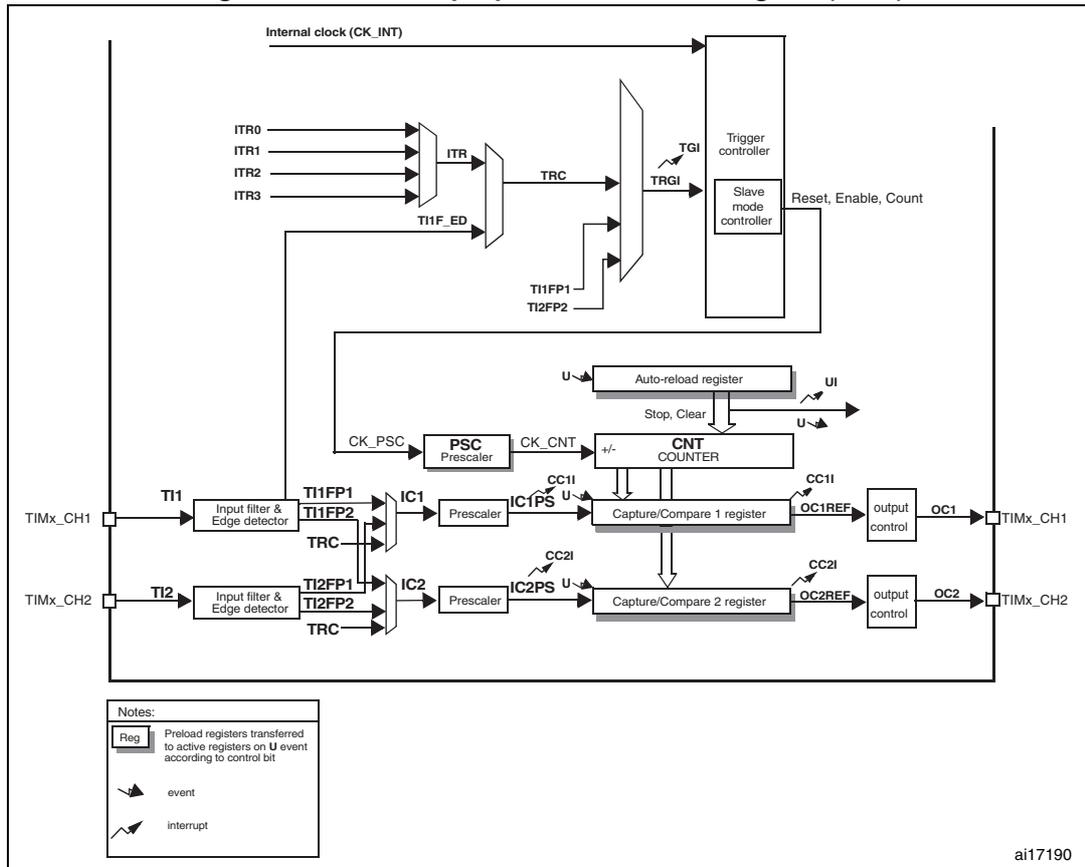
The diagram illustrates the internal architecture of a general-purpose timer (TIM9). At the top, the Internal clock (CK_INT) is connected to the Trigger controller and Slave mode controller . Four external interrupt lines ( ITR0 , ITR1 , ITR2 , ITR3 ) are multiplexed into an ITR block, which outputs TRC to the Trigger controller . The Trigger controller also receives TI1F_ED , TI1FP1 , and TI2FP2 signals and outputs TRGI to the Slave mode controller . The Slave mode controller provides Reset , Enable , and Count signals to the CNT COUNTER . The CNT COUNTER is connected to an Auto-reload register (with U and UI signals) and two Capture/Compare registers (CC1 and CC2). The Auto-reload register also receives Stop and Clear signals. The CNT COUNTER is clocked by CK_CNT , which is derived from CK_PSC via a PSC Prescaler . Two input channels, TIMx_CH1 and TIMx_CH2 , are processed through Input filter & Edge detector blocks (producing TI1 and TI2 ), then through IC1 and IC2 prescalers (producing IC1PS and IC2PS ), and finally into the Capture/Compare registers . The Capture/Compare registers output OC1REF and OC2REF signals to output control blocks, which generate OC1 and OC2 outputs on pins TIMx_CH1 and TIMx_CH2 . A Notes box at the bottom left defines symbols: Reg (Preload registers transferred to active registers on U event according to control bit), event (indicated by a small arrow), and interrupt (indicated by a larger arrow). The identifier ai17190 is in the bottom right corner.
16.2.2 TIM11 main features
The features of general-purpose timer TIM11 include:
- • 16-bit auto-reload upcounter
- • 16-bit programmable prescaler used to divide the counter clock frequency by any factor between 1 and 65536 (can be changed “on the fly”)
- • independent channel for:
- – Input capture
- – Output compare
- – PWM generation (edge-aligned mode)
- – One-pulse mode output
- • Interrupt generation on the following events:
- – Update: counter overflow, counter initialization (by software)
- – Input capture
- – Output compare
Figure 134. General-purpose timer block diagram (TIM11)
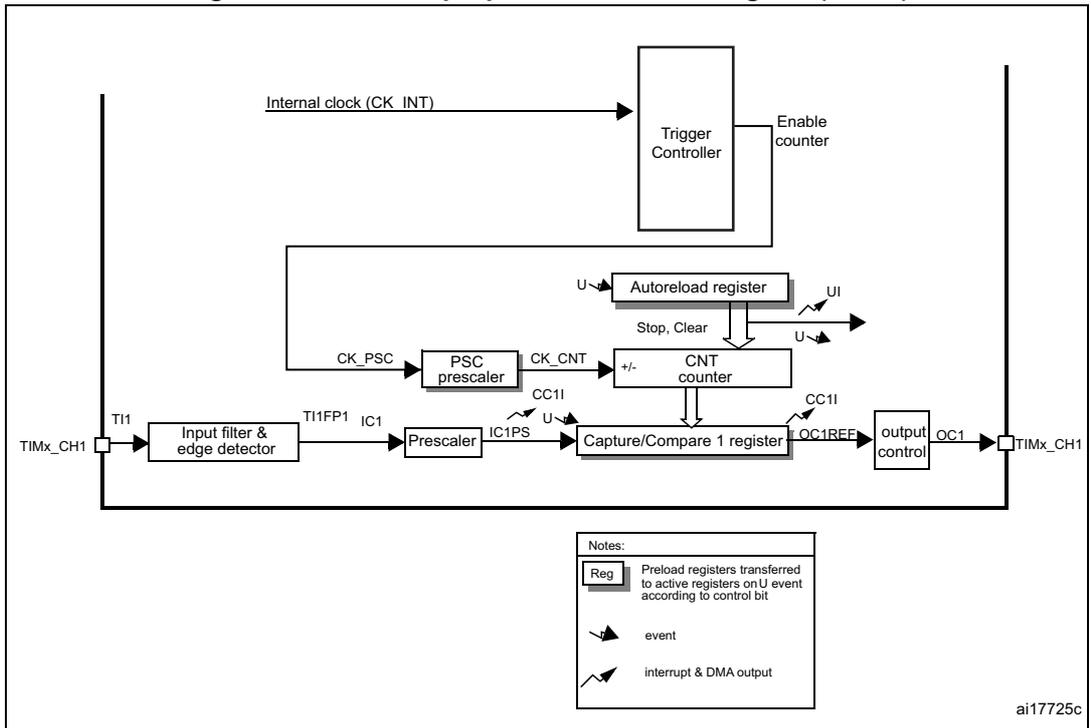
The diagram illustrates the internal architecture of the TIM11 general-purpose timer. At the top, an 'Internal clock (CK_INT)' is connected to a 'Trigger Controller'. The 'Trigger Controller' has an 'Enable counter' output. Below it, an 'Autoreload register' is shown with 'U' (update) and 'UI' (update interrupt) signals, and 'Stop, Clear' inputs. A 'CNT counter' (labeled '+/-') receives 'CK_PSC' from a 'PSC prescaler' and 'CK_CNT' from the 'Trigger Controller'. The 'CNT counter' is connected to a 'Capture/Compare 1 register' (labeled 'CC11'). This register has 'U' (update) and 'IC1PS' (input capture prescaler) signals, and 'OC1REF' (output compare 1 reference) and 'OC1' (output compare 1) signals. The 'OC1' signal is connected to an 'output control' block, which outputs 'TIMx_CH1'. The 'TIMx_CH1' signal is also connected to an 'Input filter & edge detector' block, which outputs 'TI1'. The 'TI1' signal is connected to a 'Prescaler' block, which outputs 'IC1'. The 'IC1' signal is connected to the 'Capture/Compare 1 register'. A 'Notes' box at the bottom right explains the symbols: 'Reg' for preload registers, a lightning bolt for 'event', and a lightning bolt with a diagonal line for 'interrupt & DMA output'. The identifier 'ai17725c' is in the bottom right corner.
16.3 TIM9 and TIM11 functional description
16.3.1 Time-base unit
The main block of the timer is a 16-bit counter with its related auto-reload register. The counter counts up.
The counter clock can be divided by a prescaler.
The counter, the auto-reload register and the prescaler register can be written or read by software. This is true even when the counter is running.
The time-base unit includes:
- • Counter register (TIMx_CNT)
- • Prescaler register (TIMx_PSC)
- • Auto-reload register (TIMx_ARR)
The auto-reload register is preloaded. Writing to or reading from the auto-reload register accesses the preload register. The content of the preload register are transferred into the shadow register permanently or at each update event (UEV), depending on the auto-reload preload enable bit (ARPE) in TIMx_CR1 register. The update event is sent when the counter reaches the overflow and if the UDIS bit equals 0 in the TIMx_CR1 register. It can also be generated by software. The generation of the update event is described in details for each configuration.
The counter is clocked by the prescaler output CK_CNT, which is enabled only when the counter enable bit (CEN) in TIMx_CR1 register is set (refer also to the slave mode controller description to get more details on counter enabling).
Note that the counter starts counting 1 clock cycle after setting the CEN bit in the TIMx_CR1 register.
Prescaler description
The prescaler can divide the counter clock frequency by any factor between 1 and 65536. It is based on a 16-bit counter controlled through a 16-bit register (in the TIMx_PSC register). It can be changed on the fly as this control register is buffered. The new prescaler ratio is taken into account at the next update event.
Figure 135 and Figure 136 give some examples of the counter behavior when the prescaler ratio is changed on the fly.
Figure 135. Counter timing diagram with prescaler division change from 1 to 2
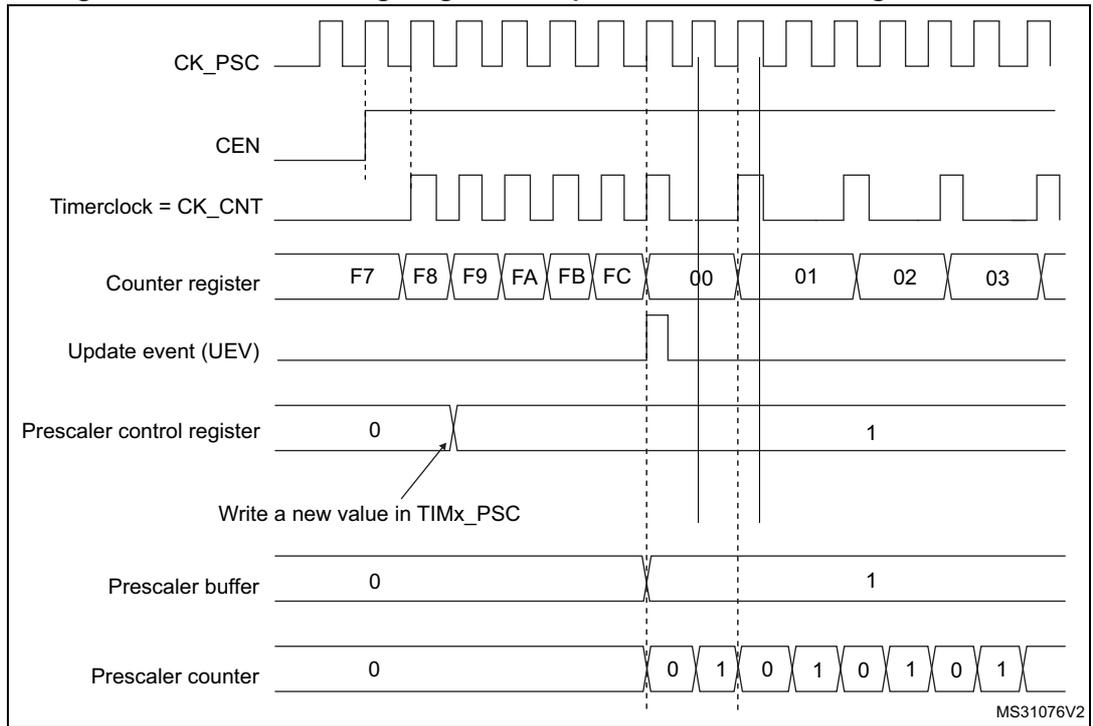
The diagram illustrates the timing of a general-purpose timer when the prescaler division is changed from 1 to 2. The signals shown are:
- CK_PSC : Prescaler clock signal, a periodic square wave.
- CEN : Counter enable signal, which goes high to enable counting.
- Timerclock = CK_CNT : The clock signal for the counter, derived from CK_PSC.
- Counter register : Shows the count values: F7, F8, F9, FA, FB, FC, 00, 01, 02, 03.
- Update event (UEV) : Generated when the counter register overflows from FC to 00.
- Prescaler control register : Initially set to 0 (division 1). A write operation changes it to 1 (division 2).
- Prescaler buffer : Latches the new prescaler value (1) from the control register.
- Prescaler counter : Counts from 0 to 1 (which corresponds to 2 CK_PSC periods) before resetting to 0. This change in counting range is reflected in the slower frequency of the Timerclock (CK_CNT) after the update.
MS31076V2
Figure 136. Counter timing diagram with prescaler division change from 1 to 4
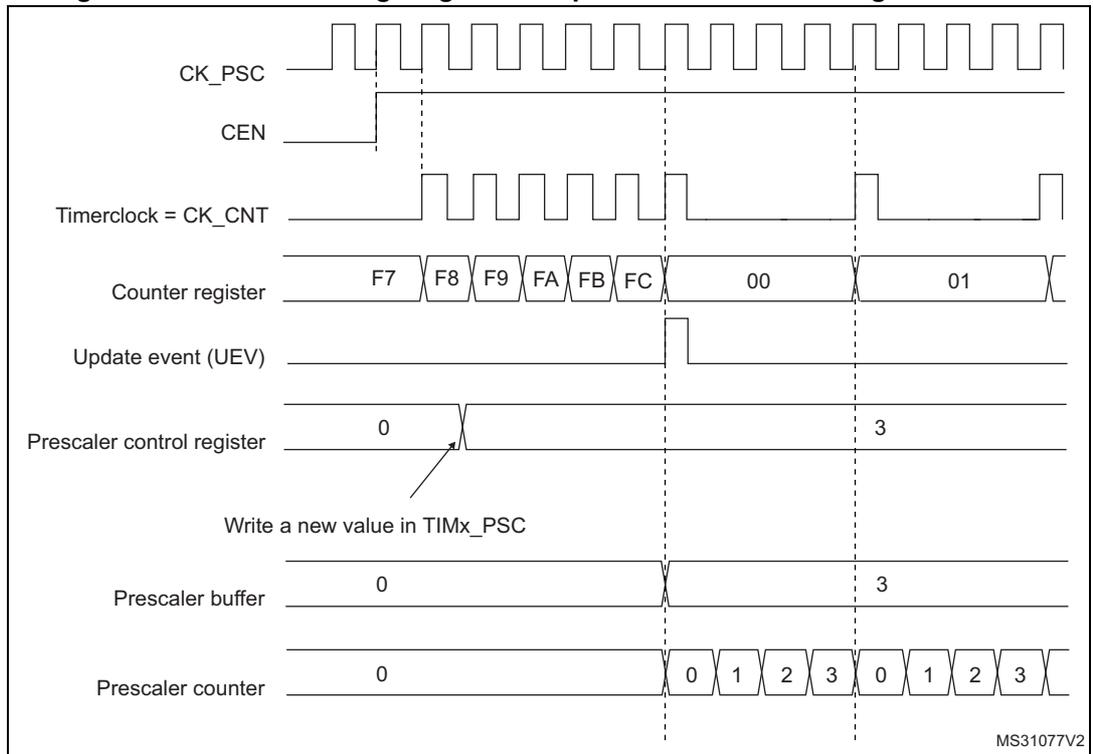
The diagram illustrates the timing of a general-purpose timer when the prescaler division is changed from 1 to 4. The signals shown are:
- CK_PSC : Prescaler clock signal, a periodic square wave.
- CEN : Counter enable signal, which goes high to enable counting.
- Timerclock = CK_CNT : The clock signal for the counter, derived from CK_PSC.
- Counter register : Shows the count values: F7, F8, F9, FA, FB, FC, 00, 01.
- Update event (UEV) : Generated when the counter register overflows from FC to 00.
- Prescaler control register : Initially set to 0 (division 1). A write operation changes it to 3 (division 4).
- Prescaler buffer : Latches the new prescaler value (3) from the control register.
- Prescaler counter : Counts from 0 to 3 (which corresponds to 4 CK_PSC periods) before resetting to 0. This change in counting range is reflected in the slower frequency of the Timerclock (CK_CNT) after the update.
MS31077V2
16.3.2 Counter modes
Upcounting mode
In upcounting mode, the counter counts from 0 to the auto-reload value (content of the TIMx_ARR register), then restarts from 0 and generates a counter overflow event.
Setting the UG bit in the TIMx_EGR register (by software or by using the slave mode controller on TIM9) also generates an update event.
The UEV event can be disabled by software by setting the UDIS bit in the TIMx_CR1 register. This is to avoid updating the shadow registers while writing new values in the preload registers. Then no update event occurs until the UDIS bit has been written to 0. However, the counter restarts from 0, as well as the counter of the prescaler (but the prescale rate does not change). In addition, if the URS bit (update request selection) in TIMx_CR1 register is set, setting the UG bit generates an update event UEV but without setting the UIF flag (thus no interrupt is sent). This is to avoid generating both update and capture interrupts when clearing the counter on the capture event.
When an update event occurs, all the registers are updated and the update flag (UIF bit in TIMx_SR register) is set (depending on the URS bit):
- • The auto-reload shadow register is updated with the preload value (TIMx_ARR),
- • The buffer of the prescaler is reloaded with the preload value (content of the TIMx_PSC register).
The following figures show some examples of the counter behavior for different clock frequencies when TIMx_ARR=0x36.
Figure 137. Counter timing diagram, internal clock divided by 1
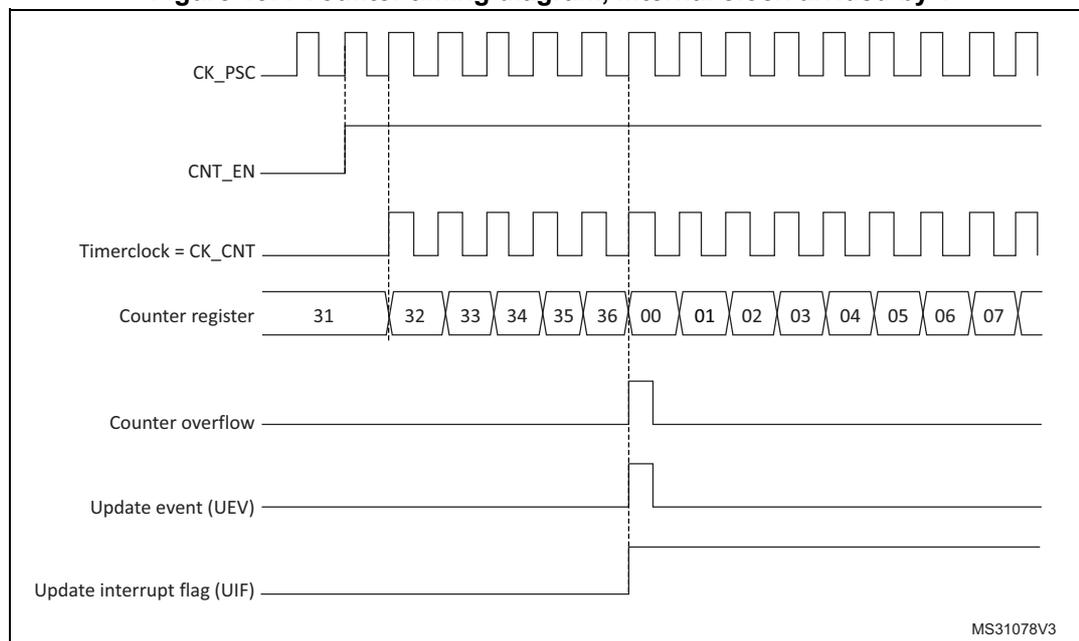
The timing diagram illustrates the counter's behavior in upcounting mode. The top signal, CK_PSC, is a periodic square wave. Below it, CNT_EN is a horizontal line that goes high to enable the counter. The third signal, Timerclock = CK_CNT, is a square wave that is active only when CNT_EN is high. The fourth signal shows the Counter register values, which increment from 31 to 32, 33, 34, 35, 36, 00, 01, 02, 03, 04, 05, 06, 07. The fifth signal, Counter overflow, is a pulse that goes high when the counter reaches 36 and returns low when it rolls over to 00. The sixth signal, Update event (UEV), is a pulse that goes high at the same time as the counter overflow. The bottom signal, Update interrupt flag (UIF), is a pulse that goes high at the same time as the counter overflow and returns low when the counter reaches 00. The diagram is labeled MS31078V3 in the bottom right corner.
Figure 138. Counter timing diagram, internal clock divided by 2
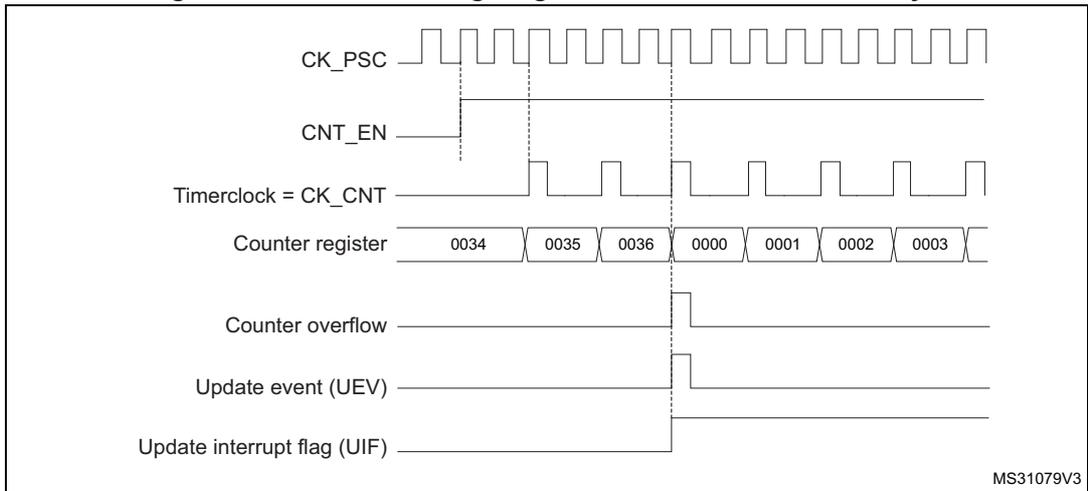
This timing diagram illustrates the operation of a timer when the internal clock is divided by 2. The top signal, CK_PSC, is a periodic square wave. Below it, CNT_EN is a high-level enable signal. The Timerclock = CK_CNT signal is a square wave with a frequency half that of CK_PSC. The Counter register shows a sequence of values: 0034, 0035, 0036, 0000, 0001, 0002, and 0003. A Counter overflow pulse occurs when the counter transitions from 0036 to 0000. The Update event (UEV) and Update interrupt flag (UIF) are shown as pulses that coincide with the counter overflow. The diagram is labeled MS31079V3.
Figure 139. Counter timing diagram, internal clock divided by 4
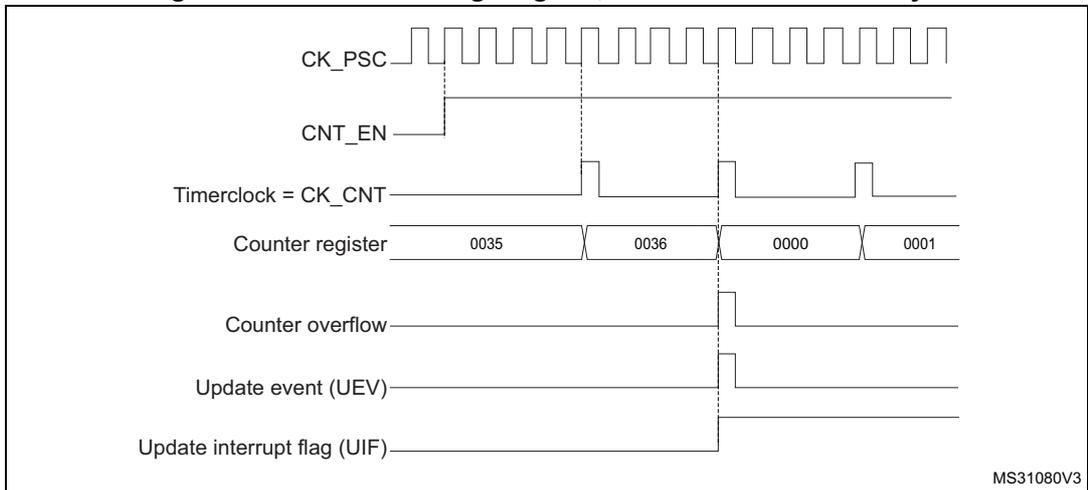
This timing diagram illustrates the operation of a timer when the internal clock is divided by 4. The top signal, CK_PSC, is a periodic square wave. Below it, CNT_EN is a high-level enable signal. The Timerclock = CK_CNT signal is a square wave with a frequency one-quarter that of CK_PSC. The Counter register shows a sequence of values: 0035, 0036, 0000, and 0001. A Counter overflow pulse occurs when the counter transitions from 0036 to 0000. The Update event (UEV) and Update interrupt flag (UIF) are shown as pulses that coincide with the counter overflow. The diagram is labeled MS31080V3.
Figure 140. Counter timing diagram, internal clock divided by N
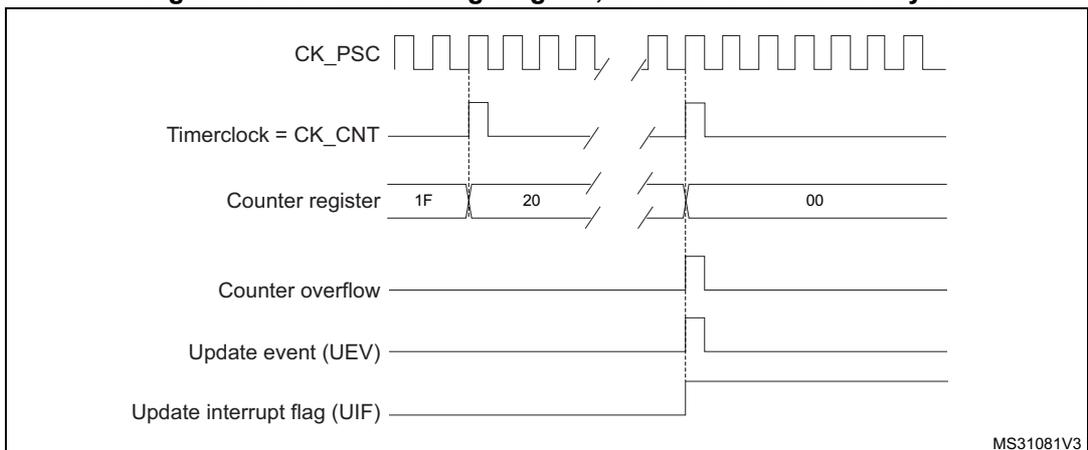
This timing diagram illustrates the operation of a timer when the internal clock is divided by an arbitrary factor N. The top signal, CK_PSC, is a periodic square wave. Below it, the Timerclock = CK_CNT signal is shown with a break in the waveform, indicating a lower frequency. The Counter register shows a sequence of values: 1F, 20, and 00. A Counter overflow pulse occurs when the counter transitions from 20 to 00. The Update event (UEV) and Update interrupt flag (UIF) are shown as pulses that coincide with the counter overflow. The diagram is labeled MS31081V3.
Figure 141. Counter timing diagram, update event when ARPE=0
(TIMx_ARR not preloaded)
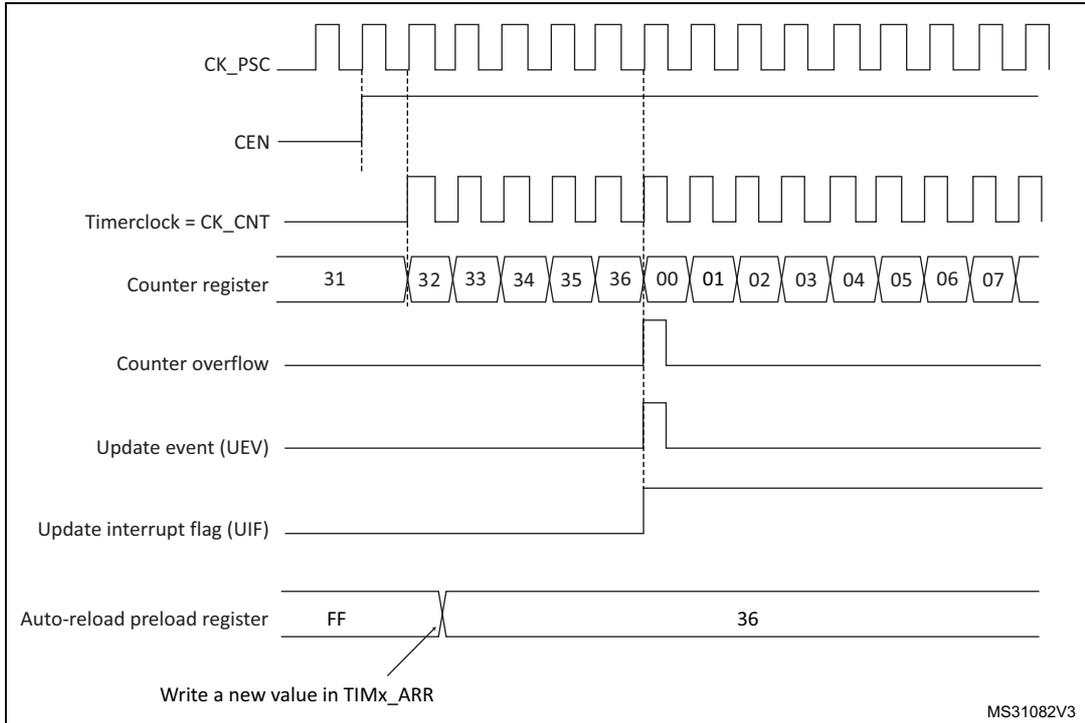
This timing diagram illustrates the operation of a timer when ARPE=0 and the auto-reload register (TIMx_ARR) is not preloaded. The diagram shows the following signals and registers over time:
- CK_PSC: A periodic clock signal for the prescaler.
- CEN: Counter Enable signal, shown as a high-level signal.
- Timerclock = CK_CNT: The clock signal for the counter, derived from CK_PSC.
- Counter register: Shows the counter values incrementing from 31 to 36, then overflowing to 00, 01, 02, 03, 04, 05, 06, and 07.
- Counter overflow: A signal that pulses high when the counter reaches its maximum value (36).
- Update event (UEV): A signal that pulses high upon counter overflow.
- Update interrupt flag (UIF): A flag that is set (goes high) when an update event occurs.
- Auto-reload preload register: Shows the register value changing from FF to 36. An arrow labeled "Write a new value in TIMx_ARR" points to this transition.
MS31082V3
Figure 142. Counter timing diagram, update event when ARPE=1
(TIMx_ARR preloaded)
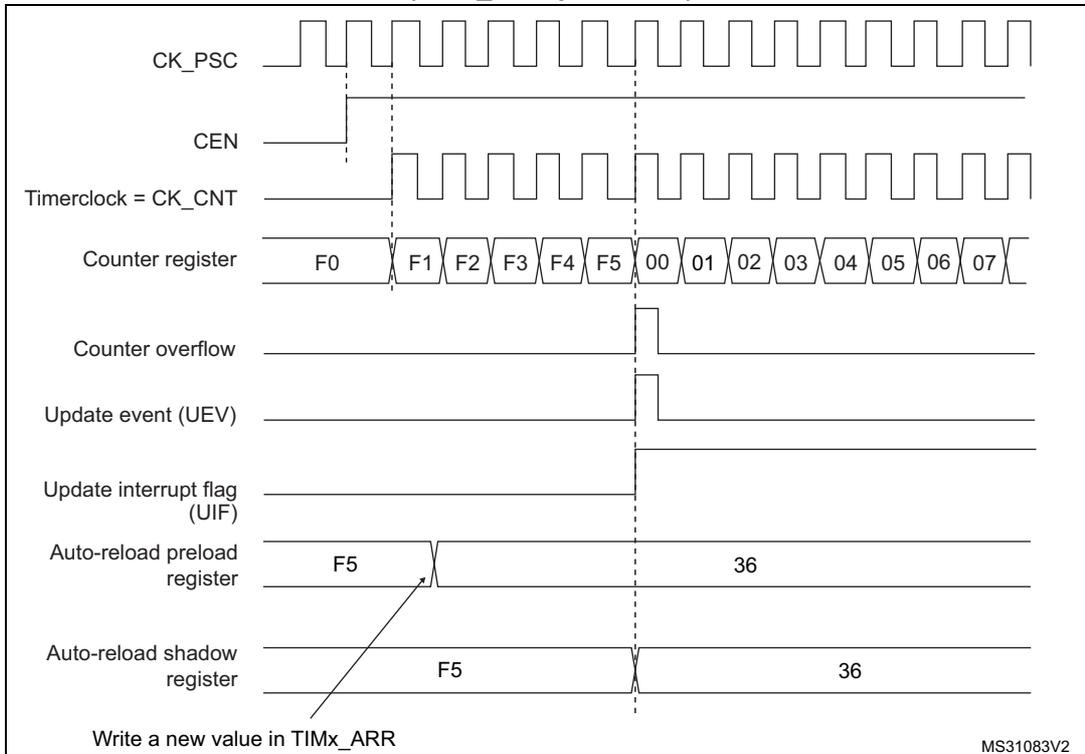
This timing diagram illustrates the operation of a timer when ARPE=1 and the auto-reload register (TIMx_ARR) is preloaded. The diagram shows the following signals and registers over time:
- CK_PSC: A periodic clock signal for the prescaler.
- CEN: Counter Enable signal, shown as a high-level signal.
- Timerclock = CK_CNT: The clock signal for the counter, derived from CK_PSC.
- Counter register: Shows the counter values incrementing from F0 to F5, then overflowing to 00, 01, 02, 03, 04, 05, 06, and 07.
- Counter overflow: A signal that pulses high when the counter reaches its maximum value (F5).
- Update event (UEV): A signal that pulses high upon counter overflow.
- Update interrupt flag (UIF): A flag that is set (goes high) when an update event occurs.
- Auto-reload preload register: Shows the register value changing from F5 to 36. An arrow labeled "Write a new value in TIMx_ARR" points to this transition.
- Auto-reload shadow register: Shows the register value changing from F5 to 36. This register is updated from the preload register at the time of the update event (counter overflow).
MS31083V2
16.3.3 Clock selection
The counter clock can be provided by the following clock sources:
- • Internal clock (CK_INT)
- • External clock mode1 (for TIM9 ): external input pin (TIx)
- • Internal trigger inputs (ITRx) (for TIM9 ): connecting the trigger output from another timer.
Internal clock source (CK_INT)
The internal clock source is the default clock source for TIM11.
For TIM9, the internal clock source is selected when the slave mode controller is disabled (SMS='000'). The CEN bit in the TIMx_CR1 register and the UG bit in the TIMx_EGR register are then used as control bits and can be changed only by software (except for UG which remains cleared). As soon as the CEN bit is programmed to 1, the prescaler is clocked by the internal clock CK_INT.
Figure 143 shows the behavior of the control circuit and the upcounter in normal mode, without prescaler.
Figure 143. Control circuit in normal mode, internal clock divided by 1
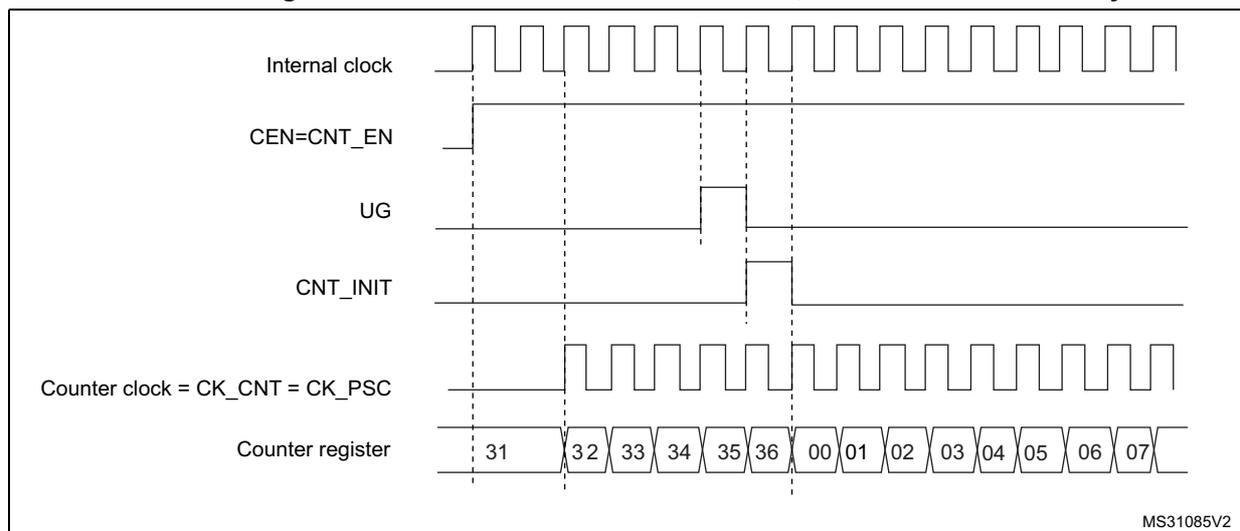
The figure is a timing diagram illustrating the control circuit and counter register behavior in normal mode with the internal clock divided by 1. It consists of five horizontal lines representing different signals over time, marked by three vertical dashed lines.
- Internal clock: A continuous square wave signal.
- CEN=CNT_EN: A signal that goes high at the first vertical dashed line and remains high.
- UG: A signal that goes high at the second vertical dashed line and remains high.
- CNT_INIT: A signal that goes high at the second vertical dashed line and then goes low at the third vertical dashed line.
- Counter register: A sequence of values: 31, 32, 33, 34, 35, 36, 00, 01, 02, 03, 04, 05, 06, 07. The counter increments by 1 at each rising edge of the counter clock, starting from 31 and rolling over to 00 after 36.
- Counter clock = CK_CNT = CK_PSC: A square wave signal that starts at the first vertical dashed line and continues to the end of the diagram.
MS31085V2
External clock source mode 1(TIM9)
This mode is selected when SMS='111' in the TIMx_SMCR register. The counter can count at each rising or falling edge on a selected input.
Figure 144. TI2 external clock connection example
![Figure 144: TI2 external clock connection example. This block diagram shows the internal logic for using the TI2 pin as an external clock source. The TI2 pin is connected to a 'Filter' block, which is controlled by the ICF[3:0] bits in the TIMx_CCMR1 register. The output of the filter goes to an 'Edge detector' block. The edge detector has two outputs: 'TI2F_Rising' and 'TI2F_Falling'. These are connected to a multiplexer (MUX) labeled '0' and '1'. The MUX is controlled by the CC2P bit in the TIMx_CCER register. The output of this MUX is connected to another MUX labeled 'TRGI'. This TRGI MUX has four inputs: '0xx' (ITRx), '100' (TI1_ED), '101' (TI1FP1), and '110' (TI2FP2). The TRGI MUX is controlled by the TS[2:0] bits in the TIMx_SMCR register. The output of the TRGI MUX is connected to a 'External clock mode 1' block. This block also receives an 'internal clock' (CK_INT) and is controlled by the SMS[2:0] bits in the TIMx_SMCR register. The output of the 'External clock mode 1' block is the 'CK_PSC' signal.](/RM0401-STM32F410/4753dd817f88f9e8bc58fcce3df36ea6_img.jpg)
For example, to configure the upcounter to count in response to a rising edge on the TI2 input, use the following procedure:
- 1. Configure channel 2 to detect rising edges on the TI2 input by writing CC2S = '01' in the TIMx_CCMR1 register.
- 2. Configure the input filter duration by writing the IC2F[3:0] bits in the TIMx_CCMR1 register (if no filter is needed, keep IC2F='0000').
- 3. Select the rising edge polarity by writing CC2P='0' and CC2NP='0' in the TIMx_CCER register.
- 4. Configure the timer in external clock mode 1 by writing SMS='111' in the TIMx_SMCR register.
- 5. Select TI2 as the trigger input source by writing TS='110' in the TIMx_SMCR register.
- 6. Enable the counter by writing CEN='1' in the TIMx_CR1 register.
Note: The capture prescaler is not used for triggering, so it does not need to be configured.
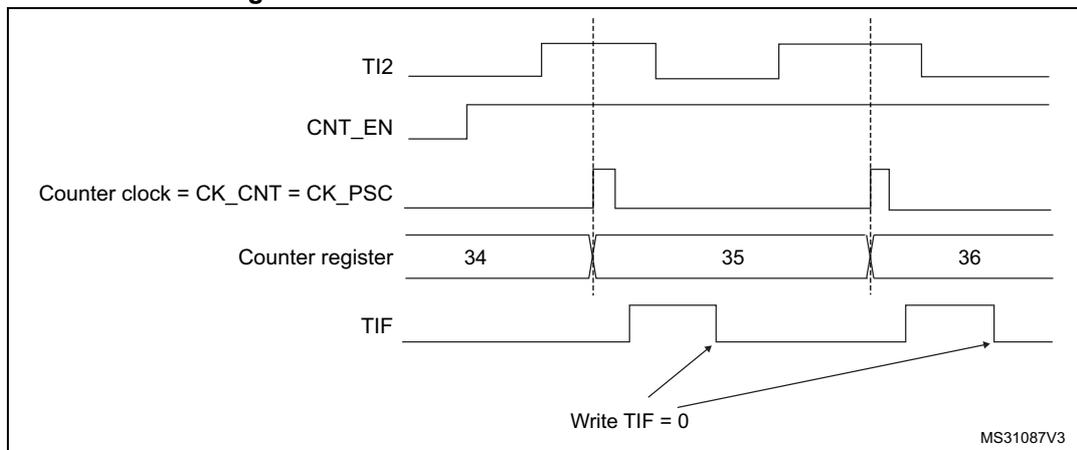
When a rising edge occurs on TI2, the counter counts once and the TIF flag is set.
The delay between the rising edge on TI2 and the actual clock of the counter is due to the resynchronization circuit on TI2 input.
Figure 145. Control circuit in external clock mode 1
16.3.4 Capture/compare channels
Each Capture/Compare channel is built around a capture/compare register (including a shadow register), a input stage for capture (with digital filter, multiplexing and prescaler) and an output stage (with comparator and output control).
Figure 146 to Figure 148 give an overview of one capture/compare channel.
The input stage samples the corresponding TIx input to generate a filtered signal TIxF. Then, an edge detector with polarity selection generates a signal (TIxFPx) which can be used as trigger input by the slave mode controller or as the capture command. It is prescaled before the capture register (ICxPS).
Figure 146. Capture/compare channel (example: channel 1 input stage)
![Block diagram of the capture/compare channel input stage for channel 1. The diagram shows the signal flow from the TI1 input through a filter downcounter, edge detector, and multiplexers to the slave mode controller and the IC1PS output. Control signals include ICF[3:0], CC1P/CC1NP, TIMx_CCER, TRC, CC1S[1:0], ICPS[1:0], and CC1E.](/RM0401-STM32F410/241c75c046c333535553f0a4631aeec7_img.jpg)
The diagram illustrates the input stage of a capture/compare channel (example: channel 1). The signal flow is as follows:
- The TI1 input is processed by a Filter downcounter (controlled by ICF[3:0] and TIMx_CCMR1 ) to produce a filtered signal TI1F .
- The TI1F signal is then processed by an Edge detector (controlled by CC1P/CC1NP and TIMx_CCER ) to generate TI1F_Rising and TI1F_Falling signals.
- These signals are multiplexed (0 for Rising, 1 for Falling) to produce TI1FP1 .
- TI1FP1 is then processed by a multiplexer (01) to produce TI1F_ED , which is sent to the slave mode controller .
- Alternatively, the signals can be multiplexed (10) to produce TI2FP1 , which is then processed by a multiplexer (10) to produce IC1 .
- IC1 is then processed by a Divider /1, /2, /4, /8 (controlled by CC1S[1:0] and ICPS[1:0] from TIMx_CCMR1 ) to produce the IC1PS output.
- The TRC signal from the slave mode controller is also processed by a multiplexer (11) to produce IC1 .
- Control signals include CC1P/CC1NP , TIMx_CCER , TRC , CC1S[1:0] , ICPS[1:0] , and CC1E .
The output stage generates an intermediate waveform which is then used for reference: OCxRef (active high). The polarity acts at the end of the chain.
Figure 147. Capture/compare channel 1 main circuit
![Figure 147. Capture/compare channel 1 main circuit diagram. This block diagram shows the internal architecture of capture/compare channel 1. At the top, an APB Bus connects to an MCU-peripheral interface. This interface has two 8-bit wide paths (high and low, if 16-bit) to a Capture/compare preload register. The preload register has write signals (write_in_progress, write CCR1H, write CCR1L) and read signals (Read CCR1H, Read CCR1L, read_in_progress). Below the preload register is a Capture/compare shadow register, which receives 'capture_transfer' and 'compare_transfer' signals. A Counter block is connected to the shadow register and a Comparator. The Comparator outputs 'CNT > CCR1' and 'CNT = CCR1'. On the left, input logic includes OR gates for CC1S[1], CC1S[0] and IC1PS, CC1E, and CC1G (from TIM1_EGR). These feed into an 'Input mode' block. On the right, output logic includes OR gates for CC1S[1], CC1S[0] and OC1PE, UEV (from time base unit). These feed into an 'Output mode' block, which produces OC1PE (from TIM1_CCMR1).](/RM0401-STM32F410/72b43e2f42ffc000f9f9b21bff9b6191_img.jpg)
Figure 148. Output stage of capture/compare channel (channel 1)
![Figure 148. Output stage of capture/compare channel (channel 1) diagram. This diagram details the output stage. It starts with an 'Output mode controller' block receiving 'CNT > CCR2' and 'CNT = CCR2' signals. It outputs 'OC1_REF' to the master mode controller and is controlled by 'OC2M[2:0]' from TIMx_CCMR1. The 'OC1_REF' signal passes through a multiplexer (selecting between 0 and 1) controlled by 'CC1P' from TIMx_CCER. The output of the multiplexer then goes to an 'Output enable circuit' controlled by 'CC1E' from TIMx_CCER, which produces the final output 'OC1'.](/RM0401-STM32F410/a754b0c3395aa9af33e8ca6bc75eb507_img.jpg)
The capture/compare block is made of one preload register and one shadow register. Write and read always access the preload register.
In capture mode, captures are actually done in the shadow register, which is copied into the preload register.
In compare mode, the content of the preload register is copied into the shadow register which is compared to the counter.
16.3.5 Input capture mode
In Input capture mode, the Capture/Compare Registers (TIMx_CCRx) are used to latch the value of the counter after a transition detected by the corresponding ICx signal. When a capture occurs, the corresponding CCxIF flag (TIMx_SR register) is set and an interrupt or a DMA request can be sent if they are enabled. If a capture occurs while the CCxIF flag was already high, then the over-capture flag CCxOF (TIMx_SR register) is set. CCxIF can be
cleared by software by writing it to '0' or by reading the captured data stored in the TIMx_CCRx register. CCxOF is cleared when it is written with 0.
The following example shows how to capture the counter value in TIMx_CCR1 when TI1 input rises. To do this, use the following procedure:
- 1. Select the active input: TIMx_CCR1 must be linked to the TI1 input, so write the CC1S bits to '01' in the TIMx_CCMR1 register. As soon as CC1S becomes different from '00', the channel is configured in input mode and the TIMx_CCR1 register becomes read-only.
- 2. Program the appropriate input filter duration in relation with the signal connected to the timer (by programming the ICxF bits in the TIMx_CCMRx register if the input is one of the TIx inputs). Let's imagine that, when toggling, the input signal is not stable during at most 5 internal clock cycles. We must program a filter duration longer than these 5 clock cycles. We can validate a transition on TI1 when 8 consecutive samples with the new level have been detected (sampled at \( f_{DTS} \) frequency). Then write IC1F bits to '0011' in the TIMx_CCMR1 register.
- 3. Select the edge of the active transition on the TI1 channel by programming CC1P and CC1NP bits to '00' in the TIMx_CCER register (rising edge in this case).
- 4. Program the input prescaler. In our example, we wish the capture to be performed at each valid transition, so the prescaler is disabled (write IC1PS bits to '00' in the TIMx_CCMR1 register).
- 5. Enable capture from the counter into the capture register by setting the CC1E bit in the TIMx_CCER register.
- 6. If needed, enable the related interrupt request by setting the CC1IE bit in the TIMx_DIER register.
When an input capture occurs:
- • The TIMx_CCR1 register gets the value of the counter on the active transition.
- • CC1IF flag is set (interrupt flag). CC1OF is also set if at least two consecutive captures occurred whereas the flag was not cleared.
- • An interrupt is generated depending on the CC1IE bit.
In order to handle the overcapture, it is recommended to read the data before the overcapture flag. This is to avoid missing an overcapture which could happen after reading the flag and before reading the data.
Note: IC interrupt requests can be generated by software by setting the corresponding CCxG bit in the TIMx_EGR register.
16.3.6 PWM input mode (only for TIM9)
This mode is a particular case of input capture mode. The procedure is the same except:
- • Two ICx signals are mapped on the same TIx input.
- • These 2 ICx signals are active on edges with opposite polarity.
- • One of the two TIxFP signals is selected as trigger input and the slave mode controller is configured in reset mode.
For example, one can measure the period (in TIMx_CCR1 register) and the duty cycle (in TIMx_CCR2 register) of the PWM applied on TI1 using the following procedure (depending on CK_INT frequency and prescaler value):
- 1. Select the active input for TIMx_CCR1: write the CC1S bits to '01' in the TIMx_CCMR1 register (TI1 selected).
- 2. Select the active polarity for TI1FP1 (used both for capture in TIMx_CCR1 and counter clear): program the CC1P and CC1NP bits to '00' (active on rising edge).
- 3. Select the active input for TIMx_CCR2: write the CC2S bits to '10' in the TIMx_CCMR1 register (TI1 selected).
- 4. Select the active polarity for TI1FP2 (used for capture in TIMx_CCR2): write the CC2P bit to '1' and the CC2NP bit to '0' (active on falling edge).
- 5. Select the valid trigger input: write the TS bits to '101' in the TIMx_SMCR register (TI1FP1 selected).
- 6. Configure the slave mode controller in reset mode: write the SMS bits to '100' in the TIMx_SMCR register.
- 7. Enable the captures: write the CC1E and CC2E bits to '1' in the TIMx_CCER register.
Figure 149. PWM input mode timing
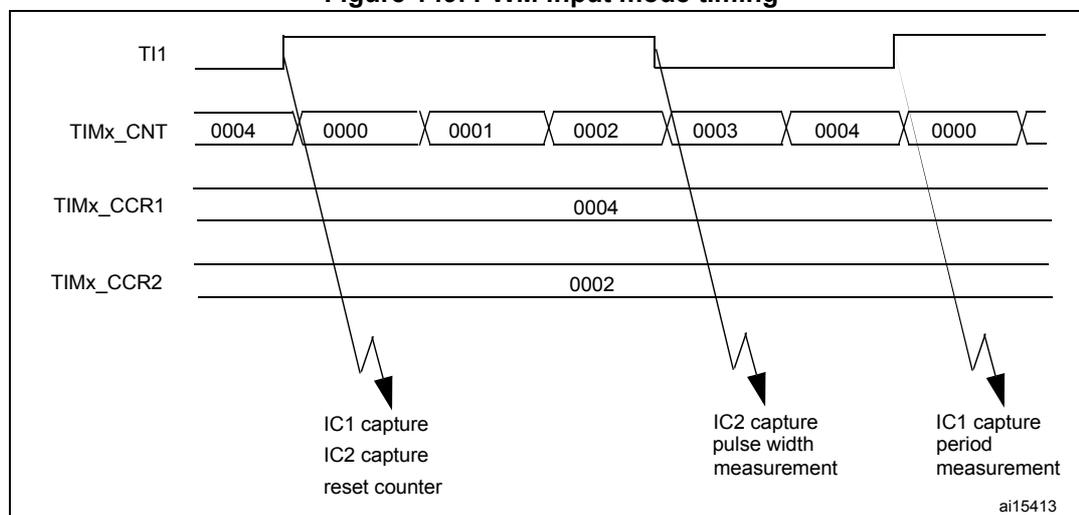
- 1. The PWM input mode can be used only with the TIMx_CH1/TIMx_CH2 signals due to the fact that only TI1FP1 and TI2FP2 are connected to the slave mode controller.
16.3.7 Forced output mode
In output mode (CCxS bits = '00' in the TIMx_CCMRx register), each output compare signal (OCxREF and then OCx) can be forced to active or inactive level directly by software, independently of any comparison between the output compare register and the counter.
To force an output compare signal (OCXREF/OCx) to its active level, one just needs to write '101' in the OCxM bits in the corresponding TIMx_CCMRx register. Thus OCXREF is forced high (OCxREF is always active high) and OCx get opposite value to CCxP polarity bit.
For example: CCxP='0' (OCx active high) => OCx is forced to high level.
The OCxREF signal can be forced low by writing the OCxM bits to '100' in the TIMx_CCMRx register.
Anyway, the comparison between the TIMx_CCRx shadow register and the counter is still performed and allows the flag to be set. Interrupt requests can be sent accordingly. This is described in the output compare mode section below.
16.3.8 Output compare mode
This function is used to control an output waveform or indicating when a period of time has elapsed.
When a match is found between the capture/compare register and the counter, the output compare function:
- 1. Assigns the corresponding output pin to a programmable value defined by the output compare mode (OCxM bits in the TIMx_CCMRx register) and the output polarity (CCxP bit in the TIMx_CCER register). The output pin can keep its level (OCxM='000'), be set active (OCxM='001'), be set inactive (OCxM='010') or can toggle (OCxM='011') on match.
- 2. Sets a flag in the interrupt status register (CCxIF bit in the TIMx_SR register).
- 3. Generates an interrupt if the corresponding interrupt mask is set (CCxIE bit in the TIMx_DIER register).
The TIMx_CCRx registers can be programmed with or without preload registers using the OCxPE bit in the TIMx_CCMRx register.
In output compare mode, the update event UEV has no effect on OCxREF and OCx output. The timing resolution is one count of the counter. Output compare mode can also be used to output a single pulse (in One-pulse mode).
Procedure:
- 1. Select the counter clock (internal, external, prescaler).
- 2. Write the desired data in the TIMx_ARR and TIMx_CCRx registers.
- 3. Set the CCxIE bit if an interrupt request is to be generated.
- 4. Select the output mode. For example:
- – Write OCxM = '011' to toggle OCx output pin when CNT matches CCRx
- – Write OCxPE = '0' to disable preload register
- – Write CCxP = '0' to select active high polarity
- – Write CCxE = '1' to enable the output
- 5. Enable the counter by setting the CEN bit in the TIMx_CR1 register.
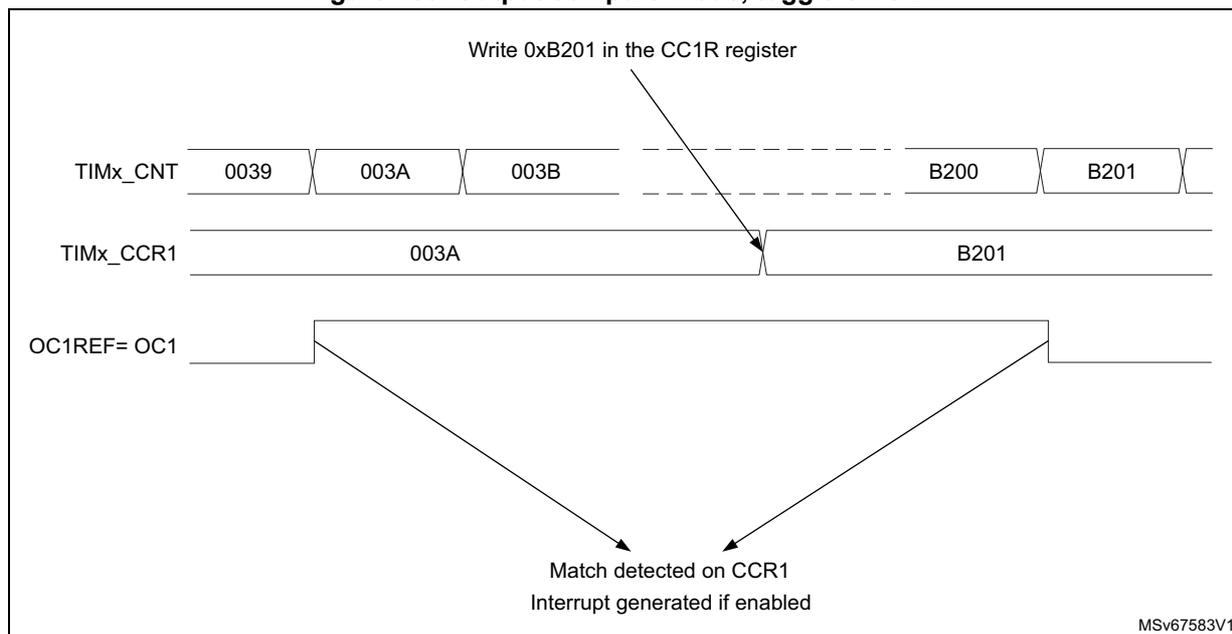
The TIMx_CCRx register can be updated at any time by software to control the output waveform, provided that the preload register is not enabled (OCxPE='0', else TIMx_CCRx shadow register is updated only at the next update event UEV). An example is given in Figure 150 .
Figure 150. Output compare mode, toggle on OC1.
16.3.9 PWM mode
Pulse Width Modulation mode allows to generate a signal with a frequency determined by the value of the TIMx_ARR register and a duty cycle determined by the value of the TIMx_CCRx register.
The PWM mode can be selected independently on each channel (one PWM per OCx output) by writing '110' (PWM mode 1) or '111' (PWM mode 2) in the OCxM bits in the TIMx_CCMRx register. The corresponding preload register must be enabled by setting the OCxPE bit in the TIMx_CCMRx register, and eventually the auto-reload preload register (in upcounting or center-aligned modes) by setting the ARPE bit in the TIMx_CR1 register.
As the preload registers are transferred to the shadow registers only when an update event occurs, before starting the counter, all registers must be initialized by setting the UG bit in the TIMx_EGR register.
The OCx polarity is software programmable using the CCxP bit in the TIMx_CCER register. It can be programmed as active high or active low. The OCx output is enabled by the CCxE bit in the TIMx_CCER register. Refer to the TIMx_CCERx register description for more details.
In PWM mode (1 or 2), TIMx_CNT and TIMx_CCRx are always compared to determine whether \( TIMx\_CNT \leq TIMx\_CCRx \) .
The timer is able to generate PWM in edge-aligned mode only since the counter is upcounting.
PWM edge-aligned mode
In the following example, we consider PWM mode 1. The reference PWM signal OCxREF is high as long as \( TIMx\_CNT < TIMx\_CCRx \) else it becomes low. If the compare value in TIMx_CCRx is greater than the auto-reload value (in TIMx_ARR) then OCxREF is held at '1'. If the compare value is 0 then OCxRef is held at '0'. Figure 151 shows some edge-aligned PWM waveforms in an example where TIMx_ARR=8.
Figure 151. Edge-aligned PWM waveforms (ARR=8)
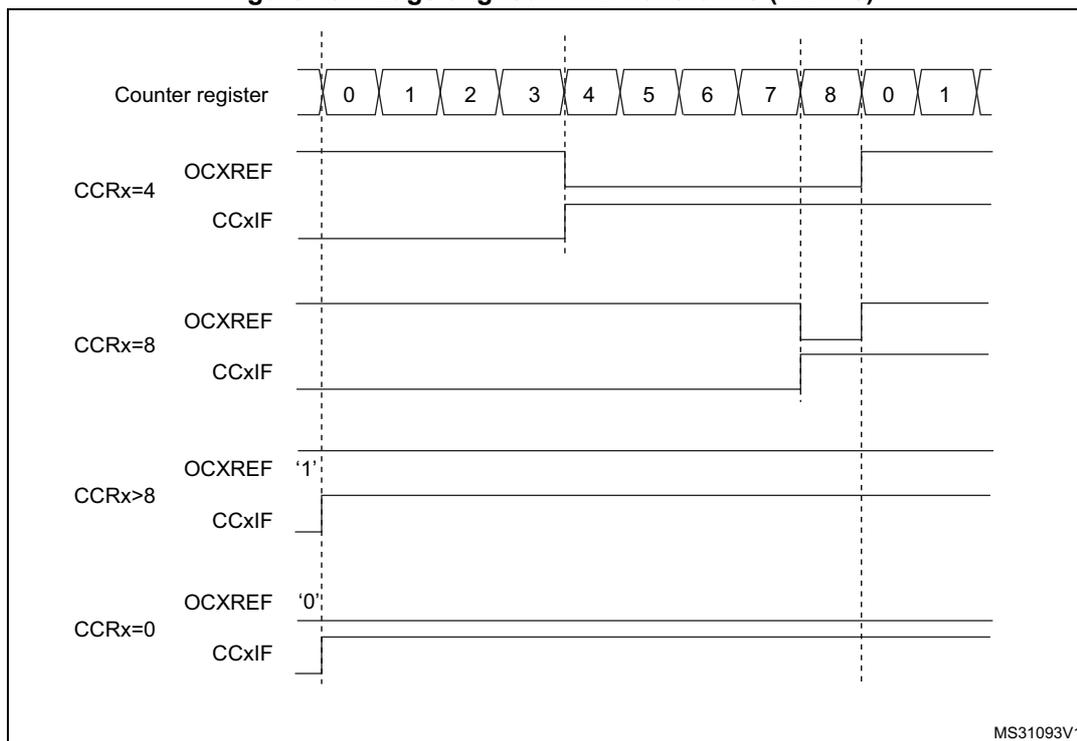
The diagram illustrates the relationship between the Counter register, OCXREF, and CCxIF signals for different CCRx values. The Counter register sequence is 0, 1, 2, 3, 4, 5, 6, 7, 8, 0, 1. Vertical dashed lines mark the counter values 0, 4, 8, and 0 again.
- CCRx=4: OCXREF is high from counter 0 to 4, then low. CCxIF is high at counter 4.
- CCRx=8: OCXREF is high from counter 0 to 8, then low. CCxIF is high at counter 8.
- CCRx>8: OCXREF is high from counter 0 to 8, then high again at counter 0. CCxIF is high at counter 0.
- CCRx=0: OCXREF is high from counter 0 to 8, then low. CCxIF is high at counter 0.
MS31093V1
16.3.10 One-pulse mode
One-pulse mode (OPM) is a particular case of the previous modes. It allows the counter to be started in response to a stimulus and to generate a pulse with a programmable length after a programmable delay.
Starting the counter can be controlled through the slave mode controller. Generating the waveform can be done in output compare mode or PWM mode. One-pulse mode is selected by setting the OPM bit in the TIMx_CR1 register. This makes the counter stop automatically at the next update event UEV.
A pulse can be correctly generated only if the compare value is different from the counter initial value. Before starting (when the timer is waiting for the trigger), the configuration must be as follows:
Figure 152. Example of One-pulse mode
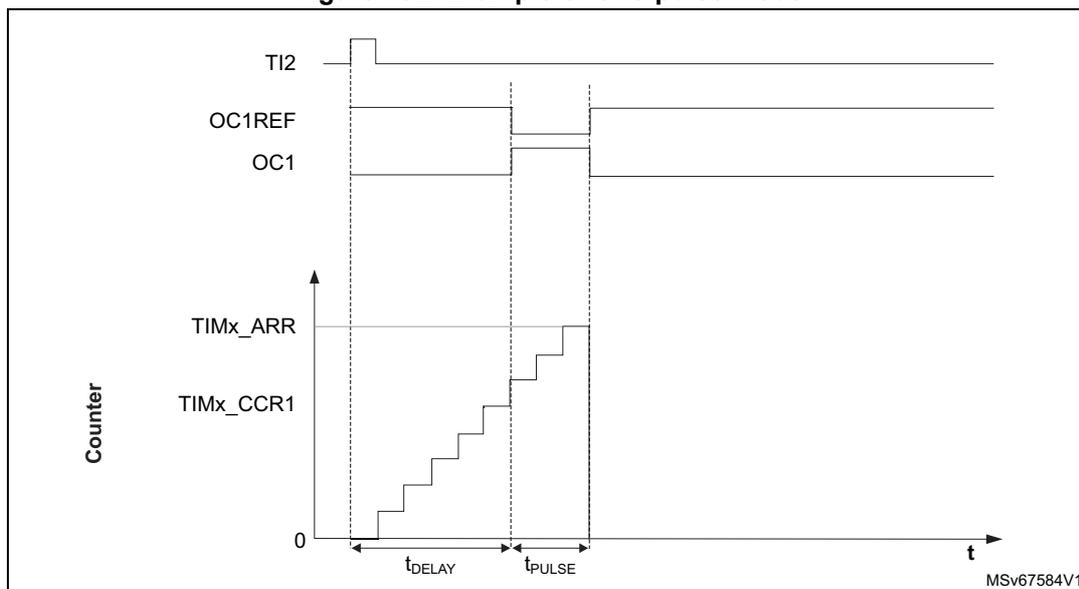
For example one may want to generate a positive pulse on OC1 with a length of \( t_{PULSE} \) and after a delay of \( t_{DELAY} \) as soon as a positive edge is detected on the TI2 input pin.
Use TI2FP2 as trigger 1:
- 1. Map TI2FP2 to TI2 by writing CC2S='01' in the TIMx_CCMR1 register.
- 2. TI2FP2 must detect a rising edge, write CC2P='0' and CC2NP = '0' in the TIMx_CCER register.
- 3. Configure TI2FP2 as trigger for the slave mode controller (TRGI) by writing TS='110' in the TIMx_SMCR register.
- 4. TI2FP2 is used to start the counter by writing SMS to '110' in the TIMx_SMCR register (trigger mode).
The OPM waveform is defined by writing the compare registers (taking into account the clock frequency and the counter prescaler).
- • The \( t_{DELAY} \) is defined by the value written in the TIMx_CCR1 register.
- • The \( t_{PULSE} \) is defined by the difference between the auto-reload value and the compare value ( \( TIMx\_ARR - TIMx\_CCR1 \) ).
- • Let's say one want to build a waveform with a transition from '0' to '1' when a compare match occurs and a transition from '1' to '0' when the counter reaches the auto-reload value. To do this PWM mode 2 must be enabled by writing OC1M='111' in the TIMx_CCMR1 register. Optionally the preload registers can be enabled by writing OC1PE='1' in the TIMx_CCMR1 register and ARPE in the TIMx_CR1 register. In this case one has to write the compare value in the TIMx_CCR1 register, the auto-reload value in the TIMx_ARR register, generate an update by setting the UG bit and wait for external trigger event on TI2. CC1P is written to '0' in this example.
Since only 1 pulse (Single mode) is needed, a 1 must be written in the OPM bit in the TIMx_CR1 register to stop the counter at the next update event (when the counter rolls over from the auto-reload value back to 0). When OPM bit in the TIMx_CR1 register is set to '0', so the Repetitive Mode is selected.
Particular case: OCx fast enableIn One-pulse mode, the edge detection on TIx input set the CEN bit which enables the counter. Then the comparison between the counter and the compare value makes the output toggle. But several clock cycles are needed for these operations and it limits the minimum delay \( t_{\text{DELAY min}} \) we can get.
If one wants to output a waveform with the minimum delay, the OCxFE bit can be set in the TIMx_CCMRx register. Then OCxRef (and OCx) are forced in response to the stimulus, without taking in account the comparison. Its new level is the same as if a compare match had occurred. OCxFE acts only if the channel is configured in PWM1 or PWM2 mode.
16.3.11 TIM9 external trigger synchronizationThe TIM9 timers can be synchronized with an external trigger in several modes: Reset mode, Gated mode and Trigger mode.
Slave mode: Reset modeThe counter and its prescaler can be reinitialized in response to an event on a trigger input. Moreover, if the URS bit from the TIMx_CR1 register is low, an update event UEV is generated. Then all the preloaded registers (TIMx_ARR, TIMx_CCRx) are updated.
In the following example, the upcounter is cleared in response to a rising edge on TI1 input:
- 1. Configure the channel 1 to detect rising edges on TI1. Configure the input filter duration (in this example, we do not need any filter, so we keep IC1F='0000'). The capture prescaler is not used for triggering, so it does not need to be configured. The CC1S bits select the input capture source only, CC1S = '01' in the TIMx_CCMR1 register. Program CC1P and CC1NP to '00' in TIMx_CCER register to validate the polarity (and detect rising edges only).
- 2. Configure the timer in reset mode by writing SMS='100' in TIMx_SMCR register. Select TI1 as the input source by writing TS='101' in TIMx_SMCR register.
- 3. Start the counter by writing CEN='1' in the TIMx_CR1 register.
The counter starts counting on the internal clock, then behaves normally until TI1 rising edge. When TI1 rises, the counter is cleared and restarts from 0. In the meantime, the trigger flag is set (TIF bit in the TIMx_SR register) and an interrupt request can be sent if enabled (depending on the TIE bit in TIMx_DIER register).
The following figure shows this behavior when the auto-reload register TIMx_ARR=0x36. The delay between the rising edge on TI1 and the actual reset of the counter is due to the resynchronization circuit on TI1 input.
Figure 153. Control circuit in reset mode
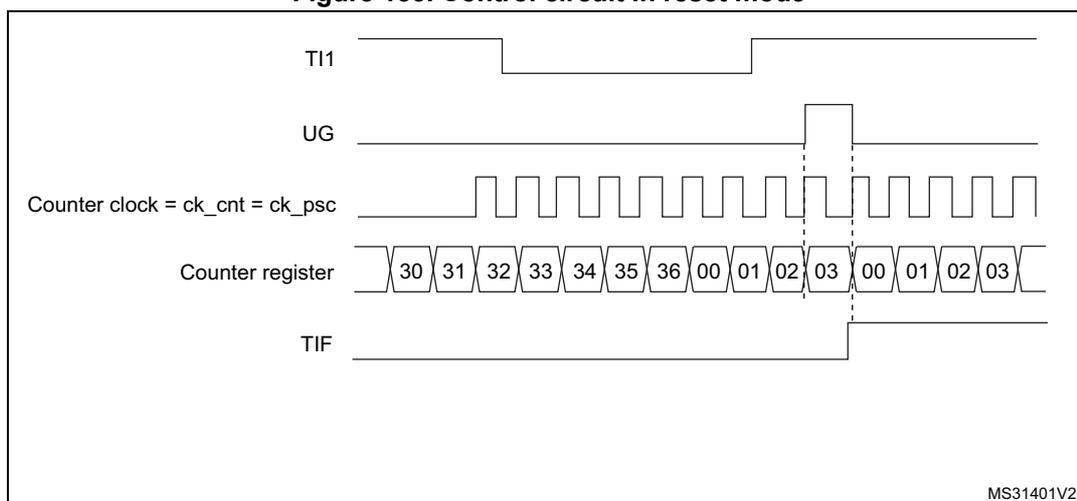
The diagram illustrates the control circuit in reset mode. The TI1 input is high initially, then goes low, and then high again. The UG (Update Generation) signal is a pulse when TI1 goes high. The Counter clock (ck_cnt = ck_psc) is a periodic square wave. The Counter register shows values 30, 31, 32, 33, 34, 35, 36, 00, 01, 02, 03, 00, 01, 02, 03. The TIF (Trigger Interrupt Flag) is a pulse when TI1 goes high.
MS31401V2
Slave mode: Gated mode
The counter can be enabled depending on the level of a selected input.
In the following example, the upcounter counts only when TI1 input is low:
- 1. Configure the channel 1 to detect low levels on TI1. Configure the input filter duration (in this example, we do not need any filter, so we keep IC1F='0000'). The capture prescaler is not used for triggering, so it does not need to be configured. The CC1S bits select the input capture source only, CC1S='01' in TIMx_CCMR1 register. Program CC1P='1' and CC1NP= '0' in TIMx_CCER register to validate the polarity (and detect low level only).
- 2. Configure the timer in gated mode by writing SMS='101' in TIMx_SMCR register. Select TI1 as the input source by writing TS='101' in TIMx_SMCR register.
- 3. Enable the counter by writing CEN='1' in the TIMx_CR1 register (in gated mode, the counter doesn't start if CEN='0', whatever is the trigger input level).
The counter starts counting on the internal clock as long as TI1 is low and stops as soon as TI1 becomes high. The TIF flag in the TIMx_SR register is set both when the counter starts or stops.
The delay between the rising edge on TI1 and the actual stop of the counter is due to the resynchronization circuit on TI1 input.
Figure 154. Control circuit in gated mode
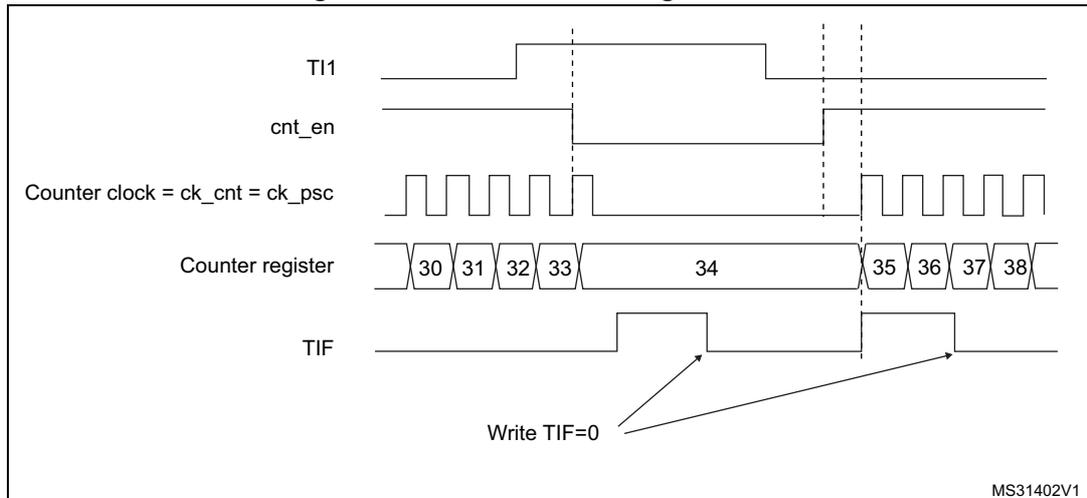
Slave mode: Trigger mode
The counter can start in response to an event on a selected input.
In the following example, the upcounter starts in response to a rising edge on TI2 input:
- 1. Configure the channel 2 to detect rising edges on TI2. Configure the input filter duration (in this example, we do not need any filter, so we keep IC2F='0000'). The capture prescaler is not used for triggering, so it does not need to be configured. The CC2S bits are configured to select the input capture source only, CC2S='01' in TIMx_CCMR1 register. Program CC2P='1' and CC2NP='0' in TIMx_CCER register to validate the polarity (and detect low level only).
- 2. Configure the timer in trigger mode by writing SMS='110' in TIMx_SMCR register. Select TI2 as the input source by writing TS='110' in TIMx_SMCR register.
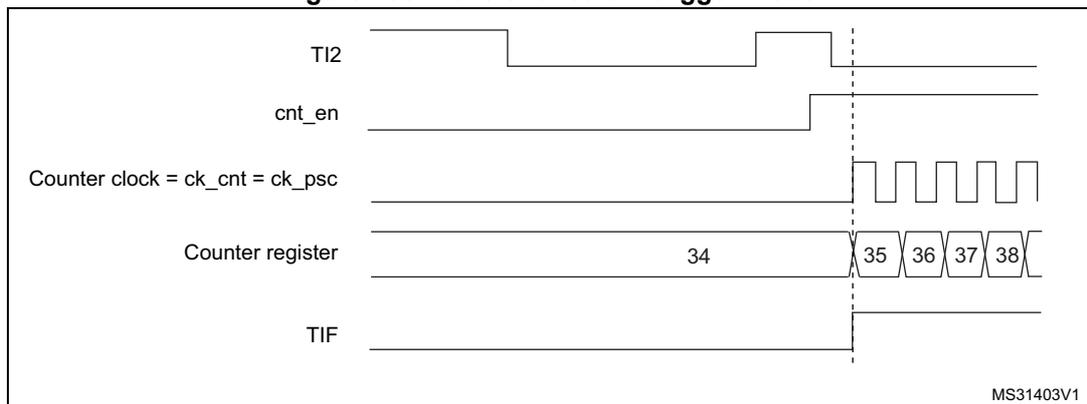
When a rising edge occurs on TI2, the counter starts counting on the internal clock and the TIF flag is set.
The delay between the rising edge on TI2 and the actual start of the counter is due to the resynchronization circuit on TI2 input.
Figure 155. Control circuit in trigger mode
16.3.12 Debug mode
When the microcontroller enters debug mode (Cortex®-M4 with FPU core halted), the TIMx counter either continues to work normally or stops, depending on DBG_TIMx_STOP configuration bit in DBGMCU module. For more details, refer to Section 26.16.2: Debug support for timers, watchdog, and I 2 C .
16.4 TIM9 registers
Refer to Section 1.2 on page 35 for a list of abbreviations used in register descriptions.
The peripheral registers have to be written by half-words (16 bits) or words (32 bits). Read accesses can be done by bytes (8 bits), half-words (16 bits) or words (32 bits).
16.4.1 TIM9 control register 1 (TIMx_CR1)
Address offset: 0x00
Reset value: 0x0000
| 15 | 14 | 13 | 12 | 11 | 10 | 9 | 8 | 7 | 6 | 5 | 4 | 3 | 2 | 1 | 0 |
|---|---|---|---|---|---|---|---|---|---|---|---|---|---|---|---|
| Res. | Res. | Res. | Res. | Res. | Res. | CKD[1:0] | ARPE | Res. | Res. | Res. | OPM | URS | UDIS | CEN | |
| rw | rw | rw | rw | rw | rw | ||||||||||
Bits 15:10 Reserved, must be kept at reset value.
Bits 9:8 CKD : Clock division
This bit-field indicates the division ratio between the timer clock (CK_INT) frequency and sampling clock used by the digital filters (TIx),
00: \( t_{DTS} = t_{CK\_INT} \)
01: \( t_{DTS} = 2 \times t_{CK\_INT} \)
10: \( t_{DTS} = 4 \times t_{CK\_INT} \)
11: Reserved
Bit 7 ARPE : Auto-reload preload enable
0: TIMx_ARR register is not buffered.
1: TIMx_ARR register is buffered.
Bits 6:4 Reserved, must be kept at reset value.
Bit 3 OPM : One-pulse mode
0: Counter is not stopped on the update event
1: Counter stops counting on the next update event (clearing the CEN bit).
Bit 2 URS: Update request sourceThis bit is set and cleared by software to select the UEV event sources.
0: Any of the following events generates an update interrupt if enabled:
- – Counter overflow
- – Setting the UG bit
1: Only counter overflow generates an update interrupt if enabled.
Bit 1 UDIS: Update disableThis bit is set and cleared by software to enable/disable update event (UEV) generation.
0: UEV enabled. An UEV is generated by one of the following events:
- – Counter overflow
- – Setting the UG bit
Buffered registers are then loaded with their preload values.
1: UEV disabled. No UEV is generated, shadow registers keep their value (ARR, PSC, CCRx). The counter and the prescaler are reinitialized if the UG bit is set.
Bit 0 CEN: Counter enable0: Counter disabled
1: Counter enabled
CEN is cleared automatically in one-pulse mode, when an update event occurs.
16.4.2 TIM9 slave mode control register (TIMx_SMCR)
Address offset: 0x08
Reset value: 0x0000
| 15 | 14 | 13 | 12 | 11 | 10 | 9 | 8 | 7 | 6 | 5 | 4 | 3 | 2 | 1 | 0 |
|---|---|---|---|---|---|---|---|---|---|---|---|---|---|---|---|
| Res. | Res. | Res. | Res. | Res. | Res. | Res. | Res. | MSM | TS[2:0] | Res. | SMS[2:0] | ||||
| rw | rw | rw | rw | rw | rw | rw | |||||||||
Bits 15:8 Reserved, must be kept at reset value.
Bit 7 MSM : Master/Slave mode
0: No action
1: The effect of an event on the trigger input (TRGI) is delayed to allow a perfect synchronization between the current timer and its slaves (through TRGO). It is useful in order to synchronize several timers on a single external event.
Bits 6:4 TS : Trigger selection
This bitfield selects the trigger input to be used to synchronize the counter.
000: Internal Trigger 0 (ITR0)
001: Internal Trigger 1 (ITR1)
010: Internal Trigger 2 (ITR2)
011: Internal Trigger 3 (ITR3)
100: TI1 Edge Detector (TI1F_ED)
101: Filtered Timer Input 1 (TI1FP1)
110: Filtered Timer Input 2 (TI2FP2)
111: Reserved.
See Table 66 for more details on the meaning of ITRx for each timer.
Note: These bits must be changed only when they are not used (e.g. when SMS='000') to avoid wrong edge detections at the transition.
Bit 3 Reserved, must be kept at reset value.
Bits 2:0 SMS : Slave mode selection
When external signals are selected, the active edge of the trigger signal (TRGI) is linked to the polarity selected on the external input (see Input control register and Control register descriptions).
000: Slave mode disabled - if CEN = 1 then the prescaler is clocked directly by the internal clock
001: Reserved
010: Reserved
011: Reserved
100: Reset mode - Rising edge of the selected trigger input (TRGI) reinitializes the counter and generates an update of the registers
101: Gated mode - The counter clock is enabled when the trigger input (TRGI) is high. The counter stops (but is not reset) as soon as the trigger becomes low. Counter starts and stops are both controlled
110: Trigger mode - The counter starts on a rising edge of the trigger TRGI (but it is not reset). Only the start of the counter is controlled
111: External clock mode 1 - Rising edges of the selected trigger (TRGI) clock the counter
Note: The Gated mode must not be used if TI1F_ED is selected as the trigger input (TS='100'). Indeed, TI1F_ED outputs 1 pulse for each transition on TI1F, whereas the Gated mode checks the level of the trigger signal.
Table 66. TIMx internal trigger connections
| Slave TIM | ITR0 (TS = '000') | ITR1 (TS = '001') | ITR2 (TS = '010') | ITR3 (TS = '011') |
|---|---|---|---|---|
| TIM5 | Reserved | LPTIM | Reserved | Reserved |
| TIM9 | Reserved | LPTIM | Reserved | TIM11 |
16.4.3 TIM9 Interrupt enable register (TIMx_DIER)
Address offset: 0x0C
Reset value: 0x0000
| 15 | 14 | 13 | 12 | 11 | 10 | 9 | 8 | 7 | 6 | 5 | 4 | 3 | 2 | 1 | 0 |
|---|---|---|---|---|---|---|---|---|---|---|---|---|---|---|---|
| Res. | Res. | Res. | Res. | Res. | Res. | Res. | Res. | Res. | TIE | Res. | Res. | Res. | CC2IE | CC1IE | UIE |
| rw | rw | rw | rw |
Bits 15:7 Reserved, must be kept at reset value.
Bit 6 TIE : Trigger interrupt enable
0: Trigger interrupt disabled.
1: Trigger interrupt enabled.
Bits 5:3 Reserved, must be kept at reset value.
Bit 2 CC2IE : Capture/Compare 2 interrupt enable
0: CC2 interrupt disabled.
1: CC2 interrupt enabled.
Bit 1 CC1IE : Capture/Compare 1 interrupt enable
0: CC1 interrupt disabled.
1: CC1 interrupt enabled.
Bit 0 UIE : Update interrupt enable
0: Update interrupt disabled.
1: Update interrupt enabled.
16.4.4 TIM9 status register (TIMx_SR)
Address offset: 0x10
Reset value: 0x0000
| 15 | 14 | 13 | 12 | 11 | 10 | 9 | 8 | 7 | 6 | 5 | 4 | 3 | 2 | 1 | 0 |
|---|---|---|---|---|---|---|---|---|---|---|---|---|---|---|---|
| Res. | Res. | Res. | Res. | Res. | CC2OF | CC1OF | Res. | Res. | TIF | Res. | Res. | Res. | CC2IF | CC1IF | UIF |
| rc_w0 | rc_w0 | rc_w0 | rc_w0 | rc_w0 | rc_w0 |
Bits 15:11 Reserved, must be kept at reset value.
Bit 10
CC2OF
: Capture/compare 2 overcapture flag
refer to CC1OF description
Bit 9 CC1OF : Capture/Compare 1 overcapture flag
This flag is set by hardware only when the corresponding channel is configured in input capture mode. It is cleared by software by writing it to '0'.
0: No overcapture has been detected.
1: The counter value has been captured in TIMx_CCR1 register while CC1IF flag was already set
Bits 8:7 Reserved, must be kept at reset value.
Bit 6 TIF : Trigger interrupt flag
This flag is set by hardware on trigger event (active edge detected on TRGI input when the slave mode controller is enabled in all modes but gated mode. It is set when the counter starts or stops when gated mode is selected. It is cleared by software.
0: No trigger event occurred.
1: Trigger interrupt pending.
Bits 5:3 Reserved, must be kept at reset value.
Bit 2
CC2IF
: Capture/Compare 2 interrupt flag
refer to CC1IF description
Bit 1 CC1IF : Capture/compare 1 interrupt flag
If channel CC1 is configured as output:
This flag is set by hardware when the counter matches the compare value. It is cleared by software.
0: No match.
1: The content of the counter TIMx_CNT matches the content of the TIMx_CCR1 register. When the contents of TIMx_CCR1 are greater than the contents of TIMx_ARR, the CC1IF bit goes high on the counter overflow.
If channel CC1 is configured as input:
This bit is set by hardware on a capture. It is cleared by software or by reading the TIMx_CCR1 register.
0: No input capture occurred.
1: The counter value has been captured in TIMx_CCR1 register (an edge has been detected on IC1 which matches the selected polarity).
Bit 0 UIF : Update interrupt flag
This bit is set by hardware on an update event. It is cleared by software.
0: No update occurred.
1: Update interrupt pending. This bit is set by hardware when the registers are updated:
- – At overflow and if UDIS='0' in the TIMx_CR1 register.
- – When CNT is reinitialized by software using the UG bit in TIMx_EGR register, if URS='0' and UDIS='0' in the TIMx_CR1 register.
- – When CNT is reinitialized by a trigger event (refer to the synchro control register description), if URS='0' and UDIS='0' in the TIMx_CR1 register.
16.4.5 TIM9 event generation register (TIMx_EGR)
Address offset: 0x14
Reset value: 0x0000
| 15 | 14 | 13 | 12 | 11 | 10 | 9 | 8 | 7 | 6 | 5 | 4 | 3 | 2 | 1 | 0 |
|---|---|---|---|---|---|---|---|---|---|---|---|---|---|---|---|
| Res. | Res. | Res. | Res. | Res. | Res. | Res. | Res. | Res. | TG | Res. | Res. | Res. | CC2G | CC1G | UG |
| w | w | w | w |
Bits 15:7 Reserved, must be kept at reset value.
Bit 6 TG : Trigger generation
This bit is set by software in order to generate an event, it is automatically cleared by hardware.
0: No action
1: The TIF flag is set in the TIMx_SR register. Related interrupt can occur if enabled
Bits 5:3 Reserved, must be kept at reset value.
Bit 2 CC2G : Capture/compare 2 generation
refer to CC1G description
Bit 1 CC1G : Capture/compare 1 generation
This bit is set by software to generate an event, it is automatically cleared by hardware.
0: No action
1: A capture/compare event is generated on channel 1:
If channel CC1 is configured as output:
the CC1IF flag is set, the corresponding interrupt is sent if enabled.
If channel CC1 is configured as input:
The current counter value is captured in the TIMx_CCR1 register. The CC1IF flag is set, the corresponding interrupt is sent if enabled. The CC1OF flag is set if the CC1IF flag was already high.
Bit 0 UG : Update generation
This bit can be set by software, it is automatically cleared by hardware.
0: No action
1: Re-initializes the counter and generates an update of the registers. The prescaler counter is also cleared and the prescaler ratio is not affected. The counter is cleared.
16.4.6 TIM9 capture/compare mode register 1 (TIMx_CCMR1)
Address offset: 0x18
Reset value: 0x0000
The channels can be used in input (capture mode) or in output (compare mode). The direction of a channel is defined by configuring the corresponding CCxS bits. All the other bits in this register have different functions in input and output modes. For a given bit, OCxx describes its function when the channel is configured in output mode, ICxx describes its function when the channel is configured in input mode. So one must take care that the same bit can have different meanings for the input stage and the output stage.
| 15 | 14 | 13 | 12 | 11 | 10 | 9 | 8 | 7 | 6 | 5 | 4 | 3 | 2 | 1 | 0 |
|---|---|---|---|---|---|---|---|---|---|---|---|---|---|---|---|
| Res. | OC2M[2:0] | OC2PE | OC2FE | CC2S[1:0] | Res. | OC1M[2:0] | OC1PE | OC1FE | CC1S[1:0] | ||||||
| IC2F[3:0] | IC2PSC[1:0] | IC1F[3:0] | IC1PSC[1:0] | ||||||||||||
| rw | rw | rw | rw | rw | rw | rw | rw | rw | rw | rw | rw | rw | rw | rw | rw |
Output compare mode
Bit 15 Reserved, must be kept at reset value.
Bits 14:12 OC2M[2:0] : Output compare 2 mode
Bit 11 OC2PE : Output compare 2 preload enable
Bit 10 OC2FE : Output compare 2 fast enable
Bits 9:8 CC2S[1:0] : Capture/Compare 2 selection
This bitfield defines the direction of the channel (input/output) as well as the used input.
00: CC2 channel is configured as output
01: CC2 channel is configured as input, IC2 is mapped on TI2
10: CC2 channel is configured as input, IC2 is mapped on TI1
11: CC2 channel is configured as input, IC2 is mapped on TRC. This mode works only if an internal trigger input is selected through the TS bit (TIMx_SMCR register)
Note: The CC2S bits are writable only when the channel is OFF (CC2E = 0 in TIMx_CCER).
Bit 7 Reserved, must be kept at reset value.
Bits 6:4 OC1M : Output compare 1 mode
These bits define the behavior of the output reference signal OC1REF from which OC1 and OC1N are derived. OC1REF is active high whereas the active levels of OC1 and OC1N depend on the CC1P and CC1NP bits, respectively.
000: Frozen - The comparison between the output compare register TIMx_CCR1 and the counter TIMx_CNT has no effect on the outputs. (this mode is used to generate a timing base).
001: Set channel 1 to active level on match. The OC1REF signal is forced high when the TIMx_CNT counter matches the capture/compare register 1 (TIMx_CCR1).
010: Set channel 1 to inactive level on match. The OC1REF signal is forced low when the TIMx_CNT counter matches the capture/compare register 1 (TIMx_CCR1).
011: Toggle - OC1REF toggles when TIMx_CNT=TIMx_CCR1
100: Force inactive level - OC1REF is forced low
101: Force active level - OC1REF is forced high
110: PWM mode 1 - In upcounting, channel 1 is active as long as TIMx_CNT < TIMx_CCR1 else it is inactive. In downcounting, channel 1 is inactive (OC1REF='0') as long as TIMx_CNT > TIMx_CCR1, else it is active (OC1REF='1')
111: PWM mode 2 - In upcounting, channel 1 is inactive as long as TIMx_CNT < TIMx_CCR1 else it is active. In downcounting, channel 1 is active as long as TIMx_CNT > TIMx_CCR1 else it is inactive.
Note: In PWM mode 1 or 2, the OCREF level changes only when the result of the comparison changes or when the output compare mode switches from "frozen" mode to "PWM" mode.
Bit 3 OC1PE : Output compare 1 preload enable
0: Preload register on TIMx_CCR1 disabled. TIMx_CCR1 can be written at anytime, the new value is taken into account immediately
1: Preload register on TIMx_CCR1 enabled. Read/Write operations access the preload register. TIMx_CCR1 preload value is loaded into the active register at each update event
Bit 2 OC1FE : Output compare 1 fast enable
This bit is used to accelerate the effect of an event on the trigger input on the CC output.
0: CC1 behaves normally depending on the counter and CCR1 values even when the trigger is ON. The minimum delay to activate the CC1 output when an edge occurs on the trigger input is 5 clock cycles
1: An active edge on the trigger input acts like a compare match on the CC1 output. Then, OC is set to the compare level independently of the result of the comparison. Delay to sample the trigger input and to activate CC1 output is reduced to 3 clock cycles. OC1FE acts only if the channel is configured in PWM1 or PWM2 mode.
Bits 1:0 CC1S : Capture/Compare 1 selection
This bitfield defines the direction of the channel (input/output) as well as the used input.
00: CC1 channel is configured as output
01: CC1 channel is configured as input, IC1 is mapped on TI1
10: CC1 channel is configured as input, IC1 is mapped on TI2
11: CC1 channel is configured as input, IC1 is mapped on TRC. This mode works only if an internal trigger input is selected through the TS bit (TIMx_SMCR register)
Note: The CC1S bits are writable only when the channel is OFF (CC1E = 0 in TIMx_CCER).
Input capture mode
Bits 15:12 IC2F : Input capture 2 filter
Bits 11:10 IC2PSC[1:0] : Input capture 2 prescaler
Bits 9:8 CC2S : Capture/compare 2 selection
This bitfield defines the direction of the channel (input/output) as well as the used input.
00: CC2 channel is configured as output
01: CC2 channel is configured as input, IC2 is mapped on TI2
10: CC2 channel is configured as input, IC2 is mapped on TI1
11: CC2 channel is configured as input, IC2 is mapped on TRC. This mode works only if an internal trigger input is selected through the TS bit (TIMx_SMCR register)
Note: The CC2S bits are writable only when the channel is OFF (CC2E = 0 in TIMx_CCER).
Bits 7:4 IC1F : Input capture 1 filter
This bitfield defines the frequency used to sample the TI1 input and the length of the digital filter applied to TI1. The digital filter is made of an event counter in which N consecutive events are needed to validate a transition on the output:
0000: No filter, sampling is done at \( f_{DTS} \) 1000: \( f_{SAMPLING}=f_{DTS}/8 \) , N=6
0001: \( f_{SAMPLING}=f_{CK\_INT} \) , N=2 1001: \( f_{SAMPLING}=f_{DTS}/8 \) , N=8
0010: \( f_{SAMPLING}=f_{CK\_INT} \) , N=4 1010: \( f_{SAMPLING}=f_{DTS}/16 \) , N=5
0011: \( f_{SAMPLING}=f_{CK\_INT} \) , N=8 1011: \( f_{SAMPLING}=f_{DTS}/16 \) , N=6
0100: \( f_{SAMPLING}=f_{DTS}/2 \) , N=6 1100: \( f_{SAMPLING}=f_{DTS}/16 \) , N=8
0101: \( f_{SAMPLING}=f_{DTS}/2 \) , N=8 1101: \( f_{SAMPLING}=f_{DTS}/32 \) , N=5
0110: \( f_{SAMPLING}=f_{DTS}/4 \) , N=6 1110: \( f_{SAMPLING}=f_{DTS}/32 \) , N=6
0111: \( f_{SAMPLING}=f_{DTS}/4 \) , N=8 1111: \( f_{SAMPLING}=f_{DTS}/32 \) , N=8
Bits 3:2 IC1PSC : Input capture 1 prescaler
This bitfield defines the ratio of the prescaler acting on the CC1 input (IC1).
The prescaler is reset as soon as CC1E='0' (TIMx_CCER register).
00: no prescaler, capture is done each time an edge is detected on the capture input
01: capture is done once every 2 events
10: capture is done once every 4 events
11: capture is done once every 8 events
Bits 1:0 CC1S : Capture/Compare 1 selection
This bitfield defines the direction of the channel (input/output) as well as the used input.
00: CC1 channel is configured as output
01: CC1 channel is configured as input, IC1 is mapped on TI1
10: CC1 channel is configured as input, IC1 is mapped on TI2
11: CC1 channel is configured as input, IC1 is mapped on TRC. This mode is working only if an internal trigger input is selected through TS bit (TIMx_SMCR register)
Note: The CC1S bits are writable only when the channel is OFF (CC1E = 0 in TIMx_CCER).
16.4.7 TIM9 capture/compare enable register (TIMx_CCER)
Address offset: 0x20
Reset value: 0x0000
| 15 | 14 | 13 | 12 | 11 | 10 | 9 | 8 | 7 | 6 | 5 | 4 | 3 | 2 | 1 | 0 |
|---|---|---|---|---|---|---|---|---|---|---|---|---|---|---|---|
| Res. | Res. | Res. | Res. | Res. | Res. | Res. | Res. | CC2NP | Res. | CC2P | CC2E | CC1NP | Res. | CC1P | CC1E |
| rw | rw | rw | rw | rw | rw |
Bits 15:8 Reserved, must be kept at reset value.
Bit 7
CC2NP
: Capture/Compare 2 output Polarity
refer to CC1NP description
Bit 6 Reserved, must be kept at reset value.
Bit 5
CC2P
: Capture/Compare 2 output Polarity
refer to CC1P description
Bit 4
CC2E
: Capture/Compare 2 output enable
refer to CC1E description
Bit 3
CC1NP
: Capture/Compare 1 complementary output Polarity
CC1 channel configured as output: CC1NP must be kept cleared
CC1 channel configured as input: CC1NP is used in conjunction with CC1P to define TI1FP1/TI2FP1 polarity (refer to CC1P description).
Bit 2 Reserved, must be kept at reset value.
Bit 1 CC1P : Capture/Compare 1 output Polarity.
CC1 channel configured as output:
0: OC1 active high.
1: OC1 active low.
CC1 channel configured as input:
CC1NP/CC1P bits select TI1FP1 and TI2FP1 polarity for trigger or capture operations.
00: noninverted/rising edge
Circuit is sensitive to TIxFP1 rising edge (capture, trigger in reset, external clock or trigger mode), TIxFP1 is not inverted (trigger in gated mode, encoder mode).
01: inverted/falling edge
Circuit is sensitive to TIxFP1 falling edge (capture, trigger in reset, external clock or trigger mode), TIxFP1 is inverted (trigger in gated mode, encoder mode).
10: reserved, do not use this configuration.
Note: 11: noninverted/both edges
Circuit is sensitive to both TIxFP1 rising and falling edges (capture, trigger in reset, external clock or trigger mode), TIxFP1 is not inverted (trigger in gated mode). This configuration must not be used for encoder mode.
Bit 0 CC1E : Capture/Compare 1 output enable.
CC1 channel configured as output:
0: Off - OC1 is not active.
1: On - OC1 signal is output on the corresponding output pin.
CC1 channel configured as input:
This bit determines if a capture of the counter value can actually be done into the input capture/compare register 1 (TIMx_CCR1) or not.
0: Capture disabled.
1: Capture enabled.
Table 67. Output control bit for standard OCx channels| CCxE bit | OCx output state |
|---|---|
| 0 | Output disabled (OCx='0', OCx_EN='0') |
| 1 | OCx=OCxREF + Polarity, OCx_EN='1' |
Note: The states of the external I/O pins connected to the standard OCx channels depend on the state of the OCx channel and on the GPIO registers.
16.4.8 TIM9 counter (TIMx_CNT)
Address offset: 0x24
Reset value: 0x0000 0000

| 15 | 14 | 13 | 12 | 11 | 10 | 9 | 8 | 7 | 6 | 5 | 4 | 3 | 2 | 1 | 0 |
| CNT[15:0] | |||||||||||||||
| rw | rw | rw | rw | rw | rw | rw | rw | rw | rw | rw | rw | rw | rw | rw | rw |
Bits 15:0 CNT[15:0] : Counter value
16.4.9 TIM9 prescaler (TIMx_PSC)
Address offset: 0x28
Reset value: 0x0000

| 15 | 14 | 13 | 12 | 11 | 10 | 9 | 8 | 7 | 6 | 5 | 4 | 3 | 2 | 1 | 0 |
| PSC[15:0] | |||||||||||||||
| rw | rw | rw | rw | rw | rw | rw | rw | rw | rw | rw | rw | rw | rw | rw | rw |
Bits 15:0 PSC[15:0] : Prescaler value
The counter clock frequency CK_CNT is equal to \( f_{CK\_CNT} = f_{CK\_PSC} / (PSC[15:0] + 1) \) .
PSC contains the value to be loaded into the active prescaler register at each update event.
16.4.10 TIM9 auto-reload register (TIMx_ARR)
Address offset: 0x2C
Reset value: 0x0000

| 15 | 14 | 13 | 12 | 11 | 10 | 9 | 8 | 7 | 6 | 5 | 4 | 3 | 2 | 1 | 0 |
| ARR[15:0] | |||||||||||||||
| rw | rw | rw | rw | rw | rw | rw | rw | rw | rw | rw | rw | rw | rw | rw | rw |
Bits 15:0 ARR[15:0] : Auto-reload value
ARR is the value to be loaded into the actual auto-reload register.
Refer to Section 16.3.1: Time-base unit for more details about ARR update and behavior.
The counter is blocked while the auto-reload value is null.
16.4.11 TIM9 capture/compare register 1 (TIMx_CCR1)
Address offset: 0x34
Reset value: 0x0000

| 15 | 14 | 13 | 12 | 11 | 10 | 9 | 8 | 7 | 6 | 5 | 4 | 3 | 2 | 1 | 0 |
| CCR1[15:0] | |||||||||||||||
| rw | rw | rw | rw | rw | rw | rw | rw | rw | rw | rw | rw | rw | rw | rw | rw |
Bits 15:0 CCR1[15:0] : Capture/Compare 1 value
If channel CC1 is configured as output:
CCR1 is the value to be loaded into the actual capture/compare 1 register (preload value). It is loaded permanently if the preload feature is not selected in the TIMx_CCMR1 register (OC1PE bit). Else the preload value is copied into the active capture/compare 1 register when an update event occurs.
The active capture/compare register contains the value to be compared to the TIMx_CNT counter and signaled on the OC1 output.
If channel CC1 is configured as input:
CCR1 is the counter value transferred by the last input capture 1 event (IC1).
16.4.12 TIM9 capture/compare register 2 (TIMx_CCR2)
Address offset: 0x38
Reset value: 0x0000

| 15 | 14 | 13 | 12 | 11 | 10 | 9 | 8 | 7 | 6 | 5 | 4 | 3 | 2 | 1 | 0 |
| CCR2[15:0] | |||||||||||||||
| rw | rw | rw | rw | rw | rw | rw | rw | rw | rw | rw | rw | rw | rw | rw | rw |
Bits 15:0 CCR2[15:0] : Capture/Compare 2 value
If channel CC2 is configured as output:
CCR2 is the value to be loaded into the actual capture/compare 2 register (preload value). It is loaded permanently if the preload feature is not selected in the TIMx_CCMR2 register (OC2PE bit). Else the preload value is copied into the active capture/compare 2 register when an update event occurs.
The active capture/compare register contains the value to be compared to the TIMx_CNT counter and signalled on the OC2 output.
If channel CC2 is configured as input:
CCR2 is the counter value transferred by the last input capture 2 event (IC2).
16.4.13 TIM9 register map
TIM9 registers are mapped as 16-bit addressable registers as described below:
Table 68. TIM9 register map and reset values
| Offset | Register | 31-16 | 15 | 14 | 13 | 12 | 11 | 10 | 9 | 8 | 7 | 6 | 5 | 4 | 3 | 2 | 1 | 0 | |||||||||||||||
|---|---|---|---|---|---|---|---|---|---|---|---|---|---|---|---|---|---|---|---|---|---|---|---|---|---|---|---|---|---|---|---|---|---|
| 0x00 | TIMx_CR1 | Res. | Res. | Res. | Res. | Res. | Res. | Res. | CKD [1:0] | ARPE | Res. | Res. | Res. | OPM | URS | UDIS | CEN | ||||||||||||||||
| Reset value | 0 | 0 | 0 | 0 | 0 | 0 | 0 | ||||||||||||||||||||||||||
| 0x08 | TIMx_SMCR | Res. | Res. | Res. | Res. | Res. | Res. | Res. | Res. | MSM | TS[2:0] | Res. | SMS[2:0] | ||||||||||||||||||||
| Reset value | 0 | 0 | 0 | 0 | |||||||||||||||||||||||||||||
| 0x0C | TIMx_DIER | Res. | Res. | Res. | Res. | Res. | Res. | Res. | Res. | Res. | TIE | Res. | Res. | Res. | Res. | CC2IE | CC1IE | UIE | |||||||||||||||
| Reset value | 0 | 0 | 0 | 0 | |||||||||||||||||||||||||||||
| 0x10 | TIMx_SR | Res. | Res. | Res. | Res. | Res. | Res. | CC2OF | CC1OF | Res. | Res. | TIF | Res. | Res. | Res. | CC2IF | CC1IF | UIF | |||||||||||||||
| Reset value | 0 | 0 | 0 | 0 | 0 | 0 | |||||||||||||||||||||||||||
| 0x14 | TIMx_EGR | Res. | Res. | Res. | Res. | Res. | Res. | Res. | Res. | Res. | TG | Res. | Res. | Res. | Res. | CC2G | CC1G | UG | |||||||||||||||
| Reset value | 0 | 0 | 0 | 0 | |||||||||||||||||||||||||||||
| 0x18 | TIMx_CCMR1 Output Compare mode | Res. | OC2M [2:0] | OC2PE | OC2FE | CC2S [1:0] | Res. | OC1M [2:0] | OC1PE | OC1FE | CC1S [1:0] | ||||||||||||||||||||||
| Reset value | 0 | 0 | 0 | 0 | 0 | 0 | 0 | 0 | 0 | 0 | 0 | 0 | 0 | 0 | |||||||||||||||||||
| TIMx_CCMR1 Input Capture mode | Res. | IC2F[3:0] | IC2PSC [1:0] | CC2S [1:0] | IC1F[3:0] | IC1PSC [1:0] | CC1S [1:0] | ||||||||||||||||||||||||||
| Reset value | 0 | 0 | 0 | 0 | 0 | 0 | 0 | 0 | 0 | 0 | 0 | 0 | 0 | 0 | 0 | 0 | |||||||||||||||||
| 0x1C | Reserved | Res. | Res. | ||||||||||||||||||||||||||||||
| 0x20 | TIMx_CCER | Res. | Res. | Res. | Res. | Res. | Res. | Res. | Res. | CC2NP | Res. | CC2P | CC2E | Res. | CC1NP | Res. | CC1P | CC1E | |||||||||||||||
| Reset value | 0 | 0 | 0 | 0 | 0 | 0 | |||||||||||||||||||||||||||
| 0x24 | TIMx_CNT | Res. | CNT[15:0] | ||||||||||||||||||||||||||||||
| Reset value | 0 | 0 | 0 | 0 | 0 | 0 | 0 | 0 | 0 | 0 | 0 | 0 | 0 | 0 | 0 | 0 | |||||||||||||||||
| 0x28 | TIMx_PSC | Res. | PSC[15:0] | ||||||||||||||||||||||||||||||
| Reset value | 0 | 0 | 0 | 0 | 0 | 0 | 0 | 0 | 0 | 0 | 0 | 0 | 0 | 0 | 0 | 0 | |||||||||||||||||
| 0x2C | TIMx_ARR | Res. | ARR[15:0] | ||||||||||||||||||||||||||||||
| Reset value | 0 | 0 | 0 | 0 | 0 | 0 | 0 | 0 | 0 | 0 | 0 | 0 | 0 | 0 | 0 | 0 | |||||||||||||||||
| 0x30 | Reserved | Res. | Res. | ||||||||||||||||||||||||||||||
Table 68. TIM9 register map and reset values (continued)
| Offset | Register | 31 | 30 | 29 | 28 | 27 | 26 | 25 | 24 | 23 | 22 | 21 | 20 | 19 | 18 | 17 | 16 | 15 | 14 | 13 | 12 | 11 | 10 | 9 | 8 | 7 | 6 | 5 | 4 | 3 | 2 | 1 | 0 | |
|---|---|---|---|---|---|---|---|---|---|---|---|---|---|---|---|---|---|---|---|---|---|---|---|---|---|---|---|---|---|---|---|---|---|---|
| 0x34 | TIMx_CCR1 | Res | Res | Res | Res | Res | Res | Res | Res | Res | Res | Res | Res | Res | Res | Res | Res | CCR1[15:0] | ||||||||||||||||
| Reset value | 0 | 0 | 0 | 0 | 0 | 0 | 0 | 0 | 0 | 0 | 0 | 0 | 0 | 0 | 0 | 0 | ||||||||||||||||||
| 0x38 | TIMx_CCR2 | Res | Res | Res | Res | Res | Res | Res | Res | Res | Res | Res | Res | Res | Res | Res | Res | CCR2[15:0] | ||||||||||||||||
| Reset value | 0 | 0 | 0 | 0 | 0 | 0 | 0 | 0 | 0 | 0 | 0 | 0 | 0 | 0 | 0 | 0 | ||||||||||||||||||
| 0x3C to 0x4C | Reserved | Res | Res | Res | Res | Res | Res | Res | Res | Res | Res | Res | Res | Res | Res | Res | Res | Res | Res | Res | Res | Res | Res | Res | Res | Res | Res | Res | Res | Res | Res | Res | Res | |
Refer to Section 2.2 on page 39 for the register boundary addresses.
16.5 TIM11 registers
The peripheral registers have to be written by half-words (16 bits) or words (32 bits). Read accesses can be done by bytes (8 bits), half-words (16 bits) or words (32 bits).
16.5.1 TIM11 control register 1 (TIMx_CR1)
Address offset: 0x00
Reset value: 0x0000
| 15 | 14 | 13 | 12 | 11 | 10 | 9 | 8 | 7 | 6 | 5 | 4 | 3 | 2 | 1 | 0 |
|---|---|---|---|---|---|---|---|---|---|---|---|---|---|---|---|
| Res. | Res. | Res. | Res. | Res. | Res. | CKD[1:0] | ARPE | Res. | Res. | Res. | Res. | URS | UDIS | CEN | |
| rw | rw | rw | rw | rw | |||||||||||
Bits 15:10 Reserved, must be kept at reset value.
Bits 9:8 CKD : Clock division
This bit-field indicates the division ratio between the timer clock (CK_INT) frequency and sampling clock used by the digital filters (TIx),
00:
\(
t_{DTS} = t_{CK\_INT}
\)
01:
\(
t_{DTS} = 2 \times t_{CK\_INT}
\)
10:
\(
t_{DTS} = 4 \times t_{CK\_INT}
\)
11: Reserved
Bit 7 ARPE : Auto-reload preload enable
0: TIMx_ARR register is not buffered
1: TIMx_ARR register is buffered
Bits 6:3 Reserved, must be kept at reset value.
Bit 2 URS : Update request source
This bit is set and cleared by software to select the update interrupt (UEV) sources.
0: Any of the following events generate an UEV if enabled:
- – Counter overflow
- – Setting the UG bit
1: Only counter overflow generates an UEV if enabled.
Bit 1 UDIS : Update disable
This bit is set and cleared by software to enable/disable update interrupt (UEV) event generation.
0: UEV enabled. An UEV is generated by one of the following events:
- – Counter overflow
- – Setting the UG bit.
Buffered registers are then loaded with their preload values.
1: UEV disabled. No UEV is generated, shadow registers keep their value (ARR, PSC, CCRx). The counter and the prescaler are reinitialized if the UG bit is set.
Bit 0 CEN : Counter enable
0: Counter disabled
1: Counter enabled
16.5.2 TIM11 Interrupt enable register (TIMx_DIER)
Address offset: 0x0C
Reset value: 0x0000
| 15 | 14 | 13 | 12 | 11 | 10 | 9 | 8 | 7 | 6 | 5 | 4 | 3 | 2 | 1 | 0 |
|---|---|---|---|---|---|---|---|---|---|---|---|---|---|---|---|
| Res. | Res. | Res. | Res. | Res. | Res. | Res. | Res. | Res. | Res. | Res. | Res. | Res. | Res. | CC1IE | UIE |
| rw | rw |
Bits 15:2 Reserved, must be kept at reset value.
Bit 1 CC1IE : Capture/Compare 1 interrupt enable
0: CC1 interrupt disabled
1: CC1 interrupt enabled
Bit 0 UIE : Update interrupt enable
0: Update interrupt disabled
1: Update interrupt enabled
16.5.3 TIM11 status register (TIMx_SR)
Address offset: 0x10
Reset value: 0x0000
| 15 | 14 | 13 | 12 | 11 | 10 | 9 | 8 | 7 | 6 | 5 | 4 | 3 | 2 | 1 | 0 |
|---|---|---|---|---|---|---|---|---|---|---|---|---|---|---|---|
| Res. | Res. | Res. | Res. | Res. | Res. | CC1OF | Res. | Res. | Res. | Res. | Res. | Res. | Res. | CC1IF | UIF |
| rc_w0 | rc_w0 | rc_w0 |
Bits 15:10 Reserved, must be kept at reset value.
Bit 9 CC1OF : Capture/Compare 1 overcapture flag
This flag is set by hardware only when the corresponding channel is configured in input capture mode. It is cleared by software by writing it to '0'.
0: No overcapture has been detected.
1: The counter value has been captured in TIMx_CCR1 register while CC1IF flag was already set
Bits 8:2 Reserved, must be kept at reset value.
Bit 1 CC1IF : Capture/compare 1 interrupt flag
If channel CC1 is configured as output:
This flag is set by hardware when the counter matches the compare value. It is cleared by software.
0: No match.
1: The content of the counter TIMx_CNT matches the content of the TIMx_CCR1 register. When the contents of TIMx_CCR1 are greater than the contents of TIMx_ARR, the CC1IF bit goes high on the counter overflow.
If channel CC1 is configured as input:
This bit is set by hardware on a capture. It is cleared by software or by reading the TIMx_CCR1 register.
0: No input capture occurred.
1: The counter value has been captured in TIMx_CCR1 register (an edge has been detected on IC1 which matches the selected polarity).
Bit 0 UIF : Update interrupt flag
This bit is set by hardware on an update event. It is cleared by software.
0: No update occurred.
1: Update interrupt pending. This bit is set by hardware when the registers are updated:
- – At overflow and if UDIS='0' in the TIMx_CR1 register.
- – When CNT is reinitialized by software using the UG bit in TIMx_EGR register, if URS='0' and UDIS='0' in the TIMx_CR1 register.
16.5.4 TIM11 event generation register (TIMx_EGR)
Address offset: 0x14
Reset value: 0x0000
| 15 | 14 | 13 | 12 | 11 | 10 | 9 | 8 | 7 | 6 | 5 | 4 | 3 | 2 | 1 | 0 |
|---|---|---|---|---|---|---|---|---|---|---|---|---|---|---|---|
| Res. | Res. | Res. | Res. | Res. | Res. | Res. | Res. | Res. | Res. | Res. | Res. | Res. | Res. | CC1G | UG |
| w | w |
Bits 15:2 Reserved, must be kept at reset value.
Bit 1 CC1G : Capture/compare 1 generation
This bit is set by software in order to generate an event, it is automatically cleared by hardware.
0: No action
1: A capture/compare event is generated on channel 1:
If channel CC1 is configured as output:
CC1IF flag is set, Corresponding interrupt or is sent if enabled.
If channel CC1 is configured as input:
The current value of the counter is captured in TIMx_CCR1 register. The CC1IF flag is set, the corresponding interrupt is sent if enabled. The CC1OF flag is set if the CC1IF flag was already high.
Bit 0 UG : Update generation
This bit can be set by software, it is automatically cleared by hardware.
0: No action
1: Re-initialize the counter and generates an update of the registers. Note that the prescaler counter is cleared too (anyway the prescaler ratio is not affected). The counter is cleared.
16.5.5 TIM11 capture/compare mode register 1 (TIMx_CCMR1)
Address offset: 0x18
Reset value: 0x0000
The channels can be used in input (capture mode) or in output (compare mode). The direction of a channel is defined by configuring the corresponding CCxS bits. All the other bits of this register have a different function in input and in output mode. For a given bit, OCxx describes its function when the channel is configured in output, ICxx describes its function when the channel is configured in input. So the user must take care that the same bit can have a different meaning for the input stage and for the output stage.
| 15 | 14 | 13 | 12 | 11 | 10 | 9 | 8 | 7 | 6 | 5 | 4 | 3 | 2 | 1 | 0 |
|---|---|---|---|---|---|---|---|---|---|---|---|---|---|---|---|
| Res. | Res. | Res. | Res. | Res. | Res. | Res. | Res. | Res. | OC1M[2:0] | OC1PE | OC1FE | CC1S[1:0] | |||
| IC1F[3:0] | IC1PSC[1:0] | ||||||||||||||
| rw | rw | rw | rw | rw | rw | rw | rw | ||||||||
Output compare mode
Bits 15:7 Reserved, must be kept at reset value.
Bits 6:4 OC1M : Output compare 1 mode
These bits define the behavior of the output reference signal OC1REF from which OC1 is derived. OC1REF is active high whereas OC1 active level depends on CC1P bit.
000: Frozen. The comparison between the output compare register TIMx_CCR1 and the counter TIMx_CNT has no effect on the outputs.
001: Set channel 1 to active level on match. OC1REF signal is forced high when the counter TIMx_CNT matches the capture/compare register 1 (TIMx_CCR1).
010: Set channel 1 to inactive level on match. OC1REF signal is forced low when the counter TIMx_CNT matches the capture/compare register 1 (TIMx_CCR1).
011: Toggle - OC1REF toggles when TIMx_CNT = TIMx_CCR1.
100: Force inactive level - OC1REF is forced low.
101: Force active level - OC1REF is forced high.
110: PWM mode 1 - Channel 1 is active as long as TIMx_CNT < TIMx_CCR1 else inactive.
111: PWM mode 2 - Channel 1 is inactive as long as TIMx_CNT < TIMx_CCR1 else active.
Note: In PWM mode 1 or 2, the OCREF level changes when the result of the comparison changes or when the output compare mode switches from frozen to PWM mode.
Bit 3 OC1PE : Output compare 1 preload enable
0: Preload register on TIMx_CCR1 disabled. TIMx_CCR1 can be written at anytime, the new value is taken in account immediately.
1: Preload register on TIMx_CCR1 enabled. Read/Write operations access the preload register. TIMx_CCR1 preload value is loaded in the active register at each update event.
Bit 2 OC1FE : Output compare 1 fast enable
This bit is used to accelerate the effect of an event on the trigger input on the CC output.
0: CC1 behaves normally depending on counter and CCR1 values even when the trigger is ON. The minimum delay to activate CC1 output when an edge occurs on the trigger input is 5 clock cycles.
1: An active edge on the trigger input acts like a compare match on CC1 output. OC is then set to the compare level independently of the result of the comparison. Delay to sample the trigger input and to activate CC1 output is reduced to 3 clock cycles. OC1FE acts only if the channel is configured in PWM1 or PWM2 mode.
Bits 1:0 CC1S : Capture/Compare 1 selection
This bit-field defines the direction of the channel (input/output) as well as the used input.
00: CC1 channel is configured as output.
01: CC1 channel is configured as input, IC1 is mapped on TI1.
10:
11:
Note: CC1S bits are writable only when the channel is OFF (CC1E = 0 in TIMx_CCER).
Input capture mode
Bits 15:8 Reserved, must be kept at reset value.
Bits 7:4 IC1F : Input capture 1 filter
This bit-field defines the frequency used to sample TI1 input and the length of the digital filter applied to TI1. The digital filter is made of an event counter in which N consecutive events are needed to validate a transition on the output:
0000: No filter, sampling is done at \( f_{DTS} \) 1000: \( f_{SAMPLING}=f_{DTS}/8 \) , N=6
0001: \( f_{SAMPLING}=f_{CK\_INT} \) , N=2 1001: \( f_{SAMPLING}=f_{DTS}/8 \) , N=8
0010: \( f_{SAMPLING}=f_{CK\_INT} \) , N=4 1010: \( f_{SAMPLING}=f_{DTS}/16 \) , N=5
0011: \( f_{SAMPLING}=f_{CK\_INT} \) , N=8 1011: \( f_{SAMPLING}=f_{DTS}/16 \) , N=6
0100: \( f_{SAMPLING}=f_{DTS}/2 \) , N=6 1100: \( f_{SAMPLING}=f_{DTS}/16 \) , N=8
0101: \( f_{SAMPLING}=f_{DTS}/2 \) , N=8 1101: \( f_{SAMPLING}=f_{DTS}/32 \) , N=5
0110: \( f_{SAMPLING}=f_{DTS}/4 \) , N=6 1110: \( f_{SAMPLING}=f_{DTS}/32 \) , N=6
0111: \( f_{SAMPLING}=f_{DTS}/4 \) , N=8 1111: \( f_{SAMPLING}=f_{DTS}/32 \) , N=8
Bits 3:2 IC1PSC : Input capture 1 prescaler
This bit-field defines the ratio of the prescaler acting on CC1 input (IC1).
The prescaler is reset as soon as CC1E='0' (TIMx_CCER register).
00: no prescaler, capture is done each time an edge is detected on the capture input
01: capture is done once every 2 events
10: capture is done once every 4 events
11: capture is done once every 8 events
Bits 1:0 CC1S : Capture/Compare 1 selection
This bit-field defines the direction of the channel (input/output) as well as the used input.
00: CC1 channel is configured as output
01: CC1 channel is configured as input, IC1 is mapped on TI1
10: Reserved
11: Reserved
Note: CC1S bits are writable only when the channel is OFF (CC1E = 0 in TIMx_CCER).
16.5.6 TIM11 capture/compare enable register (TIMx_CCER)
Address offset: 0x20
Reset value: 0x0000
| 15 | 14 | 13 | 12 | 11 | 10 | 9 | 8 | 7 | 6 | 5 | 4 | 3 | 2 | 1 | 0 |
|---|---|---|---|---|---|---|---|---|---|---|---|---|---|---|---|
| Res. | Res. | Res. | Res. | Res. | Res. | Res. | Res. | Res. | Res. | Res. | Res. | CC1NP | Res. | CC1P | CC1E |
| rw | rw | rw |
Bits 15:4 Reserved, must be kept at reset value.
Bit 3 CC1NP : Capture/Compare 1 complementary output Polarity.
CC1 channel configured as output: CC1NP must be kept cleared.
CC1 channel configured as input: CC1NP bit is used in conjunction with CC1P to define TI1FP1 polarity (refer to CC1P description).
Bit 2 Reserved, must be kept at reset value.
Bit 1 CC1P : Capture/Compare 1 output Polarity.
CC1 channel configured as output:
0: OC1 active high
1: OC1 active low
CC1 channel configured as input:
The CC1P bit selects TI1FP1 and TI2FP1 polarity for trigger or capture operations.
00: noninverted/rising edge
Circuit is sensitive to TI1FP1 rising edge (capture mode), TI1FP1 is not inverted.
01: inverted/falling edge
Circuit is sensitive to TI1FP1 falling edge (capture mode), TI1FP1 is inverted.
10: reserved, do not use this configuration.
11: noninverted/both edges
Circuit is sensitive to both TI1FP1 rising and falling edges (capture mode), TI1FP1 is not inverted.
Bit 0 CC1E : Capture/Compare 1 output enable.
CC1 channel configured as output:
0: Off - OC1 is not active
1: On - OC1 signal is output on the corresponding output pin
CC1 channel configured as input:
This bit determines if a capture of the counter value can actually be done into the input capture/compare register 1 (TIMx_CCR1) or not.
0: Capture disabled
1: Capture enabled
Table 69. Output control bit for standard OCx channels
| CCxE bit | OCx output state |
|---|---|
| 0 | Output Disabled (OCx='0', OCx_EN='0') |
| 1 | OCx=OCxREF + Polarity, OCx_EN='1' |
Note: The state of the external I/O pins connected to the standard OCx channels depends on the OCx channel state and the GPIO registers.
16.5.7 TIM11 counter (TIMx_CNT)
Address offset: 0x24
Reset value: 0x0000

| 15 | 14 | 13 | 12 | 11 | 10 | 9 | 8 | 7 | 6 | 5 | 4 | 3 | 2 | 1 | 0 |
| CNT[15:0] | |||||||||||||||
| rw | rw | rw | rw | rw | rw | rw | rw | rw | rw | rw | rw | rw | rw | rw | rw |
Bits 15:0 CNT[15:0] : Counter value
16.5.8 TIM11 prescaler (TIMx_PSC)
Address offset: 0x28
Reset value: 0x0000

| 15 | 14 | 13 | 12 | 11 | 10 | 9 | 8 | 7 | 6 | 5 | 4 | 3 | 2 | 1 | 0 |
| PSC[15:0] | |||||||||||||||
| rw | rw | rw | rw | rw | rw | rw | rw | rw | rw | rw | rw | rw | rw | rw | rw |
Bits 15:0 PSC[15:0] : Prescaler value
The counter clock frequency \( CK\_CNT \) is equal to \( f_{CK\_PSC} / (PSC[15:0] + 1) \) .
PSC contains the value to be loaded in the active prescaler register at each update event.
16.5.9 TIM11 auto-reload register (TIMx_ARR)
Address offset: 0x2C
Reset value: 0x0000

| 15 | 14 | 13 | 12 | 11 | 10 | 9 | 8 | 7 | 6 | 5 | 4 | 3 | 2 | 1 | 0 |
| ARR[15:0] | |||||||||||||||
| rw | rw | rw | rw | rw | rw | rw | rw | rw | rw | rw | rw | rw | rw | rw | rw |
Bits 15:0 ARR[15:0] : Auto-reload value
ARR is the value to be loaded in the actual auto-reload register.
Refer to Section 16.3.1: Time-base unit for more details about ARR update and behavior.
The counter is blocked while the auto-reload value is null.
16.5.10 TIM11 capture/compare register 1 (TIMx_CCR1)
Address offset: 0x34
Reset value: 0x0000
| 15 | 14 | 13 | 12 | 11 | 10 | 9 | 8 | 7 | 6 | 5 | 4 | 3 | 2 | 1 | 0 |
|---|---|---|---|---|---|---|---|---|---|---|---|---|---|---|---|
| CCR1[15:0] | |||||||||||||||
| rw | rw | rw | rw | rw | rw | rw | rw | rw | rw | rw | rw | rw | rw | rw | rw |
Bits 15:0 CCR1[15:0] : Capture/Compare 1 value
If channel CC1 is configured as output:
CCR1 is the value to be loaded in the actual capture/compare 1 register (preload value).
It is loaded permanently if the preload feature is not selected in the TIMx_CCMR1 register (bit OC1PE). Else the preload value is copied in the active capture/compare 1 register when an update event occurs.
The active capture/compare register contains the value to be compared to the counter TIMx_CNT and signaled on OC1 output.
If channel CC1 is configured as input:
CCR1 is the counter value transferred by the last input capture 1 event (IC1).
16.5.11 TIM11 option register 1 (TIM11_OR)
Address offset: 0x50
Reset value: 0x0000
| 15 | 14 | 13 | 12 | 11 | 10 | 9 | 8 | 7 | 6 | 5 | 4 | 3 | 2 | 1 | 0 |
|---|---|---|---|---|---|---|---|---|---|---|---|---|---|---|---|
| Res. | Res. | Res. | Res. | Res. | Res. | Res. | Res. | Res. | Res. | Res. | Res. | Res. | Res. | TI1_RMP[1:0] | |
| rw | |||||||||||||||
Bits 15:2 Reserved, must be kept at reset value.
Bits 1:0 TI1_RMP[1:0] : TIM11 Input 1 remapping capability
Set and cleared by software.
00,01,11: TIM11 Channel1 is connected to the GPIO (refer to the Alternate function mapping table in the datasheets).
10: HSE_RTC clock (HSE divided by programmable prescaler) is connected to the TIM11_CH1 input for measurement purposes.
16.5.12 TIM11 register map
TIMx registers are mapped as 16-bit addressable registers as described in the table below:
Table 70. TIM11 register map and reset values
| Offset | Register | 31 | 30 | 29 | 28 | 27 | 26 | 25 | 24 | 23 | 22 | 21 | 20 | 19 | 18 | 17 | 16 | 15 | 14 | 13 | 12 | 11 | 10 | 9 | 8 | 7 | 6 | 5 | 4 | 3 | 2 | 1 | 0 |
|---|---|---|---|---|---|---|---|---|---|---|---|---|---|---|---|---|---|---|---|---|---|---|---|---|---|---|---|---|---|---|---|---|---|
| 0x00 | TIMx_CR1 | Res. | CKD [1:0] | ARPE | Res. | URS | UDIS | CEN | |||||||||||||||||||||||||
| Reset value | 0 | 0 | 0 | 0 | 0 | 0 | |||||||||||||||||||||||||||
| 0x08 | TIMx_SMCR | Res. | |||||||||||||||||||||||||||||||
| Reset value | |||||||||||||||||||||||||||||||||
| 0x0C | TIMx_DIER | Res. | CC1IE | UIE | |||||||||||||||||||||||||||||
| Reset value | 0 | 0 | |||||||||||||||||||||||||||||||
| 0x10 | TIMx_SR | Res. | CC1OF | Res. | CC1IF | UIF | |||||||||||||||||||||||||||
| Reset value | 0 | 0 | 0 | ||||||||||||||||||||||||||||||
| 0x14 | TIMx_EGR | Res. | CC1G | UG | |||||||||||||||||||||||||||||
| Reset value | 0 | 0 | |||||||||||||||||||||||||||||||
| 0x18 | TIMx_CCMR1 Output compare mode | Res. | OC1M [2:0] | OC1PE | OC1FE | CC1S [1:0] | |||||||||||||||||||||||||||
| Reset value | 0 | 0 | 0 | 0 | 0 | 0 | 0 | ||||||||||||||||||||||||||
| TIMx_CCMR1 Input capture mode | Res. | IC1F[3:0] | IC1PSC [1:0] | CC1S [1:0] | |||||||||||||||||||||||||||||
| Reset value | 0 | 0 | 0 | 0 | 0 | 0 | 0 | 0 | |||||||||||||||||||||||||
| 0x1C | Reserved | Res. | |||||||||||||||||||||||||||||||
| 0x20 | TIMx_CCER | Res. | CC1NP | Res. | CC1P | CC1E | |||||||||||||||||||||||||||
| Reset value | 0 | 0 | 0 | ||||||||||||||||||||||||||||||
| 0x24 | TIMx_CNT | Res. | CNT[15:0] | ||||||||||||||||||||||||||||||
| Reset value | 0 | 0 | 0 | 0 | 0 | 0 | 0 | 0 | 0 | 0 | 0 | 0 | 0 | 0 | 0 | 0 | |||||||||||||||||
| 0x28 | TIMx_PSC | Res. | PSC[15:0] | ||||||||||||||||||||||||||||||
| Reset value | 0 | 0 | 0 | 0 | 0 | 0 | 0 | 0 | 0 | 0 | 0 | 0 | 0 | 0 | 0 | 0 | |||||||||||||||||
| 0x2C | TIMx_ARR | Res. | ARR[15:0] | ||||||||||||||||||||||||||||||
| Reset value | 0 | 0 | 0 | 0 | 0 | 0 | 0 | 0 | 0 | 0 | 0 | 0 | 0 | 0 | 0 | 0 | |||||||||||||||||
| 0x30 | Reserved | Res. | |||||||||||||||||||||||||||||||
Table 70. TIM11 register map and reset values (continued)
| Offset | Register | 31 | 30 | 29 | 28 | 27 | 26 | 25 | 24 | 23 | 22 | 21 | 20 | 19 | 18 | 17 | 16 | 15 | 14 | 13 | 12 | 11 | 10 | 9 | 8 | 7 | 6 | 5 | 4 | 3 | 2 | 1 | 0 |
|---|---|---|---|---|---|---|---|---|---|---|---|---|---|---|---|---|---|---|---|---|---|---|---|---|---|---|---|---|---|---|---|---|---|
| 0x34 | TIMx_CCR1 | Res | Res | Res | Res | Res | Res | Res | Res | Res | Res | Res | Res | Res | Res | Res | Res | CCR1[15:0] | |||||||||||||||
| Reset value | 0 | 0 | 0 | 0 | 0 | 0 | 0 | 0 | 0 | 0 | 0 | 0 | 0 | 0 | 0 | 0 | |||||||||||||||||
| 0x38 to 0x4C | Reserved | Res | Res | Res | Res | Res | Res | Res | Res | Res | Res | Res | Res | Res | Res | Res | Res | Res | Res | Res | Res | Res | Res | Res | Res | Res | Res | Res | Res | Res | Res | Res | Res |
| 0x50 | TIMx_OR | Res | Res | Res | Res | Res | Res | Res | Res | Res | Res | Res | Res | Res | Res | Res | Res | Res | Res | Res | Res | Res | Res | Res | Res | Res | Res | Res | Res | Res | Res | Res | T11_RMP |
| Reset value | 0 | 0 | |||||||||||||||||||||||||||||||
Refer to Section 2.2.2 on page 40 for the register boundary addresses.