32. Serial audio interface (SAI)
32.1 Introduction
The SAI interface (serial audio interface) offers a wide set of audio protocols due to its flexibility and wide range of configurations. Many stereo or mono audio applications may be targeted. I2S standards, LSB or MSB-justified, PCM/DSP, TDM, and AC'97 protocols may be addressed for example. SPDIF output is offered when the audio block is configured as a transmitter.
To bring this level of flexibility and reconfigurability, the SAI contains two independent audio subblocks. Each block has its own clock generator and I/O line controller.
The SAI works in master or slave configuration. The audio subblocks are either receiver or transmitter and work synchronously or not (with respect to the other one).
32.2 SAI main features
- • Two independent audio subblocks, which can be transmitters or receivers with their respective FIFO
- • 8-word integrated FIFOs for each audio subblock
- • Synchronous or asynchronous mode between the audio subblocks
- • Master or slave configuration independent for both audio subblocks
- • Clock generator for each audio block to target independent audio frequency sampling when both audio subblocks are configured in master mode
- • Data size configurable: 8-, 10-, 16-, 20-, 24-, 32-bit
- • Audio protocol: I2S, LSB- or MSB-justified, PCM/DSP, TDM, AC'97
- • SPDIF output available if required
- • Up to 16 slots available with configurable size
- • Number of bits by frame can be configurable
- • Frame synchronization active level configurable (offset, bit length, level)
- • First active bit position in the slot is configurable
- • LSB first or MSB first for data transfer
- • Mute mode
- • Stereo/Mono audio frame capability
- • Communication clock strobing edge configurable (SCK)
- • Error flags with associated interrupts if enabled respectively
- – Overrun and underrun detection
- – Anticipated frame synchronization signal detection in slave mode
- – Late frame synchronization signal detection in slave mode
- – Codec not ready for the AC'97 mode in reception
- • Interrupt sources when enabled:
- – Errors
- – FIFO requests
- • 2-channel DMA interface
32.3 SAI implementation
Table 208. STM32F469xx and STM32F479xx SAI features
| SAI features | SAI1 |
|---|---|
| I2S, LSB or MSB-justified, PCM/DSP, TDM, AC'97 | X |
| Mute mode | X |
| Stereo/mono audio frame capability | X |
| Data size configurable: 8-, 10-, 16-20-, 24-, 32-bit | X |
| FIFO size | 8 words |
| SPDIF | X |
| PDM | - |
32.4 SAI functional description
32.4.1 SAI block diagram
Figure 382 shows the SAI block diagram while Table 209 and Table 210 list SAI internal and external signals.
Figure 382. SAI functional block diagram
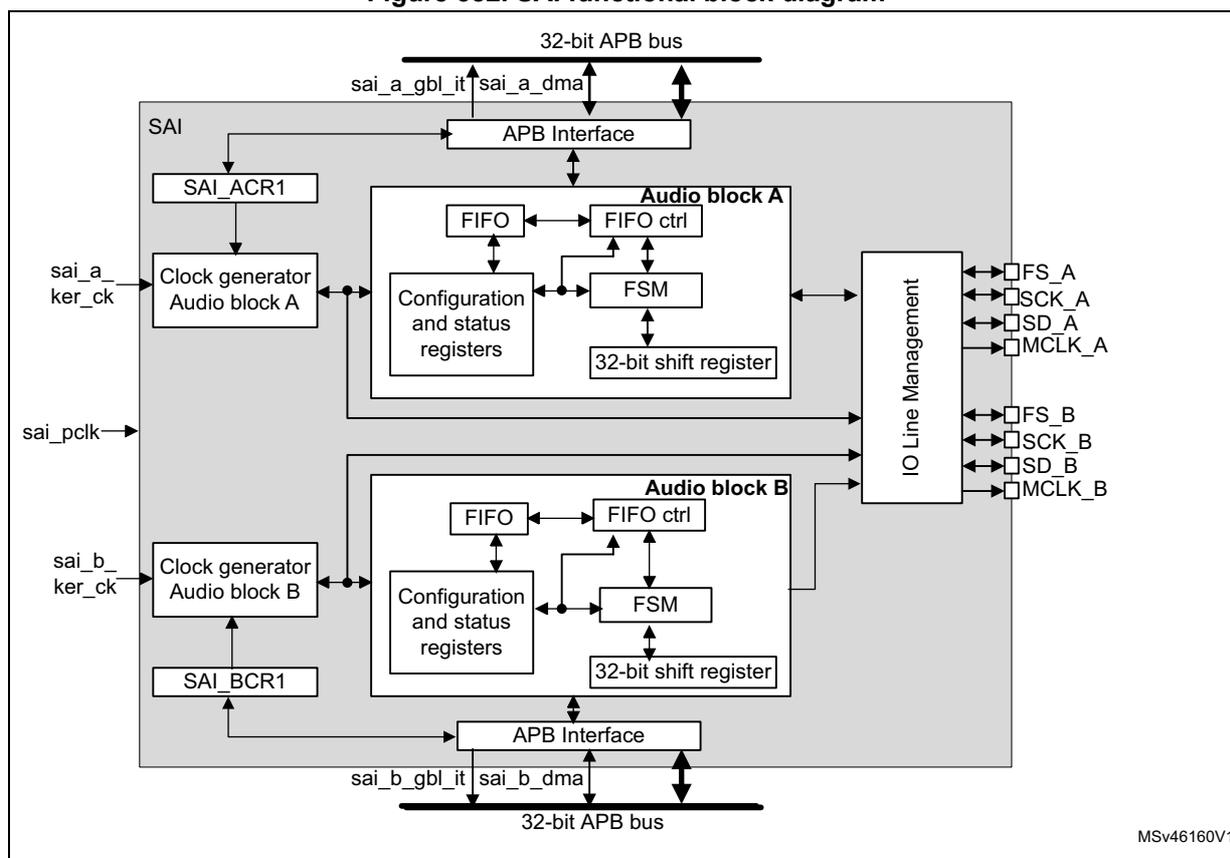
The SAI is mainly composed of two audio subblocks with their own clock generator. Each audio block integrates a 32-bit shift register controlled by their own functional state machine. Data are stored or read from the dedicated FIFO. FIFO may be accessed by the CPU, or by DMA to leave the CPU free during the communication. Each audio block is independent. They can be synchronous with each other.
An I/O line controller manages a set of 4 dedicated pins (SD, SCK, FS, MCLK) for a given audio block in the SAI. Some of these pins can be shared if the two subblocks are declared as synchronous to leave some free to be used as general purpose I/Os. The MCLK pin can be output, or not, depending on the application, the decoder requirement and whether the audio block is configured as the master.
If one SAI is configured to operate synchronously with another one, even more I/Os can be freed (except for pins SD_x).
The functional state machine can be configured to address a wide range of audio protocols. Some registers are present to set up the desired protocols (audio frame waveform generator).
The audio subblock can be a transmitter or receiver, in master or slave mode. The master mode means the SCK_x bit clock and the frame synchronization signal are generated from the SAI, whereas in slave mode, they come from another external or internal master. There is a particular case for which the FS signal direction is not directly linked to the master or slave mode definition. In AC'97 protocol, it is an SAI output even if the SAI (link controller) is set up to consume the SCK clock (and so to be in Slave mode).
Note: For ease of reading of this section, the notation SAI_x refers to SAI_A or SAI_B, where 'x' represents the SAI A or B subblock.
32.4.2 SAI pins and internal signals
Table 209. SAI internal input/output signals
| Internal signal name | Signal type | Description |
|---|---|---|
| sai_a_gbl_it/ sai_b_gbl_it | Output | Audio block A and B global interrupts |
| sai_a_dma, sai_b_dma | Input/output | Audio block A and B DMA acknowledges and requests |
| sai_a_ker_ck/ sai_b_ker_ck | Input | Audio block A/B kernel clock |
| sai_pclk | Input | APB clock |
Table 210. SAI input/output pins
| Pin name | Pin type | Comments |
|---|---|---|
| SAI_SCK_A/B | Input/output | Audio block A/B bit clock |
| SAI_MCLK_A/B | Output | Audio block A/B master clock |
| SAI_SD_A/B | Input/output | Data line for block A/B |
| SAI_FS_A/B | Input/output | Frame synchronization line for audio block A/B |
32.4.3 Main SAI modes
Each audio subblock of the SAI can be configured to be master or slave via the MODE bits in the SAI_xCR1 register of the selected audio block.
Master mode
In master mode, the SAI delivers the timing signals to the external connected device:
- • The bit clock and the frame synchronization are output on pin SCK_x and FS_x, respectively.
- • If needed, the SAI can also generate a master clock on the MCLK_x pin.
Both SCK_x, FS_x and MCLK_x are configured as outputs.
Slave mode
The SAI expects to receive timing signals from an external device.
- • If the SAI subblock is configured in asynchronous mode, then the SCK_x and FS_x pins are configured as inputs.
- • If the SAI subblock is configured to operate synchronously with the second audio subblock, the corresponding SCK_x and FS_x pins are left free to be used as general purpose I/Os.
In slave mode, the MCLK_x pin is not used and can be assigned to another function.
It is recommended to enable the slave device before enabling the master.
Configuring and enabling SAI modes
Each audio subblock can be independently defined as a transmitter or receiver through the MODE bit in the SAI_xCR1 register of the corresponding audio block. As a result, the SAI_SD_x pin is respectively configured as an output or an input.
Two master audio blocks in the same SAI can be configured with two different MCLK and SCK clock frequencies. In this case, they have to be configured in asynchronous mode.
Each of the audio blocks in the SAI is enabled by the SAIEN bit in the SAI_xCR1 register. As soon as this bit is active, the transmitter or the receiver is sensitive to the activity on the clock, data, and synchronization lines in slave mode.
In master Tx mode, enabling the audio block immediately generates the bit clock for the external slaves even if there is no data in the FIFO. However, FS signal generation is conditioned by the presence of data in the FIFO. After the FIFO receives the first data to transmit, this data is output to external slaves. If there is no data to transmit in the FIFO, 0 values are then sent in the audio frame with an underrun flag generation.
In slave mode, the audio frame starts when the audio block is enabled and when a start of frame is detected.
In Slave Tx mode, no underrun event is possible on the first frame after the audio block is enabled, because the mandatory operating sequence in this case is:
- 1. Write into the SAI_xDR (by software or by DMA).
- 2. Wait until the FIFO threshold (FLH) flag is different from 0b000 (FIFO empty).
- 3. Enable the audio block in slave transmitter mode.
32.4.4 SAI synchronization mode
SAI subclock A and B can be synchronized.
Internal synchronization
An audio subblock can be configured to operate synchronously with the second audio subblock in the same SAI. In this case, the bit clock and the frame synchronization signals are shared to reduce the number of external pins used for the communication. The audio block configured in synchronous mode sees its own SCK_x, FS_x, and MCLK_x pins released back as GPIOs while the audio block configured in asynchronous mode is the one for which FS_x and SCK_x and MCLK_x I/O pins are relevant (if the audio block is considered as master).
Typically, the audio block in synchronous mode can be used to configure the SAI in full duplex mode. One of the two audio blocks can be configured as a master and the other as slave, or both as slaves with one asynchronous block (corresponding SYNCEN[1:0] bits set to 00 in SAI_xCR1) and one synchronous block (corresponding SYNCEN[1:0] bits set to 01 in the SAI_xCR1 register).
Note: Due to internal resynchronization stages, PCLK APB frequency must be higher than twice the bit rate clock frequency.
32.4.5 Audio data size
The audio frame can target different data sizes by configuring bit DS[2:0] in the SAI_xCR1 register. The data sizes may be 8, 10, 16, 20, 24, or 32 bits. During the transfer, either the
MSB or the LSB of the data is sent first, depending on the configuration of the LSBFIRST bit in the SAI_xCR1 register.
32.4.6 Frame synchronization
The FS signal acts as the frame synchronization signal in the audio frame (start of frame). The shape of this signal is completely configurable to target the different audio protocols with their own specificities concerning this frame synchronization behavior. This reconfigurability is done using the SAI_xFRCR register. Figure 383 illustrates this flexibility.
Figure 383. Audio frame
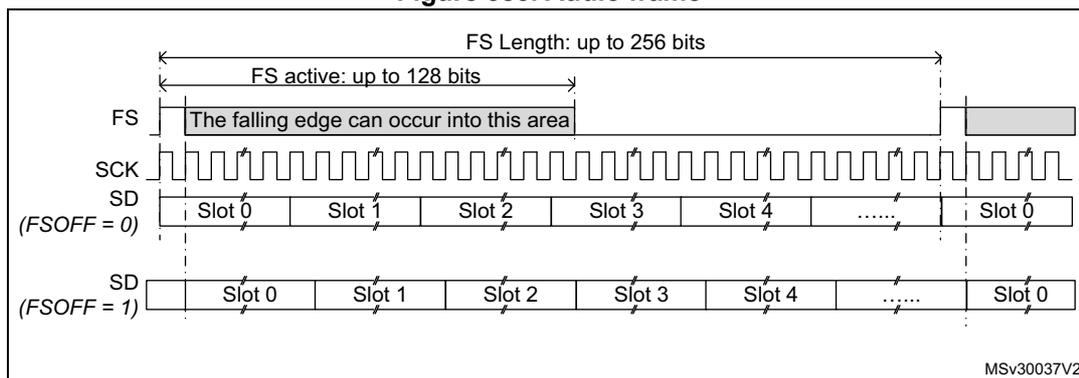
In AC'97 mode or in SPDIF mode (bit PRTCFCG[1:0] = 10 or PRTCFCG[1:0] = 01 in the SAI_xCR1 register), the frame synchronization shape is forced to match the AC'97 protocol. The SAI_xFRCR register value is ignored.
Each audio block is independent and consequently each one requires a specific configuration.
Frame length
- Master mode
The audio frame length can be configured to up to 256-bit clock cycles, by configuring the FRL[7:0] field in the SAI_xFRCR register.
If the frame length is greater than the number of declared slots for the frame, the remaining bits to transmit are extended to 0 or the SD line is released to high-Z depending on the state of bit TRIS in the SAI_xCR2 register (refer to FS signal role ). In reception mode, the remaining bit is ignored.
If bit NODIV is cleared, (FRL+1) must be equal to a power of 2, from 8 to 256, to ensure that an audio frame contains an integer number of MCLK pulses per bit clock cycle.
If bit NODIV is set, the (FRL+1) field can take any value from 8 to 256. Refer to Section 32.4.8: SAI clock generator
- Slave mode
The audio frame length is mainly used to specify to the slave the number of bit clock cycles per audio frame sent by the external master. It is used mainly to detect from the master any anticipated or late occurrence of the frame synchronization signal during an ongoing audio frame. In this case, an error is generated. For more details, refer to Section 32.4.13: Error flags .
In slave mode, there are no constraints on the FRL[7:0] configuration in the SAI_xFRCR register.
The number of bits in the frame is equal to FRL[7:0] + 1.
The minimum number of bits to transfer in an audio frame is 8.
Frame synchronization polarity
The FSPOL bit in the SAI_xFRCR register sets the active polarity of the FS pin from which a frame is started. The start of the frame is edge sensitive.
In slave mode, the audio block waits for a valid frame to start transmitting or receiving. The start of the frame is synchronized to this signal. It is effective only if the start of the frame is not detected during an ongoing communication and assimilated to an anticipated start of frame (refer to Section 32.4.13: Error flags ).
In master mode, the frame synchronization is sent continuously each time an audio frame is complete until the SAIEN bit in the SAI_xCR1 register is cleared. If no data are present in the FIFO at the end of the previous audio frame, an underrun condition is managed as described in Section 32.4.13: Error flags , but the audio communication flow is not interrupted.
Frame synchronization active level length
The FSALL[6:0] bits of the SAI_xFRCR register enable the configuration of the length of the active level of the frame synchronization signal. The length can be set from 1- to 128-bit clock cycles.
As an example, the active length can be half of the frame length in I2S, LSB or MSB-justified modes, or one-bit wide for PCM/DSP or TDM.
Frame synchronization offset
Depending on the audio protocol targeted in the application, the frame synchronization signal can be asserted when transmitting the last bit or the first bit of the audio frame (this is the case in I2S standard protocol and in MSB-justified protocol, respectively). The FSOFF bit in the SAI_xFRCR register enables the possibility to choose between two configurations.
FS signal role
The FS signal can have a different meaning depending on the FS function. FSDEF bit in the SAI_xFRCR register selects which meaning it has:
- • 0: start of frame, like, for instance, the PCM/DSP, TDM, AC'97, audio protocols,
- • 1: start of frame and channel side identification within the audio frame like for the I2S or the MSB- or LSB-justified protocols.
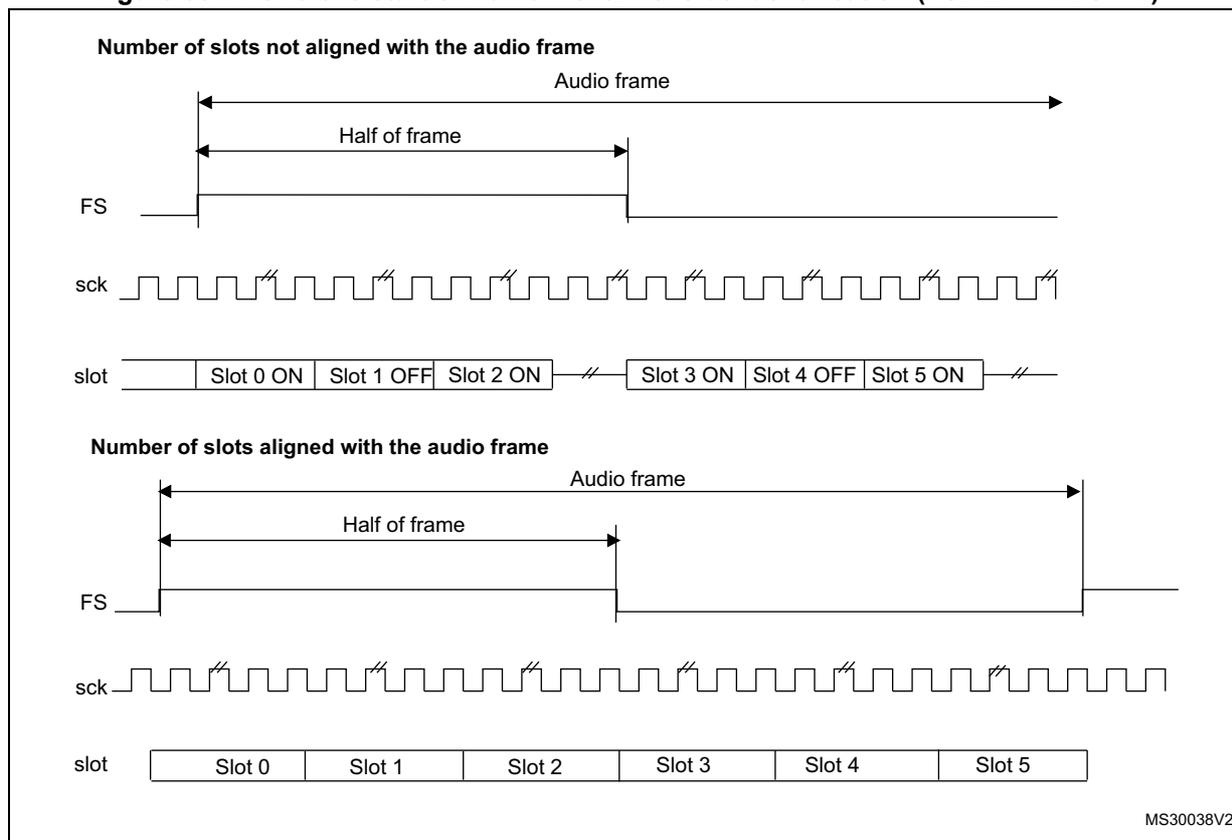
When the FS signal is considered as a start of frame and channel side identification within the frame, the number of declared slots must be considered to be half the number for the left channel and half the number for the right channel. If the number of bit clock cycles on half audio frame is greater than the number of slots dedicated to a channel side, and TRIS = 0, 0 is sent for transmission for the remaining bit clock cycles in the SAI_xCR2 register. Otherwise, if TRIS = 1, the SD line is released to high-Z. In reception mode, the remaining bit clock cycles are not considered until the channel side changes.
Figure 384. FS role is start of frame + channel side identification (FSDEF = TRIS = 1)
Number of slots not aligned with the audio frame
Audio frame
Half of frame
FS
sck
slot Slot 0 ON Slot 1 OFF Slot 2 ON // Slot 3 ON Slot 4 OFF Slot 5 ON //
Number of slots aligned with the audio frame
Audio frame
Half of frame
FS
sck
slot Slot 0 Slot 1 Slot 2 Slot 3 Slot 4 Slot 5
MS30038V2
- 1. The frame length must be even.
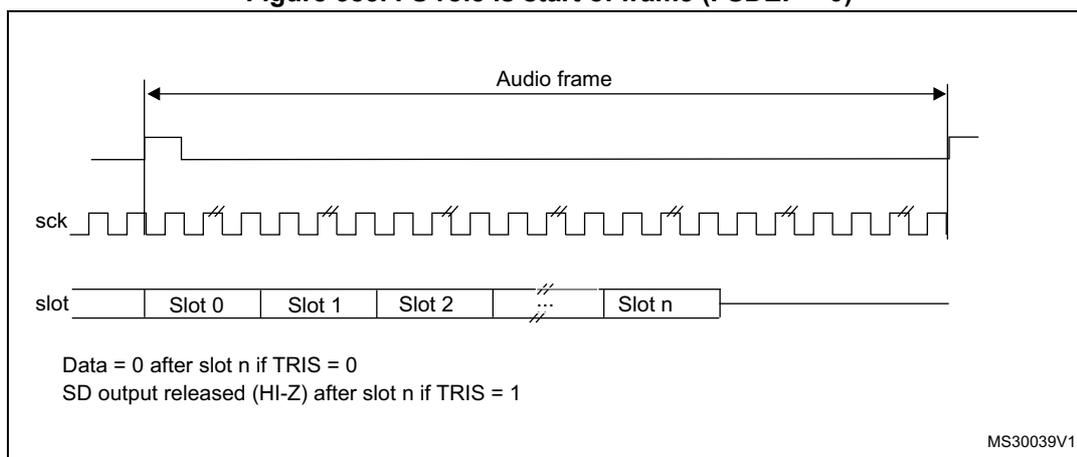
If the FSDEF bit in SAI_xFRCR is kept clear, so FS signal is equivalent to a start of frame, and if the number of slots defined in NBSLOT[3:0] in SAI_xSLOTR multiplied by the number of bits by slot configured in SLOTSZ[1:0] in SAI_xSLOTR is less than the frame size (bit FRL[7:0] in the SAI_xFRCR register), then:
- • If TRIS = 0 in the SAI_xCR2 register, the remaining bit after the last slot is forced to 0 until the end of frame in case of transmitter,
- • If TRIS = 1, the line is released to high-Z during the transfer of these remaining bits. In reception mode, these bits are discarded.
Figure 385. FS role is start of frame (FSDEF = 0)
The diagram illustrates the timing of an audio frame. The top signal is the FS (Frame Synchronization) signal, which is a square wave that goes high at the start of the audio frame and returns low at the start of the next frame. The middle signal is the SCK (Serial Clock) signal, which is a continuous square wave. The bottom signal is the SD (Serial Data) line, which is divided into slots: Slot 0, Slot 1, Slot 2, ..., Slot n. The data for Slot n is shown as a horizontal line. Below the slots, there is a note: "Data = 0 after slot n if TRIS = 0" and "SD output released (HI-Z) after slot n if TRIS = 1". The diagram is labeled "MS30039V1" in the bottom right corner.
The FS signal is not used when the audio block in transmitter mode is configured to get the SPDIF output on the SD line. The corresponding FS I/O is released and left free for other purposes.
32.4.7 Slot configuration
The slot is the basic element in the audio frame. The number of slots in the audio frame is equal to NBSLOT[3:0] + 1.
The maximum number of slots per audio frame is fixed at 16.
For AC'97 protocol or SPDIF (when bit PRTCFCFG[1:0] = 10 or PRTCFCFG[1:0] = 01), the number of slots is automatically set to target the protocol specification, and the value of NBSLOT[3:0] is ignored.
Each slot can be defined as a valid slot, or not, by setting SLOTEN[15:0] bits of the SAI_xSLOTR register.
When an invalid slot is transferred, the SD data line is either forced to 0 or released to high-Z depending on the TRIS bit configuration (refer to Output data line management on an inactive slot ) in transmitter mode. In receiver mode, the received value from the end of this slot is ignored. Consequently, there is no FIFO access and so no request to read or write the FIFO linked to this inactive slot status.
The slot size is also configurable as shown in Figure 386 . The size of the slots is selected by configuring the SLOTSZ[1:0] bits in the SAI_xSLOTR register. The size is applied identically for each slot in an audio frame.
Figure 386. Slot size configuration with FBOFF = 0 in SAI_xSLOTR
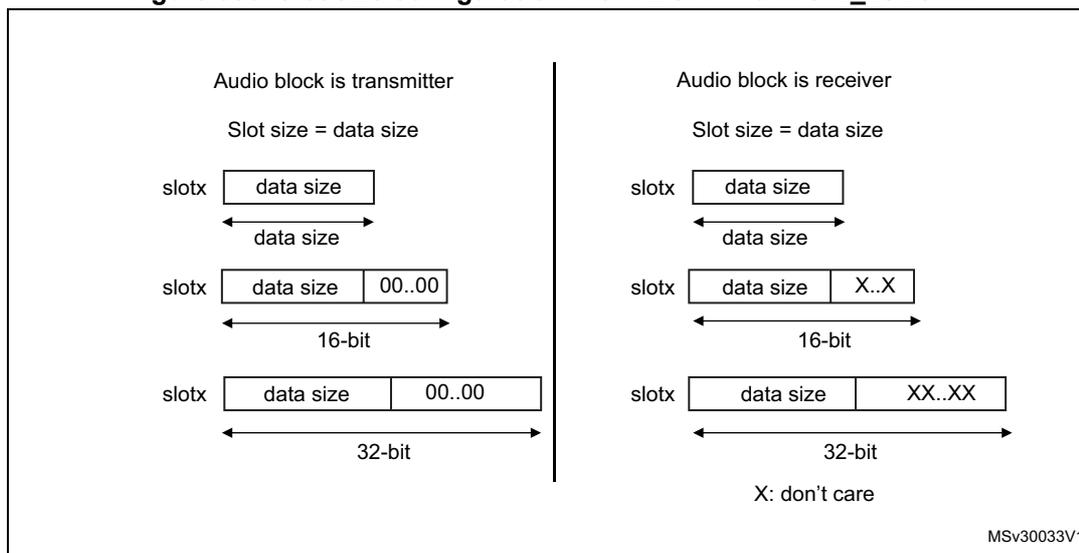
It is possible to choose the position of the first data bit to transfer within the slots. This offset is configured by FBOFF[4:0] bits in the SAI_xSLOTR register. 0 values are injected in transmitter mode from the beginning of the slot until this offset position is reached. In reception, the bit in the offset phase is ignored. This feature targets the LSB justified protocol (if the offset is equal to the slot size minus the data size).
Figure 387. First bit offset
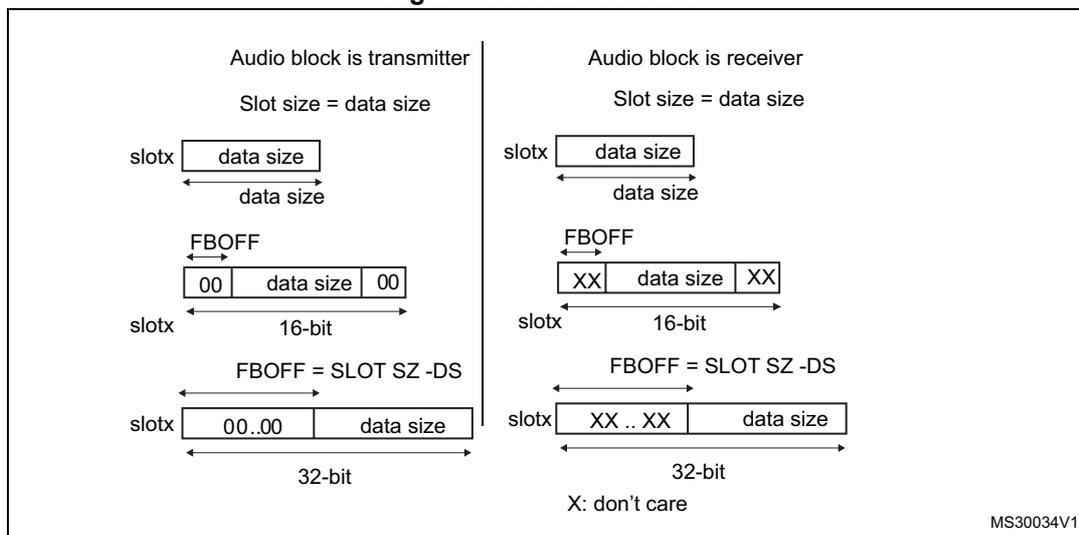
It is mandatory to respect the following conditions to avoid bad SAI behavior:
- • \( FBOFF \leq (SLOTSZ - DS) \)
- • \( DS \leq SLOTSZ \)
- • \( NBSLOT \times SLOTSZ \leq FRL \) (frame length)
The number of slots must be even when bit FSDEF in the SAI_xFRCR register is set.
In AC'97 and SPDIF protocol (bit PRTCFC[1:0] = 10 or PRTCFC[1:0] = 01), the slot size is automatically set as defined in Section 32.4.10: AC'97 link controller .
32.4.8 SAI clock generator
Each audio block has its own clock generator that makes these two blocks completely independent. There is no difference in terms of functionality between these two clock generators.
When the audio block is configured as Master, the clock generator provides the communication clock (the bit clock) and the master clock for external decoders.
When the audio block is defined as slave, the clock generator is OFF.
Figure 388 illustrates the architecture of the audio block clock generator.
Figure 388. Audio block clock generator overview
![Figure 388. Audio block clock generator overview. The diagram shows the internal architecture of the SAI clock generator. A sai_x_ker_ck clock signal enters from the left and is split into two paths. The first path goes through a 'Master clock divider' block, which is controlled by MCKDIV[3:0]. The output of this divider is connected to a 2-to-1 multiplexer. The second path for sai_x_ker_ck goes through another 2-to-1 multiplexer, which is controlled by NODIV. The outputs of these two multiplexers are combined and then enter a 'Bit clock divider' block, which is controlled by FRL[7:0]. The output of the bit clock divider is connected to a third 2-to-1 multiplexer, also controlled by NODIV. The final output is SCK_x. The MCLK_x output is also shown, which is the output of the first multiplexer. The diagram is labeled MSv30040V2.](/RM0386-STM32F469-479/e11e89e09dc7e1ccb6b641f606b2028d_img.jpg)
Note: If NODIV is set to 1, the MCLK_x signal is set at 0 level if this pin is configured as the SAI pin in GPIO peripherals.
The clock source for the clock generator comes from the product clock controller. The sai_x_ker_ck clock is equivalent to the master clock, which can be divided for the external decoders using bit MCKDIV[3:0]:
MCLK_x signal is used only in Free protocol mode.
The division must be even to keep 50% on the duty cycle on the MCLK output and on the SCK_x clock. If bit MCKDIV[3:0] = 0000, division by one is applied to obtain MCLK_x equal to sai_x_ker_ck.
In the SAI, the single ratio \( \text{MCLK/FS} = 256 \) is considered. Mostly, three frequency ranges are encountered, as illustrated in Table 211 .
Table 211. Example of possible audio frequency sampling range| Input sai_x_ker_ck clock frequency | Most usual audio frequency sampling achievable | MCKDIV[3:0] |
|---|---|---|
| 192 kHz x 256 | 192 kHz | MCKDIV[3:0] = 0000 |
| 96 kHz | MCKDIV[3:0] = 0001 | |
| 48 kHz | MCKDIV[3:0] = 0010 | |
| 16 kHz | MCKDIV[3:0] = 0110 | |
| 8 kHz | MCKDIV[3:0] = 1100 | |
| 44.1 kHz x 256 | 44.1 kHz | MCKDIV[3:0] = 0000 |
| 22.05 kHz | MCKDIV[3:0] = 0001 | |
| 11.025 kHz | MCKDIV[3:0] = 0010 | |
| sai_x_ker_ck = MCLK (1) | MCLK | MCKDIV[3:0] = 0000 |
1. This may happen when the product clock controller selects an external clock source, instead of PLL clock.
The master clock can be generated externally on an I/O pad for external decoders if the corresponding audio block is declared as master with bit NODIV = 0 in the SAI_xCR1 register. In slave, the value set in this last bit is ignored since the clock generator is OFF, and the MCLK_x I/O pin is released for use as a general purpose I/O.
The bit clock is derived from the master clock. The bit clock divider sets the divider factor between the bit clock (SCK_x) and the master clock (MCLK_x) following the formula:
Where:
256 is the fixed ratio between MCLK and the audio frequency sampling.
FRL[7:0] is the number of bit clock cycles- 1 in the audio frame, configured in the SAI_xFRCR register.
In master mode, it is mandatory that (FRL[7:0] +1) is equal to a number with a power of 2 (refer to Section 32.4.6: Frame synchronization ) to obtain an even integer number of MCLK_x pulses by bit clock cycle. The 50% duty cycle is guaranteed on the bit clock (SCK_x).
The sai_x_ker_ck clock can also be equal to the bit clock frequency. In this case, the NODIV bit in the SAI_xCR1 register should be set and the value inside the MCKDIV divider and the bit clock divider will be ignored. In this case, the number of bits per frame is fully configurable without the need to be equal to a power of two.
The bit clock strobing edge on SCK can be configured by bit CKSTR in the SAI_xCR1 register.
Refer to Section 32.4.11: SPDIF output for details on clock generator programming in SPDIF mode.
32.4.9 Internal FIFOs
Each audio block in the SAI has its own FIFO. Depending on if the block is defined to be a transmitter or a receiver, the FIFO can be written or read, respectively. Thus, there is only one FIFO request linked to the FREQ bit in the SAI_xSR register.
An interrupt is generated if the FREQIE bit is enabled in the SAI_xIM register. This depends on:
- • The FIFO threshold setting (FLVL bits in SAI_xCR2).
- • Communication direction (transmitter or receiver). Refer to Interrupt generation in transmitter mode and Interrupt generation in reception mode .
Interrupt generation in transmitter mode
The interrupt generation depends on the FIFO configuration in transmitter mode:
- • When the FIFO threshold bits in the SAI_xCR2 register are configured as FIFO empty (FTH[2:0] set to 0b000), an interrupt is generated (FREQ bit set by hardware to 1 in the SAI_xSR register) if no data are available in the SAI_xDR register (FLVL[2:0] bits in SAI_xSR are less than 0b001). This interrupt (FREQ bit in the SAI_xSR register) is cleared by hardware when the FIFO is no longer empty (FLVL[2:0] bits in SAI_xSR are different from 0b000), that is, one or more data are stored in the FIFO.
- • When the FIFO threshold bits in the SAI_xCR2 register are configured as FIFO quarter full (FTH[2:0] set to 0b001), an interrupt is generated (FREQ bit set by hardware to 1 in the SAI_xSR register) if less than a quarter of the FIFO contains data (FLVL[2:0] bits in SAI_xSR are less than 0b010). This interrupt (FREQ bit in the SAI_xSR register) is cleared by hardware when at least a quarter of the FIFO contains data (FLVL[2:0] bits in SAI_xSR are higher than or equal to 0b010).
- • When the FIFO threshold bits in the SAI_xCR2 register are configured as FIFO half full (FTH[2:0] set to 0b010), an interrupt is generated (FREQ bit set by hardware to 1 in the SAI_xSR register) if less than half of the FIFO contains data (FLVL[2:0] bits in SAI_xSR are less than 0b011). This interrupt (FREQ bit in the SAI_xSR register) is cleared by hardware when at least half of the FIFO contains data (FLVL[2:0] bits in SAI_xSR are higher than or equal to 0b011).
- • When the FIFO threshold bits in the SAI_xCR2 register are configured as FIFO three quarter (FTH[2:0] set to 0b011), an interrupt is generated (FREQ bit is set by hardware to 1 in the SAI_xSR register) if less than three quarters of the FIFO contains data (FLVL[2:0] bits in SAI_xSR are less than 0b100). This interrupt (FREQ bit in the SAI_xSR register) is cleared by hardware when at least three quarters of the FIFO contains data (FLVL[2:0] bits in SAI_xSR are higher than or equal to 0b100).
- • When the FIFO threshold bits in the SAI_xCR2 register are configured as FIFO full (FTH[2:0] set to 0b100), an interrupt is generated (FREQ bit is set by hardware to 1 in the SAI_xSR register) if the FIFO is not full (FLVL[2:0] bits in SAI_xSR are less than 0b101). This interrupt (FREQ bit in the SAI_xSR register) is cleared by hardware when the FIFO is full (FLVL[2:0] bits in SAI_xSR are equal to 0b101).
Interrupt generation in reception mode
The interrupt generation depends on the FIFO configuration in reception mode:
- • When the FIFO threshold bits in the SAI_xCR2 register are configured as FIFO empty (FTH[2:0] set to 0b000), an interrupt is generated (FREQ bit is set by hardware to 1 in the SAI_xSR register) if at least one data is available in the SAI_xDR register (FLVL[2:0] bits
in SAI_xSR are higher than or equal to 0b001). This interrupt (FREQ bit in the SAI_xSR register) is cleared by hardware when the FIFO becomes empty (FLVL[2:0] bits in the SAI_xSR are equal to 0b000), that is, no data are stored in FIFO.
- • When the FIFO threshold bits in the SAI_xCR2 register are configured as FIFO quarter full (FTH[2:0] set to 0b001), an interrupt is generated (FREQ bit is set by hardware to 1 in the SAI_xSR register) if at least one quarter of the FIFO data locations are available (FLVL[2:0] bits in SAI_xSR are higher than or equal to 0b010). This interrupt (FREQ bit in the SAI_xSR register) is cleared by hardware when less than a quarter of the FIFO data locations become available (FLVL[2:0] bits in SAI_xSR are less than 0b010).
- • When the FIFO threshold bits in the SAI_xCR2 register are configured as FIFO half full (FTH[2:0] set to 0b010), an interrupt is generated (FREQ bit is set by hardware to 1 in the SAI_xSR register) if at least half of the FIFO data locations are available (FLVL[2:0] bits in SAI_xSR are higher than or equal to 0b011). This interrupt (FREQ bit in the SAI_xSR register) is cleared by hardware when less than half of the FIFO data locations become available (FLVL[2:0] bits in SAI_xSR are less than 0b011).
- • When the FIFO threshold bits in the SAI_xCR2 register are configured as FIFO three quarter full (FTH[2:0] set to 0b011), an interrupt is generated (FREQ bit is set by hardware to 1 in the SAI_xSR register) if at least three quarters of the FIFO data locations are available (FLVL[2:0] bits in SAI_xSR are higher than or equal to 0b100). This interrupt (FREQ bit in the SAI_xSR register) is cleared by hardware when the FIFO has less than three quarters of the FIFO data locations available (FLVL[2:0] bits in SAI_xSR is less than 0b100).
- • When the FIFO threshold bits in the SAI_xCR2 register are configured as FIFO full (FTH[2:0] set to 0b100), an interrupt is generated (FREQ bit is set by hardware to 1 in the SAI_xSR register) if the FIFO is full (FLVL[2:0] bits in SAI_xSR are equal to 0b101). This interrupt (FREQ bit in the SAI_xSR register) is cleared by hardware when the FIFO is not full (FLVL[2:0] bits in SAI_xSR are less than 0b101).
Like interrupt generation, the SAI can use the DMA if the DMAEN bit in the SAI_xCR1 register is set. The FREQ bit assertion mechanism is the same as the interrupt generation mechanism described above for FREQIE.
Each FIFO is an 8-word FIFO. Each read or write operation from/to the FIFO targets one word FIFO location whatever the access size. Each FIFO word contains one audio slot. FIFO pointers are incremented by one word after each access to the SAI_xDR register.
Data must be right-aligned when written in the SAI_xDR register.
Data received are right-aligned in the SAI_xDR register.
The FIFO pointers can be reinitialized when the SAI is disabled by configuring the FFLUSH bit in the SAI_xCR2 register. If FFLUSH is set when the SAI is enabled, the data present in the FIFO are lost automatically.
32.4.10 AC'97 link controller
The SAI is able to work as an AC'97 link controller. In this protocol:
- • The slot number and the slot size are fixed.
- • The frame synchronization signal is perfectly defined and has a fixed shape.
To select this protocol, set the PRTCFCFG[1:0] bits in the SAI_xCR1 register to 10. When AC'97 mode is selected, only data sizes of 16 or 20 bits can be used, otherwise the SAI behavior is not guaranteed.
- • The NBSLOT[3:0] and SLOTSZ[1:0] bits are consequently ignored.
- • The number of slots is fixed at 13 slots. The first one is 16 bits wide and all the others are 20 bits wide (data slots).
- • The FBOFF[4:0] bits in the SAI_xSLOTR register are ignored.
- • The SAI_xFRCR register is ignored.
- • The MCLK is not used.
The FS signal from the block defined as asynchronous is configured automatically as an output, since the AC'97 controller link drives the FS signal whatever the master or slave configuration.
Figure 389 shows an AC'97 audio frame structure.
Figure 389. AC'97 audio frame
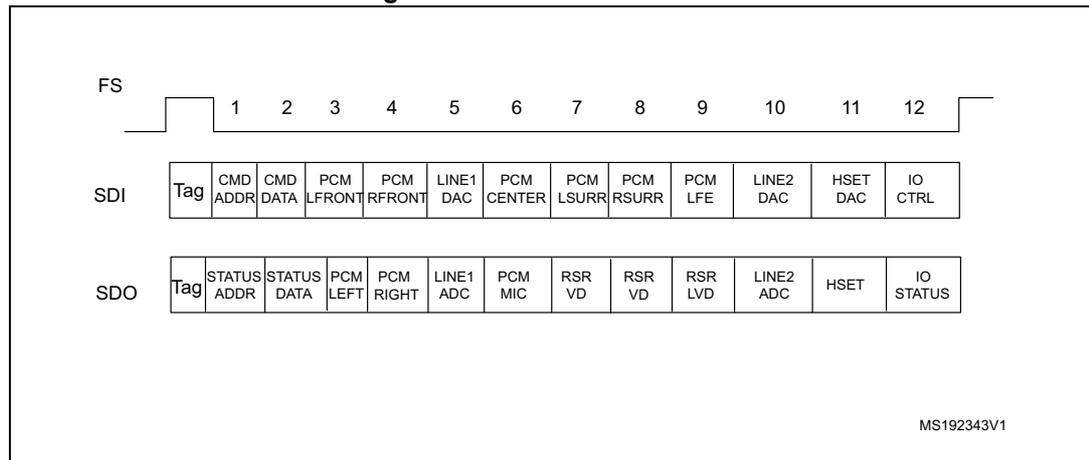
| Signal | Slot 0 (Tag) | Slot 1 | Slot 2 | Slot 3 | Slot 4 | Slot 5 | Slot 6 | Slot 7 | Slot 8 | Slot 9 | Slot 10 | Slot 11 | Slot 12 |
|---|---|---|---|---|---|---|---|---|---|---|---|---|---|
| SDI | Tag | CMD ADDR | CMD DATA | PCM LFRONT | PCM RFRONT | LINE1 DAC | PCM CENTER | PCM LSURR | PCM RSURR | PCM LFE | LINE2 DAC | HSET DAC | IO CTRL |
| SDO | Tag | STATUS ADDR | STATUS DATA | PCM LEFT | PCM RIGHT | LINE1 ADC | PCM MIC | RSR VD | RSR VD | RSR LVD | LINE2 ADC | HSET | IO STATUS |
MS192343V1
Note: In the AC'97 protocol, bit 2 of the tag is reserved (always 0), so bit 2 of the TAG is forced to 0 level whatever the value written in the SAI FIFO.
For more details about tag representation, refer to the AC'97 protocol standard.
One SAI can be used to target an AC'97 point-to-point communication.
In receiver mode, the SAI acting as an AC'97 link controller requires no FIFO request and so no data storage in the FIFO when the codec-ready bit in slot 0 is decoded low. If bit CNRDYIE is enabled in the SAI_xIM register, flag CNRDY is set in the SAI_xSR register and an interrupt is generated. This flag is dedicated to the AC'97 protocol.
Clock generator programming in AC’97 mode
In AC’97 mode, the frame length is fixed at 256 bits, and its frequency must be set to 48 kHz. The formulas given in Section 32.4.8: SAI clock generator must be used with \( FRL = 255 \) , to generate the proper frame rate ( \( F_{FS\_x} \) ).
32.4.11 SPDIF output
The SPDIF interface is available in transmitter mode only. It supports the audio IEC60958.
To select SPDIF mode, set the PRTCFG[1:0] bits to 01 in the SAI_xCR1 register.
For SPDIF protocol:
- • Only the SD data line is enabled.
- • The FS, SCK, and MCLK I/Os pins are left free.
- • The MODE[1] bit is forced to 0 to select the master mode to enable the clock generator of the SAI and manage the data rate on the SD line.
- • The data size is forced to 24 bits. The value set in the DS[2:0] bits in the SAI_xCR1 register is ignored.
- • The clock generator must be configured to define the symbol-rate, knowing that the bit clock must be twice the symbol-rate. The data is coded in Manchester protocol.
- • The SAI_xFRCR and SAI_xSLOTR registers are ignored. The SAI is configured internally to match the SPDIF protocol requirements as shown in Figure 390 .
Figure 390. SPDIF format
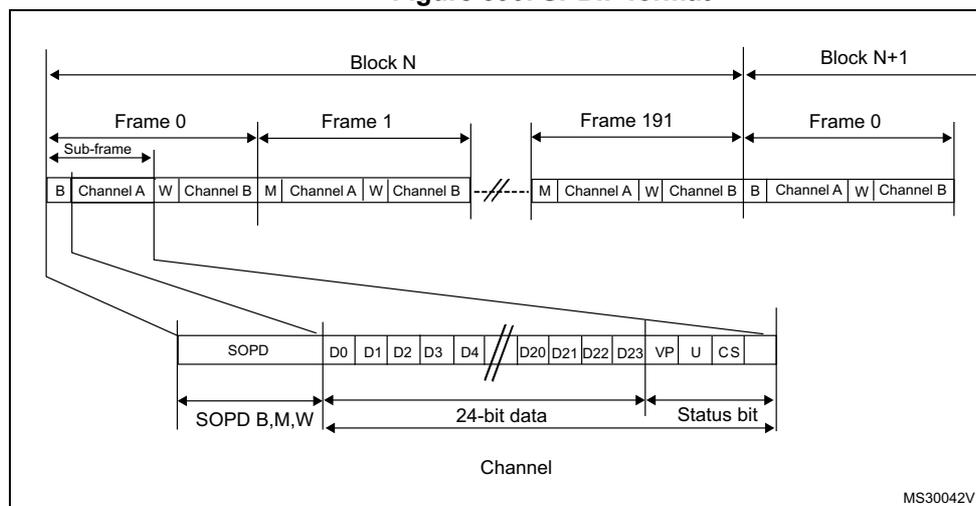
The diagram illustrates the SPDIF format. At the top, a horizontal timeline shows 'Block N' and 'Block N+1'. 'Block N' contains 'Frame 0', 'Frame 1', and 'Frame 191'. 'Block N+1' contains 'Frame 0'. Each frame is divided into two 'Sub-frame' units. Each sub-frame is further divided into 'Channel A' and 'Channel B' sections, each preceded by a 'B', 'W', or 'M' bit. Below this, a detailed view of a sub-frame shows a 'SOPD' (4-bit) section followed by a '24-bit data' section and a 'Status bit' section. The SOPD section is labeled 'SOPD B,M,W'. The 24-bit data section is labeled 'D0 D1 D2 D3 D4' followed by a break and 'D20 D21 D22 D23'. The status bit section is labeled 'VP U CS'. Lines connect the 'B', 'W', and 'M' bits in the sub-frames to the 'SOPD' section, and the data and status bits to the '24-bit data' and 'Status bit' sections respectively. The diagram is labeled 'MS30042V1' in the bottom right corner.
An SPDIF block contains 192 frames. Each frame is composed of two 32-bit subframes, generally one for the left channel and one for the right channel. Each subframe is composed of a SOPD pattern (4-bit) to specify if the subframe is the start of a block (and so is identifying a channel A) or if it is identifying a channel A somewhere in the block, or if it is referring to channel B (see Table 212 ). The next 28 bits of channel information are composed of 24 data bits + 4 status bits.
Table 212. SOPD pattern
| SOPD | Preamble coding | Description | |
|---|---|---|---|
| last bit is 0 | last bit is 1 | ||
| B | 11101000 | 00010111 | Channel A data at the start of block |
| W | 11100100 | 00011011 | Channel B data somewhere in the block |
| M | 11100010 | 00011101 | Channel A data |
The data stored in SAI_xDR has to be filled as follows:
- • SAI_xDR[26:24] contain the channel status, user, and validity bits.
- • SAI_xDR[23:0] contain the 24-bit data for the considered channel.
If the data size is 20 bits, the data must be mapped on SAI_xDR[23:4].
If the data size is 16 bits, the data must be mapped on SAI_xDR[23:8].
SAI_xDR[23] always represents the MSB.
Figure 391. SAI_xDR register ordering
![Diagram of SAI_xDR register ordering showing a 27-bit register (bits 26 to 0). Bits 26, 25, and 24 are labeled CS, U, and V respectively, and are grouped as 'Status bits'. Bits 23 down to 0 are labeled D23 through D0 and are grouped as 'Data[23:0]'. The diagram shows the register layout with bit 26 on the left and bit 0 on the right.](/RM0386-STM32F469-479/754cb0bb1ece0188357c8633c9cc0df6_img.jpg)
Note: The transfer is always performed with LSB first.
The SAI first sends the adequate preamble for each subframe in a block. The SAI_xDR is then sent on the SD line (Manchester coded). The SAI ends the subframe by transferring the parity bit calculated as described in Table 213 .
Table 213. Parity bit calculation
| SAI_xDR[26:0] | Parity bit P value transferred |
|---|---|
| odd number of 0 | 0 |
| odd number of 1 | 1 |
The underrun is the only error flag available in the SAI_xSR register for SPDIF mode since the SAI can only operate in transmitter mode. As a result, the following sequence must be
executed to recover from an underrun error detected via the underrun interrupt or the underrun status bit:
- 1. Disable the DMA stream (via the DMA peripheral) if the DMA is used.
- 2. Disable the SAI and check that the peripheral is physically disabled by polling the SAIEN bit in the SAI_xCR1 register.
- 3. Clear the COVRUNDR flag in the SAI_xCLRFR register.
- 4. Flush the FIFO by setting the FFLUSH bit in SAI_xCR2.
The software needs to point to the address of the future data corresponding to the start of a new block (data for preamble B). If the DMA is used, the DMA source base address pointer must be updated accordingly.
- 5. Enable the DMA stream (DMA peripheral) again if the DMA is used to manage data transfers according to the new source base address.
- 6. Enable the SAI again by configuring the SAIEN bit in the SAI_xCR1 register.
Clock generator programming in SPDIF generator mode
For the SPDIF generator, the SAI provides a bit clock twice as fast as the symbol-rate. The table below shows examples of symbol rates with respect to the audio sampling rate.
Table 214. Audio sampling frequency versus symbol rates
| Audio sampling frequencies (F S ) | Symbol-rate |
|---|---|
| 44.1 kHz | 2.8224 MHz |
| 48 kHz | 3.072 MHz |
| 96 kHz | 6.144 MHz |
| 192 kHz | 12.288 MHz |
More generally, the relationship between the audio sampling frequency (F S ) and the bit clock rate (F SCK_x ) is given by the formula:
The bit clock rate is obtained as follows:
Note: The above formulas are valid only if NODIV is set to 1 in the SAI_ACR1 register.
32.4.12 Specific features
The SAI interface embeds specific features that can be useful depending on the audio protocol selected. These functions are accessible through specific bits of the SAI_xCR2 register.
Mute mode
The mute mode can be used when the audio subblock is a transmitter or a receiver.
Audio subblock in transmission mode
In transmitter mode, the mute mode can be selected at any time. The mute mode is active for entire audio frames. The MUTE bit in the SAI_xCR2 register enables the mute mode when it is configured during an ongoing frame.
The mute mode bit is strobed only at the end of the frame. If it is set at this time, the mute mode is active at the beginning of the new audio frame and for a complete frame, until the next end of frame. The bit is then strobed to determine if the next frame is still a mute frame.
If the number of slots set through the NBSLOT[3:0] bits in the SAI_xSLOTR register is lower than or equal to 2, it is possible to specify if the value sent in mute mode is 0 or if it is the last value of each slot. The selection is done via the MUTEVAL bit in the SAI_xCR2 register.
If the number of slots set in the NBSLOT[3:0] bits in the SAI_xSLOTR register is greater than 2, the MUTEVAL bit in the SAI_xCR2 register is meaningless as 0 values are sent on each bit on each slot.
The FIFO pointers are still incremented in mute mode. This means that data present in the FIFO and for which the mute mode is requested are discarded.
Audio subblock in reception mode
In reception mode, it is possible to detect a mute mode sent from the external transmitter when all the declared and valid slots of the audio frame receive 0 for a given consecutive number of audio frames (MUTECNT[5:0] bits in the SAI_xCR2 register).
When the number of MUTE frames is detected, the MUTEDET flag in the SAI_xSR register is set and an interrupt can be generated if the MUTEDETIE bit is set in SAI_xCR2.
The mute frame counter is cleared when the audio subblock is disabled or when a valid slot receives at least one data in an audio frame. The interrupt is generated just once, when the counter reaches the value specified in the MUTECNT[5:0] bits. The interrupt event is then reinitialized when the counter is cleared.
Note: The mute mode is not available for SPDIF audio blocks.
Mono/stereo mode
In transmitter mode, the mono mode can be addressed without any data preprocessing in memory, assuming the number of slots is equal to 2 (NBSLOT[3:0] = 0001 in SAI_xSLOTR). In this case, the access time to and from the FIFO is reduced by 2 since the data for slot 0 is duplicated into data slot 1.
To enable the mono mode:
- 1. Set the MONO bit to 1 in the SAI_xCR1 register.
- 2. Set NBSLOT to 1 and SLOTEN to 3 in SAI_xSLOTR.
In reception mode, the MONO bit can be set and is meaningful only if the number of slots is equal to 2, like in transmitter mode. When it is set, only slot 0 data are stored in the FIFO. The data belonging to slot 1 are discarded since, in this case, it is supposed to be the same as the previous slot. If the data flow in reception mode is a real stereo audio flow with a distinct and different left and right data, the MONO bit is meaningless. The conversion from the output stereo file to the equivalent mono file is done by software.
Companding mode
Telecommunication applications can require processing the data to be transmitted or received using a data companding algorithm.
Depending on the COMP[1:0] bits in the SAI_xCR2 register (used only when free protocol mode is selected), the application software can choose to process or not the data before sending it on the SD serial output line (compression) or to expand the data after the reception on the SD serial input line (expansion), as illustrated in Figure 392 . The two companding modes supported are the \( \mu \) -Law and the A-Law logs, which are a part of the CCITT G.711 recommendation.
The companding standard used in the United States and Japan is the \( \mu \) -Law. It supports 14 bits of dynamic range (COMP[1:0] = 10 in the SAI_xCR2 register).
The European companding standard is A-Law and supports 13 bits of dynamic range (COMP[1:0] = 11 in the SAI_xCR2 register).
Both \( \mu \) -Law and A-Law companding standard can be computed based on 1's complement or 2's complement representation, depending on the CPL bit setting in the SAI_xCR2 register.
In \( \mu \) -Law and A-Law standards, data are coded as 8 bits with MSB alignment. Companded data are always 8 bits wide. For this reason, the DS[2:0] bits in the SAI_xCR1 register are forced to 010 when the SAI audio block is enabled (the SAIEN bit = 1 in the SAI_xCR1 register) and when one of these two companding modes is selected through the COMP[1:0] bits.
If no companding processing is required, the COMP[1:0] bits must be kept clear.
Figure 392. Data companding hardware in an audio block in the SAI
![Figure 392: Data companding hardware in an audio block in the SAI. The diagram shows two modes: Receiver mode (bit MODE[0] = 1 in SAI_xCR1) and Transmitter mode (bit MODE[0] = 0 in SAI_xCR1). In Receiver mode, data from the SD line enters a 32-bit shift register, then an 'expand' block, and finally a multiplexer controlled by COMP[1]. The output of the multiplexer goes to the FIFO. In Transmitter mode, data from the FIFO goes to a 'compress' block, then a multiplexer controlled by COMP[1], and finally a 32-bit shift register which outputs to the SD line.](/RM0386-STM32F469-479/dc3a7f4c8a8abbcc7d60df88a649f087_img.jpg)
The diagram illustrates the data flow for companding in the SAI audio block. It is divided into two sections: Receiver mode and Transmitter mode.
- Receiver mode (bit MODE[0] = 1 in SAI_xCR1): The data flow starts from the SD line, entering a 32-bit shift register. The output of the shift register goes to an 'expand' block. The output of the 'expand' block then enters a multiplexer. The multiplexer is controlled by the COMP[1] bit. The output of the multiplexer (selected based on COMP[1]) is then stored in the FIFO.
- Transmitter mode (bit MODE[0] = 0 in SAI_xCR1): The data flow starts from the FIFO, entering a 'compress' block. The output of the 'compress' block then enters a multiplexer. The multiplexer is controlled by the COMP[1] bit. The output of the multiplexer (selected based on COMP[1]) is then stored in a 32-bit shift register, which outputs to the SD line.
- 1. Not applicable when AC'97 or SPDIF are selected.
Expansion and compression mode are automatically selected through SAI_xCR2:
- • If the SAI audio block is configured to be a transmitter, and if the COMP[1] bit is set in the SAI_xCR2 register, the compression mode is applied.
- • If the SAI audio block is declared as a receiver, the expansion algorithm is applied.
Output data line management on an inactive slot
In transmitter mode, it is possible to choose the behavior of the SD line output when an inactive slot is sent on the data line (via the TRIS bit).
- • Either the SAI forces 0 on the SD output line when an inactive slot is transmitted, or
- • The line is released in high-Z state at the end of the last bit of data transferred, to release the line for other transmitters connected to this node.
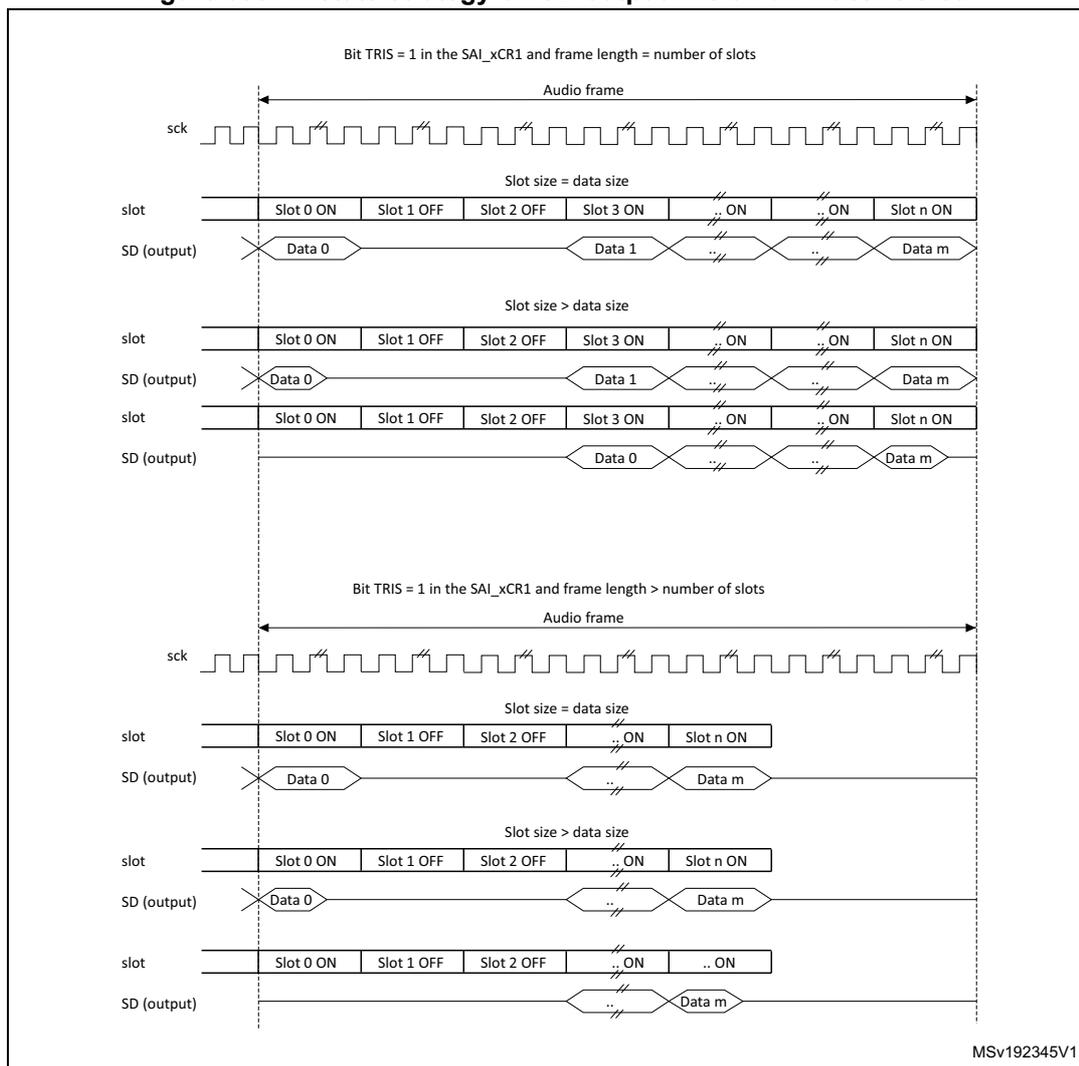
It is important to note that the two transmitters cannot attempt to drive the same SD output pin simultaneously, which may result in a short circuit. To ensure a gap between transmissions, if the data is lower than 32-bit, the data can be extended to 32-bit by setting the bit SLOTSZ[1:0] = 10 in the SAI_xSLOTR register. The SD output pin is then tri-stated at the end of the LSB of the active slot (during the padding to 0 phase to extend the data to 32-bit) if the following slot is declared inactive.
In addition, if the number of slots multiplied by the slot size is lower than the frame length, the SD output line is tri-stated when the padding to 0 is done to complete the audio frame.
Figure 393 illustrates these behaviors.
Figure 393. Tristate strategy on SD output line on an inactive slot
Bit TRIS = 1 in the SAI_xCR1 and frame length = number of slots
Audio frame
sck
Slot size = data size
| slot | Slot 0 ON | Slot 1 OFF | Slot 2 OFF | Slot 3 ON | .. ON | .. ON | Slot n ON |
SD (output)
Data 0
Data 1
Data m
Slot size > data size
| slot | Slot 0 ON | Slot 1 OFF | Slot 2 OFF | Slot 3 ON | .. ON | .. ON | Slot n ON |
SD (output)
Data 0
Data 1
Data m
slot
| Slot 0 ON | Slot 1 OFF | Slot 2 OFF | Slot 3 ON | .. ON | .. ON | Slot n ON |
SD (output)
Data 0
Data m
Bit TRIS = 1 in the SAI_xCR1 and frame length > number of slots
Audio frame
sck
Slot size = data size
| slot | Slot 0 ON | Slot 1 OFF | Slot 2 OFF | .. ON | Slot n ON |
SD (output)
Data 0
Data m
Slot size > data size
| slot | Slot 0 ON | Slot 1 OFF | Slot 2 OFF | .. ON | Slot n ON |
SD (output)
Data 0
Data m
slot
| Slot 0 ON | Slot 1 OFF | Slot 2 OFF | .. ON | .. ON |
SD (output)
Data m
MSV192345V1
When the selected audio protocol uses the FS signal as a start of frame and a channel side identification (bit FSDEF = 1 in the SAI_xFRCR register), the tristate mode is managed according to Figure 394 (where the bit TRIS in the SAI_xCR1 register = 1, and FSDEF=1, and half frame length is higher than number of slots/2, and NBSLOT=6).
Figure 394. Tristate on output data line in a protocol like I2S
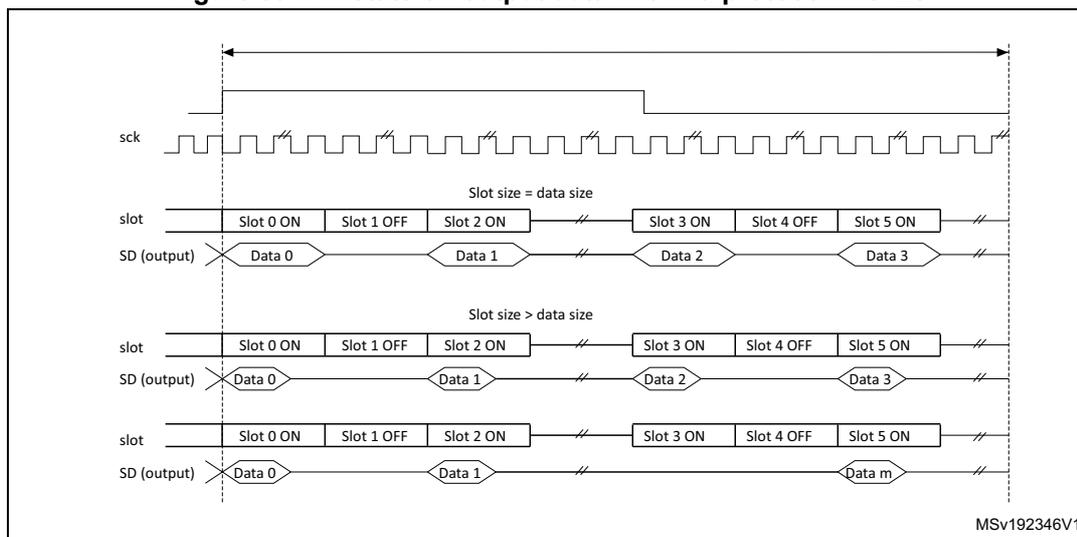
If the TRIS bit in the SAI_xCR2 register is cleared, all the high impedance states on the SD output line in Figure 393 and Figure 394 are replaced by a drive with a value of 0.
32.4.13 Error flags
The SAI implements the following error flags:
- • FIFO overrun/underrun.
- • Anticipated frame synchronization detection.
- • Late frame synchronization detection.
- • Codec not ready (AC'97 exclusively).
- • Wrong clock configuration in master mode.
FIFO overrun/underrun (OVRUDR)
The FIFO overrun/underrun bit is called OVRUDR in the SAI_xSR register.
The overrun or underrun errors share the same bit since an audio block can be either receiver or transmitter and each audio block in a given SAI has its own SAI_xSR register.
Overrun
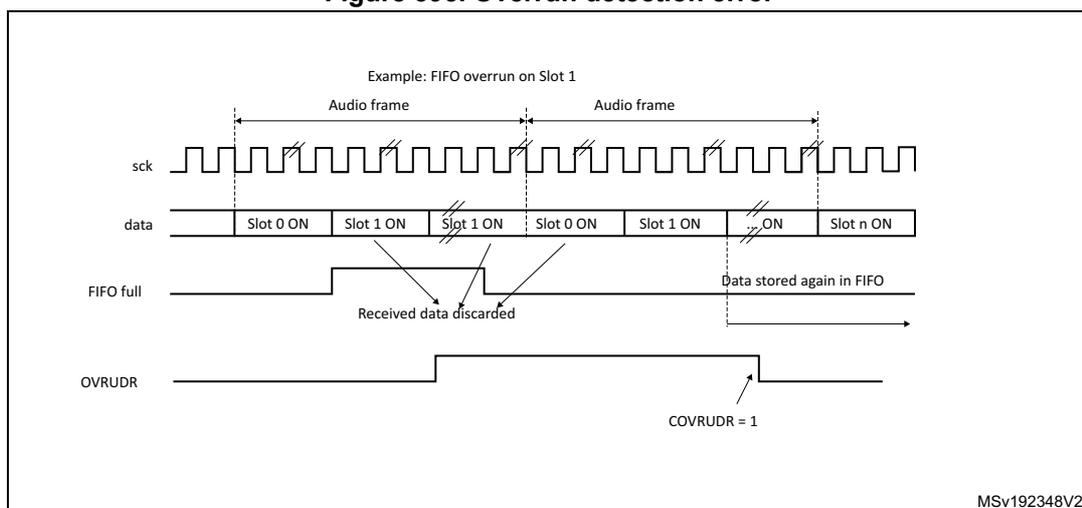
When the audio block is configured as receiver, an overrun condition may appear if data are received in an audio frame when the FIFO is full and not able to store the received data. In this case, the received data are lost, the OVRUDR flag in the SAI_xSR register is set, and an interrupt is generated if the OVRUDRIE bit is set in the SAI_xIM register. The slot number, from which the overrun occurs, is stored internally. No more data are stored into the FIFO until it becomes free to store new data. When the FIFO has at least one data free, the SAI audio block receiver stores new data (from a new audio frame) from the slot number that was stored internally when the overrun condition was detected. This avoids data slot dealignment in the destination memory (refer to Figure 395).
The OVRUDR flag is cleared when the COVRUDR bit is set in the SAI_xCLRFR register.
Figure 395. Overrun detection error
Example: FIFO overrun on Slot 1
MSV192348V2
Underrun
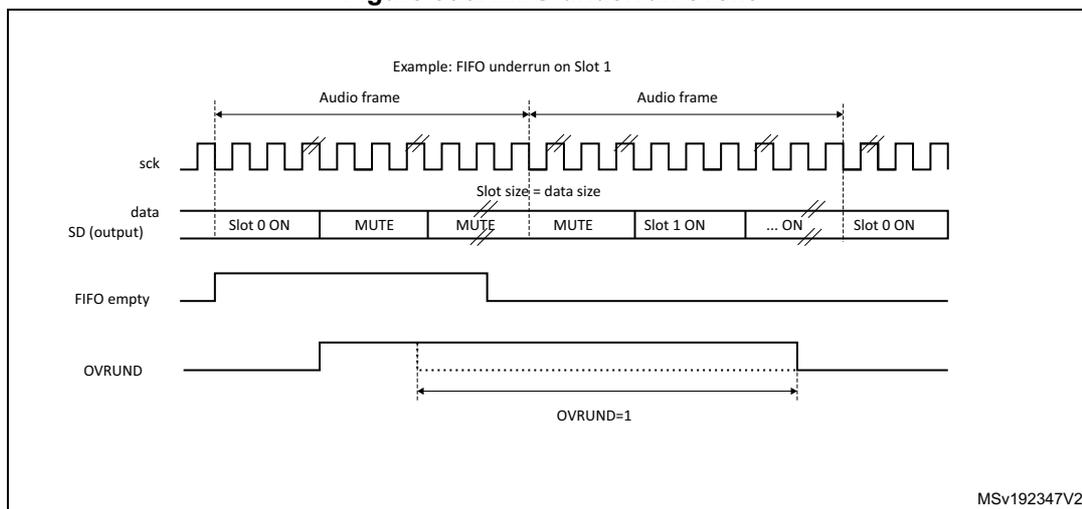
An underrun may occur when the audio block in the SAI is a transmitter and the FIFO is empty when data need to be transmitted. If an underrun is detected, the slot number for which the event occurs is stored and the MUTE value (00) is sent until the FIFO is ready to transmit the data corresponding to the slot for which the underrun was detected (refer to Figure 396 ). This avoids desynchronization between the memory pointer and the slot in the audio frame.
The underrun event sets the OVRUDR flag in the SAI_xSR register and an interrupt is generated if the OVRUDRIE bit is set in the SAI_xIM register. To clear this flag, set the COVRUDR bit in the SAI_xCLRFR register.
The underrun event can occur when the audio subblock is configured as master or slave.
Figure 396. FIFO underrun event
Example: FIFO underrun on Slot 1
MSV192347V2
Anticipated frame synchronization detection (AFSDET)
The AFSDET flag is used only in slave mode. It is never asserted in master mode. It indicates that a frame synchronization (FS) has been detected earlier than expected since the frame length, the frame polarity, and the frame offset are defined and known.
Anticipated frame detection sets the AFSDET flag in the SAI_xSR register.
This detection has no effect on the current audio frame, which is not sensitive to the anticipated FS. This means that “parasitic” events on signal FS are flagged without any perturbation of the current audio frame.
An interrupt is generated if the AFSDETIE bit is set in the SAI_xIM register. To clear the AFSDET flag, the CAFSDET bit must be set in the SAI_xCLRFR register.
To resynchronize with the master after an anticipated frame detection error, four steps are required:
- 1. Disable the SAI block by resetting the SAIEN bit in the SAI_xCR1 register. To make sure that the SAI is disabled, read back the SAIEN bit and check it is set to 0.
- 2. Flush the FIFO via the FFLUS bit in the SAI_xCR2 register.
- 3. Enable the SAI peripheral again (SAIEN bit set to 1).
- 4. The SAI block waits for the assertion on FS to restart the synchronization with master.
Note: The AFSDET flag is not asserted in AC'97 mode since the SAI audio block acts as a link controller and generates the FS signal even when declared as slave. It has no meaning in SPDIF mode since the FS signal is not used.
Late frame synchronization detection
The LFSDET flag in the SAI_xSR register can be set only when the SAI audio block operates as a slave. The frame length, the frame polarity, and the frame-offset configuration are known in register SAI_xFRCR.
If the external master does not send the FS signal at the expected time, thus generating the signal too late, the LFSDET flag is set and an interrupt is generated if the LFSDETIE bit is set in the SAI_xIM register.
The LFSDET flag is cleared when the CLFSDET bit is set in the SAI_xCLRFR register.
The late frame synchronization detection flag is set when the corresponding error is detected. The SAI needs to be resynchronized with the master (see sequence described in Anticipated frame synchronization detection (AFSDET) ).
In a noisy environment, glitches on the SCK clock may be wrongly detected by the audio block state machine and shift the SAI data at a wrong frame position. This event can be detected by the SAI and reported as a late frame synchronization detection error.
There is no corruption if the external master is not managing the audio data frame transfer in continuous mode, which must not be the case in most applications. In this case, the LFSDET flag is set.
Note: The LFSDET flag is not asserted in AC'97 mode since the SAI audio block acts as a link controller and generates the FS signal even when declared as slave. It has no meaning in SPDIF mode since the signal FS is not used by the protocol.
Codec not ready (CNRDY AC'97)
The CNRDY flag in the SAI_xSR register is relevant only if the SAI audio block is configured to operate in AC'97 mode (PRTCFCG[1:0] = 10 in the SAI_xCR1 register). If the CNRDYIE bit is set in the SAI_xIM register, an interrupt is generated when the CNRDY flag is set.
CNRDY is asserted when the codec is not ready to communicate during the reception of the TAG 0 (slot 0) of the AC'97 audio frame. In this case, no data are automatically stored into the FIFO since the codec is not ready, until the TAG 0 indicates that the codec is ready. All the active slots defined in the SAI_xSLOTR register are captured when the codec is ready.
To clear the CNRDY flag, the CCNRDY bit must be set in the SAI_xCLRFR register.
Wrong clock configuration in master mode (with NODIV = 0)
When the audio block operates as a master (MODE[1] = 0) and the NODIV bit is equal to 0, the WCKCFG flag is set as soon as the SAI is enabled if the following conditions are met:
- • (FRL+1) is not a power of 2, and
- • (FRL+1) is not between 8 and 256.
The MODE, NODIV, and SAIEN bits belong to the SAI_xCR1 register and FRL to the SAI_xFRCR register.
If the WCKCFGIE bit is set, an interrupt is generated when the WCKCFG flag is set in the SAI_xSR register. To clear this flag, set the CWCKCFG bit in the SAI_xCLRFR register.
When the WCKCFG bit is set, the audio block is automatically disabled, thus performing a hardware clear of the SAIEN bit.
32.4.14 Disabling the SAI
The SAI audio block can be disabled at any moment by clearing the SAIEN bit in the SAI_xCR1 register. All the already started frames are automatically completed before the SAI stops working. The SAIEN bit remains high until the SAI is completely switched off at the end of the current audio frame transfer.
If an audio block in the SAI operates synchronously with the other one, the one that is the master must be disabled first.
32.4.15 SAI DMA interface
To free the CPU and to optimize bus bandwidth, each SAI audio block has an independent DMA interface to read/write from/to the SAI_xDR register (to access the internal FIFO). There is one DMA channel per audio subblock supporting the basic DMA request/acknowledge protocol.
To configure the audio subblock for DMA transfer, set the DMAEN bit in the SAI_xCR1 register. The DMA request is managed directly by the FIFO controller depending on the FIFO threshold level (for more details refer to Section 32.4.9: Internal FIFOs ). The DMA transfer direction is linked to the SAI audio subblock configuration:
- • If the audio block operates as a transmitter, the audio block FIFO controller outputs a DMA request to load the FIFO with data written in the SAI_xDR register.
- • If the audio block operates as a receiver, the DMA request is related to read operations from the SAI_xDR register.
Follow the sequence below to configure the SAI interface in DMA mode:
- 1. Configure the SAI and FIFO threshold levels to specify when the DMA request is launched.
- 2. Configure the SAI DMA channel.
- 3. Enable the DMA.
- 4. Enable the SAI interface.
32.5 SAI interrupts
The SAI supports 7 interrupt sources, as shown in Table 215 .
Table 215. SAI interrupt sources
| Interrupt acronym | Interrupt source | Interrupt group | Audio block mode | Interrupt enable | Interrupt clear |
|---|---|---|---|---|---|
| SAI | FREQ | FREQ | Master or slave Receiver or transmitter | FREQIE in SAI_xIM register | Depends on: – FIFO threshold setting (FLVL bits in SAI_xCR2) – Communication direction (transmitter or receiver) For more details refer to Section 32.4.9: Internal FIFOs |
| OVRUDR | ERROR | Master or slave Receiver or transmitter | OVRUDRIE in SAI_xIM register | COVRUDR = 1 in SAI_xCLRFR register | |
| AFSDET | ERROR | Slave (not used in AC'97 mode and SPDIF mode) | AFSDETIE in SAI_xIM register | CAFSDET = 1 in SAI_xCLRFR register | |
| LFSDET | ERROR | Slave (not used in AC'97 mode and SPDIF mode) | LFSDETIE in SAI_xIM register | CLFSDET = 1 in SAI_xCLRFR register | |
| CNRDY | ERROR | Slave (only in AC'97 mode) | CNRDYIE in SAI_xIM register | CCNRDY = 1 in SAI_xCLRFR register | |
| MUTEDET | MUTE | Master or slave Receiver mode only | MUTEDETIE in SAI_xIM register | CMUTEDET = 1 in SAI_xCLRFR register | |
| WCKCFG | ERROR | Master with NODIV = 0 in SAI_xCR1 register | WCKCFGIE in SAI_xIM register | CWCKCFG = 1 in SAI_xCLRFR register |
Follow the sequence below to enable an interrupt:
- 1. Disable SAI interrupt.
- 2. Configure SAI.
- 3. Configure SAI interrupt source.
- 4. Enable SAI.
32.6 SAI registers
The peripheral registers have to be accessed by words (32 bits).
32.6.1 SAI configuration register 1 (SAI_ACR1)
Address offset: 0x04
Reset value: 0x0000 0040
| 31 | 30 | 29 | 28 | 27 | 26 | 25 | 24 | 23 | 22 | 21 | 20 | 19 | 18 | 17 | 16 |
|---|---|---|---|---|---|---|---|---|---|---|---|---|---|---|---|
| Res. | Res. | Res. | Res. | Res. | Res. | Res. | Res. | MCKDIV[3:0] | NODIV | Res. | DMAEN | SAIEN | |||
| rw | rw | rw | rw | rw | rw | rw | |||||||||
| 15 | 14 | 13 | 12 | 11 | 10 | 9 | 8 | 7 | 6 | 5 | 4 | 3 | 2 | 1 | 0 |
|---|---|---|---|---|---|---|---|---|---|---|---|---|---|---|---|
| Res. | Res. | OUTDIV | MONO | SYNCEN[1:0] | CKSTR | LSBFIRST | DS[2:0] | Res. | PRTCFCFG[1:0] | MODE[1:0] | |||||
| rw | rw | rw | rw | rw | rw | rw | rw | rw | rw | rw | rw | rw | |||
Bits 31:24 Reserved, must be kept at reset value.
Bits 23:20 MCKDIV[3:0]: Master clock divider
These bits are set and cleared by software. These bits are meaningless when the audio block operates in slave mode. They have to be configured when the audio block is disabled.
0000: Divides by 1 the master clock input.
Others: the master clock frequency is calculated accordingly to the following formula:
Bit 19 NODIV : No divider
This bit is set and cleared by software.
0: Master clock generator is enabled
1: No divider used in the clock generator (in this case Master Clock Divider bit has no effect)
Bit 18 Reserved, must be kept at reset value.
Bit 17 DMAEN : DMA enable
This bit is set and cleared by software.
0: DMA disabled
1: DMA enabled
Note: Since the audio block defaults to operate as a transmitter after reset, the MODE[1:0] bits must be configured before setting DMAEN to avoid a DMA request in receiver mode.
Bit 16 SAIEN : Audio block enable
This bit is set by software.
To switch off the audio block, the application software must program this bit to 0 and poll the bit till it reads back 0, meaning that the block is completely disabled. Before setting this bit to 1, check that it is set to 0, otherwise the enable command is not taken into account.
This bit enables to control the state of the SAI audio block. If it is disabled when an audio frame transfer is ongoing, the ongoing transfer completes and the cell is fully disabled at the end of this audio frame transfer.
0: SAI audio block disabled
1: SAI audio block enabled.
Note: When the SAI block (A or B) is configured in master mode, the clock must be present on the SAI block input before setting SAIEN bit.
Bits 15:14 Reserved, must be kept at reset value.
Bit 13 OUTDRIV : Output drive
This bit is set and cleared by software.
0: Audio block output driven when SAIEN is set
1: Audio block output driven immediately after the setting of this bit.
Note: This bit has to be set before enabling the audio block and after the audio block configuration.
Bit 12 MONO : Mono mode
This bit is set and cleared by software. It is meaningful only when the number of slots is equal to 2. When the mono mode is selected, slot 0 data are duplicated on slot 1 when the audio block operates as a transmitter. In reception mode, the slot1 is discarded and only the data received from slot 0 are stored. Refer to Section : Mono/stereo mode for more details.
0: Stereo mode
1: Mono mode.
Bits 11:10 SYNCEN[1:0] : Synchronization enable
These bits are set and cleared by software. They must be configured when the audio subblock is disabled.
00: audio subblock in asynchronous mode.
01: audio subblock is synchronous with the other internal audio subblock. In this case, the audio subblock must be configured in slave mode
10: Reserved.
11: Reserved
Note: The audio subblock must be configured as asynchronous when SPDIF mode is enabled.
Bit 9 CKSTR : Clock strobing edge
This bit is set and cleared by software. It must be configured when the audio block is disabled. This bit has no meaning in SPDIF audio protocol.
0: Signals generated by the SAI change on SCK rising edge, while signals received by the SAI are sampled on the SCK falling edge.
1: Signals generated by the SAI change on SCK falling edge, while signals received by the SAI are sampled on the SCK rising edge.
Bit 8 LSBFIRST : Least significant bit first
This bit is set and cleared by software. It must be configured when the audio block is disabled. This bit has no meaning in AC'97 audio protocol since AC'97 data are always transferred with the MSB first. This bit has no meaning in SPDIF audio protocol since in SPDIF data are always transferred with LSB first.
0: Data are transferred with MSB first
1: Data are transferred with LSB first
Bits 7:5 DS[2:0] : Data size
These bits are set and cleared by software. These bits are ignored when the SPDIF protocols are selected (bit PRTCFG[1:0]), because the frame and the data size are fixed in such case. When the companding mode is selected through COMP[1:0] bits, DS[1:0] are ignored since the data size is fixed to 8 bits by the algorithm.
These bits must be configured when the audio block is disabled.
000: Reserved
001: Reserved
010: 8 bits
011: 10 bits
100: 16 bits
101: 20 bits
110: 24 bits
111: 32 bits
Bit 4 Reserved, must be kept at reset value.
Bits 3:2 PRTCFCG[1:0] : Protocol configuration
These bits are set and cleared by software. These bits have to be configured when the audio block is disabled.
00: Free protocol. Free protocol enables to use the powerful configuration of the audio block to address a specific audio protocol (such as I2S, LSB/MSB justified, TDM, PCM/DSP...) by setting most of the configuration register bits as well as frame configuration register.
01: SPDIF protocol
10: AC'97 protocol
11: Reserved
Bits 1:0 MODE[1:0] : SAIx audio block mode
These bits are set and cleared by software. They must be configured when SAIx audio block is disabled.
00: Master transmitter
01: Master receiver
10: Slave transmitter
11: Slave receiver
Note: When the audio block is configured in SPDIF mode, the master transmitter mode is forced (MODE[1:0] = 00).
32.6.2 SAI configuration register 2 (SAI_ACR2)
Address offset: 0x08
Reset value: 0x0000 0000
| 31 | 30 | 29 | 28 | 27 | 26 | 25 | 24 | 23 | 22 | 21 | 20 | 19 | 18 | 17 | 16 |
|---|---|---|---|---|---|---|---|---|---|---|---|---|---|---|---|
| Res. | Res. | Res. | Res. | Res. | Res. | Res. | Res. | Res. | Res. | Res. | Res. | Res. | Res. | Res. | Res. |
| 15 | 14 | 13 | 12 | 11 | 10 | 9 | 8 | 7 | 6 | 5 | 4 | 3 | 2 | 1 | 0 |
| COMP[1:0] | CPL | MUTECNT[5:0] | MUTE VAL | MUTE | TRIS | F FLUSH | FTH[2:0] | ||||||||
| rw | rw | rw | rw | rw | rw | w | rw | ||||||||
Bits 31:16 Reserved, must be kept at reset value.
Bits 15:14 COMP[1:0] : Companding mode.
These bits are set and cleared by software. The \( \mu \) -Law and the A-Law log are a part of the CCITT G.711 recommendation, the type of complement that is used depends on CPL bit .
The data expansion or data compression are determined by the state of bit MODE[0].
The data compression is applied if the audio block is configured as a transmitter.
The data expansion is automatically applied when the audio block is configured as a receiver.
Refer to Section : Companding mode for more details.
00: No companding algorithm
01: Reserved.
10: \( \mu \) -Law algorithm
11: A-Law algorithm
Note: Companding mode is applicable only when Free protocol mode is selected.
Bit 13 CPL: Complement bit.This bit is set and cleared by software.
It defines the type of complement to be used for companding mode
0: 1's complement representation.
1: 2's complement representation.
Note: This bit has effect only when the companding mode is \( \mu \) -Law algorithm or A-Law algorithm.
Bits 12:7 MUTECNT[5:0]: Mute counter.These bits are set and cleared by software. They are used only in reception mode.
The value set in these bits is compared to the number of consecutive mute frames detected in reception. When the number of mute frames is equal to this value, the flag MUTEDET is set and an interrupt is generated if bit MUTEDETIE is set.
Refer to Section : Mute mode for more details.
Bit 6 MUTEVAL: Mute value.This bit is set and cleared by software. It is meaningful only when the audio block operates as a transmitter, the number of slots is lower or equal to 2 and the MUTE bit is set.
If more slots are declared, the bit value sent during the transmission in mute mode is equal to 0, whatever the value of MUTEVAL.
if the number of slot is lower or equal to 2 and MUTEVAL = 1, the MUTE value transmitted for each slot is the one sent during the previous frame.
Refer to Section : Mute mode for more details.
0: Bit value 0 is sent during the mute mode.
1: Last values are sent during the mute mode.
Note: This bit is meaningless and must not be used for SPDIF audio blocks.
Bit 5 MUTE: Mute.This bit is set and cleared by software. It is meaningful only when the audio block operates as a transmitter. The MUTE value is linked to value of MUTEVAL if the number of slots is lower or equal to 2, or equal to 0 if it is greater than 2.
Refer to Section : Mute mode for more details.
0: No mute mode.
1: Mute mode enabled.
Note: This bit is meaningless and must not be used for SPDIF audio blocks.
Bit 4 TRIS: Tristate management on data line.This bit is set and cleared by software. It is meaningful only if the audio block is configured as a transmitter. This bit is not used when the audio block is configured in SPDIF mode. It must be configured when SAI is disabled.
Refer to Section : Output data line management on an inactive slot for more details.
0: SD output line is still driven by the SAI when a slot is inactive.
1: SD output line is released (HI-Z) at the end of the last data bit of the last active slot if the next one is inactive.
Bit 3 FFLUSH: FIFO flush.This bit is set by software. It is always read as 0. This bit must be configured when the SAI is disabled.
0: No FIFO flush.
1: FIFO flush. Programming this bit to 1 triggers the FIFO Flush. All the internal FIFO pointers (read and write) are cleared. In this case data still present in the FIFO are lost (no more transmission or received data lost). Before flushing, SAI DMA stream/interrupt must be disabled
Bits 2:0 FTH[2:0] : FIFO threshold.
This bit is set and cleared by software.
000: FIFO empty
001: ¼ FIFO
010: ½ FIFO
011: ¾ FIFO
100: FIFO full
101: Reserved
110: Reserved
111: Reserved
32.6.3 SAI frame configuration register (SAI_AFRCR)
Address offset: 0x0C
Reset value: 0x0000 0007
Note: This register has no meaning in AC'97 and SPDIF audio protocol.
| 31 | 30 | 29 | 28 | 27 | 26 | 25 | 24 | 23 | 22 | 21 | 20 | 19 | 18 | 17 | 16 |
|---|---|---|---|---|---|---|---|---|---|---|---|---|---|---|---|
| Res. | Res. | Res. | Res. | Res. | Res. | Res. | Res. | Res. | Res. | Res. | Res. | Res. | FSOFF | FSPOL | FSDEF |
| rw | rw | r |
| 15 | 14 | 13 | 12 | 11 | 10 | 9 | 8 | 7 | 6 | 5 | 4 | 3 | 2 | 1 | 0 |
|---|---|---|---|---|---|---|---|---|---|---|---|---|---|---|---|
| Res. | FSALL[6:0] | FRL[7:0] | |||||||||||||
| rw | rw | rw | rw | rw | rw | rw | rw | rw | rw | rw | rw | rw | rw | rw | |
Bits 31:19 Reserved, must be kept at reset value.
Bit 18 FSOFF : Frame synchronization offset.
This bit is set and cleared by software. It is meaningless and is not used in AC'97 or SPDIF audio block configuration. This bit must be configured when the audio block is disabled.
0: FS is asserted on the first bit of the slot 0.
1: FS is asserted one bit before the first bit of the slot 0.
Bit 17 FSPOL : Frame synchronization polarity.
This bit is set and cleared by software. It is used to configure the level of the start of frame on the FS signal. It is meaningless and is not used in AC'97 or SPDIF audio block configuration.
This bit must be configured when the audio block is disabled.
0: FS is active low (falling edge)
1: FS is active high (rising edge)
Bit 16 FSDEF : Frame synchronization definition.
This bit is set and cleared by software.
0: FS signal is a start frame signal
1: FS signal is a start of frame signal + channel side identification
When the bit is set, the number of slots defined in the SAI_xSLOTR register has to be even. It means that half of this number of slots are dedicated to the left channel and the other slots for the right channel (e.g: this bit has to be set for I2S or MSB/LSB-justified protocols...).
This bit is meaningless and is not used in AC'97 or SPDIF audio block configuration. It must be configured when the audio block is disabled.
Bit 15 Reserved, must be kept at reset value.
Bits 14:8 FSALL[6:0] : Frame synchronization active level length.
These bits are set and cleared by software. They specify the length in number of bit clock (SCK) + 1 (FSALL[6:0] + 1) of the active level of the FS signal in the audio frame
These bits are meaningless and are not used in AC'97 or SPDIF audio block configuration.
They must be configured when the audio block is disabled.
Bits 7:0 FRL[7:0] : Frame length.
These bits are set and cleared by software. They define the audio frame length expressed in number of SCK clock cycles: the number of bits in the frame is equal to FRL[7:0] + 1.
The minimum number of bits to transfer in an audio frame must be equal to 8, otherwise the audio block behaves in an unexpected way. This is the case when the data size is 8 bits and only one slot 0 is defined in NBSLOT[4:0] of SAI_xSLOTR register (NBSLOT[3:0] = 0000).
In master mode, if the master clock (available on MCLK_x pin) is used, the frame length must be aligned with a number equal to a power of 2, ranging from 8 to 256. When the master clock is not used (NODIV = 1), it is recommended to program the frame length to an value ranging from 8 to 256.
These bits are meaningless and are not used in AC'97 or SPDIF audio block configuration. They must be configured when the audio block is disabled.
32.6.4 SAI slot register (SAI_ASLOTR)
Address offset: 0x10
Reset value: 0x0000 0000
Note: This register has no meaning in AC'97 and SPDIF audio protocol.
| 31 | 30 | 29 | 28 | 27 | 26 | 25 | 24 | 23 | 22 | 21 | 20 | 19 | 18 | 17 | 16 |
|---|---|---|---|---|---|---|---|---|---|---|---|---|---|---|---|
| SLOTEN[15:0] | |||||||||||||||
| rw | rw | rw | rw | rw | rw | rw | rw | rw | rw | rw | rw | rw | rw | rw | rw |
| 15 | 14 | 13 | 12 | 11 | 10 | 9 | 8 | 7 | 6 | 5 | 4 | 3 | 2 | 1 | 0 |
| Res. | Res. | Res. | Res. | NBSLOT[3:0] | SLOTSZ[1:0] | Res. | FBOFF[4:0] | ||||||||
| rw | rw | rw | rw | rw | rw | rw | rw | rw | rw | rw | |||||
Bits 31:16 SLOTEN[15:0] : Slot enable.
These bits are set and cleared by software.
Each SLOTEN bit corresponds to a slot position from 0 to 15 (maximum 16 slots).
0: Inactive slot.
1: Active slot.
The slot must be enabled when the audio block is disabled.
They are ignored in AC'97 or SPDIF mode.
Bits 15:12 Reserved, must be kept at reset value.
Bits 11:8 NBSLOT[3:0] : Number of slots in an audio frame.
These bits are set and cleared by software.
The value set in this bitfield represents the number of slots + 1 in the audio frame (including the number of inactive slots). The maximum number of slots is 16.
The number of slots must be even if FSDEF bit in the SAI_xFRCR register is set.
The number of slots must be configured when the audio block is disabled.
They are ignored in AC'97 or SPDIF mode.
Bits 7:6 SLOTSZ[1:0] : Slot size
This bits is set and cleared by software.
The slot size must be higher or equal to the data size. If this condition is not respected, the behavior of the SAI is undetermined.
Refer to Output data line management on an inactive slot for information on how to drive SD line.
These bits must be set when the audio block is disabled.
They are ignored in AC'97 or SPDIF mode.
00: The slot size is equivalent to the data size (specified in DS[3:0] in the SAI_xCR1 register).
01: 16-bit
10: 32-bit
11: Reserved
Bit 5 Reserved, must be kept at reset value.
Bits 4:0 FBOFF[4:0] : First bit offset
These bits are set and cleared by software.
The value set in this bitfield defines the position of the first data transfer bit in the slot. It represents an offset value. In transmission mode, the bits outside the data field are forced to 0. In reception mode, the extra received bits are discarded.
These bits must be set when the audio block is disabled.
They are ignored in AC'97 or SPDIF mode.
32.6.5 SAI interrupt mask register (SAI_AIM)
Address offset: 0x14
Reset value: 0x0000 0000
| 31 | 30 | 29 | 28 | 27 | 26 | 25 | 24 | 23 | 22 | 21 | 20 | 19 | 18 | 17 | 16 |
|---|---|---|---|---|---|---|---|---|---|---|---|---|---|---|---|
| Res. | Res. | Res. | Res. | Res. | Res. | Res. | Res. | Res. | Res. | Res. | Res. | Res. | Res. | Res. | Res. |
| 15 | 14 | 13 | 12 | 11 | 10 | 9 | 8 | 7 | 6 | 5 | 4 | 3 | 2 | 1 | 0 |
| Res. | Res. | Res. | Res. | Res. | Res. | Res. | Res. | Res. | LFSDETI IE | AFSDETI E | CNRDY IE | FREQ IE | WCKCFG IE | MUTEDET IE | OVRUDR IE |
| rw | rw | rw | rw | rw | rw | rw |
Bits 31:7 Reserved, must be kept at reset value.
Bit 6 LFSDETI : Late frame synchronization detection interrupt enable.
This bit is set and cleared by software.
0: Interrupt is disabled
1: Interrupt is enabled
When this bit is set, an interrupt is generated if the LFSDET bit is set in the SAI_xSR register.
This bit is meaningless in AC'97, SPDIF mode or when the audio block operates as a master.
Bit 5 AFSDETI : Anticipated frame synchronization detection interrupt enable.
This bit is set and cleared by software.
0: Interrupt is disabled
1: Interrupt is enabled
When this bit is set, an interrupt is generated if the AFSDET bit in the SAI_xSR register is set.
This bit is meaningless in AC'97, SPDIF mode or when the audio block operates as a master.
Bit 4 CNRDYIE : Codec not ready interrupt enable (AC'97).
This bit is set and cleared by software.
0: Interrupt is disabled
1: Interrupt is enabled
When the interrupt is enabled, the audio block detects in the slot 0 (tag0) of the AC'97 frame if the Codec connected to this line is ready or not. If it is not ready, the CNRDY flag in the SAI_xSR register is set and an interrupt is generated.
This bit has a meaning only if the AC'97 mode is selected through PRTCFG[1:0] bits and the audio block is operates as a receiver.
Bit 3 FREQIE : FIFO request interrupt enable.
This bit is set and cleared by software.
0: Interrupt is disabled
1: Interrupt is enabled
When this bit is set, an interrupt is generated if the FREQ bit in the SAI_xSR register is set.
Since the audio block defaults to operate as a transmitter after reset, the MODE bit must be configured before setting FREQIE to avoid a parasitic interrupt in receiver mode,
Bit 2 WCKCFGIE : Wrong clock configuration interrupt enable.
This bit is set and cleared by software.
0: Interrupt is disabled
1: Interrupt is enabled
This bit is taken into account only if the audio block is configured as a master (MODE[1] = 0) and NODIV = 0.
It generates an interrupt if the WCKCFG flag in the SAI_xSR register is set.
Note: This bit is used only in Free protocol mode and is meaningless in other modes.
Bit 1 MUTEDETIE : Mute detection interrupt enable.
This bit is set and cleared by software.
0: Interrupt is disabled
1: Interrupt is enabled
When this bit is set, an interrupt is generated if the MUTEDET bit in the SAI_xSR register is set.
This bit has a meaning only if the audio block is configured in receiver mode.
Bit 0 OVRUDRIE : Overrun/underrun interrupt enable.
This bit is set and cleared by software.
0: Interrupt is disabled
1: Interrupt is enabled
When this bit is set, an interrupt is generated if the OVRUDR bit in the SAI_xSR register is set.
32.6.6 SAI status register (SAI_ASR)
Address offset: 0x18
Reset value: 0x0000 0008
| 31 | 30 | 29 | 28 | 27 | 26 | 25 | 24 | 23 | 22 | 21 | 20 | 19 | 18 | 17 | 16 |
|---|---|---|---|---|---|---|---|---|---|---|---|---|---|---|---|
| Res. | Res. | Res. | Res. | Res. | Res. | Res. | Res. | Res. | Res. | Res. | Res. | Res. | FLVL[2:0] | ||
| r | r | r | |||||||||||||
| 15 | 14 | 13 | 12 | 11 | 10 | 9 | 8 | 7 | 6 | 5 | 4 | 3 | 2 | 1 | 0 |
| Res. | Res. | Res. | Res. | Res. | Res. | Res. | Res. | Res. | LFSDET | AFSDET | CNRDY | FREQ | WCKCFG | MUTEDET | OVRUDR |
| r | r | r | r | r | r | r | |||||||||
Bits 31:19 Reserved, must be kept at reset value.
Bits 18:16 FLVL[2:0] : FIFO level threshold.
This bit is read only. The FIFO level threshold flag is managed only by hardware and its setting depends on SAI block configuration (transmitter or receiver mode).
000: FIFO empty (transmitter and receiver modes)
001: FIFO \( \leq \frac{1}{4} \) but not empty (transmitter mode), FIFO \( < \frac{1}{4} \) but not empty (receiver mode)
010: \( \frac{1}{4} < \text{FIFO} \leq \frac{1}{2} \) (transmitter mode), \( \frac{1}{4} \leq \text{FIFO} < \frac{1}{2} \) (receiver mode)
011: \( \frac{1}{2} < \text{FIFO} \leq \frac{3}{4} \) (transmitter mode), \( \frac{1}{2} \leq \text{FIFO} < \frac{3}{4} \) (receiver mode)
100: \( \frac{3}{4} < \text{FIFO} \) but not full (transmitter mode), \( \frac{3}{4} \leq \text{FIFO} \) but not full (receiver mode)
101: FIFO full (transmitter and receiver modes)
Others: Reserved
Bits 15:7 Reserved, must be kept at reset value.
Bit 6 LFSDET : Late frame synchronization detection.
This bit is read only.
0: No error.
1: Frame synchronization signal is not present at the right time.
This flag can be set only if the audio block is configured in slave mode.
It is not used in AC'97 or SPDIF mode.
It can generate an interrupt if LFSDETIE bit is set in the SAI_xIM register.
This flag is cleared when the software sets bit CLFSDET in SAI_xCLRFR register
Bit 5 AFSDET : Anticipated frame synchronization detection.
This bit is read only.
0: No error.
1: Frame synchronization signal is detected earlier than expected.
This flag can be set only if the audio block is configured in slave mode.
It is not used in AC'97 or SPDIF mode.
It can generate an interrupt if AFSDETIE bit is set in SAI_xIM register.
This flag is cleared when the software sets CAFSDET bit in SAI_xCLRFR register.
Bit 4 CNRDY : Codec not ready.
This bit is read only.
0: External AC'97 Codec is ready
1: External AC'97 Codec is not ready
This bit is used only when the AC'97 audio protocol is selected in the SAI_xCR1 register and configured in receiver mode.
It can generate an interrupt if CNRDYIE bit is set in SAI_xIM register.
This flag is cleared when the software sets CCNRDY bit in SAI_xCLRFR register.
Bit 3 FREQ : FIFO request.
This bit is read only.
0: No FIFO request.
1: FIFO request to read or to write the SAI_xDR.
The request depends on the audio block configuration:
- – If the block is configured in transmission mode, the FIFO request is related to a write request operation in the SAI_xDR.
- – If the block configured in reception, the FIFO request related to a read request operation from the SAI_xDR.
This flag can generate an interrupt if FREQIE bit is set in SAI_xIM register.
Bit 2 WCKCFG : Wrong clock configuration flag.
This bit is read only.
0: Clock configuration is correct
1: Clock configuration does not respect the rule concerning the frame length specification defined in Section 32.4.6: Frame synchronization (configuration of FRL[7:0] bit in the SAI_xFRCR register)
This bit is used only when the audio block operates in master mode (MODE[1] = 0) and NODIV = 0.
It can generate an interrupt if WCKCFGIE bit is set in SAI_xIM register.
This flag is cleared when the software sets CWCKCFG bit in SAI_xCLRFR register.
Bit 1 MUTEDET : Mute detection.
This bit is read only.
0: No MUTE detection on the SD input line
1: MUTE value detected on the SD input line (0 value) for a specified number of consecutive audio frame
This flag is set if consecutive 0 values are received in each slot of a given audio frame and for a consecutive number of audio frames (set in the MUTECNT bit in the SAI_xCR2 register).
It can generate an interrupt if MUTEDETIE bit is set in SAI_xIM register.
This flag is cleared when the software sets bit CMUTEDET in the SAI_xCLRFR register.
Bit 0 OVRUDR : Overrun / underrun.
This bit is read only.
0: No overrun/underrun error.
1: Overrun/underrun error detection.
The overrun and underrun conditions can occur only when the audio block is configured as a receiver and a transmitter, respectively.
It can generate an interrupt if OVRUDRIE bit is set in SAI_xIM register.
This flag is cleared when the software sets COVRUDR bit in SAI_xCLRFR register.
32.6.7 SAI clear flag register (SAI_ACLRFR)
Address offset: 0x1C
Reset value: 0x0000 0000
| 31 | 30 | 29 | 28 | 27 | 26 | 25 | 24 | 23 | 22 | 21 | 20 | 19 | 18 | 17 | 16 |
|---|---|---|---|---|---|---|---|---|---|---|---|---|---|---|---|
| Res. | Res. | Res. | Res. | Res. | Res. | Res. | Res. | Res. | Res. | Res. | Res. | Res. | Res. | Res. | Res. |
| 15 | 14 | 13 | 12 | 11 | 10 | 9 | 8 | 7 | 6 | 5 | 4 | 3 | 2 | 1 | 0 |
| Res. | Res. | Res. | Res. | Res. | Res. | Res. | Res. | Res. | CLFSDDET | CAFSDET | CCNRDY | Res. | CWCKCFG | CMUTEDET | COVRUDR |
| w | w | w | w | w | w |
Bits 31:7 Reserved, must be kept at reset value.
Bit 6 CLFSDDET : Clear late frame synchronization detection flag.
This bit is write only.
Programming this bit to 1 clears the LFSDET flag in the SAI_xSR register.
This bit is not used in AC'97 or SPDIF mode
Reading this bit always returns the value 0.
Bit 5 CAFSDET : Clear anticipated frame synchronization detection flag.
This bit is write only.
Programming this bit to 1 clears the AFSDET flag in the SAI_xSR register.
It is not used in AC'97 or SPDIF mode.
Reading this bit always returns the value 0.Bit 4 CCNRDY : Clear Codec not ready flag.
This bit is write only.
Programming this bit to 1 clears the CNRDY flag in the SAI_xSR register.
This bit is used only when the AC'97 audio protocol is selected in the SAI_xCR1 register.
Reading this bit always returns the value 0.Bit 3 Reserved, must be kept at reset value.
Bit 2 CWCKCFG : Clear wrong clock configuration flag.
This bit is write only.
Programming this bit to 1 clears the WCKCFG flag in the SAI_xSR register.
This bit is used only when the audio block is set as master (MODE[1] = 0) and NODIV = 0 in the SAI_xCR1 register.
Reading this bit always returns the value 0.Bit 1 CMUTEDET : Mute detection flag.
This bit is write only.
Programming this bit to 1 clears the MUTEDET flag in the SAI_xSR register.
Reading this bit always returns the value 0.Bit 0 COVRUDR : Clear overrun / underrun.
This bit is write only.
Programming this bit to 1 clears the OVRUDR flag in the SAI_xSR register.
Reading this bit always returns the value 0.
32.6.8 SAI data register (SAI_ADR)
Address offset: 0x20
Reset value: 0x0000 0000
| 31 | 30 | 29 | 28 | 27 | 26 | 25 | 24 | 23 | 22 | 21 | 20 | 19 | 18 | 17 | 16 |
| DATA[31:16] | |||||||||||||||
| rw | rw | rw | rw | rw | rw | rw | rw | rw | rw | rw | rw | rw | rw | rw | rw |
| 15 | 14 | 13 | 12 | 11 | 10 | 9 | 8 | 7 | 6 | 5 | 4 | 3 | 2 | 1 | 0 |
| DATA[15:0] | |||||||||||||||
| rw | rw | rw | rw | rw | rw | rw | rw | rw | rw | rw | rw | rw | rw | rw | rw |
Bits 31:0 DATA[31:0] : Data
A write to this register loads the FIFO provided the FIFO is not full.
A read from this register empties the FIFO if the FIFO is not empty.
32.6.9 SAI configuration register 1 (SAI_BCR1)
Address offset: 0x24
Reset value: 0x0000 0040
| 31 | 30 | 29 | 28 | 27 | 26 | 25 | 24 | 23 | 22 | 21 | 20 | 19 | 18 | 17 | 16 |
|---|---|---|---|---|---|---|---|---|---|---|---|---|---|---|---|
| Res. | Res. | Res. | Res. | Res. | Res. | Res. | Res. | MCKDIV[3:0] | NODIV | Res. | DMAEN | SAIEN | |||
| rw | rw | rw | rw | rw | rw | rw | |||||||||
| 15 | 14 | 13 | 12 | 11 | 10 | 9 | 8 | 7 | 6 | 5 | 4 | 3 | 2 | 1 | 0 |
|---|---|---|---|---|---|---|---|---|---|---|---|---|---|---|---|
| Res. | Res. | OUTDRIV | MONO | SYNCEN[1:0] | CKSTR | LSBFIRST | DS[2:0] | Res. | PRTCFCFG[1:0] | MODE[1:0] | |||||
| rw | rw | rw | rw | rw | rw | rw | rw | rw | rw | rw | rw | rw | |||
Bits 31:24 Reserved, must be kept at reset value.
Bits 23:20 MCKDIV[3:0]: Master clock divider
These bits are set and cleared by software. These bits are meaningless when the audio block operates in slave mode. They have to be configured when the audio block is disabled.
0000: Divides by 1 the master clock input.
Others: the master clock frequency is calculated accordingly to the following formula:
Bit 19 NODIV : No divider
This bit is set and cleared by software.
0: Master clock generator is enabled
1: No divider used in the clock generator (in this case Master Clock Divider bit has no effect)
Bit 18 Reserved, must be kept at reset value.
Bit 17 DMAEN : DMA enable
This bit is set and cleared by software.
0: DMA disabled
1: DMA enabled
Note: Since the audio block defaults to operate as a transmitter after reset, the MODE[1:0] bits must be configured before setting DMAEN to avoid a DMA request in receiver mode.
Bit 16 SAIEN : Audio block enable
This bit is set by software.
To switch off the audio block, the application software must program this bit to 0 and poll the bit till it reads back 0, meaning that the block is completely disabled. Before setting this bit to 1, check that it is set to 0, otherwise the enable command is not taken into account.
This bit enables to control the state of the SAI audio block. If it is disabled when an audio frame transfer is ongoing, the ongoing transfer completes and the cell is fully disabled at the end of this audio frame transfer.
0: SAI audio block disabled
1: SAI audio block enabled.
Note: When the SAI block (A or B) is configured in master mode, the clock must be present on the SAI block input before setting SAIEN bit.
Bits 15:14 Reserved, must be kept at reset value.
Bit 13 OUTDRIV : Output driveThis bit is set and cleared by software.
0: Audio block output driven when SAIEN is set
1: Audio block output driven immediately after the setting of this bit.
Note: This bit has to be set before enabling the audio block and after the audio block configuration.
Bit 12 MONO : Mono modeThis bit is set and cleared by software. It is meaningful only when the number of slots is equal to 2. When the mono mode is selected, slot 0 data are duplicated on slot 1 when the audio block operates as a transmitter. In reception mode, the slot1 is discarded and only the data received from slot 0 are stored. Refer to Section : Mono/stereo mode for more details.
0: Stereo mode
1: Mono mode.
Bits 11:10 SYNCEN[1:0] : Synchronization enableThese bits are set and cleared by software. They must be configured when the audio subblock is disabled.
00: audio subblock in asynchronous mode.
01: audio subblock is synchronous with the other internal audio subblock. In this case, the audio subblock must be configured in slave mode
10: Reserved.
11: Reserved
Note: The audio subblock must be configured as asynchronous when SPDIF mode is enabled.
Bit 9 CKSTR : Clock strobing edgeThis bit is set and cleared by software. It must be configured when the audio block is disabled. This bit has no meaning in SPDIF audio protocol.
0: Signals generated by the SAI change on SCK rising edge, while signals received by the SAI are sampled on the SCK falling edge.
1: Signals generated by the SAI change on SCK falling edge, while signals received by the SAI are sampled on the SCK rising edge.
Bit 8 LSBFIRST : Least significant bit firstThis bit is set and cleared by software. It must be configured when the audio block is disabled. This bit has no meaning in AC'97 audio protocol since AC'97 data are always transferred with the MSB first. This bit has no meaning in SPDIF audio protocol since in SPDIF data are always transferred with LSB first.
0: Data are transferred with MSB first
1: Data are transferred with LSB first
Bits 7:5 DS[2:0] : Data sizeThese bits are set and cleared by software. These bits are ignored when the SPDIF protocols are selected (bit PRTCFCFG[1:0]), because the frame and the data size are fixed in such case. When the companding mode is selected through COMP[1:0] bits, DS[1:0] are ignored since the data size is fixed to 8 bits by the algorithm.
These bits must be configured when the audio block is disabled.
000: Reserved
001: Reserved
010: 8 bits
011: 10 bits
100: 16 bits
101: 20 bits
110: 24 bits
111: 32 bits
Bit 4 Reserved, must be kept at reset value.
Bits 3:2 PRTCFG[1:0] : Protocol configuration
These bits are set and cleared by software. These bits have to be configured when the audio block is disabled.
00: Free protocol. Free protocol enables to use the powerful configuration of the audio block to address a specific audio protocol (such as I2S, LSB/MSB justified, TDM, PCM/DSP...) by setting most of the configuration register bits as well as frame configuration register.
01: SPDIF protocol
10: AC'97 protocol
11: Reserved
Bits 1:0 MODE[1:0] : SAIx audio block mode
These bits are set and cleared by software. They must be configured when SAIx audio block is disabled.
00: Master transmitter
01: Master receiver
10: Slave transmitter
11: Slave receiver
Note: When the audio block is configured in SPDIF mode, the master transmitter mode is forced (MODE[1:0] = 00). In Master transmitter mode, the audio block starts generating the FS and the clocks immediately.
32.6.10 SAI configuration register 2 (SAI_BCR2)
Address offset: 0x28
Reset value: 0x0000 0000
| 31 | 30 | 29 | 28 | 27 | 26 | 25 | 24 | 23 | 22 | 21 | 20 | 19 | 18 | 17 | 16 |
|---|---|---|---|---|---|---|---|---|---|---|---|---|---|---|---|
| Res. | Res. | Res. | Res. | Res. | Res. | Res. | Res. | Res. | Res. | Res. | Res. | Res. | Res. | Res. | Res. |
| 15 | 14 | 13 | 12 | 11 | 10 | 9 | 8 | 7 | 6 | 5 | 4 | 3 | 2 | 1 | 0 |
| COMP[1:0] | CPL | MUTECNT[5:0] | MUTE VAL | MUTE | TRIS | F FLUSH | FTH[2:0] | ||||||||
| rw | rw | rw | rw | rw | rw | rw | rw | rw | rw | rw | rw | w | rw | rw | rw |
Bits 31:16 Reserved, must be kept at reset value.
Bits 15:14 COMP[1:0] : Companding mode.
These bits are set and cleared by software. The \( \mu \) -Law and the A-Law log are a part of the CCITT G.711 recommendation, the type of complement that is used depends on CPL bit .
The data expansion or data compression are determined by the state of bit MODE[0].
The data compression is applied if the audio block is configured as a transmitter.
The data expansion is automatically applied when the audio block is configured as a receiver.
Refer to Section : Companding mode for more details.
00: No companding algorithm
01: Reserved.
10: \( \mu \) -Law algorithm
11: A-Law algorithm
Note: Companding mode is applicable only when Free protocol mode is selected.
Bit 13 CPL: Complement bit.This bit is set and cleared by software.
It defines the type of complement to be used for companding mode
0: 1's complement representation.
1: 2's complement representation.
Note: This bit has effect only when the companding mode is \( \mu \) -Law algorithm or A-Law algorithm.
Bits 12:7 MUTE CNT[5:0]: Mute counter.These bits are set and cleared by software. They are used only in reception mode.
The value set in these bits is compared to the number of consecutive mute frames detected in reception. When the number of mute frames is equal to this value, the flag MUTEDET is set and an interrupt is generated if bit MUTEDETIE is set.
Refer to Section : Mute mode for more details.
Bit 6 MUTE VAL: Mute value.This bit is set and cleared by software. It is meaningful only when the audio block operates as a transmitter, the number of slots is lower or equal to 2 and the MUTE bit is set.
If more slots are declared, the bit value sent during the transmission in mute mode is equal to 0, whatever the value of MUTE VAL.
if the number of slot is lower or equal to 2 and MUTE VAL = 1, the MUTE value transmitted for each slot is the one sent during the previous frame.
Refer to Section : Mute mode for more details.
0: Bit value 0 is sent during the mute mode.
1: Last values are sent during the mute mode.
Note: This bit is meaningless and must not be used for SPDIF audio blocks.
Bit 5 MUTE: Mute.This bit is set and cleared by software. It is meaningful only when the audio block operates as a transmitter. The MUTE value is linked to value of MUTE VAL if the number of slots is lower or equal to 2, or equal to 0 if it is greater than 2.
Refer to Section : Mute mode for more details.
0: No mute mode.
1: Mute mode enabled.
Note: This bit is meaningless and must not be used for SPDIF audio blocks.
Bit 4 TRIS: Tristate management on data line.This bit is set and cleared by software. It is meaningful only if the audio block is configured as a transmitter. This bit is not used when the audio block is configured in SPDIF mode. It must be configured when SAI is disabled.
Refer to Section : Output data line management on an inactive slot for more details.
0: SD output line is still driven by the SAI when a slot is inactive.
1: SD output line is released (HI-Z) at the end of the last data bit of the last active slot if the next one is inactive.
Bit 3 FFLUSH: FIFO flush.This bit is set by software. It is always read as 0. This bit must be configured when the SAI is disabled.
0: No FIFO flush.
1: FIFO flush. Programming this bit to 1 triggers the FIFO Flush. All the internal FIFO pointers (read and write) are cleared. In this case data still present in the FIFO are lost (no more transmission or received data lost). Before flushing, SAI DMA stream/interrupt must be disabled
Bits 2:0 FTH[2:0] : FIFO threshold.
This bit is set and cleared by software.
000: FIFO empty
001: ¼ FIFO
010: ½ FIFO
011: ¾ FIFO
100: FIFO full
101: Reserved
110: Reserved
111: Reserved
32.6.11 SAI frame configuration register (SAI_BFCR)
Address offset: 0x2C
Reset value: 0x0000 0007
Note: This register has no meaning in AC'97 and SPDIF audio protocol
| 31 | 30 | 29 | 28 | 27 | 26 | 25 | 24 | 23 | 22 | 21 | 20 | 19 | 18 | 17 | 16 |
|---|---|---|---|---|---|---|---|---|---|---|---|---|---|---|---|
| Res. | Res. | Res. | Res. | Res. | Res. | Res. | Res. | Res. | Res. | Res. | Res. | Res. | FSOFF | FSPOL | FSDEF |
| rw | rw | r | |||||||||||||
| 15 | 14 | 13 | 12 | 11 | 10 | 9 | 8 | 7 | 6 | 5 | 4 | 3 | 2 | 1 | 0 |
| Res. | FSALL[6:0] | FRL[7:0] | |||||||||||||
| rw | rw | rw | rw | rw | rw | rw | rw | rw | rw | rw | rw | rw | rw | rw | |
Bits 31:19 Reserved, must be kept at reset value.
Bit 18 FSOFF : Frame synchronization offset.
This bit is set and cleared by software. It is meaningless and is not used in AC'97 or SPDIF audio block configuration. This bit must be configured when the audio block is disabled.
0: FS is asserted on the first bit of the slot 0.
1: FS is asserted one bit before the first bit of the slot 0.
Bit 17 FSPOL : Frame synchronization polarity.
This bit is set and cleared by software. It is used to configure the level of the start of frame on the FS signal. It is meaningless and is not used in AC'97 or SPDIF audio block configuration.
This bit must be configured when the audio block is disabled.
0: FS is active low (falling edge)
1: FS is active high (rising edge)
Bit 16 FSDEF : Frame synchronization definition.
This bit is set and cleared by software.
0: FS signal is a start frame signal
1: FS signal is a start of frame signal + channel side identification
When the bit is set, the number of slots defined in the SAI_xSLOTR register has to be even. It means that half of this number of slots is dedicated to the left channel and the other slots for the right channel (e.g: this bit has to be set for I2S or MSB/LSB-justified protocols...).
This bit is meaningless and is not used in AC'97 or SPDIF audio block configuration. It must be configured when the audio block is disabled.
Bit 15 Reserved, must be kept at reset value.
Bits 14:8 FSALL[6:0] : Frame synchronization active level length.
These bits are set and cleared by software. They specify the length in number of bit clock (SCK) + 1 (FSALL[6:0] + 1) of the active level of the FS signal in the audio frame
These bits are meaningless and are not used in AC'97 or SPDIF audio block configuration.
They must be configured when the audio block is disabled.
Bits 7:0 FRL[7:0] : Frame length.
These bits are set and cleared by software. They define the audio frame length expressed in number of SCK clock cycles: the number of bits in the frame is equal to FRL[7:0] + 1.
The minimum number of bits to transfer in an audio frame must be equal to 8, otherwise the audio block behaves in an unexpected way. This is the case when the data size is 8 bits and only one slot 0 is defined in NBSLOT[4:0] of SAI_xSLOTR register (NBSLOT[3:0] = 0000).
In master mode, if the master clock (available on MCLK_x pin) is used, the frame length must be aligned with a number equal to a power of 2, ranging from 8 to 256. When the master clock is not used (NODIV = 1), it is recommended to program the frame length to an value ranging from 8 to 256.
These bits are meaningless and are not used in AC'97 or SPDIF audio block configuration.
32.6.12 SAI slot register (SAI_BLOTR)
Address offset: 0x30
Reset value: 0x0000 0000
Note: This register has no meaning in AC'97 and SPDIF audio protocol.
| 31 | 30 | 29 | 28 | 27 | 26 | 25 | 24 | 23 | 22 | 21 | 20 | 19 | 18 | 17 | 16 |
|---|---|---|---|---|---|---|---|---|---|---|---|---|---|---|---|
| SLOTEN[15:0] | |||||||||||||||
| rw | rw | rw | rw | rw | rw | rw | rw | rw | rw | rw | rw | rw | rw | rw | rw |
| 15 | 14 | 13 | 12 | 11 | 10 | 9 | 8 | 7 | 6 | 5 | 4 | 3 | 2 | 1 | 0 |
| Res. | Res. | Res. | Res. | NBSLOT[3:0] | SLOTSZ[1:0] | Res. | FBOFF[4:0] | ||||||||
| rw | rw | rw | rw | rw | rw | rw | rw | rw | rw | rw | |||||
Bits 31:16 SLOTEN[15:0] : Slot enable.
These bits are set and cleared by software.
Each SLOTEN bit corresponds to a slot position from 0 to 15 (maximum 16 slots).
0: Inactive slot.
1: Active slot.
The slot must be enabled when the audio block is disabled.
They are ignored in AC'97 or SPDIF mode.
Bits 15:12 Reserved, must be kept at reset value.
Bits 11:8 NBSLOT[3:0] : Number of slots in an audio frame.
These bits are set and cleared by software.
The value set in this bitfield represents the number of slots + 1 in the audio frame (including the number of inactive slots). The maximum number of slots is 16.
The number of slots must be even if FSDEF bit in the SAI_xFRCR register is set.
The number of slots must be configured when the audio block is disabled.
They are ignored in AC'97 or SPDIF mode.
Bits 7:6 SLOTSZ[1:0] : Slot size
This bits is set and cleared by software.
The slot size must be higher or equal to the data size. If this condition is not respected, the behavior of the SAI is undetermined.
Refer to Output data line management on an inactive slot for information on how to drive SD line.
These bits must be set when the audio block is disabled.
They are ignored in AC'97 or SPDIF mode.
00: The slot size is equivalent to the data size (specified in DS[3:0] in the SAI_xCR1 register).
01: 16-bit
10: 32-bit
11: Reserved
Bit 5 Reserved, must be kept at reset value.
Bits 4:0 FBOFF[4:0] : First bit offset
These bits are set and cleared by software.
The value set in this bitfield defines the position of the first data transfer bit in the slot. It represents an offset value. In transmission mode, the bits outside the data field are forced to 0. In reception mode, the extra received bits are discarded.
These bits must be set when the audio block is disabled.
They are ignored in AC'97 or SPDIF mode.
32.6.13 SAI interrupt mask register (SAI_BIM)
Address offset: 0x34
Reset value: 0x0000 0000
| 31 | 30 | 29 | 28 | 27 | 26 | 25 | 24 | 23 | 22 | 21 | 20 | 19 | 18 | 17 | 16 |
|---|---|---|---|---|---|---|---|---|---|---|---|---|---|---|---|
| Res. | Res. | Res. | Res. | Res. | Res. | Res. | Res. | Res. | Res. | Res. | Res. | Res. | Res. | Res. | Res. |
| 15 | 14 | 13 | 12 | 11 | 10 | 9 | 8 | 7 | 6 | 5 | 4 | 3 | 2 | 1 | 0 |
| Res. | Res. | Res. | Res. | Res. | Res. | Res. | Res. | Res. | LFSDET IE | AFSDET IE | CNRDY IE | FREQ IE | WCKCFG IE | MUTEDET IE | OVRUDR IE |
| rw | rw | rw | rw | rw | rw | rw |
Bits 31:7 Reserved, must be kept at reset value.
Bit 6 LFSDETIE : Late frame synchronization detection interrupt enable.
This bit is set and cleared by software.
0: Interrupt is disabled
1: Interrupt is enabled
When this bit is set, an interrupt is generated if the LFSDET bit is set in the SAI_xSR register.
This bit is meaningless in AC'97, SPDIF mode or when the audio block operates as a master.
Bit 5 AFSDETIE : Anticipated frame synchronization detection interrupt enable.
This bit is set and cleared by software.
0: Interrupt is disabled
1: Interrupt is enabled
When this bit is set, an interrupt is generated if the AFSDET bit in the SAI_xSR register is set.
This bit is meaningless in AC'97, SPDIF mode or when the audio block operates as a master.
Bit 4 CNRDYIE : Codec not ready interrupt enable (AC'97).
This bit is set and cleared by software.
0: Interrupt is disabled
1: Interrupt is enabled
When the interrupt is enabled, the audio block detects in the slot 0 (tag0) of the AC'97 frame if the Codec connected to this line is ready or not. If it is not ready, the CNRDY flag in the SAI_xSR register is set and an interrupt is generated.
This bit has a meaning only if the AC'97 mode is selected through PRTCFG[1:0] bits and the audio block is operates as a receiver.
Bit 3 FREQIE : FIFO request interrupt enable.
This bit is set and cleared by software.
0: Interrupt is disabled
1: Interrupt is enabled
When this bit is set, an interrupt is generated if the FREQ bit in the SAI_xSR register is set.
Since the audio block defaults to operate as a transmitter after reset, the MODE bit must be configured before setting FREQIE to avoid a parasitic interrupt in receiver mode,
Bit 2 WCKCFGIE : Wrong clock configuration interrupt enable.
This bit is set and cleared by software.
0: Interrupt is disabled
1: Interrupt is enabled
This bit is taken into account only if the audio block is configured as a master (MODE[1] = 0) and NODIV = 0.
It generates an interrupt if the WCKCFG flag in the SAI_xSR register is set.
Note: This bit is used only in Free protocol mode and is meaningless in other modes.
Bit 1 MUTEDETIE : Mute detection interrupt enable.
This bit is set and cleared by software.
0: Interrupt is disabled
1: Interrupt is enabled
When this bit is set, an interrupt is generated if the MUTEDET bit in the SAI_xSR register is set.
This bit has a meaning only if the audio block is configured in receiver mode.
Bit 0 OVRUDRIE : Overrun/underrun interrupt enable.
This bit is set and cleared by software.
0: Interrupt is disabled
1: Interrupt is enabled
When this bit is set, an interrupt is generated if the OVRUDR bit in the SAI_xSR register is set.
32.6.14 SAI status register (SAI_BSR)
Address offset: 0x38
Reset value: 0x0000 0008
| 31 | 30 | 29 | 28 | 27 | 26 | 25 | 24 | 23 | 22 | 21 | 20 | 19 | 18 | 17 | 16 |
|---|---|---|---|---|---|---|---|---|---|---|---|---|---|---|---|
| Res. | Res. | Res. | Res. | Res. | Res. | Res. | Res. | Res. | Res. | Res. | Res. | Res. | FLVL[2:0] | ||
| r | r | r | |||||||||||||
| 15 | 14 | 13 | 12 | 11 | 10 | 9 | 8 | 7 | 6 | 5 | 4 | 3 | 2 | 1 | 0 |
| Res. | Res. | Res. | Res. | Res. | Res. | Res. | Res. | Res. | LFSDET | AFSDET | CNRDY | FREQ | WCKCFG | MUTEDET | OVRUDR |
| r | r | r | r | r | r | r | |||||||||
Bits 31:19 Reserved, must be kept at reset value.
Bits 18:16 FLVL[2:0] : FIFO level threshold.
This bit is read only. The FIFO level threshold flag is managed only by hardware and its setting depends on SAI block configuration (transmitter or receiver mode).
000: FIFO empty (transmitter and receiver modes)
001: FIFO \( \leq \frac{1}{4} \) but not empty (transmitter mode), FIFO \( < \frac{1}{4} \) but not empty (receiver mode)
010: \( \frac{1}{4} < \text{FIFO} \leq \frac{1}{2} \) (transmitter mode), \( \frac{1}{4} \leq \text{FIFO} < \frac{1}{2} \) (receiver mode)
011: \( \frac{1}{2} < \text{FIFO} \leq \frac{3}{4} \) (transmitter mode), \( \frac{1}{2} \leq \text{FIFO} < \frac{3}{4} \) (receiver mode)
100: \( \frac{3}{4} < \text{FIFO} \) but not full (transmitter mode), \( \frac{3}{4} \leq \text{FIFO} \) but not full (receiver mode)
101: FIFO full (transmitter and receiver modes)
Others: Reserved
Bits 15:7 Reserved, must be kept at reset value.
Bit 6 LFSDET : Late frame synchronization detection.
This bit is read only.
0: No error.
1: Frame synchronization signal is not present at the right time.
This flag can be set only if the audio block is configured in slave mode.
It is not used in AC'97 or SPDIF mode.
It can generate an interrupt if LFSDETIE bit is set in the SAI_xIM register.
This flag is cleared when the software sets bit CLFSDET in SAI_xCLRFR register
Bit 5 AFSDET : Anticipated frame synchronization detection.
This bit is read only.
0: No error.
1: Frame synchronization signal is detected earlier than expected.
This flag can be set only if the audio block is configured in slave mode.
It is not used in AC'97 or SPDIF mode.
It can generate an interrupt if AFSDETIE bit is set in SAI_xIM register.
This flag is cleared when the software sets CAFSDET bit in SAI_xCLRFR register.
Bit 4 CNRDY : Codec not ready.
This bit is read only.
0: External AC'97 Codec is ready
1: External AC'97 Codec is not ready
This bit is used only when the AC'97 audio protocol is selected in the SAI_xCR1 register and configured in receiver mode.
It can generate an interrupt if CNRDYIE bit is set in SAI_xIM register.
This flag is cleared when the software sets CCNRDY bit in SAI_xCLRFR register.
Bit 3 FREQ : FIFO request.
This bit is read only.
0: No FIFO request.
1: FIFO request to read or to write the SAI_xDR.
The request depends on the audio block configuration:
- – If the block is configured in transmission mode, the FIFO request is related to a write request operation in the SAI_xDR.
- – If the block configured in reception, the FIFO request related to a read request operation from the SAI_xDR.
This flag can generate an interrupt if FREQIE bit is set in SAI_xIM register.
Bit 2 WCKCFG : Wrong clock configuration flag.
This bit is read only.
0: Clock configuration is correct
1: Clock configuration does not respect the rule concerning the frame length specification defined in Section 32.4.6: Frame synchronization (configuration of FRL[7:0] bit in the SAI_xFRCR register)
This bit is used only when the audio block operates in master mode (MODE[1] = 0) and NODIV = 0.
It can generate an interrupt if WCKCFGIE bit is set in SAI_xIM register.
This flag is cleared when the software sets CWCKCFG bit in SAI_xCLRFR register.
Bit 1 MUTEDET : Mute detection.
This bit is read only.
0: No MUTE detection on the SD input line
1: MUTE value detected on the SD input line (0 value) for a specified number of consecutive audio frame
This flag is set if consecutive 0 values are received in each slot of a given audio frame and for a consecutive number of audio frames (set in the MUTECNT bit in the SAI_xCR2 register).
It can generate an interrupt if MUTEDETIE bit is set in SAI_xIM register.
This flag is cleared when the software sets bit CMUTEDET in the SAI_xCLRFR register.
Bit 0 OVRUDR : Overrun / underrun.
This bit is read only.
0: No overrun/underrun error.
1: Overrun/underrun error detection.
The overrun and underrun conditions can occur only when the audio block is configured as a receiver and a transmitter, respectively.
It can generate an interrupt if OVRUDRIE bit is set in SAI_xIM register.
This flag is cleared when the software sets COVRUDR bit in SAI_xCLRFR register.
32.6.15 SAI clear flag register (SAI_BCLRFR)
Address offset: 0x3C
Reset value: 0x0000 0000
| 31 | 30 | 29 | 28 | 27 | 26 | 25 | 24 | 23 | 22 | 21 | 20 | 19 | 18 | 17 | 16 |
|---|---|---|---|---|---|---|---|---|---|---|---|---|---|---|---|
| Res. | Res. | Res. | Res. | Res. | Res. | Res. | Res. | Res. | Res. | Res. | Res. | Res. | Res. | Res. | Res. |
| 15 | 14 | 13 | 12 | 11 | 10 | 9 | 8 | 7 | 6 | 5 | 4 | 3 | 2 | 1 | 0 |
| Res. | Res. | Res. | Res. | Res. | Res. | Res. | Res. | Res. | CLFSDDET | CAFSDET | CCNRDY | Res. | CWCKCFG | CMUTEDET | COVRUDR |
| w | w | w | w | w | w |
Bits 31:7 Reserved, must be kept at reset value.
Bit 6 CLFSDET : Clear late frame synchronization detection flag.
This bit is write only.
Programming this bit to 1 clears the LFSDET flag in the SAI_xSR register.
This bit is not used in AC’97or SPDIF mode
Reading this bit always returns the value 0.
Bit 5 CAFSDET : Clear anticipated frame synchronization detection flag.
This bit is write only.
Programming this bit to 1 clears the AFSDET flag in the SAI_xSR register.
It is not used in AC’97or SPDIF mode.
Reading this bit always returns the value 0.
Bit 4 CCNRDY : Clear Codec not ready flag.
This bit is write only.
Programming this bit to 1 clears the CNRDY flag in the SAI_xSR register.
This bit is used only when the AC’97 audio protocol is selected in the SAI_xCR1 register.
Reading this bit always returns the value 0.
Bit 3 Reserved, must be kept at reset value.
Bit 2 CWCKCFG : Clear wrong clock configuration flag.
This bit is write only.
Programming this bit to 1 clears the WCKCFG flag in the SAI_xSR register.
This bit is used only when the audio block is set as master (MODE[1] = 0) and NODIV = 0 in the SAI_xCR1 register.
Reading this bit always returns the value 0.
Bit 1 CMUTEDET : Mute detection flag.
This bit is write only.
Programming this bit to 1 clears the MUTEDET flag in the SAI_xSR register.
Reading this bit always returns the value 0.
Bit 0 COVRUDR : Clear overrun / underrun.
This bit is write only.
Programming this bit to 1 clears the OVRUDR flag in the SAI_xSR register.
Reading this bit always returns the value 0.
32.6.16 SAI data register (SAI_BDR)
Address offset: 0x40
Reset value: 0x0000 0000
| 31 | 30 | 29 | 28 | 27 | 26 | 25 | 24 | 23 | 22 | 21 | 20 | 19 | 18 | 17 | 16 |
|---|---|---|---|---|---|---|---|---|---|---|---|---|---|---|---|
| DATA[31:16] | |||||||||||||||
| rw | rw | rw | rw | rw | rw | rw | rw | rw | rw | rw | rw | rw | rw | rw | rw |
| 15 | 14 | 13 | 12 | 11 | 10 | 9 | 8 | 7 | 6 | 5 | 4 | 3 | 2 | 1 | 0 |
| DATA[15:0] | |||||||||||||||
| rw | rw | rw | rw | rw | rw | rw | rw | rw | rw | rw | rw | rw | rw | rw | rw |
Bits 31:0 DATA[31:0] : Data
A write to this register loads the FIFO provided the FIFO is not full.
A read from this register empties the FIFO if the FIFO is not empty.
32.6.17 SAI register map
Table 216. SAI register map and reset values
| Offset | Register name | 31 | 30 | 29 | 28 | 27 | 26 | 25 | 24 | 23 | 22 | 21 | 20 | 19 | 18 | 17 | 16 | 15 | 14 | 13 | 12 | 11 | 10 | 9 | 8 | 7 | 6 | 5 | 4 | 3 | 2 | 1 | 0 |
|---|---|---|---|---|---|---|---|---|---|---|---|---|---|---|---|---|---|---|---|---|---|---|---|---|---|---|---|---|---|---|---|---|---|
| Res | Res | Res | Res | Res | Res | Res | Res | Res | Res | Res | Res | Res | Res | Res | Res | Res | Res | Res | Res | Res | Res | Res | Res | Res | Res | Res | Res | Res | Res | Res | Res | ||
| 0x0000 | Reserved | ||||||||||||||||||||||||||||||||
| 0x0004 or 0x0024 | SAI_xCR1 | Res | Res | Res | Res | Res | Res | Res | Res | Res | Res | Res | Res | Res | Res | Res | Res | Res | Res | Res | Res | Res | Res | Res | Res | Res | Res | Res | Res | Res | Res | Res | Res |
| Reset value | |||||||||||||||||||||||||||||||||
| 0x08 or 0x28 | SAI_xCR2 | Res | Res | Res | Res | Res | Res | Res | Res | Res | Res | Res | Res | Res | Res | Res | Res | Res | Res | Res | Res | Res | Res | Res | Res | Res | Res | Res | Res | Res | Res | Res | Res |
| Reset value | |||||||||||||||||||||||||||||||||
| 0x0C or 0x2C | SAI_xFCR | Res | Res | Res | Res | Res | Res | Res | Res | Res | Res | Res | Res | Res | Res | Res | Res | Res | Res | Res | Res | Res | Res | Res | Res | Res | Res | Res | Res | Res | Res | Res | Res |
| Reset value | |||||||||||||||||||||||||||||||||
| 0x10 or 0x30 | SAI_xSLOTR | SLOTEN[15:0] | |||||||||||||||||||||||||||||||
| Reset value | 0 | 0 | 0 | 0 | 0 | 0 | 0 | 0 | 0 | 0 | 0 | 0 | 0 | 0 | 0 | 0 | 0 | 0 | 0 | 0 | 0 | 0 | 0 | 0 | 0 | 0 | 0 | 0 | 0 | 0 | 0 | 0 | |
| 0x14 or 0x34 | SAI_xIM | Res | Res | Res | Res | Res | Res | Res | Res | Res | Res | Res | Res | Res | Res | Res | Res | Res | Res | Res | Res | Res | Res | Res | Res | Res | Res | Res | Res | Res | Res | Res | Res |
| Reset value | |||||||||||||||||||||||||||||||||
| 0x18 or 0x38 | SAI_xSR | Res | Res | Res | Res | Res | Res | Res | Res | Res | Res | Res | Res | Res | Res | Res | Res | Res | Res | Res | Res | Res | Res | Res | Res | Res | Res | Res | Res | Res | Res | Res | Res |
| Reset value | |||||||||||||||||||||||||||||||||
| 0x1C or 0x3C | SAI_xCLRFR | Res | Res | Res | Res | Res | Res | Res | Res | Res | Res | Res | Res | Res | Res | Res | Res | Res | Res | Res | Res | Res | Res | Res | Res | Res | Res | Res | Res | Res | Res | Res | Res |
| Reset value | |||||||||||||||||||||||||||||||||
| 0x20 or 0x40 | SAI_xDR | DATA[31:0] | |||||||||||||||||||||||||||||||
| Reset value | 0 | 0 | 0 | 0 | 0 | 0 | 0 | 0 | 0 | 0 | 0 | 0 | 0 | 0 | 0 | 0 | 0 | 0 | 0 | 0 | 0 | 0 | 0 | 0 | 0 | 0 | 0 | 0 | 0 | 0 | 0 | 0 | |
Refer to Section 2.2 for the register boundary addresses.