23. Basic timers (TIM6/7)
23.1 Introduction
The basic timers TIM6, TIM7 consist of a 16-bit auto-reload counter driven by a programmable prescaler.
They can be used as generic timers for timebase generation but they are also specifically used to drive the digital-to-analog converter (DAC). In fact, the timers are internally connected to the DAC and are able to drive it through their trigger outputs.
The timers are completely independent, and do not share any resources.
23.2 TIM6/7 main features
Basic timer (TIM6/TIM7) features include:
- • 16-bit auto-reload upcounter
- • 16-bit programmable prescaler used to divide (also “on the fly”) the counter clock frequency by any factor between 1 and 65536
- • Synchronization circuit to trigger the DAC
- • Interrupt/DMA generation on the update event: counter overflow
Figure 190. Basic timer block diagram
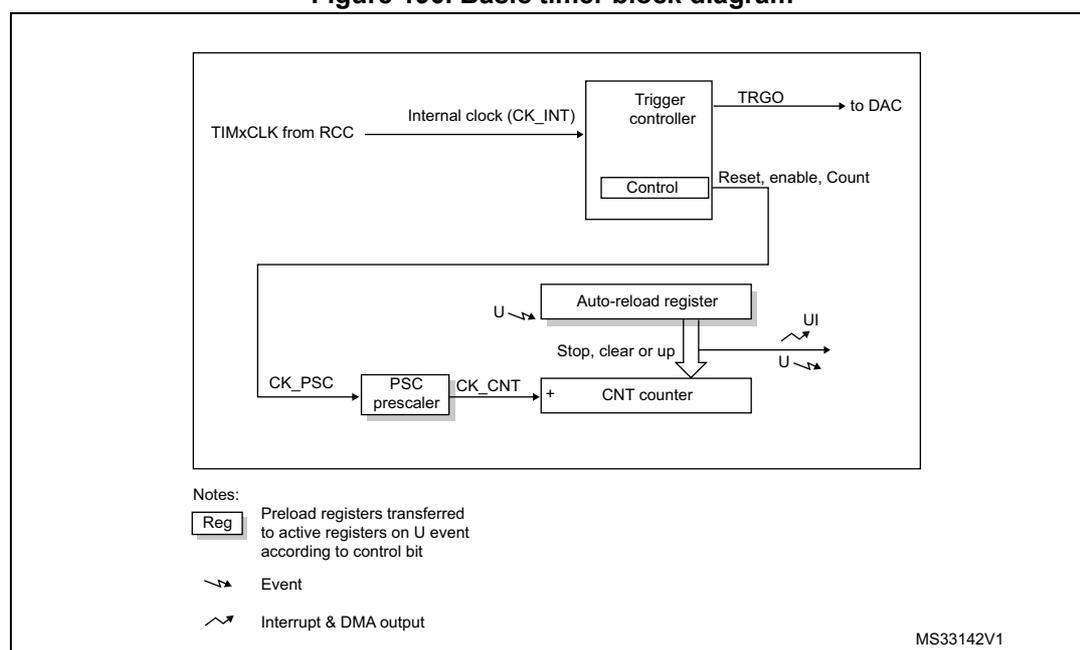
The block diagram illustrates the internal architecture of the TIM6/7 basic timer. The main components are:
- Input: TIMxCLK from RCC enters the system.
- Internal Clock (CK_INT): Derived from TIMxCLK, it is fed into the Trigger controller.
- Trigger controller: Contains a Control block. It receives CK_INT and control signals (Reset, enable, Count). It generates the TRGO output to the DAC and provides control signals to the counter.
- CK_PSC: Derived from TIMxCLK, it is fed into the PSC prescaler.
- PSC prescaler: Divides the CK_PSC frequency to produce CK_CNT.
- CNT counter: A 16-bit upcounter that receives CK_CNT and control signals (Reset, enable, Count). It generates an interrupt and DMA output on overflow.
- Auto-reload register: Stores the reload value. It is updated by a 'U' (Update) event and provides the reload value to the counter. It also generates an interrupt and DMA output on update ('UI').
- Control Signals: Reset, enable, and Count are provided by the Trigger controller to the CNT counter.
- Events: 'U' (Update) and 'UI' (Update Interrupt) are indicated by arrows with a small triangle symbol.
Notes:
- Reg (Preload registers transferred to active registers on U event according to control bit)
- Event (indicated by an arrow with a small triangle)
- Interrupt & DMA output (indicated by an arrow with a small lightning bolt)
MS33142V1
23.3 TIM6/7 functional description
23.3.1 Time-base unit
The main block of the programmable timer is a 16-bit upcounter with its related auto-reload register. The counter clock can be divided by a prescaler.
The counter, the auto-reload register and the prescaler register can be written or read by software. This is true even when the counter is running.
The time-base unit includes:
- • Counter Register (TIMx_CNT)
- • Prescaler Register (TIMx_PSC)
- • Auto-Reload Register (TIMx_ARR)
The auto-reload register is preloaded. The preload register is accessed each time an attempt is made to write or read the auto-reload register. The contents of the preload register are transferred into the shadow register permanently or at each update event UEV, depending on the auto-reload preload enable bit (ARPE) in the TIMx_CR1 register. The update event is sent when the counter reaches the overflow value and if the UDIS bit equals 0 in the TIMx_CR1 register. It can also be generated by software. The generation of the update event is described in detail for each configuration.
The counter is clocked by the prescaler output CK_CNT, which is enabled only when the counter enable bit (CEN) in the TIMx_CR1 register is set.
Note that the actual counter enable signal CNT_EN is set 1 clock cycle after CEN.
Prescaler description
The prescaler can divide the counter clock frequency by any factor between 1 and 65536. It is based on a 16-bit counter controlled through a 16-bit register (in the TIMx_PSC register). It can be changed on the fly as the TIMx_PSC control register is buffered. The new prescaler ratio is taken into account at the next update event.
Figure 191 and Figure 192 give some examples of the counter behavior when the prescaler ratio is changed on the fly.
Figure 191. Counter timing diagram with prescaler division change from 1 to 2
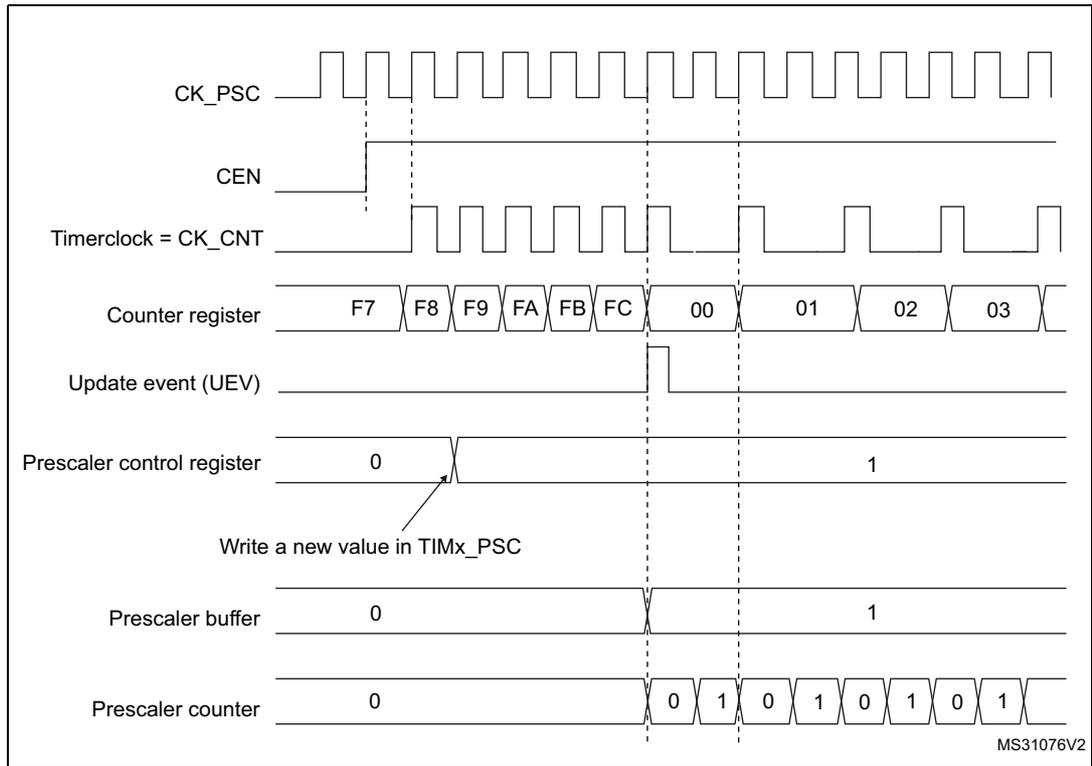
This timing diagram shows the relationship between several signals over time. The signals are: CK_PSC (a periodic square wave), CEN (an active-low enable signal), Timerclock = CK_CNT (a square wave derived from CK_PSC), Counter register (showing hexadecimal values F7, F8, F9, FA, FB, FC, 00, 01, 02, 03), Update event (UEV) (a pulse), Prescaler control register (showing values 0 and 1), Prescaler buffer (showing values 0 and 1), and Prescaler counter (showing a sequence of 0, 1, 0, 1, 0, 1, 0, 1). Vertical dashed lines indicate key events: the rising edge of CK_PSC that starts counting, the falling edge of CEN that enables counting, the rising edge of Timerclock that increments the counter, the falling edge of UEV that triggers an update, and the rising edge of the Prescaler control register that updates the prescaler buffer. An arrow points to the Prescaler control register with the text 'Write a new value in TIMx_PSC'. The diagram is labeled MS31076V2 in the bottom right corner.
Figure 192. Counter timing diagram with prescaler division change from 1 to 4
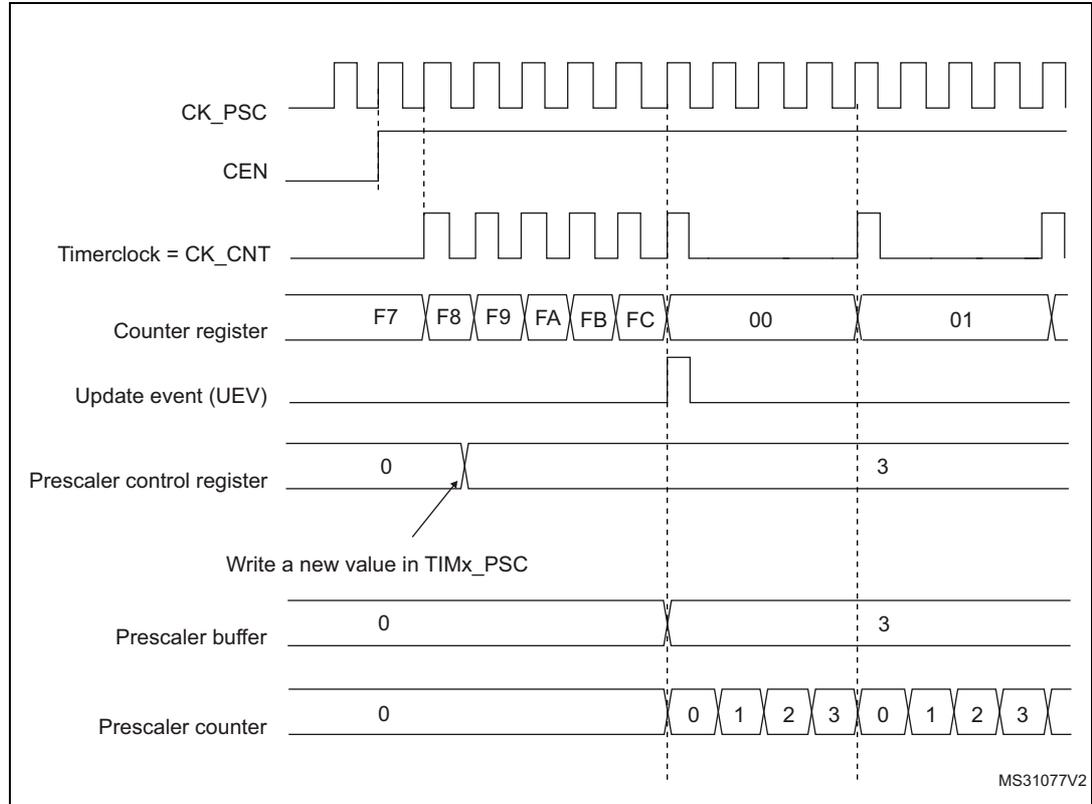
This timing diagram is similar to Figure 191 but shows a change in prescaler division from 1 to 4. The signals and their behavior are: CK_PSC, CEN, Timerclock = CK_CNT, Counter register (values F7, F8, F9, FA, FB, FC, 00, 01), Update event (UEV), Prescaler control register (values 0 and 3), Prescaler buffer (values 0 and 3), and Prescaler counter (values 0, 1, 2, 3, 0, 1, 2, 3). The sequence of values in the Prescaler control register, Prescaler buffer, and Prescaler counter reflects the division change from 1 to 4. The diagram is labeled MS31077V2 in the bottom right corner.
23.3.2 Counting mode
The counter counts from 0 to the auto-reload value (contents of the TIMx_ARR register), then restarts from 0 and generates a counter overflow event.
An update event can be generated at each counter overflow or by setting the UG bit in the TIMx_EGR register (by software or by using the slave mode controller).
The UEV event can be disabled by software by setting the UDIS bit in the TIMx_CR1 register. This avoids updating the shadow registers while writing new values into the preload registers. In this way, no update event occurs until the UDIS bit has been written to 0, however, the counter and the prescaler counter both restart from 0 (but the prescale rate does not change). In addition, if the URS (update request selection) bit in the TIMx_CR1 register is set, setting the UG bit generates an update event UEV, but the UIF flag is not set (so no interrupt or DMA request is sent).
When an update event occurs, all the registers are updated and the update flag (UIF bit in the TIMx_SR register) is set (depending on the URS bit):
- • The buffer of the prescaler is reloaded with the preload value (contents of the TIMx_PSC register)
- • The auto-reload shadow register is updated with the preload value (TIMx_ARR)
The following figures show some examples of the counter behavior for different clock frequencies when TIMx_ARR = 0x36.
Figure 193. Counter timing diagram, internal clock divided by 1
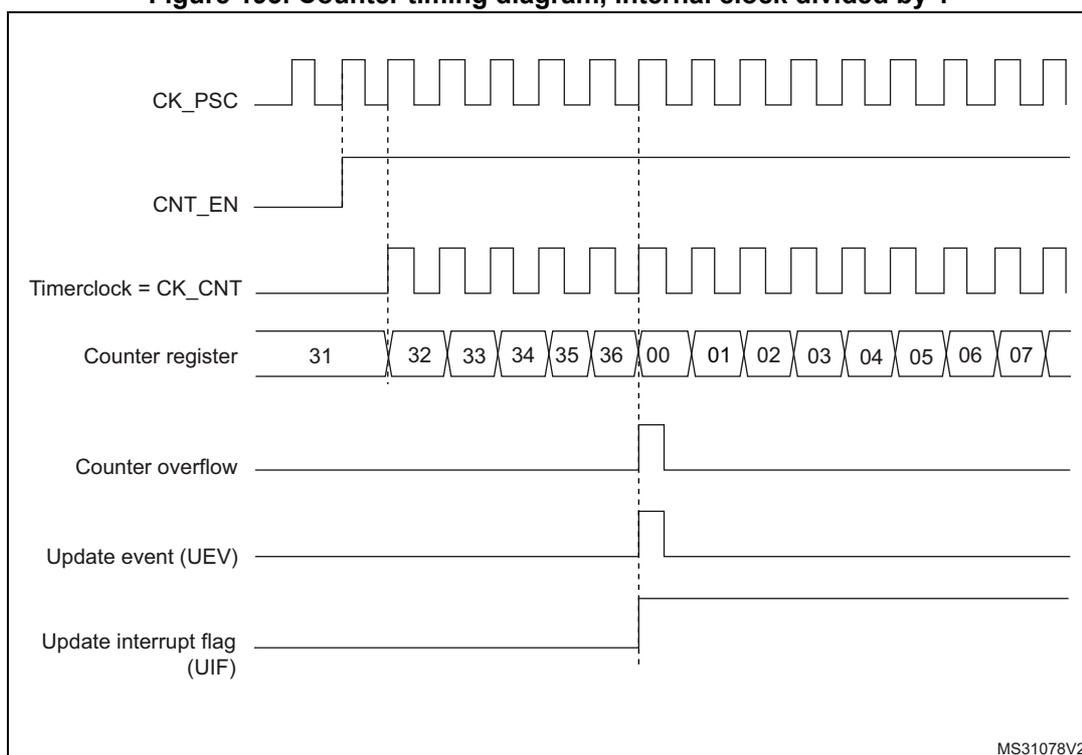
The timing diagram illustrates the counter's behavior over time. The top signal, CK_PSC, is a periodic square wave. Below it, CNT_EN is a signal that goes high to enable the counter. When enabled, the Timerclock = CK_CNT signal becomes a square wave with a frequency twice that of CK_PSC. The Counter register is shown as a sequence of values: 31, 32, 33, 34, 35, 36, 00, 01, 02, 03, 04, 05, 06, 07. The Counter overflow signal is a pulse that occurs when the counter reaches the value 36. The Update event (UEV) signal is a pulse that occurs when the counter overflows. The Update interrupt flag (UIF) signal is a pulse that occurs when the counter overflows. Vertical dashed lines indicate the timing relationships between the signals.
MS31078V2
Figure 194. Counter timing diagram, internal clock divided by 2
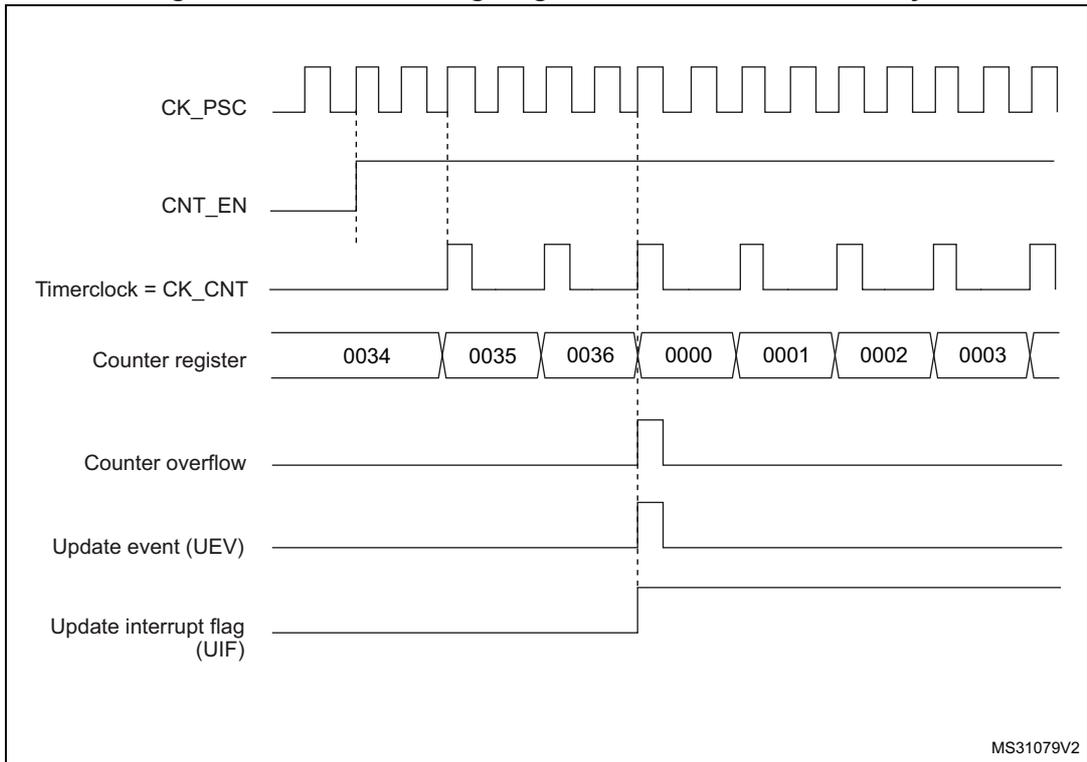
This timing diagram illustrates the operation of a basic timer with the internal clock divided by 2. The top signal, CK_PSC, is a periodic square wave. Below it, CNT_EN is a high-level enable signal. The Timerclock = CK_CNT signal is a square wave with a frequency half that of CK_PSC. The Counter register shows a sequence of values: 0034, 0035, 0036, 0000, 0001, 0002, and 0003. Vertical dashed lines indicate key timing points: the first at the rising edge of Timerclock when the counter is 0034, the second at the rising edge when it is 0036, and the third at the rising edge after the overflow to 0000. At the third dashed line, the Counter overflow, Update event (UEV), and Update interrupt flag (UIF) signals all transition from low to high. The UIF signal remains high until the counter reaches 0001.
MS31079V2
Figure 195. Counter timing diagram, internal clock divided by 4
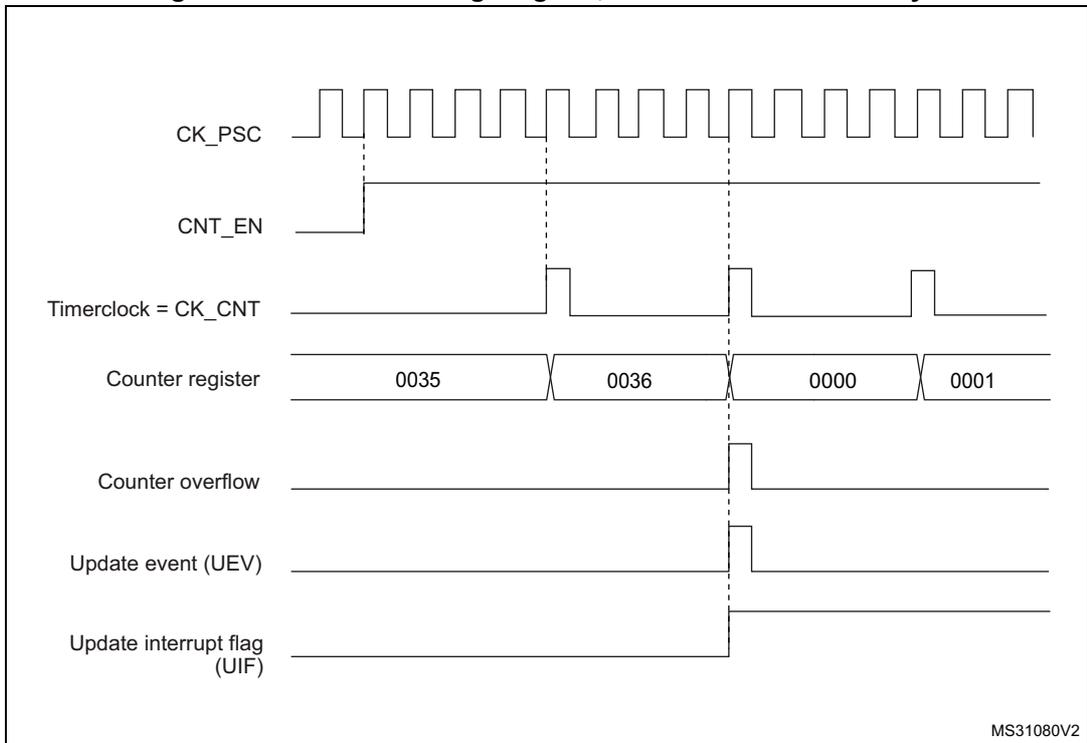
This timing diagram illustrates the operation of a basic timer with the internal clock divided by 4. The top signal, CK_PSC, is a periodic square wave. Below it, CNT_EN is a high-level enable signal. The Timerclock = CK_CNT signal is a square wave with a frequency one-quarter that of CK_PSC. The Counter register shows a sequence of values: 0035, 0036, 0000, and 0001. Vertical dashed lines indicate key timing points: the first at the rising edge of Timerclock when the counter is 0035, the second at the rising edge when it is 0036, and the third at the rising edge after the overflow to 0000. At the third dashed line, the Counter overflow, Update event (UEV), and Update interrupt flag (UIF) signals all transition from low to high. The UIF signal remains high until the counter reaches 0001.
MS31080V2
Figure 196. Counter timing diagram, internal clock divided by N
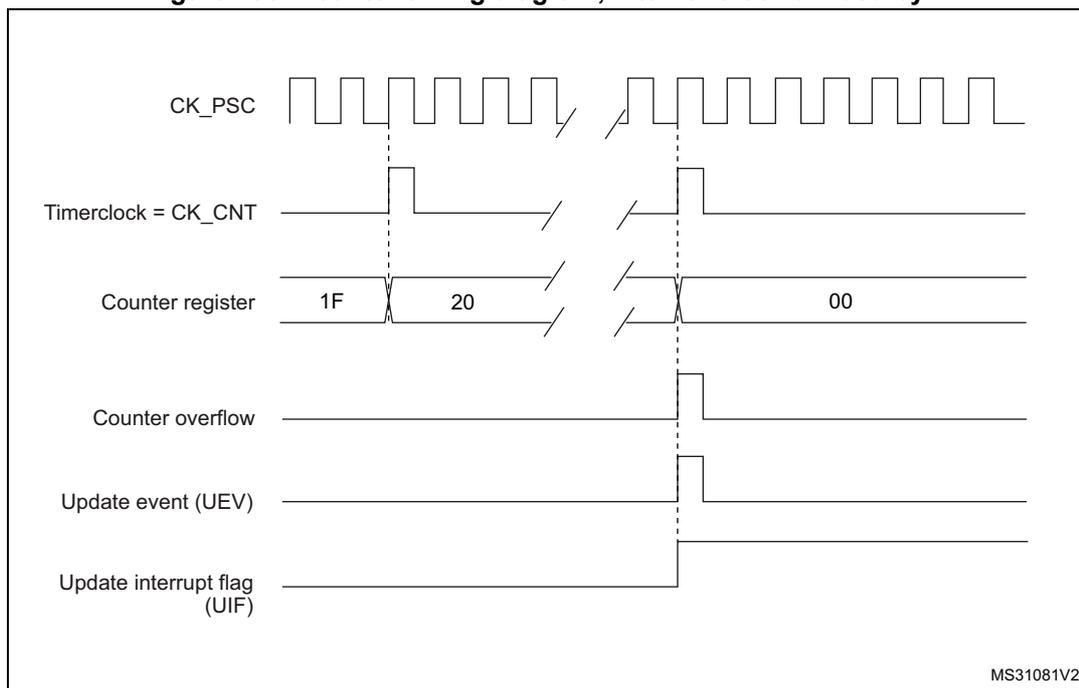
Figure 196 is a timing diagram for a basic timer (TIM6/7) using an internal clock divided by N. The diagram illustrates the following signals and their timing relationships:
- CK_PSC : Prescaler clock signal, shown as a square wave.
- Timerclock = CK_CNT : Counter clock signal, derived from CK_PSC. It is a square wave with a frequency divided by N.
- Counter register : Shows the counter value. It starts at 1F (hex), increments to 20 (hex), and then overflows to 00 (hex).
- Counter overflow : A signal that goes high when the counter register overflows from 20 to 00.
- Update event (UEV) : A signal that goes high when the counter register overflows.
- Update interrupt flag (UIF) : A signal that goes high when the counter register overflows and remains high until cleared.
The diagram shows two instances of the counter register. In the first instance, the counter starts at 1F and increments to 20. In the second instance, the counter starts at 00 and increments. The overflow event occurs when the counter transitions from 20 to 00.
MS31081V2
Figure 197. Counter timing diagram, update event when ARPE = 0 (TIMx_ARR not preloaded)
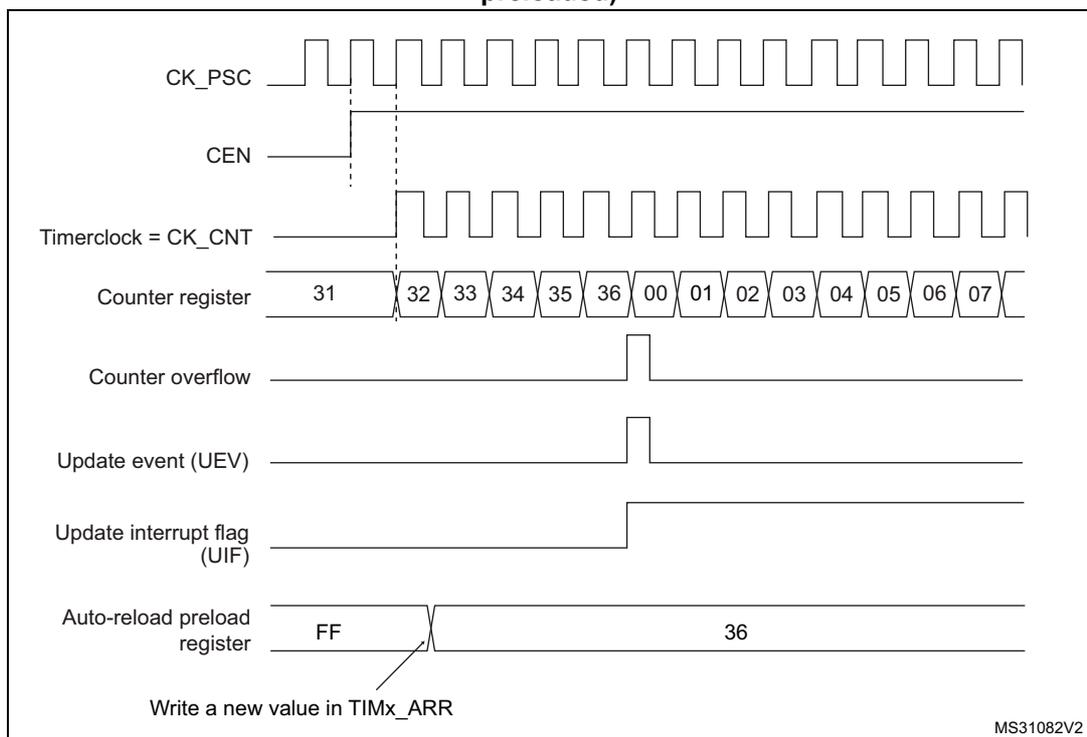
Figure 197 is a timing diagram for a basic timer (TIM6/7) using an internal clock divided by N, with the update event occurring when ARPE = 0 (TIMx_ARR not preloaded). The diagram illustrates the following signals and their timing relationships:
- CK_PSC : Prescaler clock signal, shown as a square wave.
- CEN : Counter enable signal, shown as a high-level signal.
- Timerclock = CK_CNT : Counter clock signal, derived from CK_PSC. It is a square wave with a frequency divided by N.
- Counter register : Shows the counter value. It starts at 31 (hex), increments through 32, 33, 34, 35, 36, and then overflows to 00, 01, 02, 03, 04, 05, 06, 07 (hex).
- Counter overflow : A signal that goes high when the counter register overflows from 36 to 00.
- Update event (UEV) : A signal that goes high when the counter register overflows.
- Update interrupt flag (UIF) : A signal that goes high when the counter register overflows and remains high until cleared.
- Auto-reload preload register : Shows the preload value. It starts at FF (hex) and is updated to 36 (hex) when a new value is written in TIMx_ARR.
The diagram shows the counter register incrementing from 31 to 36, then overflowing to 00. The overflow event occurs when the counter transitions from 36 to 00. The update event (UEV) and update interrupt flag (UIF) are generated at this point. The auto-reload preload register is updated from FF to 36 when a new value is written in TIMx_ARR.
MS31082V2
Figure 198. Counter timing diagram, update event when ARPE=1 (TIMx_ARR preloaded)
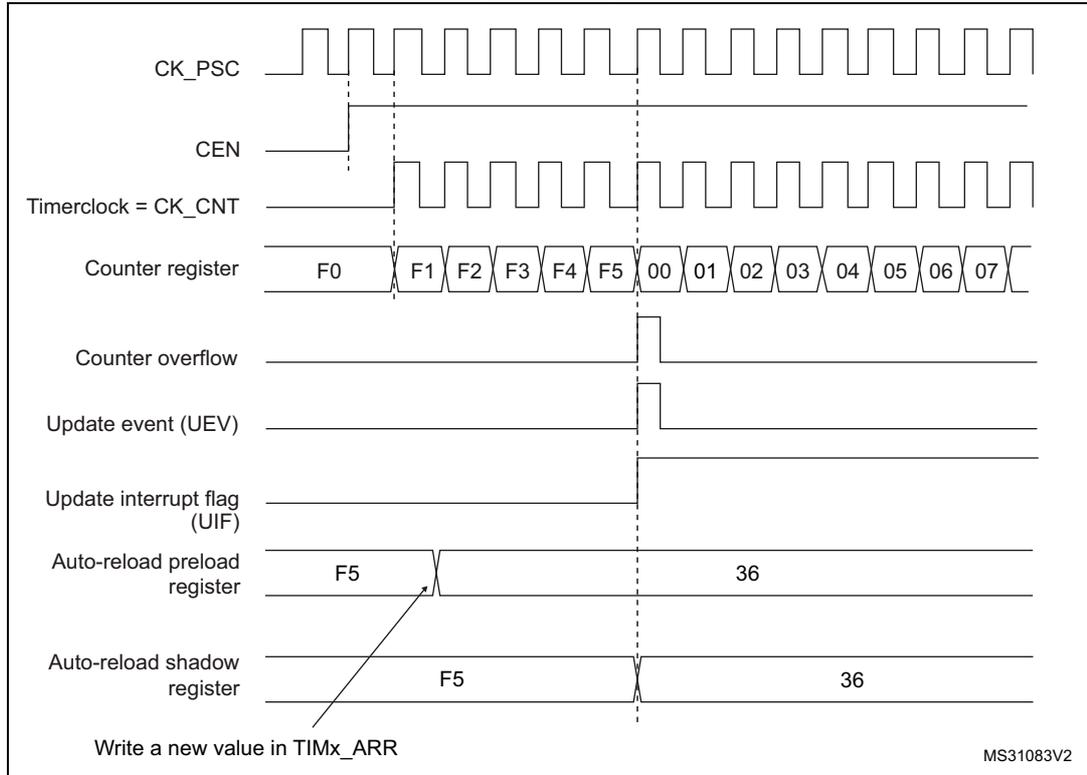
The timing diagram illustrates the operation of a basic timer (TIM6/7) with ARPE=1. The signals shown are:
- CK_PSC : Prescaler clock signal, a periodic square wave.
- CEN : Counter Enable signal, which goes high to enable the counter.
- Timerclock = CK_CNT : Counter clock signal, derived from CK_PSC when CEN is high.
- Counter register : Shows the counter values: F0, F1, F2, F3, F4, F5, 00, 01, 02, 03, 04, 05, 06, 07. The counter increments on each rising edge of the timer clock.
- Counter overflow : A pulse generated when the counter reaches its maximum value (F5 in this case).
- Update event (UEV) : A pulse generated at the counter overflow.
- Update interrupt flag (UIF) : A flag that is set by the UEV.
- Auto-reload preload register : Contains the value F5. An arrow indicates a new value is being written.
- Auto-reload shadow register : Contains the value 36. It is updated from the preload register at the UEV.
MS31083V2
23.3.3 Clock source
The counter clock is provided by the Internal clock (CK_INT) source.
The CEN (in the TIMx_CR1 register) and UG bits (in the TIMx_EGR register) are actual control bits and can be changed only by software (except for UG that remains cleared automatically). As soon as the CEN bit is written to 1, the prescaler is clocked by the internal clock CK_INT.
Figure 199 shows the behavior of the control circuit and the upcounter in normal mode, without prescaler.
Figure 199. Control circuit in normal mode, internal clock divided by 1
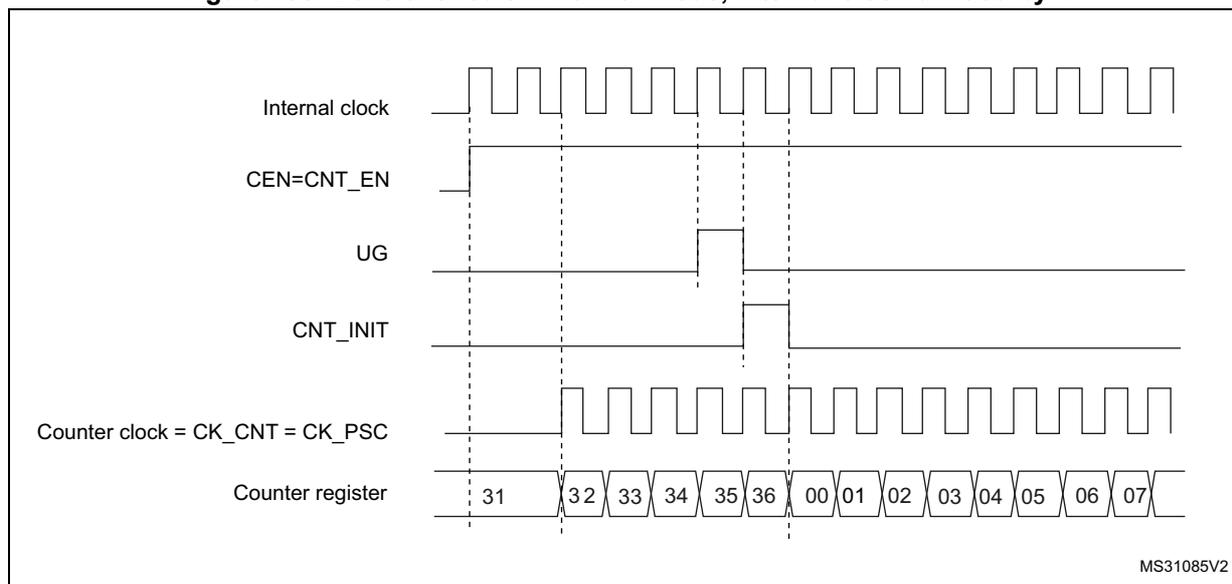
The timing diagram shows the following signals and their relationship:
- Internal clock: A continuous square wave.
- CEN=CNT_EN: Counter Enable. It is initially low, then goes high, and then goes low again. The counter starts counting when this signal is high.
- UG: Update Generation. It is initially low. It goes high when CEN=CNT_EN is high and CNT_INIT is high. It then goes low.
- CNT_INIT: Counter Initialization. It is initially low. It goes high when UG is high and then goes low.
- Counter clock = CK_CNT = CK_PSC: This signal is initially low. It becomes a square wave when CEN=CNT_EN is high. It is the clock for the counter register.
- Counter register: The register values are shown in a sequence of boxes. The sequence starts at 31, then 32, 33, 34, 35, 36, 00, 01, 02, 03, 04, 05, 06, 07. The values 31 through 36 are shown before the counter starts counting from 00.
MS31085V2
23.3.4 Debug mode
When the microcontroller enters the debug mode (Cortex ® -M0+ core - halted), the TIMx counter either continues to work normally or stops, depending on the DBG_TIMx_STOP configuration bit in the DBG module. For more details, refer to Section 33.9.2: Debug support for timers, watchdog and I 2 C .
23.4 TIM6/7 registers
Refer to Section 1.2: List of abbreviations for registers for a list of abbreviations used in register descriptions.
The peripheral registers have to be written by half-words (16 bits) or words (32 bits). Read accesses can be done by bytes (8 bits), half-words (16 bits) or words (32 bits).
23.4.1 TIM6/7 control register 1 (TIMx_CR1)
Address offset: 0x00
Reset value: 0x0000
| 15 | 14 | 13 | 12 | 11 | 10 | 9 | 8 | 7 | 6 | 5 | 4 | 3 | 2 | 1 | 0 |
|---|---|---|---|---|---|---|---|---|---|---|---|---|---|---|---|
| Res. | Res. | Res. | Res. | Res. | Res. | Res. | Res. | ARPE | Res. | Res. | Res. | OPM | URS | UDIS | CEN |
| rw | rw | rw | rw | rw |
Bits 15:8 Reserved, must be kept at reset value.
Bit 7 ARPE : Auto-reload preload enable
0: TIMx_ARR register is not buffered.
1: TIMx_ARR register is buffered.
Bits 6:4 Reserved, must be kept at reset value.
Bit 3 OPM : One-pulse mode
0: Counter is not stopped at update event
1: Counter stops counting at the next update event (clearing the CEN bit).
Bit 2 URS : Update request source
This bit is set and cleared by software to select the UEV event sources.
0: Any of the following events generates an update interrupt or DMA request if enabled.
These events can be:
- – Counter overflow/underflow
- – Setting the UG bit
- – Update generation through the slave mode controller
1: Only counter overflow/underflow generates an update interrupt or DMA request if enabled.
Bit 1 UDIS : Update disable
This bit is set and cleared by software to enable/disable UEV event generation.
0: UEV enabled. The Update (UEV) event is generated by one of the following events:
- – Counter overflow/underflow
- – Setting the UG bit
- – Update generation through the slave mode controller
Buffered registers are then loaded with their preload values.
1: UEV disabled. The Update event is not generated, shadow registers keep their value (ARR, PSC). However the counter and the prescaler are reinitialized if the UG bit is set or if a hardware reset is received from the slave mode controller.
Bit 0 CEN : Counter enable
0: Counter disabled
1: Counter enabled
Note: Gated mode can work only if the CEN bit has been previously set by software.
However trigger mode can set the CEN bit automatically by hardware.
CEN is cleared automatically in one-pulse mode, when an update event occurs.
23.4.2 TIM6/7 control register 2 (TIMx_CR2)
Address offset: 0x04
Reset value: 0x0000
| 15 | 14 | 13 | 12 | 11 | 10 | 9 | 8 | 7 | 6 | 5 | 4 | 3 | 2 | 1 | 0 |
|---|---|---|---|---|---|---|---|---|---|---|---|---|---|---|---|
| Res. | Res. | Res. | Res. | Res. | Res. | Res. | Res. | Res. | MMS[2:0] | Res. | Res. | Res. | Res. | ||
| rw | rw | rw | |||||||||||||
Bits 15:7 Reserved, must be kept at reset value.
Bits 6:4 MMS : Master mode selection
These bits are used to select the information to be sent in master mode to slave timers for synchronization (TRGO). The combination is as follows:
000: Reset - the UG bit from the TIMx_EGR register is used as a trigger output (TRGO). If reset is generated by the trigger input (slave mode controller configured in reset mode) then the signal on TRGO is delayed compared to the actual reset.
001: Enable - the Counter enable signal, CNT_EN, is used as a trigger output (TRGO). It is useful to start several timers at the same time or to control a window in which a slave timer is enabled. The Counter Enable signal is generated by a logic OR between CEN control bit and the trigger input when configured in gated mode.
When the Counter Enable signal is controlled by the trigger input, there is a delay on TRGO, except if the master/slave mode is selected (see the MSM bit description in the TIMx_SMCR register).
010: Update - The update event is selected as a trigger output (TRGO). For instance a master timer can then be used as a prescaler for a slave timer.
Bits 3:0 Reserved, must be kept at reset value.
23.4.3 TIM6/7 DMA/Interrupt enable register (TIMx_DIER)
Address offset: 0x0C
Reset value: 0x0000
| 15 | 14 | 13 | 12 | 11 | 10 | 9 | 8 | 7 | 6 | 5 | 4 | 3 | 2 | 1 | 0 |
|---|---|---|---|---|---|---|---|---|---|---|---|---|---|---|---|
| Res. | Res. | Res. | Res. | Res. | Res. | Res. | UDE | Res. | Res. | Res. | Res. | Res. | Res. | Res. | UIE |
| rw | rw |
Bits 15:9 Reserved, must be kept at reset value.
Bit 8 UDE : Update DMA request enable
0: Update DMA request disabled.
1: Update DMA request enabled.
Bits 7:1 Reserved, must be kept at reset value.
Bit 0 UIE : Update interrupt enable
0: Update interrupt disabled.
1: Update interrupt enabled.
23.4.4 TIM6/7 status register (TIMx_SR)
Address offset: 0x10
Reset value: 0x0000
| 15 | 14 | 13 | 12 | 11 | 10 | 9 | 8 | 7 | 6 | 5 | 4 | 3 | 2 | 1 | 0 |
|---|---|---|---|---|---|---|---|---|---|---|---|---|---|---|---|
| Res. | Res. | Res. | Res. | Res. | Res. | Res. | Res. | Res. | Res. | Res. | Res. | Res. | Res. | Res. | UIF |
| rc_w0 |
Bits 15:1 Reserved, must be kept at reset value.
Bit 0 UIF : Update interrupt flag
This bit is set by hardware on an update event. It is cleared by software.
0: No update occurred.
1: Update interrupt pending. This bit is set by hardware when the registers are updated:
- – At overflow or underflow regarding the repetition counter value and if UDIS = 0 in the TIMx_CR1 register.
- – When CNT is reinitialized by software using the UG bit in the TIMx_EGR register, if URS = 0 and UDIS = 0 in the TIMx_CR1 register.
23.4.5 TIM6/7 event generation register (TIMx_EGR)
Address offset: 0x14
Reset value: 0x0000
| 15 | 14 | 13 | 12 | 11 | 10 | 9 | 8 | 7 | 6 | 5 | 4 | 3 | 2 | 1 | 0 |
|---|---|---|---|---|---|---|---|---|---|---|---|---|---|---|---|
| Res. | Res. | Res. | Res. | Res. | Res. | Res. | Res. | Res. | Res. | Res. | Res. | Res. | Res. | Res. | UG |
| w |
Bits 15:1 Reserved, must be kept at reset value.
Bit 0 UG : Update generation
This bit can be set by software, it is automatically cleared by hardware.
0: No action.
1: Re-initializes the timer counter and generates an update of the registers. Note that the prescaler counter is cleared too (but the prescaler ratio is not affected).
23.4.6 TIM6/7 counter (TIMx_CNT)
Address offset: 0x24
Reset value: 0x0000
| 15 | 14 | 13 | 12 | 11 | 10 | 9 | 8 | 7 | 6 | 5 | 4 | 3 | 2 | 1 | 0 |
|---|---|---|---|---|---|---|---|---|---|---|---|---|---|---|---|
| CNT[15:0] | |||||||||||||||
| rw | rw | rw | rw | rw | rw | rw | rw | rw | rw | rw | rw | rw | rw | rw | rw |
Bits 15:0 CNT[15:0] : Counter value
23.4.7 TIM6/7 prescaler (TIMx_PSC)
Address offset: 0x28
Reset value: 0x0000

| 15 | 14 | 13 | 12 | 11 | 10 | 9 | 8 | 7 | 6 | 5 | 4 | 3 | 2 | 1 | 0 |
| PSC[15:0] | |||||||||||||||
| rw | rw | rw | rw | rw | rw | rw | rw | rw | rw | rw | rw | rw | rw | rw | rw |
Bits 15:0 PSC[15:0] : Prescaler value
The counter clock frequency (CK_CNT) is equal to \( f_{CK\_PSC} / (PSC[15:0] + 1) \) .
PSC contains the value to be loaded in the active prescaler register at each update event (including when the counter is cleared through UG bit of TIMx_EGR register or through trigger controller when configured in “reset mode”).
23.4.8 TIM6/7 auto-reload register (TIMx_ARR)
Address offset: 0x2C
Reset value: 0xFFFF

| 15 | 14 | 13 | 12 | 11 | 10 | 9 | 8 | 7 | 6 | 5 | 4 | 3 | 2 | 1 | 0 |
| ARR[15:0] | |||||||||||||||
| rw | rw | rw | rw | rw | rw | rw | rw | rw | rw | rw | rw | rw | rw | rw | rw |
Bits 15:0 ARR[15:0] : Auto-reload value
ARR is the value to be loaded into the actual auto-reload register.
Refer to Section 23.3.1: Time-base unit on page 601 for more details about ARR update and behavior.
The counter is blocked while the auto-reload value is null.
23.4.9 TIM6/7 register map
TIMx registers are mapped as 16-bit addressable registers as described in the table below:
Table 106. TIM6/7 register map and reset values
| Offset | Register | 15 | 14 | 13 | 12 | 11 | 10 | 9 | 8 | 7 | 6 | 5 | 4 | 3 | 2 | 1 | 0 |
|---|---|---|---|---|---|---|---|---|---|---|---|---|---|---|---|---|---|
| 0x00 | TIMx_CR1 | Res. | Res. | Res. | Res. | Res. | Res. | Res. | Res. | ARPE | Res. | Res. | Res. | OPM | URS | UDIS | CEN |
| Reset value | 0 | 0 | 0 | 0 | 0 | ||||||||||||
| 0x04 | TIMx_CR2 | Res. | Res. | Res. | Res. | Res. | Res. | Res. | Res. | Res. | MMS[2:0] | Res. | Res. | Res. | Res. | ||
| Reset value | 0 | 0 | 0 | ||||||||||||||
| 0x08 | Res. | ||||||||||||||||
| 0x0C | TIMx_DIER | Res. | Res. | Res. | Res. | Res. | Res. | Res. | UDE | Res. | Res. | Res. | Res. | Res. | Res. | Res. | UIE |
| Reset value | 0 | 0 | |||||||||||||||
| 0x10 | TIMx_SR | Res. | Res. | Res. | Res. | Res. | Res. | Res. | Res. | Res. | Res. | Res. | Res. | Res. | Res. | Res. | UIF |
| Reset value | 0 | ||||||||||||||||
| 0x14 | TIMx_EGR | Res. | Res. | Res. | Res. | Res. | Res. | Res. | Res. | Res. | Res. | Res. | Res. | Res. | Res. | Res. | UG |
| Reset value | 0 | ||||||||||||||||
| 0x18 | Res. | ||||||||||||||||
| 0x1C | Res. | ||||||||||||||||
| 0x20 | Res. | ||||||||||||||||
| 0x24 | TIMx_CNT | CNT[15:0] | |||||||||||||||
| Reset value | 0 | 0 | 0 | 0 | 0 | 0 | 0 | 0 | 0 | 0 | 0 | 0 | 0 | 0 | 0 | 0 | |
| 0x28 | TIMx_PSC | PSC[15:0] | |||||||||||||||
| Reset value | 0 | 0 | 0 | 0 | 0 | 0 | 0 | 0 | 0 | 0 | 0 | 0 | 0 | 0 | 0 | 0 | |
| 0x2C | TIMx_ARR | ARR[15:0] | |||||||||||||||
| Reset value | 1 | 1 | 1 | 1 | 1 | 1 | 1 | 1 | 1 | 1 | 1 | 1 | 1 | 1 | 1 | 1 | |
Refer to Section 2.2 on page 58 for the register boundary addresses.