16. Operational amplifier (OPAMP)
16.1 OPAMP introduction
STM32F334xx devices embed 1 operational amplifier OPAMP2. It can either be used as a standalone amplifier or as a follower / programmable gain amplifier.
The operational amplifier output is internally connected to an ADC channel for measurement purposes.
16.2 OPAMP main features
- • Rail-to-rail input/output
- • Low offset voltage
- • Capability of being configured as a standalone operational amplifier or as a programmable gain amplifier (PGA)
- • Access to all terminals
- • Input multiplexer on inverting and non-inverting input
- • Input multiplexer can be triggered by a timer and synchronized with a PWM signal.
16.3 OPAMP functional description
16.3.1 General description
On every OPAMP, there is one 4:1 multiplexer on the non-inverting input and one 2:1 multiplexer on the inverting input.
The inverting and non inverting inputs selection is made using the VM_SEL and VP_SEL bits respectively in the OPAMPx_CSR register.
The I/Os used as OPAMP input/outputs must be configured in analog mode in the GPIOs registers.
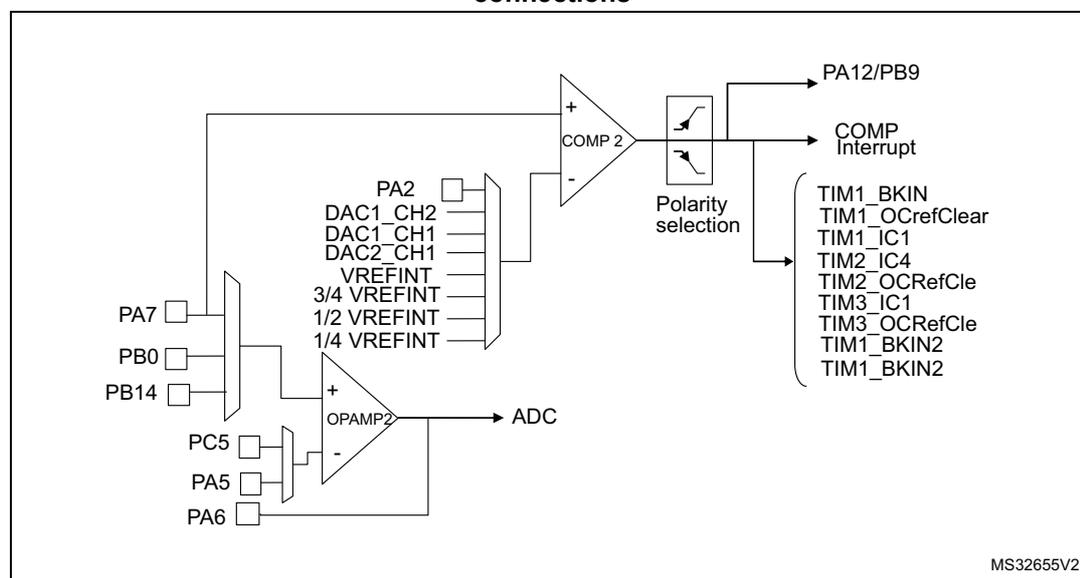
The connections with dedicated I/O are summarized in the table below and in Figure 94 .
Table 58. Connections with dedicated I/O
| OPAMP2 inverting input | OPAMP2 non inverting input |
|---|---|
| PA5 (VM1) | PA7 (VP0) |
| PC5 (VM0) | PD14 (VP1) |
| - | PB0 (VP2) |
16.3.2 Clock
The OPAMP clock provided by the clock controller is synchronized with the PCLK2 (APB2 clock). There is no clock enable control bit provided in the RCC controller. To use a clock source for the OPAMP, the SYSCFG clock enable control bit must be set in the RCC controller.
16.3.3 Operational amplifiers and comparators interconnections
Internal connections between the operational amplifiers and the comparators are useful in motor control applications. These connections are summarized in the following figures.
Figure 94. STM32F334xx comparator and operational amplifier connections
16.3.4 Using the OPAMP outputs as ADC inputs
In order to use OPAMP outputs as ADC inputs, the operational amplifiers must be enabled and the ADC must use the OPAMP output channel number:
- • For OPAMP2, ADC2 channel 3 is used.
16.3.5 Calibration
The OPAMP interface continuously sends trimmed offset values to the 4 operational amplifiers. At startup, these values are initialized with the preset 'factory' trimming value.
Furthermore each operational amplifier offset can be trimmed by the user.
The user can switch from the 'factory' values to the 'user' trimmed values using the USER_TRIM bit in the OPAMP control register. This bit is reset at startup ('factory' values are sent to the operational amplifiers).
The rail-to-rail input stage of the OPAMP is composed of two differential pairs:
- • One pair composed of NMOS transistors
- • One pair composed of PMOS transistors.
As these two pairs are independent, the trimming procedure calibrates each one separately. The TRIMOFFSETN bits calibrate the NMOS differential pair offset and the TRIMOFFSETP bits calibrate the PMOS differential pair offset.
To calibrate the NMOS differential pair, the following conditions must be met: CALON=1 and CALSEL=11. In this case, an internal high voltage reference ( \( 0.9 \times V_{DDA} \) ) is generated and applied on the inverting and non inverting OPAMP inputs connected together. The voltage
applied to both inputs of the OPAMP can be measured (the OPAMP reference voltage can be output through the TSTREF bit and connected internally to an ADC channel; refer to Section 13: Analog-to-digital converters (ADC) on page 211 ). The software should increment the TRIMOFFSETN bits in the OPAMP control register from 0x00 to the first value that causes the OUTCAL bit to change from 1 to 0 in the OPAMP register. If the OUTCAL bit is reset, the offset is calibrated correctly and the corresponding trimming value must be stored.
The calibration of the PMOS differential pair is performed in the same way, with two differences: the TRIMOFFSETP bits-fields are used and the CALSEL bits must be programmed to '01' (an internal low voltage reference ( \( 0.1 \times V_{DDA} \) ) is generated and applied on the inverting and non inverting OPAMP inputs connected together).
Note: During calibration mode, to get the correct OUTCAL value, please make sure the OFFTRIMmax delay (specified in the datasheet electrical characteristics section) has elapsed between the write of a trimming value (TRIMOFFSETP or TRIMOFFSETN) and the read of the OUTCAL value,
To calibrate the NMOS differential pair, use the following software procedure:
- 1. Enable OPAMP by setting the OPAMPxEN bit
- 2. Enable the user offset trimming by setting the USERTRIM bit
- 3. Connect VM and VP to the internal reference voltage by setting the CALON bit
- 4. Set CALSEL to 11 (OPAMP internal reference \( = 0.9 \times V_{DDA} \) )
- 5. In a loop, increment the TRIMOFFSETN value. To exit from the loop, the OUTCAL bit must be reset. In this case, the TRIMOFFSETN value must be stored.
The same software procedure must be applied for PMOS differential pair calibration with CALSEL = 01 (OPAMP internal reference \( = 0.1 \times V_{DDA} \) ).
16.3.6 Timer controlled Multiplexer mode
The selection of the OPAMP inverting and non inverting inputs can be done automatically. In this case, the switch from one input to another is done automatically. This automatic switch is triggered by the TIM1 CC6 output arriving on the OPAMP input multiplexers.
This is useful for dual motor control with a need to measure the currents on the 3 phases instantaneously on a first motor and then on the second motor.
The automatic switch is enabled by setting the TCM_EN bit in the OPAMP control register. The inverting and non inverting inputs selection is performed using the VPS_SEL and VMS_SEL bit fields in the OPAMP control register. If the TCM_EN bit is cleared, the selection is done using the VP_SEL and VM_SEL bit fields in the OPAMP control register.
Figure 95. Timer controlled Multiplexer mode
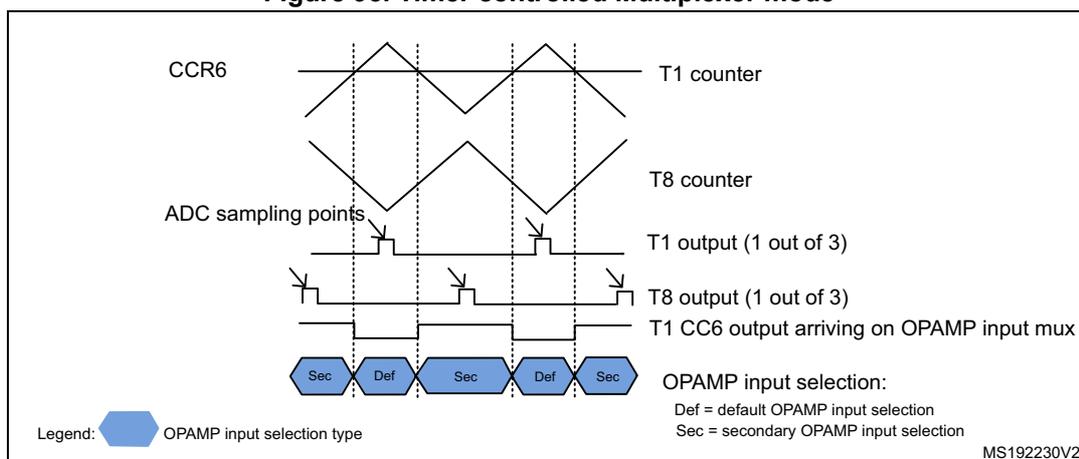
The diagram illustrates the timing for the Timer controlled Multiplexer mode. It shows the following signals and their relationships:
- CCR6 : Control register for the T1 counter.
- T1 counter : A counter that generates a sawtooth waveform.
- T8 counter : A counter that generates a sawtooth waveform.
- ADC sampling points : Indicated by vertical dashed lines, these points are used to sample the OPAMP input signals.
- T1 output (1 out of 3) : A signal derived from the T1 counter.
- T8 output (1 out of 3) : A signal derived from the T8 counter.
- T1 CC6 output arriving on OPAMP input mux : A signal that controls the OPAMP input multiplexer.
- OPAMP input selection : The multiplexer selects between 'Sec' (secondary OPAMP input selection) and 'Def' (default OPAMP input selection) inputs. The legend indicates that blue hexagons represent the OPAMP input selection type.
MS192230V2
16.3.7 OPAMP modes
The operational amplifier inputs and outputs are all accessible on terminals. The amplifiers can be used in multiple configuration environments:
- • Standalone mode (external gain setting mode)
- • Follower configuration mode
- • PGA modes
Important note: the amplifier output pin is directly connected to the output pad to minimize the output impedance. It cannot be used as a general purpose I/O, even if the amplifier is configured as a PGA and only connected to the ADC channel.
Note: The impedance of the signal must be maintained below a level which avoids the input leakage to create significant artefacts (due to a resistive drop in the source). Please refer to the electrical characteristics section in the datasheet for further details.
Standalone mode (external gain setting mode)
The external gain setting mode gives full flexibility to choose the amplifier configuration and feedback networks. This mode is enabled by writing the VM_SEL bits in the OPAMPx_CR register to 00 or 01, to connect the inverting inputs to one of the two possible I/Os.
Figure 96. Standalone mode: external gain setting mode
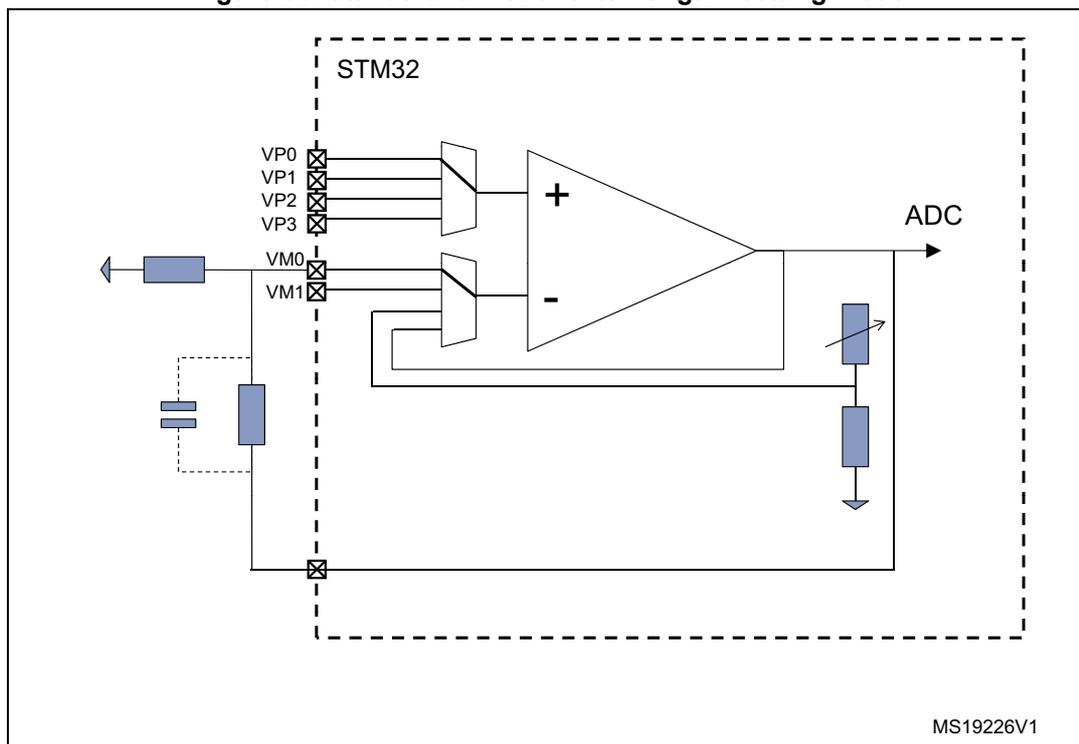
The diagram illustrates an operational amplifier (OPAMP) configured in an inverting mode within an STM32 microcontroller. The non-inverting input (+) is connected to a multiplexer with four inputs: VP0, VP1, VP2, and VP3. The inverting input (-) is connected to a node labeled VM0, which is also connected to an external circuit consisting of a resistor and a capacitor. The output of the OPAMP is connected to an ADC and to a feedback network consisting of two resistors in series, with the junction between them connected back to the inverting input (-). The feedback network is labeled VM1. The diagram is labeled MS19226V1 in the bottom right corner.
- 1. This figure gives an example in an inverting configuration. Any other option is possible, including comparator mode.
Follower configuration mode
The amplifier can be configured as a follower, by setting the VM_SEL bits to 11 in the OPAMPx_CR register. This allows you for instance to buffer signals with a relatively high impedance. In this case, the inverting inputs are free and the corresponding ports can be used as regular I/Os.
Figure 97. Follower configuration
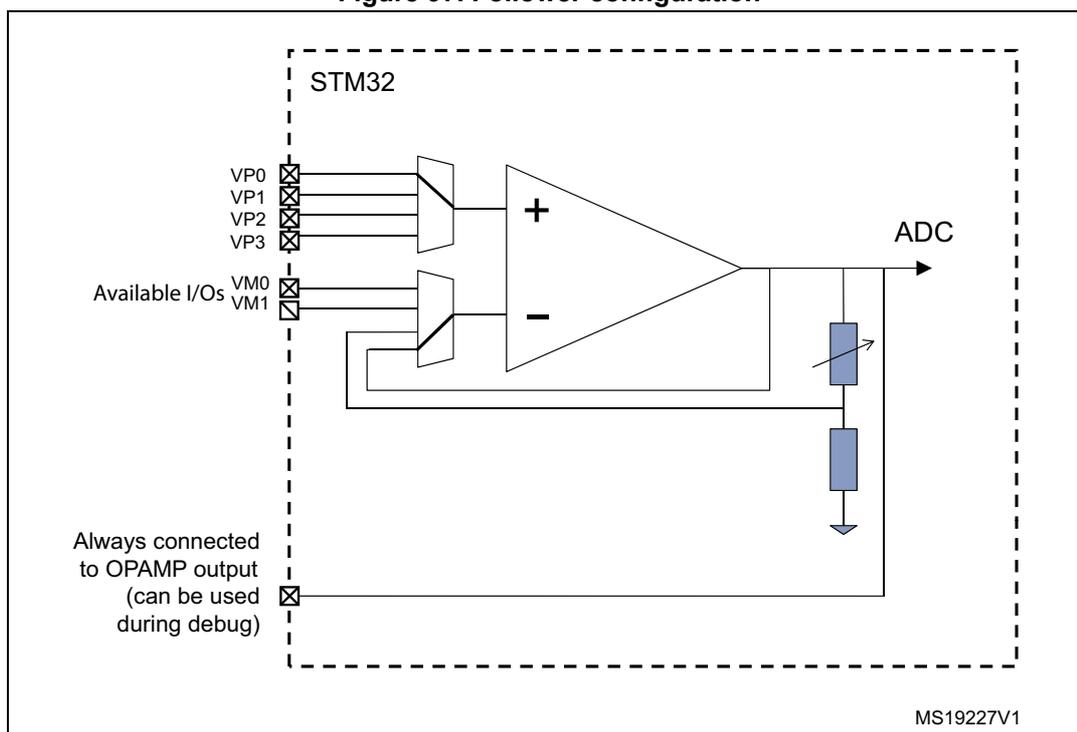
- 1. This figure gives an example in an inverting configuration. Any other option is possible, including comparator mode.
Programmable Gain Amplifier mode
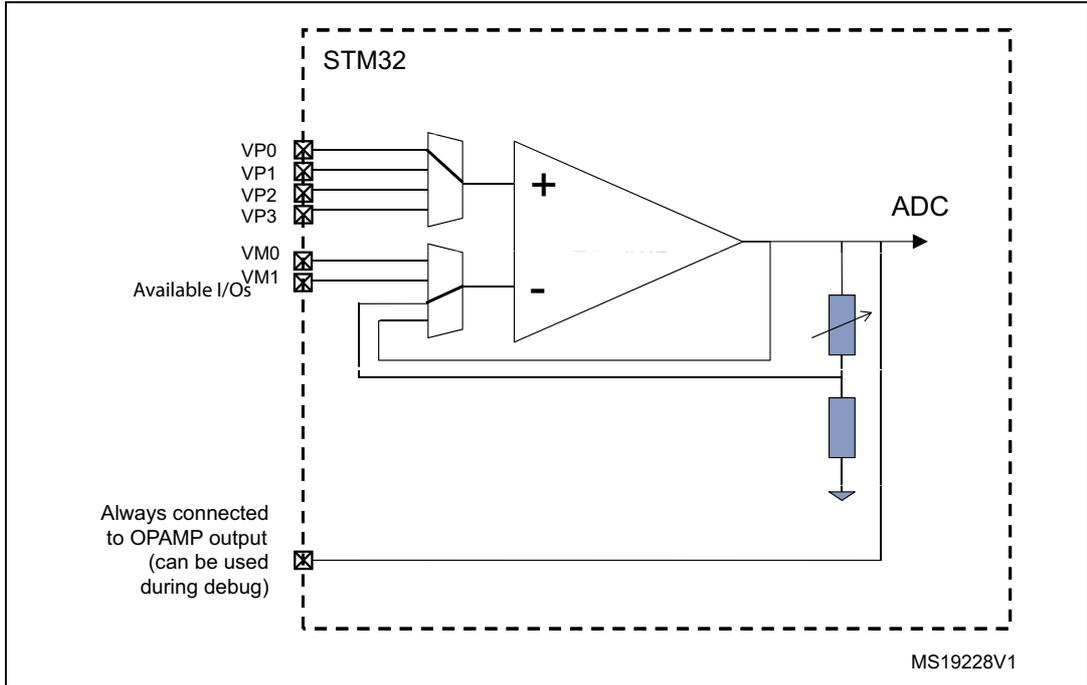
The Programmable Gain Amplifier (PGA) mode is enabled by writing the VM_SEL bits to 10 in the OPAMPx_CR register. The gain is set using the PGA_GAIN bits which must be set to 0x00..0x11 for gains ranging from 2 to 16.
In this case, the inverting inputs are internally connected to the central point of a built-in gain setting resistive network. Figure 98: PGA mode, internal gain setting (x2/x4/x8/x16), inverting input not used shows the internal connection in this mode.
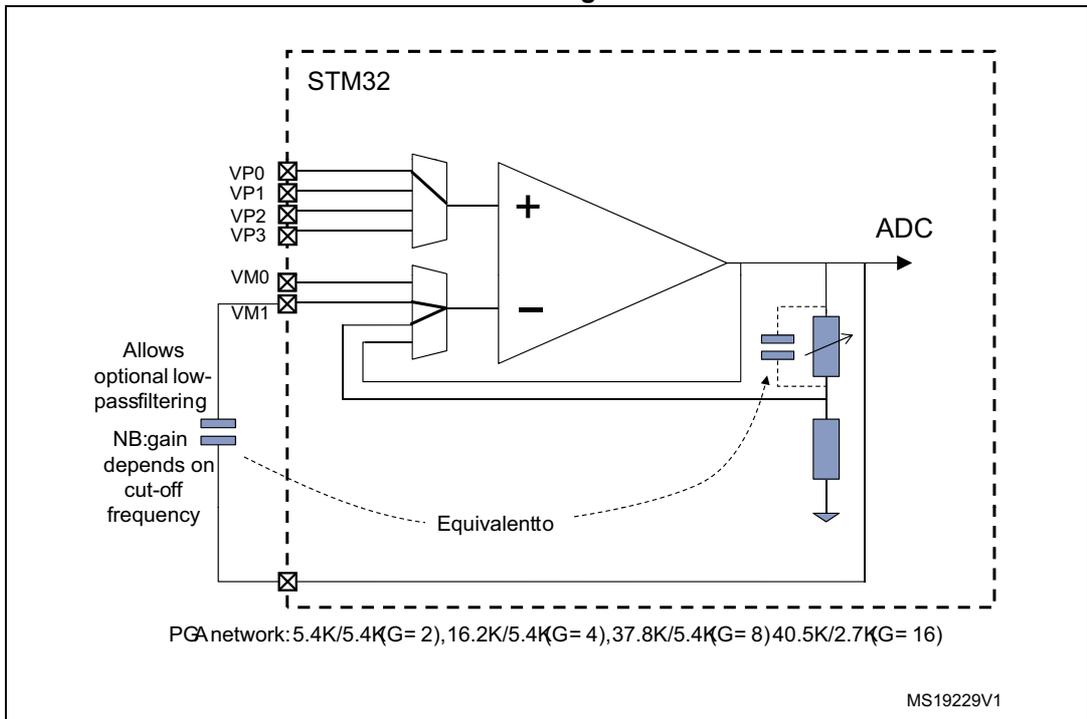
An alternative option in PGA mode allows you to route the central point of the resistive network on one of the I/Os connected to the non-inverting input. This is enabled using the PGA_GAIN bits in OPAMPx_CR register:
- • 10xx values are setting the gain and connect the central point to one of the two available inputs
- • 11xx values are setting the gain and connect the central point to the second available input
This feature can be used for instance to add a low-pass filter to PGA, as shown in Figure 99: PGA mode, internal gain setting (x2/x4/x8/x16), inverting input used for filtering . Please note that the cut-off frequency is changed if the gain is modified (refer to the electrical characteristics section of the datasheet for details on resistive network elements).
Figure 98. PGA mode, internal gain setting (x2/x4/x8/x16), inverting input not used
STM32
VP0
VP1
VP2
VP3
Available I/Os
VM0
VM1
ADC
Always connected to OPAMP output (can be used during debug)
MS19228V1
Figure 99. PGA mode, internal gain setting (x2/x4/x8/x16), inverting input used for filtering
STM32
VP0
VP1
VP2
VP3
VM0
VM1
ADC
Allows optional low-pass filtering
NB: gain depends on cut-off frequency
Equivalent to
PGA network: \( 5.4K/5.4K (G=2) \) , \( 16.2K/5.4K (G=4) \) , \( 37.8K/5.4K (G=8) \) , \( 40.5K/2.7K (G=16) \)
MS19229V1
16.4 OPAMP registers
16.4.1 OPAMP2 control register (OPAMP2_CSR)
Address offset: 0x3C
Reset value: 0xXXXX 0000
| 31 | 30 | 29 | 28 | 27 | 26 | 25 | 24 | 23 | 22 | 21 | 20 | 19 | 18 | 17 | 16 |
|---|---|---|---|---|---|---|---|---|---|---|---|---|---|---|---|
| LOCK | OUTCAL | TSTREF | TRIMOFFSETN | TRIMOFFSETP | USER_TRIM | PGA_GAIN | |||||||||
| rw | r | rw | rw | rw | rw | rw | |||||||||
| 15 | 14 | 13 | 12 | 11 | 10 | 9 | 8 | 7 | 6 | 5 | 4 | 3 | 2 | 1 | 0 |
| PGA_GAIN | CALSEL | CALON | VPS_SEL | VMS_SEL | TCM_EN | VM_SEL | Res. | VP_SEL | FORCE_VP | OPAMP2EN | |||||
| rw | rw | rw | rw | rw | rw | rw | rw | rw | rw | ||||||
Bit 31 LOCK: OPAMP 2 lock
This bit is write-once. It is set by software. It can only be cleared by a system reset.
This bit is used to configure the OPAMP2_CSR register as read-only.
0: OPAMP2_CSR is read-write.
1: OPAMP2_CSR is read-only.
Bit 30 OUTCAL:
OPAMP output status flag, when the OPAMP is used as comparator during calibration.
0: Non-inverting < inverting
1: Non-inverting > inverting.
Bit 29 TSTREF:
This bit is set and cleared by software. It is used to output the internal reference voltage ( \( V_{REFOPAMP2} \) ).
0: \( V_{REFOPAMP2} \) is output.
1: \( V_{REFOPAMP2} \) is not output.
Bits 28:24 TRIMOFFSETN: Offset trimming value (NMOS)
Bits 23:19 TRIMOFFSETP: Offset trimming value (PMOS)
Bit 18 USER_TRIM: User trimming enable.
This bit is used to configure the OPAMP offset.
0: User trimming disabled.
1: User trimming enabled.
Bits 17:14 PGA_GAIN: gain in PGA mode
0X00 = Non-inverting gain = 2
0X01 = Non-inverting gain = 4
0X10 = Non-inverting gain = 8
0X11 = Non-inverting gain = 16
1000 = Non-inverting gain = 2 - Internal feedback connected to VM0
1001 = Non-inverting gain = 4 - Internal feedback connected to VM0
1010 = Non-inverting gain = 8 - Internal feedback connected to VM0
1011 = Non-inverting gain = 16 - Internal feedback connected to VM0
1100 = Non-inverting gain = 2 - Internal feedback connected to VM1
1101 = Non-inverting gain = 4 - Internal feedback connected to VM1
1110 = Non-inverting gain = 8 - Internal feedback connected to VM1
1111 = Non-inverting gain = 16 - Internal feedback connected to VM1
Bits 13:12 CALSEL: Calibration selectionThis bit is set and cleared by software. It is used to select the offset calibration bus used to generate the internal reference voltage when CALON = 1 or FORCE_VP= 1.
00 = \( V_{REFOPAMP} = 3.3\% V_{DDA} \)
01 = \( V_{REFOPAMP} = 10\% V_{DDA} \)
10 = \( V_{REFOPAMP} = 50\% V_{DDA} \)
11 = \( V_{REFOPAMP} = 90\% V_{DDA} \)
Bit 11 CALON: Calibration mode enableThis bit is set and cleared by software. It is used to enable the calibration mode connecting VM and VP to the OPAMP internal reference voltage.
0: calibration mode disabled.
1: calibration mode enabled.
Bits 10:9 VPS_SEL: OPAMP2 Non inverting input secondary selection.These bits are set and cleared by software. They are used to select the OPAMP2 non inverting input when TCM_EN = 1.
00: Reserved
01: PB14 used as OPAMP2 non inverting input
10: PB0 used as OPAMP2 non inverting input
11: PA7 used as OPAMP2 non inverting input
Bit 8 VMS_SEL: OPAMP2 inverting input secondary selectionThis bit is set and cleared by software. It is used to select the OPAMP2 inverting input when TCM_EN = 1.
0: PC5 (VM0) used as OPAMP2 inverting input
1: PA5 (VM1) used as OPAMP2 inverting input
Bit 7 TCM_EN: Timer controlled Mux mode enable.This bit is set and cleared by software. It is used to control automatically the switch between the default selection (VP_SEL and VM_SEL) and the secondary selection (VPS_SEL and VMS_SEL) of the inverting and non inverting inputs.
Bits 6:5 VM_SEL: OPAMP2 inverting input selection.These bits are set and cleared by software. They are used to select the OPAMP2 inverting input.
00: PC5 (VM0) used as OPAMP2 inverting input
01: PA5 (VM1) used as OPAMP2 inverting input
10: Resistor feedback output (PGA mode)
11: follower mode
Bit 4 Reserved, must be kept at reset value.
Bits 3:2 VP_SEL : OPAMP2 non inverting input selection.
These bits are set/reset by software. They are used to select the OPAMP2 non inverting input.
00: Reserved
01: PB14 used as OPAMP2 non inverting input
10: PB0 used as OPAMP2 non inverting input
11: PA7 used as OPAMP2 non inverting input
Bit 1 FORCE_VP :
This bit forces a calibration reference voltage on non-inverting input and disables external connections.
0: Normal operating mode. Non-inverting input connected to inputs.
1: Calibration mode. Non-inverting input connected to calibration reference voltage.
Bit 0 OPAMP2EN : OPAMP2 enable.
This bit is set and cleared by software. It is used to select the OPAMP2.
0: OPAMP2 is disabled.
1: OPAMP2 is enabled.
16.4.2 OPAMP register map
The following table summarizes the OPAMP registers.
Table 59. OPAMP register map and reset values
| Offset | Register | 31 | 30 | 29 | 28 | 27 | 26 | 25 | 24 | 23 | 22 | 21 | 20 | 19 | 18 | 17 | 16 | 15 | 14 | 13 | 12 | 11 | 10 | 9 | 8 | 7 | 6 | 5 | 4 | 3 | 2 | 1 | 0 |
|---|---|---|---|---|---|---|---|---|---|---|---|---|---|---|---|---|---|---|---|---|---|---|---|---|---|---|---|---|---|---|---|---|---|
| 0x3C | OPAMP2_CSR | LOCK | OUTCAL | TSTREF | TRIMOFFSETN | TRIMOFFSETP | USER_TRIM | PGA_GAIN | CALSEL | CALON | VPS_SEL | VMS_SEL | TOM_EN | VM_SEL | Res | VP_SEL | FORCE_VP | OPAMP2EN | |||||||||||||||
| Reset value | X | X | X | X | X | X | X | X | X | X | X | X | X | X | X | X | 0 | 0 | 0 | 0 | 0 | 0 | 0 | 0 | 0 | 0 | 0 | 0 | 0 | 0 | 0 |
Refer to Section 2.2 on page 47 for the register boundary addresses.